


Introduction
Enhanced cognitive behavioural therapy (CBT-E) is a manualized, time-limited treatment designed to be suitable for all eating disorders, including anorexia nervosa (AN), bulimia nervosa (BN), binge eating disorder (BED), other specified feeding or eating disorder (OSFED) and unspecified feeding or eating disorder (UFED), as outlined in the fifth edition of the Diagnostic and Statistical Manual of Mental Disorders [DSM-5; American Psychiatric Association (APA), 2013]. Developed from the transdiagnostic cognitive behavioural theory introduced by Fairburn, Cooper and Shafran (Reference Fairburn, Cooper and Shafran2003), CBT-E targets the common mechanisms proposed to maintain eating disorder psychopathology, and in particular, the over-evaluation of weight and shape and their control.
A number of randomized controlled trials (RCTs) have examined the efficacy of CBT-E. Fairburn and colleagues (Reference Fairburn, Cooper, Doll, O'Connor, Bohn and Hawker2009) conducted a two-site trial amongst 149 patients diagnosed with BN or eating disorder not otherwise specified (EDNOS) (body mass index [BMI] > 17.5) attending two clinics in the United Kingdom (UK). By the end of treatment, 66.4% of those who completed treatment had a global eating disorder examination (EDE; Fairburn and Cooper, Reference Fairburn, Cooper, Fairburn and Wilson1993) score of less than one standard deviation (SD) above community norms, which was defined as a good outcome. Improvements were maintained at the 60-week follow-up, and an attrition rate of 22.1% was reported. Subsequent RCTs have also provided support for the efficacy of CBT-E as a treatment for all eating disorders (Fairburn et al., Reference Fairburn, Bailey-Strabler, Basden, Doll and Jones, Murphy2015; Poulsen et al., Reference Poulsen, Lunn, Daniel, Folke, Mathiesen, Katznelson and Fairburn2014; Wonderlich et al., Reference Wonderlich, Peterson, Crosby, Smith, Klein, Mitchell and Crow2014; Zipfel et al., Reference Zipfel, Wild, Groß, Friederich, Teufel and Schellberg2014).
Although RCTs are regarded as being the gold standard in scientific research, the findings of efficacy studies may not be generalizable to ‘real-world’ clinical settings, where there is generally greater patient heterogeneity, less therapist training and supervision, and increased waiting time for treatment (Fairburn et al., Reference Fairburn, Bailey-Strabler, Basden, Doll and Jones, Murphy2015; Knott et al., Reference Knott, Woodward, Hoefkens and Limbert2015; Waller et al., Reference Waller, Gray, Hinrichsen, Mountford, Lawson and Patient2014). Clinicians may therefore question the relevance of efficacy research within clinical practice, which may represent a potential barrier to the implementation of evidence-based treatments (Waller et al., Reference Waller, Stringer and Meyer2012; Wilson et al., Reference Wilson, Grilo and Vitousek2007). Therefore, effectiveness research is necessary to demonstrate the applicability and usefulness of evidence-based approaches for eating disorders within out-patient and community mental health settings.
Only two known published studies have examined the effectiveness of CBT-E for adults with a range of eating disorder presentations at present. Byrne et al. (Reference Byrne, Fursland, Allen and Watson2011) conducted an open trial for adults with AN, BN and EDNOS with a BMI ≥ 14, who attended a public out-patient clinic in Perth, Western Australia. Of the 125 patients who entered the trial, 40% dropped out, and waiting time for treatment was associated with drop-out. At post-treatment, significant improvements in eating disorder and associated psychopathology were observed amongst treatment completers and the intention-to-treat sample. More specifically, 66.7% of patients who completed treatment achieved a good outcome, as defined as having a global EDE questionnaire (EDE-Q; Fairburn and Beglin, Reference Fairburn and Beglin1994) score less than one standard deviation above Australian community norms (i.e. < 2.46; Mond et al., Reference Mond, Hay, Rodgers and Owen2006). With the exception of a higher attrition rate, the findings compared favourably to the RCT conducted by Fairburn et al. (Reference Fairburn, Cooper, Doll, O'Connor, Bohn and Hawker2009). More recently, Knott et al. (Reference Knott, Woodward, Hoefkens and Limbert2015) investigated the effectiveness of CBT-E amongst BN and EDNOS patients within the context of a UK National Health Service (NHS) eating disorder service. Although a similar attrition rate (40.8%) was observed, a higher proportion of treatment completers achieved a good outcome (78.3%), which was again defined as having a global EDE-Q score of less than one standard deviation above the community mean.
Taken together, the findings of these two studies provide support for the effectiveness of CBT-E amongst adult patients with a range of eating disorders within clinical settings. Further support for the effectiveness of CBT-E within community-based eating disorder clinics comes from studies which have investigated treatment outcomes amongst adults and adolescents with AN specifically (Dalle Grave et al., Reference Dalle Grave, Calugi, Doll and Fairburn2013; Fairburn et al., Reference Fairburn, Cooper, Doll, O'Connor, Palmer and Dalle Grave2013). The effectiveness of other versions of CBT for eating disorders, such as that developed by Waller and colleagues (2007), has also been investigated and supported within a small number of studies (Turner et al., Reference Turner, Marshall, Stopa and Waller2015; Waller et al., Reference Waller, Gray, Hinrichsen, Mountford, Lawson and Patient2014).
Adding to the growing evidence base of effectiveness research, the current study aimed to evaluate the treatment outcomes associated with CBT-E in an out-patient eating disorder service in Brisbane, Queensland, Australia. Expanding upon previous studies, this study included a follow-up assessment period of approximately 20 weeks post-treatment to permit examination of the maintenance of change following treatment completion.
In total, five key clinical questions were addressed within the study. Firstly, what proportion of patients complete CBT-E treatment? Secondly, what are the outcomes of those who complete treatment? Thirdly, how do outcomes compare with the previous Australian effectiveness study of CBT-E? Fourthly, are changes maintained at the 20-week follow-up period? Finally, what variables are associated with drop-out from treatment?
Method
Recruitment procedures
The sample comprised patients who received CBT-E treatment at the Eating Disorders Outreach Service (EDOS), a public out-patient eating disorder service located in Brisbane, Queensland. Specifically, the de-identified data of patients who received CBT-E treatment at EDOS between January 2009 and June 2013 were analysed. All patients were referred to EDOS by a general practitioner or other health professional, and underwent an initial assessment appointment with a consultant psychiatrist or psychiatry registrar before an internal referral to commence CBT-E was made. To be eligible for CBT-E treatment at EDOS, patients must be 18 years or older, have a diagnosed eating disorder, a BMI of ≥ 16, and live in the catchment area of the service. CBT-E is not offered to patients who cannot be managed safely within an out-patient setting due to medical or psychiatric reasons (e.g. compromised physical health, suicide risk, severe clinical depression and suicidality, or ongoing substance misuse). The estimated waiting time between the initial referral and commencement of CBT-E treatment at EDOS is approximately 6 weeks.
Treatment
Treatment was delivered on an out-patient basis following the procedures outlined in the CBT-E treatment guide (Fairburn et al., Reference Fairburn, Cooper, O'Connor and Fairburn2008), and progressed through four stages. Stage one focused on engaging and educating the patient; arriving at a personalized formulation; and maximizing early behavioural change through strategies such as self-monitoring, in-session weighing, and regular eating. In stage two, progress was collaboratively reviewed, modifications to the formulation were made, and the third stage of treatment was planned. The key mechanisms maintaining the individual's eating disorder, as outlined in the personalized formulation, were targeted in stage three. If clinically indicated, external maintaining mechanisms (i.e. clinical perfectionism, core low self-esteem, and interpersonal problems) were also addressed within this stage. In stage four, maintenance and relapse prevention were prioritized. A review session was offered 20 weeks post-treatment to assess progress and determine the need for further ‘booster’ sessions.
Prior to commencing CBT-E, patients attended 1–3 assessment sessions with the assigned therapist. They then received, on average, 20–40 individual treatment sessions of approximately 50 minutes duration. Those with a BMI over 17.5 were offered 20 sessions of treatment, while those with a BMI of between 16 and 17.5 were offered 40 sessions. Treatment was extended for underweight patients to permit sufficient time for prioritizing weight restoration and enhancing motivation for change. Completion of treatment was defined as progression through the four stages of treatment, while drop-out was defined as premature termination of treatment.
Patients were treated by a psychologist or psychiatry registrar. A total of seven therapists were involved in delivering CBT-E at EDOS between 2009 and 2013. For these therapists, training consisted of an orientation to the treatment, familiarization with the CBT-E treatment guide, and observation of sessions. Therapists received regular supervision and attended weekly case review meetings. Given the naturalistic nature of the study, therapist adherence to the treatment guide was not directly monitored.
Assessment
Outcome variables
Continuous outcome variables of interest were scores on measures of eating disorder psychopathology, general psychopathology, and psychosocial impairment associated with eating disorder features. On these measures, clinically significant change was defined as functioning within the normative range at post-treatment and/or follow-up, as indicated by scoring within one standard deviation of Australian community norms (Kendall et al., Reference Kendall, Marrs-Garcia, Nath and Sheldrick1999). In line with the Western Australia (WA) study conducted by Byrne et al. (Reference Byrne, Fursland, Allen and Watson2011), two categorical outcome variables were also examined: (1) having a post-treatment global EDE-Q score less than one standard deviation above Australian community norms (i.e. below 2.46; Mond et al., Reference Mond, Hay, Rodgers and Owen2006), which was indicative of good outcome; and (2) having a post-treatment global EDE-Q score of < 2.46 in addition to having a BMI of ≥ 18.5, the World Health Organization (WHO) cut-off for healthy weight (WHO, 2014).
Measures
Diagnosis of an eating disorder and co-morbid disorder(s) was made by the treating therapist following the initial assessment sessions and was made on the basis of reported symptoms (i.e. the frequency of binge and compensatory behaviours), BMI, and clinical assessment, which incorporated findings from self-report measures, and namely the EDE-Q. Patients were assessed with regard to the diagnostic criteria outlined in the fourth edition of the Diagnostic and Statistical Manual of Mental Disorders (DSM-IV-TR; APA, 2000), and were given a diagnosis of either AN, BN or EDNOS (which included BED and other unspecified eating disorders). As per the DSM-IV-TR (APA, 2000) multi-axial classification system, five axes were assessed: clinical disorders (axis I); personality disorders (axis II); general medical conditions (axis III); psychosocial and environmental problems which may affect diagnosis, treatment, and prognosis (axis IV); and the client's overall level of functioning on the global assessment of functioning scale (GAF, axis V). Patients were re-assessed at the final session and at the review session held approximately 20 weeks post-treatment. BMI was also recorded by the treating therapist at each assessment point, with weight and height measured using regularly calibrated digital medical scales and a wall-mounted stadiometer.
In addition to the EDE-Q, two other standardized and validated self-report measures were administered by treating therapists at the three assessment points: the depression, anxiety, and stress scale (DASS; Lovibond and Lovibond, Reference Lovibond and Lovibond1995) provided a measure of general psychopathology, while the clinical impairment assessment questionnaire (CIA; Bohn and Fairburn, Reference Bohn, Fairburn and Fairburn2008) was administered to assess psychosocial impairment associated with eating disorder features.
Statistical methods
Data analyses were carried out by R.S. using SPSS 21 (IBM Corporation, 2012), and consisted of both completer and intention-to-treat methods. For intention-to-treat analyses, pre-treatment data were carried forwards in instances where post-treatment and follow-up data were missing. To assess the outcomes of those who completed treatment, repeated-measures MANOVAs and ANOVAs were conducted. Chi-square tests were also performed to determine whether the proportion of patients achieving categorical outcomes accorded with the findings of Byrne and colleagues (Reference Byrne, Fursland, Allen and Watson2011). To examine whether there were any differences at baseline between those who completed treatment (treatment completers) and those who did not (non-completers), chi-square tests and one-way ANOVAs and MANOVAs were conducted. Finally, binary logistic regression was performed to examine whether certain baseline characteristics predicted drop-out from treatment.
All parametric analyses were conducted with transformed and untransformed variables, and with and without outliers. Considering that transforming skewed variables and removing outliers did not produce substantive changes to interpretation, untransformed variables were utilized and outliers were retained for the reported results. In order to balance the relatively small sample size resulting from attrition with the number of statistical tests to be conducted, an overall significance level of p < .01 was set. Estimates of effect size were the partial eta-squared values produced by SPSS 21.
Ethics
The authors assert that all procedures contributing to this work comply with the ethical standards of the National Health and Medical Research Council of Australia and with the Helsinki Declaration of 1975, and its most recent revision. The project received ethical clearance from and the Royal Brisbane and Women's Hospital (RBWH) Human Research Ethics Committee (HREC/13/QRBW/59), who granted a waiver of consent to include the data of past CBT-E patients. Ethics approval was also obtained from the University of Queensland School of Psychology Ethics Review Committee (13-PSYCH-DCP-37-JJ).
Results
Patient characteristics
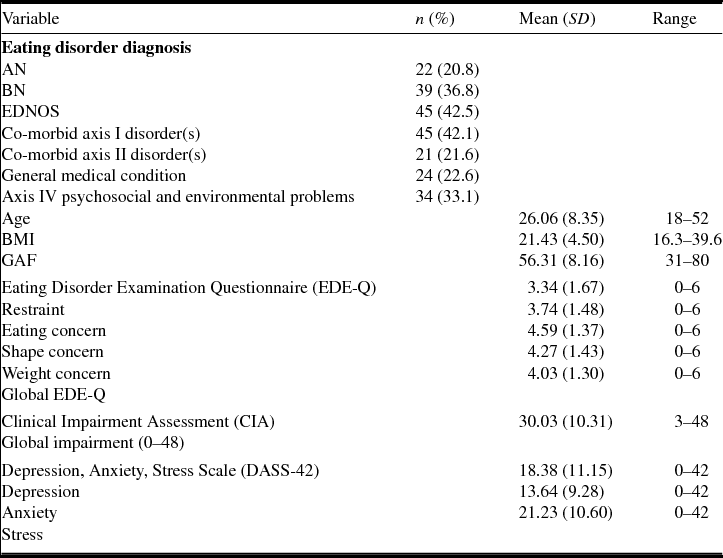
One hundred and eighteen patients commenced CBT-E treatment at EDOS within the study period, including four males, who were removed from the analyses in order to make interpretation of the results clearer and applicable to the female population. The total sample thus consisted of 114 female patients, whose baseline characteristics are presented in Table 1. As shown, the most common diagnosis was EDNOS (42.5%), followed by BN (36.8%) and AN (20.8%). Of the total sample, 42.1% had a co-morbid axis I disorder, 21.6% had a co-morbid axis II personality disorder, and 33% experienced axis IV psychosocial and environmental problems. Baseline EDE-Q subscale and global scores were all more than one standard deviation above Australian community norms (Mond et al., Reference Mond, Hay, Rodgers and Owen2006), as were scores on the three scales of the DASS (Lovibond and Lovibond, Reference Lovibond and Lovibond1995).
Characteristics of CBT-E patients (n = 114) at baseline

Percentages reported are valid percentages and do not include missing data.
Intention-to-treat findings at post-treatment and follow-up
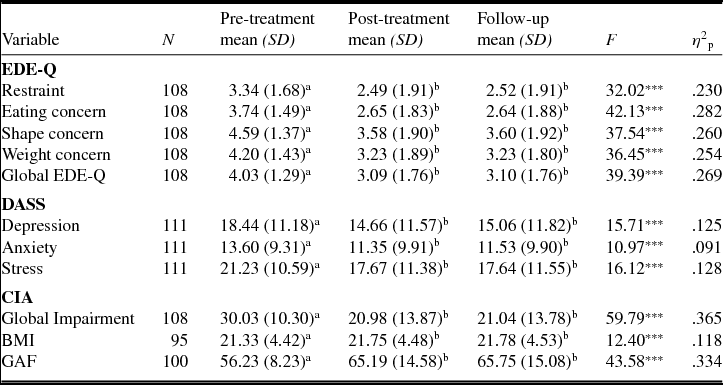
Amongst the total sample, there were statistically significant improvements on the EDE-Q, DASS and CIA from pre- to post-treatment, which were largely maintained at follow-up (see Table 2). Nearly half of the total sample (42.2%) achieved a good outcome (a global EDE-Q score < 2.46) at post-treatment, and 35.4% had a global EDE-Q score of < 2.46 in addition to a BMI of ≥ 18.5. At follow-up, 43.1% of the total sample had a global EDE-Q score < 2.46, and 34.4% had a global EDE-Q score of < 2.46 as well as a BMI of ≥ 18.5.
Results from univariate tests for the total (intention-to-treat) sample across all time points

Different superscripts denote significant differences between means. Differing n values are due to listwise deletion. ***p < .001.
Question 1 – What proportion of patients complete treatment?
Of the 114 clients who commenced CBT-E, 57 (50%) did not complete treatment and had pre-treatment data only. Fifty-seven clients were regarded as completing treatment and had pre- and post-treatment data. Of the 57 treatment completers, 37 (65%) attended the 20-week review session and also had follow-up data.
Question 2 – What are the outcomes of clients who complete treatment?
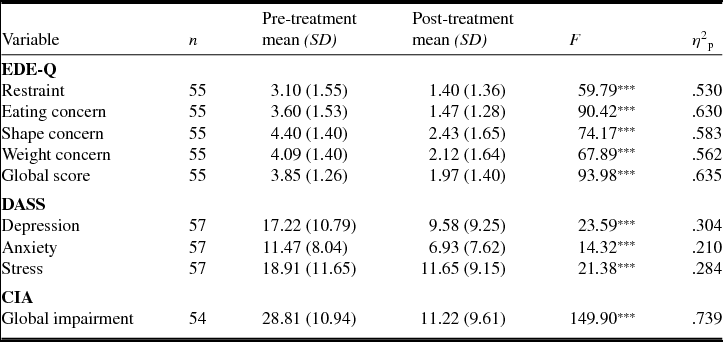
Amongst those who completed treatment, significant improvements were observed on the EDE-Q, DASS and CIA (see Table 3). On all variables, medium to large effect sizes were observed (Cohen, Reference Cohen1988). Mean EDE-Q subscale and global scores all fell within the one standard deviation of Australian community norms (Mond et al., Reference Mond, Hay, Rodgers and Owen2006), as did scores on the depression, anxiety and stress scales of the DASS (Lovibond and Lovibond, Reference Lovibond and Lovibond1995). At post-treatment, 69.1% of treatment completers achieved a good outcome (global EDE-Q score < 2.46), and 60.8% had a global EDE-Q score of < 2.46 in addition to a BMI of ≥ 18.5.
Results from univariate tests for all treatment completers

A p value of < .01 was used to indicate statistical significance. Differing n values are due to listwise deletion. ***p < .001.
Question 3 – How do outcomes compare with the previous Australian effectiveness study of CBT-E?
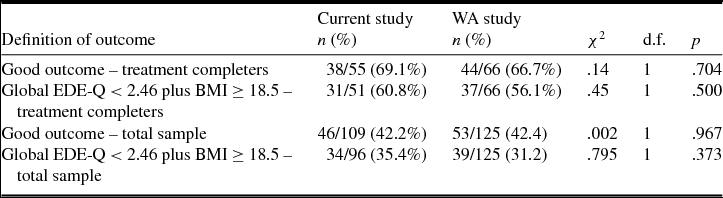
Table 4 presents a comparison of the results of the current study with those of the previous WA study. As shown, the proportion of treatment completers and the total sample achieving a good outcome (global EDE-Q score < 2.46) and a global EDE-Q score of < 2.46 in addition to a BMI of ≥ 18.5 at post-treatment, was consistent with the findings of Byrne et al. (Reference Byrne, Fursland, Allen and Watson2011).
Treatment outcomes at post-treatment for treatment completers and the total sample compared with the findings of Byrne et al. (Reference Byrne, Fursland, Allen and Watson2011)

Percentages are valid percentages and do not include missing data. Differing n values are due to listwise deletion. d.f., degrees of freedom.
Question 4 – Are changes maintained at the 20-week follow-up period?
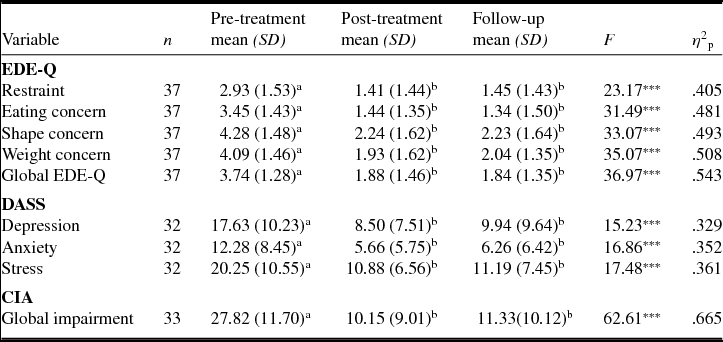
Only 65% of treatment completers (or 32% of the total sample) attended the review appointment and had at least some follow-up assessment data. Table 5 presents the results from the analyses on the pre-, post- and follow-up data of those patients. As can be seen, there were no statistically significant increases in eating disorder or associated psychopathology from post-treatment to follow-up. Mean EDE-Q subscale and global scores were still within one standard deviation of Australian community norms, as were scores on the scales of the DASS. In addition, 75% of patients still had a global EDE-Q score < 2.46, and 64.5% of clients had a global EDE-Q score of < 2.46 as well as a BMI of ≥ 18.5. Thus changes made during treatment were generally maintained at follow-up.
Results from univariate tests for treatment completers with pre-, post- and follow-up data

A p value of < .01 was used to indicate statistical significance. Different superscripts denote significant differences between means. ***p < .001.
Question 5 – What variables are associated with drop-out from treatment?
Comparisons of baseline characteristics revealed that compared with treatment completers, non-completers had higher levels of restraint (as measured by the EDE-Q), anxiety and stress (as measured by the DASS). In addition, a disproportionately higher number of non-completers experienced psychosocial and environmental problems (axis IV), and had a co-morbid axis II diagnosis compared with treatment completers. Differences in all variables were only statistically significant at the less stringent alpha level of p < .05, with the exception of psychosocial and environmental stressors; χ2 (103) = 15.9, p < .001 (53 versus 16.1% amongst completers). Binary logistic regression revealed that the presence of psychosocial and environmental problems on axis IV was the only significant predictor of drop-out from treatment (χ 2 (1) = 9.76, p = .002), and was associated with an increase in the odds of drop-out by a factor of 6.05 (95% CI: 1.97 to 18.60).
Discussion
The aim of the current study was to evaluate the effectiveness of CBT-E within an out-patient eating disorder service in Brisbane, Queensland. The de-identified treatment data of 114 female patients who received CBT-E treatment at EDOS from 2009 to 2013 were analysed using completer and intention-to-treat approaches. Four main findings emerged.
The first finding was that the rate of attrition was high. The attrition rate (50%) was higher than the 40% drop-out rate observed by Byrne and colleagues (Reference Byrne, Fursland, Allen and Watson2011), as well as the 40.8% reported by Knott et al. (Reference Knott, Woodward, Hoefkens and Limbert2015), and the 21.1% observed by Fairburn et al. (Reference Fairburn, Cooper, Doll, O'Connor, Bohn and Hawker2009). The fact that attrition was higher than that reported in the RCT by Fairburn et al. (Reference Fairburn, Cooper, Doll, O'Connor, Bohn and Hawker2009) is unsurprising given that the current sample were clients attending an out-patient service offering a free treatment, and commitment to treatment may have been less. More surprising was that attrition was higher than that observed in other effectiveness studies, and in particular, the open trial by Byrne and colleagues (Reference Byrne, Fursland, Allen and Watson2011), whose sample also consisted of patients attending a public out-patient clinic within Australia. Additionally, the experience level of therapists and staff turnover were comparable between the studies, and the waiting time between referral and the start of treatment was less at EDOS (approximately 6 weeks compared with 22.46 weeks reported by Byrne et al., Reference Byrne, Fursland, Allen and Watson2011). The current sample may have had a higher prevalence of co-morbid psychopathology and psychosocial and environmental problems than the previous study. Indeed, 42.1% of CBT-E clients had a co-morbid axis I disorder, 21.6% had an axis II disorder, and 33% experienced psychosocial and environmental problems at baseline. By comparison, 31.2% of patients in the study of Byrne et al. (Reference Byrne, Fursland, Allen and Watson2011) experienced a depressive episode and 20.8% of clients had an anxiety disorder. However, the presence of axis II disorders and psychosocial and environmental problems was not reported by Byrne and colleagues, making comparison between the studies difficult. While the attrition rate observed in the current study exceeded that of previous studies evaluating CBT-E, it should be noted that it was still well within the range of that reported in other trials of out-patient treatments for eating disorders (29–73%; Fassino et al., Reference Fassino, Piero, Tomba and Abbate-Daga2009).
The second finding was that CBT-E was associated with statistically and clinically significant improvements in eating disorder and general psychopathology amongst those who completed treatment, and statistically significant improvements amongst the total sample. At post-treatment, 69.1% of treatment completers, and 42.1% of the total sample had a global EDE-Q score within one standard deviation of Australian community norms (i.e. below 2.46; Mond et al., Reference Mond, Hay, Rodgers and Owen2006). These findings accord with the previous effectiveness study by Byrne and colleagues (Reference Byrne, Fursland, Allen and Watson2011), who similarly found that 66.7% of treatment completers achieved a good outcome. Fairburn et al. (Reference Fairburn, Cooper, Doll, O'Connor, Bohn and Hawker2009) and Knott et al. (Reference Knott, Woodward, Hoefkens and Limbert2015) also found that a high proportion of treatment completers achieved a good outcome (66.4 and 78.3%, respectively). The findings provide support for the effectiveness of CBT-E within out-patient settings, and indicate that good outcomes are likely if patients remain in treatment. In this regard, minimizing drop-out from CBT-E treatment appears to be an important priority for out-patient and community-based eating disorder services.
The third finding was that changes made during treatment were largely maintained at the 20-week follow-up. Indeed, 75% of patients who attended the review session still had a global EDE-Q score < 2.46, and mean EDE-Q and DASS subscale scores remained within one standard deviation of Australian community norms. While no other published effectiveness studies of CBT-E have included follow-up data to permit comparison, Fairburn et al. (Reference Fairburn, Cooper, Doll, O'Connor, Bohn and Hawker2009) similarly found that changes were well maintained at the 60-week follow-up assessment. Nonetheless, the follow-up period in the current study was much shorter and the sample size considerably smaller, which undermines the interpretability and generalizability of the follow-up assessment findings. Still, the findings are suggestive that changes made during out-patient CBT-E treatment were maintained for most clients, at least in the short-term.
The fourth finding was that certain factors appeared to influence drop-out from treatment. Compared with treatment completers, a significantly greater proportion of non-completers experienced psychosocial and environmental problems at baseline. In particular, problems with the primary support group (e.g. relationship discord) and the social environment (e.g. inadequate social support) were most commonly reported. Regression analyses revealed that the presence of psychosocial and environmental problems at baseline was the only significant predictor of drop-out from treatment. This is not entirely surprising given that clients who experience stressors, such as relationship distress or unemployment, may find it difficult to attend and actively engage in sessions and complete assigned homework tasks. While no known published studies have directly assessed and reported on the role of DSM-IV axis IV psychosocial and environmental problems specifically in predicting drop-out from eating disorder treatments, drop-out has been found to be predicted by life events in previous studies (e.g. Fassino et al., Reference Fassino, Piero, Tomba and Abbate-Daga2009).
A strength of the current study was that it incorporated a 20-week follow-up assessment period to examine the maintenance of change following completion of CBT-E treatment. Nonetheless, there were many limitations associated with the naturalistic nature of the study. In particular, attrition was problematic and was higher than that observed in previous effectiveness studies (Byrne et al., Reference Byrne, Fursland, Allen and Watson2011; Knott et al., Reference Knott, Woodward, Hoefkens and Limbert2015). Indeed, the sample size was reduced by half at post-treatment, and only a third of patients had follow-up assessment data. The proportion of treatment completers that had follow-up data (65%) was therefore much lower than the prior RCTs conducted by Fairburn et al. (Reference Fairburn, Cooper, Doll, O'Connor, Bohn and Hawker2009) and Fairburn et al. (Reference Fairburn, Bailey-Strabler, Basden, Doll and Jones, Murphy2015), where 95.1 and 84% of treatment completers, respectively, were reassessed. Another limitation was that the follow-up assessment period, which coincided with the 20-week review session, was considerably shorter than the 60-week follow-up of previous RCTs (e.g. Fairburn et al., Reference Fairburn, Cooper, Doll, O'Connor, Bohn and Hawker2009, Reference Fairburn, Bailey-Strabler, Basden, Doll and Jones, Murphy2015). Given that eating disorders commonly have a chronic course characterized by cycles of treatment and relapse episodes (Fairburn et al., Reference Fairburn, Stice, Cooper, Doll, Norman and O'Connor2003), future effectiveness studies should attempt to incorporate longer follow-up periods to determine whether changes are maintained over significant periods of time.
The absence of structured interviews (for example, the EDE; Fairburn and Cooper, Reference Fairburn, Cooper, Fairburn and Wilson1993) to inform diagnostic assessment was also a weakness that may have undermined the objectivity and accuracy of assessment. Furthermore, the fact that the treating therapists administered self-report measures to patients was another weakness, and may have increased the potential for response bias. In addition, therapist adherence to the CBT-E treatment protocol was not directly measured or monitored to ensure treatment fidelity. Finally, the fact that the data were previously collected by the service placed limitations on the measures administered. In particular, the absence of a specific measure of waiting-time for treatment for each individual client was problematic, considering that wait-list time may have influenced drop-out, as was the case in the previous study by Byrne et al. (Reference Byrne, Fursland, Allen and Watson2011).
Despite these limitations, the current naturalistic effectiveness study provided further support for the use of CBT-E as a treatment for all eating disorders within routine clinical settings. Amongst treatment completers and the total sample, CBT-E was associated with significant improvements in eating disorder, general psychopathology, and psychosocial impairment associated with eating disorder features. In addition, the majority of those who completed treatment (69.1%) achieved a good outcome, and changes made during treatment were generally maintained at follow-up. However, half of the sample did not complete treatment, and psychosocial and environmental problems predicted drop-out from treatment. Given that previous effectiveness trials of CBT-E (Byrne et al., Reference Byrne, Fursland, Allen and Watson2011; Knott et al., Reference Knott, Woodward, Hoefkens and Limbert2015) also reported high rates of attrition (albeit lower than the current study), minimizing drop-out from CBT-E within routine clinical settings appears to be an important consideration. As such, identifying and implementing strategies to minimize drop-out and enhance client engagement, both before and during treatment, should be prioritized when implementing CBT-E within ‘real-world’ clinical settings.
Acknowledgements
The authors are grateful to Elaine Painter and Erin Marsland from EDOS who assisted with the ethics application process and the creation and maintenance of the EDOS CBT-E data set. R.S. and J.S. would also like to acknowledge Joanne Brown (The University of Queensland) for her assistance with the interpretation of more complex data analyses, and Susan Patterson (Metro North, Queensland Health) for her assistance with the ethical approval process.
Conflicts of interest: The authors have no conflicts of interest with respect to this publication.
Financial support: This research received no specific grant from any funding agency, commercial or not-for-profit sectors.



Comments
No Comments have been published for this article.