

Published online by Cambridge University Press: 17 March 2006
This article uses money order data to examine the determinants of British migrant remittances prior to 1914. Using panel data and cointegration analysis, it provides evidence of four distinct types of remittance behavior, lending support to Lucas and Stark's theory that remittances are driven by an implicit contract between remitter and remittee. The relative strengths of these different forms of remittance varied across the English-speaking world, with the largest differences occurring between migrants residing in America and those in the self-governing dominions. The explanation for these differences is seen to lie in the distinctive nature of British emigration to America.
Between 1853 and 1900 over 5.5 million people left the British Isles for destinations outside Europe, the vast majority eventually ending up either in North America or Australasia.1
Baines and Woods, “Population,” p. 39.
Schrier, Emigration, p. 105; and Simon, “Balance of Payments,” table 21, pp. 682–83. Of course, some regions of the United Kingdom were bigger recipients of remittances than others. In certain Irish communities, for example, it is likely that remittances were sufficiently regular and sizeable to be an integral part of the family budget, and all that stood between financial independence and parish relief. Moreover, in the case of Irish migrants we know that the public back home saw remittances as one of the immediate benefits of migration—a measure of compensation for the loss of a family member. There are even stories of families being allowed to run up credit in December in anticipation of the Christmas letter home. See Bielenberg, Irish Diaspora, pp. 55–59. We are also grateful to Paddy Fitzgerald at the Ulster American Folk Park, Omagh, for his advice here. The key point, however, is that the Irish were not unique: see the example of the Cornish miner migrants below for a community that was equally if not more dependent on the flow of remittances.
On the British transnational network, see Bridge and Fedorowich, “British World.”
A potentially rich and hitherto unexplored source of information on these remittance flows can be found in the records of the money order systems operated by national and colonial postal offices in the latter half of the nineteenth century.4
In addition to money orders, British post offices offered other services that could be used for remittances. The most important of these was the postal note or order, introduced in the United Kingdom in 1881. With the creation of Imperial Postal Order Service in 1904, the system was officially extended to parts of the empire. Australia and Canada, however, opted not to participate, and postal orders were not exchanged between Britain and foreign countries. Stephen, Henry Fawcett, pp. 427–29; Post Office Archives, Post 27 (131), “Imperial Postal Order Service. Heads of Arrangement, 11/7/1904” and “Report on the Imperial Postal Order Scheme Two Years After Its Commencement.” In the decade prior to the First World War, the telegraph also began to be used for transferring funds. However, the sums involved in telegraph money orders were relatively small: they totalled only 169,301 in number and £1,470,795 in value for the years 1900–1910. Business did not even commence with Canada and the United States until 1910, and proposals for extending the service to India, Ceylon, South Africa, Australia, and New Zealand were still under consideration in 1913/14. Postmaster General [hereafter PMG], Annual Report, 1913–14, p. 8.
Robinson British Post Office, pp. 149–50; Daunton, Royal Mail, p. 84; and Perry, Victorian Post Office, p. 16.
PMG, Annual Report, 1873, p. 11. The main exceptions were British Central Africa and Southern Rhodesia, both of which joined the money order system only in 1901. Many colonies, such as Australia and Canada, even adopted their own money order services. These were, in effect, largely extensions of the existing British money order system. See Commonwealth Bureau of Census and Statistics, Year Book, pp. 616–17; and Viner, Indebtedness, p. 60. In 1868 the United Kingdom's first money order agreement with a foreign country was signed (with Switzerland). Other agreements quickly followed, a convention with the United States, for example, being entered into in 1871. Schrier, Emigration, p. 107.
From its inception, this modern money order system proved very popular, bringing large volumes of funds into the United Kingdom. Thus the £69,058,714 and £73,768,713 remitted respectively from the colonies and the rest of the world between 1880 and 1913 was equivalent to approximately 1.5 percent of the total U.K. domestic export revenue earned during these years or, alternatively, about 5.6 percent of Britain's GDP in 1913. Within the empire, the major sources of these remittances were Canada (27.7 percent), South Africa (23.8 percent), Australia (14.7 percent), India (11.2 percent), and New Zealand (5.9 percent). Overall, though, the United States was by far the biggest sender of money orders “no doubt owing,” as the Postmaster General opined, “to there being in that country a large body of emigrants from the United Kingdom and to the fact that very many of these emigrants sent over money to their relatives at home to enable them to pay their passage across the Atlantic.”7
PMG, Annual Report, 1872, p. 15.
It is important to remember that money orders flowed both ways. The net effect of these flows was that between 1880 and 1913, £89,204,442 entered the United Kingdom as money orders, of which £51,494,163 (57.7 percent) came from the empire.
A central contention of this article is that these flows of funds through the money order system can be used to shed quantitative light on remittance behavior in the English-speaking world of the later-Victorian and Edwardian era. There are three reasons why this is held to be true. First, from the Post Office Archives we know that a major part of the rationale for the development of the money order system was to facilitate the payment of remittances, and that they were indeed widely used for this purpose. Second, although it is also true that money orders were only one of several means by which private and personal remittances could be transferred, they were almost certainly the most important, and there is no a priori reason to expect that factors that led to movements in one major form of remittance should not also have been closely reflected in another.9
In addition to postal orders and telegraphic transfers offered by post offices, remittances were also sent through banks, insurance companies, and news agencies. Alternatively, they could be placed in envelopes and sent though the regular mail or simply carried by travelers returning home.
See, for example, Viner, Indebtedness, pp. 58–61; Benham, Prosperity, p. 260; Wilson, Imports, pp. 24–26; Knox, Dominion, pp. 83–93; Hartland, “Canadian Balance of Payments,” p. 746; and Schrier, Emigration, pp. 116–17.
Of course, such a use of money order data is not without problems. The crucial complication arises from the fact that money order data incorporate not only migrant remittances, but also payments for small commercial transactions and consignments sent through the post, as well as transfers made by travelers and other migrants in order to support themselves in the recipient country.11
Viner, Indebtedness, pp. 58–59; Wilson, Imports, p. 24; and Simon, “Balance of Payments,” p. 684.
Wilson, Imports, p. 25.
Viner, Indebtedness, p. 58.
If such an assumption were wrong, one would expect to find a relationship between the volume of money orders dispatched and average real income. This is because commercial transactions carried out through the money order system ought to be a positive function of the income available to the consumer.
The literature on remittances suggests that it is an activity determined by a wide range of factors.15
Poirine, “Theory,” p. 590.
Glytsos, “Temporary Migration,” pp. 524–49.
Hoddinott, “Model,” p. 461.
Osaki, “Migrant Remittances,” pp. 203 and 212.
Lucas and Stark, “Motivations”; and Glytsos, “Temporary Migration.”
Lucas and Stark, “Motivations,” pp. 905–06; and Poirine “Theory,” pp. 589–90.
Lucas and Stark, “Motivations,” p. 904; Hoddinott, “Model”; and Glytsos, “Determinants,” pp. 253–54. Fitzpatrick (“Ocean,” pp. 70–71) gives examples from the letters of nineteenth-century Irish emigrants to Australia that illustrate how social perceptions and the desire to retain claims upon family property encouraged the payment of remittances.
This notion of “required” remittances resonates with what we already know about nineteenth-century migration. During this period, successive rounds of emigration were funded from the earnings of previous emigrants. For example, Douglass North found a close correlation between the inflow of British migrants into the United States in the early to mid-nineteenth century and the outflow of remittances to the United Kingdom three years later, a relationship he attributed to the fact that “it took immigrants three years to save sufficient money to pay the passage of friends and relatives and that remittances … went mostly for passage money.”22
North, “Balance of Payments,” p. 616. For other examples, where such a relationship is supposed, see Feinstein, National Income, p. 127; Imlah, Elements, p. 57; and Butlin, Domestic Product, p. 433.
Richards, Britannia's Children, p. 167; Todd, Cornish Miner, pp. 19–20; Richards, “Poverty,” p. 17; and Fitzpatrick, “Ocean,” pp. 74–75.
The larger the costs imposed on the family, the greater the moral debt incurred and the larger and longer the remittances that presumably had to be paid; see here Sjaastad, “Costs”; and Lucas and Stark, “Motivations,” p. 905.
Given what has been said, the payment of required remittances should have displayed certain characteristics. First, as remittances were effectively a repayment for support provided, the amount sent each year should have remained fairly stable and not primarily been influenced by everyday variations in the economic circumstances of either the settled migrant or the receiving household.25
Poirine, “Theory,” p. 590; and Osaki, “Migrant Remittances,” p. 212.
The temporary migrant's reasons for remitting were likely to differ from those of the long-term migrant, therefore.26
Glytsos, “Determinants,” p. 256.
Harper, “Introduction”; McCarthy, “Letters,” p. 316; and Inglis, “Home,” pp. 112–13.
Thernstorm, Encylopedia, pp. 326 and 330.
Lucas and Stark, “Motivations,” pp. 903–04; and Glytsos, “Temporary Migration.”
Piore, Birds, p. 150; and Glytsos, “Behaviour.”
A third form of remittances may be labeled “desired.” Desired remittance involves the movement of capital between locations merely in order to maintain or increase its value. This type of remittance, entirely driven by rational self-interest, is best understood within the framework of portfolio management choice. One can, therefore, expect the desired remitter to be acutely sensitive to movements in interest rate and inflation differentials.31
Katseli and Glytsos, “Empirical Determinants,” pp. 95–115; Glytsos, “Determinants,” p. 254; Foster, “Relationship,” p. 133; and El-Sakka and McNabb, “Macroeconomic Determinants,” p. 1496.
Fourth, remittances were used to help family and community members back home to cope with specific, one-off, difficulties.32
Poirine, “Theory,” p. 590; and Straubhaar, “Determinants,” p. 738.
Dawe, Cornish Pioneers, pp. xv and 123.
See also Payton, Cornish Overseas, p. 367; and Dawe, Cornish Pioneers, pp. 118, 129, and 272.
Finally, there were “autonomous” remittances. This form of remittance activity was not first and foremost related to the short-term obligations of recent migrants, or to affordability and the accumulation of capital, or to the dispensing of relief. Rather, it can best be perceived as the general background level of remitting behavior that carried on irrespective of immediate circumstances. A number of factors, including random elements, potentially influence the scale of autonomous remittances in any given context. One such factor, for which there is considerable evidence in the historical literature, is a sense of obligation that continues to bind members of an ethnic community—spiritually, culturally, or politically—to their ancestral homeland even after direct personal ties had begun to dissolve. Contributions to political movements would be a case in point—for example, we know that first and second generation Irish American and Irish Australian migrants gave generously to Parnell's Land League and Redmond's home rule funds, and that Australian trade unions effectively propped up the London dockers' “great strike” of 1889 by making regular and sizeable donations to their fellow workers in the United Kingdom. Such flows of money were by nature less contractual than either required or even affordable remittances, and are perhaps better regarded as gifts than requirements. Thus, whereas required remitters saw themselves as fulfilling a debt to their family, such “gift-giving” remitters were more likely to have seen themselves in the role of benefactor—indeed, a year after the London dockers' strike a new silk banner made for the Australian union movement depicted a grateful English worker shaking hands with his Australian brother. Typically, the remittance literature suggests that over time the amount of money sent by migrants tended to fall, eventually disappearing altogether, once the migrant's financial and emotional commitments in the host country became stronger than his or her obligations to those left behind. Hence the focus of this literature is on recent migrants—namely, on those who have arrived in the last few years.35
See, for example, Ascencio, Bringing it, pp. 14–15; and Schrier, Emigration, pp. 108–09.
In this section the movement of money orders around the English-speaking world is analyzed econometrically. In the first instance, panel data techniques are employed to changes in the flow of four different streams of remittances for which a range of comparable variables are available: from Australia to the United Kingdom, United Kingdom to Australia, United States to the United Kingdom, and from the United Kingdom to the United States. Panel data are especially useful in this context, because they allow direct contrasts between streams to be made.
36For an introduction to panel data analysis, see Gujarati, Basic Econometrics, ch. 16.

where ΔRst is the change in the flow of remittances (value of money orders) from sending (s) to receiving country (r) in year t; ΔSst, the change in the stock of remitters originally from the receiving country residing in the sending country; ΔMst, the change in the stock of recent migrants from the sending country currently in the receiving country; ΔYst, the change in average real income in the sending country, and ΔYrt, the change in average real income in the receiving nation. ΔUt, ΔIt and ΔPt are measures for changes respectively in unemployment, inflation, and interest rates differentials between sending and receiving nation. ust is the error term. All variables are specified in differences in order to eliminate problems associated with nonstationarity.
37In levels, the key variables are I(2). When differenced, they become integrated of order one and cointegrated, a condition necessary for the estimates produced to be super-consistent. When this condition does not hold and variables are non-stationary, then any detected relationship may be spurious. See Tsionas and Christopoulos, “Efficiency Measures,” pp. 1–2. On the problem of nonstationary variables in panel and pooled data in general, see Levin and Lin, “Panel Data”; and Banerjee, “Unit Roots.”
In line with our earlier discussion, one would expect the presence of required remittances in this formulation to be captured by a positive sign on ΔSst if the obligation of payments falls on the recent migrant and on ΔMst if it falls on their family at home.38
In both cases, the stock of potential remitters in any year is calculated as the sum of immigrants arriving from the relevant country in the last five years. This is not to deny that some individuals still remitted money after being away for more than five years. What matters here, though, is the norm. Contemporary studies of remittance flows support the position taken here: that the volume of remittances provided by the typical migrant tends to reach a peak a few years after arrival and declines rapidly thereafter. As Rod and Murphy, Transfers, p. 42, explains “the longer immigrants remain in the host country, the more likely it is that most of their close relatives have joined them, their children are growing up in the new environment, and they have homes and other financial commitments in their new country, all acting to attenuate the links with the country of origin.” See, also Ascencio, Bringing it, pp. 14–15; and Schrier, Emigration, pp. 108–09. In our model, the extent to which migrants and indeed their descendants continued to remit after being away for more than five years is captured by the intercept term, our measure of autonomous remittances.
Glytsos, “Determinants,” p. 253. Such an outcome would also be consistent with the possibility that some of the change in money orders purchased may have been due to their increased or decreased use for commercial transactions.
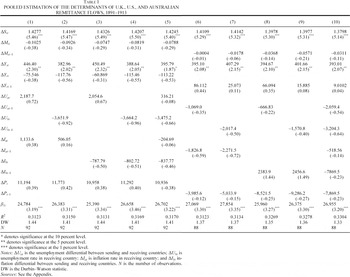
The results of the pooled estimation for the period 1891 to 1913 are given in Table 1. These show the significance of required, affordable, and autonomous remittances. On average, for each additional migrant departing the U.K. in any year about £1.4 of extra money orders were received in return (about 3 percent of average income in 1913), whereas for each pound increase experienced in the average income of the remitting country, approximately a further £400 would be remittances would be generated. Money orders also increased independently by around £26,000 each year. None of the regressions reported in Table 1 provide any evidence of either distress or desired remittances, even when the relevant variables are lagged.40
Table 1 gives just ten of the most typical estimations carried out. Other specifications were tested, but did not noticeably affect the results.
The restrictive assumptions of the pooled model used to generate Table 1, however, pose two problems. First, is it valid to take the values of the intercept and coefficients for each independent variable across streams as identical? Second, given that economic and societal crises tend to occur at the regional level, can the impact of distress be adequately captured by national aggregates? After all, within the United Kingdom out-migration rates are known to have varied considerably by county, whereas migrants from distressed regions often had preferred destinations. One might, therefore, reasonably expect country- and county-specific variations in the response to distress.41
Baines, Migration, pp. 153, 157, and 282.
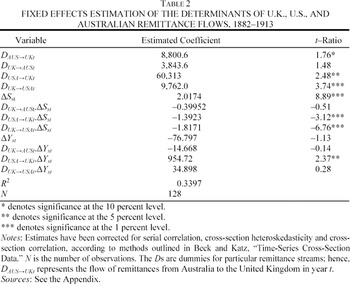
To account for such factors a fixed effects model, taking Australian remittances to the United Kingdom as its base group, is estimated for the same four remittance flows analyzed in Table 1.42
The model reported here is the final estimated equation and was derived in the following manner. A full fixed effects model, incorporating all available variables used in the pooled regression was first estimated. Variables found to be insignificant were then removed and the model re-estimated. The results of this latter estimation are presented in Table 2.
Between 1865 and 1913, around five million Britons went to America, just over two million to Canada, 1.1 million to Australia, and some 660,000 to South Africa. The accumulated stock of people of British ancestry in the United States, therefore, was larger than in all of the British settler societies combined.
In terms of required remittances, Table 2 indicates that the situation was very different. For each addition to the stock of remitters in our base group in any year—that is, among Australian remitters to the United Kingdom—around a further £2 (about 4 percent of a departing emigrant's average income in 1913) was remitted via money orders to the United Kingdom. The amount for U.K.-to-Australia remittances was about the same, possibly less (£2.0174 − £0.39952 = £1.61788), though this difference is not statistically significant. By contrast, there is strong evidence to show that required remittances per additional remitter were considerably lower between the United States and the United Kingdom: £0.6251 for U.S.-to-U.K. remittances and £0.2003 for U.K.-to-U.S. remittances. Finally, the estimation also demonstrates that affordable remittances were significant only in the case of U.S.-to-U.K. remittances. Even there, the effect was not large. The reported coefficient of £877.92 is in effect the individual's marginal propensity to remit multiplied by the stock of remitters. Given that, using our methods, the average size of the stock of remitters in the United States in this period was around 494,404, it follows that for every increase in average income by £1000, each American remitter would send only an additional £1.78 back to the United Kingdom. This finding, of course, does not mean that the growth of average income had little or no impact on the amount of remittances sent, merely that the effect was not direct. Thus, higher incomes levels in Australia, by inducing more Britons in subsequent years to migrate there, may have ultimately led to more remittances being sent home. Such additional remittances, though, would have been driven not by the growth in income per se, but by the increase in potential remitters.44
A further implication of this finding is that it suggests that, apart from U.S. remitters, changes in the value of money orders issued were not being noticeably driven by their use for commercial purposes. See note 14 for details.
In the case of the United States, the lowness of required remittances and the higher level of affordable remittances appear to have their roots in the distinctive nature of British emigration there in the latter half of the nineteenth century. Two features in particular stand out. The first (regarding required remittances) is the relatively low cost of getting to and returning from America, an advantage that steadily increased over time as steam shipping came to dominate the transatlantic run from the 1870s.45
Baines, Migration, pp. 128–35; and Piore, Birds, p. 154.
Fitzpatrick, “Billows,” pp. 142–43.
The second factor (regarding affordable remittances) is that lower transport costs to America also made it easier for short-term, seasonal migration to occur. Many Britons took advantage of this opportunity. We know that the return rate of British migrants to all overseas destinations was among the highest of all European.47
Baines and Wood, “Population,” pp. 40–41. Their figure of a 40 percent rate of return is an estimate on permanent emigration against outward sailings, discounting for nonemigrant passengers. It is noteworthy that, Piore, Birds, p. 153 contends that some 39 percent of third-class passengers on steamships leaving British ports at the beginning of the twentieth century ultimately returned.
Erickson, Invisible Immigrants, p. 236.
Fitzpatrick, “Billows,” p. 149.
Berthoff, Immigrants, pp. 21–29, and 52–53; Wyman, Round-Trip, pp. 59–61; and Richards, “Return Migration,” p. 104.
On savings, see Schrier, Emigration, pp. 116–17. On “returning Yanks,” see Wyman, Round-Trip, pp. 132–36.
Bodnar, Transplanted, pp. 60–61; Jones, Wales, pp. xx, 11, 16, 178–86, and 195–201; and Harper, “Tradesmen,” pp. 56–57.
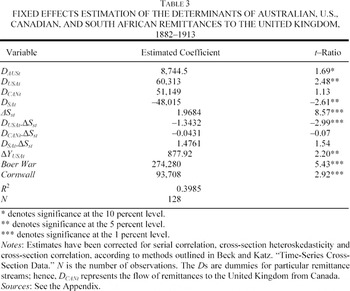
Table 3 extends our analysis by comparing as far as possible the remittance behavior of settler societies in four different locations in the later nineteenth century: Australia, America, Canada, and South Africa.53
Owing to the limits of existing data, not all variables could be included in the estimations. For example, as there is no South African GDP series for the period in question, affordable remittances cannot be directly compared.
In South Africa, meanwhile, autonomous remittances decreased rapidly throughout the period. This may suggest that the rate of return of Cornish miners was relatively high and that their average periods of stay were relatively short. This impression is confirmed by the fact that in several years there was an inward balance of migration from South Africa to the United Kingdom—in 1883–1885, 1899, 1904 and 1906–1908.54
Bradlow, Immigration, p. 409.
Burke, Cornish Miner, pp. 440–51; and Payton, Cornish Overseas, p. 346.
See Thompson, “Languages,” pp. 625–28, for an assessment of the Transvaal's English-speaking population and the place of the Cornish community within it.
The middle classes made some effort to do so, but the cost of following metropolitan fashions must have been prohibitive for many: see Lester, Imperial Networks, pp. 74–75.
Ross, Status, pp. 63–66.
Thompson, “Languages,” p. 623.
Table 3 also allows the regional distress hypothesis to be tested. We have again taken Cornwall as an example, partly because of the strength and depth of local histories of the region, partly because the Cornish copper industry, an integral part of the Duchy's traditional economy, underwent a profound decline that had severe consequences for entire communities. Particularly sharp downturns, where the industry's output in a short space of time fell by 15 percent or more, occurred in the periods 1886/87, 1893–1895, 1902/03, and in 1913.60
The crisis periods represent both the years in which there was an actual crash in output plus the year that immediately followed. The latter is included to allow for the lagged effects of the downturn.
Neither the Boer war nor Cornish distress significantly affected any other flow.
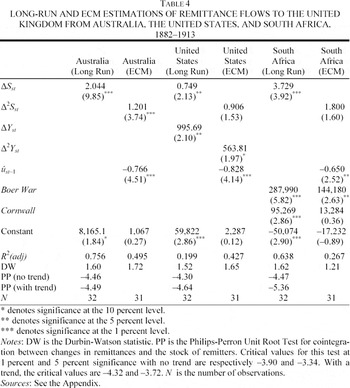
It will be recalled from our earlier discussion that one of the predicted properties of required remittances is that they exhibit stability across time. This is because they were regarded as a regular, obligatory payment for support—economic or emotional—provided by the family. Like any contractual arrangement, the remitter had a duty to pay in full, almost irrespective of circumstances. When this proved impossible, restitution should have occurred at the earliest opportunity. Another way of expressing this property is that observed flows ought to have exhibited a tendency to converge toward a long-run stable relationship between the level of required remittances and the stock of recently arrived immigrants.62
Given that the data used in this article relate to aggregate behavior, the coefficients it estimates actually are for average required remittances per additional remitter in each setting. Individual required remittances, of course, vary from case to case. There is no reason to presume, however, that average required remittances should not also display a tendency to return to a stable long-run equilibrium. Indeed, the fact that it did would indicate how pervasively such senses of obligation were felt.
See Gujarati, Basic Econometrics, ch. 21 for an introduction to cointegration.
The main exception is Canada-to-United Kingdom remittances, for which no evidence of a cointegrating regression is apparent. Interestingly, the main “from-United Kingdom” flows (unreported here) were also cointegrated, suggesting that binding familial obligations also mattered to those who moved in the other direction.
A number of features of these estimations are noteworthy. First, the results show that the long-run coefficients produced by individual country regressions (ΔSst, ΔYst) are similar to those estimated by panel data techniques. Second, the short-run effects of changes in most independent variables on the growth of remittances are smaller than the long run. The exception here relates to the impact of changes in the stock of remitters on the United States to the United Kingdom. In this instance, however, not all of the relevant coefficients are statistically significant at normal levels. Third, and perhaps most importantly, the error correction term (the coefficient on ûst−1 in each ECM estimation) for each reported remittance flow is statistically significant at least at the 5 percent level. In other words, any annual deviation from the long-run equilibrium amount of remittance tended to be at least partially corrected for in the following year. The precise degree to which these corrections occurred is given by the value attached to the error correction term itself. Thus, approximately 77 percent of errors made in the amount of Australian remittances sent home to the United Kingdom in one year tended to be compensated for in the following. The corresponding figure for the U.S.-to-U.K. remittances was 83 percent, and it was 65 percent for South Africa-to-U.K. remittances. This is a strong finding that lends support to Lucas and Stark's implicit contract hypothesis. It implies that for many remitters in the English-speaking world, the commitment to remit was an earnest one. At least with respect to family responsibilities, bygones were not simply regarded as bygones.
This article has provided evidence of four distinct types of remittance behavior in the English-speaking world in the later nineteenth and early twentieth centuries: required, affordable, distress, and autonomous. The relative strength of these different forms of remittance varied from place to place. Within the self-governing dominions, required remittances were stronger from South Africa than from Australia, a finding that has its roots in the larger proportion of migrants in South Africa whose income, as we have seen, was commonly the primary means of support for dependents back in Britain. An even greater difference in behavior exists between America and the self-governing dominions. From the United States to the United Kingdom there were large amounts of autonomous and affordable remittances, and a relatively small amount of required remittances. What accounts for these differences? Although there is some evidence to suggest that the English, in particular, may not have developed as extensive an institutional life in America as they did in the colonies (implying that organizational donations may have been less frequent or substantial) it is not conclusive.65
For example, papers designed for English immigrants were short-lived, friendly societies did not long remain in old-country hands, and second-generation immigrants rapidly drifted away from ethnic societies founded to preserve English culture: see Thernstorm, Encyclopedia, pp. 334–35; Berthoff, Immigrants, pp. 143–44, 162–64, 179–80, and 210; and Jones, Wales, pp. 12–13, and 92, who briefly discusses the English in Scranton.
American differences in remittance behavior most likely stemmed as much from geography as from any particular outlook on the world its immigrants may have held. Indeed, in several ways, the remittance activity of British migrants to America shared much in common with that of British migrants to the rest of the English-speaking world. Although American immigrants may have been more strongly influenced by income levels and in a better position to build up nest eggs to take home, they too felt the pull of kith and kin. Affordable remittances helped to supplement family income (even if they are unlikely to have constituted a large or regular portion of it); autonomous remittances were in part predicated on financial and emotional commitments between migrants and their families and communities in Britain that endured over time. Like return migration, therefore, the remittance behavior of British migrants, regardless of their destination, “brings the historian face to face with the importance of human feelings,” and testifies to the strength of family and community across national boundaries.66
Wyman, Round-Trip, pp. 208–09.
Hoerder, “Labor Markets,” p. 91; and Ross McCormack, “Networks,” p. 58.
Money orders, income, and U.K. copper output: The money order data used in this article come from the Postmaster General's Annual Reports from 1859 to 1914 and the Annual Reports of the Money Orders Office (1899–1908). In its raw form, much of this material is recorded in years that run from 1 April through to 31 March the following year. We have corrected the data to make them correspond to calendar years. We have done this by assuming that an annual figure can be calculated by adding together a quarter of the last observation and three quarters of the current observation. Hence, the observation for 1885 is (0.25 × 1884/85) + (0.75 × 1885/86). This approach is adopted from 1880 onwards. Before then, the calendar year data are used where available. In cases where there is no recorded observation for the previous year, that reported observation is taken to be the figure for the year for which it represents nine months. Hence, the figure used for 1879 is actually the 1879/1880 observation. Figures for 1875, 1877, and 1878 have been interpolated based on compound growth rates between the reported 1873, 1876, and 1879 values. Average real income figures are taken from Maddison, Monitoring, appendix D. U.K. copper output data come from Mitchell, Statistics, p. 310.
Stock of remitters: The stock of remitters is calculated as the sum of the last five years arrivals of migrants from the receiving country. Data on migration flows come from Mitchell, Statistics, pp. 81–82. Australian figures are based on Australasian data with a figure for New Zealand subtracted. For the period 1887 to 1913, this figure for the inflow of U.K. citizens to New Zealand is taken directly from the New Zealand Official Year-Book, various additions 1897–1914. For the earlier period, 1882–1887, it is assumed that the inflow of U.K. migrants to New Zealand was 20 percent of the reported Australasian figure. This percentage is chosen because it represents New Zealand's average share in the period for which we have good data. The flow of Australians to the United Kingdom is calculated by multiplying the volume of Australasian migration to the United Kingdom by its share of migration from the United Kingdom.
Unemployment: Australian unemployment figures are based on Noel Butlin's national estimates for 1901–1913. The 1892–1900 figures were derived by assuming Butlin's national series moved in parallel with the series for Amalgamated Society of Engineers in this period. This is a reasonable assumption because both series are highly correlated (0.88) in the period between 1901 and 1913 when they overlap. All data are found in Vamplew, Australians, pp. 152–53. U.S. unemployment figures come from Romer, “Unemployment,” Table 9, p. 31. U.K. unemployment rates were taken from Feinstein, National Income, table 57.
Interest rates: For Australia, the rates used on government bonds, as found in Vamplew, Australians, p. 240, are used. U.S. rates are for ten-year government bonds and are taken from the Global Historical Financial Database found at http://www. globalfindata.com. U.K. rates are for consols. These are taken from Mitchell, Statistics, p. 678. For the period, 1879–1902, Harley's alternative yields are used.
Inflation: Inflation rates calculated from price series given in Vamplew, Australians, p. 219, the Global Historical Financial Database, and Feinstein, National Income, Table 61, T132.
The authors would like to thank Tim Hatton, Max Corden, Bill Griffiths, Sisira Jayasuriya, Roberto Raimondo, Carl Bridge, Kent Fedorowich, Marjory Harper, Philip Payton, and Eric Richards as well as participants at conferences, workshops, and seminars in Oxford, London, Bristol, Melbourne, Auckland, and Singapore for their comments on earlier versions of this article. This article has also benefited greatly from the perceptive comments of two anonymous referees and Knick Harley. Usual disclaimers apply.
TABLE 1 POOLED ESTIMATION OF THE DETERMINANTS OF U.K., U.S., AND AUSTRALIAN REMITTANCE FLOWS, 1891–1913
TABLE 2 FIXED EFFECTS ESTIMATION OF THE DETERMINANTS OF U.K., U.S., AND AUSTRALIAN REMITTANCE FLOWS, 1882–1913
TABLE 3 FIXED EFFECTS ESTIMATION OF THE DETERMINANTS OF AUSTRALIAN, U.S., CANADIAN, AND SOUTH AFRICAN REMITTANCES TO THE UNITED KINGDOM, 1882–1913
TABLE 4 LONG-RUN AND ECM ESTIMATIONS OF REMITTANCE FLOWS TO THE UNITED KINGDOM FROM AUSTRALIA, THE UNITED STATES, AND SOUTH AFRICA, 1882–1913