Introduction
While institutionalization is often being considered as an undesirable outcome for any elderly person, it remains to be a practical though not always desirable solution for many whose family lacks the manpower or resources to continue home care. It is also the inevitable place of abode for many frail elderly individuals with no family, limited resources, or with an equally disabled spouse. Having dementia is one of the major predictors of institutionalization (Woo et al., Reference Woo, Ho, Yu and Lau2000; Bharucha et al., Reference Bharucha, Pandav, Shen, Dodge and Ganguli2004; Nihtilä et al., Reference Nihtilä, Martikainen, Koskinen, Reunanen, Noro and Häkkinen2008; Chau et al., Reference Chau, Woo, Kwok, Chan, Hui and Chan2010), due to its global impact on activities of daily living, falls, and associated behavioral symptoms (Balestreri et al., Reference Balestreri, Grossberg and Grossberg2000; van Doorn et al., Reference van Doorn2003; Rozzini et al., Reference Rozzini, Cornali, Chilovi, Ghianda, Padovani and Trabucchi2006; Lee et al., Reference Lee, Hui, Chan, Chi and Woo2008). As a result, the proportion of dementia residents in residential care homes remains high in most countries (Matthews et al., Reference Matthews and Dening2002; Woo and Chau, Reference Woo and Chau2009; Seitz et al., Reference Seitz, Purandare and Conn2010).
Attitudes of residential care staff toward residents with dementia matter because these will be reflected in the manner they treat these residents in their daily work and ultimately, resident outcomes (Bonner et al., Reference Bonner, Castle, Men and Handler2009). Staff attitude might be affected by personal and institutional factors, such as age, work experience, knowledge about dementia, exposure to dementia care, ability to recognize cognitive impairment, and number of dementia residents in the workplace (Macdonald and Woods, Reference Macdonald and Woods2005; Kada et al., Reference Kada, Nygaard, Mukesh and Geitung2009). Staff attitude is also related to work stress which will in turn determine whether they are likely to stay in their job (Zimmerman et al., Reference Zimmerman2005). High staff turnover is associated with poor resident outcomes and quality of care (Castle et al., Reference Castle and Engberg2005; Bostick et al., Reference Bostick, Rantz, Flesner and Riggs2006). This is particularly important for residents with dementia who generally do not cope well with strangers. To improve the retention rate of these staff, it is important to understand their attitudes and perceived difficulties in their daily work, because appropriate staff training can help to reduce long-term care staff turnover (Grant et al., Reference Grant, Kane, Potthoff and Ryden1996; Coogle et al., Reference Coogle, Parham, Jablonski and Rachel2007).
Studies have demonstrated beneficial effects of specialized care units for nursing home residents with dementia on behavioral symptoms and family caregiver burden (Bakker et al., Reference Bakker, Duivenvoorden, van der Lee, Olde Rikkert, Beekman and Ribbe2011; Kolanowski et al., Reference Kolanowski, Litaker, Buettner, Moeller and Costa2011), though others suggested that there was no strong evidence to support the beneficial effect on specialized care units for nursing home residents with dementia (Lai et al., Reference Lai, Yeung, Mok and Chi2009). Whether the presence of specialized care units or programs has any effect on staff attitude is less studied (Zimmerman et al., Reference Zimmerman2005) and results may differ with different cultures, staff- and resident-mix. We conducted a survey to examine the attitude of frontline residential care staff toward residents with dementia in Hong Kong, and how the presence of specialized program in the workplace may affect staff attitude. We attempted to test the hypothesis that the presence of specialized programs in residential care homes would be associated with differences in staff attitude toward dementia care training and commitment in dementia care.
Methods
The community geriatrics outreach teams in Hong Kong were invited by email invitations sent by the authors. Twelve out of 14 teams responded and agreed to participate. A cross-sectional survey was then sent out to 12 out of the 14 community geriatrics outreach teams in Hong Kong between May and July 2010. Staff working in these teams and in residential care homes served by these teams were invited to participate. The individual nursing home participants were invited by nurses of the outreach teams via the manager of their respective nursing homes to participate in the survey. All participants and residential care homes were anonymous. The nursing homes were located in all three major areas in Hong Kong, namely Hong Kong Island, Kowloon, and the New Territories. The exact number and names of nursing homes were not recorded. The authors had hoped to increase participation of homes by allowing them to remain anonymous, as the purpose was not to compare the services or staff attitude between homes. The numbers of participants from each of the three major areas were 512 from the New Territories, 330 from Kowloon, and 205 from Hong Kong Island.
Questionnaire
The questionnaire items were divided into four parts: the current state of dementia care in the workplace (prevalence of dementia among residents, availability of specialized dementia care unit or programs such as orientation programs and cognitive training), opinion regarding dementia care or dementia care training in general (perceived need for specialized care programs, need for further improvement in dementia management approaches, manpower requirement for dementia care, perceived difficulty in dementia care, whether the participant would be willing to have further dementia care training, and willingness to participant in dementia care in the future), the importance or level of concern of certain dementia behaviors in their daily work, and demographic data of the participant. The questionnaire was developed specifically for this study and it had never been used, either in part or in its entirety, in any prior studies.
Dementia symptoms
Dementia symptoms listed in the questionnaire were categorized as positive symptoms and negative symptoms for analysis. Positive symptoms included those that cause disturbance in daily care: aggression, nighttime behavior, wandering, repetitive behavior, being quarrelsome, yelling, and resistance to care. Negative symptoms were apathy and eating problems including refusal to eat and dysphagia.
Institutional approval
The study was supported and approved by the Hong Kong Geriatrics Society, approved by the management board of the individual residential care homes, and approved by the team heads of the participating geriatrics outreach teams.
Data analysis
Descriptive statistics were used to describe demographic data of the participants, prevalence of dementia residents in their workplace, and the prevalence of the most difficult symptoms according to staff. χ 2-test was used to compare the differences between nurses and personal care workers, between for-profit and non-profit homes, and between staff with different levels of experience, where appropriate. Logistic regression analysis was used to study the relationship between subjective difficulty in long-term dementia care and various possible related factors, and between positive attitude toward dementia care training and future commitment and various possible related factors. All tests were two-sided and a p value of <0.05 was taken as statistically significant. All analyses were performed using SPSS version 16.0.
Results
Participants
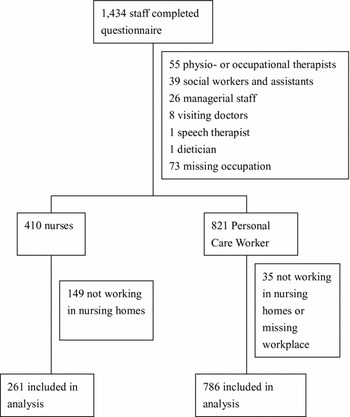
A total of 1,434 staff completed the survey. The majority were frontline personal care workers or nurses, 821 (57.2%) and 410 (28.5%), respectively. The remaining included 55 physiotherapists and occupational therapists, 39 social workers or social work assistants, 26 managerial staff, 8 doctors, 1 speech therapist, and 1 dietician. Seventy-three did not disclose their post. As the primary target is frontline workers in nursing homes, the following analysis only included data from personal care workers and nurses working in nursing homes and excluded those working in outreach teams (Figure 1).
Participants of questionnaire according to occupation and place of work.

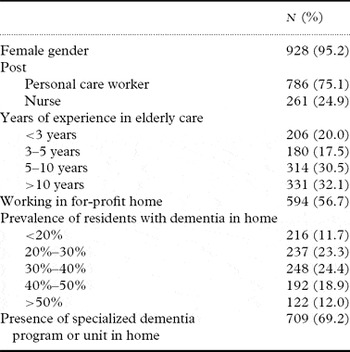
Most participants (62.6%) had over five years of elderly care experience with over 32.1% having over ten years of experience. Approximately half of the participants worked in for-profit homes (56.7%). The commonest reported prevalence of dementia among residents in participating homes was 20%–40% (reported by 47.7% of participants) (Table 1).
Participant characteristics (n = 1,047)*

*Some questions have missing responses; therefore, the total number was different (gender, missing = 72; experience in elderly work, missing = 16; prevalence of residents with dementia, missing = 32; presence of specialized dementia program or unit in home, missing = 32).
Difficult dementia symptoms according to staff
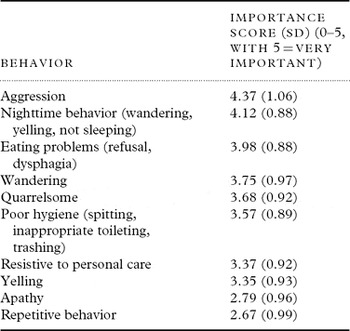
Behavioral symptoms causing most concerns in the care of the residents with dementia were aggression and nighttime behavior, followed by eating problems, wandering, and being quarrelsome (Table 2). Apathy, a negative symptom, and repetitive behavior ranked the lowest.
Problem behavior and their importance in dementia care according to staff

Note: Questions have missing responses; therefore, the total number of responses for each symptom was different (missing responses in each were as follows: aggression 38, nighttime behavior 13, eating problems 23, wandering 17, quarrelsome 29, poor hygiene 29, resistive to personal care 35, yelling 24, apathy 49, and repetitive behavior 28).
Difficulties in managing residents with dementia
A total of 812 out of 1,030 (78.8%) respondents who answered the question reported difficulties in managing residents with dementia. Significantly, more nurses reported difficulties than personal care workers (83.7% vs. 77.2%, p = 0.026). More staff working in non-profit homes reported difficulties than those working in for-profit homes (84.5% vs. 74.5%, p <0.001). The tendency to report difficulty increased with longer working experience in the field (74.9% for those with <3 years of experience, 73.1% for those with between 3 and 5 years of experience, 77.8% for those with between 5 and 10 years of experience, and 84.9% for those with more than 10 years of experiences, p for trend = 0.002).
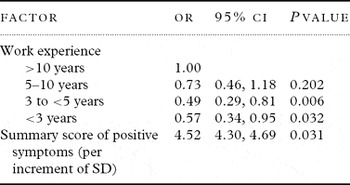
The vast majority (95.3%) agreed that comparing with the care for nursing home residents without dementia, caring for the residents with dementia required more manpower. In multiple logistic regressions, gender, post (nurses or personal care workers), type of home (for-profit or non-profit), the prevalence of dementia, and the presence of any specialized dementia program or unit in their workplace were not associated with difficulties in care reported by the staff. Staff with less work experience (<5 years) were less likely to feel the difficulty when compared with those with over ten years of experience. Those who ranked positive symptoms as more important, as reflected by a higher total importance score, were more likely to report difficulty in caring (OR 4.52 per 1 standard deviation increment in score, p 0.031) (Table 3).
Factors associated with subjective difficulty in long-term dementia care

SD = standard deviation, CI = confidence interval.
Adjusted for gender, post, type of home, and dementia prevalence in home.
(N = 823; cases with missing value in any of the independent variables were omitted from the analysis).
Positive attitude toward dementia care training and future commitment in dementia care
A total of 93.8% and 90.4% of the staff were willing to receive further dementia care training and were willing to work in dementia care, respectively. Multiple logistic regression analyses were performed to look for factors associated with positive attitudes toward receiving further dementia care training or willingness to work in dementia care. Adjustments were made for gender, work experience in elderly care, post (nurses or personal care workers), type of home (for-profit or non-profit) currently working in, dementia prevalence in the current workplace, and whether there is a dementia program or unit in place in the current workplace. The only factor associated with a positive attitude toward receiving further dementia care training was working in a non-profit home (OR 2.36, 95% CI 1.12–4.99; p = 0.024) while having a dementia program or unit in the current workplace also showed a trend toward significant association (OR 1.80, 95% CI 0.985, 3.302; p = 0.056). The only factor associated with commitment to stay in dementia care is having a dementia program or unit in their current workplace (OR 1.86, 95% CI 1.10–3.15; p = 0.021).
Discussions
The majority of staff felt that dementia care is difficult and required more manpower. The most difficult symptoms in the staff's perspective were aggression, nighttime confusion, eating problems, wandering, and being quarrelsome. Out of these, being aggressive and quarrelsome (similar to being stubborn) were also among the top five difficult-to-cope-with symptoms in another nursing home staff survey conducted elsewhere (Brodaty et al., Reference Brodaty, Draper and Low2003). Difficult behavior might be direct reasons for rapid staff turnover especially among those who provided direct care.
Independent factors associated with subjective difficulties in dementia care were higher perceived importance of positive symptoms of dementia and a longer elderly work experience of ten or more years, compared with those with five or fewer years. The former was understandable and might have reflected the individual staff's helplessness in face of those symptoms. However, the latter was in contrast with findings by Kada et al. (Reference Kada, Nygaard, Mukesh and Geitung2009) and Zimmerman et al. (Reference Zimmerman2005), which showed that staff with fewer years of experience reported lower hope attitudes or work stress. The reason for this discrepancy is unclear. Nevertheless, work experience ceased to be associated with either willingness to receive further training or commitment to stay in dementia care in the multivariate model. This suggested that despite being more appreciative of the difficulty in dementia care, experienced staff were not more willing to receive further training. Perhaps over the longer period of service, these staff had already experienced various kinds of talks about dementia and did not find them useful.
Based on the high percentage of staff willing to attend training irrespective of experience level, and that many of these behavioral symptoms are amenable to non-pharmacological management, which can be carried out by the staff themselves (Volicer et al., Reference Volicer, Simard, Pupa, Medrek and Riordan2006; Aman and Thomas, Reference Aman and Thomas2009; Simard and Volicer, Reference Simard and Volicer2010), educational efforts on this aspect may be useful to improve care. In fact, educational programs for frontline nursing home staff might be useful to reduce staff turnover (Grant et al., Reference Grant, Kane, Potthoff and Ryden1996; Zimmerman et al., Reference Zimmerman2005), and providing training might also be seen as good organizational support for staff which may help staff retention (Filipova et al., Reference Filipova2011). Training on communication techniques (McCallion et al., Reference McCallion, Toseland, Lacey and Banks1999; Williams et al., Reference Williams, Herman, Gajewski and Wilson2009; Williams and Herman, Reference Williams and Herman2011) and resident programs adopting a more person-centered approach (Volicer et al., Reference Volicer, Simard, Pupa, Medrek and Riordan2006; Simard and Volicer, Reference Simard and Volicer2010) might be useful to reduce both resistive behaviors among residents with dementia and staff turnover. Training in geriatric case management (Coogle et al., Reference Coogle, Parham, Jablonski and Rachel2007) and the promotion of person-centered care for the residents with dementia (Cohen-Mansfield and Mintzer, Reference Cohen-Mansfield and Mintzer2005; Cohen-Mansfield et al., Reference Cohen-Mansfield2005) are other means of improving quality of dementia care and staff job satisfaction.
Eating problems ranked as the third most concerned behavior in this survey. The onset of eating problems might herald the end of life in advanced dementia (Mitchell et al., Reference Mitchell2009). Knowledge of this among staff might help to reduce the pressure of starting burdensome interventions such as tube feeding or repeated hospitalization, but instead trigger end of life care planning among the residents’ family members.
Having exposure to a specialized dementia care program or unit in the current workplace was associated with a positive staff attitude toward future dementia care training and commitment to stay in dementia care. The latter was important both because of the significance of the association (p = 0.021) and its being the only significant factor found in our model. It has been reported that staff turnover rate was lower in homes with dementia specialized care units (Grant et al., Reference Grant, Kane, Potthoff and Ryden1996), although mediating factors were uncertain. Some have suggested that positive relationship between staff and residents’ families within these specialized care units promoted job satisfaction and reduced the desire to quit (Robison and Pillemer, Reference Robison and Pillemer2007). A recent meta-analysis on the usefulness of specialized care units for the residents with dementia in nursing homes, however, has commented that there was a lack of evidence of these units in terms of resident benefit, due to the lack of randomized trials (Lai et al., Reference Lai, Yeung, Mok and Chi2009). Nevertheless, the marginal benefits of using less restraint, having less behavioral psychological symptoms of dementia (BPSD) among the residents might also be rewarding experiences for staff. Nonetheless, nursing home staff might be more inclined toward a person-centered approach, commonly employed in specialized care units, in the management of dementia behavior (Pulsford et al., Reference Pulsford, Duxbury and Hadi2011). Thus, the establishment of these units, apart from benefiting residents with dementia, may also serve to provide a rewarding experience to nursing home staff.
As both BPSD and use of psychotropic medications were adversely related to quality of life of nursing home residents with dementia (Cordner et al., Reference Cordner, Blass, Rabins and Black2010; Wetzels et al., Reference Wetzels, Zuidema, de Jonghe, Verhey and Koopmans2010), and staff education programs were associated with reduced BPSD (Deudon et al., Reference Deudon2009), willingness to have further dementia care training is an important step toward both improved quality of care and quality of life for residents. Establishing a specialized care unit in the nursing home might be a useful method to encourage positive staff attitude toward dementia, increase staff commitment to stay in their job, and at the same time improve resident outcomes.
The staff-mix of nursing homes in Hong Kong was likely to be quite different to that in other developed countries. The majority of local frontline personal workers was of a relatively low education level and was unlikely to have received any training in elderly care or healthcare, unlike nurses’ aides elsewhere. This study provided a unique opportunity to examine long-term care staff attitude toward dementia and might be able to guide future training development for this staff group.
Cultural differences in the perception of dementia might also play a role in affecting how staff reacts to behavioral symptoms in residents with dementia. There were several schools of thoughts with respect to how the Chinese culture might affect caregiver attitude: the willingness to accept dementia as part of the normal aging process (Mukadam et al., Reference Mukadam, Cooper and Livingston2011), the influence of filial piety (Chou et al., Reference Chou, LaMontagne and Hepworth1999), and the tendency to view dementia as a chronic mental illness akin to schizophrenia and thus even more associated with stigma (Liu et al., Reference Liu, Hinton, Tran, Hinton and Barker2008). Filial piety has been found to be associated with lower caregiver burden (Chou et al., Reference Chou, LaMontagne and Hepworth1999), and seeing dementia as normal aging may reduce stigmatization (Mukadam et al., Reference Mukadam, Cooper and Livingston2011). However, among paid caregivers, filial piety will not have any major role, and difficult behavior causing more work stress would likely exaggerate stigmatization associated with the concept that dementia is a severe chronic mental disease. Reducing stigmatization by patient-centered education at work could have improved staff attitude by correcting this misconception.
Limitations
We employed a convenient sampling method rather than a truly randomized sampling. In the hope to encourage participation by both the nursing home management and the frontline care workers, the survey was purposefully designed to be very brief and simple. Unfortunately, this has also made more in-depth analysis impossible. Our results may not be generalized to residential care homes not covered by community geriatrics outreach teams as the case-mix and staff attitude in these homes might be different from the ones we surveyed. However, the most reported prevalence of dementia (20%–40%) corresponded well to the mean prevalence of 31.6% reported in the 2009 Hong Kong census (Census and Statistics Department, The Hong Kong SAR Government, 2009), suggesting that participating homes were a representative sample in this aspect. We have no data regarding the total number of people working in residential care homes in Hong Kong, therefore, it is not known what proportion of that population we have surveyed. However, about 57% of our respondents worked in for-profit homes. This percentage is similar to the percentage of nursing home residents residing in for-profit homes in Hong Kong (60%) (Census and Statistics Department, The Hong Kong SAR Government, 2009). The number of homes that participated in the survey was not known, hence, although the participants came from homes located in all three main areas of Hong Kong, and the proportion of dementia residents and for-profit homes was grossly similar to that in the Hong Kong census, the exact response rate of homes remained unknown. The representativeness of the survey might thus be compromised. Although staff–resident ratio might differ between for- and non-profit homes, we believe this help to support the representation of our staff sample. We have no details of what type of specialized dementia care programs were in place in the homes and, therefore, were unable to examine in details what type of programs have more positive effect on staff. We were not able to identify the exact turnover rate of nursing home staff and, therefore, were unable to identify the exact relationship between the presence of specialized care units and staff turnover rate.
Conclusion
Although the majority of long-term care staff felt dementia care to be difficult, in particular those having ten years or more experience, most of them hold positive attitudes toward further training and were committed to stay in dementia care. Having a specialized dementia care unit or program in the current workplace was associated with commitment to stay in dementia care and was marginally associated with willingness to undergo further dementia care training.
Conflict of interest
None.
Description of authors’ roles
Dr. Jenny Lee took the role of formulating the research questions, designing the study, carrying it out, analyzing the data, and writing the paper. Dr. Elsie Hui took the role of formulating the research questions, designing the study, and carrying it out. Dr. Carolyn Kng took the role of formulating the research questions, designing the study, and carrying it out. Dr. Tung Wai Auyeung took the role of formulating the research questions, designing the study, carrying it out, analyzing the data, and writing the paper.
Acknowledgments
The authors are particularly grateful to the assistance of Drs Felix Chan, Ming Hung Chan, Bernard Kong, Chun Bong Law, Ho Yin Leung, Man Fuk Leung, Kwun Man Lo, Winnie Mok, Jennifer Myint, Stanley Tam, Yee Ming Wu, Kwan Mo Yeung, and the CGAT teams of Alice Ho Mui Ling Nethersole Hospital, Fung Yiu King Hospital, Haven of Hope Hospital, Kowloon Hospital, Kwong Wah Hospital, North District Hospital, Princess Margaret Hospital, Queen Elizabeth Hospital, Ruttonjee Hospital, Shatin Hospital, Tuen Mun Hospital, and United Christian Hospital. The authors are also grateful to the Hong Kong Geriatrics Society for the funding of the survey.