Every 20 years the handiwork of Elbridge Gerry, fifth US vice president, member of the first and second House, and Constitutional Convention refusenik, (Billias Reference Billias1976) comes into play in a way that could determine the outcome of the electoral vote. Thanks to Elbridge Gerry presidential elections in years ending in a 2, for example, 1792 and 2012, are contested with an Electoral College based on the newly apportioned, incoming House of Representatives rather than the previously apportioned, outgoing House. It did not have to be that way. The precise details of the coalition of states needed for an Electoral College victory in the 2012 presidential election could have depended on Gerry's suspicions.
The Elector clause of Article II states
Each state shall appoint, in such manner as the Legislature thereof may direct, a number of electors, equal to the whole number of Senators and Representatives to which the State may be entitled in the Congress.
To how many electors would each state be entitled for the election of 1792? Would Rhode Island be entitled to three electors based on its one member in the current House then in session, or to four electors based on its two members in the House that would convene in 1793?
The Elector clause first appears in the Convention records for September 4, 1787, in the report from the Committee on Postponed Matters.
Each State shall appoint in such manner as its Legislature may direct, a number of electors equal to the whole number of Senators and members of the House of Representatives, to which the State may be entitled in the Legislature
(Farrand Reference Farrand1937, 2:497).The clause underwent only minor stylistic changes over the next 13 days, and there was no recorded debate whether the number of electors to which states were entitled was forward looking and based on a newly apportioned, incoming House, or backward looking and based on the outgoing House. During the Convention's final fortnight there was simply too much else to resolve about filling the presidency.
Nor during all of the debate about congressional selection of the president was there any recorded debate about whether the incoming Congress or the outgoing Congress would make the choice. Perhaps the delegates simply assumed that it would be the incoming Congress that selected the president, as it had to be for the first presidential election! That was the model in all of the states whose legislature chose their governor.Footnote 1
As James Madison noted in a letter to Edmund Pendleton dated February 21, 1792, “The text of the Constitution was not decisive” on the question of which House should serve as the basis of apportionment (Madison 1962–Reference Madison, Hutchinson and Rachal1991, 14:435). Indeed, the Constitution did not mandate that congressional terms and presidential terms expire on the same day. That was a question taken up by the first Congress.
The first Congress convened on March 4, 1789. The House achieved a quorum on April 1, the Senate on April 6. With a quorum of both chambers in place the Senate was finally able to elect a president pro tempore “for the sole purpose of opening and counting the votes for President of the United States” as required by the Constitution. With that bit of housekeeping out of the way the two chambers met in joint session to certify the election of George Washington as president and John Adams as vice president of the United States (Annals of Congress 1789, 17). They took their oaths of office on April 30.
A year later Congress faced the issue of determining
when, according to the Constitution, the terms for which the President, Vice President, Senators, and Representatives have been respectively chosen, shall be deemed to have commenced
(House Journal 1790, 207; Senate Journal 1790, 136).The joint committee formed to study the topic reported back two weeks later
That the terms for which the President, Vice President, Senators, and Representatives, of the United States, were respectively chosen, did, according to the constitution, commence on the 4th day of March, 1789; and so the Senators of the first class, and the Representatives, will not, according to the constitution, be entitled, by virtue of the same election by which they hold seats in the present Congress, to seats in the next Congress, which will be assembled after the 3d day of March, 1791; and further, that, whenever a vacancy shall happen in the Senate or House of Representatives, and an election to fill such vacancy, the person elected will not, according to the constitution, be entitled, by virtue of such election, to hold a seat beyond the time for which the Senator or Representative in whose stead such person shall have been elected, would, if the vacancy had not happened, have been entitled to hold a seat
(Senate Journal 1790, 140–41).The Senate agreed to the report with no recorded debate (Annals of Congress 1790, 1011). In the House an unidentified member argued
that the Constitution was explicit in declaring that the members of the House should be chosen every second year, plainly implying that they were elected for two years; … the State of North Carolina will not, in all probability, be represented in next Congress; as the circumstances of that State do not admit of their assemblies being convened more than once a year
(Annals of Congress 1790, 1637).After a short debate the House agreed to the report “and ordered a bill to be prepared in conformity thereto” (Annals of Congress 1790, 1638). No such bill would be forthcoming from the first Congress.
Issues relating to presidential succession were left to the next Congress. On November 24, 1791, the Senate began what would become a four-month ordeal working on the apportionment of the House following the receipt of census data. Six days later the Senate passed an initial version of the Presidential Succession Act (Senate Journal 1791–1792, 346). It did not address the question of whether the Electoral College for the upcoming presidential election should be based on the outgoing House or the incoming House.
The House took up the Presidential Succession Act in the middle of February, by which time it had been embroiled in the apportionment problem for more than three months. At that time the House narrowly backed a 112-seat apportionment that was perceived as favoring the South while the Senate narrowly backed a 105-seat apportionment plan that was perceived as favoring the North.
On February 13 an unidentified member moved that the upcoming presidential election be based on the outgoing House. This undoubtedly aroused Elbridge Gerry's suspicions, suspicions that had first surfaced at the Convention. Concerned that the Convention's initial House apportionment did not accurately reflect the states' populations, Gerry twice offered motions that prior to the first census-apportioned House, direct taxes be apportioned among the states according to their number of representatives rather than their estimated populationsFootnote 2 (Farrand Reference Farrand1937, 1:601–03, 2:350, 357). Following defeat of the motion to base the 1792 Electoral College on the outgoing House
Mr. Gerry moved to insert a clause which specified that “the Electors shall be equal to the number of Senators and Representatives to which the several States may by law be entitled at the time when the President and Vice President thus to be chosen should come into office”
(Annals of Congress 1791–1792, 405).Only William Vans Murray from Maryland made a recorded comment, one that reflected the concerns that Gerry had expressed at the Philadelphia Convention.
[H]e was in favor of the whole, both the proposition and the proviso: the first meditates a more equal representation of the wishes of the people of America in the election of the two great officers of the State; the proviso guards against a confusion which might take place without the provision. The present representation in Congress is by no means equal; the States in their conventional deliberation, produced the present proportion of Representatives more from compromise than from authenticated data; no census had then measured to the public the proportions of population which one State bore to another; and Representatives, including Senators and Electors of President and Vice President, being the same in number, and the scale of Representatives being unfounded in facts and evidence, the inequality, which is evident, is not to be wondered at
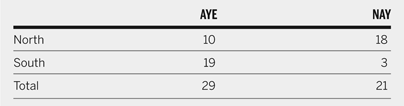
(Annals of Congress 1791–1792, 406).The Annals records that the motion was adopted “with very little objection” (Annals of Congress 1791–1792, 405). There might have been very little argument against the motion, but as Madison wrote to Pendleton “the Northern interest was strongly in favor of the latter interpretation” (basing the Electoral College on the outgoing House) (Madison 1962–Reference Madison, Hutchinson and Rachal1991, 14:435). Gerry's amendment passed by a vote of 29–21 revealing a fissure at the Mason-Dixon line as shown in table 1 (House Journal 1791–1792, 508).
Northern/Southern Voting on Gerry's Amendment
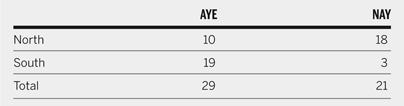
This breakdown suggests that North/South sectional interests reflecting the struggle over apportionment strongly influenced many votes. Nearly all of the southern representatives, viewing the 112-seat plan as favorable to their region, voted in favor of basing the Electoral College on the incoming House. A majority of the northern representatives, viewing the 112-seat plan as unfavorable to their region, voted against basing the Electoral College on the incoming House. Had four more of their northern colleagues not seen what Madison described to Pendleton as the “intrinsic rectitude” (Madison 1962–Reference Madison, Hutchinson and Rachal1991, 14:435) of the forward looking Electoral College, the Presidential Succession Act of 1792 might have been passed mandating a retrospective Electoral College based on the outgoing House of Representatives and that provision might still be in the statute books today.Footnote 3
Of course, Gerry's amendment is still in the statute books as 3 U.S.C. 3 and its contrary is not. That difference could have determined the outcome of the 2012 presidential election.Footnote 4
Suppose that Mitt Romney had won an additional 5% of the popular vote in each state and done just a little bit better in New Hampshire, which borders his home state of Massachusetts.
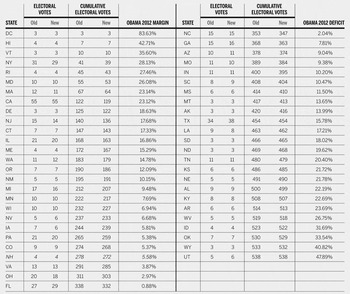
Table 2 presents the actual 2012 popular vote totals by state, sorted in descending order of Obama's actual margin (/deficit) versus Romney, with New Hampshire moved below Colorado to align with the supposition just made.Footnote 5 When ranked in this order Obama would have won all of the states down to Colorado, and Romney would have won New Hampshire, Virginia, Ohio, and Florida in addition to all of the states he actually won.
2012 Presidential Vote Ranked by Obama Margin(/Deficit), New Hampshire Moved Below Colorado, Electoral Vote Based on Old and New House Apportionment

With Gerry's amendment in the statute books that would have left Obama with only 268 electoral votes and Romney would have been the Electoral College winner with 270 electoral votes. However, if the northern interests in Congress had prevailed in 1792 Obama would have been reelected president with 274 electoral votes.Footnote 6
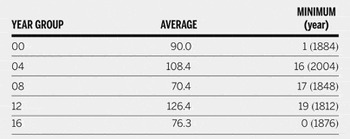
Average and Minimum Electoral Votes to Spare by Year Grouping

(Spreadsheet on file with the author)
Defenders of the Electoral College frequently assert that victory in the Electoral College requires a winning candidate to “produce a coalition of states with wide and diverse interests” (Sayre and Parris Reference Sayre and Parris1970, 62) thereby producing “a broadly based electoral victory” (Best Reference Best1975, 52). For these defenders of the Electoral College, simply winning the popular vote is not sufficient.
Not just any majority will do in a government dedicated to protecting the equal rights of all. One must pay heed not only to the numerical size of a winning coalition, but to the manner of its composition
(Uhlmann Reference Uhlmann2001).They claim that in elections such as 2000, in which the candidate who captured the largest share of the national popular vote lost the vote in the Electoral College, “the candidate who did a better job of building a national coalition and generating support nationally was sent to the White House” (Ross Reference Ross2012, 209). “In each case the victor was able to succeed because his opponent did not build the national coalition that is required by the Electoral College” (Ross Reference Ross2012, 193). Of course, none of these Electoral College proponents ever pauses to consider that the coalition needed to achieve a majority may depend on Elbridge Gerry's suspicions and the “intrinsic rectitude” of having the Electoral College's apportionment be prospective rather than retrospective, a contingency that could be changed by legislation.Footnote 7