INTRODUCTION
Substantial changes occur in the functional integration and organization of brain functional networks from adolescence through adulthood (Kundu et al., Reference Kundu, Benson, Rosen, Frangou, Leibenluft, Luh, Bandettini, Pine and Ernst2018). While these neural changes lead to significant improvements in complex cognitive functions, the elevations in novelty seeking, risk-taking behaviors, and increases in peer-directed social interactions make adolescence a period of heightened vulnerability for the onset of alcohol and drug use (Spear, Reference Spear2000). The triadic model of adolescent motivated behavior (Ernst, Reference Ernst2014) proposes triangular relationship between three functional neural systems (the PFC, the striatum, and the amygdala) and how the predetermined order in which these neural systems mature impacts adolescent behavior.
Alcohol and cannabis remain the substances most widely used by adolescents, with 59% of students having consumed alcohol by the end of high school and one in seventeen 12th graders smoking cannabis daily (Johnston et al., Reference Johnston, Miech, O’Malley, Bachman, Schulenberg and Patrick2019). Importantly, the neurotoxic effects of substance use may have serious long-lasting implications on the developing brain (Meruelo, Castro, Cota, & Tapert, Reference Meruelo, Castro, Cota and Tapert2017; Squeglia, Jacobus, & Tapert, Reference Squeglia, Jacobus and Tapert2009). While negative effects of alcohol and cannabis on adolescent cognition have been widely reported in the literature, there are significant limitations in the research thus far (Gonzalez, Pacheco-Colón, Duperrouzel, & Hawes, Reference Gonzalez, Pacheco-Colón, Duperrouzel and Hawes2017; Luciana et al., Reference Luciana, Bjork, Nagel, Barch, Gonzalez, Nixon and Banich2018). Important limitations to consider relate to the cross-sectional structure of many study designs and assignment of participants into categorical groups (e.g., heavy using adolescents, adolescents with substance use disorder) and comparing them to nonusers or those with minimal substance use, despite the dimensional nature of the data. Additionally, alcohol and cannabis use have commonly been modeled as static variables (i.e., the extent of use modeled as cumulative use and thus one predictor) in previous longitudinal studies, which ignores the frequently changing nature of substance use and cognition across adolescence. Better understanding of the dynamic relationship between trajectories of substance use in relation to brain and cognitive development is needed. Longitudinal research that examines trajectories of use will allow for such evaluation.
Previous studies indicate that in comparison to light and nondrinkers, adolescents who engage in heavy drinking, including binge drinking, show worse neuropsychological performance across several domains, such as learning and memory (Brown, Tapert, Granholm & Delis, Reference Brown, Tapert, Granholm and Delis2000; Green et al., Reference Green, Garrick, Sheedy, Blake, Shores and Harper2010; Nguyen-Louie et al., Reference Nguyen-Louie, Castro, Matt, Squeglia, Brumback and Tapert2015; Sneider, Cohen-Gilbert, Crowley, Paul, & Silveri, Reference Sneider, Cohen-Gilbert, Crowley, Paul and Silveri2013), visuospatial functioning (Nguyen-Louie et al., Reference Nguyen-Louie, Castro, Matt, Squeglia, Brumback and Tapert2015; Squeglia, Spadoni, Infante, Myers, & Tapert, Reference Squeglia, Spadoni, Infante, Myers and Tapert2009; Tapert & Brown, Reference Tapert and Brown1999; Tapert, Granholm, Leedy, & Brown, Reference Tapert, Granholm, Leedy and Brown2002), executive function (Giancola, Mezzich, & Tarter, Reference Giancola, Mezzich and Tarter1998; Gil-Hernandez et al., Reference Gil-Hernandez, Mateos, Porras, Garcia-Gomez, Navarro and Garcia-Moreno2017; Parada et al., Reference Parada, Corral, Mota, Crego, Rodríguez Holguín and Cadaveira2012; Thoma et al., Reference Thoma, Monnig, Lysne, Ruhl, Pommy, Bogenschutz, Tonigan and Yeo2011; Winward, Hanson, Bekman, Tapert, & Brown, Reference Winward, Hanson, Bekman, Tapert and Brown2014), as well as attention and processing speed (Ferrett, Carey, Thomas, Tapert, & Fein, Reference Ferrett, Carey, Thomas, Tapert and Fein2010; Nguyen-Louie et al., Reference Nguyen-Louie, Castro, Matt, Squeglia, Brumback and Tapert2015; Tapert et al., Reference Tapert, Granholm, Leedy and Brown2002; Tarter, Mezzich, Hsieh, & Parks, Reference Tarter, Mezzich, Hsieh and Parks1995; Thoma et al., Reference Thoma, Monnig, Lysne, Ruhl, Pommy, Bogenschutz, Tonigan and Yeo2011). However, the strict use of categorical classification in these studies is a limitation, as the alcohol use groups often include a wide range of alcohol consumption, and therefore, alterations in cognition related to changing patterns of alcohol use may not be detected (Nguyen-Louie et al., Reference Nguyen-Louie, Tracas, Squeglia, Matt, Eberson-Shumate and Tapert2016).
The impact of adolescent cannabis use on cognition has been less consistent. Compared to nonusers, moderate to heavy adolescent cannabis users tend to show poorer performance on measures of attention, memory, processing speed, and executive functioning (Dahlgren, Sagar, Racine, Dreman, & Gruber, Reference Dahlgren, Sagar, Racine, Dreman and Gruber2016; Fontes et al., Reference Fontes, Bolla, Cunha, Almeida, Jungerman, Laranjeira, Bressan and Lacerda2011; Gonzalez et al., Reference Gonzalez, Pacheco-Colón, Duperrouzel and Hawes2017; Jacobus et al., Reference Jacobus, Squeglia, Infante, Castro, Brumback, Meruelo and Tapert2015; Mathias et al., Reference Mathias, Blumenthal, Dawes, Liguori, Richard, Bray, Tong and Dougherty2011; Scott et al., Reference Scott, Slomiak, Jones, Rosen, Moore and Gur2018; Winward, Hanson, Tapert, & Brown, Reference Winward, Hanson, Tapert and Brown2014). While protracted cannabis use has been linked to subtle cognitive weaknesses, the magnitude of such effects has been inconsistent across studies (Jacobus & Tapert, Reference Jacobus and Tapert2014; Scott et al., Reference Scott, Slomiak, Jones, Rosen, Moore and Gur2018). Using a co-twin control study design, Jackson et al. (Reference Jackson, Isen, Khoddam, Irons, Tuvblad, Iacono, McGue, Raine and Baker2016) prospectively showed that, compared to nonusers, youths who use cannabis exhibit decreases on the Wechsler Abbreviated Scale of Intelligence (WASI; Wechsler, Reference Wechsler1999) Vocabulary subtest. However, there were no significant differences in performance between users and nonusers on the remaining five WASI subtests. Further, there were no significant differences in cognitive performances between adolescent cannabis users and their twins after adjusting for demographic and covarying factors (i.e., age, sex, race, zygosity, socioeconomic status (SES), and other substance use). Similarly, Meier et al. (Reference Meier, Caspi, Danese, Fisher, Houts, Arseneault and Moffitt2018) found some evidence for a cannabis-related working memory impairment, but not IQ or executive functioning, using a co-twin design.
There is evidence to suggest that cognitive functioning improves with cannabis abstinence (Crean, Crane, & Mason, Reference Crean, Crane and Mason2011; Scott et al., Reference Scott, Slomiak, Jones, Rosen, Moore and Gur2018), though this may be domain-specific. Decrements in attention and working memory have been found to resolve following abstinence, ranging from days to weeks after cessation of use. In contrast, some investigations also report poorer performance on tests of learning and memory (Medina et al., Reference Medina, Hanson, Schweinsburg, Cohen-Zion, Nagel and Tapert2007) and aspects of executive functioning (i.e., decision-making and risk-taking) after prolonged abstinence from cannabis (Verdejo-Garcia, Rivas-Perez, Lopez-Torrecillas, & Perez-Garcia, Reference Verdejo-Garcia, Rivas-Perez, Lopez-Torrecillas and Perez-Garcia2006). Studies that are able to assess neuropsychological functioning prior to cannabis exposure and well into young adulthood with multiple assessments are needed to provide more clarity on cannabis-related alterations on cognitive development in the short and long term (Volkow et al., Reference Volkow, Koob, Croyle, Bianchi, Gordon, Koroshetz, Pérez-Stable, Riley, Bloch, Conway and Weiss2018).
The aim of this study is to examine the different longitudinal associations between alcohol and cannabis use and cognitive function measured over 14 years in a sample of adolescents aged 12–15 years at baseline. This study expands on several earlier investigations from our team that examined this sample while the study was ongoing and thus includes shorter follow-up periods (3–4 years on average). For instance, Squeglia, Spadoni, Infante, et al., (Reference Squeglia, Spadoni, Infante, Myers and Tapert2009) found that initiation of alcohol use was associated with poorer neuropsychological performance over a 3-year follow-up period. Nguyen-Louie et al. (Reference Nguyen-Louie, Castro, Matt, Squeglia, Brumback and Tapert2015) found that more days of alcohol and cannabis use were associated with poorer neuropsychological performance over 4 years of follow-up. Data collection is no longer ongoing, and therefore, the present study is the first to examine substance-related behaviors on a continuous spectrum in the entire sample over a 14-year period for all subjects that have three or more follow-up time points available. This study is also the first to address our previous study limitations by closer examination of within-person variability of alcohol and cannabis use on neuropsychological performance over time. Thus, allowing for the examination of (1) the independent effects of high levels of substance use across time and (2) time-specific fluctuations in substances use (i.e., deviations from the person’s mean percent use days, which varied across time) on neuropsychological test performance measured over multiple time points. Specifically, we focused on four cognitive domains that have previously been shown to be affected by alcohol and cannabis use, namely processing speed, executive functioning, learning and memory, and visuospatial functioning (Jacobus et al., Reference Jacobus, Squeglia, Infante, Castro, Brumback, Meruelo and Tapert2015; Nguyen-Louie et al., Reference Nguyen-Louie, Castro, Matt, Squeglia, Brumback and Tapert2015; Squeglia, Spadoni, Infante, et al., Reference Squeglia, Spadoni, Infante, Myers and Tapert2009; Winward, Hanson, Tapert, et al., Reference Winward, Hanson, Tapert and Brown2014). It was anticipated that neuropsychological performance at any given time point would be influenced by both between-person variability (i.e., a person being a more frequent drinker, on average, across years) and within-person variability (i.e., a person drinking or using cannabis more frequently than usual during the year) in substance use. Based on previous studies, we hypothesized that increases in alcohol and cannabis use would be associated with worse performance over time on tests in these domains (between-person variability). Within-person variability was also examined; however, no hypothesis was made regarding this effect given the novelty of the literature in this area.
METHODS
Participants and Procedures
The sample included all data available from a longitudinal study of 295 youths with and without identified environmental risk factors and genetic liability for substance use disorder at study enrollment (Brumback et al., Reference Brumback, Worley, Nguyen-Louie, Squeglia, Jacobus and Tapert2016; Nguyen-Louie et al., Reference Nguyen-Louie, Tracas, Squeglia, Matt, Eberson-Shumate and Tapert2016; Nguyen-Louie et al., Reference Nguyen-Louie, Simmons, Squeglia, Alejandra Infante, Schacht and Tapert2018; Squeglia et al., Reference Squeglia, Tapert, Sullivan, Jacobus, Meloy, Rohlfing and Pfefferbaum2015). At baseline, participants in the parent project were healthy adolescents aged 12–15 years with very little to no experience with alcohol or other substances and recruited from San Diego area middle schools via flyers sent to the students’ households. Baseline exclusionary criteria included any report of prenatal alcohol (>2 drinks during a given week) or illicit substance exposure, premature birth (prior to 35th gestational week), history of any neurological or Diagnostic and Statistical Manual-IV (American Psychiatric Association, 2000) Axis I disorder, history of head trauma or loss of consciousness (>2 min) or chronic medical illness, learning disability or mental retardation, psychoactive medication use, history of alcohol use that exceeds 10 total lifetime drinking days or >2 drinks per week, history of other substance use above minimal levels (defined as ≥3 lifetime experiences with cannabis or use in the past 3 months, ≥5 lifetime cigarette uses, or any other intoxicant use), English nonfluency, and noncorrectable sensory problems. Written informed assent for adolescent participants and consent of the parent/legal guardian were obtained prior to participation in accordance with the University of California San Diego Human Research Protections Program.
At baseline, eligible youths were administered detailed, structured clinical interviews assessing demographic and psychosocial functioning, Axis I psychiatric disorders, and substance use history. An informant (a biological parent in the majority of cases) was also interviewed on demographic and family history to corroborate the report of the youth. Follow-up assessments were administered in a similar manner. Youths were followed up, on average, 5.1 times (SD = 1.4; range 3–11) after baseline. All participants were asked to abstain from alcohol and recreational drug use for at least 24 hr prior to all baseline and follow-up appointments, and abstinence was confirmed via breath alcohol concentration and urine drug screen in the laboratory. Additional study details are available in previous publications (Nguyen-Louie et al., Reference Nguyen-Louie, Castro, Matt, Squeglia, Brumback and Tapert2015; Squeglia, Schweinsburg, Pulido, & Tapert, Reference Squeglia, Schweinsburg, Pulido and Tapert2011).
Measures
Demographics
Participant age and sex at the time of assessment were acquired as part of the standard interview procedure. The Hollingshead Index of Social Position score, an index of SES (Hollingshead, Reference Hollingshead1965), was calculated for each participant at baseline using parental socioeconomic background information (i.e., educational attainment, occupation, and salary of each parent) to characterize the youth’s rearing environment. Higher values on this measure indicate lower SES.
Substance use measures
The Customary Drinking and Drug Use Record (Brown et al., Reference Brown, Myers, Lippke, Tapert, Stewart and Vik1998) is a structured interview that examines the use patterns and severity of substance involvement including alcohol and cannabis. The percentage of alcohol and cannabis use days in the past year was individually calculated at baseline and each follow-up time point. Alcohol and cannabis recency were defined as the number of days prior to neuropsychological assessment participants last used alcohol or cannabis; larger values represent less recent use.
Neuropsychological test measures
A comprehensive neuropsychological battery was administered at baseline and follow-up to assess cognitive functioning in the parent study. In the current study, baseline and follow-up neuropsychological data included Wechsler Intelligence Scale for Children—Third Edition (WISC-III; Wechsler, Reference Wechsler1991) Digit Span and Digit Symbol subtests, WASI Block Design subtest, Delis–Kaplan Executive Function System (D-KEFS; Delis, Kaplan, & Kramer, Reference Delis, Kaplan and Kramer2001) Color Word Interference (CWI) and Trail Making Test (TMT) subtests, and the California Verbal Learning Test – Children’s Version (CVLT-C; Delis, Kramer, Kaplan, & Ober, Reference Delis, Kramer, Kaplan and Ober1994). At follow-up, participants 18 years and older were administered the adult versions of the CVLT—Second Edition (CVLT-II; Wechsler, Reference Wechsler1997) and Wechsler Adult Intelligence Scale—Third Edition (WAIS-III; Wechsler, Reference Wechsler1997). Alternate version of the CVLT-C and CVLT-II was used to avoid practice effects in the learning and memory domain.
Statistical Analysis
Hierarchical linear modeling (HLM) examined the effects of alcohol and cannabis use on neuropsychological functioning over the course of 14 years of assessments in 175 participants (age range 12–29 across follow-up). The use of HLM allowed for examination of both constant (i.e., sex) and time-varying covariates (i.e., age and alcohol/cannabis use recency) and for assessing within- and between-person changes in substance use over multiple time points (Curran & Bauer, Reference Curran and Bauer2011; Worley et al., Reference Worley, Trim, Tate, Roesch, Myers and Brown2014). All models included random person-level intercepts; random slope for time was also included when inclusion improved model fit. Neuropsychological and substance use data were derived from 14 time points, assessed yearly, from 2004 to 2018. Subjects provided data from as few as 3 to as many as 14 time points, and all available time points were included in models using maximum likelihood estimation, with missing data assumed to be missing at random. For each follow-up year, analyses revealed no differences in missing data on the basis of age (ps = .12–.78), sex (ps = .07–.90), or substance use (past year alcohol use days, ps = .08–.98; past year marijuana use days, ps = .07–.92), supporting this assumption. Data from one participant whose missing data were due to substance use treatment were excluded. To assess linear trends in substance use and cognitive functioning, participants with only 2 years of data (i.e., baseline and one follow-up time point) were excluded from the current analyses.
The neuropsychological outcome measures of interest included raw scores from the WISC-III (at baseline) or WAIS-III (at follow-up) Digit Span forward, Digit Span backward, Digit Symbol subtests, WASI Block Design subtest, the CVLT Short Delay Free Recall, Long Delay Free Recall, List A Trials 1–5 total, and List A Trial 5 indices. Contrast scores (i.e., the difference in scaled scores between the two conditions) for D-KEFS CWI Inhibition versus Color Naming condition and TMT Letter–Number Sequencing versus Motor Speed condition tasks were also investigated to better assess the effects of substance use on inhibitory control and cognitive flexibility. A positive contrast score indicates greater time required to complete the CWI Inhibition and TMT Letter–Number Sequencing conditions, independent of reading and psychomotor speed (Delis et al., Reference Delis, Kaplan and Kramer2001). Raw scores from WISC-III and WAIS-III Digit Span subtests were converted to percent correct to account for differences in the maximum total score between versions. These particular tests were chosen based on evidence from prior studies in our laboratory and others demonstrating their significant associations with alcohol and cannabis use in adolescents (Jacobus et al., Reference Jacobus, Squeglia, Infante, Castro, Brumback, Meruelo and Tapert2015; Nguyen-Louie et al., Reference Nguyen-Louie, Castro, Matt, Squeglia, Brumback and Tapert2015; Nguyen-Louie et al., Reference Nguyen-Louie, Matt, Jacobus, Li, Cota, Castro and Tapert2017; Squeglia, Spadoni, Infante, et al., Reference Squeglia, Spadoni, Infante, Myers and Tapert2009). The percent of drinking days and percent of cannabis use days in the past year were log-transformed and included in all models as independent predictors.
We expected that neuropsychological performance in any given year would be influenced by both between-person variability (i.e., a person being a more frequent drinker, on average, across years) and within-person variability (i.e., a person drinking more frequently than usual during the year) in substance use. To model these effects independently, substance use indices (i.e. percent days of alcohol or cannabis use in the past year) were grand mean-centered and decomposed into two variables for both cannabis and alcohol: (1) a variable representing each person’s mean percent use days, which was constant across time, and (2) a variable representing time-specific deviations from the person’s mean percent use days, which varied across time. This modeling strategy allows for examination of both the independent effects of chronically high levels of substance use and, importantly, time-specific fluctuations in substance use on neuropsychological performance. It also reduces the degree of correlation between the substance use variables and age. To examine the association between alcohol and cannabis use and neuropsychological functioning separately, eight models were estimated, one model for each unique pairing of neuropsychological outcome and substance (i.e., cannabis or alcohol). Age, sex, and alcohol/cannabis use recency were included as covariates and retained in final full models if statistically significant. Estimates of f 2 effect sizes were calculated using recommended procedures for multilevel models (Selya, Rose, Dierker, Hedeker, & Mermelstein, Reference Selya, Rose, Dierker, Hedeker and Mermelstein2012). All statistical analyses were performed in Stata 14.2 (StataCorp, 2007).
RESULTS
Description of Sample
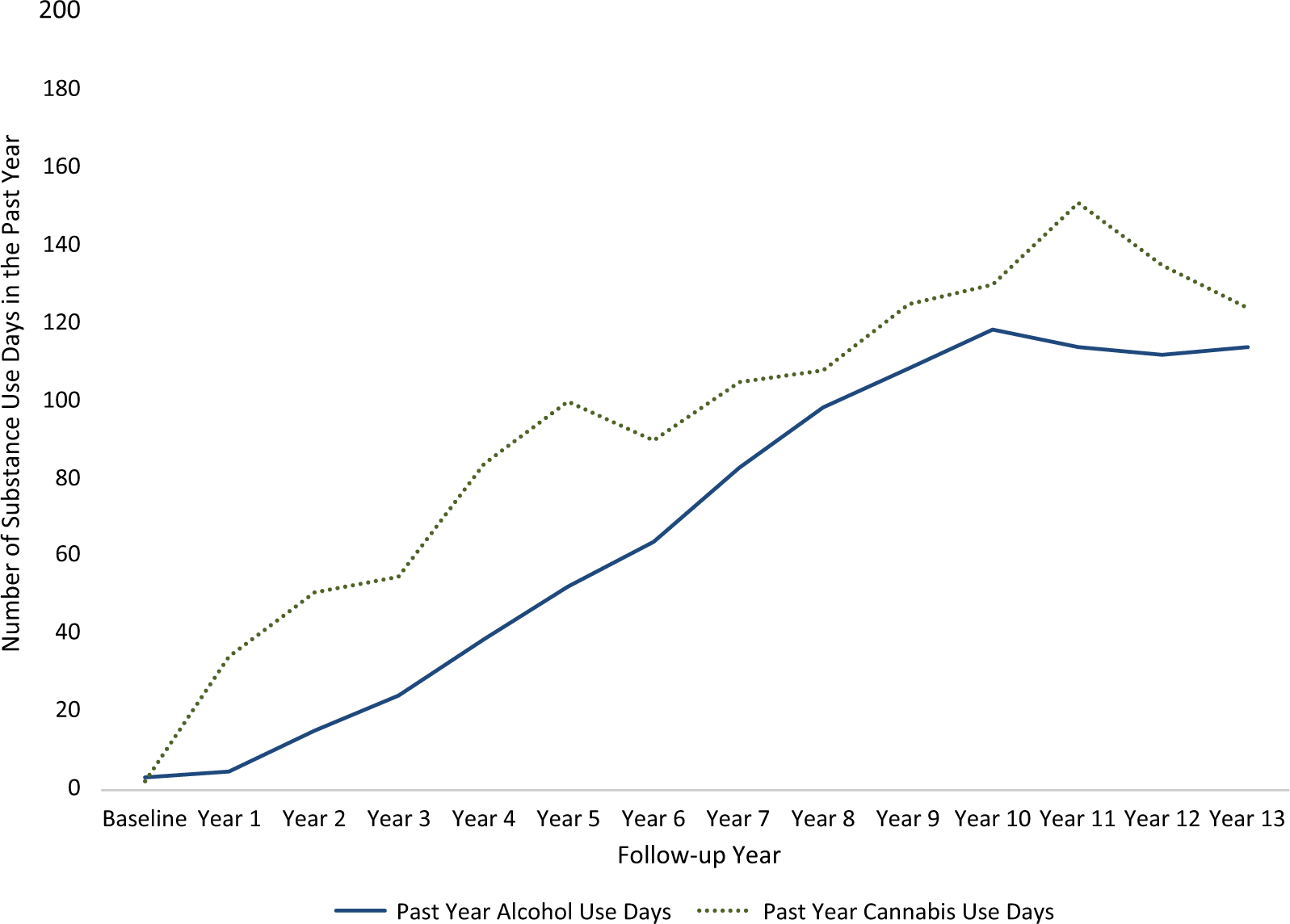
At baseline, participants (N = 175; 43% female) were between 12 and 15 years old (M = 13, SD = .80). Sixty-eight percent of participants were White, 17% were African American/Black, and 6% were Asian American. Youths were primarily from middle-class families, with a median Hollingshead Index of Social Position score of 23.1 (SD = 13.7); however, the sample represented youth from a range of SES backgrounds, with scores between 11 and 73. At baseline, 88% of youths had never tried alcohol, 95% had never tried cannabis, and 87% had never tried any substances. On average, youth initiated drinking at age 16.4 (SD = 2.26) and cannabis at 16.8 (SD = 2.34). Trajectories of alcohol and cannabis use by year are presented in Figure 1.
Trajectories of substance use over the course of 14 years.

Covariates
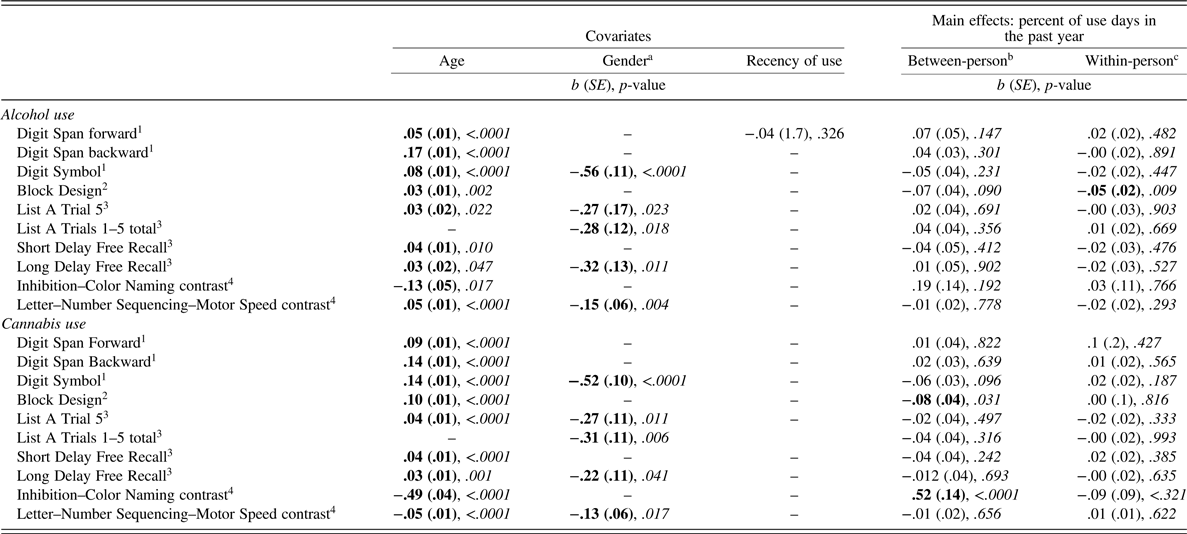
Age was positively associated with 9 of 10 neuropsychological measures over time, such that individuals performed significantly better on these measures as their age increased (ps < .05). Age was not associated with CVLT List A Trials 1–5 total (p = .780). More recent alcohol use was significantly associated with poorer performance on Digit Span Forward (B = .04, SE = .02, p = .04). Alcohol use recency was not a significant predictor of any other neuropsychological performance (ps > .05). Independent of age, women performed significantly better than men over time on WAIS Digit Symbol, CVLT Short and Long Delay Free Recall, List A Trials 1–5 total, List A Trial 5, and D-KEFS Number-Letter Switching-Motor Speed contrast (ps < .05). Sex was not a significant predictor of performance on Digit Span Forward and Backward, WASI Block Design, or D-KEFS CWI Inhibition–Color Naming contrast. The appropriate covariates were included in all models in which associations were found with the corresponding outcome (e.g., alcohol recency and Digit Span Forward).
Effects of Alcohol on Cognition
Accounting for the effects of age, greater mean percent days of drinking across time (between-person effect) were associated with better performance on WAIS Digit Span Forward (B = .10, SE = .02, p = .03, f 2 < .01). When the model included alcohol use recency, this relationship was no longer significant (p = .15).
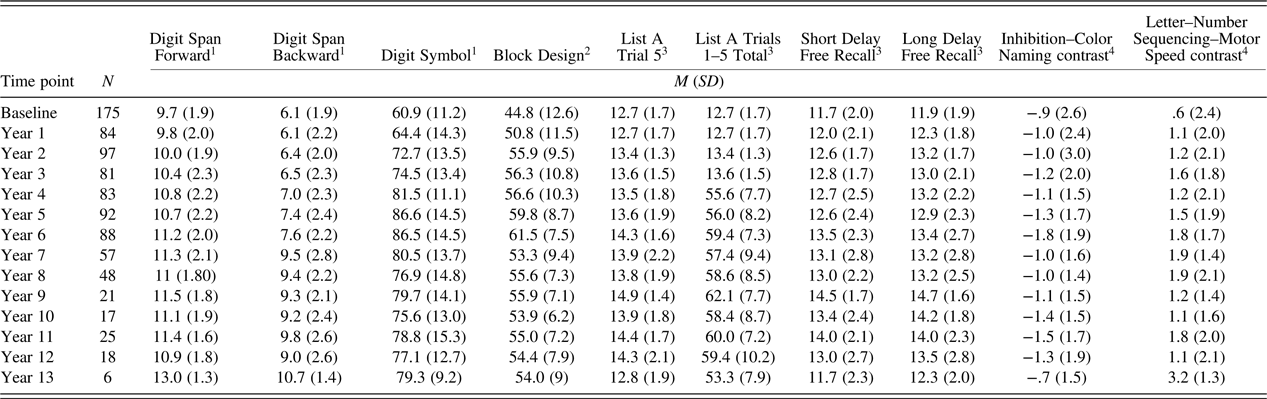
Controlling for age, time-specific fluctuations in alcohol use (i.e., drinking more frequently than usual within the year; “within-person effect”) predicted worse performance across time on Block Design (B = −.05, SE = .02, p = .01, f 2 < .01). There were no significant effects of between-person alcohol use on WASI Block Design (p = .09). There were no significant effects of within- or between-person alcohol use on D-KEFS CWI or TMT contrast scores, WAIS Symbol Digits, CVLT Short and Long Delay Free Recall, List A Trial 5, or List A Trials 1–5 total (ps > .05). See Table 1 for results. Neuropsychological test scores for baseline and each follow-up year are presented in Table 2.
Effects of covariates and within- and between-person changes in alcohol and cannabis use over 14 years on neuropsychological functioning among adolescents

Bolded values are statistically significant, p < .05 and italic values represent p values. Age, sex, and alcohol/cannabis use recency were included as covariates and retained in final full models if only statistically significant. Covariates removed in the final model are indicated with “–” in the appropriate cell.
a Positive values indicate better performance by men.
b Between-person differences in overall alcohol or marijuana use frequency in the past year.
c Within-person differences in yearly alcohol or marijuana frequency compared to the year prior.
1 WISC-III at baseline, WAIS-III at follow-up.
2 WASI.
3 CVLT-C at baseline, CVLT—Second Edition at follow-up.
4 D-KEFS.
Neuropsychological performance for baseline and each follow-up year

All scores are unstandardized, raw scores. Inhibition–Color Naming and Letter–Number Sequencing–Motor Speed contrast scores indicate the difference in scaled scores between the two respective conditions. The number of missing data for each follow-up year can be calculated as 175-N, where N indicates the number of adolescents assessed in the table.
1 WISC-III at baseline, WAIS-III at follow-up.
2 WASI.
3 CVLT-C at baseline, CVLT-II at follow-up.
4 D-KEFS.
Effects of Cannabis on Cognition
Accounting for the effects of age, greater mean levels of percent days of cannabis use across time (between-person effect) were associated with an increased contrast score between D-KEFS CWI Inhibition and Color Naming conditions (B = .52, SE = .14, p < .001, f 2 < .01). Follow-up analyses revealed that this effect was largely driven by the association between greater cannabis use over time and worse performance over time on the Inhibition condition (p < .001) versus the Color Naming condition, suggesting poorer inhibitory control with more cannabis use. Greater mean percent days of cannabis use across time (between-person effect) also predicted poorer performance over time on WASI Block Design (B = −.08, SE = .04, p = .031, f 2 < .01). There were no significant effects of time-specific fluctuations in cannabis use (within-person effect) on Block Design (p = .816), nor within- or between-person effects of cannabis use on D-KEFS TMT contrast scores, WAIS Symbol Digits, or CVLT Short and Long Delay Free Recall, List A Trial 5, or List A Trials 1–5 total (ps > .05). See Table 1 for results. Notably, cannabis use recency was not significantly associated with performance on any neuropsychological measures (ps > .05). Neuropsychological test scores for baseline and each follow-up year are presented in Table 2.
DISCUSSION
This study examined the longitudinal association between alcohol and cannabis use and cognition among a group of typically developing healthy adolescents with minimal substance use at baseline (aged 12–14 years). Our results showed three key findings: (1) after accounting for the effects of age, greater mean percent days of cannabis use over time were associated with worse performance on a measure of inhibitory control (D-KEFS CWI Inhibition–Color Naming contrast); (2) after accounting for the effects of age, greater mean percent days of cannabis use over time were associated with worse performance on a visuospatial functioning task (WASI Block Design); and (3) an individual drinking more frequently than usual predicted worse performance on the WASI Block Design test. Greater mean percent days of alcohol use across time were not associated with worse performance in the cognitive domains assessed. Contrary to our hypothesis, we found no association between alcohol and/or cannabis use over time on test performance in the verbal memory and processing speed domains.
In our sample, greater percent days of cannabis use were associated with deficits in inhibitory control over time. There is growing evidence that executive functions continue to develop throughout late adolescence and into young adulthood (Barber, Caffo, Pekar, & Mostofsky, Reference Barber, Caffo, Pekar and Mostofsky2013; Rubia, Reference Rubia2013; Rubia, Smith, Taylor, & Brammer, Reference Rubia, Smith, Taylor and Brammer2007). The inhibitory control circuit, in particular, may be particularly vulnerable to cannabis use in adolescence (Fontes et al., Reference Fontes, Bolla, Cunha, Almeida, Jungerman, Laranjeira, Bressan and Lacerda2011; Yanes et al., Reference Yanes, Riedel, Ray, Kirkland, Bird, Boeving, Reid, Gonzalez, Robinson, Laird and Sutherland2018). In accordance with our findings, previous studies have found that adolescent cannabis use is associated with inhibitory control deficits (Dahlgren et al., Reference Dahlgren, Sagar, Racine, Dreman and Gruber2016; Fontes et al., Reference Fontes, Bolla, Cunha, Almeida, Jungerman, Laranjeira, Bressan and Lacerda2011; Jacobus et al., Reference Jacobus, Squeglia, Infante, Castro, Brumback, Meruelo and Tapert2015; Lisdahl & Price, Reference Lisdahl and Price2012; Mathias et al., Reference Mathias, Blumenthal, Dawes, Liguori, Richard, Bray, Tong and Dougherty2011). Such deficits might result in a vulnerability and/or failure to inhibit maladaptive behavior; more specifically, adolescent cannabis users may experience greater difficulty abstaining from cannabis in the presence of cannabis cues. Inhibitory control deficits might further increase the likelihood of engaging in other risky behaviors (Spear, Reference Spear2000).
At the neural level, alterations in brain response patterns (Gruber, Dahlgren, Sagar, Gönenc, & Killgore, Reference Gruber, Dahlgren, Sagar, Gönenc and Killgore2012; Gruber & Yurgelun-Todd, Reference Gruber and Yurgelun-Todd2005; Solowij et al., Reference Solowij, Jones, Rozman, Davis, Ciarrochi, Heaven, Pesa, Lubman and Yucel2012) and connectivity (Behan et al., Reference Behan, Connolly, Datwani, Doucet, Ivanovic, Morioka, Stone, Watts, Smyth and Garavan2014) have been reported among adolescents and young adult cannabis users during the tasks of inhibitory control. Even after prolonged abstinence, regular cannabis use has been associated with altered neural activation in the executive and default mode network (Blest-Hopley, Giampietro, & Bhattacharyya, Reference Blest-Hopley, Giampietro and Bhattacharyya2019). Preexisting vulnerabilities in the inhibitory control circuitry have also been associated with substance use initiation and other risk behaviors (Giancola & Parker, Reference Giancola and Parker2001). Thus, it is possible that preexisting neurodevelopmental vulnerabilities compounded with the impact of cannabis on the developing brain over time results in neuropsychological deficits in cognitive control.
Deficits in visuospatial functioning (Block Design) were associated with both a person drinking more frequently than usual and reporting more cumulative cannabis use across time. Despite differences in study design and neuropsychological tests used to asses visuospatial functioning, the impact of adolescent alcohol use on visuospatial functioning has been frequently documented (Nguyen-Louie et al., Reference Nguyen-Louie, Castro, Matt, Squeglia, Brumback and Tapert2015; Squeglia, Spadoni, Infante, et al., Reference Squeglia, Spadoni, Infante, Myers and Tapert2009; Tapert & Brown, Reference Tapert and Brown1999; Tapert et al., Reference Tapert, Granholm, Leedy and Brown2002). For example, in a previous report from our group (a subgroup of the current sample), Nguyen-Louie et al. (Reference Nguyen-Louie, Castro, Matt, Squeglia, Brumback and Tapert2015) found worsening visuospatial functioning over a 4-year period after initiation of heavy drinking. Similarly, Squeglia, Spadoni, Infante, et al. (Reference Squeglia, Spadoni, Infante, Myers and Tapert2009) found that greater number of drinking days predicted worsening visuospatial functioning performance among adolescent girls who initiated moderate to heavy drinking. Our findings expand on our previous research and suggest that deficits in visuospatial functioning might be more sensitive to a “spike” in drinking pattern versus cumulative reports of drinking behaviors. The impact of cannabis use on visuospatial functioning has been less consistent (Gonzalez et al., Reference Gonzalez, Pacheco-Colón, Duperrouzel and Hawes2017; Scott et al., Reference Scott, Slomiak, Jones, Rosen, Moore and Gur2018). In support of our findings, a study by Lyons et al. (Reference Lyons, Bar, Panizzon, Toomey, Eisen, Xian and Tsuang2004) compared monozygotic twin pairs who were discordant for regular cannabis use and found that out of 16 neuropsychologist tests, cannabis users performed worse than nonusers on the WAIS-R Block Design subtest. In a different sample, our group found that heavy cannabis users (aged 16–22 years) performed worse on visuospatial functioning tasks compared to demographically matched nonusers (Jacobus et al., Reference Jacobus, Squeglia, Infante, Castro, Brumback, Meruelo and Tapert2015). In contrast, others have found no impact of cannabis use on visuospatial functioning (Jackson et al., Reference Jackson, Isen, Khoddam, Irons, Tuvblad, Iacono, McGue, Raine and Baker2016; Meier et al., Reference Meier, Caspi, Ambler, Harrington, Houts, Keefe, McDonald, Ward, Poulton and Moffitt2012). Our findings suggest both alcohol and cannabis use throughout adolescence may impact visusopatial functioning. The Block Design subtest has been found to be a predictor of everyday spatial ability (Groth-Marnat & Teal, Reference Groth-Marnat and Teal2000). This has important implications as adolescents become more independent and begin to drive. Block design is also frequently associated with central executive/frontal lobe function (Lezak, Howieson, & Loring, Reference Lezak, Howieson and Loring2004) and has been used as a measure of central executive functioning in previous studies (Brown, Brockmole, Gow, & Deary, Reference Brown, Brockmole, Gow and Deary2012). Thus, we cannot discard the possibility that the observed deficits in Block Design might be the result of visuospatial planning and organization deficits. Future studies using a wide range of neuropsychological measures are needed to definitely disentangle the impact of alcohol and cannabis use on visuospatial skills.
Notably, we did not find alcohol or cannabis use to be associated with deficits in verbal memory. This was surprising given results from previous studies, including those from our group, that indicate associations between poorer performance on verbal memory tests and frequent alcohol and cannabis use (Green et al., Reference Green, Garrick, Sheedy, Blake, Shores and Harper2010; Jacobus et al., Reference Jacobus, Squeglia, Infante, Castro, Brumback, Meruelo and Tapert2015; Nguyen-Louie et al., Reference Nguyen-Louie, Castro, Matt, Squeglia, Brumback and Tapert2015; Nguyen-Louie et al., Reference Nguyen-Louie, Tracas, Squeglia, Matt, Eberson-Shumate and Tapert2016; Sneider et al., Reference Sneider, Cohen-Gilbert, Crowley, Paul and Silveri2013; Solowij et al., Reference Solowij, Jones, Rozman, Davis, Ciarrochi, Heaven, Lubman and Yücel2011; Winward, Hanson, Tapert, et al., Reference Winward, Hanson, Tapert and Brown2014). Similarly, we did not find alcohol and/or cannabis use to impact neuropsychological performance on working memory and/or processing speed tasks. This is in contrast to some previous studies that show decrements in processing speed among cannabis users even after 3 weeks of abstinence (Winward, Hanson, Bekman, et al., Reference Winward, Hanson, Bekman, Tapert and Brown2014). Although the notable length of follow-up period (3–14 years) might have played a role as other well-designed prospective studies have also identified modest or no differences in these domains (Gonzalez et al., Reference Gonzalez, Pacheco-Colón, Duperrouzel and Hawes2017; Lyons et al., Reference Lyons, Bar, Panizzon, Toomey, Eisen, Xian and Tsuang2004; Scott et al., Reference Scott, Slomiak, Jones, Rosen, Moore and Gur2018).
Examining patterns of substance use on cognitive functioning from early-mid adolescence to young adulthood is critical given changes in substance throughout this period as well as dramatic changes in brain development and cognition. Despite the strengths of this prospective study, including the statistical design that incorporates time-specific fluctuations in substance use, the large sample size, and the number of assessment points, our study has some limitations that are worth noting. Only a limited number of covariates and confounders were evaluated in order to preserve statistical power. The potential for self-report bias to decrease the precision of adolescent alcohol and cannabis use estimates is another important limitation. Lack of information on cannabis product types, potency, and cannabis constituents is another limitation given the increasing heterogeneity of cannabis products available (Wilson, Freeman, & Mackie, Reference Wilson, Freeman and Mackie2019). A separate model for each neuropsychology measure was tested to best address issues of multicollinearity. However, there remains the possibility that Type I error is inflated given multiple models were examined. Nevertheless, our models were established a priori and given the larger sample size and established validity of the measures used our effect sizes should be fairly representative of the population. Practice effects of repeated neuropsychological testing should also be considered. Lastly, our study was conducted with a high SES and predominantly Caucasian sample and the findings may not generalize to other populations.
Results from this study suggest that throughout adolescence and young adulthood, greater lifetime cannabis use may be associated with poorer inhibitory control and visuospatial functioning, whereas alcohol-related neurocognitive alterations may be more sensitive to proximal fluctuations in use severity, particularly in the domain of visuospatial processing. These findings add to the growing body of literature on the impact of alcohol and cannabis use on cognition from adolescence to young adulthood. The reliance on retrospective self-report is a limitation, and while errors in recall may impact the validity of some self-reported substance use estimates, we used well-validated substance use assessment measures (e.g., Timeline Follow back) to minimize bias in substance use estimation. Nevertheless, replication is important and we will continue to examine to what extent differences in neurocognitive outcomes are driven by preexisting environmental and biological factors versus substance-related exposure in large sample prospective studies (Luciana et al., Reference Luciana, Bjork, Nagel, Barch, Gonzalez, Nixon and Banich2018). Examining the unique trajectories of alcohol and cannabis use (the most widely used substances by adolescents) and impact on cognition will help inform policy-makers, prevention strategies, and targets for novel interventions to reduce adolescent substance use.
ACKNOWLEDGMENTS
This study was supported by National Institute on Alcohol Abuse and Alcoholism (J.J., A.I., R01 AA013419), National Institute on Drug Abuse (J.J., A.I., C.C., U01 DA041089; J.J., K.E.C., R21 DA047953; M.W., K23DA039348), National Institute of Mental Health (K.E.C., T32 MH018399), National Center for Advancing Translational Science (J.J., KL2 TR001444), and the California Tobacco-Related Disease Research Grants Program Office of the University of California (J.J., K.E.C., Grant 580264). The authors would like to thank participating schools in the San Diego Unified School District, participating families, and the Adolescent Brain Imaging Project laboratory. The authors have no financial relationships.
CONFLICT OF INTEREST
The authors have nothing to disclose.