


1.1 Introduction
In 2009, scientists introduced the planetary boundaries, a set of nine variables designed to portray the degree to which human activities are pushing Earth into unsafe territory. Nearly 15 years later, in 2023, all 9 boundaries were quantitatively measured for the first time (see Richardson et al. Reference Richardson, Steffen and Lucht2023). Six exceeded what is required to retain the stability and resilience of the Earth system. Those eclipsed were the boundaries for climate change, biosphere integrity, land system change, freshwater change, biogeochemical flows, and novel entities. Three others were at levels safe for the planet, but not always trending in the right direction: ocean acidification, atmospheric aerosol loading, and stratospheric ozone depletion. Then, in 2025, a seventh boundary was crossed: ocean acidification (Findlay et al. Reference Findlay, Feely, Jiang, Pelletier and Bednaršek2025). Between its original announcement and its collective quantification, the planetary boundaries framework has been challenged, its measurements refined, and its content updated as it moved from a novel idea to a mainstay of sustainability science. It has also been used to justify new approaches to sustainable development and become the basis for alternative economic models. It has inspired policies at urban and regional scales and provided a paradigm for new ideas in ecological law and governance. In 2021, the planetary boundaries framework even had its own special on Netflix narrated, in part, by David Attenborough – Breaking Boundaries: The Science of Our Planet.
As the planetary boundaries framework has gained influence, however, its ethical aspects have received comparatively less attention. This is peculiar given that, at its centre, the framework has a normative target of maintaining planetary conditions that provide a ‘safe operating space’ for humanity (Figure 1.1). Recently, authors and advocates of the planetary boundaries framework have taken up ethical issues more directly. In that work, the planetary boundaries are used to scope matters of justice within what the planet might permit (Gupta et al. Reference Gupta, Liverman and Bai2021, Reference Gupta, Liverman and Prodani2023a, Reference Gupta, Prodani and Bai2023b; Rockström et al. Reference Rockström, Gupta and Qin2023). Proponents argue that the framework guides ‘humanity’s future on Earth’ because truly sustainable development is defined by staying within planetary boundaries (Rockström et al. Reference Rockström, Donges and Fetzer2024: 773). Those who use the planetary boundaries framework in this way share a common premise: that preserving the planetary conditions that have made complex societies possible marks a perimeter for justice. The question then becomes: what approach to justice best suits the ways that the planetary boundaries framework discloses issues as diverse as climate change, mass extinction, water scarcity, or ‘forever’ chemicals? This question sits at the heart of this book, but not because it is one this collection of essays sets out to answer. Instead of treating the planetary boundaries as a perimeter within which to pursue justice, this book examines how the framework not only describes interactions of people and planet but also influences how connections among humans, other species, and Earth’s biophysical processes are interpreted and understood.
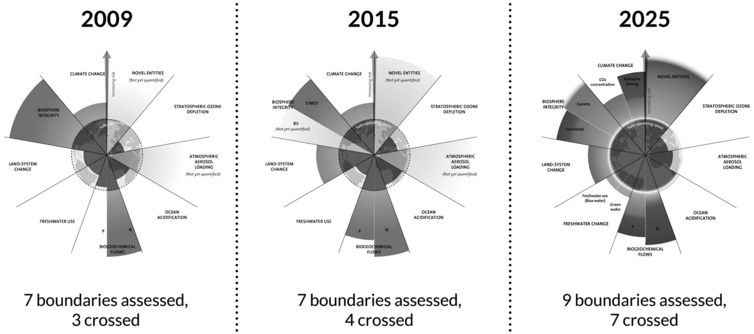
The planetary boundaries framework. This figure tracks the progression of the planetary boundaries framework, including some of the changes to how boundaries are defined, in its three assessments in 2009, 2015, and 2023.
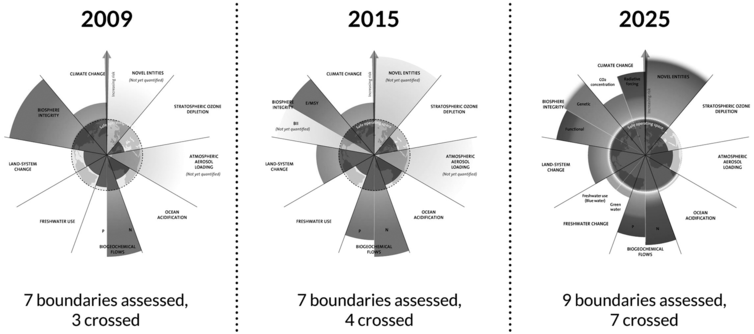
Figure 1.1 Long description
The three panels show the following details. Each panel has nine boundaries arranged radially in wedges around a central and circular zone labelled, safe operating space. The left panel analyzes eight planetary boundaries in 2009, out of which three cross the safe zone. Novel entities are yet to be quantified. Stratospheric Ozone depletion, atmospheric aerosol loading, ocean acidification, bio flows under biogeochemcial flows, freshwater use, and land-system change are well within the safe zone while biospheric integrity, climate change, and geochemical flows cross the safe zone. The central panel analyzes eight boundaries in 2015 out of which four cross the safe zone. Novel entities are yet to be quantified. Stratospheric Ozone depletion, atmospheric aerosol loading, ocean acidification, and freshwater use are well within the safe zone while climate change, land-system change, E slash M S Y under biosphere integrity, biogeochemical flows cross the safe zone. The right panel analyzes nine boundaries in 2025 out of which six have crossed the safe zone. Stratospheric Ozone depletion, atmospheric aerosol loading, and ocean acidification are still within the safe operating space. However, ocean identification is at the threshold of crossing over to the unsafe zone. Novel entities quantified in 2015 crosses the safe zone and are identified as posing increasing risk. Other boundaries crossing the safe zone are climate change with carbon-di-oxide poisoning and radiative forcing, functional and genetic biosphere integrity, land-system and fresh water change, and biogeochemical flows.
Ethics matter to the planetary boundaries framework beyond just applications of the framework that use it to stake out parameters for justice. This is because the planetary boundaries framework directs attention – scientific and ethical – to some concerns and not others. For instance, the authors of its first fully quantified assessment make clear that ‘the planetary boundaries framework is only concerned with the stability and resilience of the Earth system, i.e. not about human or ecosystem health’ (Richardson et al. Reference Richardson, Steffen and Lucht2023: 6). This is a clear restriction on the scale of scientific concern. It also entails ethical considerations. This is because, as the original authors of the planetary boundaries framework state, boundaries themselves do not represent facts about planetary thresholds for Earth’s climate or biodiversity (or any other planetary boundary). Rather, when the planetary boundaries were introduced in 2009, they were described as ‘human-determined values of the control variable set at a “safe” distance from a dangerous level’; as such, ‘determining a safe distance involves normative judgments of how societies choose to deal with risk and uncertainty’ (Rockström et al. Reference Rockström, Steffen and Noone2009b: 3). This prominent role for values means that ethics are never far from the science of planetary boundaries. By 2024, however, this explicit role for values and judgements had been expunged. Instead, proponents stated that ‘it is a fundamental property of the PB framework that boundaries are set purely on biophysical grounds’ and without reference to human considerations (Rockström et al. Reference Rockström, Donges and Fetzer2024: 774). How did the intrinsic role of values and judgement ossify into inhuman boundaries? They were intrinsic to the framework initially, yet now, when that framework is used to establish the perimeter for justice, the boundaries are presented as value-free facts. It is not uncommon for scientific frameworks to evolve, but it is also important to situate them socially, especially when they make claims about humanity’s future writ large. When and how, for instance, did the initial value judgements used to establish planetary boundaries evolve into a basis for defining the perimeter for justice?
This book offers a set of different views on ethics and planetary boundaries. Rather than taking the planetary boundaries as a perimeter within which to think about ethics or justice, it probes matters of ethics across a range of concerns and perspectives, including those critical of the planetary boundaries framework. To grapple with ethics and the planetary boundaries we invited experts to a dialogue with the editors, and where possible with each other, on each of the nine planetary boundaries. These conversations often entailed thinking about ethics in multiple ways, and there is no effort in the book to adjudicate the different ways that concerns of fairness, equity, moral standing, relations, or justice are approached. Instead, we embraced a diversity of approaches so that a richer discussion might be had about the ethics of planetary boundaries. Often, these discussions also entailed thinking about how one planetary boundary is entangled with others. For example, it is difficult (and arguably a bit contrived) to talk about anomalously extreme water events of flood or drought without discussing climate change. In what follows, scientists, artists, anthropologists, philosophers, as well as political scientists, geographers, lawyers, and Indigenous scholars discuss what the planetary boundaries mean to them, their work, and the ways concerns over what to do are entangled with ways of knowing.
The chapters that comprise this book do not all pull in the same direction, and they account for only some potential positions on ethics and the planetary boundaries. This reflects the aim of the volume, which is not comprehensive coverage but to collectively show why ethics are critical to situating the planetary boundaries framework with respect to scholarship, policy, and concerns with relations among people, other species, and Earth system processes. To this end, the remainder of this introduction does three things: First, it explains the planetary boundaries framework in more detail, both in terms of the sciences it relies on and how its authors and advocates have used it to shape spaces of ethics and justice. Second, it discusses some of the ways planetary boundaries have sparked new ideas among scholars and governance practitioners – some of these ideas have been subsequently incorporated into later iterations of the planetary boundaries itself. Third, it discusses criticisms of the planetary boundaries framework and why further ethical engagement with them is warranted. With these considerations in hand, the conclusion to this chapter situates the book’s dialogues on each planetary boundary. It also identifies themes that emerge across different chapters – of both consensus and contention – discussed further in the book’s conclusion.
1.2 The Planetary Boundaries Framework
When it was introduced, the planetary boundaries framework identified the ‘environmental preconditions’ for human development through nine ‘control variables’ of the Earth system that establish a safe operating space for humanity (Rockström et al. Reference Rockström, Steffen and Noone2009a). These variables – the nine planetary boundaries – have subsequently been renamed, refocused, and refined in many cases. This includes changes to what is measured and how, and these choices matter ethically. This is because the planetary boundaries framework seeks an account of how anthropogenic (i.e., human) activities affect the planet. As a result, the choice of what to measure is also a choice about which activities, and responsibility for them, contribute to its planetary assessment. Further, those activities entail distinct histories, economies, politics, technologies, and inequalities. So, these measures matter morally even where the science stops short of assigning responsibility. This remains the case even when the scale of concern is restricted to the planet (i.e., not humans or ecosystems) because changes to planetary conditions have effects on the conditions of social life. So, in addition to the value judgements that, as discussed earlier, were initially acknowledged when determining boundaries themselves, matters of ethics are never far from the sciences the framework draws together either.
The planetary boundaries framework is based on bringing together ‘three branches of scientific inquiry’: (1) research on the scale of human action relative to Earth’s capacity to sustain it; (2) research on ‘Earth system processes’, including changes humans have introduced to them; and (3) research on resilience and the ways complex systems regulate themselves in response to change and disturbance (Rockström et al. Reference Rockström, Steffen and Noone2009b: 4). Students and scholars of environmental thought will notice straightaway that each of these areas has its own history, and the planetary boundaries framework is explicitly set in a history of Western environmental sciences. For instance, on the first issue of human impacts on the planet, the framework draws on earlier ideas of ecosystem capacity and debates over the ‘limits to growth’ that characterized twentieth-century environmental debates (see Sabin Reference Sabin2013). But the planetary boundaries framework also seeks to update earlier ideas. For instance, rather than taking planetary limits as ‘fixed’ or stable, it recognizes the ways that human activities are now of such scale that they affect how the planet regulates itself. In making these updates, the framework walks a careful line between planetary limits, on the one hand, and, on the other, boundaries that operate in proximity to those limits. This tension is discussed further next, but it is worth noting that the planetary boundaries framework is explicit about the fact that, even though ‘boundaries’ are not synonymous with planetary limits, the Earth system does have thresholds that exist ‘irrespective of peoples’ preferences, values, or compromises based on political and socioeconomic feasibility’ (Rockström et al. Reference Rockström, Steffen and Noone2009b: 5).
With Earth’s thresholds in mind, planetary boundaries began by defining ‘the “planetary playing field” for the human enterprise’ (Rockström et al. Reference Rockström, Steffen and Noone2009b: 6). Those thresholds and the setting of boundaries that would keep human impacts a safe distance from them are anchored in Earth system sciences that treat the Earth as a single, integrated system – the Earth system. To treat the Earth as a single system is a relatively recent idea, one developed during the latter decades of the twentieth century (see Steffen et al. Reference Steffen, Richardson and Rockström2020). It departs from earlier notions of the planet as either a machine or an organic whole that is characterized by its stability – what is sometimes referred to as the ‘balance of nature’. Instead, the Earth system is an ever-changing, self-regulating system in which complex feedback links the atmosphere, the biosphere, the hydrosphere (including the cryosphere), and the geosphere at different temporal and spatial scales. For instance, the cyanobacteria that evolved to produce oxygen radically remade the Earth’s atmosphere in a complex set of biogeochemical relationships. Amid the deep history of planetary evolution, Earth system scientists now identify a new sphere dominated by humans – the anthroposphere – that cumulatively, albeit extremely unequally, has become another of the ‘great forces’ of nature (Steffen et al. Reference Steffen, Crutzen and McNeill2007).
Crucial for the planetary boundaries framework is the idea that the complex processes at work across the Earth system can be understood in terms of its nine control variables. These control variables – the planetary boundaries – narrow how the Earth system’s complex relationships are represented and give special attention to how different planetary configurations make for safe or unsafe conditions for humans. For instance, during approximately the past 12,000 years human civilizations have evolved under relatively stable geologic conditions known as the Holocene. Stability in this sense does not imply a static planet, but rather that variability in planetary conditions operated in an envelope of planetary thresholds conducive to the emergence of increasing social complexity. By contrast, when the planetary boundaries framework was introduced, its authors frequently referenced a new geological epoch, the Anthropocene, owing to how the collective impact of human activities now affects planetary evolution in ways that could destabilize planetary conditions (Rockström et al. Reference Rockström, Steffen and Noone2009b, Reference Rockström, Donges and Fetzer2024). The capacity for humans to affect how the Earth system functions marks an important evolutionary shift, one in which the planet’s future now turns on how human–Earth interactions proceed (Waters et al. Reference Waters, Zalasiewicz and Summerhayes2016). As we consider below, however, both the idea and the practice of treating ‘human impacts’ collectively can mask inequalities regarding responsibility for these impacts.
The third and final scientific pillar of the planetary boundaries framework is the notion of resilience. In its original formulation by the ecologist C. S. ‘Buzz’ Holling (Reference Holling1973), resilience was part of a shift in understanding complex systems not as tending towards stability but as characterized by change and surprise. This was a major departure from dominant theories at the time, where the ‘balance of nature’ had been suffused to interpretations of ecological systems as seeking stability. Forests, for instance, were harvested according to their ‘maximum sustainable yield’ based on the assumption that their reproductive processes were stable over time and not naturally changing (Langston Reference Langston1995). The idea of stability was well suited to policy approaches of ‘command and control’ but not to thinking about how human impacts on ecosystems were just one among many dynamics that affect them and through which they evolve (Holling & Meffe Reference Holling and Meffe1996). In this context, ecological resilience offered a paradigmatic shift: complex systems were not stable, but rather constantly changing and adapting through complex processes, some of which could be expected but others of which were unanticipated. As the idea developed, resilience came to be understood as the capacity of a system to respond to disturbances while still retaining its essential functions, feedback, and identity (Folke Reference Folke2006).
Closely related to the concept of resilience was the idea of thresholds – another of Holling’s key scientific ideas. Ecological thresholds are the points at which the relationships that make an ecological system resilient are radically, often irreversibly, reorganized (Holling Reference Holling, Clark and Munn1986). These thresholds, for instance, are what would be surpassed when logging is so extensive that a forest no longer regrows and instead a new set of processes set in, such as when rainforest deforestation leads not to tropical regrowth but to savannah. Importantly, these thresholds are not entirely knowable in advance. This is because the complexity of ecological systems means that there are irreducible elements of uncertainty. Uncertainty with respect to thresholds makes it prudent to set boundaries at a ‘safe’ distance from potentially irreversible shifts, but also to appreciate the ways that rapid disturbances, like industrialized extraction, can have unforeseen, surprising effects when they accelerate at unprecedented rates (Gunderson & Holling Reference Gunderson and Holling2002).
Taken together, the three scientific pillars of the planetary boundaries framework both update debates on limits and growth and incorporate new Earth system sciences that significantly alter thinking about the planet. The shifts in thought are immense. Donna Meadows (Reference Meadows1999, Reference Meadows2008), one of the early authors of work on the limits to growth, argued that what was now required was to ‘think in systems’ and to identify ‘leverage points’ that are key to effecting change. Arguably, the idea that the complexity of the Earth system can be understood in terms of nine key variables – the planetary boundaries – takes the idea of leverage points out to the scale of Earth as a whole. That is, the planetary boundaries are proxies for complexity that capture important – not all – of the ways that human activities intersect with Earth’s biophysical processes. As the planetary boundaries framework evolved, some boundaries like climate change became more closely aligned with biophysical determinations while others retained their association with areas of increasing risk (Rockström et al. Reference Rockström, Donges and Fetzer2024). The result is that not all ‘boundaries’ are boundaries of the same sort. Further, because they are not synonymous with ‘limits’ or thresholds, there remain important normative considerations regarding how to integrate Earth system science into assessments of the risks that arise from the impacts of ‘the human enterprise’ on the planet. In addition to shifting how human–Earth relationships are conceptualized, however, the planetary boundaries framework did not stop there. It has also been used to scope matters of ethics and justice.
1.2.1 Normative Space within Planetary Boundaries
The planetary boundaries framework has evolved over time from its initial contrast of value-laden boundaries and objectively independent thresholds. Today, it draws a sharper separation of facts and values. This creates a dynamic where matters of judgement once acknowledged within the framework are being reworked with respect to it. In this section we introduce some of the ways that this shift is explained by authors and advocates of the planetary boundaries framework. This is principally accomplished by using scientific assessments to mark a perimeter for a ‘safe operating space’ for humanity. Or, as Gupta (Reference Gupta, Nicholson and Jinnah2016) put it, to define an ‘eco-space’ in which Earth’s processes and resources can be shared fairly by humans and other species without risking the transgression of boundaries that would undermine planetary conditions. But this is not all that the planetary boundaries framework does. As the late ecologist James Kay (Reference Kay, Jørgensen and Müller2000: 135) argued, recognition of large-scale scientific uncertainties has the effect of putting ‘scientists in the role of narrators’. Narrators that, as they explain complex dynamics, also scope potential trade-offs and delimit possible futures. This section identifies how the use of the planetary boundaries framework to scope matters of justice similarly implies trade-offs that, as later chapters consider, do not always capture the full array of ethical options available.
First, there is what seems a conundrum: the planetary boundaries framework initially acknowledged that what constitutes a ‘boundary’ is determined through social values and judgements regarding risks, while Earth’s biophysical processes remain indifferent to human ideas about them. One of the original authors of the planetary boundaries framework, Hans Schellnhuber (Reference Schellnhuber2000: 3), thought this tension could be resolved by subsuming ethics within science. As he argued in the same issue of the newsletter that first announced the Anthropocene: ‘ultimately, Earth System analysis will even be able to address the challenge of sustainable development in a no-nonsense way by deducing macro-options for future ecosphere-anthroposphere co-evolution from first cognitive and ethical principles’. The reduction of ethics to science, however, is increasingly seen as unlikely given the ways that uncertainty and complexity mark the limits of what could be rationally deduced for ethics from Earth system science. However, there is a close conceptual cousin that is often relied upon to navigate the intersection where values meet biophysical indifference. This is the view that science does not settle matters of ethics but rather scopes the space of ethical possibilities. This latter view more fairly captures the position of the planetary boundaries framework, which does not offer a ‘roadmap for sustainable development’ but rather identifies the ‘biophysical boundaries at the planetary scale within which humanity has the flexibility to choose a myriad of pathways for human well-being and development’ (Rockström et al. Reference Rockström, Steffen and Noone2009b: 7).
The premise that science marks a perimeter for ethics can be found in numerous articles that seek a more explicit place for justice in the planetary boundaries framework. In fact, these efforts have led to adjustments in terminology to reflect a more conscious incorporation of justice. In that adjusted terminology, planetary boundaries are replaced with ideas of ‘safe and just’ Earth system boundaries – a shift meant to demarcate what is ‘safe’ as referring to the resilience of the planet and what is ‘just’ referring to equitable distribution of benefits and risks among people (Rockström et al. Reference Rockström, Gupta and Lenton2021). For instance, Gupta et al. (Reference Gupta, Liverman and Prodani2023a) build on the planetary boundaries framework to elaborate what they term safe and just Earth system boundaries. Here, the social values initially used to determine the planetary boundaries fade into the background and are instead presumed upon to shape how matters of justice consider both the limits on, and demands for, sufficient resources for a good life. Gupta et al. (Reference Gupta, Liverman and Prodani2023a) find that lifting those worst off out of poverty cannot be done without exceeding the planetary boundaries unless there is also a radical redistribution of wealth from rich to poor. Still, Gupta et al. (Reference Gupta, Prodani and Bai2023b) find the idea of Earth system boundaries a promising way to rethink how sustainable development agendas and the global environmental assessments that shape them can be enhanced by attention to justice.
One challenge to explicitly incorporating justice into the planetary boundaries framework is that there are multiple ways of knowing and multiple approaches to justice. This is not a unique challenge. It affects global environmental assessments generally (Castree et al. Reference Castree, Bellamy and Osaka2021). A significant issue for the planetary boundaries framework, however, is that the background values used to determine boundaries do not stay in the background. Instead, explaining the relationship between different boundaries is a constant challenge. Initially, the planetary boundaries framework distinguished zones of ‘increasing’ versus ‘high’ risks. However, owing to the difficulty in quantifying where the line between the two could be drawn in a consistent way across all boundaries, the framework now adopts the ‘burning embers’ approach used by the Intergovernmental Panel on Climate Change (Richardson et al. Reference Richardson, Steffen and Lucht2023). In the ‘burning embers’ model, risks grade into one another instead of being sharply demarcated. However, this model is also highly contested. In 2007, climate negotiators dropped it altogether amid debates over what constitutes ‘dangerous’ climate change (see Mahony Reference Mahony2015). Likewise, when the planetary boundaries framework adopts the ‘burning embers’ model it raises questions over who should decide what is ‘safe’ and through what processes? In negotiations over dangerous degrees of climate warming by the IPCC, the difference between 1.5°C versus 2.0°C warming proved a crucial part of a larger socio-political context in which international negotiations took place (Cointe & Guillemot Reference Cointe and Guillemot2023; Randalls Reference Randalls2010). Not only does the planetary boundaries framework apply the ‘burning embers’ model to all nine boundaries, it does so in an international context that is not equal when it comes to deciding on how to define what is safe. For instance, IPCC processes perpetuate inequality when they ignore how even 1.5°C warming is dangerous for island nations and many peoples of colour, such as those in the Caribbean, who already bear the burden of environmental inequality (Sealey-Huggins Reference Sealey-Huggins, Johnson, Joseph-Salisbury and Kamunge2018).
A concern closely related to how risks are navigated is how planetary boundaries are measured. This concern matters not only empirically, in terms of what may or may not be considered a ‘safe’ space, but also ethically, since what is measured in terms of anthropogenic impacts on the planet has implications for who is responsible for those impacts. Here, it is important to note that, over its assessments (in 2009, 2015, 2023, 2025), many of the planetary boundaries have evolved in terms of what is measured and how. This makes pinning down matters of responsibility difficult. It also makes consistently calculating the risk trajectory of human impacts on different boundaries challenging. For instance, the first iteration of the framework identified ‘chemical pollution’ as a planetary boundary but wasn’t yet able to quantify it (Rockström et al. Reference Rockström, Steffen and Noone2009b). That boundary evolved into the idea of ‘novel entities’ (Steffen et al. Reference Steffen, Richardson and Rockström2015), which refer to ‘truly novel anthropogenic introductions to the Earth system’ like microplastics, nuclear waste, genetically modified organisms, and other ‘direct human interventions into evolutionary processes’ (Richardson et al. Reference Richardson, Steffen and Lucht2023: 6). These kinds of conceptual adjustments are not uncommon in the formation of scientific ideas. Yet in the planetary boundaries framework they affect questions of ethics, such as those regarding different social causes of environmental impacts. For instance, the boundary for land-system change was initially described as ‘driven primarily by agricultural expansion and intensification’ (Rockström et al. Reference Rockström, Steffen and Noone2009b), but its most recent appraisal doesn’t mention agriculture at all. Instead, land-system change is referenced to deforestation (Richardson et al. Reference Richardson, Steffen and Lucht2023).
Recent efforts to integrate considerations of justice with the planetary boundaries framework, or through terminological shifts to ‘safe and just’ Earth system boundaries, are efforts to craft ethical space. Initially, the planetary boundaries were designed to safeguard the ‘freedom to pursue long-term social and economic development’ (Rockström et al. Reference Rockström, Steffen and Noone2009a: 475). More recent efforts continue to use the planetary boundaries to mark out a moral perimeter by employing judgements and metrics to calculate different parameters affecting Earth’s resilience. In its old and new iterations, ethical challenges arise. For one, the power of the inference from independent planetary processes structuring safe conditions for humanity to the claim that planetary boundaries similarly structure ethics is intuitive to many. But it is entirely provisional. It is an inference premised on accepting the value judgements that determine the planetary boundaries themselves, from those initially acknowledged to those now used to negotiate different sorts of boundaries and their collective perimeter for justice. It is reasonable here to ask questions about how determinations of ‘safe’ were made, for whom, and by whom. These issues bump into those over categories of risk, whether strictly demarcated or which operate through a gradual, ‘burning embers’ approach. Replacing a system for risk calculation premised on measurement with one politically negotiated for climate change – not with other planetary boundaries necessarily so easily captured – is a significant ethical issue. It is one that can reproduce marginalization or suppress alternatives that may incorporate different values or approaches to risk. These are challenges returned to below and which later chapters address in different ways. First, however, it is worth exploring further how the planetary boundaries framework has inspired and influenced new ideas in economics, governance, and law. These, too, help show why ethics matter to the planetary boundaries.
1.3 The Promise of Planetary Boundaries
The planetary boundaries framework has shaped global discussions about science and sustainability and has also inspired new ideas that draw upon and extend its central ideas (Rockström et al. Reference Rockström, Donges and Fetzer2024). For instance, Jeffrey Sachs (Reference Sachs2015), the President of the UN Sustainable Development Solutions Network, incorporated the planetary boundaries framework directly into his influential book, The Age of Sustainable Development. Ecological economists have similarly made reports to the United Nations that use the planetary boundaries to argue that the economy must be seen as just one aspect of social relationships that are all embedded in Earth’s life-support system (Costanza et al. Reference Costanza, Alperovitz and Daly2012). Here we discuss just two examples of how the planetary boundaries framework has inspired new ways of thinking in other fields concerned with human–Earth relationships. The first, popularized by Kate Raworth, complements the ‘upper ceiling’ of planetary boundaries with a ‘social floor’ that would establish minimum distributions of planetary goods for human security. The second employs the planetary boundaries framework in international law so that a system of agreements can be rationally developed based on a shared empirical framework. Both ideas draw on what might be termed the normative promise of the planetary boundaries framework – the idea that the framework offers terms upon which to link an empirical account of how humans affect the planet with scales of decision-making in which values can operate in ways consistent with Earth system science.
1.3.1 Donut Economics
Kate Raworth (Reference Raworth2017a) has argued that while the planetary boundaries framework marks an upper ceiling for human impacts on the planet, what is also needed is a social floor to ensure minimum needs for all are met. Unlike climate change, or ocean acidification, or other boundaries that matter to the planet, the ‘social floor’ is about what matters inside the ‘safe operating space’ for humanity. Specifically, it is about both material needs for energy, clean water, adequate food, and health that exist alongside a suite of other socially relevant requirements for a good life, such as education, literacy, gender equality, income security, and work. The economy, Raworth argues, should be reconfigured to allocate resources between these two constraints in a way that is fair and just. Raworth’s idea has caught on, with the city of Amsterdam beginning to experiment with it at a municipal level. It has also been influential in the planetary boundaries framework itself. For instance, Rockström et al. (Reference Rockström, Gupta and Qin2023) cite the idea explicitly in their effort to incorporate social goals alongside those that the planetary boundaries framework sets for the Earth system.
The idea that there is a ‘social floor’ for what might be considered a fair or just distribution of resources is not one that operates exclusively at a planetary scale. This is because many of the policies affecting societies and the environment are made by institutions operating at national or sub-national scales (i.e. regional or local). So, if the planetary boundaries are to gain purchase on sites of actual decision-making, finding ways to utilize them at other scales is necessary (Dearing et al. Reference Dearing, Wang and Zhang2014). For this kind of ‘down-scaling’ it is critical to note that Raworth’s model uses a host of indicators developed to capture social concerns, such as metrics of gender equality in earnings or gender representation in parliaments from the International Labour Organisation and the World Bank, respectively. Likewise, material requirements are determined through measures of access to drinking water from the World Health Organisation and UNICEF, and access to energy is measured in terms of electricity and cooking facilities data from the OECD (see Raworth Reference Raworth2017b). Here, the justification for what is measured (and how) within the donut is not itself referenced to a theory of justice or ethics, but to metrics developed by a variety of globally influential organizations and institutions.
The reach of the Raworth’s idea in discussions of planetary boundaries stands equal to the challenge that it also points out. Namely, and as Gupta et al. (Reference Gupta, Liverman and Prodani2023a) noted earlier, efforts to quantify a ‘social floor’ have found that ensuring equity in access to social and material resources would likely exceed the planetary boundaries. More than this, however, efforts to translate the planetary boundaries into a framework for justice can also create a moral hierarchy with science at the top. For instance, Häyhä et al. (Reference Häyhä, Lucas and Van Vuuren2016) attempt to craft an integrated use of the planetary boundaries across scales but achieve this by prioritizing biophysical considerations before socio-economic concerns, both of which are addressed before ethical issues. Given the intrinsic normative concerns within the planetary boundaries framework and judgements used to benchmark risks, however, it is unclear why ethics is left to the last. Or, as in Raworth’s model, why explanations for what ought to be aimed for are outsourced to metrics developed by institutions that are not free from their own normative positions. So, in a way similar to how the normative values of the planetary boundaries framework don’t stay in the background, neither should the normative values of institutions be uncritically accepted in accounts of a ‘social floor’ designed to complement the ceiling provided by planetary boundaries. As many chapters in this book point out, there is more to consider.
1.3.2 International Environmental Law
Planetary boundaries have also inspired new approaches to environmental law and governance. Many scholars find significant promise in how the planetary boundaries can provide a basis for agreements that are not biased to any country or international actor. For instance, Geoffrey Garver’s (Reference Garver2021: 4) arguments for ecological law are based on the idea that planetary boundaries ‘must have primacy over economic, political, and other considerations’. Importantly, efforts to incorporate the planetary boundaries into legal or governance frameworks are not only theoretical. For instance, reference to planetary boundaries can be found in statements by the United Nations and the European Union (see Fernández & Malwé Reference Fernández and Malwé2019). So, the promise of the planetary boundaries on matters of environmental governance is not confined to academia but is reaching practical, applied avenues of governance as well.
One prominent proposal for incorporating the planetary boundaries into law and governance is to treat the boundaries as a grundnorm – a concept with a longer legal history that identifies the ways that some norms come logically and empirically prior to others. Kim and Bosselmann (Reference Kim and Bosselmann2015) argued that the environmental preconditions identified through the planetary boundaries framework satisfy the logical and empirical demands to be a grundnorm because they provide a framework for preserving the conditions of ecological and social life. Since those conditions are an empirical requirement for any system of law, they should also be appraised for whether they offer a rational basis for law. On this score they also find strong promise owing to the scientific basis of the planetary boundaries not in any society’s views but in the science of how the Earth system functions. Since it is irrational for international agreements to find common ground in ways that would empirically undermine the conditions that universally provide for social well-being, the planetary boundaries framework is presented as a rationally sound and empirically defensible candidate for a grundnorm.
The promise of a grundnorm has been further extended by those who argue that treating the planetary boundaries in this way can provide a way to find convergence between Earth system science and global governance initiatives, like the Sustainable Development Goals (Kim Reference Kim2016). This aim fits well with the initial promise of the planetary boundaries to provide a framework for human development without prescribing what form that might take (Rockström et al. Reference Rockström, Steffen and Noone2009b). But it also repeats, albeit in a different way, the idea that there is a moral hierarchy for decision-making that can be mapped onto a hierarchy for maintaining planetary conditions. For instance, it could potentially delay ethical deliberation until after biophysical matters are scientifically ‘settled’, which is a significant issue given that every iteration of the planetary boundaries framework has changed something about how to measure different variables. It could also make some logical inferences intractable. This is because justifying a grundnorm through the planetary boundaries framework would also need a way to deduce, from the many non-linear and cross scalar dynamics that impact the Earth system, a rational account of cause and effect that could be used in decision-making (Schmidt Reference Schmidt2019). As philosophers of science sometimes put it, however, there is a logical gap between hunting causes and using them in public policy (Cartwright Reference Cartwright2007). So, despite the promise of a planetary grundnorm, issues of judgement, values, and ethics remain salient.
1.4 Criticisms of the Planetary Boundaries
In different ways, the aforementioned examples are inspired by the planetary boundaries and encounter the kinds of challenges that are not uncommon in cases of significant social and ecological complexity. There are also, however, critiques of the planetary boundaries framework. These come in forms that can be anticipated from some of what has already been implied – several authors of the chapters in this book develop their own critiques as well. Some of these critiques are partial in the sense that they target just one element (or some subset) of the planetary boundaries framework. Others are more holistic. Here, we survey some prominent criticisms of the planetary boundaries framework alongside some of the responses to them.
In an in-depth, holistic critique of the planetary boundaries framework, Biermann and Kim (Reference Biermann and Kim2020: 3) note that, although the normative aspects of determining boundaries are highlighted, ‘this normativity had no consequences for the assessment process itself’. Instead, they argue, the definitions of boundaries proceeded instead from a ‘purely scientific, expert-driven perspective’. This critique gets at an important consideration: the role of judgements in determining boundaries is not explained well in the planetary boundaries framework, and neither was determining those boundaries an open social process. Instead, judgements relied on appraisals by a particular scientific community that formed around the planetary boundaries concept. These formations are sometimes referred to as ‘epistemic communities’ because they tend to share deeply held commitments about how to appraise sources of knowledge and forms of reasoning (Haas Reference Haas1992). That is, they share a way of knowing. This way of knowing in the planetary boundaries framework, however, is further critiqued by Biermann and Kim (Reference Biermann and Kim2020) for prioritizing epistemic practices of the Global North and claiming a kind of planetary authority for them.
Epistemic communities can share ethical commitments too, such as those Naomi Oreskes (Reference Oreskes2020) describes as a ‘duty to warn’ that arises from the specialized knowledge scientists hold. But what the critique of Biermann and Kim (Reference Biermann and Kim2020) points out is something different. Namely, if commitments to a shared way of knowing do not translate into an open explanation of how normative judgements inform scientific assessments, then the framework is not operating with a clear ethical justification. It is important here to note that measures of risk and questions of viability regarding different future scenarios do not operate in a social vacuum, and themselves can also be affected by institutional, cultural, or other constraints (Paprocki Reference Paprocki2022). As with the insight from James Kay (Reference Kay, Jørgensen and Müller2000) earlier regarding the role of the scientists as narrators of different risks and trade-offs, what this means is that ethical implications should receive more up-front considerations rather than being found on the last branches of decision trees.
A second criticism is that the idea of a ‘safe operating space for humanity’ is anthropocentric. That is, it situates humans as the central, potentially exclusive subjects of moral consideration. Rejections of, and responses to, anthropocentrism have a long history in environmental ethics: from claims of intrinsic value for non-human individuals or species through to ‘weak’ anthropocentrism that views the natural world as worthy of attention owing to the importance of healthy environments for people (see Norton Reference Norton1984). In the case of how the planetary boundaries place humans at the framework’s centre, two critiques are often in play. The first is that humans are relational in the sense that they exist in interdependent relations with multiple species both within and beyond their persons (for example, Heikkurinen et al. Reference Heikkurinen, Clegg and Pinnington2021). From gut bacteria to food supply chains to the biosphere’s role in biogeochemical cycles, people are entangled in multispecies worlds. This critique targets the singling out of one species from those it is interdependent with. The second idea is that non-humans are important to consider in their own right but also that creating a safe space for humanity must entail respecting the ways that other species and processes act in ways that are relevant to more than only the human enterprise (Eckersley Reference Eckersley2017). This critique recommends respect for everything happening on the planet that isn’t about people, which is quite a lot. Taken together, critiques of anthropocentrism are not merely about ensuring attention is paid to more than humans alone but about whether the framework has at its core an adequate account of why planetary conditions matter morally given the many ways that other species – the biosphere – relate to one another, people, and the planet.
A third criticism is that the planetary boundaries framework isn’t capacious enough when it comes to other ways of knowing, or the social worlds in which those ways of knowing matter. For instance, it is often the case that achieving justice for the poor is not among the key priorities of large-scale environmental assessments (Kashwan et al. Reference Kashwan, Biermann and Gupta2020). Farhana Sultana (Reference Sultana2023) argues that planetary crises demand social as well as scientific explanations so that matters of inequities at a planetary scale can be seen as outcomes of social forces and political choices, such as colonialism. Another aspect of this critique is that the kinds of risk-forecasting that anchors the planetary boundaries framework do not respect how many peoples have already lived through environmental apocalypse and have practices – ethical and epistemic – for maintaining their lifeways (Davis & Todd Reference Davis and Todd2017; Ghosh Reference Ghosh2016). The worry here is amplified when, as Kyle Powys Whyte (Reference Whyte2020) argues in the case of Indigenous injustices, the opportunities to address long-standing inequalities are overridden by the urgency of acting quickly on planetary concerns; to take one example, avoiding a climate tipping point may come at the expense of transgressing a relational tipping point that could address planetary crises in terms ethically acceptable to Indigenous peoples.
Not everybody is convinced by these (or other) critiques, and in this book, we do not seek to adjudicate them. For example, Clive Hamilton (Reference Hamilton2017) argues that human impacts on the Earth system burdens humanity with a unique, geologically exceptional form of moral responsibility. The exceptional planetary condition identified through Earth system science, on Hamilton’s view, presents a powerful case for reconceiving of what ‘ethics’ even means when decisions have far-reaching and difficult to predict consequences. In this volume, the aim is to prompt further discussions given the role of values in different aspects of the framework itself and the implications of using (or ignoring) the ways that it discloses relationships between people and planet on each of the variables that it treats discretely but which collectively are meant to capture core, collective concerns of human relations to the Earth system.

 Open access