INTRODUCTION
Soil-transmitted helminthiasis (STH) remains a global public health concern, especially in the tropical and subtropical regions. Recent estimates suggest that Ascaris lumbricoides infects 800 million people, while hookworms and Trichuris trichiura infect 600 million people each (Hotez and Kamath, Reference Hotez and Kamath2009). School-age children are reported to be more prone to infection by these worms with a reported impact on their nutritional status, learning proficiency and school performance (Nokes and Bundy, Reference Nokes and Bundy1994; Al-Mekhlafi et al. Reference Al-Mekhlafi, Norhayati, Azlin, Nor Aini, Shaik, Fatmah, Ismail, Firdaus-Ahmad, Aisah, Rozlida and Norhayati2005; World Health Organization, 2005). These negative impacts may continue into adulthood and affect one's future economic productivity, thereby putting the population at risk of being trapped in a cycle of poverty and disease (Miguel and Kremer, Reference Miguel and Kremer2003; Bleakley, Reference Bleakley2007).
Many previous studies have reported high prevalence and intensities of STH in various parts of Malaysia especially among the rural and Aboriginal populations (Norhayati et al. Reference Norhayati, Zainudin, Mohammad, Oothuman, Azizi and Fatmah1997; Zulkifli et al. Reference Zulkifli, Anuar, Atiya and Yano2000; Al-Mekhlafi et al. Reference Al-Mekhlafi, Atiya, Lim, Mahdy, Ariffin, Abdullah and Surin2007; Ngui et al. Reference Ngui, Ishak, Chuen, Mahmud and Lim2011). However, information on the effects of these infections on school participation (attendance) among the rural Malaysian Aborigines is lacking. Therefore, this study aimed at investigating the potential effect of intestinal helminthiasis on school attendance among Aboriginal schoolchildren living in an endemic area for soil-transmitted helminthiasis.
MATERIALS AND METHODS
Study area
This study was carried out, between April and October 2010, in Satak, Raub District, Pahang state, located approximately 200 km northeast of Kuala Lumpur in Peninsular Malaysia. The area, located between latitude 3°59′22″N–4°02′03″N and longitude 101°37′48″E–101°43′47″E, is comprised of 5 main Aboriginal settlements namely; Satak, Rensong, Ruai, Ruai hilir and Kelang. Most of the houses in the area are made of wooden materials and bamboo, and almost all the houses have electricity. The main sources of water for daily activities are the rivers; however, some communities have access to piped water. The majority of the people in the villages engage in subsistence farming and odd jobs such as selling forest products to earn a living. The majority of the houses have no toilet facilities. The children go barefooted and swim in the rivers located alongside their villages after school and during their leisure time.
Study population
The study population comprises all apparently healthy pupils enrolled in Sekolah Kebangsaan Satak (National School of Satak), located on lat. 4°00′48″N and long. 101°39′46″E. The pupils were not involved in any de-worming scheme prior to this survey. The school has a total enrolment of 364 pupils. However, 289 (140 males and 149 females) pupils aged 6–13 years participated voluntarily in this study. Of these 289 pupils, 254 delivered stool samples for examination and therefore, the statistical analysis for the association between variables was based on this sample size.
Questionnaire
A pre-tested questionnaire, constructed in English and then translated into Malay (the local language), was used to obtain demographic and socio-economic information on each of the children and their parents. The questions sought information on age, sex, household monthly income, parental educational level, parental employment status, source of water, family size and some personal hygiene practices.
Parasitology
After a clear explanation of the objectives and the involvements of the subjects in this study, each child was given a 100 ml vol. wide-mouthed and screw-capped container, in which to put a specimen of early morning feces and bring to the school. The collected stools were transported to the Department of Parasitology, University of Malaya and were analysed using the Kato-Katz and Harada Mori techniques (World Health Organization, 1991). For quality control purposes, duplicate Kato Katz thick smears were prepared for each stool sample. The smears were read twice by 2 different microscopists. The first smear was examined for hookworm within 30 min and the second was examined for Ascaris/Trichuris within 40 min and more; the average of the counts was used in this report. The intensity of infection was graded as heavy, moderate or light according to the criteria proposed by the World Health Organization (2004). Scores for the intensity of infection were given to each STH species (light=1, moderate=2 and heavy=3) and infections with worm species score ⩾2 were included in the analysis as moderate-to-heavy infections. After the baseline stool analysis, all the infected subjects were treated with a 3-day course of 400 mg Albendazole (Zentel®) tablets. Each child chewed the tablets before swallowing them with some water, while being observed by a researcher, medical officer, and a teacher (Direct Observed Therapy).
Nutritional status assessment
Anthropometric measurements for weight and height were collected for each subject. The children were weighed without shoes using a calibrated scale (Seca 709; Seca, Hamburg, Germany); height was measured to the nearest 0·1 cm using the same device that has a scale and a sliding head piece. The precision of the scales was checked regularly to ensure scale calibration. Weight-for-age, Height-for-age and Weight-for-height Z-scores were used as indicators for underweight, stunting (chronic malnutrition) and wasting (acute malnutrition), respectively. The Z-scores were calculated using reference data from NCHS and the World Health Organization in EPI-Info for windows 2007, version 3.4.3 software (Centres for Disease Control and Prevention, Atlanta, GA). Children who had Z score below −2 standard deviations of the National Center for Health Statistics (NCHS) Reference Population were considered to be significantly malnourished.
Blood
Blood samples were collected from subjects using finger pricks, and haemoglobin (Hb) concentrations were measured directly using the HemoCue hemoglobinometer (HemoCue, AB, Angelhom, Sweden). Children with Hb levels lower than 12 g/dl were considered as anaemic (World Health Organization, 2001).
School attendance
The school session runs from January–November each year and is divided into 2 terms (January and June), with 4 examination sessions in March, May, August and November.
The school attendance/absenteeism data were obtained using the school attendance registers recorded daily by the respective class masters. We have also made several visits to the school during the survey period in order to monitor the children's school attendance. The school attendance data of each child for a period of 3 months pre- and post-de-worming were obtained for the purpose of this research.
Statistical analysis
Data were analysed using the SPSS for windows software version 13. The distribution of quantitative data was examined using the Shapiro-Wilk test and found to be normal. For descriptive analysis, proportion was used to present the prevalence of categorical variables while mean was used to present the quantitative data. An independent t-test was used to compare the mean days absent from school (pre-treatment) between groups while a paired t-test was used to examine the difference in the mean days absent from school of pre- and post-treatment. Due to ethical reasons, we could not use a placebo control group for comparison purposes. However, we compared the differences in attendance at pre- and post-treatment evaluation between the subjects who had moderate-to-heavy infections and those reported negative or had only light infections. Moderate-to-heavy infections are clinically important because problems associated with STH are proportional to the worm burden (World Health Organization, 1991; Nokes et al. Reference Nokes, Grantham-McGregor, Sawyer, Cooper, Robinson and Bundy1992; Al-Mekhlafi et al. Reference Al-Mekhlafi, Atiya, Lim, Mahdy, Ariffin, Abdullah and Surin2007; Ngui et al. Reference Ngui, Ishak, Chuen, Mahmud and Lim2011). Therefore, anticipated improvement in the attendance of pupils who had moderate-to-heavy burden of STH could be attributed to the effect of de-worming.
A significance level of 0·05 was used for all statistical tests. However, in order to retain all possible significant associations between the dependent and explanatory variables, variables that showed difference with P-value ⩽0·20 were used to develop a multiple linear regression model to identify the predictors of high absenteeism (Bendel and Afifi, Reference Bendel and Afifi1977).
Ethical issues
The protocol of this study (Reference Number: 788.74) has been approved by the Medical Ethics Committee of the University of Malaya Medical Centre, Kuala Lumpur, Malaysia. During the visits to the school and the villages, community meetings were held with the headmaster of the school, teachers, the heads of the villages, the parents and their school-age children before the commencement of the study in order to give a clear explanation of the objectives of the study. Parents of all children have agreed to have their children participate in the study and verbal consents were obtained.
RESULTS
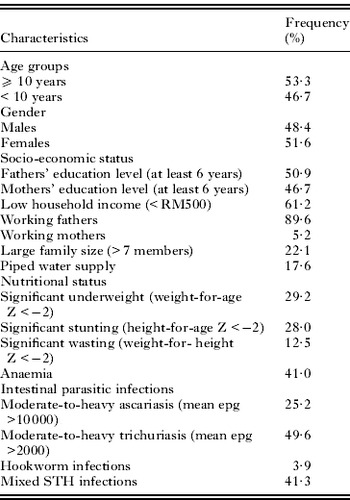
In total 289 pupils aged 6–13 years with a mean age of 9·7±0·2 years participated in this study. The general characteristics of the subjects and their families are shown in Table 1. Overall, almost half of the fathers and mothers had no formal education and about two thirds of the families had low household monthly income (<RM500; US$=RM3.00). Almost 94% of all the subjects were found to be infected by at least 1 STH species. The result indicated that 84·6%, 47·6% and 3·9% of the children had trichuriasis, ascariasis and hookworm infections, respectively. Almost half and a quarter of the group of children with Trichuris and Ascaris infections respectively, were of moderate-to-heavy burden. However, all hookworm infections were of very low intensity.
General characteristics of subjects that participated in this study

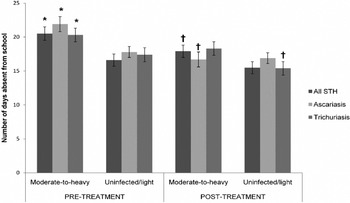
Regarding school attendance, the overall mean number of days of pupils' absenteeism from school was 19·5±0·5 days (3 months prior to treatment). According to individual worm infection, the mean number of days absent from school among pupils infected with moderate-to-heavy ascariasis was significantly higher than the mean among those not infected or having only light infections (21·9±0·7 days compared to 17·8±0·4 days; t=2·542, P= 0·012). Similarly, the mean days absent from the school was significantly higher among the subjects having moderate-to-heavy trichuriasis than those not infected or having only light infections (20·3±0·6 days compared to 17·4±0·5 days; t=2·085, P=0·038) (Fig. 1).
Number of days absent from school in relation to intestinal helminth infections. All values are mean±s.e.m.* Significant difference (higher) compared to uninfected/light infection group (independent t-test, P<0·05). † Significant difference (lower) compared to pre-treatment (Paired t-test, P<0·05).

The output of the paired t-test (Fig. 1) showed that the number of days absent was reduced significantly among the subjects having moderate-to-heavy STH after treatment (20·5±0·6 days pre-treatment compared to 17·9±0·5 days post-treatment; t=2·752, P=0·007). Similar findings were reported among those having moderate-to-heavy ascariasis (21·9±0·7 days pre-treatment compared to 16·7±0·7 days post-treatment; t=4·703, P<0·001). A reduction of 2 days was reported among those having moderate-to-heavy trichuriasis, however, the difference was not statistically significant (20·3±0·6 days pre-treatment compared to 18·3±0·6 days post-treatment; t=1·952, P>0·05).
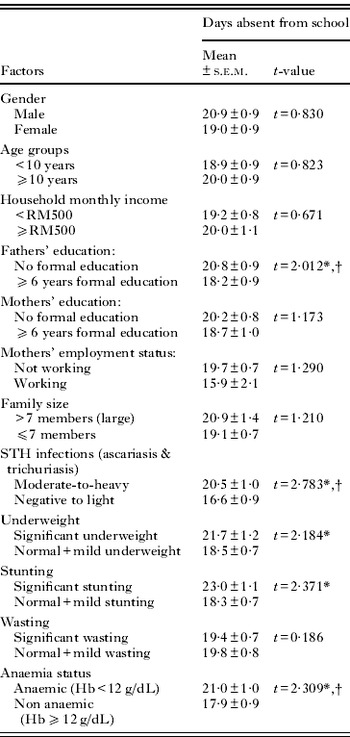
The differences in mean days absent from school in relation to socio-economic, health, nutritional and demographic factors were examined and the results are shown in Table 2. Mean days absent from school was significantly higher among children having moderate-to-heavy STH compared to those not infected or having only light infections (t=2·783, P=0·006). Similarly, students whose fathers had a low education level had significantly higher absenteeism (t=2·012, P=0·045) than those students whose fathers had at least 6 years of formal education. Children suffering from anaemia also had a significantly higher absenteeism rate than non-anaemic children (t=2·309, P=0·022). Moreover, significantly underweighted and stunted children were found to have higher absenteeism than those who were well nourished or suffering from mild underweight and stunting (t=2·184, P=0·030 and t=2·371, P=0·021, respectively).
Univariate and multivariate analyses for the number of days absent from school due to socio-economic, health and nutritional factors among Aboriginal schoolchildren

* Significant association (P<0·05; independent t-test).
† Confirmed as a significant determinant by multiple linear regression.
A stepwise multiple linear regression model was developed to identify the significant predictors of absenteeism among the subjects. The output of the model showed that absenteeism was found to be significantly influenced by the level of their fathers' education which contributed the most to the regression variance (r2=0·116, P=0·020) followed by anaemia (r2=0·095, P=0·019) and moderate-to-heavy STH (r2=0·044, P=0·011), while the non-significant variables (P>0·05) were removed in a stepwise manner.
DISCUSSION
Despite continuous efforts by the government to narrow the educational gap between the rural and urban areas and to improve the school participation among these populations, the rate of school absenteeism and dropout in Aboriginal populations is still high and remains a matter of concern. The present study investigated the impact of STH and nutritional status together with some demographic and socio-economic factors on the school participation among Aboriginal schoolchildren. Our findings showed that the prevalence of STH infections among these people remains very alarming and consistent with previous local reports (Norhayati et al. Reference Norhayati, Zainudin, Mohammad, Oothuman, Azizi and Fatmah1997; Zulkifli et al. Reference Zulkifli, Anuar, Atiya and Yano2000; Al-Mekhlafi et al. Reference Al-Mekhlafi, Atiya, Lim, Mahdy, Ariffin, Abdullah and Surin2007; Ngui et al. Reference Ngui, Ishak, Chuen, Mahmud and Lim2011). The current study showed that children infected with moderate-to-heavy burdens of A. lumbricoides and/ or T. trichiura had lost more school days compared to counterparts with low burden or no infection. Similarly, STH was found to be associated with higher rates of absenteeism and school dropouts among Indian schoolchildren in eastern Delhi (Bobonis et al. Reference Bobonis, Miguel and Sharma2006). Moreover, a previous study among Jamaican schoolchildren reported that the more heavily infected individuals recorded double the rate of absenteeism from school than their un-infected counterparts (Nokes and Bundy, Reference Nokes and Bundy1993). Children infected with helminths are lethargic and weak, and have frequent attacks of diarrhoea or dysentery and abdominal pain and this will prevent them from attending schools.
After complete de-worming, we noticed that school absenteeism (3 months after treatment) was significantly reduced by about 16% among the pupils. This is consistent with findings from Kenya and India that de-worming reduced school absenteeism by one-quarter and one-fifth, respectively (Miguel and Kremer, Reference Miguel and Kremer2003; Bobonis et al. Reference Bobonis, Miguel and Sharma2006). By contrast, a previous local study among urban and rural schoolchildren (non-Aboriginal children) in Kelantan state found a significantly higher absenteeism rate among schoolchildren infected with T. trichiura and A. lumbricoides (Raj et al. Reference Raj, Sein, Khairul Anuar and Mustaffa1997). However, this study found no significant improvement in the school attendance after de-worming and therefore, stated that the association was not causal. This could be attributed to the differences in socio-economic and health characteristics between the Aboriginal population and other rural populations of Malaysia, and the low intensity of infections (all infections were of light burden) reported by Raj et al. (Reference Raj, Sein, Khairul Anuar and Mustaffa1997). Similarly, a previous clinical trial among primary schoolchildren in Guatemala could not detect any improvement in attendance after de-worming for Ascaris infections (Watkins et al. Reference Watkins, Cruz and Pollitt1996). The authors evaluated the effects of de-worming after 6 months and indicated that the treated children were largely free of Ascaris for at least 6 months. A recent study on STH, among Aboriginal children in Malaysia, revealed a very high re-infection rate; 50% and 100% of the children were found to be re-infected by 3 months and 6 months, respectively (Al-Mekhlafi et al. Reference Al-Mekhlafi, Surin, Atiya, Ariffin, Mahdy and Abdullah2008). Furthermore, a high proportion of heavy STH infections has been reported by all previous studies conducted in Aboriginal communities. Both the intensity and continuation of infection are the key factors determining the pathological changes and the long-term complications. Thus, impact of these infections on pupil attendance is anticipated and de-worming would help to improve children's school participation.
We also identified anaemia as a significant predictor of absenteeism, as anaemic children showed longer periods of school days lost than non-anaemic children. A recent local study among Aboriginal children showed that children suffering from anaemia were more prone to have lower cognitive function and educational achievement than non-anaemic children (Al-Mekhlafi et al. Reference Al-Mekhlafi, Mahdy, Atiya, Ariffin, Al-Mekhlafi, Amran and Surin2011). A previous study reported that school participation was boosted by reducing anaemia among Indian pre-school children (Bobonis et al. Reference Bobonis, Miguel and Sharma2006). Similarly, the Report of the Program for Human and Holistic Development (UPHOLD), indicated that the high prevalence of anaemia was a contributory factor to the low attendance rate of 63% among children in Uganda (UPHOLD, 2005). Previous studies showed that more than one third of the Aboriginal children in rural Malaysia were anaemic and iron deficiency anaemia (IDA) accounted for more than 70% of the anaemic cases (Nor Aini et al. Reference Nor Aini, Al-Mekhlafi, Azlin, Shaik, Sa'iah, Fatmah, Ismail, Ahmad Firdaus, Aisah, Rozlida and Norhayati2007; Al-Mekhlafi et al. Reference Al-Mekhlafi, Mahdy, Atiya, Ariffin, Al-Mekhlafi, Amran and Surin2011). This high prevalence of anaemia among these children could be due to infections and poor dietary intake because of poverty and low purchasing power. The association of STH with IDA is well documented and this may further explain the role of high prevalence of anaemia among the subjects in the resultant negative synergistic impact on the school participation (Stoltzfus et al. Reference Stoltzfus, Chwaya, Tielsch, Schulze, Albonico and Savioli1997; Brooker et al. Reference Brooker, Peshu, Warn, Masobo, Guyatt, Marsh and Snow1999; Dreyfuss et al. Reference Dreyfuss, Stoltzfus, Jaya, Elizabeth, Steven, Subarna, Sharada, Joanne, Albonico, Keith and West2000; Nor Aini et al. Reference Nor Aini, Al-Mekhlafi, Azlin, Shaik, Sa'iah, Fatmah, Ismail, Ahmad Firdaus, Aisah, Rozlida and Norhayati2007).
Other compounding factors may play a role in influencing school attendance among these groups of people. Obviously, poverty as well as the desire to stay away from other people or work at home could be associated with school dropout and absenteeism rates among these people. In the present study, we also found that the low level of parental education has a negative impact on the school attendance of the children. It is well known that educated parents play a crucial role in the educational process of their children (Davis-Kean, Reference Davis-Kean2005; Al-Mekhlafi et al. Reference Al-Mekhlafi, Mahdy, Atiya, Ariffin, Al-Mekhlafi, Amran and Surin2011). Poverty also limits school participation in different ways with children of poor families being forced to work, which discourages their school attendance and performance. However, the present study could not detect a significant difference in absenteeism according to the household income groups. In this population, poverty is dominant and this may hide the anticipated difference.
In our study, univariate analysis showed that stunting and underweight were significantly associated with school absenteeism. A previous clinical trial among Jamaican primary schoolchildren infected with T. trichiura showed a possible interaction effect of the nutritional status and STH on the school attendance (Simeon et al. Reference Simeon, Grantham-McGregor, Callender and Wong1995). Previous studies among Aboriginal schoolchildren in Malaysia have identified STH as a significant risk factor of malnutrition and anaemia and this could explain the possibility that STH is amongst the main causes of school absenteeism in these children (Al-Mekhlafi et al. Reference Al-Mekhlafi, Norhayati, Azlin, Nor Aini, Shaik, Fatmah, Ismail, Firdaus-Ahmad, Aisah, Rozlida and Norhayati2005; Nor Aini et al. Reference Nor Aini, Al-Mekhlafi, Azlin, Shaik, Sa'iah, Fatmah, Ismail, Ahmad Firdaus, Aisah, Rozlida and Norhayati2007). However, this requires proper attention and urges for further studies on various important and interrelated aspects of the problem.
In conclusion, this study provides information on the effects of STH on school participation among the Malaysian Aborigines. The government of Malaysia has embarked on various socio-economic and poverty-alleviation programmes to encourage the Aboriginal people to send their children to school but with little impact. Aboriginal communities are distributed in almost all the states of Peninsular Malaysia. Their socio-economic and epidemiological characteristics are virtually similar, as reported in different surveys. Parasitological surveys conducted among these people in different states revealed that they are bedeviled by a host of helminthic diseases at high prevalence rates especially among children (Norhayati et al. Reference Norhayati, Zainudin, Mohammad, Oothuman, Azizi and Fatmah1997; Zulkifli et al. Reference Zulkifli, Anuar, Atiya and Yano2000; Al-Mekhlafi et al. Reference Al-Mekhlafi, Atiya, Lim, Mahdy, Ariffin, Abdullah and Surin2007; Ngui et al. Reference Ngui, Ishak, Chuen, Mahmud and Lim2011). These diseases, compounded with poverty, lead to the persistence of high rates of school dropouts and absenteeism. We therefore suggest that the government should, in addition to the ongoing educational assistance for the Aboriginal communities, embark on a comprehensive integrated programme to boost school attendance, including the introduction of an evidence-based de-worming programme in all the Aboriginal schools.
ACKNOWLEDGEMENTS
The authors wish to acknowledge the support and cooperation of the Headmaster, staff and pupils of the National Primary School of Satak in making this survey a success. We also wish to express our appreciation to the parents, and the staff of the District Education Office in Raub, for their kind support and cooperation.
FINANCIAL SUPPORT
This study was supported by the University of Malaya research grants (PS181/2009C & PS233/2010B).