Staphylococcus aureus bacteremia (SAB) has been associated with significant morbidity and mortality.Reference Holland, Arnold and Fowler 1 Antimicrobial stewardship programs (ASPs) are now a required component of healthcare systems.
Staphylococcus aureus is one of the most frequently identified bacteremia pathogens. Infectious diseases (ID) consultation, removal of intravascular foci of infection, and treatment duration of ≥28 days in complicated SAB infections have all been associated with improved 28-day mortality.Reference Honda, Krauss and Jones 2 – Reference Turner, Valcarlos, Won, Change and Schwartz 5
In the Omaha, Nebraska, metropolitan area, there are 5 Catholic Health Initiative (CHI)-affiliated hospitals, and 1 is the major teaching institution for Creighton University Health Science schools. In this retrospective review of SAB, we compared the outcome of patients from the academic institution with those of 3 community-based institutions within the health system to compare patient outcomes between the academic hospital setting and the community hospital setting.
METHODS
The central microbiology laboratory identified SAB patients within our health system from 2013 through the first quarter of 2015. Using the electronic medical record system (EMR), SAB patients ≥19 years of age with blood culture(s) positive for S. aureus were retrospectively enrolled in this study. Exclusion criteria included age <19 years, patient refusal of treatment, or any of the following within 4 days of the initial positive blood culture sample: death, initiation of hospice care, or transfer to another facility.Reference Shorr, Tabak, Killian, Gupta, Liu and Kollef 6 Primary sites of infection associated with SAB were determined from the EMR by reviewing physical exam information.
Creighton University Medical Center is a 232-bed academic hospital. The 3 community-based hospitals included in this study (631 total beds) became a part of our health system in 2013. Creighton University Medical Center has a multidisciplinary ASP. In 2014, the health system added rapid molecular identification (BioFire FilmArray blood culture identification, bioMèrieux, Marcy-l'Étoile, France) for positive blood cultures. Positive blood culture identification results were electronically placed in the EMR, which generated alerts to pharmacists at the community hospitals. In contrast, technologists contacted the on-call ASP consultant at the academic hospital via pager. Antimicrobial recommendations were made to the primary care physician or resident after speaking to an ID physician. This project was approved by the Institutional Review Board (IRB) at Creighton University.
Deidentified data were collected for all SAB patients, entered into an Excel spreadsheet (Microsoft, Pullman, WA), and uploaded to the statistical software (SPSS version 24, IBM, Armonk, NY). All spreadsheet data were reviewed by C.J.D. prior to SPSS upload.
The 4 key standards of care for SAB include (1) removal of an intravascular focus (if present) within 4 days, (2) obtaining follow-up cultures every 2–4 days after initial positive blood culture, (3) use of parenteral β-lactam therapy for methicillin-sensitive infection, and (4) administration of ≥28 total days of therapy for complicated SAB.Reference Liu, Bayer and Cosgrove 8 The appropriate duration of therapy for uncomplicated infections was considered to be 14 days. Vancomycin use was considered inappropriate when used for ≥7 days for a methicillin-sensitive infection in the absence of a β-lactam allergy or intolerance. Oral therapy was considered inappropriate.
Treatment failure included any of the following: (1) microbiological failure, defined as a blood culture growing S. aureus obtained ≥10 days from the initial positive culture specimen and before the completion of antimicrobial therapy; (2) recurrent bacteremia, defined as a blood culture positive for S. aureus obtained after completion of antimicrobial therapy; (3) late metastatic infection, defined as hematogenous seeding ≥10 days after the initial positive blood culture; or (4) death.Reference Holland, Arnold and Fowler 1 Complications of treatment for SAB included grade 3 or 4 abnormalities in laboratory parameters.
Statistical comparisons of discrete variables regarding SAB management between the community hospital setting and the academic hospital setting were conducted using the χ2 test, Fisher’s exact test, or Wilcoxon rank-sum test, where appropriate. The Student t test was used to compare continuous variables. Mean±SD or percentages are reported. P≤0.05 was considered statistically significant.
RESULTS
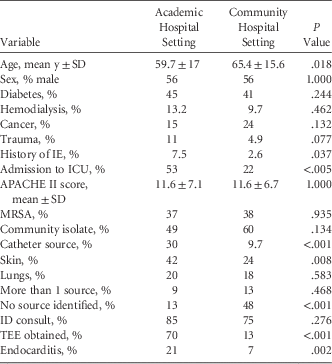
In total, 298 SAB patients were retrospectively enrolled in this study: 53 patients in 1 academic hospital and 245 patients in 3 community hospitals. Overall, 56% of all patients were male (Table 1). SAB patients were significantly younger at the academic hospital: mean age±standard deviation (SD) was 59.7±17 years in the academic hospital and 65.4±15.6 years in the community hospitals (P<.02). Among all patients included in the study, 31% were admitted to the intensive care unit (ICU). In the academic hospital, significantly more SAB patients were admitted to the ICU than in the community hospitals (53% vs 22%, respectively; P<.005).
Comparison of Variables Pertaining to SAB Patients Between an Academic Hospital Setting and a Community Hospital Setting

NOTE. IE, infective endocarditis; ICU, intensive care unit; MRSA, methicillin-resistant Staphylococcus aureus; ID, infectious diseases; TEE, transesophageal echocardiography.
Of all S. aureus isolates, MRSA accounted for 111 (37%). Moreover, 173 cultured SAB strains (58%) were community acquired. The remaining SAB isolates were acquired from patients in the hospital setting. In addition, 40 SAB cases (13%) were associated with central catheters. Significantly more SAB cases in the academic hospital setting were from skin infections as the primary site than in the community hospital setting (42% vs 24%, respectively; P=.008). Infectious diseases consultants were contacted in 77% of all SAB cases.
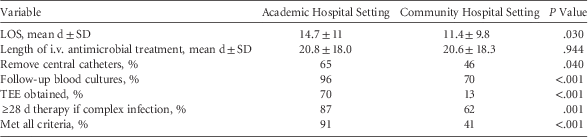
Total hospital length of stay (LOS) at the academic hospital was significantly longer than in the community hospitals (14.7±11 days vs 11.4±9.8 days, respectively; P=.03) (Table 2). There were no significant differences between the 2 groups when comparing time to appropriate therapy and duration of treatment.
Hospitalization and Treatment Management Variables

NOTE. LOS, length of hospital stay; SD, standard deviation; i.v., intravenous; TEE, transesophageal echocardiography.
Compliance with Infectious Diseases Society of America (IDSA) recommendations for SAB management was compared between the academic and community hospital settings. Transesophageal echocardiography (TEE) was performed in 70% of SAB patients in the academic hospital setting, but in only 13% of patients in the community hospital setting (P<.001). Significantly more patients in the academic hospital setting had central catheters removed after SAB diagnosis than in the community hospital setting (65% vs 46%, respectively; P=.04). Follow-up blood cultures were obtained significantly more often in the academic hospital setting than in the community hospital setting (96% vs 70%, respectively; P<.001). Patients receiving oral (p.o.) antimicrobials (n=21) demonstrated significantly shorter LOS than patients receiving intravenous (i.v.) antimicrobials (12.2±9.8 vs 5.4±3.7, respectively; P<.001). Considering these four variables together (TEE obtained, central catheters removed, follow-up blood cultures obtained, and i.v. antimicrobials for complicated SAB), patients with SAB in the academic hospital setting were managed in significantly closer accord with IDSA recommendations than patients in the community hospital setting (91% vs 41% accordance, respectively; P<.001).
A total of 28 patients (11 patients in the academic hospital and 17 patients in the community hospitals) were diagnosed with infective endocarditis. Among these patients, a significant difference in hospital stay was observed: LOS for SAB patients with infective endocarditis in the academic setting was 21.0±14.0 d, whereas LOS for these patients in the community setting was 16.9±14.5 d (P<.001). All SAB patients with infective endocarditis were managed in accordance with IDSA recommendations in both groups.
DISCUSSION
SAB is a serious infection resulting in significant morbidity and mortality. The annual incidence of SAB in the United States is 4–38 per 100,000 person years,Reference Holland, Arnold and Fowler 1 and it is the most commonly encountered bacterial pathogen in all types of bacteremia.Reference Shorr, Tabak, Killian, Gupta, Liu and Kollef 6 The use of TEE has been associated with higher rates of a diagnosis of endocarditis (14%–28%) compared with transthoracic echocardiography (TTE, 2%–15%).Reference Holland, Arnold and Fowler 1 Our results reveal that significantly fewer SAB patients underwent TEE in the community hospital setting than in the academic hospital setting in our health system.
Additionally, SAB patients admitted to community hospitals had significantly fewer central catheters removed and repeat blood cultures to demonstrate bloodstream clearance. In the academic hospital setting, significantly more patients received ≥28 days of i.v. antimicrobial therapy than patients in the community hospital setting. Major limitations associated with these results include the retrospective nature of the data collection as some data were not present in the EMR, particularly from the community hospital setting.
Based on these results, standardization of appropriate management of SAB in the community hospital setting is needed. The use of an ID physician–driven ASP would be one option to assist clinicians with appropriate management. Such a procedure could be adopted for in the community hospital setting to increase positive patient care outcomes. Additional measures to further improve patient outcomes are currently being discussed. Study limitation is the retrospective nature of the study.
In summary, this retrospective review demonstrates that significant positive patient outcomes can be correlated with appropriate management of SAB in an academic hospital setting. Overall, management of SAB patients in an academic hospital setting was more closely aligned with IDSA recommendations than management of SAB in a community hospital setting.
ACKNOWLEDGMENTS
Financial support: No financial support was provided relevant to this article.
Potential conflicts of interest: All authors report no conflicts of interest relevant to this article.