I. Introduction
In February 2020, a grave concern with “the ‘slow-moving disaster’ of harmful use of alcohol”Footnote 1 led the Executive Board of the World Health Organization (WHO) to decide to develop an “action plan”Footnote 2 to implement the WHO’s Global Strategy to Reduce the Harmful Use of Alcohol (Global Strategy).Footnote 3 This new development in the global governance of alcohol is a positive, given the considerable global burden of harm associated with the consumption of alcohol, especially for low- and middle-income countries.Footnote 4 But “an action plan” falls far short of the aspiration for a treaty on alcohol control,Footnote 5 modelled on the WHO Framework Convention on Tobacco Control (FCTC).Footnote 6
Since coming into force in 2005, the FCTC has been lauded for its multifaceted contribution to global tobacco control efforts.Footnote 7 One of the perceived benefits of the conclusion of a similar treaty on alcohol control (often referred to as a “framework convention on alcohol control” (FCAC)) would be its ability to prevent future challenges to progressive public health measures on alcohol under international trade and investment law.Footnote 8 Although there have been no such challenges in respect of alcohol to date,Footnote 9 the experience with multiple claims against tobacco control measures under international economic law is salutary,Footnote 10 and concern exists that progress on alcohol controls may be met with similar legal claims.Footnote 11
The FCTC has been used extensively in litigation in domestic courts, both as a “shield” to defend government’s progressive tobacco control measures and as a “sword” by civil society organisations to attack the adequacy of existing tobacco measures to protect health.Footnote 12 At the international level, the recent World Trade Organization (WTO) jurisprudence shows that the FCTC has been helpful to the defence of progressive tobacco control measures.Footnote 13 However, the utility of the FCTC does not lie in some capacity to override WTO rules and block all international economic law challenges. Rather, in recent WTO reports, the FCTC was looked to as a source of authoritative evidence about the “tobacco epidemic”Footnote 14 and the effectiveness of selected public health measures.Footnote 15 The successful deployment of the FCTC in this manner in formal WTO dispute settlement raises an interesting question about how different global health instruments are used in informal dispute settlement processes in the WTO. One such process is found in the WTO’s Committee on Technical Barriers to Trade (TBT Committee). The TBT Committee is a forum that has been established for WTO members to raise concerns or otherwise consult with each other about policy measures that are being proposed or have been adopted and their consistency with one of the WTO agreements called the Agreement on Technical Barriers to Trade (TBT Agreement).Footnote 16
This article takes up the question of how the Global Strategy and the FCTC, as two distinct types of global health instruments – the former being, in effect, a statement of political commitment by WHO members, and the latter being a legally binding international agreement – have been used in the context of discussions about alcohol and tobacco measures, respectively, in the TBT Committee. This research speaks to the wider debate about whether different types of international regulatory instruments and the legal status of these instruments impact their effectiveness in supporting domestic health measures. Unlike the FCTC, the Global Strategy and its proposed action plan are not binding instruments under international law, nor are they in the nature of the non-binding codes adopted by the World Health Assembly (WHA) in relation to breast-milk substitutes in 1981Footnote 17 and the recruitment of international health workers in 2010 (WHO Health Worker Code).Footnote 18 The capacity of “soft law” instruments, including codes, standards, strategies, plans of action or other instruments howsoever named, to achieve the their stated purpose in global health is disputed.Footnote 19 Some scholars, such as Allyn Taylor, whose work significantly informed the design of the FCTC and the WHO Health Worker Code and who supports the use of a non-binding code for alcohol,Footnote 20 argues that “such instruments are not without legal or political significance. Like treaties, these nonbinding instruments can be mechanisms for advancing international consensus on rules and for promoting consistent state action”.Footnote 21 Other scholars regard soft law instruments as largely inutile for alcohol control purposes.Footnote 22 The findings in this article about the use of the FCTC and the Global Strategy in the TBT Committee add a new perspective to these debates.
In order to address the question about how the FCTC and Global Strategy have been used in the TBT Committee, this article starts by explaining, firstly, the legal status and substantive content of the Global Strategy (Section II). It then does the same in relation to the FCTC (Section III). Against this background, Section IV describes the study methodology and presents the results on how the Global Strategy and the FCTC have been used in the TBT Committee. Section V provides a discussion of the reasons for the different uses of the Global Strategy and the FCTC in the TBT Committee. Section VI concludes with a discussion of the implications for the future global governance of alcohol, including the negotiation of a treaty.
II. Global governance of alcohol
Alcohol has been a sporadic focus of the WHO since its inception in 1948.Footnote 23 A renewed interest in alcohol at the WHO can be seen from 2005 when the WHA called on the WHO “to draw up recommendations for effective policies and interventions to reduce alcohol-related harm, and to develop technical tools that will support Member States in implementing and evaluating recommended strategies and programmes”.Footnote 24 It was this call that ultimately led to the WHA’s adoption of the Global Strategy in 2010.Footnote 25 The Global Strategy represents a political commitment by the WHO members to address problems related to alcohol.
Despite considerable obstacles in its making,Footnote 26 the Global Strategy “aims to give guidance for action at all levels; to set priority areas for global actions; and to recommend a portfolio of policy options”Footnote 27 for domestic implementation with a view to achieving “improved health and social outcomes … with considerably reduced morbidity and mortality due to harmful use of alcohol”.Footnote 28 In terms of domestic interventions, there are ten “recommended target areas, which should be seen as supportive and complementary of one another”:Footnote 29 leadership, awareness and commitment; health treatment services; “community action”; drink driving controls; availability restrictions; regulating alcohol marketing; pricing; reducing the negative consequences of drinking and alcohol intoxication (including consumer information and labelling on alcoholic beverages); controlling illicit and informally produced alcohol; and monitoring and surveillance of consumption, harms and policy interventions.Footnote 30
III. Global governance of tobacco
Tobacco is governed by the FCTC.Footnote 31 After four years of negotiations,Footnote 32 the treaty was adopted by the WHA on 21 May 2003.Footnote 33 It remains the only treaty adopted under Article 19 of the WHO Constitution.Footnote 34 It opened for signature on 16 June 2003 and came into force on 27 February 2005 with 168 parties.Footnote 35 It now has 181 parties.Footnote 36 Of significance, in terms of population size, is the failure of the USA and Indonesia to become parties to the FCTC.Footnote 37
Although called a “framework convention”, the FCTC does not conform to the traditional “framework convention” model, which involves “establish[ing] a general system of governance for an issue area, and not detailed obligations”,Footnote 38 followed by “separate protocols containing specific measures designed to implement these goals”.Footnote 39 Rather, the FCTC itself contains “detailed provisions” and “strong obligations”.Footnote 40 With the objective being to “protect present and future generations from the devastating … consequences of tobacco consumption and tobacco smoke”,Footnote 41 the FCTC sets clear obligations for the Parties to implement, at the domestic level, multiple measures for demand reduction. These relate to pricing and taxation,Footnote 42 packaging and labellingFootnote 43 and advertising, promotion and sponsorship.Footnote 44 There are also some supply reduction measures, in particular addressing the illicit trade in tobacco products.Footnote 45 There have been Guidelines developed by the Conference of the Parties, an institutional mechanism established under the FCTC,Footnote 46 which “are intended to help Parties to meet their obligations … [reflecting] best practices and standards that governments would benefit from in the treaty-implementation process”.Footnote 47 These Guidelines are not part of the FCTC, but may, according to Zhou and Liberman, be considered to be evidence of “subsequent agreement” between the Parties.Footnote 48 At the very least, they represent “an important statement of international evidentiary consensus and best practice”.Footnote 49 These Guidelines specifically encourage bans on additivesFootnote 50 and the use of plain packaging.Footnote 51 There has also been an optional protocol, which is a separate treaty, negotiated to eliminate illicit trade in tobacco products.Footnote 52
IV. Alcohol and tobacco in the WTO TBT Committee
This section presents the study of the use of the Global Strategy and the FCTC in the WTO’s TBT Committee. In Section IV.1, there is a discussion of the TBT Committee as an informal dispute settlement forum within international trade law. In Section IV.2, the methodology that was used in the study is described. In Sections IV.3 and IV.4, the findings in relation to alcohol and tobacco, respectively, are presented.
1. WTO TBT Committee
As explained in Section I, the TBT Committee is not a formal WTO dispute settlement mechanism. But it is said to be “akin to an informal form of resolution of trade conflicts”,Footnote 53 serving to “settle” trade concerns between membersFootnote 54 without resort to formal WTO dispute settlement. Until the recent impasse in the appointment of members of the Appellate Body,Footnote 55 the WTO’s formal enforcement process was hailed as “the central pillar of the multilateral trading system, and the WTO’s unique contribution to the stability of the global economy”.Footnote 56 Formal dispute settlement in the WTO has various stages through which a matter may be escalated if it cannot be settled. The first stage is a request for consultations between parties. The second stage involves a hearing before a Panel and the issuance of a Panel report. Any party may appeal the findings in the Panel report to the Appellate Body. The reports of the Panel and the Appellate Body must be adopted by the WTO Dispute Settlement Body (composed of all of the members of the WTO) to become binding. Reports are automatically adopted unless, by consensus, members decide not to adopt the report.Footnote 57
It is argued that the TBT Committee processes provide an alternative and less formal forum than consultations for the resolution of concerns about a member’s measure. In the Committee, WTO members have “the opportunity of consulting on any matters relating to the operation of [the TBT] Agreement or the furtherance of its objectives”.Footnote 58 The TBT Committee consists of all WTO members and accredited observers, one of which is the WHO/Food and Agriculture Organization (FAO) Codex Alimentarius Commission.Footnote 59 The Committee holds three formal meetings each year, and minutes of its meetings are made publicly available, including via the WTO’s website.Footnote 60 These meetings are unlikely to be the extent of the contact between members about matters of concern. There will likely be other communications in person or in writing, but the formal TBT Committee meetings bring matters to the attention of all WTO members and observers.
Most measures come to the TBT Committee for discussion through a “notification”, which is a formal WTO process whereby members are required to notify the WTO of new measures they are proposing.Footnote 61 Sometimes, measures come to the TBT Committee that have not been formally notified to the WTO (with the failure to notify being one of the concerns that may be raised in the TBT Committee).Footnote 62 A measure (notified or not) that is brought to the TBT Committee for discussion is called a “specific trade concern” (STC).Footnote 63 A single STC may contain multiple domestic regulatory measures.Footnote 64 In the TBT Committee, they are grouped together as a single STC.Footnote 65 Through interactions in the TBT Committee, such trade concerns, which otherwise could become the subject of formal dispute settlement, may be resolved by: (1) a member revising its measure to make it (more) WTO-consistent or more acceptable to other members; (2) complaining members offering technical or financial assistance to “facilitate compliance”;Footnote 66 or (3) complaining members coming to some level of acceptance of the proposed measure.
2. Methodology
In this study, the same methodology for the review of the TBT Committee meetings minutes was used, with appropriate adaptations, for alcohol and tobacco.
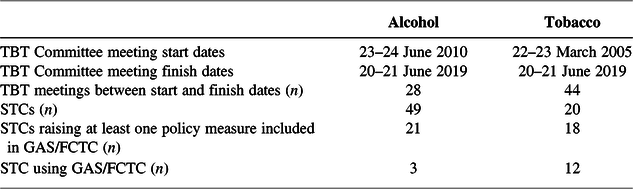
For alcohol, the review of the minutes is related to TBT Committee meetings starting from 23–24 June 2010 (being the dates of the first TBT Committee meeting after Global Strategy was adopted by the WHA)Footnote 67 until 20–21 June 2019 (being the dates of the most recent Committee meeting).Footnote 68 In this period, there were 28 TBT Committee meetings and associated sets of minutes. Each of the 28 sets of TBT Committee meeting minutes was then searched for STCs relating to alcohol.Footnote 69 I identified 49 STCs concerning alcohol measures. The minutes of the meeting discussions relating to these 49 alcohol-related STCs were then reviewed for references to the Global Strategy.Footnote 70 If there were references to the Global Strategy, the minutes were analysed to determine by whom and in what manner the Global Strategy had been used. The minutes of the 49 alcohol STCs were also reviewed to determine whether the STC related to a measure that was one of the policy options promoted by the Global Strategy.
For tobacco, the review of the minutes started with the meeting on 22–23 March 2005 (being the dates of the first TBT Committee meeting after the FCTC entered into force)Footnote 71 and finished with the meeting on 20–21 June 2019 (being the dates of the most recent Committee meeting).Footnote 72 In this period, there were 44 meetings and associated sets of minutes. Each of the 44 sets of TBT Committee minutes was searched for STCs relating to tobacco.Footnote 73 I identified 20 STCs concerning tobacco measures proposed or adopted by WTO members in the 44 sets of minutes. The minutes of the meeting discussions relating to these 20 tobacco-related STCs were then searched for references to the FCTC.Footnote 74 If there were references to the FCTC, the minutes were analysed to determine by whom and in what manner the treaty had been used. The minutes of the 20 tobacco STCs were also reviewed to determine whether the STC related to a measure that was one of the policy options covered by the FCTC.
It should be noted that the TBT Committee is the only informal WTO dispute settlement mechanism that publishes a record of the discussions occurring therein. It is therefore a valuable source of information about interactions between WTO members regarding their trade-related concerns about each other’s domestic regulatory measures. At the same time, the minutes of the meetings published by the WTO are only summaries of the discussions and are not verbatim records of the members’ contributions to the Committee meetings. It is therefore possible that there were additional references to both the Global Strategy and the FCTC that are not recorded in the available minutes.
3. Alcohol
Over the course of the 28 meetings from the time that the Global Strategy was adopted by the WHA until the present day, there were 49 individual alcohol-related STCs discussed in the meetings. Was the Global Strategy used in these discussions? If so, how was it used?
a. Was the Global Strategy used in TBT Committee meeting discussions of alcohol STCs?
Of the 49 alcohol-related STCs, 21 raised at least one measure that reflects the policy options promoted by the Global Strategy (see Table 1). Of the 21 STCs that include at least one measure consonant with the Global Strategy,Footnote 75 20 of the measures related to public health-directed labelling,Footnote 76 3 related to alcohol marketing restrictions (other than on the label space)Footnote 77 and 1 related to alcohol pricing.Footnote 78 Yet, only 3 of these 21 STCs used the Global Strategy in the TBT Committee meetings (see Table 1) and all 3 related to alcohol labelling.
Alcohol and tobacco in the World Trade Organization’s Committee on Technical Barriers to Trade Committee (TBT).

FCTC = Framework Convention on Tobacco Control; GAS = Global Alcohol Strategy; STC = specific trade concern.
The remaining 28 alcohol-related STCs did not include a single measure that fell within the scope of the Global Strategy, and they covered matter such as the use of geographical indications on the product label,Footnote 79 manufacturer and importer details,Footnote 80 ingredient lists,Footnote 81 allergen labelling,Footnote 82 product definitions,Footnote 83 maximum residue levelsFootnote 84 and product testing and certification.Footnote 85
b. How was the Global Strategy used in TBT Committee meeting discussions of alcohol STCs?
In this section, I analyse how the Global Strategy was used in discussions of three alcohol-related STCs in the TBT Committee: (1) Thailand’s graphic alcohol warnings; (2) Thailand’s alcohol marketing prohibition; and (3) Nepal’s graphic alcohol warnings.
i. Thailand: graphic warning labels
The first use of the Global Strategy in the TBT Committee meeting occurred in June 2010, almost immediately after the Global Strategy was adopted by the WHA in May 2010. It was used in discussions of a measure proposed, but never brought into law, by Thailand for the introduction of warning labels on packaged alcoholic beverages.Footnote 86 The proposed measure was a world-first in that it included graphic photograph-style warnings, adopting the approach that is widely used for warnings on tobacco packaging. It also proposed to connect the consumption of alcohol to a range of harms not generally referred to in alcohol label warnings, including the risk of suicide, family violence and sexual impotence. The labels were to be large, colourful and regularly rotated.Footnote 87
The Global Strategy was not, as might be expected, raised by Thailand in its response to member concerns about its measure. Arguably, Thailand could have pointed to the Global Strategy’s policy recommendation for “providing consumer information about, and labelling alcoholic beverages to indicate, the harm related to alcohol”.Footnote 88 However, it did not do so. Rather surprisingly, the Global Strategy was raised by New Zealand in two consecutive meetings in the course of putting up resistance to the Thai measure. The minutes record New Zealand as stating (in the very first meeting after the Global Strategy was approved), “[I]n line with the ‘WHA Strategy on the Harmful Use of Alcohol’, a proper balance between policy goals in relation to the harmful use of alcohol and other public policy goals should be achieved.”Footnote 89 New Zealand seems to have passed over the “guiding principle” that “public health should be given proper deference in relation to competing interests”,Footnote 90 and instead focused on several minor statements about the need for “balancing different interests”.Footnote 91 For example, the Global Strategy states:
Production, distribution, marketing and sales of alcohol create employment and generate considerable income for economic operators and tax revenue for governments at different levels … Policy-makers face the challenge of giving an appropriate priority to the promotion and protection of population health while taking into account other goals, obligations, including international legal obligations and interests.Footnote 92
In this questionable use of the Global Strategy, which is contrary to the intent and spirit of the instrument, New Zealand seems to have been impliedly arguing that Thailand’s proposal for graphic warning labels was an extreme public health measure, which failed to balance other important interests, such as international trade. There was no evidence in the minutes of Thailand refuting New Zealand’s use of the Global Strategy in this manner.
ii. Thailand: alcohol labelling restrictions
The Global Strategy was subsequently used by Thailand in 2014 to support a new alcohol label marketing restriction, which was implemented in 2015Footnote 93 and continues to be a source of considerable consternation in the TBT Committee.Footnote 94 The measure prohibits the use of certain words and images on the labels of alcoholic beverage containers. Prohibited messages are those that are “unfair to consumers”, lead to “bad effects to the society as a whole”, “persuade” people to drink alcohol or “exaggerate the benefit or quality of alcoholic beverages”.Footnote 95 It is this latter rule against exaggeration that has been most agitated in the TBT Committee, as it encompasses a ban on “cartoons”, as well as pictures or messages concerning athletes, artists, singers, movie stars or actors.Footnote 96
In its response to criticisms of the measure in the TBT Committee, Thailand has agreed to conduct various reviews.Footnote 97 However, throughout the TBT Committee meetings,Footnote 98 Thailand has also maintained that the measure is consistent with the TBT Agreement and other WTO obligations, including those under the Agreement on Trade-related Aspects of Intellectual Property.Footnote 99 To this end, it has explained that the measure was the government’s solution to the fact that “alcohol packaging and labelling had been used aggressively as a marketing channel”Footnote 100 (thus fuelling consumption and harm) in Thailand. In one meeting, Thailand seemed to attempt to legitimate the choice of this measure by reference to the Global Strategy. The minutes record:
In line with the principle of consumer protection, and taking account of the recommendations of the WHO’s “Global Strategy to Reduce Harmful Use of Alcohol” on controlling alcohol beverage labels to reduce the negative impacts of drinking and intoxication, Thailand developed this [measure] with the aim of reducing [the] attractiveness and appeal of alcohol to drinkers, especially young people. Footnote 101
The minutes suggest that Thailand saw the statement in the Global Strategy about alcohol labelling as a policy option as recommendatory only and not binding. This is correct as a matter of law. It is also interesting to note that the minutes record that Thailand suggests that the Global Strategy recommends “controlling alcohol beverage labels”. However, Thailand’s law to remove marketing from the beverage label is not squarely provided for in the Global Strategy. Rather, as noted above, the Global Strategy recommends “providing consumer information about, and labelling alcoholic beverages to indicate, the harm related to alcohol”,Footnote 102 which seems to be concerned with mandating the addition of warnings and other health information on the label space. Arguably, the Global Strategy’s call for the regulation of alcohol marketing might have used as the basis for Thailand’s marketing rule.Footnote 103 But Thailand seems not to have been relying on a specific provision in the Global Strategy to gird its measure. Instead, it seems to recognise the legitimacy of the Global Strategy and to seek general support for its policy from the Global Strategy.
iii. Nepal: graphic warning labels
The Global Strategy was most recently used by Nepal in 2017 in its rebuttal of criticisms of its new alcohol labelling measure. Nepal introduced a suite of alcohol controls in 2017, including advertising restrictions, limitations on availability and mandatory graphic health warnings about alcohol’s link to liver cirrhosis and damage to other organs. The labels are to cover 75% of the container space.Footnote 104 Assuming that the graphic warnings are in the nature of photographs and not just pictograms, the labelling measure makes Nepal the first and only country in the world to require graphic health warnings on alcohol, as well as the country with the most onerous standards for the amount of container space that must be covered by the label. Although the rules have been in place for several years, WTO members’ interest in this measure appears to have been activated by Nepal’s recent steps to enforce the rules.Footnote 105
There has only been one meeting at which Nepal’s measure has been discussed to date. The USA dominated the discussions, asking for information about alcohol consumption in Nepal, how 75% was chosen as the appropriate label space and offering to assist Nepal with examples of how the USA addresses alcohol-related harm.Footnote 106 Another query from the USA suggests that Nepal has likely been using the Global Strategy in its explanation of its measure. The minutes record the USA as asking, “[C]ould further information be provided on the ten WHO strategies referred to in Nepal’s policy document as obligating Nepal to implement these policies?”Footnote 107 Assuming “the ten WHO strategies” refer to the policy options set out in the Global Strategy,Footnote 108 the phrasing of the question suggests that Nepal has been arguing that it is obliged to adopt the options listed there. The Global Strategy is not legally binding, and it seems unlikely that Nepal was suggesting that it was. However, it is possible that Nepal considers it has a political obligation to other WHO Member States to implement the Global Strategy. This sense of political obligation may be institutionalised in certain countries through their involvement in WHO regional activities to support the implementation of the Global Strategy. For example, in 2014, the countries of the WHO South East Asia region passed a resolution urging countries within the region to adopt “systems and mechanisms” to implement the Global Strategy.Footnote 109
4. Tobacco
Over the course of 44 meetings of the TBT Committee from the time the FCTC entered into force until the present day, there were 20 individual tobacco-related STCs discussed. Was the FCTC used in these discussions? If so, how was it used?
a. Was the FCTC used in TBT Committee meeting discussions of tobacco STCs?
Of the 20 tobacco-related STCs, 18 raised at least 1 measure that directly reflects the policy options promoted by the FCTC (see Table 1). The 18 STCsFootnote 110 reflecting at least 1 FCTC policy related to: product composition (eg maximum amounts of tar, nicotine, etc.) (1 STC);Footnote 111 the use of additives (including flavourings) (7 STCs);Footnote 112 plain packaging (9 STCs);Footnote 113 labelling (4 STCs);Footnote 114 advertising (1 STC);Footnote 115 and product traceability for public health purposes (1 STC).Footnote 116 Of the 18 STCs relating to the FCTC, 12 were found to have referred to the FCTC in 1 or more TBT Committee meetings (see Table 1).
b. How was the FCTC used in TBT Committee meeting discussions of tobacco STCs?
In this section, I analyse how the FCTC was used in discussions of alcohol-related STCs in the TBT Committee. The tobacco-related STCs are too voluminous to be discussed individually, as was done with the alcohol-related STCs in Section IV.3. As the use of the FCTC has been overwhelmingly in connection with two types of tobacco measures (bans on additives and plain/standardised packaging) and the engagement with the FCTC has been similar across these two measures, this section briefly outlines the two measures (Sections IV.4.a.i and IV.4.a.ii) and then analyses the ways in which the FCTC has been used in the TBT Committee in relation to them (Section IV.4.a.iii).
i. Bans on flavourings and other additives
The TBT Committee meetings about tobacco have included seven STCs relating to the restriction on the use of additives in tobacco products. For example, one of these related to the Canadian Cracking Down on Tobacco Marketing Aimed at Youth Act that banned listed additives from being used in tobacco products for any purpose.Footnote 117 A less restrictive law in the USA banned the use of additives for the purpose of flavouring tobacco products.Footnote 118 The members introducing these measures all repeated some version of the purpose underpinning the Canadian legislation of “address[ing] public health concerns by reducing the incentives for young people to smoke”.Footnote 119 The purpose reflected the view that additives, particularly those that mask the harsh taste of tobacco with chocolate or fruit flavourings, play a role in young people initiating smoking. These additive bans have been heavily contested in the TBT Committee, and the US ban progressed to formal dispute settlement before the WTO Appellate Body in US: Clove Cigarettes.Footnote 120
ii. Plain packaging
Since the FCTC came into force, there have been nine STCs relating to tobacco plain packaging.Footnote 121 The first related to Australia’s Tobacco Plain Packaging Bill 2011.Footnote 122 It was the subject of TBT Committee discussion over a period of two years before Indonesia commenced the process of formal dispute settlement, which culminated in Australia’s success before a WTO Panel and the WTO Appellate Body in Australia: Tobacco Plain Packaging.Footnote 123 As evidenced by the progression of Australia’s measure to formal dispute settlement, tobacco plain packaging has been a vociferously debated matter in the WTO.
iii. Use of the FCTC
The FCTC and its Guidelines have been important to members defending their additive and plain packaging measures in the TBT Committee. The FCTC has been used in some of the same ways to how it has been used in formal dispute settlement in the WTO, but there are also additional uses that seem particular to the TBT Committee. Firstly, like in formal dispute settlement, there seems to have been some attempt to deploy the FCTC to signal the gravity of the tobacco problem and the urgency of addressing it. For example, Canada in particular repeatedly asserted in discussions the significance of tobacco being “the only good to be the subject of a legally binding treaty”.Footnote 124
Secondly, the treaty is used in various ways to support an argument as to the “appropriateness” of the contested measure. There was rightly no argument made in the TBT Committee that a member’s obligations under the FCTC take priority over their duties under the WTO Agreements. There are nonetheless mentions of the proposing member being a party to the FCTC and appeals to their need to observe their responsibilities as parties to the FCTC. The European Union (EU) has been explicit that its ban on additives was an attempt to balance its obligations under the FCTC and the TBT Agreement.Footnote 125 The EU seems to be asserting that it has struck a reasonable or appropriate balance between these two equal sets of obligations. The appropriate relationship between the TBT Agreement and the FCTC was a major concern that emerged from the minutes, with calls for a meeting between the WHO Secretariat and the WTO to “increase awareness of TBT issues and coherence with other international organizations”.Footnote 126
Furthermore, the specific content of the FCTC and its Guidelines has also been used to suggest that the chosen measure is “justified”. The FCTC or the Guidelines have been put forward as the “basis for” a measure,Footnote 127 or a measure has been said to be “in line” with the FCTC and the Guidelines.Footnote 128 For example, Australia referred to the FCTC Guidelines as “recommending” the introduction of plain packaging.Footnote 129 Norway, in its statement of support for Australia, also relied on the FCTC Guidelines having “explicitly mentioned the FCTC as one of the options to achieve the objective of health protection”.Footnote 130 Whatever the language used, members used the FCTC to prove that a measure is capable of contributing to the realisation of the member’s public health objective. With the latter approach, the FCTC and the Guidelines are treated as an authoritative source of supporting evidence for a measure.Footnote 131 This is consistent with the patterns of use of the FCTC in more formal legal contexts, including in tobacco-related litigation in the WTOFootnote 132 and elsewhere,Footnote 133 and in law-making.Footnote 134
It should also be noted that the use of the FCTC to buttress a domestic measure has not been without contest. Some members, such as Nicaragua, claimed that FCTC members were not required to implement the FCTC Guidelines, saying they were recommendatory only.Footnote 135 Others have claimed that the FCTC was being used as cover to pursue protectionist, “commercial interests”.Footnote 136
V. The Global Strategy and the FCTC compared
This study reveals fundamental differences in the use of the Global Strategy and the FCTC in the TBT Committee. In this section, I outline these differences (Section V.1) and offer an explanation for why the Global Strategy has had so little use and impact in the TBT Committee, whereas the FCTC has had such extensive use and impact (Section V.2).
1. The use of the Global Strategy and the FCTC in the WTO TBT Committee
Firstly, it is noteworthy that the FCTC has been used so extensively and on so many more occasions than the Global Strategy. It has been used in over half (12/20) of the tobacco-related STCs discussed in the TBT and in two-thirds of STCs that are about measures covered by the FCTC (12/18). It is also important to observe that there is a relatively low number of STCs relating to tobacco in the TBT Committee, which may be due to the FCTC being used to head off concerns about new tobacco measures. By comparison, the Global Strategy has only been referred to in 3 out of 49 of the STCs relating to alcohol and in 3 out of 21 of the STCs that raised matters covered by the Global Strategy. It is evident that the FCTC is highly significant in trade-related discussions about tobacco, whereas the Global Strategy is not seen as relevant at all or only very marginal to these issues.
Secondly, the ways in which the FCTC has been used in the TBT Committee confirm its authority, persuasiveness and centrality to states’ action on tobacco control. Even in an informal forum like the WTO TBT Committee, tobacco control and the FCTC are treated as inseparable. When the FCTC was raised in relation to a particular tobacco STC, it was central to the discussions, often being mentioned multiple times by several members. WTO members made reference to particular obligations imposed by the FCTC and elaborated in the Guidelines. When raised, the texts of the FCTC and the Guidelines were presented as incontrovertible evidence of the effectiveness of contested measures. The contrast is stark with the Global Strategy. The Global Strategy, when it was included in the TBT Committee meetings, was marginal to the discussions. It rated a bare and very general mention by Thailand, almost as an afterthought. The Global Strategy was not central to Thailand’s defence of its position, and there was no indication that the content of the Global Strategy had played any important part in the formulation of its domestic policies. Nepal, by contrast, did seem to have given more weight to the Global Strategy and to regard it as a blueprint for alcohol policy reforms.
Thirdly, and very significantly, the Global Strategy was notably used against public health measures to reduce alcohol-related harm. New Zealand (who was an early adopter of tobacco plain packaging and a key proponent of FCTC-based arguments in the TBT Committee) deployed the Global Strategy against Thailand’s alcohol warning label proposal. There is no indication in the TBT Committee minutes that the FCTC has been (or could be) used to support an objection to tobacco control.Footnote 137
2. Explaining the patterns of use of the Global Strategy and the FCTC in the WTO TBT Committee
What explains these patterns of use of the Global Strategy and the FCTC in the TBT Committee? The TBT Committee is an informal forum that resolves potential disputes through robust discussion, persistent questioning, persuasion and pressure between WTO members. In this forum, it might have been expected that the Global Strategy, as a statement of political commitment by WHO members, would play more of a role than this research has found to be the case. However, the work of the TBT Committee is anchored in the TBT Agreement, and so at least some of the discussion is directed towards the legal question of the consistency of a measure with the rules in the TBT Agreement. In this type of mixed political and legal space, the weak normative status of the Global Strategy results in it being marginalised. The Global Strategy has no firm legal status, no strong policy directives and no serious political support, having had so few resources dedicated to its implementation over the past ten years.Footnote 138 At the same time, the mixed political and legal environment in the TBT Committee is perfect for the use of the FCTC, which has a high legal status, defined obligations and resounding political backing from most of the world’s countries, many of whom have enacted legislation to give effect to their treaty obligations. In this section, I argue that there are three principal reasons for the differential use of the FCTC and the Global Strategy: (1) their legal status; (2) the nature of their policy recommendations; and (3) the role of industry in the policy domain of tobacco versus alcohol.
a. Legal status of the instrument
The fact that the FCTC is a treaty, which as such imposes legally binding obligations on its parties, cannot be underestimated in explaining its use in the TBT Committee. Technically, the legal status of the instrument has no significance in TBT Committee discussions. But the legal character of the FCTC seems to generally add to its status in the TBT Committee. Furthermore, the WTO Panels and the Appellate Body have recognised the relevance of the FCTC, as a treaty, to formal WTO dispute resolution, thereby legitimising its inclusion in informal dispute settlement forums like the TBT Committee.Footnote 139 By comparison, the Global Strategy is not a legal instrument, has no formal legal status under international law and has not been “approved” in the WTO dispute settlement system in the same way that the FCTC has.
However, none of what is said here about the FCTC and the Global Strategy precludes the possibility that, under the right circumstances, an instrument with a lesser legal status than a treaty may also have significant impact in the TBT Committee. The WHO/FAO Codex Alimentarius, a type of soft law instrument, could be seen as such an example. Its status in the WTO rests on it having been recognised as an “international standard” for the purposes of TBT Agreement.Footnote 140 The use and impact of the instrument may also be based on the normative force that has built up around it. This normative force may or may not be buttressed by the legal status of the instrument. Arguably, in the case of the FCTC, its status as a treaty in force under international law has contributed to the normative influence of the instrument and its use in the TBT Committee. A sense of extraordinary achievement continues to surround the conclusion of a treaty – not some lesser instrument – for global tobacco control.Footnote 141 The political solidarity that has built up between parties to the FCTC is, to some extent, predicated on a recognition of the import of states assuming legally binding commitments to confront powerful commercial interests and rid the world of the scourge of tobacco use and exposure. The other factors, discussed below, also contribute to the power and influence of the FCTC in the TBT Committee and more widely. The Global Strategy lacks the legal foundation that gives some baseline legitimacy to the FCTC. But equally significantly is the fact that the Global Strategy is weak on the other factors, discussed below, all of which are additional strengths of the FCTC.
b. Detailed, evidence-based policy measures
Some of the normative force of the FCTC is due to it offering detailed, evidence-based, policy-based measures for tobacco control. This same feature makes it especially useful in the TBT Committee context. The FCTC and its Guidelines are sufficiently specific and clear about the measures needed to tackle tobacco use and harm that WTO members can refer to these documents to support their claims of the consistency of the measure with the WTO Agreements. Offering this kind of blueprint for tobacco policy gives the FCTC relevance and significance, which in turn serves to garner adherents and advocates for the treaty, and reinforces the legal and political importance of the treaty. For example, Article 11 of the FCTC imposes an obligation on parties to introduce tobacco warning labels with specifications that the labels shall be rotating, “large, clear, visible and legible”, “50% or more of the principal display areas but … no less than 30% of the principal display areas” and “may be in the form of or include pictures or pictograms”.Footnote 142 The Guidelines, which have been elaborated through the sophisticated institutional arrangements developed under the FCTC,Footnote 143 further articulate what the evidence base and best practice indicate about effective tobacco labelling, including advice about every possible aspect of the label design.Footnote 144
By contrast, one of the defects in the Global Strategy relates to its failure to clearly articulate the policy measures that members should take. Soft law instruments that do not create legal obligations can nonetheless be detailed and precise in their content, so as to generate a sense of political obligation around their terms. In this way, soft law can also be “hard”.Footnote 145 But the Global Strategy does not meet this description. The lack of firm policy guidance undermines the relevance and authority of the Global Strategy. In terms of the TBT Committee, this defect also makes the Global Strategy largely inutile as it lacks granular detail about the policy measures that should be taken to address alcohol-related harm. The Global Strategy lists ten “policy options” that members are recommended to consider. However, specific alcohol control measures are not set out in sufficient detail, and too much leeway is left for states to interpret the content of these measures to accommodate financial and commercial interests. For example, and in contrast to the FCTC, the Global Strategy recommendation about policy action on alcohol labelling is only put in terms of “labelling alcoholic beverages to indicate the harm related to alcohol”.Footnote 146 It should be acknowledged that there have been recent attempts at WHO to address these deficits in the Global Strategy, including with the launch of the SAFER Initiative through which more technical guidance and support is being offered to Member States in relation to priority policy measures.Footnote 147 Regional plans for the implementation of the Global Strategy also constitute some attempt to overcome this serious flaw in the capacity of the Global Strategy to guide alcohol policy,Footnote 148 but none have so far fully remedied this problem.
c. Industry involvement in public health policy
The FCTC has been able to garner extensive political support over the last 15 years, which gives it significant weight in the kinds of discussions that happen in the TBT Committee. The political momentum around the FCTC’s goal of “protect[ing] present and future generations from the devastating health, social, environmental and economic consequences of tobacco consumption and exposure to tobacco smoke”Footnote 149 is attributable to many factors, but one of them is the de-legitimisation of the tobacco industry over the past 30 years. Without the tobacco industry running interference, it has been easier to bring governments to accept the public health position on tobacco control enshrined in the FCTC. The FCTC itself contributes to this side-lining of the industry. Article 5.3 of the FCTC provides that “in setting and implementing their public health policies with respect to tobacco control, Parties shall act to protect these policies from commercial and other vested interests of the tobacco industry in accordance with national law”.Footnote 150 The FCTC Guidelines further assist parties to protect their policies from tobacco industry influence.Footnote 151 The FCTC’s strong position on public health concerns not being subjugated to industry interests can be well deployed in the TBT Committee meetings. Where WTO members criticise tobacco control measures, they are generally acting as a mouthpiece for their domestic tobacco industries. The FCTC supports a strong line being taken, in the name of public health, against tobacco industry interests.
The situation with the Global Strategy could not be more different. The building of political support for the Global Strategy has been severely hampered over the past ten years by activities of the alcohol industry.Footnote 152 Lobbying by the alcohol industry at the local and global levels has stymied the widespread creation of political constituencies that support and advocate for the implementation of the Global Strategy. With so little political import, the Global Strategy is not seen as a tool of persuasion in the TBT Committee. Furthermore, and contrary to the FCTC approach, the Global Strategy itself has enabled the alcohol industry to play this undermining role. The Global Strategy sanctions alcohol industry perspectives and interests being given weight in alcohol policy development, with allowance made for the possibility that public health might be subjugated to commercial interests.Footnote 153 As such, the Global Strategy does not provide convincing support for an argument that public health concerns about alcohol consumption should trump industry interests. These failings are reflected in the fact that New Zealand was even able to contemplate using the Global Strategy to attack Thailand’s proposed alcohol warning measure.
VI. Conclusion: the future global governance of alcohol
The findings from this study, which show such a marked difference in the use of the Global Strategy and the FCTC in the WTO TBT Committee, come at an opportune time. The WHO Secretariat, as requested by the Executive Board, is about to embark on the development of an “action plan” to implement the Global Strategy for the period 2022–2030.Footnote 154 Although this process certainly means that a treaty for alcohol is off the table for at least the next ten years, the Executive Board also decided that it would review the Global Strategy in 2030.Footnote 155 In creating the action plan, the experience with the FCTC is invaluable. Accepting that the action plan will not be a legal instrument, it is essential that it otherwise bear the features of the FCTC that have contributed its political impact. This means that the action plan must: be unequivocal about the need to prioritise the addressing of alcohol-related harm over financial interests; take a strong position against alcohol industry involvement; contain very detailed, evidence-based, substantive means for doing so; use powerful institutional mechanisms for the implementation of these measures at the global and national levels; and be adequately resourced. With these features, there is the chance of greater coordinated action being taken on alcohol consumption and harm. It is also important that, although the action plan is necessarily tethered to the Global Strategy, it is not constrained by the Global Strategy, especially its position on industry involvement in alcohol policy. The political cohesion of multiple states, which produced the WHO decision to create an action plan, indicates that there are the beginnings of the global solidarity that is needed to create a robust action plan and to make it work in practice. These states, as well as the civil society organisations that supported them, need to bring other WHO members into the fold so that the action plan is created with a broad support base and is implemented widely.
The success of the alcohol action plan is arguably a precondition to any decision to negotiate a treaty. If countries are not committed to the action plan, it is highly unlikely that they will commit to the negotiation of an effective treaty on alcohol through the WHO. Therefore, the next eight years matter deeply for the future of the global governance of control. If a powerful action plan can be developed and used by many countries over the next eight years, then at the time of review in 2030, WHO members may be willing to commit to a treaty, knowing that the legal status of a treaty offers additional benefits, particularly in legal dispute settlement contexts, compared to non-legal instruments. WHO members may also decide that the action plan has been so successful that any additional benefits from a treaty are not worth the costs involved in its negotiation. But to be in a position in 2030 to make that decision, the WHO, governments, civil society, academics and other United Nations organisations need to work together (against the alcohol industry) in a concerted, coordinated, organised and well-resourced manner going forward.