Needle-stick injuries (NSIs) are a worldwide occupational health problem in the healthcare industry. In 2003, the World Health Organization (WHO) estimated that almost 3 million of 37 million healthcare workers (HCWs) experienced at least 1 NSI in the past year.Reference Prüss-Ustün, Rapiti and Hutin 1 More than 25 blood-borne viruses have been reported following NSIs among HCWs or laboratory personnel, including human immunodeficiency virus (HIV), hepatitis C virus (HCV), and hepatitis B virus (HBV).Reference Tarantola, Abiteboul and Rachline 2
In healthcare facilities, 3 broad intervention strategies are used to prevent NSIs: (1) training on safe injection procedures and proper use and disposal of sharps, commonly referred to as “universal or standard precautions”;Reference Beekmann, Vlahov, Koziol, McShalley, Schmitt and Henderson 3 (2) safety-engineered device (SED) controls, which include replacing “conventional” needles with safety needles and introducing containers for safety disposal of used needles; and (3) a combination of training and SEDs.
A large number of studies have been conducted to evaluate the effectiveness of these interventions, including several systematic reviews.Reference Trim and Elliott 4 – Reference Yang and Mullan 6 However, to our knowledge, no recent systematic review has quantitatively summarized the effectiveness of training and/or SEDs for reducing NSIs. The goal of this study was therefore to conduct a meta-analysis to produce quantitative summary estimates of the effectiveness of NSI-prevention interventions.
METHODS
Inclusion Criteria for Selected Published Studies
The proposed work included all peer-reviewed English-language research articles published between January 1, 2002, and December 31, 2012, that quantitatively estimated the effectiveness for 1 of 3 types of preventive measures: training alone, SEDs alone, or a combination of training and SEDs. Articles were limited to those reporting NSIs, ie, percutaneous or sharps injuries experienced by HCWs employed in healthcare facilities. Letters to the editor or studies reporting the experience of healthcare students (usually doctors or nurses in training) were excluded from the analysis. Included articles had to provide quantitative estimates of the interventions effectiveness as a ratio measure of association, such as an incidence rate ratio or risk ratio, as absolute incidence rates, or as risks before and after the intervention.
Search Methods for Identifying the Published Studies
Articles were identified through keyword searches in PubMed and Medline EBSCO databases. The following search terms were used in searches of both databases: (“percu* injur*, needle* stick injur*, needlestick* injur*, or sharp* injur*), AND (intervene*, prevent*, reduc* or impact*, or educat*), AND (healthcare worker* or health care worker*), AND (rate*, risk* or ratio*). All of the identified articles were combined and saved in 1 file, excluding duplicates. The reference lists of eligible articles were then manually searched to identify any additional articles that were not captured by the PubMed or Medline EBSCO searches.
Selecting and Appraising Articles
The article appraisals were conducted by 2 authors (LT and DK). LT printed the titles and abstracts of all identified articles. Abstracts meeting the inclusion criteria were retained, and then discussed with DK to reach an agreement regarding which articles were potentially eligible for meta-analysis. The full-text of articles that met the inclusion criteria were then obtained and reappraised by both of these authors to confirm that each article met the inclusion criteria. Disagreements were resolved by discussion.
Information Extracted from the Articles
The following information was extracted from each eligible article: author(s) and publication year, study design, data source, intervention procedure, study population, sampling criteria and procedure, sample size, site of study, study period, outcome, case-finding mechanism, denominator for the injury rate (described below), and effect size.
Data Analysis
Articles were divided into 3 categories based on the type of intervention methods used: (1) training on standard precautions; (2) implementation of SEDs; or (3) a combination of training plus implementation of SEDs. Studies in each of these 3 types of interventions were independently analyzed. For studies using surveillance data with multiyear observation periods, the effect estimate of the intervention 1 year before compared with 1 year after intervention was used; the effect estimate “during” the year of intervention was not included in the analysis.
Studies that reported effects of different SEDs were treated as 1 study; we used the combined (total) effect of all types of safety devices for our analysis. For example, a single study measuring injuries caused by 3 different devices (eg, winged needles, catheters, and vacuum tubes) was treated as 1 study by calculating the combined effect across all 3 interventions. Also, if 1 study measured the effects of the intervention in different occupational groups, such as doctors and nurses, the effect across all occupational groups was used.
Effect Size and Precision
Quantitative effect estimates were reported in many different ways. Some studies used relative risks or rate ratios, while other studies reported the effect size using odds ratios, incidence rates, or risks. In the meta-analysis, we recalculated the effects in all studies as relative risks with appropriate 95% confidence intervals.
NSI rates can be calculated using a variety of different denominators, including the number of full-time equivalent workers (FTEs).Reference Trapé-Cardoso and Schenck 7 The FTE is a measure of the number of workers at risk, adjusted for the number of hours they work. FTE is typically calculated as the number of total person-hours worked by the population at risk divided by the number of hours worked per year by a single full-time worker, which is usually considered to be 2,000 hours. Some studies did not account for variability in hours worked, using simply the number of HCWs at risk.Reference Azar-Cavanagh, Burdt and Green-McKenzie 8 NSI rates can also be calculated using various indicators of the expected numbers of injections performed by the at-risk population. For example, the number of patient days,Reference Valls, Lozano, Yánez, Martínez, Pascual and Lloret 9 the number of occupied beds,Reference Moens, Mylle, Johannik, Van Hoof and Helsen 10 the number of sharps devices purchased,Reference Lamontagne, Abiteboul, Lolom, Pellissier, Tarantola and Descamps 11 and the number of sharps devices usedReference Sossai, Puro, Chiappatoli, Dagnino, Odone and Polimeri 12 , Reference Alvarado-Ramy, Beltrami, Short, Srivastava, Henry and Mendelson 13 were all included in 1 or more studies as denominators for calculating NSI rates.
The studies did not provide the data required to recalculate all rates using the same denominator. Therefore, we evaluated effect measures (rate ratios) based on rates with different denominators. This method is not a serious limitation because the rate ratios are unitless quantities and tend to be less sensitive to differences in absolute magnitude than the rates themselves. We performed a subgroup analysis comparing the summary effects separately for the 2 different types of denominators (HCWs, SEDs) to investigate potential heterogeneity introduced by the denominators of the rates.
Summary of Effect Sizes
We used a random effects model to estimate summary effects.Reference Borenstein 14 The random effects model was chosen because the studies were drawn from populations and study designs that were reasonably assumed to be different from one another in important ways. In addition, subgroup analyses were performed for the 3 different interventions, as noted above, without considering the differences among rate denominators. Forest plots were constructed using a program by Neyeloff written for Microsoft Excel to provide visual summaries of the results.Reference Neyeloff, Fuchs and Moreira 15
Measures of Heterogeneity
Using Microsoft Excel (Seattle, WA), 2 measures of heterogeneity (Q and I 2) were calculated.Reference Neyeloff, Fuchs and Moreira 15 The Q statistic tests the null hypothesis that all studies have the same true effect size and I2 estimates the proportion of the total variability in effect sizes that can be attributed to between-study heterogeneity.Reference Borenstein 14 Higgins and GreenReference Higgins and Green 16 suggest that I 2<40% be interpreted as low heterogeneity, 30%–60% as moderate heterogeneity, 50%–90% as substantial heterogeneity, and 75%–100% as considerable heterogeneity.
RESULTS
Study Selection
Using the literature search terms listed above, 220 and 219 articles were identified from the Medline EBSCO and PubMed databases, respectively. These article lists were combined, and duplicate articles were excluded, yielding 250 articles for the review process. In total, 234 articles were excluded, leaving 16 articles for further analysis (Figure 1). In addition, 1 article was obtained through searching the references of the 16 eligible articles. Finally, 17 full-text articles were included in the quantitative meta-analysis.
The flow of articles selected.

Study Characteristics
We identified only 1 randomized controlled trial evaluating NSIs intervention.Reference Van der Molen, Zwinderman, Sluiter and Frings-Dresen 17 All other studies reported the rates of NSI before and after implementation of 1 or more types of interventions. Most of the studies evaluated 1 type of intervention, either training, SEDs, or training plus SEDs; 2 studies evaluated both training and training plus SEDs. Furthermore, 2 other studies evaluated SEDs separately for 3 different types of SEDs: 1 study evaluated winged needles, vacuum tube collection, and catheters,Reference Lamontagne, Abiteboul, Lolom, Pellissier, Tarantola and Descamps 11 and 1 study evaluated winged needles, vacuum tube collection, and needles.Reference Alvarado-Ramy, Beltrami, Short, Srivastava, Henry and Mendelson 13 The content of training interventions varied from one study to another but usually covered standard precautions, unsafe practices that lead to NSIs, information on the diseases transmitted through NSIs, the importance of HBV vaccination, post-exposure prophylaxis (PEP), and safe disposal procedures. Most of the studies were conducted in Western countries, especially in the United States. We identified 3 studies conducted in developing countries,Reference El Beltagy, El-Saed, Sallah and Balkhy 18 – Reference Zafar, Habib, Hadwani, Ejaz, Khowaja and Khowaja 20 although only 1 of these studies evaluated the effectiveness of SEDs.Reference Mobasherizadeh, Ebneshahidi, Mohammadi and Abazari 19
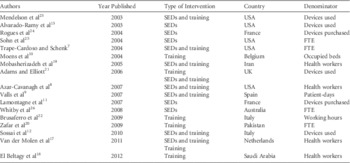
Study populations were defined in various ways, from the workers in 1 or a few hospital departments to employees of large hospital systems. There was also considerable variability in the total number of subjects, depending on the denominator used (Table 1). Study periods also varied from 12 monthsReference Van der Molen, Zwinderman, Sluiter and Frings-Dresen 17 to 10 years.Reference El Beltagy, El-Saed, Sallah and Balkhy 18 Most of the studies (59%) relied on data collected through an established surveillance system in which HCWs self-reported NSIs, whereas 41% of the studies relied on data collected by interviewers who contacted the participating HCWs and asked about their NSI experience over the previous 12 months. The studies we reviewed used 3 different definitions of the outcome being evaluated: NSIs, percutaneous injuries, and sharps injuries. These are closely related phenomena, and the overlap between them is considerable.
Characteristics of the Selected Studies

NOTE. SED, safety-engineered devices; FTE, full-time equivalent workers.
Summary Effects and Subgroup Analyses
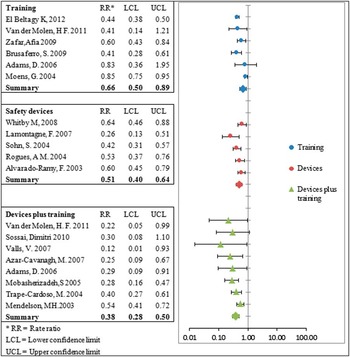
All of the interventions (ie, training, SEDs, and a combination of training plus SEDs) appeared to have protective effects (Figure 2). The introduction of SEDs combined with training was associated with greater protection than training interventions alone. Individual study results for the effect of the training intervention on the rate of NSIs ranged from 0.41 to 0.85, meaning that the NSI rate after training was 41%–85% of the rate before the intervention. The reported reductions in the rates of NSI from SEDs were generally even stronger with individual study effects, ranging from 0.26 to 0.64. The combined effects of training plus SEDs ranged from 0.12 to 0.54.
Forest plot of studies evaluating effects of 3 different interventions on the rate of needle-stick injuries.

A total of 6 studies evaluated the effectiveness of training interventions alone. All of these studies found protective effects. The summary effect of the training intervention was 0.66 (95% CI, 0.50–0.89). The Q-statistic was 54.4; df=5; P=.00 with I 2=90%. The former test indicates that the interstudy heterogeneity is too large to be likely due to chance alone, and the I 2 statistic also supports the finding of considerable interstudy heterogeneity.
The summary effect across the 5 studies that assessed the efficacy of SEDs alone was 0.51 (95% CI, 0.40–0.64). The Q-statistic was 8.5; df=4; P=.07 with I 2=53%. Unlike the summary effect for training, these statistics suggest a reasonable degree of homogeneity among the studies. A total of 8 studies evaluated the effectiveness of training plus SEDs. The summary effect was 0.38 (95% CI, 0.28–0.50). The Q-statistic was 9.4; df=7; P=.25, and I 2=26%. As with the SED interventions studies, this set of results appears to be reasonably homogeneous.
Subgroup Analyses for Alternative Denominators
We were concerned that the use of 3 different denominators for calculating NSI rates might have introduced important variability into the summary effect estimates. Overall, 4 studies evaluating the training plus SED intervention used the number of devices as the denominator, and another 4 studies used the number of HCWs as the denominator. The summary effects were somewhat different in these 2 subgroups. Using the number of devices, the summary effect size was OR=0.54 (95% CI, 0.41–0.69); however, when the number of HCWs was the denominator, the summary effect was even stronger: OR=0.35 (95% CI, 0.26–0.46). In both cases, the evidence was strong that the combination of training plus SEDs reduces the risk of NSI. All of the studies in the other 2 intervention subgroups used the same denominators; therefore, this sensitivity analysis could not be conducted for these subgroups.
DISCUSSION
The studies summarized here provide strong evidence that NSIs can be prevented. Despite differences in methodological approaches, the studies consistently showed significant effectiveness in reducing the risk of NSIs in healthcare settings. The training intervention reduced the rate of NSIs by 34% and the SEDs intervention reduced NSIs by 49%. When training was introduced along with SEDs, NSIs were reduced by 62%. We did not calculate an overall summary effect across all studies because of our a priori judgment that implementation of training alone, SEDs alone, and a combination of training and SEDs represented very different intervention strategies whose effects should not be averaged. A disadvantage of this decision was that each of the 3 subgroup analyses was based on a relatively small number of studies: 6, 5, and 8 for training, SEDs, and training plus SEDs interventions, respectively. In meta-analyses of this size, summary effect sizes should be interpreted with caution. We found evidence of heterogeneity of the effects of the training interventions, while SEDs and combined interventions had homogeneous summary effects.
The heterogeneity of the effect sizes among studies of training interventions may be due to the different content of training interventions, duration of interventions, and study populations. For example, some studies only included presentations on the use of standard precautions, while others added additional features such as the risk of infection from and the consequences of NSIs. In addition, some studies included all HCWs in a hospital, while other studies targeted specific occupational groups such as nurses. Many studies have reported that the risks of NSIs vary by occupation,Reference Wicker, Cinatl, Berger, Doerr, Gottschalk and Rabenau 27 – Reference Leigh, Wiatrowski, Gillen and Steenland 30 so it is reasonable to assume that the effectiveness of a training intervention may vary by occupation as well. However, we were unable to investigate this hypothesis because the number of studies reporting these specific data was very small.
Combining the 2 intervention approaches (training and SEDs) appears to be more effective than either intervention alone. This finding is in line with the conclusions of Ippolito et al,Reference Ippolito, Puro and De Carli 31 who argued that successful NSI prevention needed to encompass many different interventions. Our finding that SEDs appear to be more effective than training was not surprising because SEDs reduce the exposure by modifying or isolating the hazard.Reference Elder and Paterson 32 , Reference Tosini, Ciotti, Goyer, Lolom, L'Hériteau and Abiteboul 33 Training, in contrast, aims to reduce the risk by modifying the behavior of the subject (HCWs) without modifying the hazard from the devices.
In this meta-analysis, only 1 study that assessed the effectiveness of SED was conducted in a developing country.Reference Mobasherizadeh, Ebneshahidi, Mohammadi and Abazari 19 This is a concern because it suggests a lower level of concern for NSI prevention in developing countries, where the risk is, if anything, higher than that in the developed world.Reference Sagoe-Moses, Pearson, Perry and Jagger 34 , Reference Simonsen, Kane, Lloyd, Zaffran and Kane 35 The diffusion of SEDs in developing countries is subject to several practical impediments. First, SEDs are not widely available or used in healthcare setting because they are often considerably more expensive compared with the standard devices.Reference Tan, Hawk and Sterling 36 Furthermore, the design and manufacture of SEDs is more complex than for nonsafety devices. In addition, healthcare administrators may not view NSIs as a high priority, given other pressing healthcare needs.
The relative lack of research on NSI prevention in developing countries may also be partly attributed to barriers to epidemiologic research in these countries. Researchers may not be interested in this topic because they may have perceived that healthcare settings are a relatively safe place to work. Furthermore, a lack of training in healthcare surveillance research often discourages such studies. In addition, research funding may be more available for other communicable diseases with a wider at-risk population. Despite these concerns and challenges, some evidence has indicated that the introduction of SEDs in healthcare is not only health-protective but also cost-effective. 37 , Reference Glenngård and Persson 38
Several challenges need to be considered in interpreting the study findings. First, the current study included a variety of study designs with different levels of accuracy and precision. As has been noted, only 1 randomized trial was included.Reference Van der Molen, Zwinderman, Sluiter and Frings-Dresen 17 The possibility of biases in the individual studies that affected the summary effect estimates cannot be ruled out. Second, the populations included in the individual studies were diverse; some included only specific occupations such as nurses, and others included heterogeneous groups of different types of HCWs. Finally, most measures of association drawn from the individual studies were not adjusted for confounders, and the possibility remains that uncontrolled confounding biased the summary effects in some unknown way. Despite various drawbacks in the original studies, this meta-analysis did yield a quantitative summary of effects for 3 different NSI prevention interventions. All 3 interventions prevent NSIs, and the combination of training and SEDs is more effective that either intervention alone.
Acknowledgments
Financial support: Dr. Tarigan was supported by a Fulbright Scholarship.
Potential conflicts of interest: All authors report no conflicts of interest relevant to this article.