Centuries of Western European colonial rule fundamentally shaped political and economic outcomes in most non-European countries in part by creating the political institutions that countries inherited at independence.Footnote 1 Although European colonization occurred in various forms, millions of Europeans settling in North and South America, Oceania, and parts of Africa transformed the population and social structure of these colonies.Footnote 2 Considerable research on postcolonial legacies discusses how the strong organizational position of European settlers enabled them to demand representative political institutions,Footnote 3 and historical studies document that by the eighteenth century, these settlers elected representatives in many colonies, in some cases outpacing democracy in their metropole.Footnote 4 These arguments are consistent with the broader shift in the colonialism-democracy literature to focus on influential groups of people who migrated during colonial rule, which also included Protestant missionaries and forced migrants.Footnote 5
Despite ample research on postcolonial legacies, surprisingly little theory and systematic evidence addresses political institutions during colonial rule. Understanding the origins and evolution of colonial political institutions constitutes a crucial intervening factor linking varieties of colonial rule to posited postindependence legacies. Furthermore, examining colonial political institutions may provide fertile ground for assessing general theories of regime change usually tested with postin-dependence data.
This article opens the black box of colonial political institutions by building on wide-ranging debates of social scientists and historians to demonstrate the core democratic contradictions of European settlers. Although many European settler colonies created early representative institutions, this effect is limited to British settler colonies. Furthermore, even where European settlers created an early democratic advantage, they faced strong incentives to resist expanding the franchise. Contradictory democratic impulses yielded perverse institutional evolution and in many colonies undermined the earlier beneficial aspects of their British representative inheritance.
The article first assesses the origins of colonies’ representative institutions. Before World War I, elected representative institutions were the exception rather than the rule in European colonies and only became nearly universal after World War II. Why did some colonies gain early representative institutions? Many arguments posit under broad scope conditions that European settlers tended to transplant representative institutions early in the colonial era to protect property rights and to promote freedoms within the European community.Footnote 6 They also posit that large-scale European settlements broke down the traditional forms of authority that hindered postcolonial democracy in many colonies without sizable European populations.Footnote 7 Like much recent colonialism research, these accounts de-emphasize the importance of colonizer identity.Footnote 8 In contrast, another strand of the literature emphasizes the distinctiveness and benefits of British colonial rule,Footnote 9 which dovetails with the crucial historical observation that many European colonial metropoles lacked representative institutions. Despite the compelling idea that European settlers would seek to replicate political institutions from their country of origin, this impulse should not necessarily engender proto-democratic institutions. Why would European migrants promote political representation if they had no representative tradition on which to draw?
My first hypothesis posits that early representative institutions should pervade only British settler colonies. Britain’s strong history of representative institutions distinguishes it from other major European colonial powers.Footnote 10 Strikingly—given the centrality of colonial political institutions to the broader debate—no prior research presents systematic data on electoral representation during colonial rule. I introduce data on the first year with an elected representative body for 144 Western European colonies across the entire period of European overseas colonial rule, ranging from elections for the Virginia assembly in 1619 to Hong Kong’s first legislative council elections in 1985. The evidence demonstrates a qualified European settler effect: British settler colonies, but not settler colonies outside the British Empire, are associated with early elected representation.Footnote 11 Prior to the nineteenth century, no non-British colonies exhibited electoral representation in a colony-wide legislature, but electoral representation was common in British North America and the British Caribbean. Some French settler colonies gained representation in the nineteenth century—following democratic advances in metropolitan France—whereas Spanish and Portuguese colonies are notable for the complete absence of electoral representation before World War II.
Did early representative institutions yield a smooth path to eventual democratization? To examine institutional evolution, the second part of the article engages debates about franchise expansion. Even in British settler colonies, early political institutions represented only the white population, which in many cases was a small fraction of the total population. Two strands of literature yield divergent expectations for how these representative institutions should evolve. In one, Robert Dahl provides an influential argument linking competitive oligarchic institutions to subsequent polyarchy, which many refer to simply as “full” democracy in the sense of high contestation and high representation.Footnote 12 Establishing electoral competition among a small and cohesive elite like European settlers, followed by mass franchise expansion, should provide a favorable path to establishing full democracy. In such cases, “the rule, the practices, and the culture of competitive politics developed first among a small elite. . . . Later, as additional social strata were admitted into politics they were more easily socialized into the norms and practices of competitive politics already developed among the elites.”Footnote 13 This sequencing contention corresponds with Jacob Hariri’s argument that European settlers facilitated democracy by breaking down precolonial authority structures and establishing direct rule.Footnote 14
In the other strand, democratization theories focused on social classes and economic redistribution anticipate a perverse trajectory. Empirically, in most colonies with sizable and politically influential European populations, European minorities composed a landlord class that dominated large swaths of the territory’s most fertile land, sometimes organized into plantations. Privileged landed classes organized as political oligarchies should oppose widespread democratic franchises that would dilute their political and economic power. This logic features centrally in Daron Acemoglu and James Robinson’s and Carles Boix’s models of franchise expansion, as well as in much of the related class-based democratization literature.Footnote 15
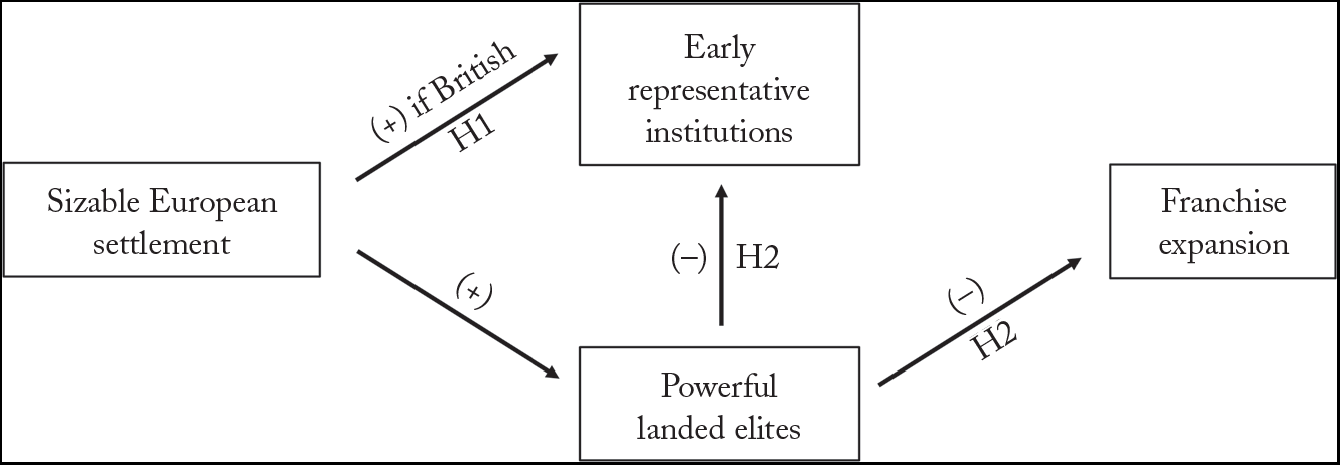
My second hypothesis draws on these class-based insights to posit that sizable European settler minorities should resist franchise expansion to include the nonwhite majority, and this resistance should tend to dilute political competition. I examine three regions with early representative institutions: two that contain most of the sizable European minority colonies (Africa and the British Caribbean) and one with a tenuous majority (US South). I analyze separate periods for each region to focus on pivotal moments in which a previously dominant white oligarchy faced a challenge from nonwhites. This occurred in Africa after World War II amid the continent-wide “wind of change,” in the British Caribbean during the mid-nineteenth century following the end of slavery in the British Empire, and in the American South after the Civil War. An analysis of data on franchise size from Africa, legislative disbandment from the Caribbean, and voting restrictions from the United States, along with qualitative evidence of mechanisms from these regions, demonstrates that ascendant but challenged white oligarchies exerted major resistance to expanding the franchise to nonwhites, and that these actions negatively affected democratic contestation. Figure 1 summarizes the two hypotheses.
Theoretical Hypotheses

These findings carry important implications for understanding colonial-era institutions, testing general theories of democratization, and comprehending postcolonial legacies. Collectively, evidence for the two hypotheses demonstrates core democratic contradictions in European settler colonies. Only British settler colonies systematically created early representative institutions, but due to vested class interests, these colonies generally exhibited significant resistance to expanding the franchise. Evidence for the institutional evolution hypothesis supports mechanisms from class-based theories of democratization as opposed to theories of early settler colonies following the heralded Dahlian path from competitive oligarchy to polyarchy. This evidence also circumscribes the beneficial British legacy posited by the institutional origins hypothesis and expounded in considerable colonialism research. Although British settlers promoted early representation, they also resisted franchise expansion even at the cost of worsening the quality of their representative institutions. A brief analysis of postcolonial legacies in this article’s conclusion shows that because of these contradictory democratic tensions, European settlers at best tended to bequeath ambiguously beneficial democratic legacies. Among forty-six postcolonial countries that had sizable European populations while colonized,Footnote 16 only four historically exceptional neo-Britains (Australia, Canada, New Zealand, and the United States) and three smaller island nations (Bahamas, Barbados, and Mauritius) exhibit (1) early creation of elected representative bodies, (2) no large-scale settler resistance to franchise expansion during the colonial period (either legislative disbandment or a major liberation war by nonwhites), and (3) democratic rule at independence. Furthermore, even some countries that meet all three conditions contain notable democratic contradictions. For example, the United States combines a long history of competitive elections and high constraints on the executive with an equally long history of enslaving or politically marginalizing nonwhites. “[A] nation born in contradiction, liberty in a land of slavery . . . will fight, forever, over the meaning of its history.”Footnote 17
Theory
Implanting early representative institutions required a group willing and able to lobby for such reforms. Although European settlers tended to exhibit economic and political influence wherever they settled in large numbers, many originated from metropoles that did not contain representative institutions. Only European settlers emanating from a home country with a representative tradition should promote early electoral institutions, which empirically distinguishes Britain from other major Western European colonial powers.
Regarding institutional evolution, for settler colonies that established early representative institutions, class-based theories of political transitions suggest an important impediment to maintaining representative institutions and to broadening the franchise to create full democracy. Large-scale resistance by European landed interests to perpetuate their political power carried negative implications for both democratic participation and contestation. This contrasts with Dahl’s argument that elites with a history of limited representative institutions should peacefully incorporate the masses into the polity,Footnote 18 and highlights a core democratic contradiction in European settler colonies.
Institutional Origins: Metropolitan Political Institutions
Why did some colonies gain early representative institutions? Existing research stresses the strong organizational position of European settlers that enabled them to demand political representation.Footnote 19 Considerable evidence, summarized below, indeed establishes the dominant economic and (often) political position that European settlers commanded. This contrasts with nonwhites who were subjugated in the colonial order and whom European officials thought unfit for self-rule.
Only European settlers who descended from a metropole that itself had a representative tradition should create early representative institutions. The general logic for qualifying the institutional origins hypothesis is straightforward. International powers with more liberal domestic political institutions are more likely to promote liberal institutions elsewhere, and the position of domestic elites on democracy promotion depends on their relationship with liberal polities. Much existing research on this topic focuses on post—Cold War actions by the United States and the European Union to promote democracy in the excommunist world and elsewhere. Their stances contrast with authoritarian powers, such as China and Russia, which either do not make electoral institutions a precondition for support or actively oppose democratic institutions. The beliefs and incentives of citizens within target countries should also matter. For example, Steven Levitsky and Lucan Way argue that in the post—Cold War world, countries with high “Western linkage” are likely to democratize because economic, cultural, and communication ties between their citizens and Western countries create greater desire for democratic institutions.Footnote 20 Although their theory does not require elites in non-Western countries to have emigrated from the West to hold these preferences for democratic institutions, such elites are akin to European settlers in the setting discussed here because affinity toward liberal institutions causes demands for electoral reform.
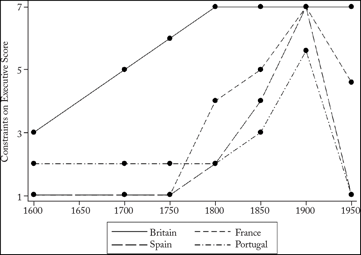
Did European colonial powers exhibit important differences in their representative institutions? Across several centuries of European colonial rule, Britain (and earlier, England) exhibited a stronger representative tradition than did Spain, Portugal, or France. Figure 2 depicts constraints on the executive for these four major Western European colonizers over fifty-year intervals between 1600 and 1950. The data draw from the Polity IV data set and from Acemoglu, Simon Johnson, and Robinson.Footnote 21 Each data point averages twenty-year windows before and after the stated year.Footnote 22 Smoothing the data provides snapshots of the differences in metropolitan executive constraints across European empires over time without depicting sharp fluctuations in democratic constraints at various periods (for example, the struggle in England between the Crown and Parliament during most of the seventeenth century).
Metropolitan Executive Constraints in Half-Century Snapshots

A notable trend in Figure 2 is that Britain’s constraints on the executive grew during the first major periods of imperial expansion and contraction, which David Abernethy dates between 1415 to 1773 and 1775 to 1824, respectively.Footnote 23 Kevin Narizny compares estates in medieval and early modern Europe and concludes, “Only in England did a medieval assembly evolve into a representative parliament with sovereign authority over the crown, and only in England was liberal protodemocracy a stable equilibrium.”Footnote 24 Especially after the Glorious Revolution in 1688, Britain exhibited parliamentary constraints on the monarch unmatched by other major colonizers,Footnote 25 and British settlers strongly imbued representative norms.Footnote 26 By contrast, the Spanish monarchy retained absolute power until the Napoleonic Wars in the early nineteenth century, which caused it to lose most of its American colonies.Footnote 27 Collectively, the British and Spanish American empires accounted for almost every colony with a sizable European population during this period.
Britain also differed from other European powers with settler colonies during the second major waves of expansion (1824 to 1912) and contraction (1940 to 1980).Footnote 28 The major migration of Portuguese settlers to Angola and Mozambique starting in the 1930s began during Antonio de Oliveira Salazar’s dictatorship,Footnote 29 which had the lowest possible Polity IV executive constraints score. France represents a mixed case. It exhibited high executive constraints between 1877 and 1939, and again between 1947 and 1957. But unlike Britain, France exhibited prolonged struggles between authoritarian and democratic forces throughout the nineteenth century, in the twentieth century during World War II, and again the late 1950s with the establishment of the Fifth Republic. Even during democratic periods, France’s politics were unstable compared to Britain’s.Footnote 30 For example, elected officials in France’s Fourth Republic were susceptible to pressure from special interests, such as European settlers and the military, due to unstable governments and weak party discipline.Footnote 31 Furthermore, Britain and France practiced different colonial governing philosophies. Although some scholars exaggerate the differences between Britain’s indirect rule policies and France’s preferences for more centralized control, variance in delegation practices did meaningfully affect prospects for institutional transplantation.Footnote 32 For example, France “tightly controlled” European settlement in French Algeria and “the Algerian enterprise received much greater governmental supervision and the population was subject to a greater degree of regulation, unthinkable in a contemporary British colony.”Footnote 33
Overall, these differences, which spanned centuries, implied that colonial officials and settlers in the British Empire had a stronger representative tradition on which to draw, yielding:
—H1. Institutional origins. Colonies with a sizable European settler population should be more likely than nonsettler colonies to elect political representatives, but only if the metropole has a representative tradition (which empirically corresponds closely with British colonial rule).
This hypothesis relates to broader debates about the importance of colonizer identity and metropolitan institutions. Research on European settlers usually de-emphasizes the importance of colonizer identity,Footnote 34 which echoes broader shifts in the colonialism-democracy literature.Footnote 35
These accounts instead argue that selection effects explain any British colonial distinction. For example, Acemoglu, Johnson, and Robinson claim, “It appears that British colonies are found to perform substantially better in other studies in large part because Britain colonized places where [large-scale European] settlements were possible, and this made British colonies inherit better institutions.”Footnote 36 Hariri argues that British and Spanish settlers drew from similar legacies because neither metropole was fully democratic in the eighteenth century,Footnote 37 and that Spanish-American settlers created “a system of comprehensive checks and balances” during the colonial era that “facilitated the spread of early representative institutions.”Footnote 38 Similarly, Robert Woodberry argues, “Some scholars suggest that British colonialism fostered democracy . . . but this may be because [Protestant missionaries] had greater influence in British colonies.”Footnote 39
Although several studies on economic development argue that the beneficial effects of European settlers are limited to British colonies,Footnote 40 my argument emphasizes distinct considerations—focused on political institutions—about British colonialism. Matthew Lange, James Mahoney, and Matthias vom Hau expound the distinction between British liberal economic institutions and Spanish mercantilist institutions,Footnote 41 and Mahoney compares differences in mercantile and liberal Spanish economic institutions over time. But the more theoretically relevant focus for studying democracy concerns the differences in Britain and Spain’s political institutions.Footnote 42 Matthew Fails and Jonathan Krieckhaus appeal to a broad range of factors that distinguish British settlers and argue that British settlement is essentially a binary variable that differentiates only the neo-Britains from the remainder of the empire.Footnote 43 But Britain also colonized numerous territories in the Caribbean that, despite featuring smaller European populations, nonetheless drew from a similar representative tradition as contemporaneous North American settlers.Footnote 44 Hypothesis 1 also applies to these colonies.
Institutional Evolution: Landed Oligarchs and Resistance to Franchise Expansion
Did early representative gains yield a smooth path to eventual democratization? Applying mechanisms from class-based theories of democratization and democratic consolidation to settler colonies demonstrates the strong incentives of landed European elites to block expansion of political participation. Landed elites feature centrally in class-based theories, which have a long history in political science. Barrington Moore famously proposed “no bourgeoisie, no democracy,” which recent research expounds.Footnote 45 Other studies focus on either the working classFootnote 46 or the interplay between the working class and political elites.Footnote 47 Regardless of the specific actor posited to promote democracy, class-based theories agree that landowning elites should repressively resist franchise expansion, especially in circumstances of high land inequality. Boix and Acemoglu and Robinson posit one plausible mechanism for this.Footnote 48 Their theories examine how a minority elite group and the masses strategically interact. The masses may pose a revolutionary threat because of their numerical superiority, which enables them to achieve concessions from the political/economic elite. But elites who control political power amid high economic inequality face incentives to repress rather than to expand the franchise to include the masses, who would redistribute considerable income from the elites to themselves. Landlords particularly fear majority rule because land is a nonmobile asset that is relatively easy to redistribute.Footnote 49
Existing theories focus on the incentives of landowning elites to prevent franchise expansion, and examine democratic participation rather than contestation. But two mechanisms can account for why actions to resist broad political participation should also diminish the quality of contestation. First, it may be possible for elites to maintain low participation—at the expense of sacrificing high contestation—by delegating authority to an authoritarian strongman who can better counteract threats from below. For example, Dan Slater argues that serious threats from below cause elites to replace democratic representation with authoritarian “protection pact” institutions that can better counteract the threat, as in postcolonial Malaysia and Singapore.Footnote 50 Second, antienfranchisement repression should foster more extreme opposition leaders. Mehdi Shadmehr shows that higher repression deters moderates from participating in organized antigovernment movements because moderates are less willing to pay the associated participation costs.Footnote 51 Relatedly, repression should also raise the likelihood of fostering extremist opposition leaders who have a comparative advantage in coercion rather than in electoral participation,Footnote 52 perhaps in the form of revolutionary vanguard parties.
The conditions under which class-based theories expect democratic resistance to expanded electoral participation closely match empirical conditions in colonies with a sizable European minority, most of which exhibited highly unequal land distribution patterns between Europeans and non-Europeans, as discussed below. Although the European settlers controlled assets in addition to land, many of these colonies were founded by displacing natives or by settling forced migrants onto European-controlled plantations, thereby making land a crucial source of economic and political power. In earlier work, I discuss how European land control in African settler colonies created broad interests against majority rule even among nonfarming whites.Footnote 53 Through land and other assets, colonial European settlers wielded considerable political influence, and by lobbying the metropole or by directly controlling the top political offices they could achieve their preferred economic policies, such as controlling the best land or distorting the labor market.
There are two additional scope conditions for when European settlers should engage in widespread resistance to electoral participation by nonwhites. First, resistance should occur only if European settlers are politically powerful—although this power could diminish over time, as occurred in the British Caribbean. Second, heavy repression should not be necessary to exclude nonwhites from political participation in territories with large European majorities that lack a sizable threat from below. Therefore, the overall relationship between European population share and incentives to exercise heavy repression should be nonmonotonic. Most constituent territories within the neo-Britains exhibited large European majorities. Although the native populations were smaller and the land was less densely populated in North America and Oceania than in many other parts of the world, aggressive European expansion early in the colonial period and natives’ lack of immunity against European diseases, which resulted in genocide-magnitude population decline, enabled the preponderance of Europeans. The one exception among the neo-Britains is the colonies/states in the American South. Because millions of enslaved Africans were forcibly moved to the region, it largely fits the scope conditions under which elites should exhibit large-scale resistance toward franchise expansion. Overall, these considerations imply:
—H2. Institutional evolution. In the presence of threats from below, sizable European settler minorities (if politically dominant) should pursue large-scale resistance to enfranchising nonwhites more frequently than in colonies with very small or very large European populations, and these actions should hinder democratic participation and contestation.
Although strategies to defend elite privilege are central to class-based theories, existing colonialism research mentions this mechanism only in passing. Fails and Krieckhaus argue that British colonies other than the neo-Britains did not exhibit meaningful variation in settler population size, and therefore medium-size British settler colonies should not differ from colonies largely devoid of European settlement. They also briefly mention that by creating an interest group that favored extractive economic institutions, small Spanish settlements could have engendered worse development legacies than colonies without settlement, which resembles my argument.Footnote 54 Lange, Mahoney, and vom Hau distinguish British from Spanish colonies based on liberal/mercantile institutions, but differences in economic institutions are less important for explaining democratic trajectories.Footnote 55 Mercantile policies might contribute to creating “entrenched actors who benefit from state privileges,”Footnote 56 but many British colonies in the Caribbean and in southern Africa contained similarly privileged European elites—even though Imperial Britain and Spain pursued divergent economic policies.
Hypothesis 2 is also theoretically intriguing because juxtaposed to Hypothesis 1 it shows how an explanatory factor can yield divergent implications for different components of democracy, a largely novel consideration for colonialism research. Much research on European settlement focuses on the distinct outcome of economic development, and studies specifically on democracy tend not to disaggregate its components. Although Acemoglu and colleagues and Hariri discuss one positive effect of European settlement on democratic contestation,Footnote 57 neither they nor their critics scrutinize how entrenched settler oligarchies’ incentives to restrict franchise expansion can undermine earlier contestation gains.
Assessing Institutional Origins
Did most varieties of European settler colonies experience early representative institutions, or was this feature largely limited to British colonies? Analyzing newly compiled data on elected colonial legislatures from the seventeenth to twentieth centuries supports Hypothesis 1. Statistically, British settler colonies—but not settler colonies outside the British Empire—are associated with elected legislatures before 1945.
Data
This section briefly describes the data in Figure 3 and Table 1 (both below). Section A.1 of the supplementary material provides more detail.Footnote 58 Table A.1 of the supplementary material lists every territory in the sample, the first year with a colonial legislature, score on the settlers’ variable, and colonizer. Table A.2 provides summary statistics.
Sample
The sample consists of a panel of 144 former Western European colonies and begins in 1600.Footnote 59 It includes numerous small islands in the Caribbean and Pacific, including several present-day dependencies. Due to data constraints, in most cases the units correspond to modern-day countries, with exceptions for Spanish American states in which the postcolonial countries do not correspond with colonial units, and six ex-British countries that combined multiple colonies at independence or after a lengthy existence as distinct colonies (six in Australia, four in Canada, four in South Africa, two in St. Kitts and Nevis, two in Trinidad and Tobago, and thirteen in the United States). Temporally, the sample includes only years under colonial rule.
Colony-Wide Elected Representative Body
This article introduces self-collected data for each colony on elections to a colony-wide representative body. A coding document provides extensive details and the sources used to code this variable.Footnote 60 The nature of elected representative bodies differed widely across empires and over time within empires. In some cases, such as assemblies in seventeenth-century British America, these elected bodies possessed extensive legislative powers. In other cases, such as many legislative councils in the British Empire from the nineteenth century on, these bodies were considerably less powerful than the colonial executive was and at least one, but not all, members were elected. For British colonial legislative councils and similar bodies in other empires, the coding requirement is that at least one member was elected rather than all members or even a majority. For example, although Britain created a legislative council for St. Lucia in the 1830s, the first year with any elected members is 1924, the year the data set uses. In other empires, representative bodies like the delégations financières introduced in Algeria in 1898 or the Volksraad introduced in Indonesia in 1916 lacked formal legislative powers and were purely advisory but meet the criteria of an elected representative body.Footnote 61 In addition, the colony-wide criterion excludes local bodies, such as town councils (cabildos; see below for more detail) in Spanish America and municipal councils. It also excludes elections to an empire-wide legislature, which France introduced in 1789 and allowed intermittently throughout the nineteenth century, because these legislatures did not grant colonial citizens or subjects voice over their own governance. In most colonies prior to World War II, the population percentage that could vote (if any) was very small.
The new data set documents colonial electoral bodies across a broader sample and period and provides more extensive documentation than earlier data sets. Most standard democracy data sets provide only post-independence data. Varieties of Democracy (v-dem) provides data on franchise size in colonies in the twentieth century,Footnote 62 but lacks earlier information or coverage for many smaller countries. A recent expansion of v-dem extends back to 1789, but Historical v-dem only covers countries that gained independence before 1900 and thereby excludes the bulk of the Western European colonial world. Fifty-seven colonies in my data set gained electoral representation prior to 1900, including thirty before 1789. The Political Institutions and Political Events data set also provides some information on legislative elections, but only exhibits widespread coverage of years under colonial rule after 1945.Footnote 63
European Settlers Variable
The main European settlers variable indicates whether a territory contained a European population share of at least 5 percent at any point in the colony’s history.Footnote 64 Several considerations motivate using this simple binary measure: the panel spans a very long period, some countries fluctuate considerably in European population share over time, and data on colonial European populations are inherently uncertain further back in time. Although 5 percent may appear to be a low threshold, the cases discussed below show that even colonies with relatively small European minorities fit the scope conditions of the theory that the European settler population is large enough to exhibit political influence. To show that the results do not depend on a particular population threshold, robustness checks analyze a logged continuous European population—share variable that fluctuates throughout the colony’s history.
Colonizer Identity
Colonizer identity is based on the final Western European country that ruled the territory. The sample excludes all years prior to the final colonizer gaining control (see Section A.1 in the supplementary material).Footnote 65 For example, because Britain conquered Mauritius during the Napoleonic Wars, the sample includes Mauritius as a British colony from 1814 until independence but excludes it before 1814.
Main Patterns
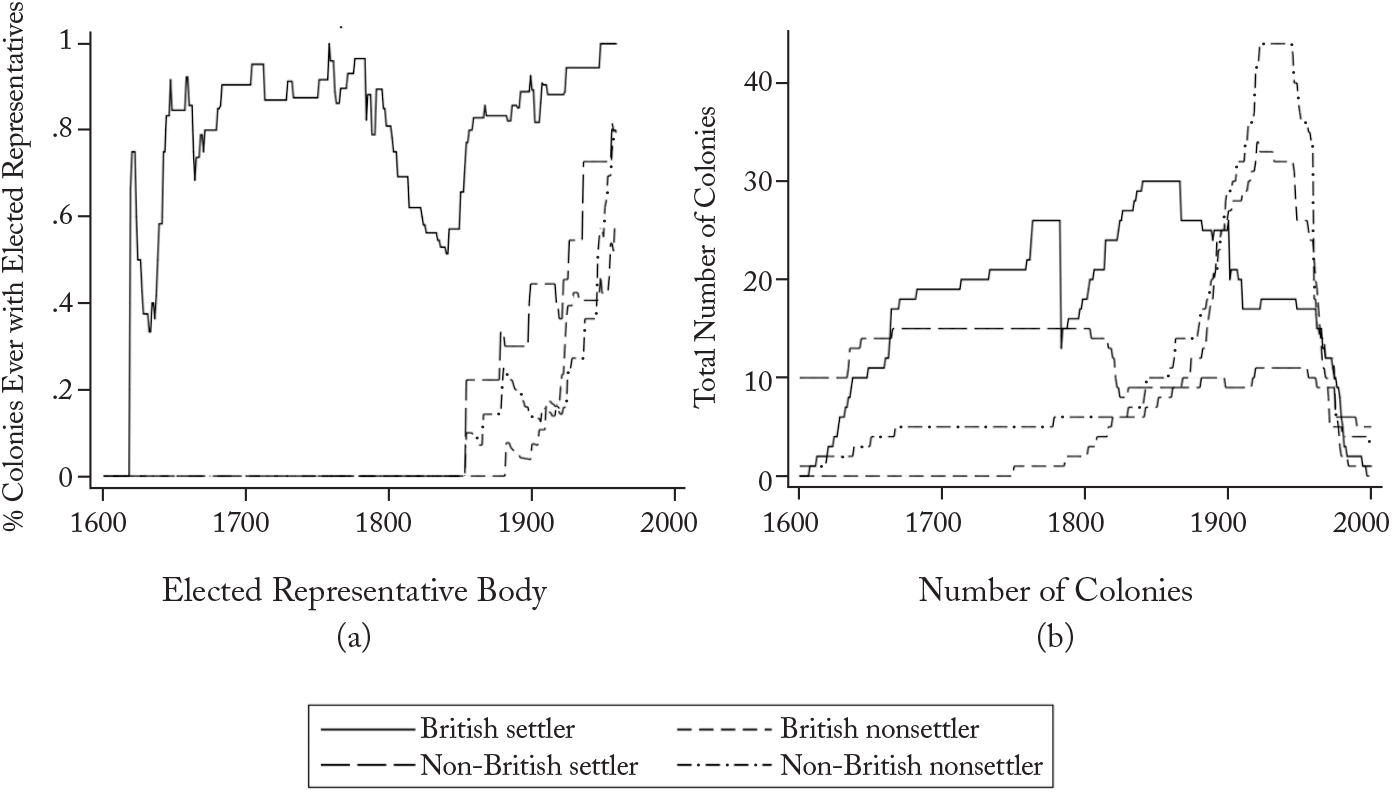
Figure 3 shows the percentage of colonies with an elected representative body between 1600 and 1959, disaggregated by settler/non and British/non. Panel (a) codes a colony year as 1 if the colony ever had an elected colonial representative body, and 0 otherwise. Because the dependent variable is whether a territory has ever had representative institutions, percentage dips occur either because a new territory entered the sample and did not immediately gain elected representation or because a colony with a representative body gained independence.Footnote 66 The cutoff year for panel (a) is 1959. The percentages are exceedingly difficult to interpret after 1959 because the number of colonies dropped precipitously in the 1960s, generating rapid fluctuation in the sample. Panel (b) shows how the sample changes over time by presenting the number of colonies by category through 2000.
Elected Colonial Representative Bodies Since the Seventeenth Century

Analyzing three distinct periods in Figure 3 yields the main takeaways.
Early Colonies
Until the mid-nineteenth century, elected representative bodies were exclusive to British settler colonies. All colonies founded by English settlers in North America and the Caribbean and some colonies founded by British conquest created elected legislatures shortly after colonization. Starting in the 1840s, similar political developments occurred in British colonies in Oceania and in southern Africa. Jack Greene discusses New World colonies and shows evidence that for Englishmen, liberty was “not just a condition enforced by law, but the very essence of their national identity.”Footnote 67 Settlers’ colonial assemblies consciously sought to replicate the English House of Commons and to obtain corresponding political privileges.Footnote 68 British North American colonies largely controlled their internal affairs, and their legislatures outpaced the House of Commons in terms of autonomy due to their “continuous and continuing British connection and the tremendous impact of the British constitution upon their own perception of the constitutional order.”Footnote 69 Even in small Caribbean islands with less ability to resist metropolitan British encroachment, legislatures exerted considerable autonomy, fully controlling finances and exercising extensive executive powers.Footnote 70
These British institutions contrast sharply with the despotisms of eighteenth-century Spanish, Portuguese, and French American empires.Footnote 71 Samuel Finer quotes Adam Smith’s The Wealth of Nations, written in 1776: “In everything except their foreign trade, the liberty of the English colonists to manage their own affairs in their own way is complete. . . . The absolute governments of Spain, Portugal, and France, on the contrary, take place in their colonies.”Footnote 72
Spain, which possessed most of the remaining American colonies at the time, practiced direct authoritarian rule. The Spanish Crown did not legally permit colonial officials to perform any executive or legislative functions. “Formal power was not shared by anyone outside the immediate Council and the king,”Footnote 73 local officials functioned solely as judiciaries, and no colony-wide parliamentary bodies were established.Footnote 74 Cabildos were the one institution with some popular participation at the local level, but shortly after towns were formed the Crown typically diminished the power of cabildos and sold the office to raise revenues.Footnote 75 “As a repository of people’s liberty, a training school for the democratic system to be set up after independence, the cabildo possessed no potency at all. It had little or no freedom in action or responsibility in government. Its weakness was not a recent development at the turn of the nineteenth century. On the contrary, the institution had been in a state of collapse for generations.”Footnote 76 The first and only attempt to promote general elections for the Spanish American Empire occurred in 1809 in response to turmoil in Spain caused by the Napoleonic Wars, but even these elections were to an empire-wide assembly in Spain rather than to local legislatures—and colonial representatives were never seated in the Junta Central.Footnote 77
These differences also highlight the importance of colonizer identity relative to natural endowments.Footnote 78 At the turn of the nineteenth century, elected legislatures pervaded British territories regardless of whether the territory was suitable for small-scale farming (former colonies in the northern United States and Canada) or for sugar plantations (much of the Caribbean), and the exceptions arose because of shifts in British colonial policy (discussed below). Spain imposed authoritarian institutions across South America, Central America, and the Caribbean despite varying endowments, as did France among its Caribbean sugar colonies and in Quebec prior to 1763.Footnote 79
Late Nineteenth Century
Several settler colonies outside the British Empire gained electoral representation starting in the mid-nineteenth century. Shortly after the 1848 Revolution in France and the establishment of the Second Republic, Guadeloupe and Martinique in the Caribbean and nonsettler Réunion in the Indian Ocean each created a conseil général; French Guyana and nonsettler Senegal followed suit several decades later.Footnote 80 Whites in Algeria (France’s primary settler colony) gained representation at the end of the nineteenth century, but French Morocco never gained a legislature, and neither did the authoritarian-ruled Portuguese settler colonies in Africa prior to 1945. Rupert Emerson qualifies the importance of representative assemblies in centrally ruled French colonies: “Despite the revolutionary tradition of liberty and equality, the French colonies offered little in the way of democratic institutions . . . At best the French created advisory councils of a dubiously representative kind with some financial and administrative powers but little general legislative competence,” consistent with France’s strong propensity for direct colonial rule.Footnote 81
According to Stephen Roberts, during the last decades of the nineteenth century amid debates about administrative issues in Algeria, “There was no question of self-government at all—no thought that the French colonies should follow the English in going from oligarchic to representative and then to responsible government.”Footnote 82 Even electoral reforms implemented in 1898 “did not envisage anything in the nature of the English autonomy or self-government: it simply meant the development by French officials as before, but in the new direction of the colony’s own interests,” as opposed to the earlier policy of controlling Algeria “from Paris and on exclusively French models.”Footnote 83
Post–World War I
By the 1930s, many nonsettler colonies had established elected legislatures, including British India (1910), British Nigeria (1923), and French Mali (1925). Only in the decades after World War II did British nonsettler colonies and non-British colonies converge to British settler colonies. France introduced legislative elections across its sub-Saharan African colonies in the 1940s and 1950s, Britain gradually decolonized its entire empire, and Portugal belatedly attempted to gain African support of the colonial project in the early 1970s by introducing elections.Footnote 84
Statistical Evidence: British Settler Colonies and Early Elected Representation
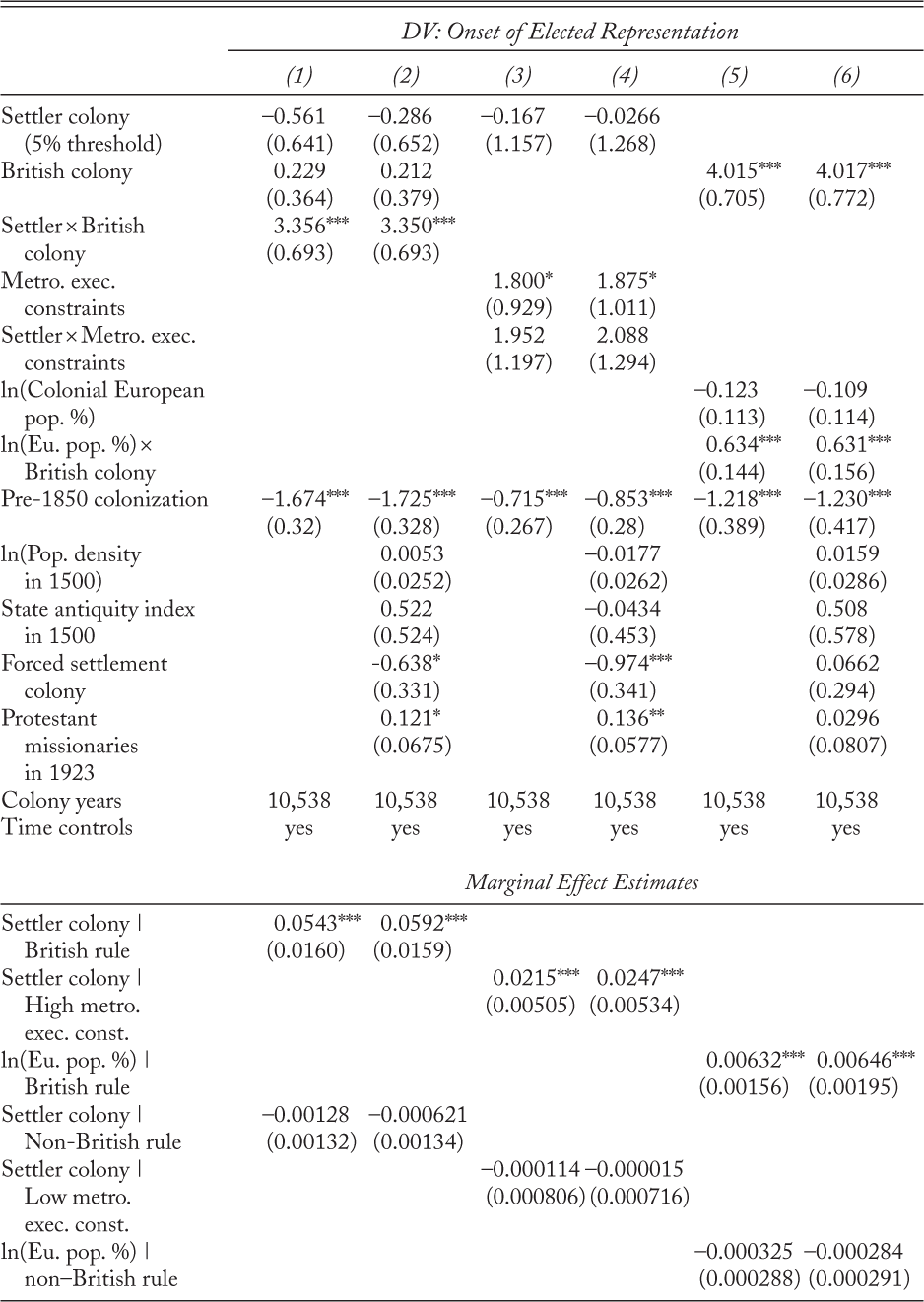
Table 1 statistically assesses correlates of early electoral representation under colonial rule. It uses the same data as in Figure 3, but the sample ends in 1945, the beginning of the terminal colonial period, to correspond with early elected representation. The table presents estimates from a series of logit models with standard errors clustered by colony. The dependent variable captures election onset, equaling 0 in all years under colonial rule before the first year with any elected representatives and 1 in the first election year, and is set to missing in all subsequent years. Every specification contains cubic polynomials that count years since colonial rule began, and a fixed effect for early colonial onset (pre-1850). Abernethy, Ola Olsson, and others argue that the nature of colonial rule changed over time, including most empires shifting from mercantile- to imperial-based colonial rule during the midnineteenth century.Footnote 85
Column 1 uses the binary settlers indicator for whether the colony ever had a European population share of at least 5 percent, and interacts it with British colonialism. Column 2 controls for four alternative explanations from the literature: population density in 1500, a territory’s history of statehood in 1500, a forced-settlement colony indicator, and colonial Protestant missionary population. Acemoglu, Johnson, and Robinson argue that Europeans faced difficulties creating large settlements in territories with high population density,Footnote 86 and Hariri argues that territories with a long history of statehood were better able to resist European encroachment.Footnote 87 Relatedly, Mahoney evaluates the effect of complexity of the indigenous society on varieties of colonialism within the Spanish Empire.Footnote 88 Olukunle Owolabi and Woodberry each focus on other colonial-era actors argued to promote democracy, forced settlers and Protestant missionaries, respectively.Footnote 89 Owolabi’s indicator for a large forced-settlement population is nearly synonymous with plantation colonies, and therefore operationalizes Stanley Engerman and Kenneth Sokoloff’s argument that land endowments favorable for plantation-type agriculture generated large slave populations and high inequality.Footnote 90 As noted above, many of these scholars explicitly argue against any Britain effect, and therefore controlling for these factors addresses the most important confounding concerns identified in the literature.Footnote 91 Column 3 replaces the British colonial rule indicator with an indicator for high metropolitan constraints on the executive,Footnote 92 and column 4 adds the four covariates. Column 5 replaces the European settlers indicator with the continuous measure of European population share, and column 6 adds covariates.
Correlates of Elected Representative Bodies: Colonial Rule 1600–1945a

***p < 0.01, ** p < 0.05, * p < 0.1
a Table 1 summarizes a series of logit regressions by presenting coefficient estimates and colony-clustered robust standard error estimates in parentheses using two-sided hypothesis tests. The bottom part of the table presents the marginal effect estimates and corresponding standard error estimates for the European settlers variables under various values of the conditioning variables.
Table 1 robustly supports Hypothesis 1. In all columns, the marginal effect estimate for European settlers is positive and statistically significant among British colonies or colonies whose metropole had high executive constraints, but it is not so among non-British colonies or colonies with low metropolitan executive constraints. In column 1, the predicted failure rate is thirty-four times higher for British settler colonies than for non-British settler colonies, fifteen times higher than for British nonsettler colonies, and nineteen times higher than for non-British nonsettler colonies. The supplementary material shows qualitatively similar results when altering the original models to end the sample in 1918 as an alternative conceptualization of early electoral representation (Table A.3), or when excluding the twenty-four colonial units within the four neo-Britains (Table A.4).Footnote 93
It is also possible, in principle, that historical population density or state antiquity can explain variation in adopting elections among British settler colonies, given Mahoney’s argument that the complexity of the precolonial society affected the mode of colonial rule and John Ger-ring and colleagues’ evidence that Britain tended to more directly rule territories with a shorter history as a centralized state.Footnote 94 However, in contrast to the Spanish American cases that Mahoney analyzes and to the sample of twentieth-century British colonies that Gerring and associates examine (which excludes many of the British settler colonies in my sample), the British settler colonies in Table 1 vary little in pre-colonial complexity. All the British settler colonies except Belize lacked any history of statehood above the local level in 1500, and all but Belize had no greater than the median level of population density in the sample in 1500.
Section A.3 of the supplementary material disaggregates British settler colonies by whether British settlement or conquest founded the colony.Footnote 95 Whereas legal precedents enabled British inhabitants of settled colonies all the political rights of British subjects, London exercised discretion regarding whether to extend rights to conquered colonies. Furthermore, although by definition settled colonies consisted of British settlers, many conquered colonies contained sizable non-British European populations upon British conquest. Table A.5 in the supplementary material shows that British settled colonies indeed gained electoral representation earlier than British conquest colonies with sizable settler populations, although both are statistically significantly different from British nonsettler colonies.Footnote 96
Assessing Institutional Evolution
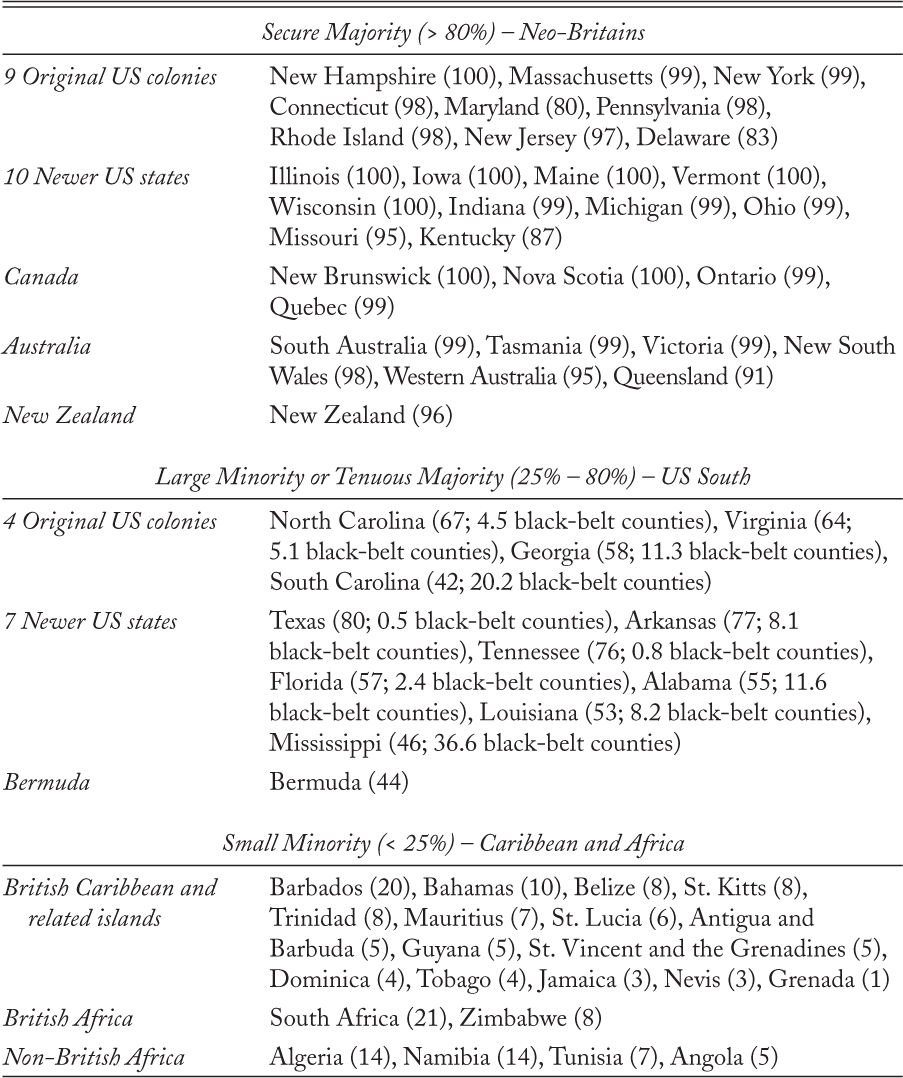
Although only British colonies empirically support arguments that colonial European settlers facilitated early representative institutions, this finding does not rule out the possibility that European settlers across the vast British Empire (or other colonies with early representative institutions) regularly bequeathed democratic institutions that postcolonial states inherited at independence. Countering this possibility, this section analyzes institutional evolution in settler colonies and demonstrates that politically influential landed classes typically resisted franchise expansion to a rising nonwhite majority, consistent with Hypothesis 2. I analyze three regions that collectively contain most colonies with relatively early representative institutions and sizable European minorities (Africa and the British Caribbean) or tenuous majorities (the American South); see Table 2.Footnote 97 I analyze separate eras for each region to concentrate on pivotal periods during which a previously dominant white oligarchy faced a challenge from nonwhites. For each region, quantitative evidence of aggregate patterns coupled with qualitative evidence of mechanisms supports the theoretical expectation of resistance to franchise expansion by vulnerable settler oligarchies. Section B.2 in the supplementary material analyzes informative null cases: British Caribbean colonies after World War I.Footnote 98
European Population Percent in British (and Select Other) Settler Coloniesa

a Using the same settler colony threshold as in Table 1 (European population share of at least 5 percent at any point in the colony’s history), Table 2 lists every British settler colony in the New World and Africa, and all non-British settler colonies in Africa, which collectively comprise nearly every colony with elected representation at any point before World War I. Whereas the sample in Table 1 only includes the thirteen US colonies, Table 2 lists every US state that joined the Union before 1850, which provides the sample of 30 US states used in Figure 6 (see below). Table 2 lists each territory’s highest European population share percent between 1850 and whichever was later, 1900 or independence. In many Caribbean colonies, European population percent was considerably lower in the nineteenth century compared to their first decade of colonial rule in the seventeenth or eighteenth century (before mass forced migration of enslaved Africans). Section A.1 in the supplementary material describes the data (Reference PainePaine 2019c). For US states in the middle category, the second number in parentheses is the percentage of the white population residing in majority black (black-belt) counties in 1940 (Reference KeyKey 1949, 7).
Post–World War II Africa
Main Pattern: Smaller Legal Franchises in Settler Colonies
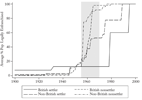
Figure 4 summarizes three distinct periods of suffrage expansion across Africa during the twentieth century, highlighting a middle period in which nonsettler colonies diverged from the settler colonies. This middle period is consistent with the theoretical expectation that when faced with a threat from below, colonies with sizable settler minorities should prevent the majority from gaining the franchise.
The sample consists of forty-three mainland African countries, including those in North Africa and Madagascar, that experienced European rule in the twentieth century and gained African majority rule after 1945.Footnote 99 It contains annual observations between 1900 and 2000, including years before and after independence. Examining pre- and postindependence periods is useful because the timing of independence is endogenous to European settlers’ political influence, which often enabled them to delay reform. The dependent variable is the percentage of the population with the legal right to vote in national elections, measured by v-dem.Footnote 100 This variable relates to legal franchise restrictions based on race, but even territories with high values of this variable are not necessarily democratic because they may lack free and fair elections. In the supplementary material, Tables A.6 and A.7 provide supporting regression analysis and Table A.8 provides summary statistics.Footnote 101
In the first period, the decades preceding World War II, Europeans pacified their African territories and established colonial rule. All territories exhibited a low percentage of the population that could legally vote. In fact, settler colonies exhibited larger franchises because they experienced legislative elections earlier. Europeans elected representatives in Cape and Natal in South Africa, Southern Rhodesia (Zimbabwe), and Algeria by the turn of the twentieth century, and in Tunisia and South-West Africa (Namibia) shortly after World War I. Although these franchises were restricted almost exclusively to whites, most nonsettler colonies lacked any electoral representations before World War II.
Legalized Suffrage in Twentieth-Century Africa (Pre- and Postindependence)

In the second period, important developments during and after World War II created changes that yielded peaceful transitions to majority rule and independence in most of nonsettler Africa,Footnote 102 but Africa’s settler colonies exhibited a divergent path from the rest of the continent. Although settler and nonsettler territories alike experienced increases in legalized suffrage in the decades following the war, this process occurred more slowly in settler colonies. The gray shaded area of Figure 4 highlights the 1955-to-1970 period and shows that nonsettler colonies expanded the franchise more rapidly than did the settler territories, as decolonization prevailed in Britain and France’s nonsettler colonies. In fact, in South Africa, the province of Cape went in reverse. Cape initiated nonracial franchise rules in the 1850s that eroded over time to a de facto ban on nonwhite political participation, which the national legislature enacted into law in 1959.
In the third period, the settler territories eventually caught up. The end of liberation wars in French North Africa (1962), Portuguese Africa (1975), and southern Africa (1980 in Zimbabwe, 1990 in Namibia, 1994 in South Africa) enabled Africans or Arabs to gain majority rule.
Evidence of white Resistance to Franchise Expansion
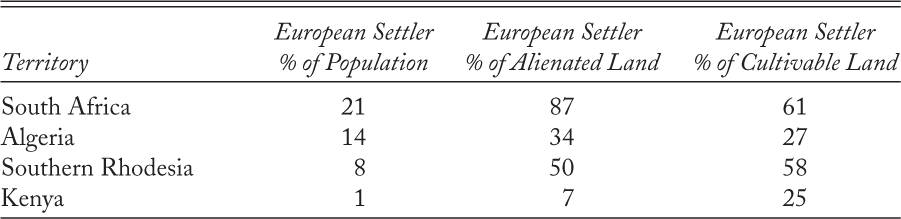
Considerable evidence supports the key redistributive mechanism for Hypothesis 2 posited by class-based theories: the settler landed elite repressed the majority to perpetuate settler dominance over the best land. Research by area specialists and historians of Africa supports the assertion that land inequality between Europeans and Africans was starkly higher in settler than nonsettler colonies. “In many African colonies without settlers, the colonial authorities did not attempt to disrupt local tenure practices. Indirect rule was interpreted to call for, in some places, vesting local authorities with control over land.”Footnote 103 By contrast, almost every colony that experienced disruption to existing land-tenure practices “saw exceptionally large amounts of land alienated during white rule for the benefit of white settlers.”Footnote 104 Table 3 summarizes starkly unequal land distribution patterns in four major settler colonies compared with 0 percent European land alienation in most colonies.Footnote 105
European settlers did not face major challenges to their political hegemony before 1945, but post—World War II changes facilitated African mobilization and created a threat from below.Footnote 106 The key economic difference between settler and nonsettler colonies—considerable European alienation of land—created broad interests against decolonization in settler colonies. For farmers, the relatively low technological barriers to farming would make it easy to replace Europeans with Africans.Footnote 107 European control of the land also created positive spillovers for nonagricultural whites via broader extractive mechanisms. The major settler colonies were founded upon preferential European access to land, and Europeans also benefited because displacing Africans from their land created a cheap and mobile labor supply.Footnote 108 Consequently, politically influential European settlers responded with repression rather than concessions to the African majority. Whites in South Africa and Southern Rhodesia elected extremist parties after World War II to combat rising indigenous demands, and French settlers in Algeria rigged the 1948 legislative elections to prevent Arab representation. Overall, each of the six African colonies coded as settler colonies in Figure 3 experienced a major liberation war to gain independence or, in the case of South Africa, to end European political dominance and gain majority rule amid repression intended to prevent enfranchising Africans. This is in contrast to the remainder of the continent, in which franchise expansion and independence occurred mostly peacefully.
European Settler Land Domination in Africaa

Source: Land data from Lützelschwab 2013, Tables 5.1 and 5.2.
a Percentages for Algeria exclude the Sahara.
Post-Slavery British Caribbean
Main Pattern: Reversals in Electoral Representation
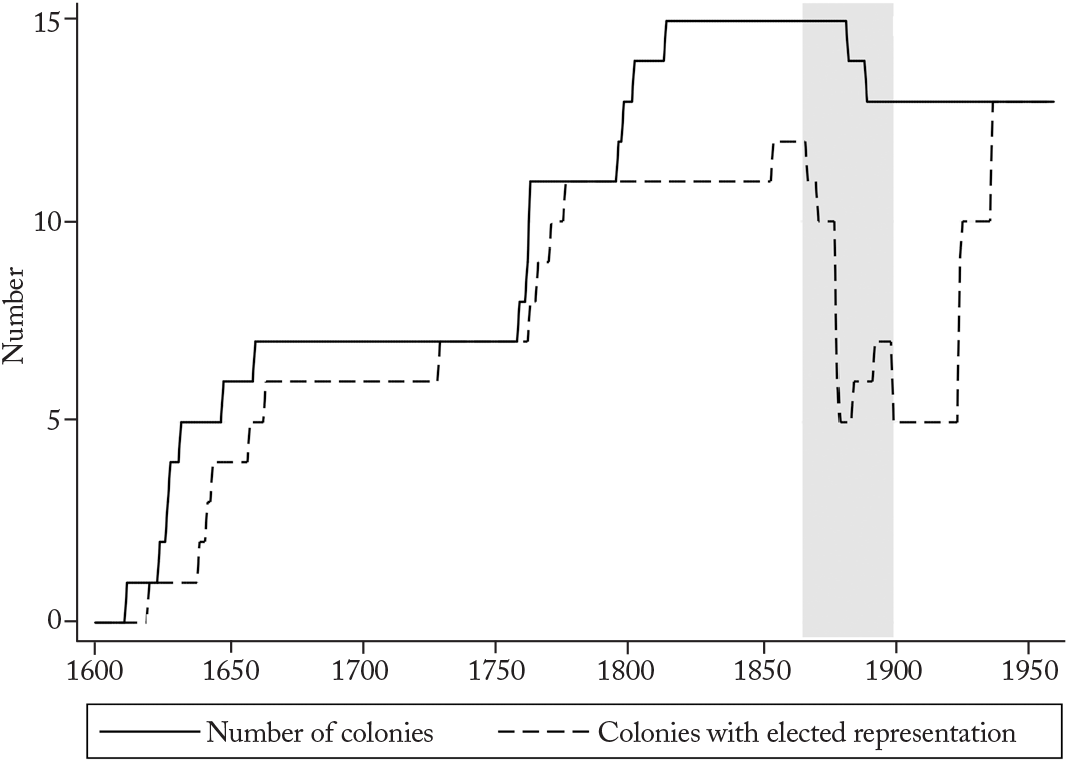
Figure 5 demonstrates three distinct periods of electoral representation in the British Caribbean between 1600 and 1950, highlighting a middle period in which most colonies ended elections. The middle period is consistent with the theoretical expectation that when sizable settler minorities faced a threat from below, their resistance to franchise expansion should hinder representative institutions.
Unlike for Africa, for British Caribbean colonies there is no within-region control group because they contained similarly sized European settler populations (although below I briefly discuss several colonies that retained uninterrupted electoral representation). Figure 5 uses the elected-legislature data from Figure 3, but it differs from that figure in three ways. First, Figure 5 contains only British Caribbean colonies.Footnote 109 Second, it lists the number rather than the percentage of colonies with an elected legislature. Third, the legislature variable equals 1 if the colony has an elected legislature in a particular year and 0 otherwise, as opposed to coding whether the colony has ever had an elected legislature.
British Caribbean Colonies with Elected Legislatures

The first period entailed British settlers creating elected assemblies shortly after colonial inception, shown in Figure 5 by the close relationship between the solid and dashed lines prior to 1800. Several colonies captured during the French Revolutionary and Napoleonic wars failed to gain electoral representation (see Section A.3 of the supplementary material).Footnote 110 Later, a wave of electoral reversals occurred, starting with Jamaica in 1865, highlighted by the gray shaded area. By 1880, only Antigua, the Bahamas, Barbados, Bermuda, and Dominica retained any elected members in their legislatures and by 1898, Antigua and Dominica had transitioned to fully nominated legislative councils. Finally, starting in the 1920s, electoral representation again pervaded the region (see Section B.2 in the supplementary material).Footnote 111
Evidence of white Resistance to Franchise Expansion
Why did electoral reversals occur in the second half of the nineteenth century and annul earlier contestation gains? Historical evidence closely matches the expectations of class-based theories, supporting Hypothesis 2. Most British Caribbean colonies produced sugar and by the nineteenth century featured a minority elite of European planters who ruled a vastly larger slave population. Around 1830, among nine British sugar colonies with disaggregated population data, the slave population ranged from six times the size of the white population in Barbados to more than thirty times it in Grenada.Footnote 112 Sugar was either the principal or the only product in most British Caribbean colonies and plantations provided the core social and economic unitsFootnote 113 —both indicators of extreme land inequality.
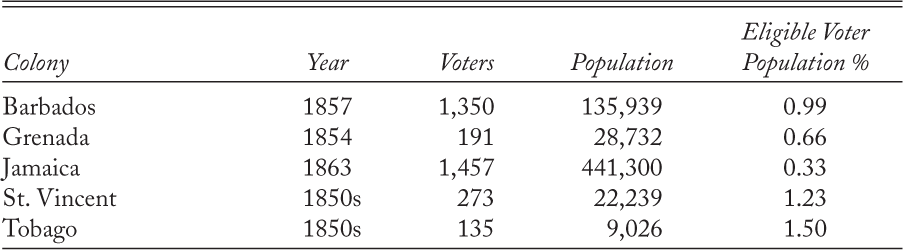
In the nineteenth century, British settlers faced two types of challenges to their political power, which they exercised through elected legislatures in most colonies. First, the latent threat of revolution by the slave majority became more acute. In addition to the successful Haitian Revolution, “[s]lave rebellions significantly increased after 1815 on all the British islands. Slaves rebelled both in the major sugar colonies and on the smaller islands.”Footnote 114 The second challenge arose in 1833 when decades of successful lobbying by white Caribbean planters finally failed and Britain outlawed slavery throughout its empire.Footnote 115 Although this development created the possibility of former slaves gaining political representation, the European settlers reacted by increasing property rights restrictions on voting and creating exceptions for whites eligible to vote under the old rules.Footnote 116 Table 4 summarizes available voter data in several colonies and shows that less than 2 percent of the population could vote in the 1850s, even though slavery had ended more than a decade earlier. Overall, British settlers “had no intention of sharing their liberty with former slaves or of making island liberty less exclusive.”Footnote 117
Apprehensive of mass enfranchisement by either peaceful or revolutionary means, settlers in most colonies ultimately forfeited electoral representation and acquiesced to direct rule by the British Crown. With the end of slavery, plantation agriculture in the Caribbean became less profitable, which in turn decreased government revenues. Over time, an increasing share of white planters believed that an authoritarian government with a strong executive would increase private investment in the islands and prevent nonwhites from gaining political power.Footnote 118 In 1852, Britain’s Secretary of State for the Colonies warned that absent reforms, “They must anticipate being overwhelmed in the Assembly by representatives of the coloured and black population.”Footnote 119 The triggering event for moving to direct British rule occurred after a major revolt led by former slaves at Morant Bay in Jamaica in 1865. Although the government successfully repressed the rebellion, “the gravity of the crisis was vastly greater than anything experienced in Jamaica since emancipation.”Footnote 120 Whites interpreted the revolt in starkly racial terms. In a speech that preceded a vote to disband the legislature, Jamaica’s governor “declared that only a strong-minded government could preserve the island from further violence.”Footnote 121 Facing largely similar circumstances, most other British Caribbean colonies followed this trajectory in the 1860s and 1870s, although in some cases the process of transforming an elected council and assembly into a single nominated council was more gradual than Jamaica’s course. First, perhaps, the council and assembly would be merged into one body, as they had been in Dominica in 1863; then the number of elected members would be reduced to leave a nominated majority; finally, the elected members would be dispensed with, and the whole legislature would consist of nominated officials.Footnote 122
Population Share of Eligible Voters in Mid-Nineteen th Century

Sources: Reference RogozińskiRogoziński 2000, 194, provides data on number of voters; Barbados population measured in 1851 and Jamaica in 1861 from Reference RogozińskiRogoziński 2000, 188; Grenada in 1829 and St. Vincent in 1825 from Reference RogozińskiRogoziński 2000, 120; and Tobago in 1775 from Reference WellsWells 1975, 253.
The three British Caribbean colonies that never eliminated electoral representation faced less dire circumstances than had Jamaica and most other sugar colonies. Neither Bermuda nor the Bahamas contained sugar plantationsFootnote 123 and Barbados was “the sugar colony in which the prosperity of the planters was not imperilled and their political domination not challenged.”Footnote 124 Although the small number of cases that do not match the scope conditions of class-based theories disallows performing statistical analysis, it is notable that the exceptions to the pattern of eliminating electoral representation correspond with theoretical expectations.
By fundamentally altering their representative system, most Caribbean settlers responded to mass threats more bluntly than other settler colonies. In contrast to the British settlers in North America, and later to those in South Africa and Rhodesia, the small size of the white plan-tocracy created severe vulnerabilities for British Caribbean settlers,Footnote 125 yielding a preference to address their fears through direct British rule rather than independence. The possibility of moving to British Crown rule was also historically contingent. For example, settler populations in Tanganyika/Tanzania, northern Rhodesia/Zambia, and Kenya were influential, but not large enough to follow the South African or Rhodesian path of independent rule. However, after World War II, Britain developed a firm commitment to promoting electoral representation inclusive of non-Europeans.
Despite nineteenth-century electoral reversals, most British Caribbean colonies gained independence peacefully in the twentieth century and consolidated democracy after independence. Section B.2 in the supplementary material provides additional discussion of the British Caribbean in the twentieth century, showing that the nonwhite professional and working classes propelled reforms that recreated electoral representation and, later, full suffrage.Footnote 126 Reform was possible because the political and economic influence of the white planter elite had weakened considerably by the twentieth century.
Post–Civil War US South
Constituent regions and colonies within the neo-Britains generally featured large white majorities. The only exception is the US South, where large-scale forced migration of enslaved Africans engendered states with tenuous white majorities or white minorities, as Table 2 above shows. The nonmonotonic logic of Hypothesis 2 implies that when comparing US states, those with lower white population shares should exhibit greater franchise restrictions in contrast to states with overwhelming white majorities that faced no threat to their dominance.Footnote 127 Membership in a large, federal political unit with a sizable white population (compared to those in the British Caribbean, for example) implied that states in the US South faced a low threat of revolution from below. But in the decades following the end of the US Civil War in 1865, the southern states’ demographics created the threat of ex-slaves and poor whites voting in numbers large enough to eliminate the Democrats’ control of the South. Southern white elites also feared economic reforms, including expanding land ownership rights for blacks. These vulnerabilities created conditions that the theory anticipates should engender repression to undermine franchise expansion. This implication is consistent with empirical patterns.
Main Pattern: voting Restrictions after Reconstruction
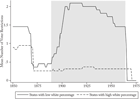
Figure 6 summarizes voter restrictions between 1850 and 1975 among US states. It highlights a middle period in which the South diverged from the rest of the country, which supports Hypothesis 2. The figure distinguishes eleven states in the South in which the white population share was less than 80 percent from nineteen states in the North and Midwest with higher white population shares. Categorizing US states by racial composition enables comparison with the other world regions considered here, and it is identical to how some Americanist research categorizes the US South.Footnote 128 The sample contains only states admitted to the Union prior to 1850, which yields a constant sample of states. In each year, a state can have up to four restrictions on voter eligibility, disaggregated by economic requirements, whites-only voting, poll taxes, and literacy requirements.Footnote 129 Therefore, the dependent variable for the figure ranges between 0 and 4, and the lines represent averages between the two groups of states.
The earliest prevalent form of voter requirements (besides those based on gender) were property-holding and related economic requirements, although by 1850 few states retained them. Between 1850 and the beginning of Reconstruction in the late 1860s, the predominant form of voter restriction was race, which the Fifteenth Amendment (adopted in 1870) disallowed. But starting in 1890, when the federal government signaled it would not interfere with states’ voting practices, poll taxes and literacy requirements gained prevalence among southern states until the adoption of the Twenty-Fourth Amendment in 1964 and the Voting Rights Act of 1965 (the gray shaded area in Figure 6). These actions created a large gap in the average number of voter restrictions between southern states and the rest of the country—supporting Hypothesis 2—although several northern states featured literacy requirements until 1970 (Connecticut, Delaware, Maine, Massachusetts, New Hampshire, New York).
Voter Restrictions in US States

Evidence of White Resistance to Franchise Expansion
Southern states differed on average from those in the Middle Atlantic and New England in their factor endowments. Northern states’ factor endowments facilitated producing crops with limited scale economies, such as grains and hay, which yielded relative economic equality among whites and relatively low demand for forcibly importing labor. By contrast, southern states specialized in crops like tobacco, rice, and cotton that exhibited scale economies and engendered large slave plantations, although “even here, the size of the slave plantations, as well as the degree of inequality in these colonies, was quite modest by the standards of Brazil or the sugar islands.”Footnote 130 In the first half of the nineteenth century political leaders in southern states campaigned vigorously for slavery to continue, eventually culminating in the US Civil War. The eleven states with a low white population percentage highlighted in Figure 6 correspond with the original states that seceded to form the Confederacy.
Following the Union’s victory in 1865, slave emancipation and constitutional amendments to grant political rights generated high rates of black participation and a rising Republican vote share in elections during and immediately after the Reconstruction era.Footnote 131 These political changes challenged Democratic dominance in the South and complicated planters’ ability to maintain a regular supply of reliable labor for cultivating cash crops,Footnote 132 similar to the concerns described above for African settler colonies. V. O. Key stresses the importance of African Americans’ political position for explaining Southern politics, and argues that whites were highly apprehensive of reform in “black belt” counties with black majorities—especially because these areas coincided with the largest number of white landowning elites with the greatest needs for black labor.Footnote 133 Table 2 lists the percentage of whites in each southern state that resided in black-belt counties.
The end of Reconstruction in 1876, Republicans’ electoral shift away from the South, and strategic use of repression and other forms of violence created an opportunity for white landlord elites to reverse electoral gains for nonwhites, particularly after the failure of the Lodge Force Bill of 1890, which would have strengthened federal oversight of states’ election procedures.Footnote 134 Figure 6 highlights the slew of voter restrictions that arose at the turn of the twentieth century in southern states. Although these restrictions did not explicitly target voters on racial criteria—made illegal by the Fifteenth Amendment—these laws primarily sought to disenfranchise blacks. They succeeded. Estimated black turnout plummeted by an average of 62 percent across ten southern states in the first election following the passage of these lawsFootnote 135 and effectively consolidated white enclave rule in the South for more than a half-century.Footnote 136
Evidence from the US South also supports the other component of Hypothesis 2—actions to prevent franchise extension can undermine democratic contestation. “[E]nclaves depended upon restrictions on free and fair political contestation . . . party-state institutions helped render opposition parties nearly unthinkable. Democrats controlled all election laws and election administration, and they took care to keep barriers to entry of potential political opponents prohibitively high. . . . In traditionally Republican upland areas of North Carolina, Tennessee, and Virginia, Democrats used other techniques to defeat opponents, such as ballot-stuffing, ballot-stealing, and mysterious poll closings. As in other electoral authoritarian polities, southern primary and general elections were neither free nor fair.”Footnote 137
Nor did voter restrictions disenfranchise only blacks. Similar to the British Caribbean colonies, but in less extreme fashion because elections continued to occur in the US South, the percentage of white voters who could participate also diminished drastically. White voter turnout declined by 26 percent on average in the first post-restriction election.Footnote 138 In Alabama, “[b]ecause white population outstripped black, by 1941 more poor whites than blacks had been disfranchised by the provisions of the 1901 Alabama Constitution, primarily by the cumulative poll tax: 600,000 whites to 520,000 blacks.”Footnote 139
Discussion
This article examines the origins and evolution of political institutions during colonial rule. I engage widely debated European settler legacies from a new perspective by extending existing theories and compiling new data. Statistical evidence shows that early elected representative institutions are limited to British settler colonies, which is also consistent with qualitative evidence that British settlers demanded (and received) electoral representation in conjunction with their proclaimed natural rights as Englishmen. But even in cases with early electoral representation, data on various franchise and contestation measures show that settler colonies in Africa and the British Caribbean and postindependence states in the US South subsequently suffered declines in contestation or participation either absolutely or relative to comparable cases. Qualitative evidence demonstrates a common pattern across the settler cases: landed European settler elites who perceived threats to their political dominance from nonwhites took vigorous action to prevent nonwhites from exerting political influence. This finding highlights the core democratic contradiction in European settler colonies. Even where they exhibited favorable conditions for establishing early representative institutions, the actors who created these institutions also harbored strong incentives to retain power only for whites.
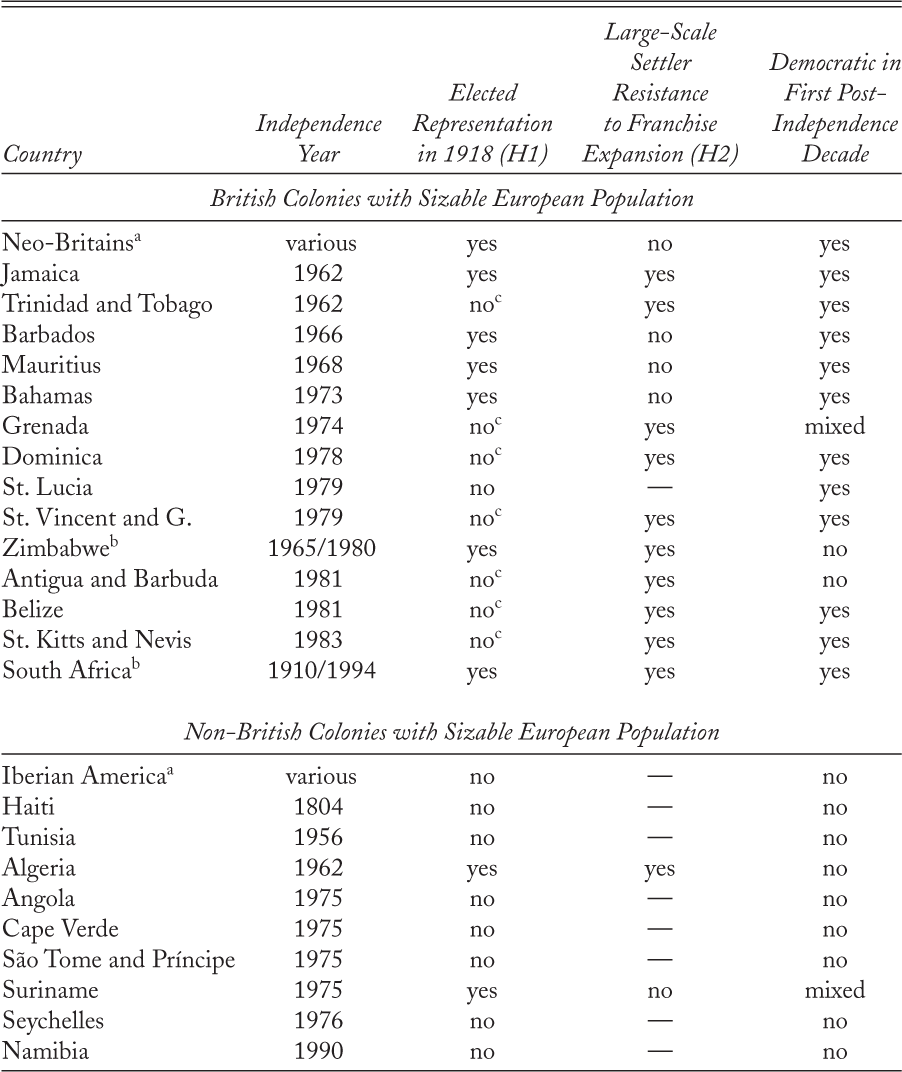
Although the article focuses primarily on colonial-era outcomes, the findings carry implications for postcolonial legacies. Table 5 lists every country in the present sample with a European population share of at least 5 percent at any point during colonial rule, disaggregated by British and non-British settler colonies. Two of the columns provide information for the hypotheses: whether the colony elected any representatives in 1918 (early elected representation),Footnote 140 and, conditional on having elected representation at any point before 1919, whether the colony exhibited large-scale settler resistance to franchise expansion during colonial rule by disbanding its legislature or by fighting a major war to prevent liberation of nonwhites. It also summarizes each country’s democracy score in its first decade of independence. “Yes” implies democracy in all ten years, “no” implies no democratic years, and “mixed” cases exhibit some years of democracy and some of non-democracy in the first postindependence decade.Footnote 141
Only seven of the forty-six countries with sizable colonial European populations exhibit (1) elected representation in 1918, (2) no large-scale settler resistance to franchise expansion during colonial rule, and (3) early postcolonial democracy: the four neo-Britains and three British islands.Footnote 142 Two additional cases (Jamaica and South Africa) exhibit mixed evidence by having elected representation in 1918 and postcolonial democracy, but they also experienced large-scale settler resistance to franchise expansion. The other settler colonies lacked elected representation in 1918 and/or stable democratic rule in the first decade of independence. Consistent with Hypothesis 1, Table 5 rejects positive settler legacies on democracy outside the British Empire, with the partial exception of Dutch Suriname. Consistent with Hypothesis 2, eleven of nineteen settler colonies that experienced electoral representation at any point prior to World War I also exhibited large-scale settler resistance to franchise expansion, and four of the eight exceptions (the neo-Britains) largely do not meet the scope conditions of Hypothesis 2 because of their sizable European majorities.
Colonial European Settlers and Postcolonial Democratic Legacies

a The neo-Britains are Australia, Canada, New Zealand, and the United States. Postcolonial Iberian American countries are Argentina, Bolivia, Brazil, Chile, Colombia, Costa Rica, Cuba, Dominican Republic, Ecuador, El Salvador, Guatemala, Honduras, Mexico, Nicaragua, Panama, Paraguay, Peru, Uruguay, and Venezuela.
b South Africa gained independence in 1910 but did not gain African majority rule until 1994. Rhodesia declared independence in 1965 but did not gain internationally recognized independence until 1980.
c European settlers created an elected legislature early in the colonial era, transitioned to an allappointed legislative council in the nineteenth century, and regained elected representation after World War I primarily via demands by non-Europeans.
The analysis carries implications for several important literatures and points toward innovative areas for future research. Most directly, a new focus on colonial-era institutional origins and evolution challenges arguments that imply favorable legacies for European settlers and democratic institutions. Regarding the broader colonialism literature, the analysis also contrasts with the recent shift toward studying specific colonial actors and de-emphasizing the importance of colonizer identity. My findings demonstrate that these two are not mutually exclusive and should be studied jointly, although older research arguing that British colonialism exerted beneficial legacies is incomplete because it overlooks British settlers’ resistance to franchise expansion despite earlier representative innovations. Furthermore, given the present analysis of colonial institutions, additional statistical tests are needed to assess the postcolonial democratic legacies of European settlers.
The theoretical and empirical analysis highlights important considerations for the broader democracy literature. Although existing theories anticipate resistance to democratization in the presence of redistributive threats,Footnote 143 there is a dearth of theoretical work that analyzes how those repressive actions can cause backsliding in electoral competition, which highlights the relevance of disaggregating democratic contestation and participation while also considering their interaction. Furthermore, contrary to Dahl’s argument about democratic sequencing,Footnote 144 establishing full democracy faces considerable impediments even after creating contestation institutions—especially in the colonial context. The reasons that a polity gains early limited representation may, paradoxically, undermine prospects for subsequent democratization, as with British settlers who inherited a representative tradition but whose large landholdings caused them to repress the masses to prevent franchise expansion. These incentives highlight a fundamental democratic contradiction in colonies that otherwise appear to exhibit favorable conditions for democracy.
Supplementary Material
Supplementary material for this article is at https://doi.org/10.1017/S0043887119000029.
Data
Replication data for this article is at https://doi.org/10.7910/DVN/LU8IDT.
Acknowledgments
I thank Scott Abramson, Volha Charnysh, Matthew Fails, Anderson Frey, Gretchen Helmke, Jonathan Krieckhaus, Mary Kroeger, Alex Lee, Bonnie Meguid, Kunle Owolabi, seminar participants at the University of Rochester, and the World Politics editors and three anonymous reviewers for helpful comments and suggestions, and Karen Albert for valuable research assistance.
Author
Jack Paineis an assistant professor of political science at the University of Rochester. His main research projects examine how dictators strategically use repression and power sharing and their consequences for authoritarian survival and civil war, and the origins and consequences of democratic institutions under colonialism. He can be reached at jackpaine@rochester.edu.