Learning to read in alphabetic languages presents a number of challenges to all children, such as mastering the alphabetic principle and learning to manipulate the sounds of oral language, an ability referred to as phonological awareness (PA). A bilingual child's oral exposure to two languages and experience with formal reading instruction in one or both of those two languages affect the resources available for meeting these challenges. A better understanding of how bilingual children's PA is influenced by oral skills and history of literacy instruction can help us understand why some of those children perform better than monolingual peers in early reading-related tasks (Bialystok, 2001), while others are at greater risk for reading difficulties than their monolingual peers (Snow, Burns, & Griffin, 1998).
Research suggests that vocabulary plays a role in the development of PA in monolingual children (for a review, see Goswami, 2000), and that there is cross-language transfer in the PA of bilingual children (e.g., Durgonoglu, Nagy, & Hancin-Bhatt, 1993). Studies of PA transfer in bilingual children have not systematically examined the language of their literacy instruction, though research on domains other than PA suggests that instruction influences the likelihood of transfer. For example, August, Carlo, Calderón, and Proctor (2005) observed that there were cross-linguistic relationships in word and pseudoword reading and reading comprehension only for Spanish–English bilingual children who had received Spanish literacy instruction, not for Spanish–English bilinguals whose literacy instruction had occurred only in Englsh.
PA
PA is a particular instance of understanding, one consisting in becoming aware that speech consists of a concatenation of arbitrary phonological structures that can be analyzed into syllables, subsyllabic units, or phonemes (Morais, 2003). It has been identified as a powerful correlate of success in reading in several alphabetic languages (for a review, see Blachman, 2000). Intervention studies, conducted mostly with English speakers, have also shown that heightening monolingual speakers' PA has a positive impact on reading ability (for a meta-analysis, see Ehri et al., 2001). Correlational and longitudinal studies have also demonstrated a positive relationship between PA and reading in monolingual Spanish speakers (Bravo, Villalón, & Orellana, 2001; González, 1996; Jiménez, 1996; Defior, 1996). PA interventions with monolingual Spanish speakers have proven successful in improving their reading (Defior, 1996; Domínguez, 1994, 1996; Defior & Tudela, 1994).
A few research studies have found a similar relationship between PA in the first language (L1) and/or second language (L2) and reading in Spanish–English bilingual children (Carlisle, Beeman, Davis, & Spharim, 1999; Cisero & Royer, 1995; Durgonoglu et al., 1993; Quiroga, Lemos-Britton, Mostafapour, Abbott, & Berninger, 2002). What remains unclear, however, is the influence of two factors, vocabulary and language of instruction, on PA development in bilingual children. It is possible that strong L1 vocabulary may result in strong L2 PA development, without the need for strong L2 vocabulary; or it may be that strong L2 vocabulary is needed to develop strong L2 PA. Likewise, it may be that L2 PA development is greatly facilitated by language and literacy instruction in the L2, or it may be that L1 language and literacy instruction is sufficient. We compared L2 PA skills in two groups of bilingual children: one that had received L1 language and literacy instruction, and one that received L2 language and literacy instruction. Thus, we could evaluate the influence of L1 versus L2 initial literacy instruction, while at the same time assessing the relation of these students' L1 and L2 vocabulary scores to their L2 PA.
It is not within the scope of this paper to discuss variations in the sociocultural context in which children develop bilingually, although it is important to note that contexts in which bilingualism is celebrated and valued may affect children's development differently than contexts in which children's bilingualism is viewed as a disadvantage. (For a discussion of positive and negative contexts for bilingual contexts, see Lambert, 1975.)
VOCABULARY
The role of L1 and L2 vocabulary in the PA and early reading of bilingual children remains unclear. There is a long-standing recognition that lexical development influences reading comprehension (Nagy & Scott, 2000). There is a growing consensus that lexical development plays an important role in monolingual children's PA in alphabetic languages (e.g., Silvén, Niemi, & Voeten, 2002; Goswami, 2000; Metsala, 1999; Wagner et al., 1999). In fact, children with less precise phonological representations of speech tend to be poorer readers (Booth, Perfetti, & MacWhinney, 1999). This suggests a relationship between lexical development and reading that is mediated by PA, but there have been conflicting results in studies of bilingual children. Verhoeven (2000) found that Dutch vocabulary knowledge had a greater impact on reading comprehension for Dutch L2 learners than for native Dutch speakers. Durgonoglu et al. (1993) found no relationship between vocabulary and PA or reading in a study of 27 Spanish-dominant, bilingual first graders receiving Spanish literacy instruction. Quiroga et al. (2002) found that L2 vocabulary, not L1 vocabulary, predicted L1 and L2 reading in a study of 30 Spanish-speaking first graders in English literacy instruction. The relationship of L1 and L2 vocabulary to PA or reading therefore remains unclear.
CROSS-LANGUAGE TRANSFER
The positive relationship between L1 PA and L2 PA in bilingual children has been replicated across studies of children from preschool through the primary grades. Dickinson, McCabe, Clark-Chiarelli, and Wolfe (2004) reported significant cross-language correlations on a PA task among Spanish–English bilingual preschoolers, and found that both Spanish PA and English vocabulary were significant predictors of end of year English PA. Durgonoglu et al. (1993) found cross-language transfer between L1 PA and L2 reading in the aforementioned study of Spanish–English bilinguals. Quiroga et al. (2002) also found cross-language transfer between L1 PA and L2 reading in Spanish–English bilinguals. Cisero and Royer (1995) found cross-language transfer between L1 PA and L2 PA in one of three PA tasks in a study of 40 Spanish- and English-speaking first graders who were receiving literacy instruction in both English and Spanish. Therefore, cross-language transfer in PA appears to occur in Spanish–English bilingual children receiving either all-English or bilingual literacy instruction. It is unclear, though, whether this transfer is all positive, or whether phonological knowledge in Spanish may also have negative effects on English PA.
CROSS-LANGUAGE INTERFERENCE
Systematic errors of interference can be “explained” by comparing and contrasting the two languages of bilinguals, through what is called contrastive analysis (Lado, 1957), a systematic inventory of the differences between languages. Whereas contrastive analysis does not predict all L2 errors, and although it predicts some errors that do not occur, research in L2 acquisition has found that there is an undeniable influence of the L1 on the L2 and contrastive analysis serves to help explain many L2 errors (Major, 2001).
An important line of research has studied the perception of phonemic categories across languages in bilinguals. Work done mostly with adults suggests that novice L2 learners use L1 phonemic structures in their perception of L2 speech, and researchers in L2 acquisition argue that certain speech production errors arise from an incorrect perceptual representation of L2 phonemes based on L1 phoneme categories (Flege, 1999, p. 108). The limited work done with early bilinguals suggests that L2 learners do not develop new L2 phonemic categories easily in their L2 speech perception (Bosch, Costa, & Sebastián-Gallés, 2000). Sometimes referred to as negative transfer or interference, these errors do not reflect language delay but rather are a normal application of L1 phonology by developing bilinguals, in which their L2 perception and production are affected by their L1 (Gass, 1996).
To our knowledge, no study has looked at the possible application of L1 phonological analysis to L2 PA in Spanish–English bilinguals. Wade-Woolley and Geva (2000) administered a phonological task to 34 English–Hebrew bilingual second graders to assess their sensitivity to a phonemic contrast that occurs in Hebrew but not in English. They concluded that a general level of phonological ability is required for reading to develop, but phonological elements specific to the L2 present additional challenges to beginning readers. How these challenges operate for bilinguals in kindergarten and first grade, during the initial period of formal literacy instruction, is an important question. In addition, it is important to clarify whether or not these challenges are related to language of instruction and L1 and L2 vocabulary development.
In the context of educational practice, phonological production is often used to assess student learning, particularly for PA tasks. Research on early bilinguals indicates that L2 phonological production is influenced by L1 phonology (Vernon-Feagans, Scheffner Hammer, Miccio, & Manlove, 2002). Data from L2 spelling also show systematic errors that can be related to the phonological as well as the orthographic systems of L1, suggesting that L1 phonology has an impact on L2 word perception and production (for examples from Spanish–English bilinguals, see Fashola, Drum, Mayer, & Kang, 1996).
There is a range of contrasts between English and Spanish that cause evident interference in production, resulting in accented speech. For example, there are vowels in both languages that consist of two sounds (an onglide and an offglide), termed diphthongs. These diphthongs, however, are hypothesized to be prime targets for interference in PA because the categorical representation of the diphthongs differs between the two languages. One such diphthong is /aI/. Literate English speakers segment a diphthong like /aI/, “I,” as one phoneme, in such words as my, pie, and buy. In contrast, literate Spanish speakers segment the same diphthong /aI/ as two phonemes, /a/-/I/, as in the “ai” of the words aire, baile, and naipe.
Presumably there is an influence of orthography from the two languages on these differing representations of the same phoneme. Treiman and Cassar (1997) showed that both first grade and adult monolingual English speakers were influenced by the orthographic representations of words in counting their constitutive phonemes, and that the influence increased with age. In their study, first graders tended to consider /aI/ equally often as one or two phonemes, while adults tended to consider this vowel a single phoneme. Thus, it is probable that spelling knowledge influences the conceptualization of phonological structures of words containing diphthongs like /aI/ in English, and it would appear that adults tend to consider them as single phonemes because they can be represented by single letters. In that same vein, it is probable that Spanish literate children and adults would consider /aI/ as two phonemes, because such a sequence can appear in a hiatus position in that language, in which case it is represented by two successive, heterosyllabic graphemes, as in the word maíz. What is interesting to explore, however, is how bilinguals who have received less than a year of formal literacy instruction produce and analyze such diphthongs.
Although /aI/ is invariably a diphthong in both English and Spanish, a second vowel combination, /eI/, can be categorized either as a diphthong or a tense vowel in English; /aI/ is a phonemic diphthong, meaning that the contrast of the diphthong with its onglide signals a change in meaning. The word “kite,” [kaIt], for example, contrasts with “cot” [kat]. In contrast, the diphthong /eI/ is an allophonic diphthong in English, that is, reducing the diphthong /eI/ to [e] does not change its meaning. The word “date” can be pronounced [deIt] or [det], and such variation is sociolinguistically determined rather than semantically contrastive. The diphthong /eI/ would also presumably be produced as one phoneme by literate English speakers, as in the “a” of lady, plate, or wait, but as two phonemes by Spanish speakers, as in the “ey” of ley or the “ei” of reina or pleito.
As noted above, young Spanish–English bilinguals produce English spellings that show the influence of Spanish phonology, for example writing “leidy” instead of “lady” (Fashola et al., 1996). Given that young readers' spellings are closely related to their phonological analyses (Templeton & Bear, 1992; Read, 1975), it seems likely that L2 learners' PA performance, like their spelling performance, would reflect specific contrasts between L1 and L2. Bilinguals may use L1 phonological categories when carrying out a phonological analysis of L2 words. This study seeks to assess whether bilingual children's English phonemic segmentation reflects phonological contrasts between L1 and L2, specifically comparing the two diphthongs previously described to nondiphthongized vowels (/a/, for example) which are similarly categorized in Spanish and English.
Phonemic segmentation, a later developing PA skill, is one of the most highly predictive of reading skills, particularly for bilingual children (Denton, Hasbrouck, Weaver, & Riccio, 2000). Segmentation is the ability to take a word and break it into its constituent parts, that is, to sound out the number of phonemes in a word. For example, a child says each phoneme in the word “fan,” that is, /f/-/a/-/n/.
The question then is whether Spanish-speaking children reveal the impact of the Spanish phonological categories when segmenting English words. If so, Spanish-speaking children would produce diphthongized vowels as two successive phonemes, whereas their responses to nondiphthongized vowels would be similar to those of monolingual English speakers. Monolingual children, relying on the typical American English phonological system that distinguishes 14 vowels, would normally sound out three phonemes for the word “fine,” with one phoneme for the vowel, just as for the word “fin.” Spanish-speaking children, relying on the Spanish phonological system with its five vowels, might more likely segment the /aI/, sounding out four phonemes, /f/-/a/-/I/-/n/, but they would probably segment the word “fin” into three phonemes.
We designed an English phoneme segmentation task including items explicitly selected to reveal whether children treated diphthongized and nondiphthongized vowels in phoneme segmentation items differently and whether those differences were systematically influenced by whether children were bilingual and were in either L1 or L2 literacy instruction. In addition, we wished to explore the relationships of language of instruction and L1 and L2 vocabulary to bilingual children's phonemic segmentation ability.
This study sought to answer the following research questions:
- Do bilingual status and English or Spanish literacy instruction contribute to children's phonemic segmentation of diphthongized versus nondiphthongized vowels?
- Do vocabulary and language of literacy instruction in English and/or Spanish contribute to English PA in bilingual children?
METHOD
Subjects
The study was conducted in a public school in the Boston metropolitan area, in which 88% of students were eligible for free or reduced lunch, 76% of students were Latino, 19% African American, 4% Anglo, and 1% Asian. The subjects of the study were 102 kindergarten and first grade children, consisting of three groups: 45 bilingual children receiving Spanish literacy instruction, 35 bilingual children receiving English literacy instruction, and 22 English monolingual children receiving English literacy instruction. The population tested was, in general, children whose mothers had a high school education, as reported in parent questionnaires, for which there was a 99% response rate for study participants. The majority of bilingual children in both Spanish and English language instruction entered school speaking both English and Spanish equally well or speaking mostly Spanish; the monolingual children entered school speaking only English, according to parent questionnaires. The children in this study were all receiving Success for All literacy instruction in English or Spanish. Success for All's instructional programs offer the same sequence of topics and activities in English and Spanish: individual letter sounds are taught, then blends (or syllables in Spanish), and finally words, using a variety of word recognition activities. The sequence in which letters/sounds are introduced is almost identical across languages (Slavin & Madden, 2001). Because instruction is so highly scripted in Success for All classrooms and curricula in English and Spanish are essentially parallel, the only true instructional difference among groups was language of instruction. The bilinguals in Spanish instruction were in a “maintenance” program in which Spanish literacy instruction was continued through the sixth grade. The goal of a maintenance program is to develop the students' native language in its own right, rather than using L1 instruction to transition children into L2 instruction as quickly as possible. The children in bilingual and monolingual instruction could not be matched on measures in Spanish or English, because these programs were selected by parents based on factors that probably covaried with child language skills.
Tasks
Vocabulary
The bilingual children's expressive vocabularies were assessed using the Spanish and English Picture Vocabulary subtests from the Woodcock Language Proficiency Battery (Woodcock, 1991). The monolingual children were tested only in English. There is some evidence that expressive vocabulary tests produce standard scores about 0.2 standard deviations lower than receptive tests for language minority children (Miccio, Tabors, Páez, Hammer, & Wagstaff, 2005), but this slight underestimate of true vocabulary knowledge can be assumed to be constant across children.
Phonemic segmentation
A phonemic segmentation task was developed, with 20 experimental and 20 control items. The task was based on the hypothesis that bilingual children would be more likely to segment the 20 pseudowords that contained the experimental diphthongs /aI/ or /eI/ as two phonemes but not more likely to segment the 20 control pseudowords that contained control vowels as two phonemes more often than other, nondiphthongized vowels. There were three practice items with nonexperimental vowels, consisting of two, four, and three phonemes, respectively. Each test item was a three-phoneme sequence, composed of a consonant, vowel, and final consonant. The varying number of phonemes in the practice items was designed to provide the anticipated range of potential responses children might give. To reduce as much as possible the influence of lexical knowledge and reading ability, the stimuli were pseudowords in English and Spanish, created by changing the initial consonants of real English words. The initial consonants were substituted with consonants in the same category, for example, the word made became the pseudoword nade by replacing the initial nasal with another nasal. The control stimuli were identical to the experimental stimuli but they contained a nonexperimental vowel, for example, nad was a control item for nade.
Because this task focused on two experimental diphthongs, the final consonants were varied systematically because they affect vowel length; half of the consonants were voiced and half were unvoiced. The experimental and control real words and their corresponding pseudowords can be found in Appendix A.
Procedure
The children were tested individually by trained research assistants (RAs). For bilingual children, one session included half of the phonemic segmentation items and the Woodcock English Picture Vocabulary Subtest; the other session included the other half of the phonemic segmentation items and the Spanish Woodcock Picture Vocabulary Subtest. Each child received one of four parallel versions of the test; the items were presented in a different order in each version to control for order and fatigue effects and to control for the possible interference caused by the assessment in Spanish of expressive vocabulary. For monolingual children, one session included one-half of the phonemic segmentation task and the English Woodcock Picture Vocabulary Subtest; the other session consisted of the second half of the phonemic segmentation task. The children's responses were audio-taped.
The children were given 10 pennies to use as “counters.” The children listened to the RA say a pseudoword stimulus, repeated the pseudoword to ensure they had heard it correctly, and then segmented the pseudoword orally, pushing forward a counter for each phoneme. The children did three practice items with feedback. For the first example, the RA would say the pseudoword [ree], the child would first repeat the pseudoword ree, then the child would say /r/-/ee/ and displace a penny for each phoneme. The counters were used to simplify the scoring of the task. The instructions were provided in English or transitioned into English after the first example to make it clear that the pseudowords were English pseudowords. The RAs were trained to administer the test with English pronunciation by the first author and were provided with pronunciation guides next to each item on each copy of the test, with the first author modeling how to administer the task and then observing the first time the RA administered the task. There was no indication at any time that the RAs were pronouncing the items differently than the test instructions.
Scoring
Phonemic segmentation
In the phonemic segmentation task, it was important to determine whether the use of counters accurately reflected the child's oral segmentation. During the administration of the test, the RAs provided corrective feedback to children if they noted that there was no correspondence between the number of counters they pushed forward and the number of phonemes they had segmented orally. To double check the correspondence between the number of counters a child pushed forward and the number of phonemes they emitted when they were segmenting orally, a comparison was made between the scoring based on number of counters against a scoring of the audio-tapes of children's segmentation, for a sample of 20% of the children. The Cohen's kappa for these responses was 0.69, with 86% agreement. Cohen's kappa is a measure of reliability that corrects for chance agreement. The level of agreement was acceptable in this case (Cohen, 1960); therefore, the number of counters the children pushed forward was used as a proxy for their oral segmentation.
To examine the role of language of instruction and English and Spanish expressive vocabulary in correct English phonemic segmentation, the responses to the items were dichotomously scored as correct or incorrect, based on the number of counters the child pushed forward. To test for differences between diphthongized and nondiphthongized vowels, the average number of pennies a child displaced for each kind of item on the phonemic segmentation task was used (average number of phonemes on items with diphthongized vs. nondiphthongized vowels).
Item analysis: Reliability and item discrimination
Item analysis was conducted to determine reliability
Cronbach's alpha for all of the children on the number of counters moved for experimental and control items was .96 for both kinds of items, respectively. Cronbach's alpha for the dichotomously scored items was .98.
RESULTS
Performance levels
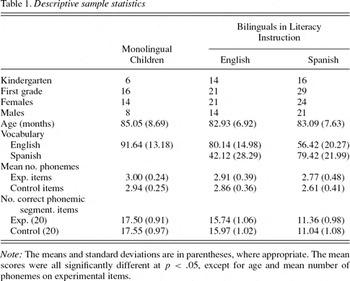
The descriptive statistics in Table 1 provide insight into the differences among kindergarten and first grade monolinguals and bilinguals in Spanish and English literacy instruction in this sample. There were no significant differences among groups on maternal educational levels. The monolinguals had the highest mean score in English vocabulary, the bilinguals in English language instruction had a slightly lower mean score, and the bilinguals in Spanish language instruction had a substantially lower mean score. The bilinguals in Spanish language instruction had a large range (0–95) in their English scores. The converse pattern emerged in the standardized scores on Spanish vocabulary: bilingual children in Spanish language instruction had a higher mean score than bilingual children in English language instruction. The bilingual children in English language instruction had a range of 1–97, similar to that of the Spanish-instructed bilinguals in the English version of the same subtest. The low mean scores in English and Spanish vocabulary, respectively, suggest that these two groups of bilingual children come from different populations, even in comparison to the monolingual children. The bilingual children in English literacy instruction appeared to be English dominant, on average, whereas bilingual children in Spanish language instruction appeared to be Spanish dominant, on average. English and Spanish expressive vocabulary were moderately negatively correlated for the entire bilingual group (r=−.35, p=.002). Correlations varied between the two groups of bilingual children: bilingual children in English literacy instruction had a negative correlation between Spanish and English vocabulary (r=−.38, p=.027), but bilingual children in Spanish language instruction had a nonsignificant but slightly positive correlation (r=.15, p=ns).

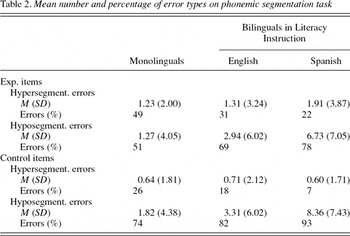
On the phonemic segmentation task in English, the monolinguals segmented on average about three phonemes on both experimental and control items. Bilinguals in English language instruction averaged 2.9 phonemes on experimental and control items. Bilinguals in Spanish language instruction averaged 2.8 phonemes on experimental items and 2.6 phonemes on control items. The errors on the phonemic segmentation task of the children in the sample were analyzed to explore how the subgroups differed (see Table 2). The majority of errors were hyposegmentation across all groups on experimental and control items alike. Hyposegmentation is the more primitive error, reflecting a developmentally prior strategy for performance on a phonemic segmentation task. Therefore, for example, an error of hyposegmentation on the item fide would be /f/-/ide/. The bilinguals in Spanish language instruction appeared to be developmentally at an earlier level in their phonemic segmentation; their percentage correct on the items was only 56%, although the other two subgroups performed at a rate of over 79% correct. All three groups produced more phonemes on experimental than control items, which may, for those instructed in English, reflect that they were still able to perceive the differences between diphthongs and nondiphthongs, regardless of the influence of orthography. An error of hypersegmentation on the item fide, according to English phonology, would be /f/-/a/-/I/-/d/. Bilinguals in Spanish language instruction were the most likely to perceive differences between diphthongs and nondiphthongs in their segmentation, even though they were also the most likely to make the developmental error of hyposegmentation overall. On experimental items 22% of their errors were hypersegmentation, whereas only 7% of their errors were hypersegmentation on control items. Bilingual children instructed in Spanish appeared to be doing all or nothing responding. They were led by certain English vowels into hypersegmentation, but most of the time they hyposegmented. In addition, it is important to note that, because hyposegmentation is the normal developmental error, it is entirely possible that these children who were skipping the vowel in the control items and segmenting out the diphthongized vowel in the experimental items would, 4–6 months later, be supplying the vowel in the control items and hypersegmenting the experimental items.

Relation of language of instruction and Spanish and English vocabulary to English PA
Analyses of variance (ANOVAs) were used to compare differences between control and experimental items and across groups: monolinguals, bilinguals in English language instruction, and bilinguals in Spanish language instruction. To explore the role of vocabulary and language of instruction in PA, multiple regression analyses were utilized. For all analyses, the control variables used were grade and gender.
Contributution of bilingual status and English or Spanish literacy instruction to children's phonemic segmentation of diphthongized versus nondiphthongized vowels
Bilingual children who were in Spanish language instruction were most likely to exhibit differentiated responses to control and experimental vowels. A repeated-measures ANOVA was conducted, with bilingual status and language of instruction (monolingual, bilingual in English language instruction, bilingual in Spanish language instruction), gender, and grade as between-subject factors. There were no significant between-subject effects for gender, F(1, 101)=2.56, p=.11, or grade, F(1, 101)=3.23, p=.08, but there was a significant effect of language of instruction and bilingual status, F(2, 100)=4.59, p=.012. The dependent variables were mean number of items correct on the control and experimental items, respectively (see Table 1 for means). There was a significant interaction, however, between bilingual status and language of instruction and average score on control versus experimental items, F(2, 100)=3.76, p=.03. This indicates that bilingual children in Spanish language instruction were more likely to respond differently to control and experimental items. Bonferroni post hoc tests indicated significant differences on responses between the monolingual English speakers and the bilingual children in Spanish literacy instruction (p=.012). Differences between bilingual children in English and Spanish literacy instruction approached significance (p=.059).
Contribution of vocabulary in English and/or Spanish and language of literacy instruction to English PA in bilingual children
To examine the role of L1 and L2 vocabulary and language of instruction in English phonemic segmentation, the total number of items correct on control items was used, so as not to introduce potential bias into the analysis with the experimental items, which were specifically designed to reflect differences between Spanish and English phonology and orthography. Only bilingual children with English and Spanish vocabulary scores were included in the regression analyses, allowing us to test for the impact of both English and Spanish vocabulary.
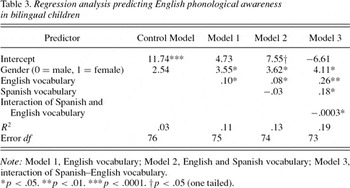
A regression model was built, beginning with the incorporation of the control variables gender and grade. Grade was not significant, and was therefore dropped from the models. English vocabulary, Spanish vocabulary, an interaction term between English and Spanish vocabulary, and language of instruction were included in subsequent regression models. English vocabulary explained variation in bilingual children's English phonemic segmentation; the amount of variation explained by English vocabulary depended on the child's Spanish vocabulary, and vice versa. This is reflected by the significant interaction between English and Spanish vocabulary in the final regression model (see Table 3 for the regression models). The interaction is significant even when language of instruction and gender are controlled for, although language of instruction was not significant and was therefore not included in the final model. The final model, which includes English and Spanish vocabulary, the interaction between them, and gender, explained 19% of the variation in phonemic segmentation scores.

This regression model provides insights into different profiles of bilingual children: unbalanced bilinguals who have a stronger L1 or L2, or balanced bilinguals who are equally strong or weak in both languages. To produce predicted scores from the regression model, we selected the 10th and 90th percentiles in the sample (equivalent to scores of 20 and 103, respectively) to represent high and low Spanish vocabulary; for English we used the same percentiles, equivalent to scores of 39 and 92, respectively. Female unbalanced bilinguals with high Spanish and low English vocabulary are predicted to score 15 points out of 20 on the PA task, but unbalanced bilinguals with low Spanish and high English vocabulary are predicted to obtain a perfect score of 20. A balanced bilingual who exhibited both high English and Spanish had a predicted score of 13 points, whereas a balanced bilingual with low English and Spanish had a predicted score of 9 points. The effects of English and Spanish vocabulary were the same for males, but their predicted scores were lower across the board. It is intriguing that unbalanced bilinguals were predicted to have higher PA scores than bilinguals with high vocabulary scores in both their languages; this finding may reflect the paucity in the sample of balanced bilinguals with truly high scores in both languages.
DISCUSSION
Spanish language instruction and bilingual status result in more Spanish-influenced English phonemic segmentation. Children with either high Spanish or English vocabulary performed better on English phonemic segmentation. This finding suggests that L1 vocabulary knowledge can facilitate L2 PA, even though L1 literacy knowledge might generate incorrect L2 phonological analyses in specific cases. The finding that the L1 needs to be well developed for its positive effect to emerge is consistent with Cummins' threshold effect (Cummins, 1979). If the L1 is weak, then development of L2 vocabulary may be important to allow for L2 PA development. In this sample, it appeared that the benefits of bilingualism were limited to children who had relatively large vocabularies in one of their two languages. It is important to note, though, that all three of these groups scored below population levels on vocabulary, and that the bilinguals on average scored lower in their dominant language than the monolinguals. Thus, the vocabulary resources available even to the highest scoring bilinguals were constrained. These findings have both methodological and theoretical implications.
Methodologically, these findings indicate that studying bilingual children requires a carefully selected battery of assessments. Clearly, if both English and Spanish vocabulary play a role in the prediction of English PA, this would suggest that future studies should evaluate children's vocabulary in both languages, even for those children receiving only English instruction. In addition, controlling for language of instruction and testing for interactions between languages should be a part of study design, wherever possible.
Theoretically, this finding would indicate that bilingual children who have been instructed in English literacy are similar to monolingual English speakers: they are not much affected by their Spanish language knowledge. On the other hand, bilingual children in Spanish literacy instruction are different from children in English literacy instruction: their English PA is influenced by their knowledge of Spanish, for points of contrast between English and Spanish. It would be interesting to replicate this study and/or to study the role of vocabulary in bilingual children's PA before any formal literacy instruction has been provided, that is, in preschool.
The English and Spanish vocabulary of these kindergarteners and first graders showed a negative correlation (r=−.35, p=.002), confirming findings previously reported for bilingual preschool children (Tabors, Páez, & López, 2003) and bilingual fourth and fifth graders (Ordónez, Carlo, Snow, & McLaughlin, 2002). This negative relationship, though, was generated by the bilingual children in English literacy instruction; they are evidently experiencing subtractive bilingualism, in which the L2 eventually replaces the first. L1 and L2 vocabularies showed a slightly positive, though nonsignificant, correlation for bilingual children in Spanish language instruction, suggesting that their acquisition of Spanish was having no negative effect on their English vocabulary skills. Further research should explore the conditions under which L1 and L2 vocabularies are positively correlated, in particular whether ongoing bilingual literacy instruction and positive sociocultural settings for the development of bilingualism (Lambert, 1975) are consistently associated with stronger positive cross-language correlations.
Bilingual children in Spanish language instruction were more likely to segment diphthongs as two phonemes than nondiphthongs. Interestingly, some monolinguals and bilinguals in English language instruction did produce two phonemes for the diphthongs, which could potentially reflect an early developmental level at which phonetic analysis wins out over orthographic knowledge, as Treiman and Cassar (1997) found with monolingual first grade English speakers. The role of orthography would need to be examined more carefully with data on students' spelling.
We have presented evidence that Spanish–English bilingual children who have a stronger knowledge of their L1 phonology and orthography are likely to use that knowledge in an L2 phonemic segmentation task. Those with more knowledge of the L2 use that rather than L1 knowledge in L2 phonemic segmentation. The differences between groups could also be related to the fact that the children taught to read in English have better knowledge of English orthography than the children taught to read in Spanish. Such knowledge may prevent them from segmenting diphthongs.
These results have practical implications. Educators may misinterpret the errors of children who are utilizing their L1 knowledge in L2 PA tasks. For example, many school districts are using phonemic segmentation tests like the Yopp–Singer Test (Yopp, 1995). Of the 22 three-phoneme items on the Yopp–Singer Test, 6 (27% of the test) include the diphthongs examined in this study, and thus might be subject to L1 influences for bilingual children transitioning from Spanish literacy instruction. Language-delayed children must be distinguished from those relying on Spanish phonology, if we are to make appropriate instructional decisions. A teacher may not have the requisite knowledge to understand the segmentation by a Spanish-speaking child of a word like “fine” as /f/-/a/-/I/-/n/ as normal, and may think the child has some language difficulties. A deficit in PA should be distinguished from a possible use of Spanish phonology and/or orthography.
LIMITATIONS
The major limitation of this study is the sample itself, a problem for any study of bilingual children. The sample may not be representative of Spanish–English bilinguals as a whole. In fact, there is not enough data on bilingual children's development of vocabulary in both languages and PA in English to know what a representative sample would be. Furthermore, although it seems plausible that the differences between the two bilingual groups can be related to their disparate experiences with literacy instruction, the two groups may also have differed somewhat on language dominance prior to school entry, which might, in part, account for their different performance levels.
The second possible limitation of this study is that the phonemic segmentation items all contained three phonemes, and that the children realized this and simply counted three phonemes as a result, without actually doing the necessary analysis. To counter this possibility, children were provided with practice items that had two, three, and four phonemes. In addition, children had to say the segments orally, not simply count them, so they had to produce a phoneme corresponding to each counter. Finally, the children committed many errors, suggesting they had not realized that all the items consisted of three phonemes.
A third limitation is that these students' orthographic knowledge was not assessed, and therefore any hypotheses about the role of orthography in children's PA development could not be examined more fully. For first graders, PA often reflects orthographic knowledge; therefore, we cannot make claims about PA as a pure outcome as opposed to a consequence of orthographic knowledge.
CONCLUSION
The role of bilingual children's English vocabulary in their English PA depends on their Spanish vocabulary, and vice versa. In addition, Spanish influences on English PA reflect language of instruction rather than knowledge of oral Spanish. Bilingual children in Spanish language instruction were more likely to segment diphthongs into two phonemes than were bilinguals or monolinguals in English language instruction. Interestingly, some monolinguals and bilinguals in English language instruction also produced two phonemes for the diphthongs, presumably reflecting a phonetic rather than a phonological analysis of the experimental items. High Spanish or English vocabulary resulted in better performance in English PA for unbalanced bilinguals. Future research should examine the role of language of instruction as well as the nature of language and literacy instruction that is received, particularly in PA, beginning with preschool children and following them longitudinally. The concurrent development of orthography should also be taken into account.
APPENDIX A

ACKNOWLEDGMENTS
Support for this research was provided by the US Department of Education's Office of English Language Acquisition (ED-98-CO-0071) and by the National Institute for Child Health and Human Development and the Institute for Education Sciences of the U.S. Department of Education (5-P01-HD039530).