How does mass partisanship develop – particularly in the absence of deep socio-economic or cultural cleavages? In this article we revisit an old question in the comparative study of parties by examining variation in the evolution of mass partisanship in contemporary Brazil, where several parties are electorally successful, but only the Workers’ Party (Partido dos Trabalhadores, PT) has managed to cultivate extensive and lasting affective partisan attachments. Classic ‘bottom-up’ approaches suggest that party systems reflect deep historical societal divides. Meanwhile, ‘top-down’ approaches respond by emphasizing the role of strategic politicians in crafting partisan attachments. Evidence from contemporary Brazil, we contend, suggests that for at least one way that partisanship can be ‘crafted,’ these two positions are flip sides of the same intellectual coin.
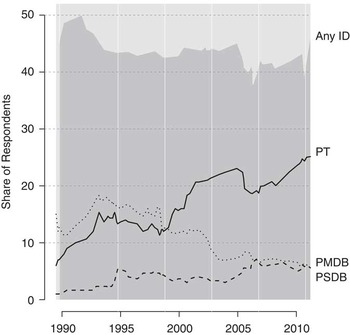
Brazil returned to competitive elections in 1985 after twenty years of dictatorship. Thirty years later it still has slightly below-average aggregate levels of mass partisanship:Footnote 1 About 45 percent of Brazilians identify with one of the twenty-three parties that have at least one seat in its legislature (as of August 2013). Yet even this figure is misleading, as most parties claim few identifiers in the electorate.Footnote 2 Since 1989 (when surveys started consistently asking a partisanship question) only three parties – PT, the PSDB (Party of Brazilian Social Democracy), and the PMDB (Party of the Brazilian Democratic Movement) – have ever commanded the sympathy of more than 5 percent of voters – and as Figure 1 shows, only the PT has managed to capture a significant number of partisans. The figure shows the proportion of voters who identify with any party (the gray shaded area) as well as the share of Brazilians who have identified with the PT, PMDB and PSDB, which are the three largest parties in Brazil's legislature.Footnote 3
Party Identification in Brazil (1989–2010) Notes: The figure shows a moving average of levels of party identification, as computed by Datafolha. White vertical lines indicate presidential elections. The question was worded exactly the same in all surveys.

The PT was granted legal recognition in 1982. By 1989 about 5 percent of Brazilians identified as ‘petistas,’ but that proportion is now about 25 percent, corresponding to almost two of every three partisan identifiers. Meanwhile, since 1989 the PMDB – the successor to the party that served as the sanctioned opposition under Brazil's 1964–85 military regime – has steadily lost identifiers, and the PSDB (which formed in 1988) – despite holding the presidency from 1995 to 2002 – has never managed to attract more than a small number of partisans. Although candidates from these and other parties have had success at the polls, only the PT has captured the partisan loyalties of a sizable proportion of voters.
It is worth mentioning that survey-experimental research has confirmed that partisanship means the same thing to voters in Brazil as it does in the United States or elsewhere – it serves as a perceptual filter through which partisans view and understand politics, and solidifies voter attachment to the party's candidates.Footnote 4 This means that the puzzle is really in the numbers.
The growth in party ID for the PT from zero to one in four voters within a single generation is a remarkable achievement, especially when compared to the trajectory of its main competitors. How did this party grow from a footnote in Brazil's party system in the early 1980s to a dominant player today – not just winning the last three presidential elections but also laying down deep roots in Brazilian society?Footnote 5
The PT's rise is theoretically puzzling because scholars predict weak mass partisanship for all of Brazil's parties. Indeed, in comparative perspective Brazil appears to be infertile territory for the cultivation of affective attachments to parties among voters, as social cleavages such as class, ethnicity, religion, or region are comparatively shallow and historically have never provided the basis for party competition.Footnote 6 And even if such cleavages existed, Brazil's political institutions work against the emergence of mass partisanship.Footnote 7 Its electoral rules permit high party-system fragmentation, complicating voters’ efforts to understand where parties stand on the issues, and fostering both intra-party and inter-party competition, which enhances the importance of individual candidates’ reputations while limiting the relevance of party labels as ‘cues.’
Where social cleavages cannot adequately explain the emergence of mass partisanship from the ‘bottom-up,’ scholars have turned to strategic elites’ ‘top-down’ efforts to articulate a distinct ideological and/or programmatic profile. Yet at first glance this explanation also appears to fall flat in the Brazilian case, because just as in many other countries, the country's main parties have all converged on the political center in recent years, diluting the coherence of their programmatic positions. Indeed, Lupu predicts that diluting a party's ‘brand name’ by contradicting long-held policy positions and allying with ideologically non-contiguous parties can lead to a collapse of partisan identities.Footnote 8 This makes the PT's trajectory all the more puzzling, as its partisan base grew even as its leaders toned down the party's leftist rhetoric, became increasingly pragmatic in their approach to winning elections and governing, and entered a confusing array of electoral coalitions with parties to its left and its right.
The explanation for the PT's successful cultivation of mass partisan attachments lies with its organizational strategy, which differed from that of other parties. Scholars taking a ‘top-down’ approach have long considered the implications of variation in the structure of national-level party organizations for electoral success and the formation of mass partisan identification, comparing and contrasting ‘elite’ and ‘mass’ ideal-type organizations, for example. Our contribution is to show that local-level party institutions should be included in the toolkit that parties possess in their efforts to cultivate affective ties. As we show below it is not merely the extent of de jure local presence that matters, but the way that parties put their local organizational presence to use that does. After all, parties can put local-level party organs to a range of uses – from ‘elite’ style politics in which party organs are mere legal fictions required to register candidacies to ‘mass’ style politics in which the party office serves as an active base of day-to-day operations for building the party's presence in and connections to society. Parties that use local organization for the latter purpose are, we hypothesize, more likely to cultivate mass partisan attachments.
As we reveal below, all major parties in Brazil have expanded their de jure local-level organizational presence over the last two decades. However, only the PT has leveraged this investment as part of a deliberate strategy to advertise its particular way of engaging citizens politically to maintain and deepen its image as a party that permits significant internal participation, with deep connections to diverse segments of organized civil society. This strategy can be summarized as ‘mobilizing the organized.’ The PT's efforts to expand its local organizational presence is part of a top-down strategy to engage organized civil society at the grass roots. In pursuing this strategy the party hoped to both gain votes and to cultivate partisan attachments in places where it had neither.
In short, variation in organizational investment strategies explains variation across Brazilian parties in terms of levels of mass partisan identification. Although the connection between organizational development and the emergence of mass partisanship resonates at a general level with what we know about European parties, to our knowledge no research has ever provided direct evidence that variation in local-level organizational presence can serve as a mechanism for the development of party ID, partly because appropriate data are extremely difficult to find.Footnote 9 We provide such evidence for a theoretically puzzling case explaining the emergence of partisanship in any party. This suggests that the same mechanism could be at work in other democracies, both older and newer.
An important implication of our argument is that it highlights the intrinsic connection between the bottom-up and top-down approaches in explaining the emergence of mass partisanship: party elites must consciously invest in cultivating affective attachments with voters, but their efforts to transform vague sentiments into more concrete political sentiments will only bear fruit if their targets are already politically active and actively engaged in civil society, often for reasons not directly related to partisan politics. In order to show this process at work, we privilege the relative precision offered by high-quality data from one country, at the expense of broad comparisons. However, our argument is not tied to Brazil. We seek to emulate influential case-specific research on the question of the emergence of partisanship:Footnote 10 to provide insight into how a particular mechanism operates; and in the hope that other work can identify similar processes elsewhere.
The article proceeds as follows. The next section develops our causal argument about the sources of mass partisanship, and explains how it relates to existing research. In the following section we describe the origins and growth of Brazil's parties, focusing in particular on the PT's strategic effort to couple organizational expansion with outreach to organized civil society, while other parties did not, and derive hypotheses to test our argument. The subsequent two sections demonstrate empirically that although all parties benefit in terms of votes from establishing a local organizational presence, only the PT manages to transform local presence into increased party ID – and that the PT gains more identifiers in places where civil society is relatively organizationally dense.
Top-Down and Bottom-Up Party-Building Strategies
Where do mass partisan cleavages come from? There are basically two views. The first is the classic ‘demand side’ social-cleavages approach originated by Lipset and Rokkan in Reference Lipset and Rokkan1967 to explain the origin of parties and party systems in Western Europe. According to this view, a political cleavage is a ‘lasting division between social groups that may give rise to open conflict.’Footnote 11 This is a largely sociological view of parties, party systems, and mass partisanship, for it assumes that parties reflect and represent pre-existing interests, which emerge ‘from below.’
A second view pays greater attention to the ‘supply side’ of politics. In this view, socio-cultural divides do not become partisan cleavages unless self-interested strategic party elites figure out how to politicize them. How do elites accomplish this? Politicians face two sets of challenges when attempting to craft partisanship: they must first create an appealing party brand, and then they must disseminate it widely.
In terms of creating a brand, scholars have emphasized the importance of elites’ use and manipulation of political rhetoric and symbols, as part of an effort to develop a coherent ideological or programmatic profile. Party leaders have incentives to bundle a strategic set of organizing principles and explanatory metaphors, in order to develop a convincing account of why a political problem exists and how to solve it. To achieve this goal, party elites craft political discourse, and develop coherent electoral platforms and policy proposals.Footnote 12 A classic example is Przeworski and Sprague's argument that an economic cleavage became important in Europe only insofar as leftist parties highlighted class issues.Footnote 13
A second challenge – the one into which we offer new insight – is disseminating the party brand. As Carmines and Stimson emphasized, most voters are fundamentally inert and do not seek out party attachments if they do not already have one.Footnote 14 The challenge that parties face is attracting adherents from among the mass of largely indifferent voters. To do so, top-down approaches have incorporated ‘strategic elites,’ national party leaders who create and disseminate partisan images. Carmines and Stimson, however, suggested that local-level party activists – not just national leaders – can be crucial for disseminating party principles and for embodying a party's mode of political engagement. We suggest broadening the notion of what ‘top-down’ means to include parties’ development of a local-level organizational presence.
By ‘development’ we mean more than merely legally establishing local branches. Some parties may create local branches merely for electoral purposes – to gain the right to run local notables for office, principally. Such parties may have an extensive de jure constant local presence, but their actual organizational activity may ebb and flow with the electoral calendar. In such parties, we expect local organizational presence to reap votes, but not partisan identifiers.
Other parties, meanwhile, use local branches for more than electoral purposes, as a demonstration of an organizational commitment both to particular issues as well as to a particular way of doing politics. Investing in local organizational outreach may reap both votes and partisan identifiers because doing so brings the party ‘closer’ to citizens and their day-to-day concerns, by making the party's brand personally relevant to citizens who are active in civil society. This tactic also provides an additional channel by which parties can reach potentially like-minded citizens. By bringing its brand down to the grass roots, by engaging in such activity outside of election seasons, a party can emphasize the differences between itself and others, and demonstrate its receptiveness to grass-roots concerns. In this way, establishing a local organizational presence may craft mass partisanship from above – but at the grass-roots level. Party scholars have yet to consider the consequences of this common sort of partisan activity.
This hypothesis resonates with longstanding notions derived from comparative parties research. Echoing Duverger's distinction between elite and mass parties, for example, scholars of Imperial Germany differentiated between ‘notables politics’ (Honoriatorenpolitik) and ‘mass politics’ (Massenpolitik).Footnote 15 Electoral politics in the former was dominated by self-appointed local elites, who only activated largely informal local-level organizations at election time, relying on personal connections and/or clientelistic relations with voters. In contrast, mass parties in Imperial Germany developed strong, centralized organizations – but also sought to develop a permanent and continuously active organizational presence at the local level. The Social Democrats (SPD) were the first to try to leverage local organization as an electoral tool. Over time, other parties sought to emulate the SPD's observed success – a phenomenon that Duverger called ‘contagion from the left.’Footnote 16
Some parties never adopted this strategy, and many elite parties continued to rely on the traditional approach – some with more success than others. For example, the British Liberal party in the period just after the First World War considered and explicitly rejected strengthening and expanding its local-level organizational presence, sticking instead with an organizational structure that resembled a decentralized federation. As a consequence the party depended on the ‘ad hoc personal and commercial relationships of local businessmen and other self-selected bourgeois notables’Footnote 17 – a tactic that ultimately failed in the face of competition from the better-organized Labour party.
Our argument also finds an echo in more recent research. Scholars have demonstrated, for example, that local-level organization helps parties recruit quality candidatesFootnote 18 and mobilize their own supporters.Footnote 19 In addition, as the example of the Argentine Peronists suggests,Footnote 20 by investing in local-level organization parties can perpetuate existing affective ties, even if the party abandons its traditional policy positions. To our knowledge, however, no research – either on historical or contemporary party politics – has ever demonstrated that parties can leverage local organization actually to create partisan identities.
The connection we draw between local party organization and organized civil society thus constitutes a missing link in existing theories of the emergence and evolution of mass partisanship. If we could go back in time and find the appropriate data, it would be no surprise to find that the European socialist parties experiencing the greatest success were not those that emerged where there were many blue-collar workers, or even those that emerged where unions had organized those workers, but were those that had opened party branches where the unions were well organized, and formally included the unions within the party's local structure. We would expect a similar result for Christian Democratic parties – partisanship would be strongest not just where there were many Catholics, but where parties reached out to both churchgoers and lay groups that were well integrated with local communities.Footnote 21 Parties that create formal links with already-organized elements in society should succeed at the polls and in crafting partisan identities.
Organizational Strategies in Brazil
As noted, Brazil is a useful case for further elaboration of the top-down approach to understanding cleavage formation, because pre-existing sociocultural and economic divides are comparatively weak. This gives us little reason to expect partisan identification to emerge naturally, without explicit crafting from above by self-interested politicians. Equally importantly, there is considerable variation in both party-building strategy and in terms of levels of partisan support across Brazil's three largest parties. All three have enjoyed electoral success, but only the PT has developed a strong brand name and a considerable pool of partisan supporters in the electorate. This difference, we contend, has less to do with the PT's location in ideological space and more with the way in which it has reached out to organized civil society through its local party-building efforts.
Local Presence and Partisanship
Since its foundation, the PT has sought to cultivate and persistently engage a large and active membership base. Organizational consolidation at the center and the development of local party branch offices have both been part of this strategy. In particular, since the 1990s the PT has prioritized investing resources in expanding its organizational reach.Footnote 22 For example, in 1995 the party affirmed at its National Meeting that it needed to increase its ‘organizational capillarity’ by opening additional local branch offices. This effort explicitly sought to increase membership, improve the party's vote totals, and cultivate deeper partisan attachments,Footnote 23 goals that have been reaffirmed at all subsequent national meetings.Footnote 24
Determining whether a party has an organizational presence at the municipal level in Brazil is challenging.Footnote 25 Most parties do not keep historical records of their local-level organizational presence – the PT has records, but they do not go back beyond 2001, so we did not use them. Moreover, Brazil's national electoral court (Tribunal Superior Eleitoral) only began compiling official records of local party organizational presence in 2010. Given this problem, we employ an alternative indicator of organizational presence: whether a party fielded at least one candidate for city council (vereador) in the previous municipal election.
This is a valid indicator of municipal-level organizational presence because in order to field a city council candidate, the electoral court must officially recognize that a party has established at least a ‘provisional’ municipal-level branch office (comissão provisôria) at least one year prior to the election. In principle a party could set up a municipal branch and not field a candidate, but given that a duly recognized party can nominate up to 1.5 times the number of council seats available (between nine and fifty-five, depending on municipal population), fielding a single candidate is an extremely low threshold. Moreover, interviews with state-level and national-level party officials confirm that the main reason parties set up local branches is to fulfill the legal requirement to run candidates in council and mayoral elections; parties expect local branches to field at least one vereador candidate. Failing to do so is evidence of incompetence and invites sanction from the state or national party office.Footnote 26
Table 1 presents the percentage of municipalities in which Brazil's three largest parties ran at least one city council candidate in recent elections. Although this was not always the case, all three parties currently have a de jure organizational presence in all but Brazil's smallest municipalities. The table also reveals the PT's organizational expansion – its main competitors have had a wider local presence for a longer time.
Party Organizational Presence, as a Percentage of all Municipalities

Source: Tribunal Superior Eleitoral
All three parties are electorally successful. So why has only the PT managed to cultivate extensive mass partisanship? What explains this variation? The answer lies partly with the path-dependent effects of organizational culture.Footnote 27 The PMDB is the successor to the sanctioned opposition party under Brazil's 1964–85 military regime. Yet time has proven this connection between the PMDB and anti-regime activism to be circumstantial and ephemeral. The military stitched the PMDB out of clientelistic and personalistic political machines that predated the 1964 coup, and by the return to democracy the one thing that united these groups had disappeared. As such, since the 1980s the party has returned to its true roots – not as an ‘opposition’ party, but as a federation of state-level electoral machines dominated by politicians who cultivate clientelistic relationships with voters.Footnote 28 The party has let its connections to organized civil society wither on the vine since redemocratization, and it has never sought to develop a coherent brand name. This electoralist orientation and the decision to disinvest in ties with organized civil society explain the decline in mass identification with the PMDB.
The PSDB emerged as a breakaway faction from within the PMDB in 1988, and adopted a structure similar to its parent party. By 1994 the party had won control of the federal government; this meteoric success generated powerful disincentives to invest in organizational development.Footnote 29 Additional disincentives come from the fact that the PSDB was born a resource-rich party, dominated by experienced office-holders from the state of São Paulo, Brazil's largest and wealthiest (see Hale's study for a similar argument about variation in organizational investment incentives in Russia).Footnote 30 For these reasons, the PSDB has made no effort to emulate the PT's organizational strategy, and to this day it remains a loose association of professional politicians, with relatively few active rank-and-file members and a local presence that – like the PMDB – ebbs and flows with the electoral calendar.Footnote 31
The PSDB remains a powerful political player because of the popularity of its leaders rather than because it articulates a coherent vision for Brazil or because it has cultivated extensive connections to organized civil society, a fact acknowledged by Fernando Henrique Cardoso, Brazil's president between 1995 and 2002.Footnote 32 In some senses the PSDB resembles the British Liberal party in the early twentieth century, in that it has eschewed cultivating ties to civil society, believing that its leaders’ reputations as efficient and effective would continue to carry the party to victory.Footnote 33
Branding and Partisanship
Samuels described how the PT developed and consolidated its party label – a deliberate effort to set itself apart from the others by developing a strong brand name.Footnote 34 To limit individualism and promote the party's collective image, the PT threatened to expel elected officials who bucked the party line after an internal vote, and it followed through on this threat on several occasions. Unlike all other Brazilian parties, the PT also requires all elected officials and political appointees to donate between 2 and 20 percent of their salary to the party (the percentage is determined on a sliding scale). These and other rules dissuade all but the most committed politicians from entering the PT, and differentiate it from other parties.
Given Brazil's institutional context, the PT adopted this institutional structure in an attempt to signal to its heterogeneous base of support among social movements, religious groups and labor activists that it would remain a distinct actor over the long run. By enforcing group cohesion and taking measures to promote and protect its label, the PT also created a political identity that could be easily marketed to a broad spectrum of individuals and groups.Footnote 35 The party has moderated its leftist discourse since the late 1990s,Footnote 36 and its distinctiveness today stems less from its ideological stance than from its self-declared efforts to ‘radicalize’ the process of Brazilian democracy, in particular by encouraging average citizens to engage in politics.
Given the party's move to the political center, it is not surprising that petistas today do not differ much from other Brazilians in terms of ideology.Footnote 37 However, evidence that the PT's investment in its brand continues to resonate can be seen in the fact that self-identified petistas differ from other Brazilians in terms of their understanding of and engagement in politics. According to a 2006 surveyFootnote 38 (the only one available that asks such questions) – petistas differ from non-partisans as well as partisans of the PMDB and PSDB in agreeing that ‘democracy is the best form of government,’ ‘politics is important to me,’ and ‘participatory processes are important.’
The PT Way of Building Partisanship
Brazil's three main parties illustrate two distinct approaches to using local party organization. The PMDB and PSDB are elite parties, albeit the former somewhat more decentralized than the latter. Both remain powerful electoral players because they offer professional politicians good prospects of wining elections. Both also have extensive local-level organizational presence, but municipal party branches are largely vehicles for local politicians to formalize their candidacies.
The PT today uses its extensive network of local branches just as these other parties do, to help its candidates win office. Yet it also does much more, as its local branches serve as a primary conduit for its efforts to engage organized civil society. The targets of the PT's outreach efforts have remained consistent over the years, since the time when it was an insignificant opposition party: Brazilians already engaged in social activism.Footnote 39 In its early years, for example, the PT explicitly drew upon a Gramscian notion of gaining ‘hegemony in social movements.’Footnote 40 This connection between PT membership and social-movement activism has remained constant as the party has sought out new generations of petistas. In 2007, for example, the proportion of delegates at the PT's National Conference who were active in a nongovernmental organization (NGO) was about 80 percent. This proportion did not vary with delegates’ age, suggesting that the connection between activism and PT membership has remained constant over time, regardless of whether someone joined the party in 1980 or 2007.Footnote 41 In short, even though the party has evolved a great deal since the early 1980s, and even after several years in power, the PT maintains an image as open to ideas and proposals emanating from organized civil society.Footnote 42 We suggest that petismo – affective partisan identification with the PT – emerges as a by-product of these efforts.
Hypotheses
If the argument we have advanced thus far were true, we would expect to observe the following. First, all parties should benefit electorally from establishing a local organizational presence. After all, gaining the ability to run candidates in local elections appears to be the primary reason parties open local branches. Second, only the PT should manage to convert local organizational presence into increased partisan identification, due to the different ways it puts local branches to use. Third, the PT should be particularly effective at cultivating mass partisanship where civil society is organizationally dense. Where civil society is thin on the ground, the PT should resemble the PMDB or the PSDB – establishing a local organizational presence should generate votes, but not partisanship. This last hypothesis is particularly important for our argument, because if the PT were creating civil society instead of engaging it, we would expect it to be equally effective in fostering party ID everywhere. Our argument suggests that the PT will be relatively more successful in cultivating affective attachments where relatively more people (per capita) are already engaged in civic activism. In the next sections we explore these hypotheses.
Party Organization and Electoral Performance
To what extent does establishing a local presence pay off in terms of votes? In this section we examine this first hypothesis for Brazil's three largest parties. Our approach consists of difference-in-difference (DiD) estimation of the electoral effect of establishing local presence. The approach compares a party's electoral performance in municipalities in which they recently established an organizational presence against those in which they did not. This design isolates the impact of establishing a local party branch, controlling for the impact of potential alternative explanations.
Data and Methods
Our dependent variable in this section is each party's proportion of votes for the lower-chamber national legislative elections, measured at the level of the municipality. Brazil has an open-list proportional representation system in which the country's twenty-seven states function as constituencies of varying district magnitude. However, the national electoral court keeps records of votes for all elections (city council up to president) at the municipal level. Voters have one vote, and can choose individual candidates or the party label. National legislative elections are held every four years.
Figure 2 illustrates the temporal structure of our data and analysis. Local elections are held every four years, in the middle of the national-election cycle. Because of the staggered electoral calendar, we measure our dependent variable as the change in a party's vote share in national legislative elections from tpre to tpost , a span of eight years. The former is two years prior to the first local election in the cycle at t 0 and the latter is two years after the local election held at t 1.
Structure of the data for the difference in difference analysis

The main independent variable is whether or not a party-established organizational presence by running at least one city council candidate in municipal elections at t 1, conditional on it not having an organizational presence (i.e. by not running a candidate) at t 0. Since we are interested in the impact of establishing a local organizational presence, municipalities in which a party already had a presence and ran at least one candidate at t 0 provide no useful information, and are excluded from the analysis. Only municipalities in which a party did not nominate a single vereador candidate at t 0 enter our analysis. Within this sample, we contrast municipalities where a party ran a candidate at t 1 against those where it could have, but did not.
We possess municipal-level data for national-level legislative elections going back to 1994, and municipal-level data on whether parties nominated a candidate for the city council going back to 1996. We are thus able to examine the effects of local organizational presence on electoral performance in national legislative elections in three eight-year cycles: 1994–2002, 1998–2006, and 2002–10. The results from the 1994–2002 cycle are particularly important to include, as it explores a period when the PT did not control the national government, allowing us to consider whether or not holding the presidency is responsible for the increase in PT partisanship.
Given the nature of our data, a difference-in-difference (DiD) approach is optimal for attempting to isolate the causal effect of our measure of local organizational presence. This approach combines both before-and-after and cross-sectional statistical contrasts, adding a ‘within-subjects’ element that can strengthen the causal interpretation of results.Footnote 43 We recognize, however, that although we use the language of experimental studies, the ‘treatment’ (establishing local organizational presence) is clearly not ‘as if’ randomly distributed.Footnote 44 True, DiD designs are typically used in natural experiment settings where treatments are rarely randomly assigned, but scholars typically assume that the treatment is exogenously assigned to units by processes unrelated to the treatment itself.
Exogeneity is often debatable, but it is clearly not present in our case. The main threat to the exogeneity assumption is that the decision to open a municipal-level party branch and run a candidate is potentially endogenous to certain municipal-level characteristics. If these same characteristics also affect the party's subsequent electoral performance, our causal inference will be flawed. To minimize the the chance that we are observing a spurious association, we first balanced the dataset by matching municipalities in the control and treatment groups on observed covariates,Footnote 45 and later performed a ‘placebo’ analysis as a robustness check.
Matching seeks to ensure that we are only comparing municipalities where parties established a local presence in the period of interest (i.e. ‘treatment group’) with similar municipalities in which the parties did not establish such presence (i.e. ‘control group’). To achieve this, we adopted a procedure that combined exact and approximate matching algorithms. We required exact matches on Brazilian region and on coarsened versions of each party's past electoral performance in the previous presidential and legislative elections.Footnote 46 We also simultaneously performed nearest-neighbor matches on population size, electoral performance in previous elections, level of development (the UNDP's Human Development Index, measured at the municipal level), distance to the state capital, civil society density,Footnote 47 and on the original (i.e. continuous) values of the coarsened variables mentioned above.
This procedure was performed independently for each party in each of the three cycles, as the set of municipalities in each condition is both cycle- and party-specific.Footnote 48 The stringent requirements of exact matches on several variables means that we are comparing pairs of municipalities that resemble each other in nearly every respect, except for the crucial variable of whether or not a party opened a local branch.
After pre-processing the data through matching, the DiD analysis itself is simple: we regress electoral performance in the municipality – measured in vote shares – on two dummy variables and their interaction. The first dummy indicates which period the observation corresponds to, and is coded as zero if it is from t 0 and 1 if the observation is from t 1. The second dummy is an indicator of the treatment, coded as 1 if the party established a local presence (ran a candidate) during the election cycle and 0 if it did not.
In this setup, the intercept of the regression represents a party's performance in the control group at t 0, which we refer to as the ‘baseline’ performance used to assess the substantive significant of our estimated causal effects. The coefficient on the time dummy captures only the trend in the control group between t 0 and t 1, and the coefficient on the treatment dummy variable captures differences between treatment and control groups at time t 0. Under the assumption that our matching procedure generated two equivalent groups of municipalities, the coefficient on the interaction term is therefore the estimate of the causal effect of opening a branch in a treated municipality at t 1. To simplify the presentation of results, we report only this last coefficient and the baseline vote share in the control group at the start of the cycle, so that the substantive magnitude of the treatment effect can be assessed. (Complete results are available in the supplementary materials.)
Results
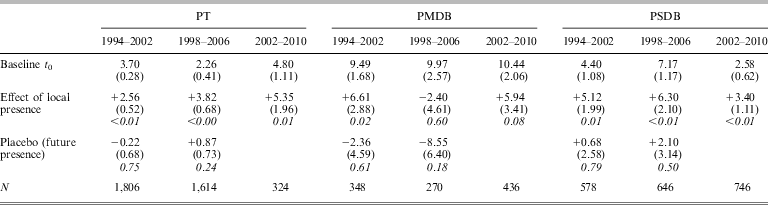
Results in Table 2 reveal that in all cycles, all three parties improve their electoral performance in national legislative elections in municipalities where they establish an organizational presence, compared against those where they do not. (The only exception is the PMDB in the 1998–2006 cycle, for which results are negative but not statistically significant.) Establishing a local branch office tends to boost parties’ electoral performance in national level elections by between 2 and 6 percentage points, which is substantively large given the parties’ relatively low baseline vote shares.
Effect of Establishing a Local Presence on Party Legislative Vote Share

Notes: DiD estimates by electoral cycle. Results were obtained after matching municipalities in the control and treatment groups on observed pre-treatment covariates, in each cycle, for each party. Standard errors are shown in parentheses and p-values in italics. Complete regression coefficients are provided in the supplementary materials.
As a robustness check, we conducted a placebo test for the results in the first two cycles. To do so we re-estimated the DiD model, but used the subsequent period's treatment indicator. Establishing a local party branch after an election cannot logically have an effect on that election. However, the same municipal characteristics that might lead a party to open municipal offices prior to one election should also encourage that party to open branches in the future. That is, municipalities in which a party establishes itself in one cycle are likely to be similar to those in which that party then establishes itself in the next. Consequently, ‘opening a branch in the future’ is a perfect placebo for estimating whether some omitted determinant of opening a branch in the present (rather than the observable fact of actually opening a branch) is driving parties’ improved electoral performance. If the results reported above are simply capturing the effect of unobserved municipal characteristics on party performance, rather than capturing the effects of organizational presence, the placebo should logically yield results similar to those of the actual treatment. Fortunately, the placebo test does nothing to damage our findings. As Table 2 reports, the placebo never has a statistically significant effect. This finding lends support to our hypothesis that establishing an organizational presence has an independent causal impact on vote share.
Party Organization and Party Identification
The fact that the three main parties benefit roughly equally, in terms of votes, from establishing local organizational presence reinforces the idea that electoral success can be achieved even without a clear ideological message. Parties have a fairly obvious reason to establish a local organizational presence – to nominate candidates, and compete in elections. Two hypotheses remain to be explored: whether the PT's distinctive success in cultivating partisans, not just voters, can be linked to the party's local-level organizational expansion, and whether this effect only appears where civil society is relatively densely organized. In this section we confirm both of these hypotheses.
Data and Methods
As before, we rely on a comparison between municipalities where parties establish themselves relative to municipalities where they do not. Although the hypothesized causal connection between local organization and the cultivation of party ID is fairly straightforward, limited availability of appropriate data presents several challenges to testing the hypothesized relationship empirically. As noted, the public-relations firm Datafolha has been regularly asking the same question about party ID since 1989. However, only surveys fielded after March 2002 identify respondents’ municipality. This presents an initial limitation, in terms of time-period, to only a single electoral cycle.
A second limitation emerges due to the hierarchical nature of the data. As in the previous section, we rely on a standard DiD design to determine whether changes in the level of party ID from the start to the end of the cycle in the treatment group (where a party established a local presence) differ significantly from any changes in the level of party ID in the control group (where it did not). However, our analysis here differs from the previous section in that in this case, although the treatment is observed at the municipal level, outcomes are observed by aggregating individual-level survey responses.
Nationally representative Datafolha surveys typically have a sample size of between 1,000 and 2,000, and they sample respondents from a couple hundred of Brazil's thousands of municipalities. This means there are too few individual observations in most municipalities to estimate party ID at the municipal level in any single survey.Footnote 49 To get around this problem, we pooled individual responses from different surveys close to October 2004 to create observations for t 0, and then did the same from surveys close to October 2008 to create observations for t 1. However, as above, we only used individuals in municipalities in which parties had no organizational presence at t 0, which left us with total sample sizes that range from just under 1,000 to 2,600 for each party (see Table 3).
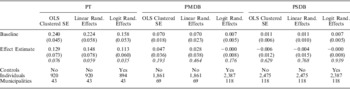
Effect of Establishing Local Presence Between 2004 and 2008 on Identification with PT, PMDB, and PSDB

Notes: The sample size varies across parties because it is based on municipalities in which each party was not yet present in 2004. The sample size varies across specifications within parties because of missing observations on the individual-level control variables (sex, income, age). For the linear regressions, the reported effects correspond directly to the regression coefficients. For the logit regression, effects were computed through parametric bootstrapping (see appendix for details). Standard errors are shown in parenthesis and p-values in italics.
Our dependent variable at the individual level is whether an individual identifies with the party or not. The quantity of interest, however, is the share of respondents that identify with the party in ‘treated’ and ‘untreated’ municipalities, and in particular, how that proportion changes from t 0 to t 1. To estimate these quantities, we pool individuals from different surveys according to whether the party opened a branch in their municipality or not. This setup is analogous to experimental settings in which treatment is assigned to clusters of individuals but behavior is observed at the individual level.Footnote 50
We then estimated linear probability models for each party. In such models, coefficients can be interpreted directly as proportions (and differences in proportions) of voters in municipalities in each of the treatment conditions. This sort of model is appropriate even though our dependent variable at the individual level is dichotomous, because the two independent variables and their interaction define non-overlapping and exhaustive subgroups in the data – i.e. the model is saturated.Footnote 51 We adjusted for the hierarchical structure of our data in two ways: first by including clustered standard errors by municipality, which accounts for the fact that individuals are not independent observations but are clustered in municipalities which can be treated or not; and then with a random-effects model, which allows treatment effects to vary across municipalities. As a robustness check we estimated a third model that includes a number of individual level control variables. In this last case we estimated a logit regression with random effects instead of a linear probability model, because the model is no longer saturated once control variables are included, rendering linear probability models inappropriate.
Results
As before, Table 3 reports only treatment effects and the baseline levels of party ID for the three main parties. For the two linear probability models, we report the the intercept and the coefficient on the interaction term, which can be directly interpreted as the baseline proportion and treatment effect, respectively. In the logit model we report the predicted baseline probability and marginal effects of the treatment for an average individual in an average municipality.
Estimates across different specifications yield similar effects for each party. However, the contrast across parties is stark: For the PT, the three models suggest that establishing local presence leads to a substantial increase in party identification – increases of close to 60 percent relative to the baseline levels in the sample, with p-values within the 0.1 level for models without controls and under 0.05 once individual-level controls are included. In contrast, for the PMDB and the PSDB the effects are essentially zero.
In sum, although opening a party branch at the local level increases electoral performance for all of Brazil's main parties, only the PT is able to translate this into stronger affective partisan attachments. This finding supports our hypothesis that what is different about the PT is not so much that it organizes locally, but that uses its local-level organizational presence differently.
The Civil Society Connection
Let us now turn to our third and final hypothesis. Here, we modify the model in the previous section by including an interaction term between the treatment indicator and the number of NGOs per thousand residents – our measure of civil society density at the municipal level. This change allows us to examine whether the effect of establishing local presence varies with the pre-existing strength of civil society.
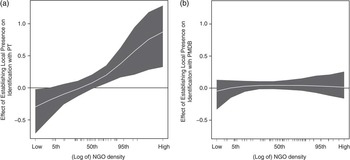
Figure 3 presents the results of this extended model graphically.Footnote 52 It shows that the effects of establishing local presence on party ID do indeed vary with civil society density – but only for the PT. The party enjoys significant increases in identification when it establishes itself in places whose civil society density is above the median. In places where organized civil society is only weakly present, in contrast, the PT is unable to cultivate affective partisan attachments. In these places, the PT is ‘just like’ the other main parties in the system. (Recall that the PT does gain votes where it establishes a local branch, so its investment is hardly wasteful.)
Effects of establishing local presence on identification, by levels of civil society density (3a, PT; 3b, PMDB) Notes: Estimates were obtained from a DiD logit with random effects by municipality and the addition of (log of) civil society density in a three-way interaction with treatment and time, and all lower dimension interaction terms. Effects were computed by parametric bootstrapping (for details, see the online appendix). For simplicity, we do not report results for the PSDB, which are even weaker than for the PMDB.

For the PMDB, there is no increase in identification at any level of civil society density. Since the results for the PSDB are essentially the same, they have been excluded for parsimony.
Discussion And Conclusion
The PT has always had a self-image as a party of activist citizens – Brazilians who want to engage in politics to help change society. Since the 1980s the party has sought to engage such citizens, primarily by cultivating connections to organized civil society. In our view the increase in mass partisanship for the PT since that time is a byproduct of these efforts. The PT is the only Brazilian party to have adopted this tactic, and as a result most people who identify with any party identify with the PT.
Our argument seeks to emulate other well-known research that both sheds light on particular cases and offers theoretical insights with broad comparative implicationsFootnote 53 – in this case, on the origins of mass partisanship. The strength of our argument lies with extending the conceptual range of the strategies parties can adopt to craft mass partisanship, and by documenting the causal impact of this mechanism.
Specifically, although many scholars have highlighted the autonomy of politics in the process of cleavage formation, such research has focused on elites’ national rhetorical, electoral and policy-making efforts. We suggest that party leaders have another tool in their kit to help instantiate their brand at the mass level: opening local party offices and engaging social groups that are already organized. This causal impact of this tactic follows the same logic as that articulated by Torcal and Mainwaring: by developing local organization, parties reach out and personally engage individuals and groups in political experiences that directly ‘forge collective memories and identities.’Footnote 54
However, our analysis reveals that it is not simply the ‘presence’ of a densely-organized civil society that can lead to increases in party ID – and also that party strategy on its own is also insufficient. Mass partisanship for the PT has been crafted from the top down, but party strategy only bears fruit when civil society – the bottom-up element – is already dense.
Local party organization is a missing link between top-down ‘supply side’ and bottom-up ‘demand side’ arguments about the origins of party systems. As such, the evidence that such a tactic works in practice carries broad comparative implications – both for understanding party-system development in a historical perspective and for understanding contemporary party-system evolution. Our findings suggest that parties can supply their product – their brand name – and reap profit in votes and partisan support if they reach out not merely to a set of individuals, but to individuals who are already enmeshed in activist social networks.
Importantly, the PT pursued this strategy both when it was in opposition and when it controlled the government, suggesting that creation and dissemination of a brand name are not tools exclusive to small, resource-poor opposition parties – they can be part of a political strategy for consolidating power over the long term.
To our knowledge, partly due to the difficulty of finding reliable data on civil-society density and local-level party organization as well as on party ID, this is the first demonstration of this tactic's effectiveness in practice. As noted, the PT's strategy resembles the tactic many Socialist and Christian Democratic parties pursued long ago. In established Western European democracies, parties on both the left and the right sought to connect not just to to like-minded individuals, but to individuals who were already enmeshed in mobilized social networks. Likewise, the decision of the PT's rivals not to pursue a similar strategy echoes the choices other parties have made, in different countries and in different historical eras. Overall, the contrast between the tactics Brazilian parties chose echoes decades-old discussions of the extent to which we observe organizational ‘contagion from the left.’
This extensive literature suggests that there is no necessary reason why parties in other countries today could not pursue a strategy similar to that of the PT. Parties can lay down roots – crafting partisan identities from above – by linking up with organized civil society. It is true that such a party-building strategy demands institutional innovation and a long-term commitment, but the fact that the PT has built its brand name in a country with anti-party electoral institutions and weak sociocultural cleavages suggests, at a minimum, that parties elsewhere could pursue a similar approach.
Around the world, many politicians rely on clientelistic access to government resources. Others, in turn, focus on their personal charisma and leadership qualities. Both of these strategies generate elite-run electoral machines, with relatively weak party organization, minimal ties to organized civil society, and tenuous partisan identification among voters. This model is Duverger's classic ‘elite’ party, and it remains prevalent across new democracies in particular.Footnote 55 However, many parties may find the tactic of reaching out to elements in civil society a profitable strategy. Future scholarship should investigate the conditions under which and ways that parties and civil society interact to form partisan cleavages.