Surgical site infections (SSIs) are a subset of healthcare-associated infections associated with longer postoperative hospital stay, additional surgery, potential long-term consequences, and even death.Reference Plowman, Graves and Griffin 1 – Reference Coello, Charlett, Wilson, Ward, Pearson and Borriello 3 Prevention of SSIs is regarded as a cornerstone of infection prevention and control, making it an important target for healthcare-associated surveillance in many European countries. 4 It is included in quality standards for healthcare-associated infections (HCAIs).Reference Wilson, Hodgson and Liu 5 – 8
The European Centre for Disease Prevention and Control (ECDC) has been responsible for coordinating the Hospitals in Europe Link for Infection Control through Surveillance (HELICS) project (now HAI-Net SSI) since 2008. 4 The ECDC collates and publishes data on superficial, deep incisional, and organ-space SSIs from national surveillance programs to improve the quality of care across Europe through standardization of definitions, data collection, and reporting procedures for hospitals participating in SSI surveillance. 4
Direct comparison of reported SSI rates between countries can be hampered by differences in healthcare systems, clinical practices, types of hospitals, and patient mix within participating hospitals as well as differences in surveillance methodology. To compare data across countries, it is essential to assess the impact of these factors on the reported SSI rates while recognizing that SSI surveillance systems in many countries predated the development of a standardized protocol.Reference Mannien, van den Hof, Brandt, Behnke, Wille and Gastmeier 9 To understand the potential impact of these intercountry differences in surveillance, a bilateral collaboration was set up between England and Norway, 2 countries with comparable national health systems. We compared the SSI surveillance systems of these 2 countries to develop recommendations for improving international SSI surveillance networks.
METHODS
Comparison of Operational Methods
To compare the SSI surveillance methods in England and Norway, we included parameters that covered requirements for hospital participation, organization of surveillance, data collection methods and scope, surgical categories included, case definitions and case finding methods, benchmarking systems, and reporting. Information on each parameter was collected by reviewing the respective protocols and interviewing surveillance staff.Reference Harrington, Wloch, Elgohari and Lamagni 10 , 11
Data Collection
We extracted data for comparison from the English and Norwegian SSI surveillance for surgeries undertaken between September 1, 2012, and December 31, 2014. Data were restricted to surgical categories included in the ECDC HAI-net program 4 in both countries, namely coronary artery bypass graft (CABG), open cholecystectomy (CHOL), open colon surgery (COLO), and total and partial hip prosthesis (HPRO). The ECDC HAI-net program also includes laparoscopic CHOL and laparoscopic COLO, caesarean sections, knee prosthesis, and laminectomies; these categories were excluded on the basis that they were not under surveillance in both countries. Anonymized disaggregate data were transferred by secure means (CyberArk, Newton, MA) from Public Health England (PHE) to the Norwegian institute for Public Health (NIPH) for analysis of the merged dataset. The UK Information Commissioner’s Anonymisation Code of Practice was used to ensure anonymity of patients and hospitals. For analytical purposes, we recoded American Society of Anesthesiologists (ASA) score and wound classification in dichotomous variables. For the ASA score, we combined scores >2 (≥3) and scores ≤2. For wound classification, we combined “contaminated” with “dirty wounds” (≥3) and compared these with “clean-contaminated” combined with “clean wounds.” The number of postoperative days was calculated using the day of surgery as day 1. As the coding system used for surgery differs between England, Norway, and the ECDC, we invited clinical experts from both countries to link the codes used in their surveillance system to the International Classification of Diseases, Ninth Revision Clinical Modification (ICD-9-CM) procedural codes used by the ECDC.
Data Analysis
We compared these 2 surveillance systems by examining the completeness of data and by comparing the populations and surgical characteristics. Differences were examined using the χ2 test for dichotomous and categorical variables and the Mann-Whitney test for continuous variables. For comparison of SSIs, we restricted analyses to SSIs occurring within 30 days after surgery, including surgeries in which implants were used. To compare the SSI rates in England and Norway, we calculated the cumulative incidence for deep incisional and organ-space SSIs reported for each surgical category. In addition, we calculated the incidence density of in-hospital SSIs per 1,000 postoperative hospital days to correct for differences in the duration of hospital admission, which could affect the number of reported in-hospital SSIs. We examined the difference in reported SSI rates between England and Norway using multivariable logistic regression, adjusting for the following known risk factors: sex, age, ASA score, wound class, postoperative hospital days, and operation duration. In these analyses, we used the reported in-hospital SSI incidence as an outcome and added country (Norway as reference) together with the examined risk factors as covariates in the model. We performed these analyses on all procedures within each surgical category, and we subsequently restricted further analyses to specific procedures included by both countries.
RESULTS
Participation in Surveillance
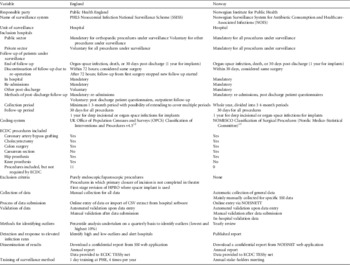
Table 1 presents an overview of the English and Norwegian surveillance systems for SSIs. In England, there is a mandatory requirement for NHS Trusts undertaking orthopedic surgery to participate in a minimum of 3 months of surveillance every year in 1 of 4 orthopedic categories in at least 1 hospital. In addition, hospitals can preselect surveillance to undertake from 13 other categories. There was no mandatory requirement for the private sector at the time the data were collected (but it was introduced in April 2016). Data are collected quarterly, and hospitals can participate for 1 or multiple periods throughout the year. In Norway, all hospitals (both public and private) that perform any of the 5 surgical categories included in the SSI surveillance system are required to participate. Hospitals are required to undertake surveillance for the whole year. Data may be submitted as determined by the hospital, but data quality checks and updated online reports are made available every 4 months.
Description of the English and Norwegian Surveillance System for Surgical Site Infections

NOTE. SSI, surgical site infections; ECDC, European Centre of Disease Control.
Procedures Included in SSI Surveillance
In England, the procedures under surveillance are coded using the UK Office of Population Censuses and Surveys (OPCS) Classification of Interventions and Procedures. In Norway, Nordic Medico-Statistical Committee Classification of Surgical Procedures (NOMESCO) coding is used, and the ECDC uses the WHO ICD-9-CM coding. England links the OPCS codes with the ICD-9 codes and only submits the corresponding codes to The European Surveillance System (TESSy). Norway has not linked the NOMESCO codes to the ICD-9 codes and submits all codes that fall under the overarching procedure descriptions to ECDC TESSy.
The ECDC, England, and Norway include different specific procedures in each of the surgical categories (Table 2). For example, the ECDC included 11 procedural codes under the surgical category CABG. Of these, England has included 10 and Norway 3, with 2 of those procedures are reported by both countries. England excludes purely endoscopic/laparoscopic procedures (however, laparoscopy-assisted surgery is included), diagnostic procedures, procedures where primary closure of incision is not completed in the surgical theatre, and first-stage revision of HPRO where a spacer implant is used. In Norway, these procedures are included.
Number of Procedural Codes Included in ECDC “Surveillance of Surgical Site Infections in European Hospitals – HAISSI” and Number of These Codes Under Surveillance in Norway and England

NOTE. CABG, coronary artery bypass grafting; CHOL, cholecystectomy; COLO, colon surgery; HPRO, hip prosthesis: ECDC, European Centre of Disease Control.
Case Finding
For both countries, and within the ECDC protocol, the follow-up period is 30 days for all procedures and 1 year for detection of deep or organ-space infections in procedures involving prosthetic implants. In England, case finding both during admission and readmission is mandatory for all surgical procedures. Other post-discharge methods (including patient questionnaires, SSIs identified in outpatient clinics or home visits) are optional and therefore are not used for benchmarking or are not reported to the ECDC. In Norway, SSI surveillance is mandatory during admission, readmission, and post-discharge follow-up using patient questionnaires with data from all follow-up methods reported to ECDC.
Submission of Data and Quality Assurance
In England, all newly registered hospitals are required to send staff for training on SSI surveillance methods as well as new staff in previously registered hospitals. The courses are run by PHE and are also open to staff wishing to refresh their knowledge of surveillance methods. Hospitals submit data through manual online data entry into a custom-built web application, or they import a. CSV file extracted from hospital software. The system includes automated validation during online data entry, and further manual validation is undertaken by the central surveillance team at PHE. PHE undertakes a percentile analysis on a quarterly basis to identify outliers on the basis of their category-specific SSI rates (lowest and highest 10%). Hospitals are alerted of their outlier status by letter. Responsibility lies with the hospital to respond to unusually elevated or low infection rates. In Norway, results are available for active use by local and regional infection control personnel, who are responsible for raising concerns with the surgical department and management.
In Norway, data collection is partly automated (ie, admission and surgical details) and partly manual (ie, post-discharge questionnaires). Automatically extracted data are validated in the hospital, which includes logic checks and follow-up on the post-discharge patient questionnaires. The data are subsequently submitted through online entry via the Internet-based data tool NOISnett, which contains automated validation. In addition, the surveillance team at NIPH performs manual validation to complete missing information. ECDC does not specify any mandatory aspects for follow-up, method for data extraction, or validation.
Analysis and Reporting of Hospital Data
In both countries, hospitals can download their confidential SSI reports from online web applications; a suite of reports are available, including risk-stratified SSI rates. Public reporting of SSI rates in both countries is undertaken annually for the mandatory categories. Furthermore, reports giving data completeness are published every 4 months at the hospital, hospital trust, and regional levels on the Norwegian website for quality indicators. As described above, the PHE alerts hospitals of their outlier status.
Variables and Case Definitions
Of 30 epidemiological variables in the standard protocol from the ECDC, England submits 26 and Norway submits 24. The ECDC specifies type of microorganism, antibiotic code, and resistance data; these variables are collected in England but not in Norway. Height and weight data are additionally collected by both countries and are used to calculate body mass index (BMI).
The definitions of possible risk factors were comparable between the ECDC, England, and Norway, with exception of urgent surgery. In England, urgent procedures are defined as unplanned, immediate life-saving operations and operations conducted as soon as possible after resuscitation. ECDC and Norway defined an urgent operation as one that was not planned at least 24 hours in advance.
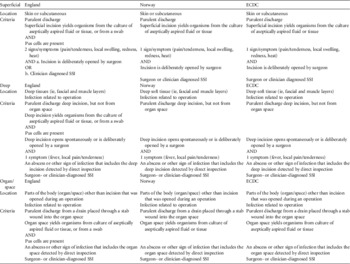
When looking at the definition of the outcome variables (superficial, deep incisional, and organ-space SSIs), the definitions used in England are more stringent than those used by Norway and ECDC on various points (Table 3). The case definition for superficial SSI differed to such extent that we restricted our analyses to deep incisional and organ-space SSIs.
Case Definition of Surgical Site Infections as Used for the Surveillance of Surgical Site Infections in England, Norway, and the HAISSI European Protocol From ECDC

Comparison of Surveillance Data
From September 2012 to January 2015, a total of 35,504 and 189,094 procedures were reported from England and Norway, respectively, in accordance with the ECDC-specified surgical categories included in these countries. Except for BMI, which was reported for 48.6% of procedures in England and 8.0% in Norway, data were missing for <10% of all variables in both countries. Information on the type of SSI was available for all individuals in Norway and for all but 1 person in England.
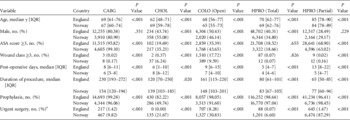
The patient characteristics for the populations under surveillance differed between England and Norway (Table 4). In particular, ASA score and wound contamination differed for various procedural categories. Urgent procedures were more common in Norway for most procedural categories, which can be explained by a stricter case definition for urgent surgery in England. In England, the operation duration was significantly longer for CABG (230 vs 154 minutes; P<.001), antibiotic prophylaxis use was more commonly used with cholecystectomy (82.2% vs 49.7%; χ2=127.3; P<.001), and the duration of hospital stay was longer for partial HPRO (13 vs 5 days; P<.001) (Table 4).
Patient and Procedural Characteristics of the Population Under Surveillance for Surgical Site Infections in England and Norway from September 2012 to December 31, 2014

NOTE. CABG, coronary artery bypass grafting; CHOL, cholecystectomy; COLO: colon surgery; HPRO, hip prosthesis: IQR, interquartile range; ASA, American Society of Anesthesiologists. Wound class ≥3 includes “contaminated” and “dirty.”
a The definition of “urgent surgery” differs between England and Norway, and therefore these data cannot be compared.
Surgical Site Infections in England and Norway
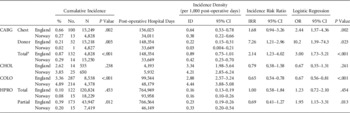
Among the surgical categories reported by both countries, England reported 728 deep incisional and organ-space SSIs (0.38%) and Norway reported 293 deep incisional and organ-space SSIs (0.80%) occurring in-hospital within 30 days after the procedure. The median number of days between the procedure date and onset of SSI showed that it was significantly longer in Norway for donor site infection after CABG: 16 days in Norway (IQR, 11–22 days) versus 14 days in England (IQR, 9–20 days; P<.001). Median days to infection were lowest for cholecystectomy with 7 days (IQR, 6–12 days) and 9 days (IQR, 7–14 days) for England and Norway, respectively (P=.236). Time to SSI after partial hip prosthesis were the longest, with a median of 16 days for both countries (IQR, 11–24 days for England and 11–21 days for Norway; P=.081).
The highest cumulative incidence of deep incisional or organ-space SSI was seen after colon surgery in both countries (Table 5). Once the number of days of inpatient follow-up was taken into account, the highest incidence in England was cholecystectomy (3.34 of 1,000 postoperative hospital days), while in Norway colon surgery remained the highest (4.44 of 1,000 postoperative hospital days) (Table 5). England had a significantly higher cumulative incidence of SSI after CABG and partial HPRO than Norway, although for partial HPRO this difference did not remain after adjustment for length of stay. In Norway, SSI rates were consistently higher for colon surgery than in England. The incidence risk ratio (IRR) for SSI in England was significantly higher for donor site SSI after CABG and lower for colon surgery (Table 5).
Cumulative Incidence and Incidence Density of Deep Incisional or Organ-Space Surgical Site Infections Within 30 Days of the Procedure From September 2012 to December 31, 2014, in Norway and England

NOTE. CABG, coronary artery bypass grafting; CHOL, cholecystectomy; COLO, colon surgery; HPRO, hip prosthesis; n, absolute number; ID, incidence density; IRR, incidence risk ratio; OR, odds ratio; 95% CI, 95% confidence interval.
a Total of chest and donor site infections combined.
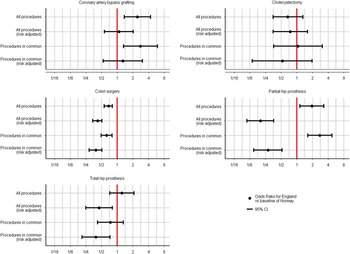
The procedures included in each surgical category differed between countries (Table 2). We performed logistic regression analyses for all procedures as well those procedures common in both the English and Norwegian surveillance systems (Table 2) with England as the reference. There was no significant difference in SSI for patients undergoing cholecystectomy between countries before or after risk adjustment (Figure 1). For the other categories, risk adjustment resulted in either a removal of country effect or a shift in the direction of effect (Figure 1). Colon surgery was the only category in which the lower odds of SSI for England (OR, 0.68; 95% CI, 0.56–0.81) did not change direction after risk adjustment and remained significant (OR, 0.42; 95% CI, 0.34–0.51). For CABG, the unadjusted excess odds for England (OR, 2.44; 95% CI, 1.37–4.36) was attenuated and lost significance after risk adjustment (OR, 1.08; 95% CI, 0.57–2.04). For total HPRO, the unadjusted analysis did not show evidence of country effect (OR, 1.23; 95% CI, 0.72–2.10), but the effect changed direction to significantly lower adjusted odds for England (OR, 0.45; 95% CI, 0.25–0.81). For partial HPRO, the unadjusted higher odds in England (OR, 1.95; 95% CI, 1.15–3.31) changed direction after risk adjustment to significantly lower odds compared with Norway (OR, 0.20; 95% CI, 0.11–0.36) (Figure 1). Similar results for both unadjusted and adjusted estimates were observed for the analysis based on the specific procedures common to both surveillance systems (Figure 1).
Odds ratios for England compared to Norway, for developing surgical site infections within 30 days after coronary artery bypass grafting (CABG), cholecystectomy, colon surgery, total hip prosthesis, and partial hip prosthesis. Odds ratios are given for all procedures and for those commonly reported by England and Norway, with and without risk adjustment. Figure shows odds ratio with 95% confidence intervals.

DISCUSSION
The surveillance systems to monitor SSIs in England and Norway differed significantly in various aspects from the ECDC protocol and from each other. We identified considerable differences in case definitions for superficial SSIs between England and Norway, but even with exclusion of these infections, differences in patient- and operation-related factors had a dramatic impact on SSI rates observed in each country. Adjusting for these factors affected the interpretation of the differences for all procedures with the exception of cholecystectomy. The most extreme effect was observed for partial HPRO, where the crude OR was 1.95 and the adjusted OR was 0.20 for England. Adjusting for length of stay (using IRRs) did not account for all the differences found when adjusting for all established risk factors. The difference in the characteristics of the population under surveillance may reflect differences in the priority criteria for surgery or differences in clinical procedure, such as how long patients typically remain in the hospital after surgery. Such differences can affect the cumulative incidence of SSI and therefore should be considered in international comparisons. However, using the unit-based (‘light’) ECDC protocol, which only includes patient-level data for patients with infection, entirely precludes risk adjustment. In contrast, Norway and England included different procedures in each surgical category, but this had minimal impact on SSI rates between the countries.
The organization of the surveillance system differs between these countries, such as mandatory aspects, reporting period, and the variables recorded. England uses more stringent case definitions and less aggressive post-discharge surveillance, both of which could lead to lower SSI rates. In addition, voluntary reporting in England might also affect the reported rates through selection bias. Previous studies have shown that voluntary and periodic reporting can influence the representativeness of the data and can affect the reported incidence of SSI.Reference Lower, Eriksen, Aavitsland and Skjeldestad 12 In addition, public reporting could affect participation and reported SSI rates in settings in which reporting is either voluntary or mandatory.Reference Haustein, Gastmeier and Holmes 13 , Reference Martin, Zingg and Hansen 14 The mandatory nature of surveillance in Norway could result in better representation of nonorthopedic categories, although its impact on the overall SSI estimate can go in either direction.
Even within the commonly reported categories, we identified differences in the procedures included. Both countries reported only a portion of the procedures in the HAI-net protocol. Including only procedures reported by both countries did not significantly affect the difference in rates between these countries. However, member states may include a mix of high- and low-risk procedures eligible for surveillance, and this can affect the reported SSI rates. Listing the procedures included in each surgical category by country would assist in interpreting the reported SSI incidence.
The limitations of this study include differences in the coverage of both surveillance systems. Due to differences in mandatory and voluntary aspects of the surveillance systems, we expect that the coverage is higher in Norway. However, we were not able to assess the completeness of reporting. In addition, we did not evaluate the validity of the data in both systems, which can be influenced by differences in the definitions used for clinical practice. Small changes in case definitions of SSI have been shown to cause major variation in estimated percentage of wound infection.Reference Wilson, Gibbons and Reeves 15 In Norway, part of the data used in the surveillance system is extracted automatically, and this may affect the quality of data.
Differences in methodology, case definitions, and population under surveillance in the English and Norwegian SSI surveillance systems affected SSI estimates, making comparison of crude rates unreliable. Based on this study, we recommend the following actions for the European Surveillance of SSI: (1) report different definitions used in national surveillance program, (2) publish rates that are adjusted for a list of specific risk factors, and (3) review the procedures under surveillance for each surgical category in the national surveillance program.
ACKNOWLEDGMENTS
We would like to thank all the hospitals for submitting data on SSIs to the national surveillance system for SSIs in England and Norway. In addition, we would like to thank Nick Hinton at Public Health England for the secure transfer of data and the SSI surveillance staff working at the English and Norwegian national institutes.
Financial support: No financial support was provided relevant to this article.
Potential conflicts of interest: All authors report no conflicts of interest relevant to this article.