INTRODUCTION
Two important constraints to the production and productivity of maize (Zea mays L.) in the savanna agroecology of West and Central Africa (WCA) are recurrent drought and infestation by Striga spp. Edmeades et al. (Reference Edmeades, Bänziger, Chapman, Ribaut, Bolanos, Badu-Apraku, Akoroda, Ouedraogo and Quin1995) reported an estimated 15% annual maize yield loss from drought stress in the West African savannas and indicated that localized losses may be much higher in marginal areas where the annual rainfall is below 500 mm and soils are sandy or shallow. Grain yield losses can be even greater if drought stress occurs at the most drought-sensitive stages of crop growth, such as flowering and grain filling (Denmead & Shaw Reference Denmead and Shaw1960; Shaw Reference Shaw1976; NeSmith & Ritchie Reference NeSmith and Ritchie1992). All the countries of WCA experience drought during the maize growth cycle. Therefore, maize breeding programmes that target the savanna agro-ecologies of the sub-region should have drought tolerance as one of their main priorities.
Severe Striga infestation can cause yield losses ranging from 10 to 100%, depending on crop variety and environmental conditions (Lagoke Reference Lagoke and Lagoke1998; Kroschel Reference Kroschel, Kroschel, Mercer-Quarshie and Sauerborn1999), and has often compelled farmers to abandon maize cultivation entirely. Various methods are recommended for the control of Striga spp. These include cultural, mechanical, physical (solarization), chemical and biological controls as well as the use of resistant varieties (Kroschel Reference Kroschel, Kroschel, Mercer-Quarshie and Sauerborn1999). However, the use of host plant resistance or tolerance is considered the most economically feasible and sustainable approach for reducing the effects of this parasitic weed (DeVries Reference DeVries, Haussmann, Hess, Koyama, Grivet, Rattunde and Geiger2000; Badu-Apraku et al. Reference Badu-Apraku, Fakorede, Menkir, Kamara, Akanvou and Chabi2004a ).
Under field conditions, Striga hermonthica infestation and drought do occur simultaneously and the combined effect can have serious consequences on maize production and productivity, particularly in the savannas of WCA. In a study, to compare the effects of drought and S. hermonthica on maize under field conditions, Badu-Apraku et al. (Reference Badu-Apraku, Fakorede, Menkir, Kamara, Akanvou and Chabi2004a ) reported that grain yield was reduced by 53% under drought and by 42% under Striga infestation. Therefore, in the Sudan and Northern Guinea savannas where intermittent drought occurs frequently, it is desirable to incorporate drought tolerance into cultivars that have resistance to Striga, as the two stresses often occur together. Presently, farmers in Striga endemic ecologies of WCA are demanding cultivars that combine Striga resistance with drought tolerance and are unwilling to adopt maize cultivars that do not possess adaptation to both drought-prone and Striga endemic environments.
Recurrent selection is an effective cyclical procedure designed to increase the frequency of favourable alleles in a population (Hallauer & Miranda Reference Hallauer, Miranda, Hallauer and Miranda1988) and has been used effectively for improvement of quantitatively inherited traits in maize breeding populations (Sprague & Eberhart Reference Sprague, Eberhart and Sprague1977; Hallauer & Miranda Reference Hallauer, Miranda, Hallauer and Miranda1988; Kling et al. Reference Kling, Fajemisin, Badu-Apraku, Diallo, Menkir and Melake-Berhan2000; Badu-Apraku Reference Badu-Apraku2007a , Reference Badu-Apraku b ; Badu-Apraku et al. Reference Badu-Apraku, Fakorede and Lum2008, Reference Badu-Apraku, Fakorede, Lum and Akinwale2009), including drought tolerance (Bolanos & Edmeades Reference Bolanos and Edmeades1993; Badu-Apraku et al. Reference Badu-Apraku, Diallo, Fajemisin, Fakorede, Edmeades, Banzinger, Mickelson and Pena-Valdivia1997; Chapman & Edmeades Reference Chapman and Edmeades1999; Monneveux et al. Reference Monneveux, Sanchez, Beck and Edmeades2006). Recurrent selection has been used successfully to improve grain yield and other agronomic traits in maize populations under Striga-infested and Striga-free environments (Badu-Apraku et al. Reference Badu-Apraku, Diallo, Fajemisin, Fakorede, Edmeades, Banzinger, Mickelson and Pena-Valdivia1997, Reference Badu-Apraku, Fakorede and Lum2008, Reference Badu-Apraku, Fakorede, Lum and Akinwale2009, Reference Badu-Apraku, Menkir, Ajala, Akinwale, Oyekunle and Obeng-Antwi2010; Kling et al. Reference Kling, Fajemisin, Badu-Apraku, Diallo, Menkir and Melake-Berhan2000; Badu-Apraku Reference Badu-Apraku2007a , Reference Badu-Apraku b ; Menkir & Kling Reference Menkir and Kling2007). For example, Badu-Apraku et al. (Reference Badu-Apraku, Fakorede and Lum2008) assessed the progress made in improving two early-maturing populations, one white- (TZE-W Pop DT STR C4) and the other yellow-endosperm (TZE-Y Pop DT STR C4), after four cycles of S1 recurrent selection for grain yield and Striga resistance. Yield gain per cycle of the yellow population was 13% when Striga-infested and 5% in Striga-free environments. Corresponding values for the white population were 15% for the Striga-infested and Striga-free environments. Realized gain in grain yield for the two populations was higher under Striga-infested than Striga-free environments. Similarly, recurrent selection has been employed to improve drought tolerance as well as grain yield and other agronomic traits in maize breeding populations (Bolanos & Edmeades Reference Bolanos and Edmeades1993; Badu-Apraku et al. Reference Badu-Apraku, Diallo, Fajemisin, Fakorede, Edmeades, Banzinger, Mickelson and Pena-Valdivia1997; Chapman & Edmeades Reference Chapman and Edmeades1999; Edmeades et al. Reference Edmeades, Bolaños, Chapman, Lafitte and Bänziger1999; Monneveux et al. Reference Monneveux, Sanchez, Beck and Edmeades2006). Edmeades et al. (Reference Edmeades, Bolaños, Chapman, Lafitte and Bänziger1999) reported that recurrent selection in two early-maturing maize populations, Pool 18 Sequia (three cycles) and Pool 16 Sequia (one cycle), resulted in gains of 175 kg/ha (14%) per cycle under drought, 162 kg/ha (3%) per cycle under well-watered conditions and 168 kg/ha (4·8%) per cycle across the two conditions. Recurrent selection under managed drought imposed during flowering and grain filling resulted in gains of 5% per year in grain yield under mid-late season water stress (Edmeades et al. Reference Edmeades, Bolaños, Chapman, Lafitte and Bänziger1999).
A successful recurrent selection programme should increase the mean performance of individuals and also maintain the genetic variability within the population to facilitate continuous improvement in advanced cycles of selection. There is a need for breeders to maintain sufficient genetic variability in the breeding population in order to ensure continuous progress from selection for a target trait. The magnitude and type of genetic variability help the breeder to determine whether or not to improve a population and the breeding schemes to use for population improvement (Shahi & Singh Reference Shahi and Singh1985). Assessment of the magnitude of genetic variability in a population following several cycles of recurrent selection is important for evaluation of the effectiveness and progress expected from the recurrent selection programme.
A drought-tolerant and Striga-resistant early maturing source population, TZE-W Pop DT STR, was developed from diverse germplasm sources through a programme initiated in 1994 in Côte d'Ivoire by the International Institute of Tropical Agriculture (IITA) in collaboration with the West Africa Maize Collaborative Research Network (WECAMAN). The population was developed from diallel crosses involving drought-tolerant and/or Striga-resistant elite maize germplasm identified through several years of extensive testing in WCA. Since then, the population has undergone five cycles of S1 family recurrent selection for improved grain yield, Striga tolerance/resistance and other agronomic traits under artificial Striga infestation. Furthermore, the population has been taken through three cycles of S1 family recurrent selection under induced moisture stress (managed drought stress) in an effort to improve grain yield and other agronomic traits under drought. Thus, at the time of the present study, the population was designated as TZE-W Pop DT C3 STR C5 and combined resistance/tolerance to Striga and drought. It is presently serving as an invaluable source of germplasm in breeding for combined resistance to S. hermonthica (Badu-Apraku et al. Reference Badu-Apraku, Fakorede and Lum2008) and drought in the sub-region (Badu-Apraku et al. Reference Badu-Apraku, Fakorede, Oyekunle, Yallou, Obeng-Antwi, Haruna, Usman and Akinwale2015). Several inbred lines with multiple-resistance alleles have been extracted from the source population for the development of maize varieties with resistance to Striga (Badu-Apraku Reference Badu-Apraku2007a ; Badu-Apraku et al. Reference Badu-Apraku, Fakorede and Lum2008).
Selection and genetic drift could change gene frequencies and genetic variances in a population undergoing recurrent selection. The question, therefore, was whether there was adequate genetic variability in TZE-W Pop DT STR after five cycles of S1 family selection for improvement of Striga resistance without intentional selection for drought tolerance, followed by three cycles of improvements for grain yield and levels of drought tolerance. This question was important to ensure that there was continued progress from selection in future cycles of selection and to determine whether the breeding scheme adopted for improvement of the two stresses is appropriate. Furthermore, in addition to the time required to complete a cycle of selection, recurrent selection involves a lot of financial input for human labour and research facilities. It is therefore important that the progress from selection after two to three cycles is assessed. Such a study is expected to provide information on changes in the genetic variances, heritabilities, genetic gains and correlations under recurrent selection. The information would be invaluable in determining if progress is being made and the modifications in the breeding methodologies and strategies that should be adopted to ensure more rapid progress in future cycles of selection in the population improvement programme.
The objectives of the present study were to: (i) determine the magnitude of the residual genetic variability for grain yield and other traits as well as heritabilities in TZE-W Pop DT C3 STR C5 after five cycles of S1 family selection under Striga infestation followed by three cycles of selection under drought; (ii) assess the gains in grain yield and other agronomic traits under drought and well-watered conditions; and (iii) predict the response to selection for drought tolerance following three cycles of recurrent selection for improved grain yield and drought tolerance in the population.
MATERIALS AND METHODS
Development of drought- and Striga-resistant population
The present study used S1 lines derived from the drought-tolerant and Striga-resistant early maturing white population TZE-W Pop DT C3 STR C5, after five cycles of selection for Striga resistance followed by three cycles of selection for drought tolerance. The breeding methodology employed for the development of the Striga-resistant and drought-tolerant early-maturing (90–95 days to maturity) white population TZE-W Pop DT C3 STR C5 has been described in detail by Badu-Apraku et al. (Reference Badu-Apraku, Fakorede and Fontem Lum2007, Reference Badu-Apraku, Fakorede and Lum2008, Reference Badu-Apraku, Fakorede, Lum and Akinwale2009). Briefly, the population was developed from outstanding local and improved maize germplasm with white endosperm, identified through several years of extensive testing in WCA as resistant to Striga and tolerant to drought. Following one cycle of half-sib recombination of the drought-tolerant white materials, Pool 16 DT, Pool 16 Sequia C2 and DR-W Pool BC1F1, the resultant early white population was designated as TZE-W Pop. The Striga-resistant/tolerant IITA inbred line TZi 3 (1368 STR) was incorporated into TZE-W Pop to upgrade the level of Striga resistance and/or tolerance of the population. This was followed by two backcrosses, the generation of S1 progenies, the selection of Striga-resistant S1 lines from each population and two cycles of random mating under artificial Striga infestation and induced moisture stress to form TZE-W Pop DT STR C0. Selection for drought tolerance was made under controlled conditions at Ferkéssedougou (Ferké) (9°30′N, 5°10′W; 325 m asl) and Sinématialli (Siné) (9°37′N, 3°04′W; 305 m asl) in Côte d'Ivoire and Kamboinse (12°28′N, 1°32′W; 303 m asl) in Burkina Faso. At Ferké and Siné, the crop was grown under irrigation during the dry season. At Kamboinse, a Sudan savanna site, varying levels of drought tolerance were induced using tied and untied ridges. The tied ridge is a water-harvesting technique capable of capturing water and holding it in place to minimize runoff and improve water infiltration (Boa Reference Boa1966; Badu-Apraku et al. Reference Badu-Apraku, Fakorede and Lum2008). At Siné in the Southern Guinea savanna, a relatively high plant density of about 80 000 plants/ha (compared with the standard density of 66 000 plants/ha) was used to induce stress conditions for selection purposes. At the initial stage, selection for drought tolerance was made under controlled conditions at Ferké and Siné in Côte d'Ivoire and Kamboinse in Burkina Faso. At the later stages, the screening sites were shifted to Ikenne and Bagauda in Nigeria. At Ferké, Siné and Ikenne the crop was grown under irrigation during the dry season using an overhead sprinkler irrigation system, which applied 17 mm of water/week. Induced drought stress was imposed by withdrawing irrigation water from about 2 weeks before anthesis to the end of the season. Another strategy that was often adopted at Siné in the Guinea savanna zone was to use high plant density to induce stressed conditions for selection purposes. At Bagauda, the materials were exposed to natural terminal drought which normally starts from flowering and continues till harvesting.
The number of progenies screened in each cycle ranged from 196 to 256. Based on the data across Striga-infested environments, 25–30% of the top ranking S1 families of the population were selected using a base index that involved grain yield, emerged Striga plants, Striga damage syndrome rating and number of ears per plant (EPP) measured under infested and/or non-infested conditions (MIP 1996; Menkir & Kling Reference Menkir and Kling2007). Similarly, the best genotypes under induced drought stress were identified, based on the index values estimated using the equation:
 $$I = [\left( {2 \times {\rm Yield}} \right) + {\rm EPP} - {\rm ASI} - {\rm PASP} - {\rm EASP} - {\rm SGC}]$$
where ASI was the anthesis-silking interval, EPP was ears per plant, PASP was the plant aspect, EASP was the ear aspect and SGC was the stay-green characteristic (leaf death scores). A minimum of three seasons were required per cycle of selection. Five cycles of selection for high grain yield and Striga resistance and three cycles of improvement for grain yield and drought tolerance had been completed in the population by the time the present experiment was initiated in 2011.
Experimental protocol
Sixty S1 families were extracted by selfing non-inbred (S0) plants from cycles C0, C1, C2 and C3 of TZE-W Pop DT C3 STR C5 population. A total of 240 S1 families were evaluated in two replicates using a resolvable incomplete block design with 16 incomplete blocks of 15 genotypes per replicate. The trials were evaluated under induced moisture stress at Ikenne (6°53′N, 30°42′E, 60 m asl, 1200 mm annual rainfall) during the 2010/11 and 2011/12 dry seasons and under well-watered conditions at Ikenne during the 2011 and 2012 rainy seasons in Nigeria. In addition, the S1 families were evaluated under terminal drought at Kadawa (drought-prone environment; 11°45′N, 8°45′E, 468·5 m asl, 884 mm annual rainfall) during the 2011 growing season. The experimental units were single-row plots, each 3 m long with an inter-row spacing of 0·75 m and intra-row spacing of 0·4 m.
Uniform competition was ensured among plants between plots by planting at least two border rows at all the edges of each range and guard rows at the front and back of the experimental plots. Three seeds were planted and the seedlings were later thinned to two per hill about 2 weeks after emergence to give a final population density of about 66 666 plants/ha.
The induced drought stress was obtained by withdrawing irrigation water from 28 days after planting (DAP) until maturity, so that the maize plants relied on stored water in the soil for growth and development. During the first 4 weeks of growth, the plants were irrigated using a sprinkler irrigation system, which provided 17 mm of water each week. Thus the flowering and grain filling periods occurred under the managed drought stress with symptoms of stress appearing after about 25–30 days of induced drought stress. The soil at the experiment station at Ikenne is Alfisol (Soil Survey Staff 1999) and the experimental fields at the station are flat and fairly uniform, with high water-holding capacity. The well-watered (rainfed) experiment at Ikenne was conducted during the rainy season. At Kadawa, a drought-prone environment, the plants were subjected to natural terminal drought stress. Except for the amount of water applied in well-watered environments, all management practices were the same for both well-watered and drought stress studies. Fertilizer [nitrogen (N), phosphorus (P) and potassium (K)] was applied to the well-watered and drought-stressed plots at Ikenne and Kadawa, at the rate of 60 kg N/ha, 60 kg P/ha and 60 kg K/ha at planting. An additional 60 kg N/ha was top-dressed at 4 weeks after planting. The trials were kept weed-free with the application of atrazine and gramoxone as pre- and post-emergence herbicides at 5 litres/ha each of Primextra and Paraquat and subsequently by manual weeding.
Data collection
Data were recorded on both drought stress and well-watered plots for days to 50% anthesis (DA) and silking (DS) as the number of days from planting to when 50% of the plants had shed pollen and emerged silks. The anthesis-silking interval (ASI) was calculated as the difference between DS and DA. Plant and ear heights were measured as the distance from the base of the plant to the height of the first tassel branch and the node bearing the upper ear, respectively. Root lodging (the percentage of plants leaning more than 30° from the vertical), and stalk lodging (the percentage of plants broken at or below the highest ear node) were recorded. Stay-green characteristic (SGC) was recorded for the drought-stress experiments at 70 DAP on a scale of 1–9, where 1 = almost all leaves green and 9 = virtually all leaves dead. Plant aspect was recorded on a scale of 1–5 based on overall plant type, where 1 = excellent plant type and 5 = poor plant type. Husk cover was rated on a scale of 1–5, where 1 = husks tightly arranged and extended beyond the ear tip and 5 = ear tips exposed. Ear aspect was based on a scale of 1–5, where 1 = clean, uniform, large and well-filled ears and 5 = ears with undesirable features. Number of EPP was computed by dividing the total number of ears harvested per plot by the number of plants in a plot at harvest. For trials conducted under drought, harvested ears from each plot were shelled to determine the percentage grain moisture. Grain yield in kg/ha was computed from the shelled grain weight, adjusted to 150 g/kg moisture. For the well-watered experiments, a shelling percentage of 80 was assumed for all lines and grain yield (obtained from ear weight and converted to kg/ha) was adjusted to 150 g/kg moisture.
Data analysis
The analysis of variance (ANOVA) was conducted separately for data collected from drought-stressed and well-watered environments for grain yield, days to 50% silking, days to anthesis, ASI, EPP, plant height, ear height, SGC, ear and plant aspects, and husk cover using a RANDOM statement with the TEST option in the Statistical Analysis System (SAS, version 9.3) (SAS Institute 2011). The location–year combinations were considered as environments in the ANOVA for each trait. The effects of environment, replication, incomplete blocks, environment by cycle interaction and environment by genotype within cycle interactions were considered random effects; cycle and genotype within cycle effects were considered fixed when estimating means and s.e. per cycle, and were considered random when estimating variance components. The genotypes were nested within cycles in the present study in order to assess the performance of each genotype within each cycle. Means of cycles were separated using the least significant difference (LSD) test. The cycles of selection across location–year combination for each environment were combined to obtain the entry means.
Genetic variance and covariance component estimates were obtained for each cycle of selection from the combined ANOVA by restricted maximum likelihood (REML) method (Holland Reference Holland2006).
The statistical model used for the combined ANOVA is as follows:
 $$Y_{klmi} = \mu _i + E_{ki} + R\left( E \right)_{kli}\, { + }\,G_{mi} + GE_{kmi} + \varepsilon _{klmi}$$
where Y klmi is the observed measurement of trait i with mean effect μ i , Eki is the effect of environment k on trait i, R(E) kli is the effect of replication l within environment k on trait i, G mi is the effect of genotype m on trait i, GE kmi is the effect of the interaction between genotype m and environment k on trait i, and ε klmi is the experimental error effect associated with genotype m and replication l within environment k on trait i.
Broad-sense heritability (H 2) was computed as the ratio of the genetic variance to the phenotypic variance on a progeny-mean basis as follows:
 $$H^2 = \displaystyle{{\sigma _g^2} \over {\sigma _g^2 + (\sigma _{ge}^2 /e) + (\sigma ^2/er)}}$$
where
 $\sigma _g^2 $
represents the component of variance estimate due to genotypes;
 $\sigma _{ge}^2 $
is the component of variance due to genotype × environment interaction (GEI); σ
2 represents the estimate of experimental error variance; e is the number of environments; r is the number of replications per environment. Genetic variance was estimated by equating the observed mean squares to their expectations and solving for the desired components according to the method of Hallauer & Miranda (Reference Hallauer, Miranda, Hallauer and Miranda1988). The incomplete block effect of the model was dropped, the residual variance estimates computed and the error variance was estimated. Standard errors for genetic variance and heritability estimates were calculated using the method of Hallauer & Miranda (Reference Hallauer, Miranda, Hallauer and Miranda1988). Changes in the variances and heritability estimates among S1 families were tested for significance by pairwise comparison of estimates using their s.e.
The predicted gain from selection (G s ), based on C3 alone, was estimated according to the method of Hallauer & Miranda (Reference Hallauer, Miranda, Hallauer and Miranda1988) as follows:
 $$G_s = k\sigma _g^2 /\sigma _p$$
where k represents the standardized selection differential for S1 families (20% selection intensity was used in this case, which is k = 1·3998),
 $\sigma _g^2 $
is the genetic variance, and σ
p
denotes the square root of the phenotypic variance. The predicted gains may be biased upwards depending on the contribution of non-additive genetic variances to σ
g
2. Means for each cycle were tested for significant differences using twice the s.e. and the difference between the means of C3 and C0 to provide an estimate of observed gain from selection. Entry means of the traits of the cycles across environments were regressed as dependent variables on cycle numbers (independent variable) to obtain estimates of realized gain per cycle of selection. The coefficient of linear regression (b-value) provided an estimate of the gain per cycle, which was divided by the intercept and multiplied by 100 to obtain the per cent response per cycle. The significance of the slope b was tested using orthogonal polynomial contrasts in the mixed model considering cycle number as fixed effect. The test was based on the linear degree of polynomial coefficients for comparison among four treatments with unequal intervals according to the method of Gomez & Gomez (Reference Gomez and Gomez1984). Specifically, the comparisons made were C0
v. others, C1
v. C2, C1
v. C3 and C2
v. C3. Genotypic correlation coefficients among agronomic traits and their s.e. were computed with the REML method (Holland Reference Holland2006) using the MIXED (i.e. the effects of environments and replications were considered as fixed effects, while genotype and GEI were considered as random effects) and IML procedures of SAS (SAS Institute 2011). The correlation was calculated using the following formula:
 $$r_{gij} = \displaystyle{{\sigma _{gij}} \over {\sqrt {\sigma _{gi}^2 + \sigma _{gj}^2}}} $$
where r
gij
is the correlation coefficient, σ
gij
is the genotypic covariance between traits i and j and
 $\sigma _{gi}^2, $
and
 $\sigma _{gj}^2 $
are variances of the two traits. Standard errors were obtained using the delta method as described by Holland (Reference Holland2006). A genetic correlation larger than twice its s.e. was considered statistically significant. Also, two times the s.e. was used to test for significant differences among the four cycles.
RESULTS
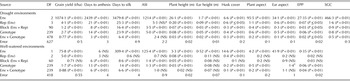
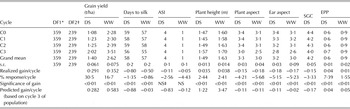
The ANOVA revealed highly significant mean squares of genotypes (G) and environments (E) for grain yield and all other traits under drought and well-watered conditions except G for ear height and E for days to anthesis under well-watered conditions (Table 1). Similarly, GEI was significant for all measured traits under both research conditions except ASI under drought and plant height, ear height, ASI and ear aspect under well-watered conditions. Grain yield ranged from 1·08 t/ha for C0 to 2·02 t/ha for C3 under drought and 2·28 t/ha for C0 to 3·51 t/ha for C3 under well-watered environments (Table 2). Realized gain from selection for grain yield was 0·291 t/ha, corresponding to 30·5% per cycle under drought and 0·352 t/ha with a corresponding gain of 16·7% per cycle under well-watered conditions. Predicted gain based on C3 was 0·282 and 0·583 t/ha under drought and well-watered environments, respectively.
Mean squares from the combined ANOVAs for traits of S1 families derived from four cycles of selection in early white maize population evaluated under drought at Ikenne during the 2010/11 and 2011/12 dry seasons and Kadawa during the 2011 growing season and under well-watered conditions at Ikenne during the growing seasons of 2011 and 2012 in Nigeria

ASI, anthesis-silking interval; EPP, ears per plant; SGC, stay-green characteristic.
* NS, Not significantly different.
Response/cycle, grain yield and other traits of S1 families derived from four cycles of selection in early white population evaluated under drought at Ikenne during the 2010/11 and 2011/12 dry seasons and at Kadawa during the 2011 growing season and under well-watered conditions at Ikenne during the 2011 and 2012 growing seasons

ASI, anthesis-silking interval; SGC, stay-green characteristic; EPP, ears per plant; DS, drought stress; WW, well-watered conditions.
* DF1, degree of freedom for drought observations.
† DF2, degree of freedom for well-watered observations.
‡ NS, not significantly different.
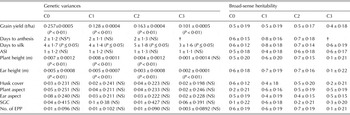
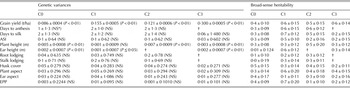
Most of the genetic variances for grain yield, days to silking, plant and ear heights in the different cycles of selection were significantly greater than zero under drought, as revealed by the s.e. In contrast, the genetic variances for days to anthesis, ASI, husk cover, plant aspect, ear aspect, SGC and EPP were not significantly different from zero. Under well-watered conditions, only the grain yield, plant and ear heights had most of the genetic variances in the different cycles of selection significantly greater than zero. Genetic variances and heritability estimates generally decreased for grain yield and other traits in advanced cycles under drought and well-watered conditions except for grain yield and ear height under well-watered conditions (Tables 3 and 4). In general, genetic variances and heritability estimates for measured traits were higher under drought than under well-watered conditions. Heritability for grain yield ranged from 0·44 for C3 to 0·49 for C1 under drought and 0·44 for C0 to 0·64 for C3 under well-watered conditions. The broad-sense heritabilities were also moderate-to-high for ASI, ear height, SGC and EPP for most of the cycles of selection.
Estimates of genetic variances and broad-sense heritability (± s.e.m.) on an entry mean basis of grain yield and other traits of S1 families derived from cycles of selection in an early white population tested under drought at Ikenne during the 2010/11 and 2011/12 dry seasons and at Kadawa during the 2011 growing season

ASI, anthesis-silking interval; SGC, stay-green characteristic; EPP, ears per plant.
* NS, not significantly different.
† equated to zero due to negative variances.
Estimates of genetic variances and broad-sense heritability (±s.e.m.) on an entry mean basis of grain yield and other traits of S1 families derived from cycles of selection in an early white population tested under well-watered conditions in Ikenne in 2011 and 2012

ASI, anthesis-silking interval; EPP, ears per plant.
* NS, not significantly different.
† equated to zero due to negative variances.
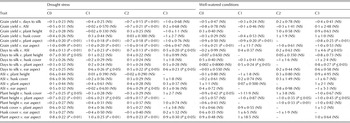
Under drought, grain yield was significantly correlated with days to silking, ASI, plant and ear aspects in C0 to C2 but not with any other trait in C3 (Table 5). Under well-watered conditions, grain yield was significantly correlated with plant and ear aspects in all cycles except for ear aspect in C1 and C3. Yield was not correlated with plant height in C0 and C1, but was significantly correlated with plant height in the advanced cycles under well-watered conditions. Days to silking had positive and significant genetic correlation with plant and ear aspects in the advanced cycles under drought. Plant aspect had positive and significant genetic correlation with ear aspect under drought and well-watered conditions.
Genetic correlation estimates (±s.e.m.) between selected pair of traits of S1 families derived from four cycles of selection in TZE-W Pop DT C3 STR C5 evaluated under drought at Ikenne during the 2010/11 and 2011/12 dry seasons and at Kadawa during the 2011 growing season, and under well-watered conditions at Ikenne during the 2011 and 2012 growing seasons

ASI, anthesis-silking interval; NS, not significant; –, could not be estimated due to negative variances.
DISCUSSION
The presence of highly significant mean squares of genotypes for grain yield and most other measured traits under drought and well-watered conditions indicated the existence of significant variation among most traits to allow significant progress from selection for the traits under both drought and well-watered conditions. This finding indicated that the genotypes in the different cycles of selection were genetically distinct, hence making selection for improved drought tolerance and grain yield possible under the research conditions (Badu-Apraku et al. Reference Badu-Apraku, Fontem, Akinwale and Oyekunle2011a , Reference Badu-Apraku, Oyekunle, Akinwale and Fontem Lum b ). The lack of significant mean squares of genotypes for ear height under well-watered conditions suggested that the gene frequencies of this trait were probably low in the early white population and that the changes, which might have occurred in the genetic variances for this trait would be small enough to be undetected with the precision usually obtained in field experiments (Da Silva & Lonquist Reference Da Silva and Lonquist1967). The significant environment mean squares for grain yield under both research conditions suggested that the test locations in Nigeria were different in terms of edaphic and climatic conditions. On the other hand, the lack of significant mean squares of environments for days to anthesis under well-watered conditions indicated that the expression of the trait in varying environments would be consistent. The highly significant GEI for grain yield and other traits under both research conditions may be attributed to the large differences in environmental factors such as soil type, temperature, amount of rainfall, and disease pressure at the contrasting terminal drought and well-watered test locations in Nigeria. Also, the presence of significant GEI indicated that the environments were unique in identifying superior cultivars. Furthermore, the significant mean squares of GEI for grain yield and most other traits under drought stress indicated that the traits used in the base index to select for tolerance to drought were affected by GEI and hence the genotypic correlations between these traits and grain yield would be expected to reduce under drought. In contrast, the lack of significant mean squares of GEI for ASI, plant and ear heights, and EASP under well-watered conditions indicated that the ranking of the genotypes for the traits in contrasting environments would be consistent.
The S1 family recurrent selection procedure is designed to improve population performance and allows alleles to be fixed rapidly, with deleterious, homozygous alleles exposed and eliminated early in the selection programme (Weyhrich et al. Reference Weyhrich, Lamkey and Hallauer1998). It was therefore anticipated that the adoption of the S1 family recurrent selection programme for the TZE-W Pop DT STR should improve the population performance and maintain genetic variability to ensure continued genetic gain in future cycles of selection. In the present study, the advanced cycles of selection of TZE-W Pop DT STR significantly out-yielded the original cycles of selection under both drought and well-watered conditions. The yield gains from selection of 30·5% per cycle and 16·7% per cycle obtained in TZE-W Pop DT C3 STR C5, when evaluated under drought and well-watered conditions in the present study, are higher than the 15% per cycle obtained under both Striga-infested and Striga-free conditions in the early white population following four cycles of S1 recurrent selection for grain yield and Striga resistance (Badu-Apraku et al. Reference Badu-Apraku, Fakorede and Lum2008). The yield gains in the present study are also substantially greater than those reported by Edmeades et al. (Reference Edmeades, Bänziger, Chapman, Ribaut, Bolanos, Badu-Apraku, Akoroda, Ouedraogo and Quin1995), who obtained yield gains of 14% per cycle under drought stress, 3% per cycle under well-watered conditions and 4·8% per cycle across the research conditions due to three cycles of S1 recurrent selection in the early-maturing population, Pool 18. The relatively higher yield gains from selection observed in the present study compared with those reported by Edmeades et al. (Reference Edmeades, Bänziger, Chapman, Ribaut, Bolanos, Badu-Apraku, Akoroda, Ouedraogo and Quin1995) indicated that the S1 recurrent selection method used in the current breeding programme had been effective.
Heritability of a trait is a measure of the genetic relationship between the parents and their offspring and is of prime importance in determining the extent to which improvement of a trait in a population is possible through selection (Badu-Apraku Reference Badu-Apraku2007a ). The low-to-moderately high broad-sense heritability estimates for grain yield of 0·44 for C3 to 0·49 for C1 under drought and 0·44 for C0 to 0·64 for C3 under well-watered conditions as well as the moderate-to-high broad-sense heritabilities observed for ASI, ear height, SGC and EPP during most of the cycles of selection suggested that these traits are under genetic control and that improvements could be made through selection in the advanced generations. However, high heritability alone is not enough to allow sufficient improvement in a recurrent selection programme. For adequate progress from selection, high heritability should be accompanied by substantial amount of genetic advance, which is dependent on the selection intensity, phenotypic variance and heritability. The decrease in the genetic variances and heritability estimates for grain yield and some other traits in advanced cycles under drought and well-watered conditions except for grain yield and ear height under well-watered conditions implied that there is not adequate genetic variability in the source population to ensure faster progress and presumably significant gain from selection in future cycles. This finding is supported by the lower predicted gain based on C3 of 0·282 t/ha under drought compared with the realized yield gains from selection for grain yield of 0·291 t/ha, corresponding to 30·5% per cycle under drought. In contrast, a predicted gain from selection of 0·583 t/ha was obtained compared with the realized gain of 0·352 t/ha with a corresponding gain of 16·7% per cycle under well-watered conditions. Similarly, lower predicted gain from selection were reported by Badu-Apraku et al. (Reference Badu-Apraku, Fakorede and Lum2008) for the early yellow population, TZE-Y Pop DT STR under Striga-infested and Striga-free environments. It should be noted that the predicted gain from selection is highly theoretical, with many underlying assumptions that may or may not be valid in actual field situations. For example, the predicted gain is normally based on parameter estimates obtained from the base population and is strictly supposed to be for one cycle of selection, whereas realized gains are estimated over several cycles of selection. Also, the estimated parameters, especially the genetic, phenotypic and environmental variances, are assumed to remain constant throughout the selection cycles being evaluated, whereas this is hardly possible under actual field conditions (Badu-Apraku et al. Reference Badu-Apraku, Akinwale, Fakorede, Oyekunle and Franco2012). This has been clearly demonstrated in the present study, where the estimated variances changed from one cycle to another, including the heritability estimates. The important conclusion to draw from the results of the present study is that three cycles of S1 recurrent selection has improved the grain yield potential of TZE-W Pop DT STR by about 30·5% per cycle under drought and 16·7% per cycle under well-watered conditions. Furthermore, results revealed that the per cent response/cycle in grain yield under drought was larger than when under well-watered conditions. This was anticipated since in the recurrent selection procedure used for the improvement of the population for grain yield, a much greater emphasis was placed on performance under drought than well-watered conditions.
In the present study, genetic variances and heritability estimates generally decreased for grain yield and other traits as selection progressed under drought and well-watered conditions, except for grain yield and ear height under well-watered conditions. Decreased genetic variability and heritability in advanced cycles of a recurrent selection programme could be due to several causes. It could result from a small population size, low frequency of drought-tolerant alleles or the contribution of the residual sum of squares for some traits, especially those with very high values (⩾0·40). It is clear that if the frequency of favourable alleles for drought tolerance were that low in the population, the realized gains from selection could not have been so high in the present study. This is further supported by the results of studies conducted to examine the gains from selection in Pool 16 DT population after eight cycles of recurrent selection for drought tolerance (Badu-Apraku et al. Reference Badu-Apraku, Fakorede, Menkir, Kamara and Adam2004b ). The most plausible explanation is that although the ANOVA model in this present study was highly significant in most cases, the residual sum of squares of these traits was sufficiently large to mask an accurate estimation of genetic variances, heritability and gains from selection. This result suggests that more focus should be placed on reducing the environmental variance for maximum progress from selection in the population improvement programme. To achieve this, more effort should be devoted to reducing the environmental variance by using more uniform fields, an irrigation system that will allow uniform distribution of water, and probably more replications and locations for testing (Badu-Apraku et al. Reference Badu-Apraku, Akinwale, Fakorede, Oyekunle and Franco2012).
It is interesting to note that the increased grain yield in the advanced cycles of selection in the TZE-W Pop DT STR under drought and well-watered conditions were associated with a decrease in days to silking, improved plant and ear aspects, delayed leaf senescence, increased plant height and number of EPP. This finding suggests that a major improvement in grain yield resulting from recurrent selection under drought was a reduction in the frequency of alleles that confer barrenness and days to silking but an increase in the frequency of alleles that delay leaf senescence, improve ear and plant aspects, increase plant height and make more photosynthates available for grain filling, thus increasing EPP. The results of the present study confirmed that EPP was a major yield determinant under drought and justifies its inclusion in the IITA selection index for grain yield improvement. This result is consistent with the findings of Badu-Apraku et al. (Reference Badu-Apraku, Oyekunle, Akinwale and Fontem Lum2011b ) who used genotype by trait biplots to identify EASP, PASP, ASI and EPP as the important secondary traits for selection under drought. This result is also in agreement with that reported for EPP under drought and Striga infestation (Badu-Apraku et al. Reference Badu-Apraku, Fakorede, Menkir, Kamara, Akanvou and Chabi2004a ) and under drought (Bolanos & Edmeades Reference Bolanos and Edmeades1993; Chapman & Edmeades Reference Chapman and Edmeades1999; Monneveux et al. Reference Monneveux, Sanchez, Beck and Edmeades2006). The increase in plant height and decrease in days to silking associated with the gain/cycle in grain yield was not expected since a base index, which deliberately penalized any tendency towards increased plant height, and change in maturity group was used in selecting S1 progenies of TZE-W Pop DT STR for recombination. In the present study, the base index was effective in increasing grain yield and EPP, improving EASP and PASP but not in maintaining constant the plant height and days to silking. These results suggested the need to re-examine the base index used in the current programme to ensure that plant height and days to silking remained constant at the level of C0, while increasing grain yield in future cycles.
In conclusion, the high realized gains from selection for grain yield under drought and well-watered conditions indicated that the S1 family selection method adopted in the current breeding programme has been effective. However, the decrease in genetic variances for most measured traits in the advanced cycles of selection, low heritability estimates, and predicted gain/cycle for grain yield and other traits suggest that there is low genetic variability in the cycle 3 to allow continued significant gain from selection under the research conditions. Therefore, for faster progress from selection, there is a need to introgress drought tolerance genes into the population.
The authors are grateful to the staff of IITA's Maize Program in Ibadan, for technical support. The financial support of DTMA Project and IITA for this research is also gratefully acknowledged.