Introduction
The parasite Chordodes nobilii is one of the non-target organisms impacted by the pesticides usually found in water bodies near agricultural regions, mainly as a consequence of run-off. Argentina is a relevant agricultural country: the borders of its cultivated land have expanded to cover large areas of the territory, of which 22.9 million hectares are devoted to transgenic soybean plus maize and cotton (James, 2010). Moreover, 35.5 million hectares can be expected to be cultivated by 2016. In South America, harvesting losses account for 32% and 44%, respectively, of the soybean and maize produced, principally through the attack of insects, fungi and weeds, among other adverse conditions. The application of agrochemicals in general, and of phytosanitary chemicals in particular, is therefore very likely to increase proportionally in the future (Pérez Leiva & Anastasio, Reference Pérez Leiva and Anastasio2003); and accordingly pesticides will then become one of the main sources of contamination for adjacent aquatic environments.
Carbendazim (CBZ; Chemical Abstracts Service (CAS) #10 605-21-7), is one of the pesticides found in the environments near to agricultural crops. Unlike other pesticides, such as chlorpyrifos insecticide and metribuzin herbicide, carbendazim is included in the biocide group (Brock et al., Reference Brock, Arts, Maltby and Van den Brink2006). The compound is a broad-spectrum benzimidazole-carbamate fungicide with systemic activity. Benzimidazoles such as CBZ are widely applied in agriculture and veterinary medicine as fungicides and anthelminthic drugs. CBZ controls fungal diseases by inhibiting germ-tube development, appressoria formation, mycelial growth, nuclear division (i.e. through blocking spindle formation) and, at least temporarily, acetylcholinesterase activity (Cuppen et al., Reference Cuppen, Van den Brink, Camps, Uil and Brock2000; Kirsch-Volders et al., Reference Kirsch-Volders, Vanhauwaert, Eichenlaub-Ritter and Decordier2003; Álvarez et al., Reference Álvarez, Tjalling, Marco Redondo and Kammenga2006; Dang & Smit, Reference Dang and Smit2008; Yenjerla et al., Reference Yenjerla, Cox, Wilson and Jordan2009); the fungicide is also a possible endocrine disruptor (Varela bruce, Reference Varela bruce2005; Mnif et al., Reference Mnif, Hassine, Bouaziz, Bartegi, Thomas and Roig2011). Regulations concerning risk classifications with respect to environmental health and safety have proposed a reclassification of CBZ, to a carcinogen and a mutagen (Slijkerman, Reference Slijkerman2006; Kähkönen & Nordström, Reference Kähkönen and Nordström2008; Miracle et al., Reference Miracle, Nandini, Sarma and Vicente2011; Palanikumar & Kumaraguru, Reference Palanikumar and Kumaraguru2014).
The criteria for risk prediction and the establishment of thresholds for permissible levels of contamination are based on species’ responses to contaminants. These guidelines are derived from laboratory toxicity tests that usually use model species in single-toxicant exposures (Fleeger et al., Reference Fleeger, Carman and Nisbet2003). Nevertheless, little information is available specifically on the sensitivity of indigenous freshwater organisms to fungicides. The available data on CBZ in particular and its relative toxicity compared to other pesticides are still scarce, while the taxa susceptible to fungicides may also not have been adequately represented among the standard aquatic test species used in the assessment of ecotoxicological risk (Cuppen et al., Reference Cuppen, Van den Brink, Camps, Uil and Brock2000; Van den Brink et al., Reference Van den Brink, Hattink, Bransen, Van Donk and Brock2000; Warming et al., Reference Warming, Mulderij and Christoffersen2009; Buchanan et al., Reference Buchanan, Liang, Liu, Razaviarani and Rahman2010). Consequently, a determination of the side-effects of CBZ on aquatic biota – and mainly on the resident species in Argentina – is highly relevant.
Chordodes nobilii, like the rest of the Gordiida, plays a key ecological role in the ecosystems it inhabits. This is because its life cycle consists of a series of freshwater stages – embryos, free-living larvae (i.e. the preparasites) and the postparasitic adults – all of which may be preyed upon (Cochran et al., Reference Cochran, Kinziger and Poly1999; Kinziger et al., Reference Kinziger, Cochran and Cochran2002; Ruiz & Figueroa, Reference Ruiz and Figueroa2005; Ponton et al., Reference Ponton, Lebarbenchon, Lefébre, Thomas, Duneau, Marché, Renault, Hughes and Biron2006; de Villalobos et al., Reference de Villalobos, Ortiz-Sandoval and Habit2008). The juveniles parasitize mainly terrestrial insects, including those of medical and agronomic relevance, causing severe injury or even death (de Villalobos, Reference de Villalobos1999; de Villalobos et al., Reference de Villalobos, Ribera and Downie1999, Reference de Villalobos, Rumi, Núñez, Schmidt-Rhaesa and Zanca2003, Reference de Villalobos, Zanca and Schmidt-Rhaesa2004; Hanelt & Janovy, Reference Hanelt and Janovy1999; Schmidt-Rhaesa & Ehrmann, Reference Schmidt-Rhaesa and Ehrmann2001; Ronderos & de Villalobos, Reference Ronderos and de Villalobos2003; Hanelt et al., Reference Hanelt, Thomas and Shmidt-Rhaesa2003). An evaluation of the impact of pollutants on this class is therefore extremely appropriate and significant.
The Gordiida, in general, act as a link between the taxa of freshwater and terrestrial ecosystems, while C. nobilii in particular is highly vulnerable to pesticides other than CBZ, as well as to a herbicide and an insecticide, even at environmentally allowable concentrations (Achiorno et al., Reference Achiorno, de Villalobos and Ferrari2008, Reference Achiorno, de Villalobos and Ferrari2009). Moreover, this species was recently validated for use in ecotoxicity assessments (Achiorno et al., Reference Achiorno, de Villalobos and Ferrari2010). The aim of the present work was therefore to evaluate the effect of the fungicide CBZ on C. nobilii (test species) based on the hypothesis that the environmentally acceptable concentrations alter the normal development and, in turn, influence the infectivity and abundance of C. nobilii in aquatic habitats.
Materials and methods
Collection of nematomorphs
Adults of C. nobilii were collected from an unpolluted stream of the Sauce-Grande basin (38°9′0″S, 61°48′0″W; Buenos Aires, Argentina) and transported to the laboratory. There, the worms were kept at constant temperature (23 ± 1°C), at a natural photoperiod, and in containers with constant aeration; with water initially from the stream, but thereafter gradually replaced by dechlorinated tapwater. After mating, the females were transferred to individual containers and checked daily for oviposition, when they laid microscopic eggs in gelatinous strings attached to the container's lower surface. The time between field collection and laying eggs was between 15 and 30 days. The bioassays were performed with embryos and larvae following the protocol described in Achiorno et al. (Reference Achiorno, de Villalobos and Ferrari2008).
Bioassays of preparasitic stages
The test fungicide used for the bioassays (technical-grade CBZ of 98% purity) was provided by the Laboratory of the National Service of Animal Health (SENASA), Argentina. The concentrations assayed were prepared by dilution from a stock solution of 2.5 mg CBZ/litre in Milli-Q™ water (nominal value). The effective concentration of CBZ in the stock solution was determined by high-performance liquid chromatography (detection limit < 0.1 mg/l), whereas the concentrations used for the embryo assay and the larval bioassay were 2.80 and 2.35 mg CBZ/litre, respectively. The CBZ concentrations assayed were 0 (control), 10, 20, 40, 80, 160 and 320 μg/l and are referred to as the nominal values. Each concentration, including that of the control, was assayed in triplicate, in a rearing chamber at 23 ± 1°C, in the dark, and under semi-static conditions involving daily medium changes (Achiorno et al., Reference Achiorno, de Villalobos and Ferrari2008).
For the assays the reconstituted hard water used as the dilution solvent had the following chemical composition (mg/l): NaHCO3, 192; CaSO4.2H2O, 120; MgSO4, 120; KCl, 8; hardness 162 mg CaCO3/litre; pH 7.99; and conductivity 1.780 μS (Weber, Reference Weber1993).
The segments of egg strings selected for the embryo bioassays contained embryos mainly in the blastula stage. The bioassay consisted of three consecutive periods, as follows.
(1) Exposure: the embryos remained in the assay solution (the above water plus the appropriate concentration of CBZ) for 96 h. The solution was partially renewed every day and entirely replaced with control hard water at the end of the period.
(2) Postexposure: the containers with the embryos previously exposed to CBZ were checked periodically by light microscopy at a magnification of 40 × until the appearance of free-living larvae (for more details see Achiorno et al., Reference Achiorno, de Villalobos and Ferrari2008).
(3) Infection of the host insect – exposure of Aedes aegypti (Diptera) larvae to C. nobilii larvae: after hatching, larvae do not exceed 100 μm in length and are able to penetrate paratenic or definitive hosts. Since C. nobilii larvae exhibit little movement, we estimated their viability indirectly by evaluating the infectivity of their emerging larvae under light microscopy, as quantitated by means of the larval-infection index per mean abundance of host larvae (IIMA), i.e. the total number of C. nobilii larvae infecting A. aegypti larvae divided by the total number of A. aegypti larvae observed (Bush et al., Reference Bush, Lafferty, Lotz and Shotsak1997).
The end points in the bioassay of the treated embryos were the proportions of non-viable embryos, i.e. those that produced no larvae by the end of the postexposure period, and the embryos yielding larvae whose effective viability was subsequently determined by the IIMA-E (the IIMA for the larvae hatched from those exposed eggs) at the end of the infection of the host insect.
In the bioassay of the treated larvae, the experimental protocol consisted of two consecutive periods: in the first, C. nobilii free-living larvae were exposed to the toxicant for 48 h, with a partial renewal of the solution at 24 h; then, in the second, A. aegypti larvae were exposed to C. nobilii free-living larvae for 72 h in control medium. In this instance, the IIMA was designated IIMA-L. Either bioassay was considered valid when the IIMA in the control group was >2.
Data analysis
The parameters calculated were the IC50-IIMA-E (defined as the concentration of toxicant producing a 50% reduction in the infectivity of the larvae from the exposed eggs) and the IC50-IIMA-L (defined as the toxicant concentration that resulted in a 50% survival of the exposed larvae).
Before analysis, the data were subjected to the Shapiro–Wilk and the Levene median tests to assess normality and homogeneity of variance, respectively. Statistical differences between the control and treated groups were determined by one-way analysis of variance followed by Tukey's post-hoc comparison test. For regression analysis, the data from control groups were omitted to prevent the wide separation from those of the experimental groups and thus disrupt an estimation of the differential effect of CBZ concentration on the dependent variable (Zar, Reference Zar1999). The significance level was set at P< 0.05. Statistical analyses were performed with the InfoStat software (Di Rienzo et al., Reference Di Rienzo, Casanoves, Balzarini, Gonzalez, Tablada and Robledo2008). The inhibitory concentrations (IC50) were calculated from the analytical values by the linear-interpolation method recommended by the United States Environmental-Protection Agency, through the use of ICp software (version 2.0; Norberg-King, Reference Norberg-King1993).
Results
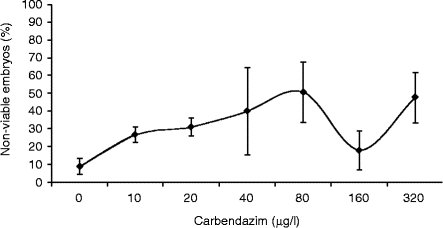
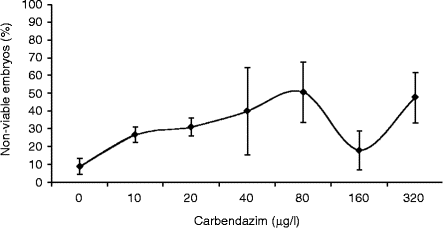
Within the concentration range tested, CBZ did not significantly inhibit embryonic development. However, it is notable that we observed an elevation in the variability of response among the replicates at increased concentrations (fig. 1).
The effect of carbendazim (μg/l) on the embryonic development of Chordodes nobilii, expressed as the mean percentage ( ± SEM) of non-viable embryos, i.e. those not reaching the larval stage.
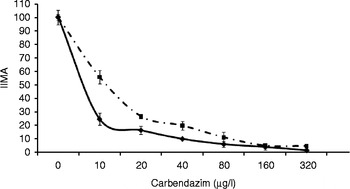
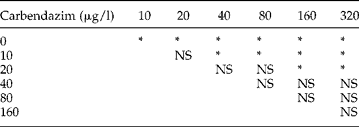
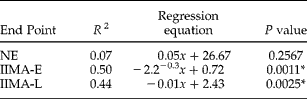
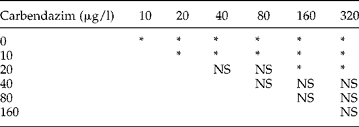
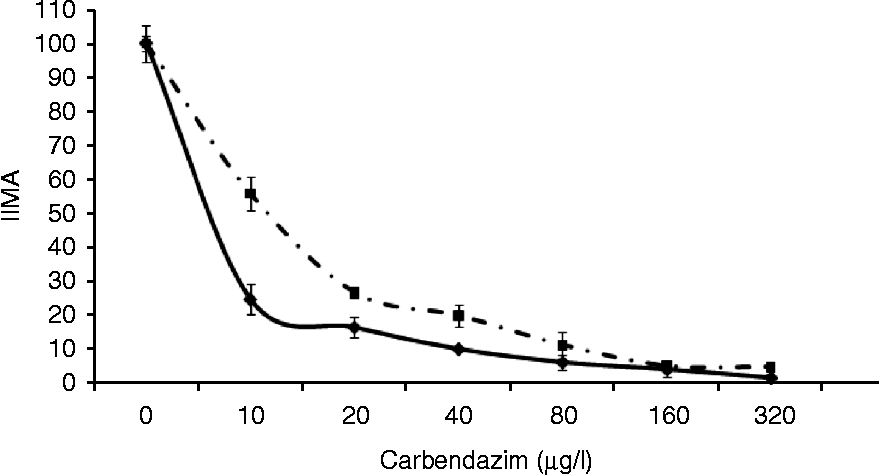
The suppression by CBZ of embryo development was reflected in the infectivity of the larvae derived from eggs that had been exposed to the fungicide (i.e. the IIMA-E values) from the lowest CBZ concentration tested (fig. 2, table 1). Furthermore, a clear concentration-dependent effect was evident from regression analysis (table 2). The median inhibitory concentration for embryos (i.e. the IC50-IIMA-E) was 7 μg/l.
The effect of carbendazim (μg/l) on the index of infection by embryos (diamonds, solid line) and by larvae (squares, dashed line) of Chordodes nobilii (IIMA). Values are expressed as percentages of the arithmetic means relative to the control data ( ± SEM).
Tukey's comparisons of assayed carbendazim concentrations (μg/l) applied to the index of infection by embryos.
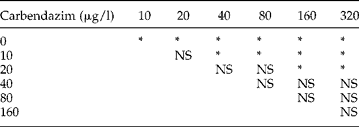
* Level of significance given as P< 0.05; NS, not significant.
Regression analysis of the non-viable embryos (NE) of Chordodes nobilii and of the infection indices for embryos (IIMA-E) and for larvae (IIMA-L) upon exposure to different concentrations of carbendazim.
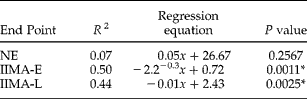
R 2, coefficient of determination; * level of significance with P< 0.05.
The responses of the larvae and embryos exposed to CBZ were qualitatively similar when assessed by the decrease in their infectivity relative to the controls; but that difference was significantly greater with the IIMA-E values than with the IIMA-L data from the lowest concentration tested (fig. 2, table 3), thus indicating a concentration-dependent differential effect (table 2). The median inhibitory concentration calculated for the larvae (i.e. the IC50-IMA-L) was 11 μg/l.
Tukey's comparisons of assayed carbendazim concentrations (μg/l) applied to the index of infection by larvae.
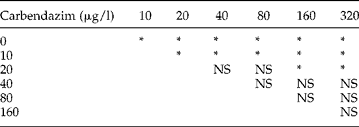
* Level of significance given as P< 0.05; NS, not significant.
Discussion
The results of this study provide useful information regarding the side-effects of CBZ on worm biology. For both the developmental stages investigated, the inhibition by CBZ of infectivity was observed at the lowest concentration tested. The embryos, though, were found to be more susceptible to the fungicide than the larvae – indicating a more drastic effect on that developmental stage (fig. 2, tables 1 and 2) – and, in turn, exhibited the lowest IC50. The IIMA-E was therefore the more sensitive variable of the two measured in the toxicity tests. The reduction in the infectivity of the larvae from the treated embryos could be explained mainly by an inhibition of viable hatching by the fungicide, a result probably related to a failure at some stage during embryonic development.
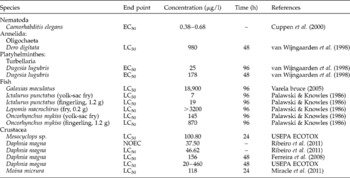
Our results provide experimental evidence that low CBZ concentrations impair the viability of the preparasitic stages of the non-target organism C. nobilii. Only scanty information is available comparing the effect of CBZ to that of other pesticides on freshwater non-target organisms. Table 4 shows some of the results from the literature, indicating that the species currently used for ecotoxicological risk assessment – such as Daphnia magna, Lepomis macrochirus and Onchorhynchus mykiss – would be the least sensitive ones to CBZ. Cuppen et al. (Reference Cuppen, Van den Brink, Camps, Uil and Brock2000) found, in a CBZ-microcosm experiment using concentrations between 3.3 and 1000 μg/l, that the worm-like taxonomic groups exposed – such as Oligochaeta, Turbellaria and Hirudinea – along with the amphipod Gammarus pulex and the snail Bithynia tentaculata were the most sensitive taxa. Since those same authors reported that Caenorhabditis elegans was the most sensitive species to CBZ (table 4), and because the lowest IC50 recorded (7 μg/l, in the present study) was for the gordiid C. nobilii, we can conclude that the worm-like taxonomic groups are probably the non-target organisms most sensitive to CBZ.
Susceptibility of selected invertebrate and fish species to concentrations of carbendazim (μg/l); end points are taken from the references, and only those values obtained under similar test conditions are included.
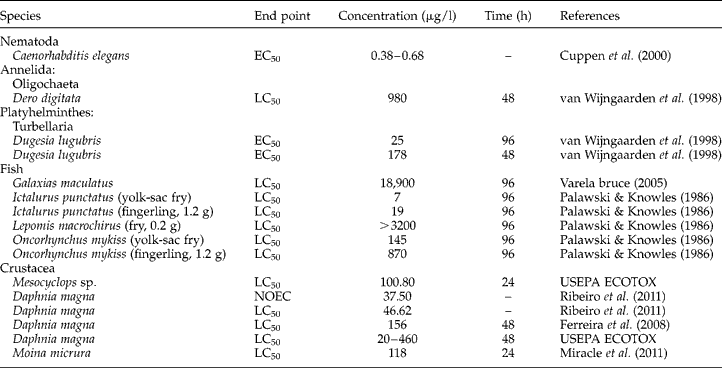
NOEC, no observed effect concentration; EC50, median effective concentration; LC50, median lethal concentration.
We wish to emphasize that our experimental design simulated a specific period of exposure to the fungicide: in terms of embryonic development, a 96-h exposure corresponds to only about 15% of the time required to reach the free larval stage. Since the reported half-life time for CBZ in aqueous solution has been from 15 to 175 days for indoor microcosms (Cuppen et al., Reference Cuppen, Van den Brink, Camps, Uil and Brock2000; Daam et al., Reference Daam, Satapornvanit, Van den Brink and Nogueira2009) and 120 days for natural habitats (Varela bruce, Reference Varela bruce2005), we can assume that in the present bioassays, on both the embryo and the larvae, the CBZ retained its potency during the entirety of both exposures. The expected environmental concentration of CBZ has been found to be in the range of 6.25 μg/l for bodies of water having depths of 2 m and up to 41.3 μg/l for much shallower reaches at depths of as low as 30 cm (SETAC, 1994). Therefore, a highly relevant result from these studies is that the IC50 values for the embryos and larvae of C. nobilii fell within the range reported for the environment, and particularly those higher levels anticipated for shallow water, such as that of the streams inhabited by gordiids.
The preparasitic stages of C. nobilii have exhibited IC50-IIMA-Es of 54 and 30 μg/l and IC50-IIMA-Ls of 19 and 67 μg/l for the herbicide glyphosate and the neurotoxic insecticide malathion, respectively (Achiorno, Reference Achiorno2011). A comparison of those values with the values obtained here for CBZ indicates an order of susceptibility for this species of CBZ > malathion > glyphosate. Thus, on the basis of these results, CBZ should be considered the most toxic pesticide of the three.
Finally, we wish to emphasize that, although no inhibition of embryonic development was observed, the maturation of the embryos was nevertheless affected since the infectivity of the larvae that were able to hatch became diminished and, as a consequence, their survival as well. From all these considerations and the literature cited, we conclude that C. nobilii is a species moderately to extremely susceptible to the noxious action of CBZ.
The results of the work presented here, the previous findings cited above and the ecological value of C. nobilii as an insect parasite all point to the usefulness of this species as a test organism for assays directed at environmental-risk assessment.
Acknowledgements
We thank Dr Susana Licastro for providing us with Aedes aegypti (Diptera) larvae and Dr Donald F. Haggerty for editing the final version of the manuscript.
Financial support
This work was supported by grants from the National University of Luján, and CIC (Scientific Research Commission)-Buenos Aires, Argentina.
Conflict of interest
None.