


Introduction
Data assimilation techniques are one method by which to improve the quality of model Simulations of Sea ice. the need for data assimilation arises from the facts that, first, physical models are far from perfect and data assimilation can compensate model errors; and Second, assimilation technique provides the mechanism for extracting useful information from noisy data, while the model provides the mechanism for constraining data and carrying information forward. the techniques used for assimilation can be divided into two broad categories: Sequential and model-trajectory methods. direct insertion, nudging, optimal interpolation (oi) and kalman filter are examples of Sequential methods. because this paper focuses on Sequential methods, especially oi, model-trajectory methods are not discussed here. for ice data, maslanik and maybee (1994) assimilated advanced very high resolution radiometer (AVHRR)-derived ice motion into a dynamic–thermodynamic ice model using direct insertion; Reference ThomasThomas and others (1996) assimilated Special Sensor microwave radiometer (SSMR)-derived ice concentration into an ice-thickness distribution model using a kalman Smoother; and Reference Meier, Maslanik and FowlerMeier and others (2000), Reference Arbetter, Lynch, Maslanik, Meier and andArbetter and others (2002) and Reference Zhang, Rothrock and LindsayZhang and others (2003) assimilated Special Sensor microwave/imager (SSM/I)-derived ice motion using oi. Reference LindsayLindsay and zhang (2005) assimilated ice motion and ice concentration using oi and nudging.
Previous Studies have Shown that assimilation of observed ice motion Significantly improves the calculation of ice motion (Reference Meier, Maslanik and FowlerMeier and others, 2000; Reference Zhang, Rothrock and LindsayZhang and others, 2003). however, it has mixed effects on the quality of other modeled fields. Reference Annan, Hargreaves and EdwardsZhang and others (2003) Showed that assimilation of ice motion improved the model performance on ice thickness. they believe that the Strengthened Spatial gradients of velocity after assimilation are likely to be the reason. Reference Arbetter, Lynch, Maslanik, Meier and andArbetter and others (2002) Showed excessive Summer ice melting after assimilating observed ice motion. a Significant difference between the Reference Arbetter, Lynch, Maslanik, Meier and andArbetter and others (2002) approach and the previous Studies is that arbetter and others assimilated motions through the Summer melt Season, while the other Studies assimilated motions only during fall through Spring. arbetter and others concluded that the increased open-water creation through enhanced divergence provides a mechanism during Summer to accelerate the ice melting. their results implied that modeled ice-motion fields (without assimilation) differ from the observed ice-motion field in Such a way as to be Significant enough to violate the underlying physical assumptions of the model.
In this Study, we first try to verify the difference between modeled and observed ice-motion fields. then we investigate the model Sensitivities to Some physical processes or parameterizations to provide clues for further fine-tuning of the model. the Strength parameterization in Sea-ice models controls the ice velocity in the model (Reference Flato and HiblerFlato and hibler, 1995) and is obtained in part by comparing modeled with observed ice motions. thus, it is logical for us to Study the Sensitivity of the Sea-ice model to variations in the Strength parameterization.
Model, Forcing Data and Data Assimilation
The Sea-ice model used here is Similar to that described by Reference Flato and HiblerFlato and hibler (1995). it is implemented on a 166×161 cartesian grid derived from the equal-area Scalable earth (ease) projection (Reference Armstrong and BrodzikArmstrong and others, 1997) with a grid Size of 25 km. each gridcell contains 12 ice categories, each category having a fixed mean thickness (Reference Thorndike, Rothrock and MaykutThorndike and others, 1975; Reference HiblerHibler, 1980). a viscous–plastic rheology (Reference HiblerHibler, 1979) is used here, with the alternate-direction implicit Solver employed (Reference ZhangZhang and rothrock, 2000). ridging and vertical redistribution of the Sea ice within each gridcell are determined using formulations for ice Strength (Reference RothrockRothrock, 1975) and ice divergence within each cell (Reference Thorndike, Rothrock and MaykutThorndike and others, 1975; Reference HiblerHibler, 1980).
The ice-strength parameterization reads

Where Cp = 1/2(pi/pw)g(pw-pi) is a constant in which ρ i and ρ w are the densities of ice and water, respectively, and g is the acceleration due to gravity. ω r and ω u are So-called ridging modes, which describe the transfer of thin ice into a distribution of thicker, ridged ice (Reference RothrockRothrock, 1975; Reference Thorndike, Rothrock and MaykutThorndike and others, 1975; Reference HiblerHibler, 1980; Reference Flato and HiblerFlato and hibler, 1995). h is ice thickness, and frictional parameter C f is defined as the ratio of total energy loss to potential energy change and is the parameter that controls the compressive Strength of the ice cover. C f is a tunable parameter and is determined by comparing the computed and observed ice drift. C f = 2 is used by Reference HiblerHibler (1980), while C f = 17 is used by Reference Flato and HiblerFlato and hibler (1995) in their baseline Simulation.
The forcing data used are the us national centers for environmental prediction (NCEP) re-analysis (Reference KalnayKalnay and others, 1996), and the observed ice motion used in this Study is the polar pathfinder daily 25 km ease-grid Sea-ice motion vectors (C. fowler, http://nsidc.org/data/nsidc-0116.html).daily ice-motion vectors are computed from avhrr, Scanning multichannel microwave radiometer (SMMR) and SSM/I using a maximum cross-correlation technique (Reference Emery, Fowler and PrellerEmery and others, 1991). daily ice motions are also calculated from international arctic buoy programme (IABP) (Reference Rigor and ColonyRigor and colony, 1995) buoy data. daily gridded fields combine data from all Sensors (for a detailed technical description of the ice-motion data, See c. fowler, http://nsidc.org/data/nsidc-0116.html). an optimum interpolation method is used to assimilate this daily gridded ice motion into the ice model (Reference Meier, Maslanik and FowlerMeier and others 2000; Reference Meier and MaslanikMeier and maslanik, 2001).
Results
We ran a total of five cases, as Summarized in table 1, to test the Sensitivities of the model to variations in the Strength parameterization and the effects of data assimilation.
Test cases
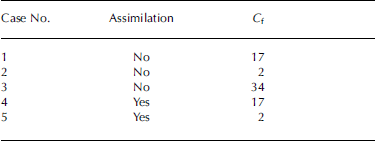
We first compare the modeled ice motions with the observed ice motions (experiments 1–3). we use the basin average ice Speed as the baseline of comparison, where the arctic basin is defined following Reference Gloersen, Campbell, Cavalieri, Comiso, Parkinson and ZwallyGloersen and others (1992). the modeled (without assimilation) basin average ice Speed is defined as the Spatial average of ice Speed at any gridcell where ice concentration is >15%. the observed basin average ice Speed is defined as the Spatial average of ice Speed from the daily gridded ice-motion dataset mentioned in the previous Section. as Shown in figure 1, we can See that the modeled ice Speed is Significantly different from the observed ice Speed. the 10 year mean of the modeled basin average ice Speed is 4.66 cms–1, while the 10 year mean of the observed basin average ice Speed is 3.82 cms–1. the Seasonal fluctuation of the modeled ice Speed is also greater than that of the observed ice Speed.
Modeled (case 1) and observed basin average ice Speed.

Experiments 4 and 5 assimilate the daily observed ice velocities into the model Solution. as expected, assimilation of Such different ice-motion data into the ice model greatly impacts the model behavior. in figure 2, we Show the normalized basin ice-cover area for cases with and without assimilation of ice motion. here the ice-cover area is normalized by the basin area. in winter, the basin is totally covered by ice; hence the normalized basin ice-cover area approaches unity. from figure 2 we can See that the modeled (without assimilation) Summer ice-cover area is around 50% of the winter ice-cover area, which agrees with the Satellite observations (Reference Gloersen and CampbellGloersen and campbell, 1991). the assimilation reduces the Summer ice-cover area by up to 40%.
The effects of assimilation (C f = 17).

Variations of frictional loss parameter C f Significantly change the ice Speed and the ice-cover area in cases without assimilation, as Shown in figures 3 and 4. however, C f has limited effects on the ice drift and ice-cover area in cases with assimilation, as Shown in figures 5 and 6. it Seems that the assimilation has an overwhelming effect, constraining the Solution to observations.
Effects of C f on basin average ice Speed (without assimilation).

Effects of C f on basin ice-cover area (without assimilation).

Effects of C f on basin average ice Speed (with assimilation). Note that the effects are very Small and the two curves almost overlap each other.

Effects of C f on basin ice-cover area (with assimilation). Note that the effects are very Small and two curves almost overlap each other.

Conclusion and Discussion
In this Study, we investigate the model Sensitivities to Strength parameterization to provide clues for further improvements to the model. assimilation of observed ice motion constrains the model Solution to closely resemble observations, but causes excessive Summer ice retreat. efforts to adjust the model by altering the frictional loss parameter have limited effects in the assimilated cases, because the assimilation of observed ice motion essentially bypasses the model dynamics.
In reality, Sea ice is composed of a number of discrete floes with Sizes ranging from a few meters to tens of kilometers or more. these floes grow thermodynamically and are deformed due to wind and water Stresses, which cause the floes to break apart (divergence) or form rubble fields and pressure ridges (convergence). it is essential to recognize that all models are at Some level a mathematical parameterization of these processes. the viscous–plastic rheology (Reference HiblerHibler 1979, Reference Hibler1980) contains an underlying assumption that the Sea ice in the arctic can be described as continuous fluid.
While others have Successfully run continuum models at resolutions finer than the 25 km used here, to our knowledge they have not incorporated high-resolution ice-motion data (including Summertime observations) on a basin-wide Scale over Several annual cycles. the observed ice-motion vectors Show discontinuities which likely indicate where floes are divergent. when these motions are assimilated into the model, the Solution does Show divergence in the Same location as observed; this results in much of the ice volume being advected out of the gridcell. however, in Summer there exists no mechanism to grow new ice. lateral melting in the model is accelerated with the increased open water, and much of the Sea ice is lost by the end of the Summer.
It is not enough to assume that the Summertime ice motions are problematic and Should be ignored. rather, the problems indicate that an observed feature of Sea ice is not reproduced well by the model, and in this case the excessive ice divergences introduced may violate the model’s physical assumptions (although not necessarily or exclusively the dynamic component). a thorough parameter estimation, including dynamic and thermodynamic parts of the model, is necessary to improve model behavior within the constraints of the observed ice motions. Reference Hargreaves, Annan and EdwardsHargreaves and others (2004) and Reference Annan, Hargreaves and EdwardsAnnan and others (2005) Simultaneously estimated 12 parameters in an intermediate-complexity coupled atmosphere and ocean global climate model (AOGCM) using an ensemble kalman filter technique with only 50 runs. their works Suggest a future direction to further improve the ice model.
Acknowledgements
This work was Supported by nasa contract nag5-10556 and a university corporation for atmospheric research (UCAR) visiting Scientist fellowship.



