Introduction
Obstructive sleep apnoea (OSA) is a prevalent sleep disorder and in recent years,Reference Jordan, McSharry and Malhotra1 hypoglossal nerve stimulation has emerged as a promising therapeutic approach for managing moderate to severe OSA in patients who are intolerant to or unsuitable for continuous positive airway pressure (CPAP) therapy.Reference Yu and Thaler2 Hypoglossal nerve stimulation involves the implantation of a device that delivers electrical stimulation to the hypoglossal nerve, facilitating tongue muscle activation and preventing airway collapse during sleep.Reference Olson and Junna3
While hypoglossal nerve stimulation holds the potential to provide significant relief to individuals suffering from OSA, there is a growing need to understand the factors that lead to the explantation of these devices and the subsequent complications that may arise. Explantation, the removal of the hypoglossal nerve stimulation device, can be attributed to a range of reasons, including technical issues, patient-specific factors and the presence of adverse events.Reference Patel, Yalamanchi, Peddireddy and Hoff4 Furthermore, the period following explantation is critical, because it allows for the observation and analysis of any complications that may occur post-procedure.
This paper aims to systematically review the reasons for explantation of hypoglossal nerve stimulation devices in patients with obstructive sleep apnoea and related conditions. By analysing the underlying factors contributing to explantation, we intend to shed light on the challenges and considerations associated with this therapeutic modality. Additionally, the study examines the spectrum of complications that arise after explantation, providing crucial insights into the post-explantation outcomes for patients.
Methods
We followed established guidelines from the Preferred Reporting Items for Systematic Reviews and Meta-Analyses (‘PRISMA’) statement to conduct a systematic search and study-selectionprocess. For this report, we focused on the following question: What are the reasons for explantation of hypoglossal nerve stimulation in patients with obstructive sleep apnoea?
Data sources and study selection
We conducted a systematic search across key databases including Embase Ovid, PubMed, the Cochrane Library, and Scopus. The search strategy included a combination of relevant keywords and medical subject headings (MeSH) terms related to “hypoglossal nerve stimulation,” “explantation” and “obstructive sleep apnoea.” The search was limited to studies published from 2010 through 2023 to ensure up-to-date information. The search strategy was adapted to meet the syntax requirements of each individual database, thus ensuring a comprehensive exploration of available literature. We limited our search to primary studies of adults that were published in peer-reviewed journals. Only English articles were selected. For each study, the title and abstract were screened independently by two reviewers with any conflicts resolved by consensus. Full-text articles of potentially relevant abstracts were retrieved. The articles were then subsequently rescreened in a similar manner for possible inclusion.
Study eligibility criteria
We included case series, case reports and cohort studies to gather comprehensive data on reasons for hypoglossal nerve stimulation device explantation in patients with OSA, only including full-text studies published between 2010 and 2023. Our study focused exclusively on studies related to hypoglossal nerve stimulation devices, covering both implantation and explantation, specifically pertaining to obstructive sleep apnoea. Data of interest were specifically outlined reasons for explantation as well as specified numbers of patients involved.
We excluded commentaries, meta-analyses, systematic reviews, book chapters, conference abstracts, study protocols, animal studies, non-English papers and letters to editors.
Data extraction and quality assessment
Two authors (Chu Z, Zhang C) extracted the studies. Data from each study were collected by one researcher and confirmed by another. Discrepancies were discussed and resolved by consensus. We used a customised data-extraction form to abstract information on population characteristics, reasons for explantation and presence of complications. We assessed the risk of bias of each study based on the quality assessment tool for before–after (pre–post) studies with no control group developed by the National Heart, Lung, and Blood Institute for the single-arm controlled trial, a modified version of the Newcastle–Ottawa Scale for single-arm cohort studies and the Joanna Briggs Institute checklist for case series and reports. Results of studies rated as having a low risk of bias are considered valid. Studies rated as having a medium risk of bias are susceptible to some bias but not sufficiently to invalidate the results. The high risk of bias in the remaining studies may invalidate the results. All quality assessments were conducted by 2 reviewers.
Data synthesis
The collected data underwent systematic analysis to identify the reasons for hypoglossal nerve stimulation device explantation in patients with obstructive sleep apnoea. Frequencies and proportions of each explantation reason were computed based on the data extracted from the selected studies.
Results
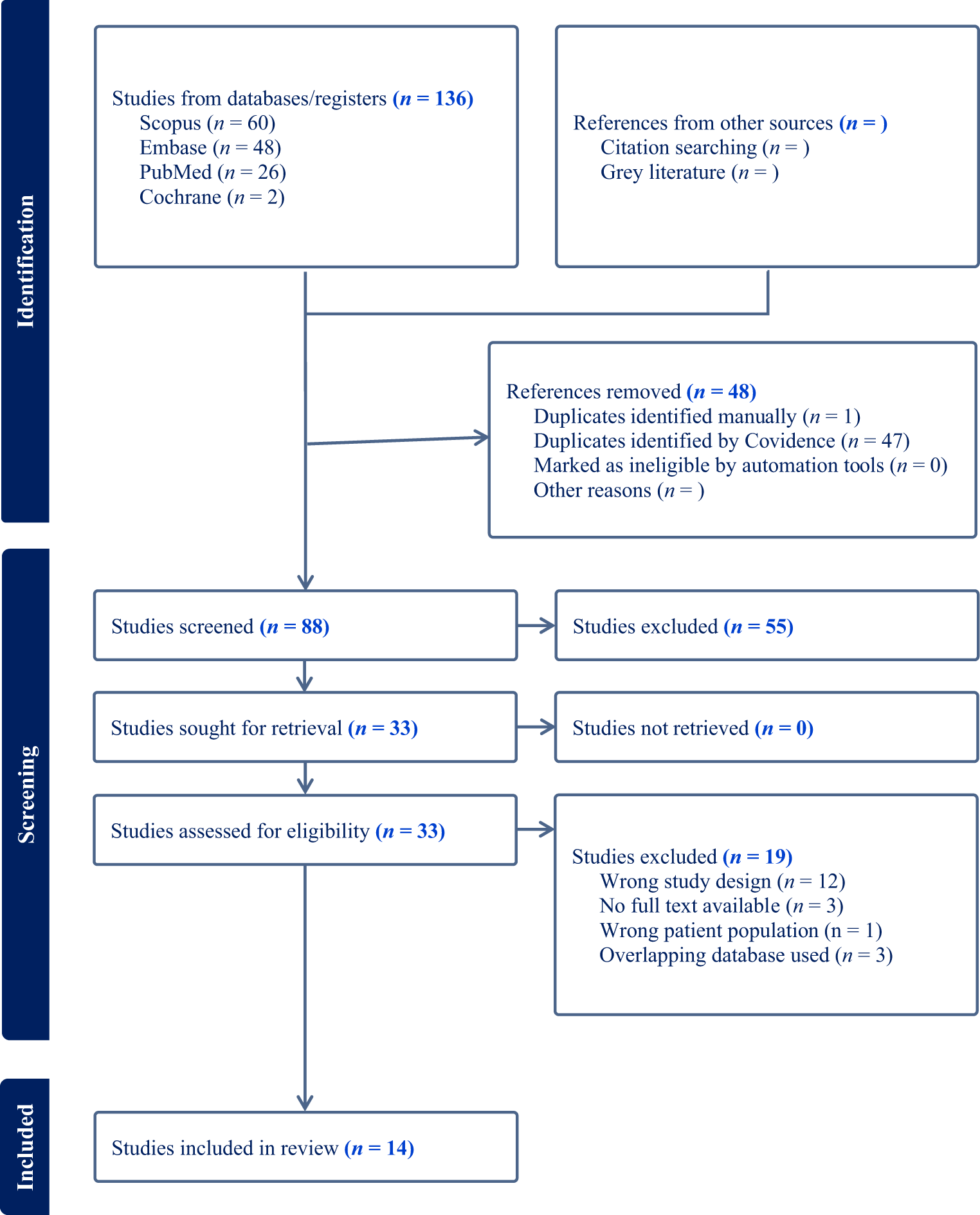
Our search initially retrieved 88 individual studies. After which, 45 duplicate studies were effectively removed. Subsequently, 43 studies underwent evaluation based on their titles and abstracts. Among these, 10 studies were excluded due to incongruence with the predefined inclusion criteria. This led to 33 studies that advanced to the full-text eligibility assessment phase.
Nineteen studies were excluded from the final analysis. This exclusion was attributed to various reasons, including 12 studies with an incompatible study design, three studies lacking full-text availability, three studies utilising overlapping databases, and one study focusing on an incorrect patient population. The selection process, illustrated in Figure 1, resulted in the inclusion of 14 studies that met our specified inclusion criteria.
Flow diagram of search and study process

Quality assessment
Among the five single-arm cohort studies, they were all deemed to be of adequate quality with a score of 5–6 (Supplementary Table 1). The risk of bias of the single-arm controlled trial was evaluated to be of some concern (Supplementary Table 2). Two case series were deemed to be of poor quality with a score of 3 and 4, while the remaining three case series were deemed to be of high quality with scores of 7–8 (Supplementary Table 3). Lastly, all three case reports were deemed to be of acceptable quality with a score of 5 and above (Supplementary Table 4).
Explantation reasons
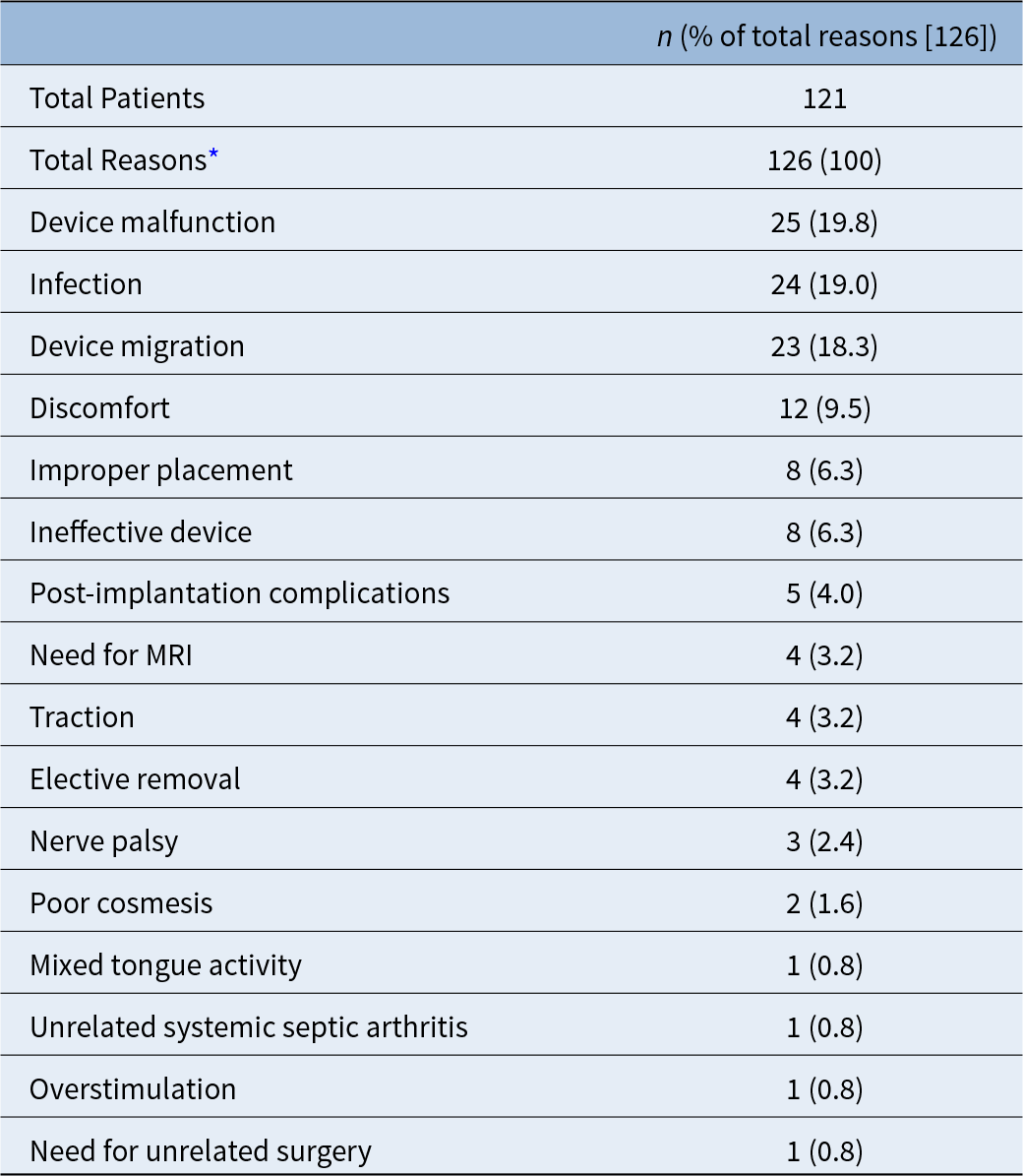
Out of 121 patients from the selected studies, 126 overlapping reasons of hypoglossal nerve stimulation device explantation were identified, with five patients having two reasons for explantation rather than one. Table 1 outlines the reasons for explantation described in each study.
Study characteristics and explantation reasons

* Includes 5 patients that had 2 reasons for explantation in total.
† The patient with the unspecified implanted pulse generator model correlated with experiencing device discomfort
The reasons for these explantations were diverse, with various factors contributing to the decision for removal (see Table 2 for more details). The most common reason for explantation was device malfunction, accounting for 25 cases (19.8 per cent). Technical issues such as malfunctions in device components, including implantable pulse generator, circuit board, sensing lead and stimulation lead, were observed as contributors to this category. Malfunction after cardioversion was also included in this category.
Synthesised reasons for explantation

* Includes 5 patients that had 2 reasons for explantation
Infection, observed in 24 cases (19.0 per cent), emerged as a notable cause for device explantation. This suggests that infections at the site of implantation significantly influenced device removal.
Device migration, defined as movement of the device from its intended location, was encountered in 23 cases (18.3 per cent). Device expulsion through skin was noted in 7 out of the 23 cases in this category, suggesting challenges in maintaining device stability.
Discomfort as the reason for explantation was documented in 12 cases (9.5 per cent), highlighting patient comfort and device integration challenges.
Improper placement of the hypoglossal nerve stimulation device was documented in eight cases (6.3 per cent), representing instances where the initial positioning of the device did not yield the expected therapeutic outcomes due to improper lead routing causing tethering or the lead being too superficially placed.
Eight patients (6.3 per cent) opted for device removal due to unsatisfactory therapeutic outcomes. The ineffectiveness of the devices was not attributable to device failure nor improper implantation.
Post-surgical complications, such as hematoma, allergic reactions and neck swelling, accounted for five cases (4 per cent) of device explantation. These complications encompassed adverse events occurring after device implantation, contributing to the decision to remove the device.
Other less prominent reasons for explantation include elective removal of unspecified motivation (4 cases, 3.2 per cent), traction-related issues (4 cases, 3.2 per cent), need for MRI (4 cases, 3.2 per cent), nerve palsy (3 cases, 2.4 per cent), poor cosmesis (2 cases, 1.6 per cent), mixed tongue activity (1 case, 0.8 per cent), unrelated systemic septic arthritis (1 case, 0.8 per cent) and need for unrelated surgery (1 case, 0.8 per cent).
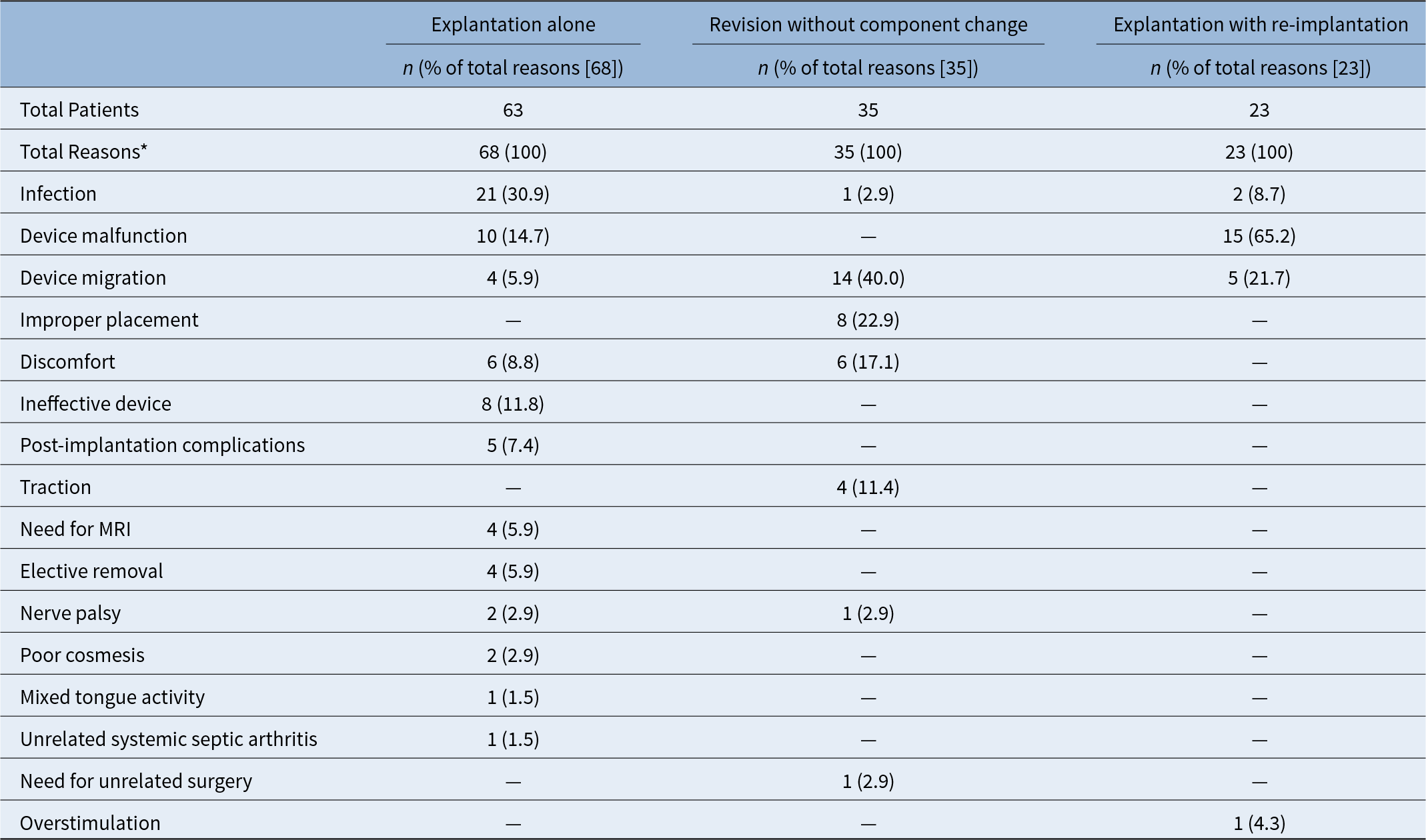
The types of explantations were then subdivided into three categories: (1) explantation alone, (2) revision without component change, and (3) explantation with re-implantation, as seen in Table 3.
Subdivided reasons for explantation

Among the 68 overlapping reasons for explantation alone, out of 63 patients, infection is the leading cause for explantation in 21 cases (30.9 per cent), followed by device malfunction in 10 cases (14.7 per cent) and an ineffective device in eight cases (11.8 per cent).
Among the 35 patients receiving revision of the device without component change, device migration is the leading cause in 14 cases (40.0 per cent), followed by improper placement in 8 cases (22.9 per cent) and discomfort in 6 cases (17.1 per cent).
Among the 23 patients receiving explantation and reimplantation of the device, device malfunction is the by far the most common reason for the procedure (15 cases, 65.2 per cent).
Explantation rates
There were 1040 patients that underwent hypoglossal nerve stimulation implantation reported by cohort studies and single-armed controlled trials. Among these patients, 13 patients (1.25 per cent) either had an explantation, revision or replacement surgery. Among the five studies, 0.1–20 per cent of patients had an explantation, revision or replacement surgery (Supplementary Table 5).
Complications
Among the 121 patients who underwent device explantation, another five instances of complications were noted in a total of three patients (2.48 per cent), with two patients noted to have two complications.
Temporary incomplete hypoglossal paresis was encountered in two patients, suggesting transient effects on hypoglossal nerve function after device removal. Discontinuation of a new implant, development of seromas and cuff dislocation was observed in one case each. The development of seromas emerged as a complication in one case.
Twenty-one cases (17.4 per cent) were explicitly reported to have no complications after explantation, while most cases (97 cases, 80.2 per cent) did not document any complications, suggesting uneventful post-explantation periods.
Discussion
This study delved into the reasons for the explantation of hypoglossal nerve stimulation devices in patients with obstructive sleep apnoea (OSA). Specific techniques and steps for explantation have been described in detail by Taylor et al.Reference Taylor Ii and Yu14
The results provide valuable insights into the complexities surrounding hypoglossal nerve stimulation therapy and offer directions for refining its implementation and management. It is worth noting that while the majority of hypoglossal nerve stimulation devices documented in the studies in this review were of the Inspire brand (Inspire Medical Systems, Minneapolis, MN), Arens et al.Reference Arens, Penzel, Fietze, Blau, Weller and Olze5 documented those of Apnex Medical (St. Paul, MN), which subsequently went out of business in 2013 after subpar results from its randomised control trial.Reference Strohl, Yamauchi, Peng and Strohl18
Infections at the implantation site played a substantial role in device explantation. The notable proportion of cases attributed to infections emphasises the significance of aseptic protocols during implantation and peri-operative antibiotic prophylaxis. For example, Maurer et al.Reference Maurer, Van de Heyning, Lin, Baskin, Anders and Hohenhorst19 suggested the intravenous administration of 2 g cephazolin, or other coverage for skin flora should the patient have an allergy to cephalosporin, upon general anaesthesia onset.Reference Maurer, Van de Heyning, Lin, Baskin, Anders and Hohenhorst19 Thorough assessment for poor wound healing contributors such as smoking and diabetes is also advised, alongside pre-operative screening and risk factor management.
Another method that could be explored would be the usage of antibacterial envelopes used in cardiac pacemaker implants, which reportedly resulted in a significantly lower incidence of major infections as compared to standard-of-care infection-prevention strategies alone, without a higher incidence of complications.Reference Tarakji, Mittal, Kennergren, Corey, Poole and Schloss20
Device malfunction emerged as a significant reason for hypoglossal nerve stimulation device explantation. Technical issues, such as abnormal impedance values and device component malfunctions, were factors leading to the removal of devices. These findings highlight the need for rigorous quality control during manufacturing and diligent intra-operative monitoring and testing to mitigate technical complications.
Improper placement of the hypoglossal nerve stimulation device is reported to be the most common device-related cause of re-operation in the Food and Drug Administration (FDA) Manufacturer and User Facility Device Experience (MAUDE) database. Although Bestourous et al.Reference Bestourous, Pasick, Benito and Zapanta6 did not delve into the details of what constituted improper placement, a search of the database revealed a variety of reasons such as superficial placement and/or tunnelling of the stimulation or sense leads, tethering of the stimulation lead in the neck, and sense leads touching the intercostal nerve resulting in pain. During stimulation lead placement, attention to tunnelling in a sub-platysmal plane and leaving adequate slack should reduce these issues. During sense-lead placement, surgeons need to ensure correct placement between inner- and outer-intercostal muscles and avoid contact with the rib. With refinements in surgical techniques over the years, we anticipate that the rate of improper placement will be reduced in the future.
To address device migration, considering the effectiveness of superior generator placement, particularly in patients with dense breast tissue (as demonstrated by Tabatabai et al.Reference Tabatabai, Karempelis and Hsia13), could enhance device stability. Selective branch placement also could be exercised, alongside confirmatory testing of hypoglossal nerve stimulation via ultrasonographic techniqueReference Korotun, Quintero, Shikowitz, Mayo and Greenberg21 to confirm base of tongue movement to optimise placement and voltage. Ensuring correct placement of anchoring stitchesReference Olson and Junna3 may decrease inadvertent device migration into an incorrect plane.
Twiddler’s syndrome is characterised by the spinning of the pulse generator within its subcutaneous pocket, leading to a displacement and malfunction of the leads.Reference Miglani, Mecham, Hines, Hinni, Miller and Bansberg22 Pre-operatively, clinicians should warn patients not to twiddle with the device. Post-operatively surgeons should be aware of patients’ habits and monitor for twiddling with history and physical examinations. A chest X-ray should be performed to look for device migration if twiddling is suspected.Reference Miglani, Mecham, Hines, Hinni, Miller and Bansberg22
Patient-centred considerations also significantly contributed to device removal decisions. Discomfort and concerns about cosmesis prompted some instances of device explantation. Therefore, thorough patient assessment and education both before and after device implantation is necessary. When addressing discomfort-related explantation, clinicians ideally should explain its possibility before surgery and follow-up post-operatively to gauge patients’ threshold for pain.
Explantations due to MRI were mainly due to earlier devices being MRI-incompatible. This is expected to reduce with the introduction of newer MRI-compatible models.Reference Mashaqi, Patel, Combs, Estep, Helmick and Machamer23
Complications following device explantation were relatively rare, with most cases indicating no complications. Instances of temporary hypoglossal paresis, discontinuation of new implants, and seroma development provide insights into potential post-explantation challenges.Reference Arens, Penzel, Fietze, Blau, Weller and Olze5
Acknowledging limitations, our study’s inclusion of case series and case reports may introduce biases. Heterogeneity in reporting practices and variations in terminologies may influence data interpretation. Furthermore, not all cases of explantations were reported, hence it is reasonable to expect that actual numbers may be higher than those reported in this review. This is compounded by the possibility that not all hypoglossal nerve stimulation trial centres reported explantation numbers. The number of explantations can be expected to increase as the number of implantations increases in coming years.
To enhance the evidence in this domain, future studies should aim for standardised reporting and larger datasets. A comprehensive approach, integrating technical, clinical, and patient-centred perspectives, could provide a holistic understanding of hypoglossal nerve stimulation device explantation.
• Device malfunction, infection, and device migration are the most common reasons for hypoglossal nerve stimulation device explantation
• The average rate of explantations reported in cohort studies or single-armed controlled trials is 1.25 per cent
• Complications post-explantation were rare but included temporary hypoglossal paresis, development of seromas and cuff dislocation
• These findings emphasise the importance of stringent quality control in device manufacturing, aseptic protocols during implantation and comprehensive patient education
• This study adds to established literature on hypoglossal nerve stimulation, a promising therapeutic approach for managing obstructive sleep apnea
Conclusion
In conclusion, device malfunction, infection, device migration, and discomfort stand out as the most prominent factors for hypoglossal nerve stimulation device explantation. Complications of explantation are relatively uncommon but include temporary incomplete hypoglossal paresis, development of seromas and cuff dislocation.
Supplementary material
The supplementary material for this article can be found at https://doi.org/10.1017/S0022215124001646.
Data availability statement
Due to the nature of the research, supporting data are not available.
Funding sources
The authors declare no funding sources.
Conflict of interest statement
The authors declare no conflict of interest.