Introduction
Carneyellids are an uncommon, but well-known component of North American, Ordovician edrioasteroid faunas (Bell, Reference Bell1976a; Meyer, Reference Meyer1990; Sumrall, Reference Sumrall2010a; Shroat-Lewis et al., Reference Shroat-Lewis, McKinney, Brett, Meyer and Sumrall2011, Reference Shroat-Lewis, Sumrall, McKinney and Meyer2014). This clade is characterized by bearing three, extremely large primary oral plates, thick and enlarged cover plates that bear elongate and oblique cover plates passageways over a large ambulacral tunnel, and a single hydropore oral that forms a slit-like external hydro-gonopore where it contacts the proximal right cover plate of ambulacrum C (Bell, Reference Bell1976a). Two North American genera are presently described and differ in the nature of the ambulacra. Carneyella, is known from three species that bear curved ambulacra, four of which curve counterclockwise, except for C, which curves clockwise. The type species, C. pilea (Hall, Reference Hall1866), bears no ornamentation on the thecal plating. Carneyella ulrichi Bassler and Shideler in Bassler, Reference Bassler1936 bears large nodes over all of the thecal plates, whereas C. faberi (Miller, Reference Miller1894) bears a large number of small nodes on the thecal plating (Bell, Reference Bell1976a; Sumrall, Reference Sumrall2010a). Cryptogoleus bears straight ambulacra that commonly extend into indentations of the inner outline of the peripheral rim. It is known from as many as six species that differ slightly in the nature of the ambulacra plating. Bell (Reference Bell1976a) was uncertain whether Cryptogoleus species were overly split, partly because several of them were known from single specimens.
Here, we add Spiracarneyella n. gen. to Carneyellidae. This genus conforms well to the Carneyellidae—bearing three large primary oral plates, biserial cover plates bearing oblique and elongate cover plate passageways, and the structure of the hydro-gonopore. Indeed, one of the specimens, USNM 170362, was described by Bell (Reference Bell1976a, Reference Bell and Pojetta1979) as an aberrant specimen of Carneyella pilea. Spiracarneyella n. gen. differs from other carneyellids by the counterclockwise curvature of ambulacrum C and the extremely small and nodose interambulacral plates of the distal interambulacra. Presently, the genus is restricted to the type species S. florencei n. gen. n. sp.
Euryeschatia from the Ordovician of Morocco was alternately interpreted as an isorophid (Sumrall and Zamora, Reference Sumrall and Zamora2011) or a carneyellid (Sumrall and Zamora, Reference Sumrall, Zamora and Hunterin press), and remains problematic. Like Spiracarneyella n. gen., all of the ambulacra curve counterclockwise, but rather than spiraling, they coil proximally into the interambulacral fields. Euryeschatia has an oral area that shows similarities to carneyellids by lacking shared cover plates in the peristomial area and it bears uniserial cover plates with cover plate passages. However, it differs from other carneyellids by the smaller size of the oral plates and the positioning of the hydropore oral (Sumrall and Zamora, Reference Sumrall and Zamora2011, Reference Sumrall, Zamora and Hunterin press). If it is a carneyellid, it is not closely related to the other genera noted above.
Geologic setting
The holotype and larger paratype specimens of Spiracarneyella florencei n. gen. n. sp. were collected from a low road cut along US Highway 127, ~1.2 km (0.75 miles) north of Shadrick Ferry Rd. (Stop 22, Peaks Mill North, in Brett et al., Reference Brett, Young, Hartshorn, McLaughlin, Dattilo, Brett, Hartshorn, Young, Schwalback and Stigall2018), 3.8 km (2.4 miles) southwest of Peaks Mill, Franklin County, Kentucky. This roadcut exposes the Upper Ordovician (Katian) upper Lexington Limestone (Locust Creek beds) and the Point Pleasant Formation (“River Quarry” beds). The section is highly fossiliferous. The lowest exposed beds show convoluted bedding that is overlain by a thin grainstone, that is tidally laminated, fine-grained, and assigned to the Locust Creek beds of the uppermost Lexington Limestone. Brett et al. (Reference Brett, Young, Hartshorn, McLaughlin, Dattilo, Brett, Hartshorn, Young, Schwalback and Stigall2018) suggested these beds be assigned to the Point Pleasant Formation and likely represent the falling state systems tract of the M6C sequence. These beds are overlain by the grainstones/rudstones of the “River Quarry beds” of the point Pleasant Formation along a sharp erosional contact and are assigned to the M6-C1 sequence of the basal Cincinnatian Series. This unit contains three stacked skeletal grainstone packages that are separated by recessive shaly packstones and shales. These shales are highly fossiliferous and rich in ramose bryozoans, brachiopods, and gastropods. Rare Anomalocrinus crinoid calyxes and common possible Anomalocrinus holdfasts occur on hardground surfaces, and the edrioasteroids were collected at this level.
The smaller paratype specimen of Spiracarneyella florencei n. gen. n. sp. was collected by J. Pojeta, Jr. at USGS locality 6699-CO, a roadcut section of the east side of Bear Creek Rd. immediately north of its intersection with US Route 52, east of Chilo, Clermont County, OH, (Bell, Reference Bell1976a, Reference Bell and Pojetta1979). This cut preserves the “River Quarry beds” of the Upper Ordovician (Katian) Point Pleasant Formation. Because the specimen was collected from float, its exact level within the roadcut is not known, but the beds preserved are the same level as the two specimens collected in Kentucky.
Ontogeny and preservation
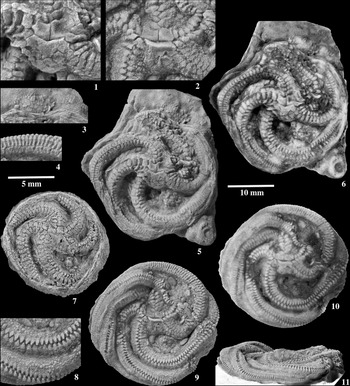
Very little ontogenetic data is available for Spiracarneyella florencei n. gen. n. sp.; however, the three known specimens include a late-stage juvenile, a mature individual, and a supermature individual. The late stage juvenile, USNM 170362 (Fig. 1.7), has an 11 mm diameter and preserves the oral surface and five ambulacra. The ambulacra all curve sharply counterclockwise almost immediately upon leaving the peristome and gently thereafter to a blunt termination. Each ambulacrum curves through ~60° of the thecal circumference. This specimen also preserves the oral surface bounded by a peripheral rim, although it is somewhat weathered and lacking in detail.
Photos of Spiracarneyella florencei n. gen. n. sp. (1, 3, 5, 6) Paratype CMC IP82748: (1) oral area showing greatly enlarged primary oral plates and the hydro-gonopore incorporated into the oral rise, whitened; (3) detail of the peripheral rim; (5, 6) oral surface whitened and immersed showing the spiraling nature of the ambulacral curvature (note the anus is offset to the right of the thecal midline in the CD interambulacrum). (7) Paratype specimen USNM 170362 showing relatively shorter ambulacra from this advanced juvenile specimen, whitened. (2, 4, 8–11) Holotype CMC IP48747: (2) oral area showing greatly enlarged primary oral plates and the hydro-gonopore incorporated into the oral rise, whitened; (4) detail of ambulacrum C showing the uniserial cover plates bearing cover plate passageways, whitened; (8) detail of the D and E ambulacra and adjacent interambulacral plating, whitened (note the small node-bearing interambulacral plates and the biserial ambulacral cover plates); (9, 10) large, well-preserved specimen with long spiraling ambulacra that curve nearly 180° around theca, whitened and immersed (growth of the specimen was constrained by a small attachment surface resulting in the peripheral rim being completely under the specimen from top view); (11) lateral view of the CD interray showing the long curved ambulacra, whitened; large white area below theca is protective plaster. Scales: (1–4, 8) = 5 mm bar; (5–7, 9–11) = 10 mm bar.

The mature paratype specimen, CMC IP82478, has a diameter of ~26 mm and is bordered by a peripheral rim that can be seen beyond the edge of the oral surface of the theca in places (Fig. 1.3, 1.5, 1.6). Like the juvenile specimen, the ambulacra curve abruptly upon leaving the peristome and curve evenly throughout their length covering ~110° of the thecal circumference. The ambulacra overlap slightly along the ambitus of the theca where they are separated by small interambulacral platelets. This gives the theca a bulbous look because the thickness of the ambulacra dominate the ambitus. The specimen is well preserved, except for ambulacrum B and the AB and BC interambulacra, which are somewhat disrupted proximally (Fig. 1.5, 1.6).
The holotype specimen, CMC IP82474, has a peripheral rim diameter of a ~26 mm. Because it was collected weathered free from surrounding matrix, it was necessary to embed the specimen in plaster prior to hand preparation. This specimen has several characters that indicate greater maturity than the presumed adult specimen of the same diameter. First, the oral surface is enlarged with respect to the smaller diameter of the peripheral rim. This specimen was attached to a small bivalve shell that has since dissolved leaving it free of matrix. The small size of this bivalve constrained the ultimate diameter of the peripheral rim because it could not extend beyond the margin of the valve. However, as the specimen continued to grow, the theca expanded above it resulting in a thecal diameter of ~28 mm, greater than the diameter of the peripheral rim, and having the peripheral rim tucked underneath the edge of the oral surface (right side of Fig. 1.11). The other feature suggesting great maturity is the greatly lengthened ambulacra (Fig. 1.9–1.11). The ambulacra of this specimen are extraordinary long and spiral ~180° around the oral surface while extending below the ambitus (Fig. 1.11). Having all of the ambulacra curve in the same direction has been argued to facilitate lengthening the ambulacra because they do not need to cross paths as in taxa where one or two curve in the opposite direction (Sumrall and Bowsher, Reference Sumrall and Bowsher1996; McKinney and Sumrall, Reference McKinney and Sumrall2011).
Heterochrony
Heterochrony is a common mechanism in the evolution of edrioasteroids (Sprinkle and Bell, Reference Sprinkle and Bell1978; Sumrall Reference Sumrall1993, Reference Sumrall2001; McKinney and Sumrall, Reference McKinney and Sumrall2011). Most arguments for heterochrony have been based on the ambulacral curvature, noting that straight distal ambulacra, a common feature of juvenile edrioasteroids (Bell, Reference Bell1976b), are retained into maturity via paedomorphosis independently numerous times in edrioasteroids (Sprinkle and Bell, Reference Sprinkle and Bell1978; McKinney and Sumrall, Reference McKinney and Sumrall2011). Other species have mature modification added to the ancestral curved ambulacra, resulting in a variety of meandering, spiraling, branching, and coiling morphologies that increase the length of the ambulacra as the organism increases in size with maturity via peramorphosis (McKinney and Sumrall, Reference McKinney and Sumrall2011). Taxa with clavate and subclavate thecae have also been argued to have paedomorphic peripheral rims that cease to develop early in ontogeny, while the extension of the pedunculate zone greatly adds to the size of the theca (Sumrall, Reference Sumrall1993, Reference Sumrall1996).
The oral area of carneyellids can be argued to have evolved through neoteny. As with most echinoderms that bear an ambulacral cover plate system, the earliest ontogenetic stages (where known) are characterized by the development of the five primary peristomial cover plates (PPCPs) prior to the development of the ambulacral system (Sumrall Reference Sumrall2010b, Reference Sumrall and Zamora2017; Sumrall and Waters, Reference Sumrall and Waters2012; Kammer et al., Reference Kammer, Sumrall, Ausich, Deline and Zamora2013). These five plates form the juvenile cover to the peristome and they template the developmental patterning of the ambulacra system later in ontogeny. They are proportionately very large, dominating the oral areas early in ontogeny and arranged into a 2-1-2 pattern as described by Sprinkle (Reference Sprinkle1973).
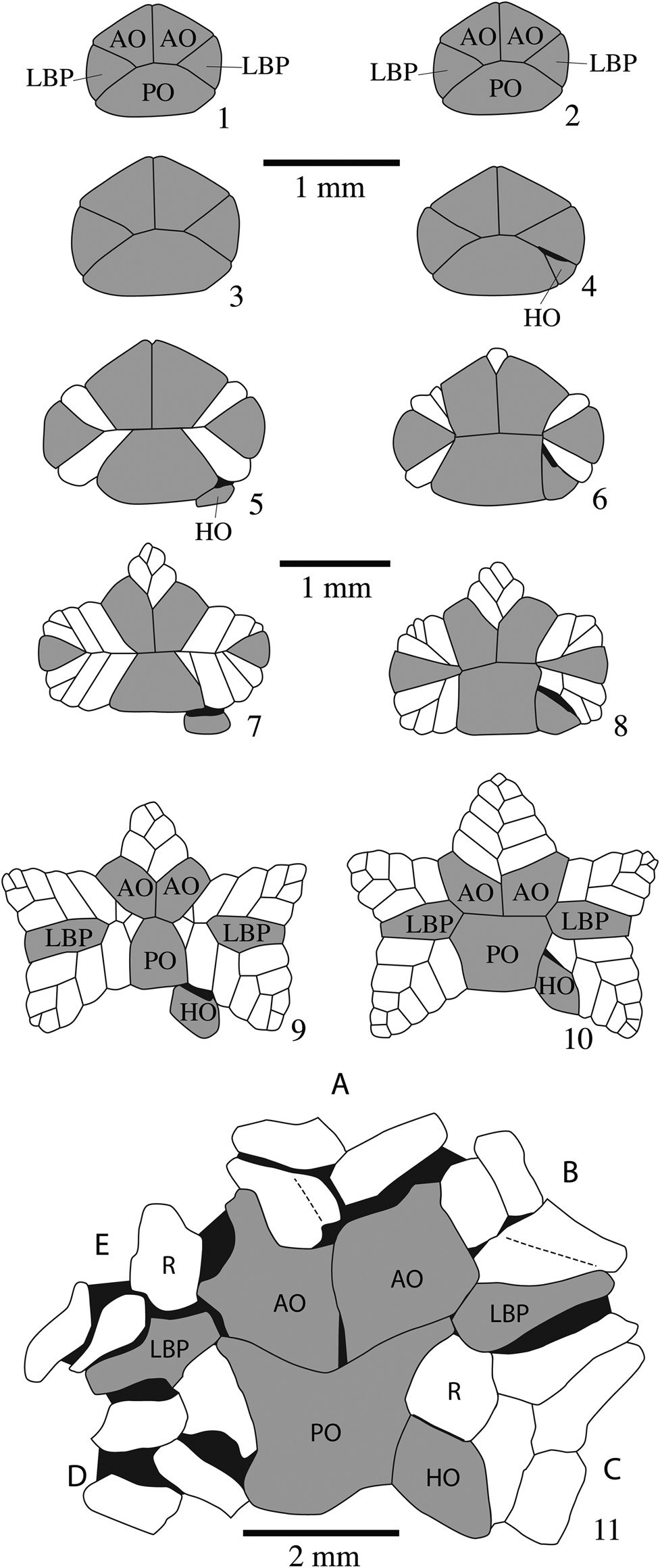
In the earliest known developmental state of edrioasteroids, PPCPs 1, 3, and 4 meet along the midline, and plates 2 and 5 articulate to along the lateral margins (Bell, Reference Bell1976b; Sumrall and Wray Reference Sumrall and Wray2007; Sumrall and Waters, Reference Sumrall and Waters2012). In edrioasteroid terminology, primary peristomial cover plates 1, 3 and 4 represent the posterior primary oral plate (PO), and anterior primary oral (AO) plates respectively, whereas PPCPs 2 and 5 represent the right and left lateral bifurcation plates (LBP) (Fig. 2.1). In most edrioasteroids, the hydropore oral plate (HO) is first seen about this stage of development between the PO and either the first right posterior shared cover plate or the right LBP (Bell, Reference Bell1976b) (Fig. 2.5). It is sometimes difficult to distinguish the HO from early developed interambulacral plates. Next, the shared cover plates develop in those taxa that bear them, and the hydropore oral becomes more prominent along ambulacrum C (Fig. 2.5, 2.7). Finally, the ambulacra bud off at the junction between the PPCPs and proceed to form the distal ambulacra (Bell, Reference Bell1976b) (Fig. 2.7, 2.9).
Isorophid oral area development and evolution by heterochrony. (1, 3, 5, 7, 9) Oral area ontogenetic series for Lebetodiscus (modified from Bell, Reference Bell1976b). Note that as ontogeny proceeds, the primary oral plates (AO and PO, shaded) decrease in size, approaching the size of the shared and ambulacral cover plates in white. Shared cover plates also separate the lateral bifurcation plates (LBP) from the oral cover plates. (2, 4, 6, 8, 10) Oral area grown series for Carneyella (modified from Bell, Reference Bell1976b). Note that as ontogeny proceeds, the primary orals (shaded) retain their relatively larger size with respect to the cover plates and no shared cover plates are added separating the LBPs from the primary oral plates. (11) The paedomorphic oral area of Spiracarneyella florencei n. gen. n. sp. showing greatly enlarged oral plates and a lack of shared cover plates, such that the LBPs are in contact with the primary orals. R is the first right plate in the C and E ambulacra, A–E are the ambulacral designations, HO is the hydropore oral.

These developmental steps occur in specimens with thecal diameters of <2.0 mm, whereas mature specimens are typically 25–35 mm in diameter (Bell, Reference Bell1976b). This suggests that simple oral areas dominated by proportionately large primary oral and lateral bifurcation that are not separated by shared cover plates characterize juvenile morphologies (Figs. 1.1, 1.2, 2.11), whereas proportionately smaller primary orals separated by shared cover plates characterized maturity (Bell Reference Bell1976b) (Fig. 2.9).
The oral area of Carneyella and presumably other carneyellids, such as Spiracarneyella n. gen. and Cryptogoleus, proceeds in a somewhat different manner (Bell, Reference Bell1976b). Here the earliest juveniles bear the five PPCPs representing the anterior and posterior oral plates and the two lateral bifurcation plates as with other edrioasteroids (Fig. 2.2) and the hydropore oral develops along ambulacrum C (Bell, Reference Bell1976b) (Fig. 2.4). However, instead of developing shared cover plates that separate the primary orals from the LBPs (Fig. 2.5), the first cover plates added are part of the distal ambulacral cover plate series and the primary orals stay in contact with the LBPs (Fig. 2.6). As ontogeny proceeds, the primary orals do not decrease in relative size (Fig. 2.9), but remain greatly enlarged with respect to the cover plate series and in contact with the LBPs (Bell, Reference Bell1976b) (Fig 2.10, 2.11). The hydropore oral forms a slit-like opening along the contact with the first right cover plate on ambulacrum C. We suspect that the first right cover plate of the C ambulacrum of carneyellids (Fig 2.11) is homologous with the first right posterior cover plate of non-carneyelids (Fig. 2.9).
Interestingly, the plate proportions and contact relationships of the oral plates in carneyellids are similar to those of closely related edrioasteroids that are ~1.25 mm in diameter, such as Isorophus and Lebetodiscus (Bell, Reference Bell1976b). The only noticeable difference is in the relative size of the lateral bifurcation plates, which have a similar size to other elements of the cover plate series (Fig. 2.11) and are only differentiated by their position and plate contacts. Consequently, the trait changes seen in the carneyellid oral area show truncation with respect to the ancestral edrioasteroid developmental trajectory while size continued to increase. This represents neotenic evolution of the oral area (McKinney, Reference McKinney and McKinney1988), while the rest of the organism developed similarly to the ancestral condition.
The distal ambulacra of carneyellids also show different types of heterochrony. The straight distal ambulacra in Cryptogoleus retain the ancestral juvenile straight morphology, suggesting that the ambulacral configuration is paedomorphic. This is a common type of heterochrony seen in edrioasteroids such as Rectitriordo and Neoisorophusella, having evolved in numerous lineages (McKinney and Sumrall, Reference McKinney and Sumrall2011). On the other hand, the distal ambulacra of Spiracarneyella n. gen. show an increased length with maturity, reaching lengths that are much greater than similarly sized specimens of Carneyella, suggesting peramorphosis (likely by acceleration), similar to that described for Giganticlavus and Streptaster (McKinney and Sumrall, Reference McKinney and Sumrall2011).
Materials
Repositories and institutional abbreviations
Specimens are reposited in the invertebrate paleontology collections of Cincinnati Museum Center (CMCIP), and the invertebrate paleontology collection of the US National Museum of Natural History (USNM).
Systematic paleontology
Class Edrioasteroidea Billings, Reference Billings1858
Order Isorophida Bell, Reference Bell1976a
Suborder Lebetodiscina Bell, Reference Bell1976a
Family Lebetodiscidae Bell, Reference Bell1976a
Family Carneyellidae Bell, Reference Bell1976a
Remarks
Carneyellid edrioasteroids are a small but important group of North American edrioasteroids characterized by the presence of three greatly enlarged primary oral plates and large thick cover plates with elongate and slit-like cover plate passageways arranged in single biseries. The clade includes Carneyella, Cryptogoleus, and Spiracarneyella n. gen. Euryeschatia is placed here provisionally.
Genus Spiracarneyella new genus
Type species
Spiracarneyella florencei n. gen. n. sp. by original designation.
Diagnosis
Same as for species by monotypy.
Occurrence
Known from the “River Quarry beds” of the Point Pleasant Formation (Upper Ordovician, Katian) of Franklin County, Kentucky and Clermont County, Ohio.
Etymology
Spiracarneyella means spiraling carneyella, referring to the spiraling ambulacra of this carneyellid.
Remarks
Spiracarneyella n. gen. is similar to other carneyellids in gross morphology, but differs from other taxa by the small, node-like plates of the distal interambulacra and the offset position of the periproct. It differs from Cryptogoleus Bell, Reference Bell1976a by having curved ambulacra. It differs from Carneyella by the curvature direction of the C ambulacrum. It differs from Euryeschatia by the position of the hydropore oral and the lack of coiling of the distal ambulacra.
Spiracarneyella florencei new genus new species
Figures 1, 2.11
- Reference Bell1976a
non Carneyella pilea (Hall) Reference Hall1866; Bell, pl. 15, figs. 11–13, text fig. 13E.
- Reference Bell and Pojetta1979
non Carneyella pilea (Hall) Reference Hall1866; Bell, pl. 1, figs. 1–3, Fig. 1.
Holotype
The type series of Spiracarneyella florencei n. gen n. sp. includes the holotype CMC IP82474, and paratypes CMC |IP82478 and USNM 170362. The holotype was weathered free of matrix and formerly attached to a small bivalve shell. It was embedded in plaster of Paris prior to preparation to help retain its integrity. Paratype CMC IP82478 is large and attached to a bryozoan fragment. Paratype USNM 170362 is heavily weathered and attached to a float block.
Diagnosis
Carneyellid with long ambulacra that spiral counterclockwise, periproct offset to the right side of CD interambulacrum, and distal interambulacral plates in the form of noded platelets.
Occurrence
Spiracarneyella florencei n. gen. n. sp. is known from the “River Quarry beds” of the Point Pleasant Formation of Franklin County, Kentucky and Clermont County, Ohio.
Description
Large discoidal carneyellid up to 28 mm in thecal diameter in available material. Oral surface formed from five stout ambulacra exiting peristome and dividing five interambulacral areas (Fig. 1). Peristome covered by three greatly enlarged orals (Figs. 1.1, 1.2, 2.11), single large posterior oral in CD interray shield-shaped, flat to slightly convex except along perradial suture where flared up forming transverse ridge. Two smaller but still greatly enlarged anterior orals in AE and AB interrays (Figs. 1.1, 1.2, 2.11), concave, taper distally, abut along the midline of ambulacrum A and abut PO along transverse midline. Lateral bifurcation plates touch oral plates along perradial suture except for large supermature holotype where slightly separated by first right cover plate of ambulacrum C (Fig. 1.2), narrow, form bifurcation point of shared ambulacra. Hydro-gonopore slit-like, formed along suture between first right cover plate of ambulacrum C and single hydropore oral (Fig. 2.11). Interior structure of oral area unknown. Ambulacra arranged in 2-1-2 pattern with all ambulacra curving counterclockwise (Fig. 1.9). Ambulacral curvature begins abruptly as ambulacra leave peristomial area and curve evenly throughout length. Curvature of ambulacra increases with maturity with small paratyp|e USNM 170362 having no ambital overlap of ambulacra (Fig. 1.7), whereas large holotype CMC IP82474 has extremely long ambulacra that spiral 180° around theca (Fig. 1.9). Ambulacra covered by stout, thick cover plates arranged in a single biseries, bearing elongate and slightly oblique cover plate passageways (Fig. 1.4, 1.8). Cover plates proximally larger than those distally and taper throughout length to blunt termination. Floor plates uniserial but otherwise unknown in present material. Interambulacral areas small and elongate, spiraling between ambulacra in distal portions, plated with small, thick, proximally imbricate plates proximally that grade into small platelets distally (Fig. 1.5, 1.9). Interambulacral plates bear small nodes on external surface giving interambulacra granular texture (Fig. 1.8). Periproct small, covered by irregularly plated series of lathe-shaped cover plates forming low cone in right side of CD interambulacrum (Fig. 1.6). Few irregular circlets of highly imbricate peduncular plates separate oral surface from the peripheral rim (Fig. 1.3). Peripheral rim located distally to pedunculate zone, formed from about six very irregular rows of plates that decrease in size distally, with distal-most plates becoming radially elongate (Fig. 1.3). Bottom surface of holotype unplated when found.
Etymology
The species in named in honor of Paul Florence who found the holotype specimen and made it available for study.
Remarks
Paratype USNM 170362 was originally described and figured as small mature specimen of Carneyella pilea but with unusual curvature of the C ambulacrum (Bell, Reference Bell1976a, Reference Bell and Pojetta1979). Bell suggested that proximally, ambulacrum C has a small aborted branch adjacent to the periproct. However, this seems to be a small area of disrupted interambulacral plating that is further confused by the overall weathered preservation of the specimen. Because this specimen is small and was found in isolation, it was considered to be a rare teratology rather than a distinct form. It was also noted to be the among the oldest known specimens of C. pilea, which is much more common in younger strata. Carneyella pilea is not known from these localities bearing S. florencei n. gen. n. sp.
The discovery of additional specimens in similarly aged rocks, both of which bear counterclockwise curvature of ambulacrum C, shows that this is not a teratology, but a real biological difference shared by these three specimens. This, coupled with differences in the plating of the interambulacra and positioning of the periproct, demonstrates that Spiracarneyella florencei n. gen. n. sp. is a distinct genus and species of carneyellid. These differences, however, are less obvious on USNM 170362 because of its relative maturity and weathered preservation.
The bottom surface of the holotype was partly exposed prior to embedding it in plaster of Paris. From this examination the uniserial ambulacral floor plates could be seen and the unplated aboral surface could be confirmed (both unfigured). Neither of these features is surprising because they are invariant across isorophid edrioasteroids.
Acknowledgments
We would like to thank P. Florence and R. Schrantz who donated specimens included in this study, and the late J. Pojeta, Jr. for collecting the original specimen. C.E. Brett and F. Ettensohn offered insight into the stratigraphy of the collecting localities. R.L. Parsley photographed the USNM specimen used in this manuscript. J. Sprinkle, B. Lefebvre, and an anonymous reviewer made useful suggestions that improved the manuscript.