I ROMAN ANIMAL SACRIFICE
This article is concerned with the practical issues involved in killing bovines, the largest of the standard set of animals that were sacrificed as part of religious rituals in the Roman world. The size of bovines and the potentially aggressive nature of some members of this family, in particular bulls, posed special challenges to those charged with the actual task of handling and killing them.Footnote 1 While animal sacrifice was a central component of ancient Roman religion, modern analyses of this phenomenon have tended to concentrate much more on certain aspects than others.Footnote 2 A plethora of excellent books and articles has investigated the symbolism of religious practices and the deeper metaphorical significance of killing and blood. Just the specific topic of how much of the meat from a sacrificial animal's carcass was eaten, and by whom, has spawned a rich bibliography.Footnote 3 However, when it comes to the admittedly unpleasant details of death and the shedding of blood in reality rather than as symbol, much less scholarly ink has been spilt. In particular, there has been a tendency to skim over the actual moment when the animal was slain.Footnote 4 Considering the attention that modern commentators have lavished on the idea of death and its meaning in ancient religious sacrifice, the relative neglect afforded to the logistics of how this death was achieved is puzzling. It is, after all, the fundamental fact that an animal was killed and bled that made a blood sacrifice a blood sacrifice, and which allows all the subsequent analysis of its symbolic importance. To some degree, this lack of interest in the moment of death in modern scholarship reflects the ancient sources, which are themselves quite vague as to the methods used in killing the animals.
One reason for this silence in antiquity may be that the people who did the dirty work of slaying and bleeding animals in Roman religious rites were not the largely aristocratic magistrates and priests who presided over the sacrifice as a whole. These men chanted the incantations, enacted the rituals, and presented token bits of flesh and blood at the altar, but when the time to slaughter the animal arrived, they palmed off this duty on mysterious figures called popae, victimarii, and cultrarii, who were slaves or other low-status individuals.Footnote 5 It is an oddity of Roman sacrifice that what might well be assumed to have been the symbolic highlight of the procedure, taking the animal's life, was performed not by the central priest, but rather by anonymous servants. This has resulted in a corresponding ambiguity and lack of detail in the ancient sources in terms of the procedures used in killing sacrificial animals.
One component of the ideology of animal sacrifice was that the animal at least nominally appear to be an eager (or at least accepting) participant in the ritual. When being led towards the altar, the animal should go willingly, without being forcibly dragged along by the attendants (e.g., Juv. 12.1–16). Once at the altar, if the animal looked overly frightened or shuddered during the prayers and anointing, this could mar the procedure (Serv. 6.244). Ideally, the animal should seem willing to die, and its death should not be accompanied by excessive protest or struggle. In a worst-case scenario, a particularly recalcitrant or violent display by the animal might invalidate the ritual, require its repetition, or at the very least necessitate an added expiation. However, such a demand for compliant behaviour presents a problem, since as soon as harm begins to be inflicted on a creature, it may naturally express its disapproval by bellowing, jerking away from the source of pain, attempting to break loose, and, if possible, running off.
While traditional views of sacrifice have followed the lead of Burkert in emphasizing the necessity of a willing victim,Footnote 6 recent scholarship has begun to challenge or complicate this notion. Most notably, Naiden has presented compelling evidence that, at least in Greek sacrifices, animals were sometimes expected to offer natural resistance to being killed, and that such acts did not ruin the ritual.Footnote 7 In this respect, Naiden's work incorporates a welcome awareness of the importance of practical issues into the debates surrounding ancient sacrifice. In the Roman context, it seems likely that a certain amount of recalcitrant behaviour may similarly have been acceptable, or could be readily countered with a quick expiatory act. Nevertheless, the ancient sources do seem to indicate that a relatively docile response by the victim was considered ideal.
While sacrificial animals usually had their throats slashed, this would not have been enough to prevent negative reactions on the animal's part. A large bovid with its throat cut still takes considerable time to bleed to death. Around 20–30 seconds will elapse before the animal loses consciousness, and it can be a further minute or more until the heart stops beating.Footnote 8 This is ample opportunity for the animal to display a negative response, which would destroy the fiction that it was a willing participant in the ritual. The animal's natural impulse to protest its death and escape would not only challenge the symbolic integrity of the ritual, but would pose practical difficulties as well. In keeping with the pretence of the ‘willing victim’, it seems that Roman animals were not constrained in any meaningful way while at the altar. Most commonly, a handler or two held on to the head of the beast.Footnote 9 Among the long list of items that would constitute a transgression of the ritual procedure and would invalidate the sacrifice was the stipulation that the animal not be bound in any way or restrained with any form of fetters (Serv. 2.134; 4.518).
It is true that modern dairy cattle are stereotypically depicted as placid in nature, but it is not hard to find examples of farmers who have been kicked or even trampled to death by their supposedly docile cows.Footnote 10 Ancient cattle were probably more feral, and bulls of any era can be extremely aggressive. Even a bovine with a docile temperament, when in the terror and agony of its death throes, might not stand calmly while being stabbed and bled to death.Footnote 11 What could go wrong is vividly evoked by Virgil in a simile describing the death of Laocoön, in which the struggles and cries of the unlucky Trojan are likened to the frenzied flight and maddened bellows of a wounded bull that has been slashed inexpertly by the axe and, breaking free from its handlers, runs in terror from the altar (Virg., Aen. 2.220–4).
Physically controlling a large sacrificial animal was no easy task. A full-grown modern cow weighs around 500 kg, and bulls can achieve weights double that amount.Footnote 12 Ancient Mediterranean cattle of the Imperial age were probably comparable in size.Footnote 13 Varro, Columella, and Pliny describe a wide variety of cattle, ranging from the small Alpine breeds to the gigantic white Umbrian breed.Footnote 14 Even allowing for a slightly smaller size for ancient bovines, the minimal restraints would not have been sufficient to prevent a maddened and desperate 400 kg animal from breaking free of its handlers and running amuck. How much more difficult it is to imagine a 1,000 kg ancient bull meekly standing still for perhaps several minutes while it bled to death.
Large animal sacrifice therefore presented several problematical requirements for the victimarii. First, a very large bovid had to be instantaneously reduced from a free, unconstrained (or only lightly restrained), conscious animal to a completely inert and insensible state without allowing it to display much negative reaction. Second, the immobilized creature had to be kept in this condition for a considerable amount of time while it suffered having its throat cut and being bled to death, again without a great deal of protest. It was also important that the animal provide a sufficient quantity of blood as a result of the throat-cutting, and in cases where little or no blood resulted, the sacrifice was regarded as having failed (e.g. Virg., Georg. 3.492).
II MODERN INTERPRETATIONS AND EVIDENCE FROM ART
The solution to these challenges, according to most modern interpretations of large animal sacrifice, is that either a hammer or an axe was used to strike the victim on the head in order to ‘stun’ it and render it unconscious but still alive. This ensured that it would not struggle when it was subsequently slain by having its throat cut with a knife and was allowed to bleed to death. However, standard reference works on Roman sacrifice tend to be extremely vague when describing this crucial moment. Most merely have some variant on the simple sentence: ‘The animal was stunned, then had its throat cut.’Footnote 15 Other more specialized scholarly studies name the hammer and axe as the featured weapons, but do not draw any distinction between the two, or suggest where they were aimed.Footnote 16 The few that do identify where the blow was directed name the head or forehead of the animal as the target zone.Footnote 17
There are a number of problems with these interpretations, even when expressed in such sketchy terms, which render them incomplete explanations. First of all, to stun an animal properly is a tricky proposition. On the one hand, the blow would have to be struck with enough force to render the creature insensible to the rather strong stimulus of having its throat cut and to keep it unconscious for several minutes while it bled to death, while alternatively, too powerful a hit might kill the animal prematurely. Even if one possessed the skill and experience to strike such a delicately calculated blow, the slightest movement of the animal or variation in its anatomy might result in a bungled sacrifice. Given the importance and expense of sacrificial rituals, it seems unlikely that the Romans would have settled on so chancy a procedure. Secondly, and more importantly, while a hammer is a logical implement for such a purpose, an axe most certainly is not. These are very dissimilar weapons that create completely different types of trauma. The literary sources and iconographic depictions leave no doubt that axes were routinely wielded in sacrificial rituals, but none of these interpretations offer an explanation for how the axe was used.
In analysing how various sacrificial weapons were employed, the evidence from Roman art is particularly significant.Footnote 18 There are at least fifty-six surviving sculptural reliefs of sacrifice scenes in which either a hammer or an axe is present and clearly distinguishable.Footnote 19 These range in date from the seventh century b.c. to the fourth century a.d., and include a number of famous monuments, such as the Ara Pacis and Trajan's Column. Nearly three-quarters date from the first or second centuries a.d. Out of the fifty-six images, forty-one feature an axe, while only fifteen depict hammers. Despite the overall predominance of axes over hammers, four out of seven of the scenes from the first century b.c. display a hammer. An additional six hammer scenes date from either the first, or very early second, centuries a.d. Interestingly, there are three monuments whose various panels picture both axes and hammers, although never in the same panel — Trajan's Column, the Arch of Beneventum, and the Ince Blundell Hall relief.
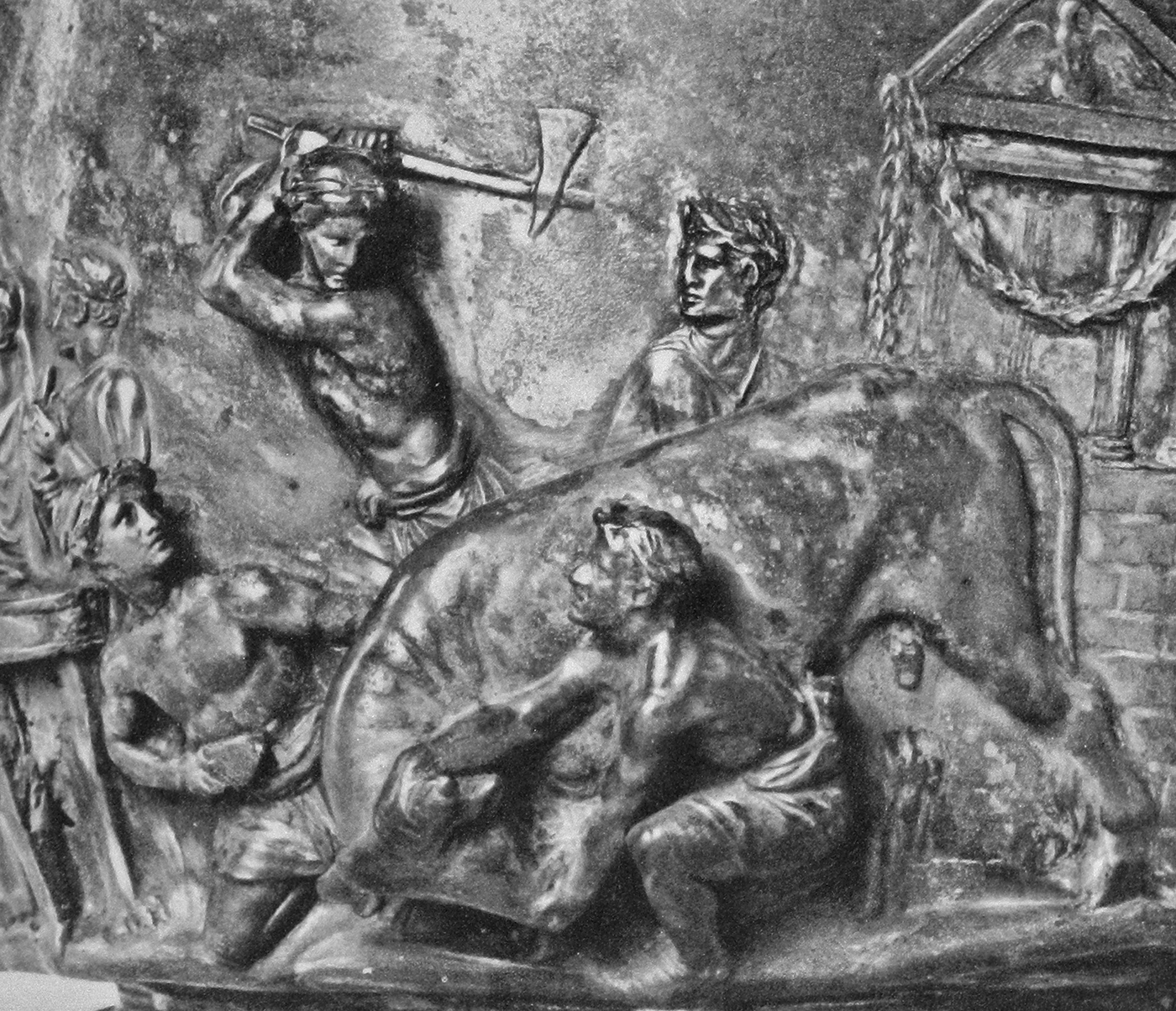
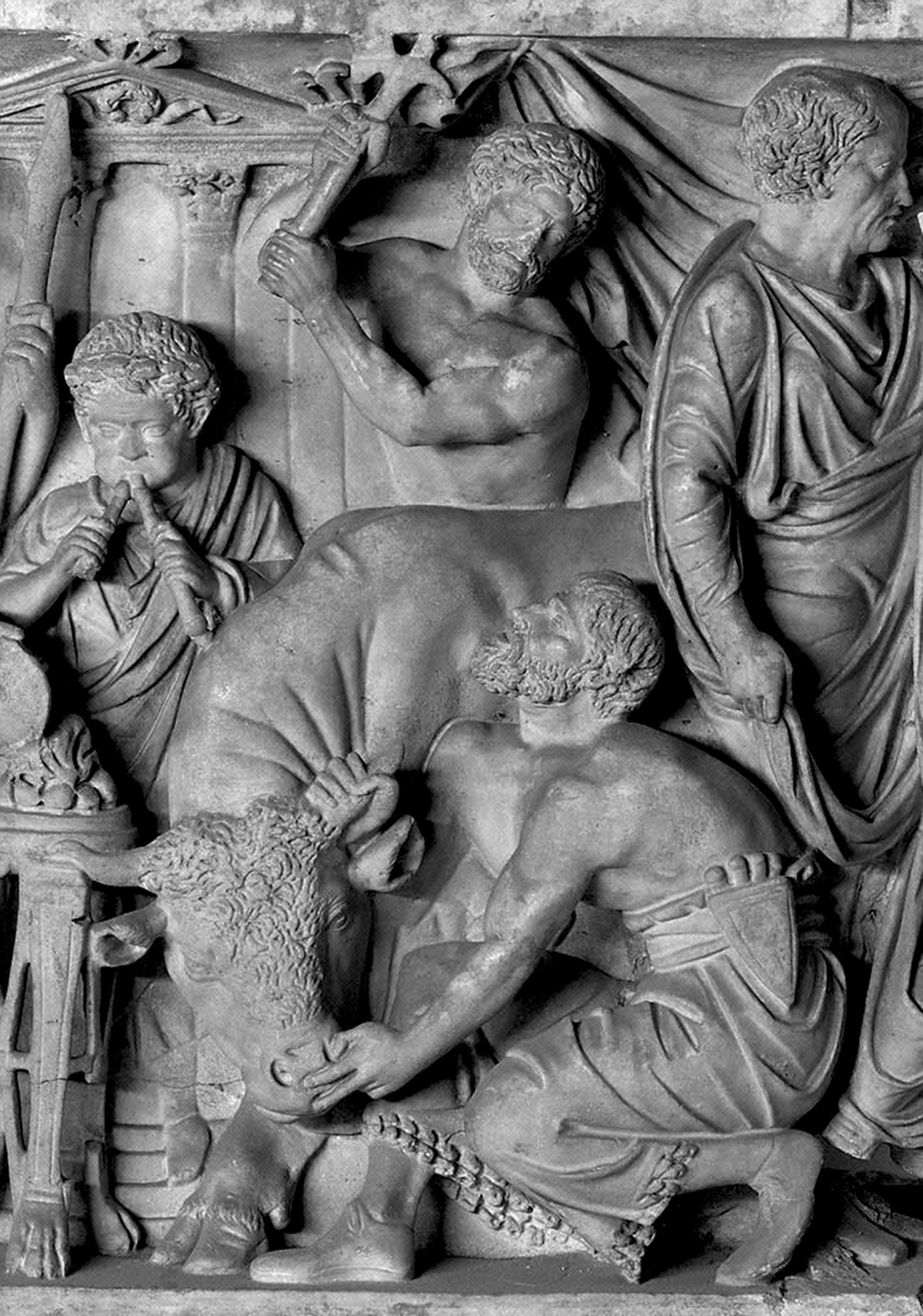
While many of the scenes show sacrificial processions, at least seventeen of them portray the moment of killing the animalFootnote 20 (Fig. 1). The standard iconography in these images includes at least one victimarius kneeling by the head of the standing animal and yanking its head very sharply downwards. The popa stands to the side of the animal with arms upraised, holding his weapon ready to strike the blow. Often a cultrarius kneels beside the animal, clutching a broad-bladed triangular knife at the ready to slit its throat as soon as it is down.
Sacrifice scene with axe-wielding popa, cultrarius holding knife, and victimarius pulling head of bovine downwards. Detail of sacrifice scene on Triumph of Tiberius Boscoreale Cup. (Photo after Héron de Villefosse, Le trésor de Boscoreale, 1899, pl. 36.2)

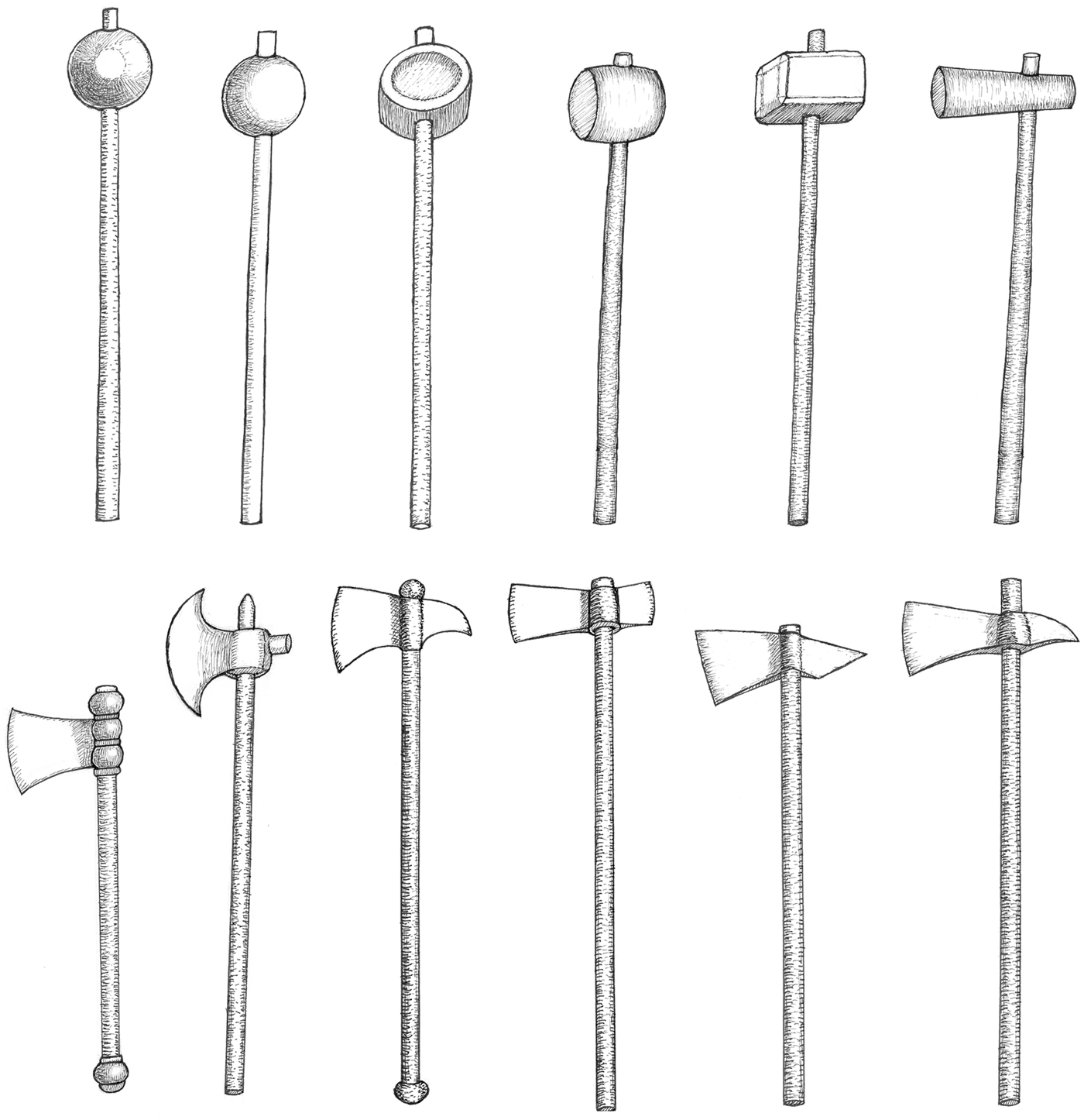
In these images, the exact type of axe or hammer varies widely. Some axes have curved blades, others straight ones. Some have a back spike while others are flat. The mallets and hammers have heads that are cylindrical, rectangular, spherical, or puck-shaped. Whether axe or hammer, almost all possess a two- or three-foot shaft and a fairly sizeable head, suggesting that they required two hands to wieldFootnote 21 (Fig. 2). Based on this body of evidence, it appears that there is a trend towards an increased appearance of axes over hammers from the Late Republic through the first two centuries of the Empire. However, how and why axes were used has not been satisfactorily explained.
Representative selection of different types of hammers (top row) and axes (bottom row) appearing in bovine sacrifice scenes in Roman art. (Drawing by Alicia Aldrete)
Therefore, when considering ancient large animal sacrifice, a basic question is just what the preferred implement was: a hammer or an axe. If both were sometimes utilized, why was one chosen for a particular sacrifice rather than the other? For each weapon, exactly how did the popa employ it, where was it aimed, and what was its intended physiological effect? How did the choice and use of these weapons interact with the requirements of sacrificial ritual? Were the animals merely stunned by the initial blow, as has commonly been assumed, or were they sometimes actually killed by it? How would this affect their ability to be bled afterwards?
Given the importance of the animal's death and bleeding to the overall ritual, a deeper investigation of this process, of the personnel who carried it out, and of the weapons that they wielded is certainly warranted. The remainder of this article will therefore draw upon a combination of iconographic, literary, physiological, and comparative evidence in order to illuminate these fundamental questions concerning the procedures and implements used by the Romans in killing large bovids during sacrificial rituals.
III HAMMERS
One way to begin answering these questions is to explore the practical aspects of how a hammer or mallet can be used to stun a bovine. Here, insights can be gleaned from comparative historical evidence derived from animal-killing practices at farms and slaughterhouses.Footnote 22 One of the traditional methods utilized by farmers and butchers throughout history to stun cattle and other large animals as a prelude to slaughtering them was to strike them on the head with a heavy mallet or hammer.
While modern discussions of stunning animals tend to focus on it as a humane act done in order to spare the animal unnecessary pain, it is clear from earlier writings that the initial purpose of this practice was the safety of the slaughtermen. In particular, there was concern to avoid being kicked or injured by frenzied animals that had had their throats cut.Footnote 23 This suggests that the need to stun animals would have been even more acute in a Roman sacrifice, since not only would there have been security issues for those conducting the sacrifice, but there was also the desire that the animals seem acquiescent to the ritual.
A standard sledgehammer with a cylindrical or rectangular flat-surfaced head, such as is used to drive stakes or posts, was often employed by those tasked with stunning animals. However, when a dedicated tool was created just for the slaughterhouse, it commonly took a different form, consisting of a handle topped by a stone, wood, or metal sphere. It is interesting to note that the specialized pig- and sheep-stunning mallets of this design that were developed for the large-scale industrialized abattoirs of the nineteenth century are identical in size and shape to some of those appearing in Roman art, such as the ones borne by three popae in a relief of a triumphal procession from the Temple of Apollo at Rome.Footnote 24
For bovines, the time-honoured optimal aiming point for a stunning blow was the flat portion on the top of the skull at the place where two imaginary lines drawn between the animal's right eye and its left horn, and its left eye and right horn, intersect. This spot corresponds to a relatively thin section of the creature's skull directly above the brain, so that a heavy blow struck here would crush the skull and inflict massive trauma on the animal's brain. Medical studies have shown that a blow inflicted here with sufficient force can cause a depressed fracture of the roof of the cranium and extensive haemorrhaging in the brain under the impact site and in the temporal and frontal lobes, and can immediately render the animal unconscious.Footnote 25 In the context of a slaughterhouse, this is the ideal result, since it allows the animal to then be bled without either struggling or suffering.
From antiquity up until the era of industrialization, the technology and techniques involved in this procedure remained fairly constant. Images in art of Romans wielding hammers for this purpose look identical to medieval and early modern depictions, such as an illustration in the Bedford Book of Hours from 1423 which shows a farmer about to bludgeon a pig with a mallet. While in theory, this method offers an effective and humane way to stun cattle, in real life, the outcome is often less satisfactory. To successfully stun a bovid by smacking it on the head with one hit requires both a high degree of precision and considerable force. If the blow is not well-aimed or the animal jerks its head, it is easy to miss the ideal spot of thin bone. Lack of knowledge or experience regarding bovine physiology can cause those attempting to slaughter cattle to strike other zones of the head that are less vulnerable. For example, historical records suggest that sometimes the poll area at the back of the head was targeted, but this region has been proven to have a heavier bone structure and is not adjacent to the more easily damaged regions of the brain. Thus, blows directed here would be far less effective.Footnote 26
Even when properly targeted, a perfectly-aimed hit with a heavy sledgehammer is often not enough to knock the creature insensible, and a whole sequence of blows can be necessary before the unfortunate animal drops. There is ample evidence from modern and early modern slaughterhouses attesting to the frequency with which attempts at stunning cattle with hammers were ineffective. For example, in 1885, a representative of the Board of the Butchers' Guild in Frankfurt, Germany, observed current slaughterhouse practices and reported that to completely stun just nine oxen required no fewer than seventy-one separate blows.Footnote 27
In the nineteenth century, when truly massive commercial slaughterhouses began to appear in large cities, a number of the more industrialized countries, including England, France, and the United States, replaced hammers with the pole axe, which was supposedly more efficient. Despite its name, the version of the pole axe used in slaughterhouses did not employ a blade to stun the animal, but instead consisted of a long handle to which was attached a heavy metal head, from which protruded a hollow, round rod about 2 cm in diameter and 8–13 cm long. The wielder of the pole axe struck the animal on the head, causing the rod to punch through the skull and penetrate the brain.Footnote 28 An elaborate study on pole axe use in slaughterhouses conducted in 1923 found that only 55 per cent of the animals were felled by one hit, with some requiring up to ten blows.Footnote 29 While this might make it sound as if something was wrong with the procedure, the report noted that these statistics were produced in a reputable plant by ‘skilled men working under reasonable conditions’. If highly experienced men wielding the apparently more efficient pole axe frequently failed to stun cattle with the first blow, it can safely be assumed that less-skilled ones using hammers would also have met with high rates of failure.Footnote 30
To a farmer or slaughterhouse worker, failure to stun a cow at the first blow might be annoying or psychologically disturbing, but it would be viewed as only a temporary inconvenience readily solvable by another hit. To the officiants in an ancient Roman sacrifice, such an occurrence could have had much graver consequences. It might have been viewed as a serious enough mishap to invalidate the entire sacrifice and necessitate its repetition from scratch. If the failed stunning attempt resulted in a negative reaction from the animal, such as struggling or vocalizations of distress, then it destroyed the fiction that the creature was a willing participant, again potentially invalidating the ritual. Thus, while a hammer might be a perfectly adequate implement for simply slaughtering an animal, the inherent variability in its effectiveness would constitute an unwelcome and problematic element in a sacrificial ritual.
Violently hitting a creature on the head with a heavy weapon can also be a hazardous and uncertain proposition for those doing the killing. This was especially true for victimarii in ancient Rome. Because sacrificial animals were not heavily restrained, there was an even greater chance than in the slaughterhouse that the animal might flinch at the crucial moment, causing the popa to miss his target or resulting in the hammer glancing off at a deadly angle. Any of these occurrences could have diverted the weapon into the leg of the popa. Even more at risk was the cultrarius, who had to kneel beside the animal, holding its head. This position meant that the cultrarius' own head was mere centimetres away from the target zone of the popa's hammer. A poorly aimed blow, a jerk from the animal, or an unfortunate bounce could have sent the weapon crashing into the head, neck, or back of the cultrarius. The moment just before the strike must always have been a nervous one for the cultrarius.
Two incidents, one ancient and one modern, vividly illustrate these dangers. One of the examples cited by Suetonius to demonstrate the sadism of Caligula was that once, when performing the rôle of popa at a sacrifice, he deliberately brought down the mallet not on the skull of the sacrifice but on the adjacent head of the unfortunate cultrarius, killing him instead of the animal (Cal. 32.2). A more modern caveat is provided by the experience of a slaughterman in York, England, who completely missed the head of his target animal, plunging the pole axe into his own leg, which subsequently required amputation.Footnote 31 Both the pressing need to immobilize the animal with the first blow and safety considerations for those involved would have placed a premium on skilled popae who would minimize the chance of mishaps that might mar or invalidate the ceremony.
There is an anatomical factor that makes a reliance on hammers in ancient sacrifice even more uncertain. While most animals killed in modern and early modern slaughterhouses are cows or calves, a favoured animal in major ancient Roman sacrifices was the bull. Bulls have much heavier cranial bone structures, so that the difficulty in stunning them would have been even more pronounced. In the 1923 pole axe study, the average number of blows needed to stun a cow was 1.27 hits, whereas bulls required an average of 2.5 strikes each.Footnote 32 A sense of how tough it is to stun a bull is offered by the following anecdote from an early twentieth-century slaughterhouse inspector: ‘I was on duty at Leeds public slaughterhouse when I heard the loud bellowing of a bull in the large slaughterhouse. On proceeding there, I saw a crowd of men and boys watching the slaughtering of a roan bull … The bull was struck with the poleaxe at least a half a dozen times on its forehead before it was knocked down. The bull bellowed fearfully at each blow except the last ... This went on for quite five minutes.’Footnote 33 This sort of repeated bludgeoning and the accompanying vigorous bellows of protest would have been highly undesirable, and potentially unacceptable, in the context of a Roman sacrifice.Footnote 34 Additionally, a bull is much more likely to respond in an aggressive manner to a botched attempt at stunning, and, due to its size and horns, would have posed a very real danger to both participants and onlookers at a sacrifice, should it run amuck. Therefore, while a hammer might have sufficed when sacrificing a pig or a cow, it would not have been an effective tool for sacrificing bulls.
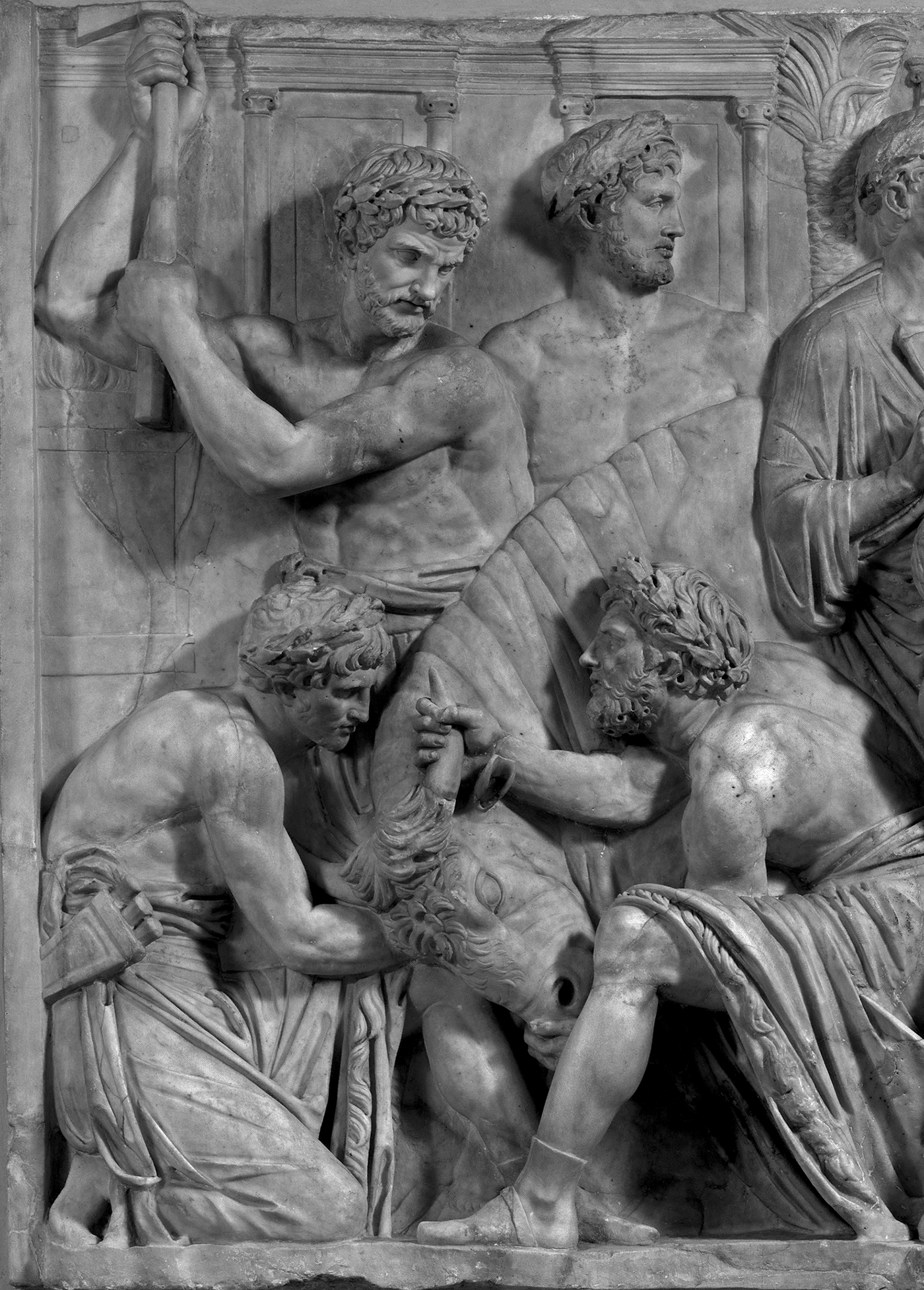
Finally, examination of the evidence preserved in ancient art representing the sacrifice of a bull reveals yet another problem. These images consistently and clearly portray the animal's head being held in a position that could not be less optimal for the striking of a stunning blow to the top of its head. Most reliefs that illustrate the moment before the blow is struck depict a victimarius kneeling beside the head of the bull, gripping its head or horns and pulling the head very sharply downwards so that the target zone on the top of the skull is perpendicular to the ground, or even angled away from the direction of the blow (Fig. 3).
Bovine sacrifice scene with victimarius pulling animal's head downwards depicted on Vota Decennalia of Hadrian relief panel now in the Uffizi. (Photo: Scala/Ministero per i Beni e le Attività culturali/Art Resource, NY)
If you are trying to stun the animal with a blow directed from above, as the images show, the best bet would be to position the animal's head parallel to the ground. In many modern slaughterhouses, when the animal reaches the killing site, a mechanized lift is brought up under its chin in order to raise its head up parallel to the ground, thus presenting the worker wielding the captive bolt stunner with an ideal flat surface on the top of the skull to aim for. Early twentieth-century photographs of cattle being struck with either a pole axe or a sledgehammer show the animals' heads in a similarly raised posture.Footnote 35 The Roman reliefs depict just the opposite position, with the flat top of the head nearly perpendicular to the ground. In the pose shown in ancient art, the popa's weapon would have had to strike a steeply inclined plane. In some of these images, the angle is so acute that it is hard to imagine how the popa would even have been able to make contact with the desired strike zone. In most of them, he would actually have been better off swinging his implement sideways like a golf club in order to hit the right spot. Even if he managed to strike the top of the animal's skull, the weapon would almost certainly have bounced off in a downward direction, straight onto the arms and head of the kneeling man holding the animal, likely resulting in his becoming an additional victim.
Thus, there are a number of problems with the interpretation that hammers or mallets were employed to stun the biggest and most dangerous sacrificial animals in ancient Roman religious rituals: they are unreliable tools for immobilizing a large animal with the first blow, as the ceremony demanded; they would have had an especially high rate of failure when used on bulls, an animal frequently specified as featuring in important sacrificial rituals; and the practical requirements of their use are completely inconsistent with the posture of the bulls being killed as illustrated in ancient art.
IV AXES
At this point, it is necessary to consider the other tool attested by both literary and visual evidence as having been utilized in Roman sacrificial rituals: the axe.Footnote 36 Unlike hammers and mallets, axes have not commonly been employed by farmers and slaughterhouse workers to stun or kill animals, but they were plainly used in ancient sacrifices. In nearly all scholarship on Roman sacrifice, these axes have been treated as being functionally interchangeable with hammers, and are described as being used to stun the animal by striking it on the head, just as one would wield a hammer. However, the blade of an axe simply cannot be employed in this manner to stun; its sole function is to inflict massive and crude gashes, not to deliver calculated taps.
One could theoretically slam a large axe blade-first onto the head of a bovid, probably splitting the skull or even lodging the axe in its brain. This would effectively render the animal compliant for whatever bleeding or other rituals followed. The angle that the animals' heads are being twisted into in the artistic images, however, is ill-suited for this, and would create an even more dangerous situation than with a hammer, since the thin edge of an axe blade would more easily slip off the animal's head than the broader blunt end of a hammer. Also, the bovine skull features many irregularities and raised surfaces, and any slight knob or ridge would be enough to divert the axe violently sideways, with disastrous consequences.
Another drawback to using an axe for stunning is that, in order to ensure success with the first stroke, the popa would have had to err on the side of hitting with more force than was needed, with the result that the axe would have cleaved through the skin and probably the skull as well. In the process, blood and brain tissue would be forcefully ejected from the split skull, spraying the bystanders with unwelcome gore. A significant reason for the slaughterman's preference for hammers is that the tough hide of the bovid remains intact through multiple blows, so that even when the skull beneath is thoroughly crushed, there is little external mess.
How, then, to account for the prevalence of axes in Roman depictions of bovine sacrifice? I would like to propose a reinterpretation of sacrificial procedure that would solve all of the problems listed above, that would be fully consistent with the visual evidence, and that would offer an explanation for why axes rather than hammers were sometimes preferred. I believe that, while hammers were used on smaller beasts, for the larger and more difficult or dangerous sacrificial animals, such as bulls, axes were the sacrificial implement of choice. Furthermore, these axes were not utilized to strike the top of the head in order to stun the creature, but instead were directed at the neck of the victim, severing its spinal column and killing it instantly. This would have ensured instant immobility and unconsciousness, so that there would have been no awkward struggles that might have ruined the fiction that the animal was a willing participant. It would have been an effective method even on thick-skulled bulls, and would explain the odd position of the head shown in art, which is precisely the posture that makes severing the vertebral column easiest.Footnote 37
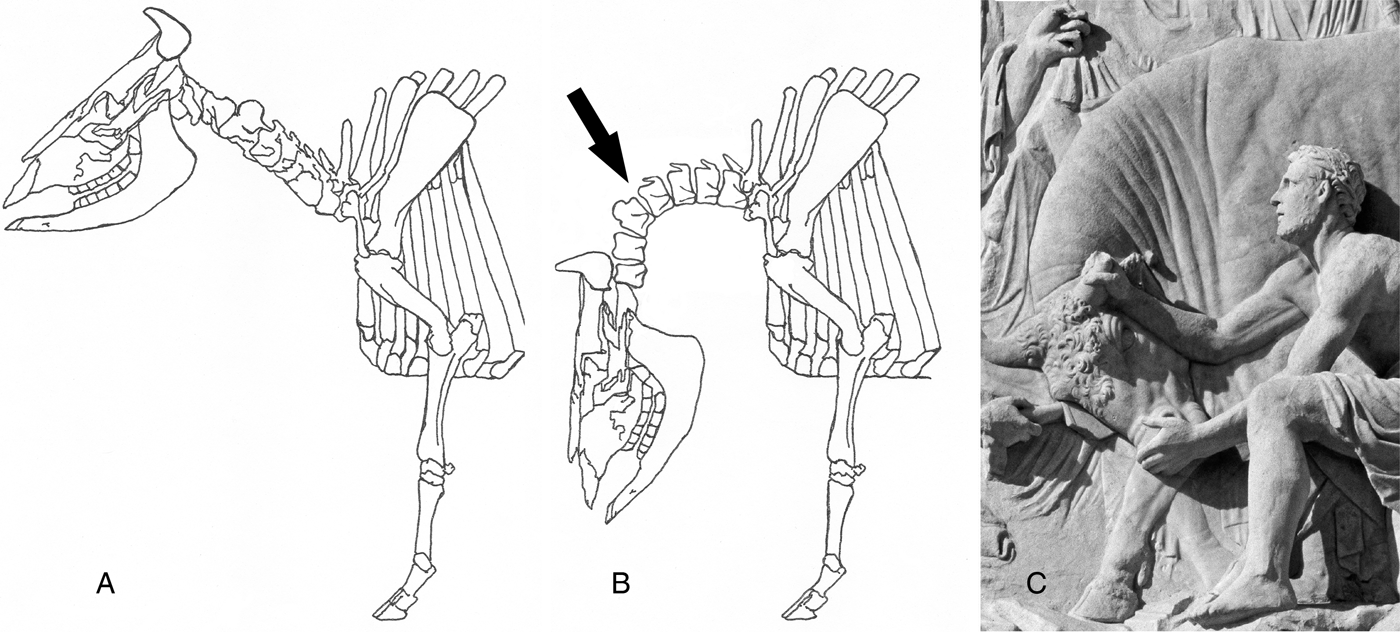
When a bovid has its head in an upright position, the vertebrae of its neck are closely pressed together (Fig. 4A). If it is hit in the neck with an axe, there is a good possibility that the axe blade might bounce off the bone and fail to sever the spinal column. When the animal's head is pulled sharply downward, however, it arches and stretches the neck, with the result that V-shaped gaps open up between each cervical vertebra, exposing the softer tissues of the spinal cord (Fig. 4B). With the neck in this posture, even if the axe blade did not immediately find one of these gaps, the angle of the blow would have caused it to slide easily along a vertebra until it slipped into the next gap. If one's purpose were to cut the spinal column, the posture depicted in art, where the victimarii are shown pulling down the heads and stretching out the necks of cows and bulls, is exactly the optimal one (Fig. 4C).
A: Bovine with head in upright position. B: Bovine with head tilted downward, opening up gaps in cervical vertebrae. C: Ara Pietatis relief showing bovine with head being pulled down into ideal position for severing the spine. (Drawings by Alicia Aldrete. Photo: The Art Archive at Art Resources, NY)
The use of axes in sacrifice to chop at the neck rather than to strike at the head is supported by both ancient iconographic and literary evidence. Out of the twenty-one scenes in art illustrating a popa with a raised weapon about to kill a sacrificial animal, it is possible to discern whether the implement is a hammer or an axe in ten.Footnote 38 Of these, eight show an axe, whereas only two feature a hammer. In all of these, the animal's neck is bent sharply downward and seems to be the point at which the popa is aiming rather than the top of its head. Thus, when animals are shown being sacrificed with the bent neck posture, the implement being used is overwhelmingly an axe (Fig. 5).
Relief from sarcophagus in Museo del Palazzo Ducale, Mantua, of sacrifice scene showing popa with upraised axe prior to striking at animal's neck. (Photo: Scala/Ministero per i Beni e le Attività culturali/Art Resource, NY)
When we turn to ancient literature, there is also a consistent theme of axes being directed at animals' necks, whereas mallets were aimed at the head. In Seneca's description of Clytemnestra preparing to slay Agamemnon, she aims her axe at his neck ‘just as the popa at the altar marks with his eyes the neck of the bull before he strikes’ (Sen., Ag. 897–901: ‘… qualisque ad aras colla taurorum popa designat oculis antequam ferro petat …’). This metaphor quite explicitly identifies the neck as the target of the popa's axe, rather than the top of the head. The fourth-century a.d. writer Quintus Smyrnaeus uses a similar metaphor when describing the death in battle of some Homeric heroes: ‘… together they fell down, as bullocks are felled by the mighty axe of the brawny slaughterer that slices through the sinews of the neck, cutting off life’ (Fall of Troy 1.262–4).Footnote 39 In the Aeneid, the cries and struggles of Laocoön are likened to ‘the bellowings of a wounded bull that has fled from the altar and shaken from its neck the ill-aimed axe’ (Virg., Aen. 2.222–4: ‘qualis mugitus, fugit cum saucius aram taurus et incertam excussit cervice securim’). All of these passages state that, when utilizing an axe, the intended strike zone was the animal's neck. Conversely, when Dionysius of Halicarnassus writes about a priest's assistants using a club on a sacrificial animal, he states that they employed it to strike the temple of the victim (R.Ant. 7.72.15).
Probably the most enlightening author in regards to matching tool to target zone, however, is Ovid. His Metamorphoses contains a number of instances of sacrificial scenes and imagery, and where details are given, almost all specify an axe chopping at the neck of a bovid. These include a sacrifice scene featuring ‘axes striking at the brawny necks of sacrificial bulls’ (7.427–9); a metaphor in which a character strives ‘as when one shatters a bull's white neck with an axe’ (12.247–50); and a pitiful description of an aged ox being slain ‘with the axe smiting its toil-weary neck’ (15.120–6). He consistently uses specific words for axe (securis) and neck (collum or cervix) in all of these passages.Footnote 40 There is a single instance when a sacrificial animal is struck on the head, and in that one case, the implement that is named is not an axe, but a hammer (malleus: 2.623–5). It is also notable, however, that this victim is identified as a thin-skulled suckling calf (lactentis vituli), whereas the animals hit with axes are bulls, oxen, or adult bovines (e.g., taurus, bos), which all would have had thicker crania. Ovid appears to have been fully aware that axes and hammers were best used on different types of bovids and against different parts of an animal's anatomy, and he accurately incorporates these key distinctions into his word choice.
Severing the spinal column followed by cutting the throat has, in certain times and places, been the preferred method in slaughterhouses. Usually this was accomplished by a technique known as the nape stab, pithing, or punctilla, in which a knife was inserted between the back of the cranium and the first cervical vertebra, transecting the spinal column.Footnote 41 Similarly, it was standard practice throughout the ancient world for war elephant mahouts to carry a knife or chisel which could be used to slay the animal by driving the implement between the cervical vertebrae in the event that the creature ran amuck in battle (Liv. 27.49.1; Amm. Mar. 25.1.15).Footnote 42
The advantages of the nape stab are that it could be more precisely aimed than a hammer or pole axe blow and that it produced immediate paralysis. Thus, it offered a surer way of rendering large or dangerous animals immobile. Not surprisingly, this method was favoured by butchers ‘as a way of dealing with bulls and dangerous cattle’.Footnote 43 These characteristics would have made severing the spinal cord an attractive option for ancient Roman victimarii, especially when dealing with very loosely restrained bulls.Footnote 44
In using an axe for this purpose, the Romans were following a precedent set by the Greeks in their own religious rituals. For example, in an oft-cited passage in the Odyssey, Nestor and his sons sacrifice a cow, and Homer depicts one of Nestor's sons striking the neck of the cow with an axe, after which the animal's throat is cut and it is bled to death. The axe is specifically described as making a deep cut to the neck, severing vital connective tissue and no doubt cutting the spine and inflicting a fatal injury (Hom., Od. 3.442–56). In the famous Buphonia ritual in Athens, the ox was killed with an axe, and this weapon (or alternatively, in some accounts, the sacrificial knife) was put on trial for the ‘murder’ of the animal (Paus. 1.24.4; Porph., De Abs. 2.10). In Greek art, the two vase paintings that explicitly illustrate a person killing a sacrificial bovid show the slayer holding a large, double-bladed axe poised above his head, ready to bring it down upon the animal's neck. In both cases, the bovid has its head bent sharply down toward the ground in a pose reminiscent of that in the Roman reliefs.Footnote 45
With their lighter cranial structures, smaller animals such as pigs and calves could indeed have been effectively stunned by being struck on the head with a hammer. However, when larger beasts were involved, the iconographic evidence, literary texts, comparative historical accounts, and bovine physiology all combine to create a consistent picture which contradicts the traditional interpretation that axes were used to stun the animal by hitting it on the head. Instead, the very same evidence indicates that axe blows were directed at the nape of the neck in order to cut its spine.Footnote 46 While the explicitness of ancient sources and art identifying the neck as the axe's target may make this conclusion seem obvious, this distinction has not yet been widely recognized. Hacking at the neck of a bull with a heavy axe in order to sever its spinal cord may seem a brutal process, but some sort of immobilization procedure was needed, and this one admirably served the specific requirements of Roman sacrificial ritual.
V BLOOD
One potential objection to this interpretation could be that it might change the time and cause of death, from being bled after the slitting of the throat to the instant when the axe severs the spinal column. The usual reason given for why the animal must be stunned and rendered unconscious but not immediately killed is so that it will bleed when its throat is cut. This argument rests on the assumption that the only way to bleed an animal to death without protest is by knocking it unconscious without inflicting any other fatal injury. In fact, even after the spinal column has been completely severed, the autonomous electrical impulses of the heart enable it to continue beating for a considerable amount of time, potentially up to three or four minutes. Therefore, the axe could be used to cut the spinal column, instantaneously rendering the animal limp with absolutely no chance that it might struggle or regain consciousness, but it could still be exsanguinated quite satisfactorily.
Both literary descriptions and iconographic depictions of sacrifices indicate that the animal's throat was slashed immediately after the popa struck his blow. Just as with the site of the stunning blow, scholars have been vague about the exact location and purpose of this cut, with a few specifying that the carotid arteries were severed, others naming the jugular veins, and most merely saying that the throat was cut. The position of the cultrarius suggests that he most likely made a diagonal slash across the underside of the animal's throat, which would have severed both the carotid arteries and the jugular veins.
These major vessels connect directly to the heart via, respectively, the aorta and the superior vena cava, and would produce copious and dramatic bleeding. These vessels are so large, in fact, that the actual reason that most animals' hearts would stop beating would not be due to the severing of the spinal column, but rather because the animal would lose such a large volume of blood so rapidly that its heart would literally run out of blood to pump. During this process, probably about 3.5 litres — 50 per cent of the animal's total volume of blood — would be drained in under a minute, with the animal losing consciousness in 20–30 seconds. In a Roman sacrifice, the animal appears to have simply been allowed to collapse onto the ground, where it bled out. In slaughterhouses, the animals are usually suspended in the air by their rear legs during the bleeding stage so as to maximize the amount of blood that is drained from the carcass. While this method would extract somewhat more blood, the Roman procedure would still have resulted in the majority of the animal's blood being pumped out through the slash in the throat.
The throat-cutting action of the cultrarius was likely quite similar to the technique known as ‘sticking’, which has been used for centuries by those killing bovines for food and is still utilized in slaughterhouses today.Footnote 47 In this process, a sharp knife is employed to make an incision in the neck or chest of the animal and to sever the carotid and jugular vessels. It is also akin to the method used by Jews in shechita (kosher) slaughter of animals for food.Footnote 48 In the Jewish tradition, however, the animals cannot be stunned, but instead have their throats slashed and then bleed to death.Footnote 49 In schechita slaughter, a typical time to collapse for cattle is 20 seconds, although one study found that 8 per cent took more than 60 seconds to collapse, and 14 per cent fell and then stood up again before terminally collapsing.Footnote 50 A study of cattle brain function during shechita slaughter showed loss of brain functions varying between 20 seconds and about two minutes, with an average time of around 75 seconds.Footnote 51
It is worth noting that the time until unconsciousness measured in cattle after sticking is notably longer than it is in pigs or sheep because in cows the vertebral artery continues to supply some blood to the brain, prolonging consciousness, even if the other vessels have been severed.Footnote 52 This is another reason why bovids would have been more problematic to deal with in ancient sacrificial rituals than other animals. Comparisons of shechita slaughter with that of cattle shot with a captive bolt stunner before bleeding demonstrate that it is still possible to exsanguinate an animal thoroughly even after its brain has effectively been destroyed. Thus, in a Roman sacrifice, a satisfactory volume of blood could have been obtained even after the victim had been felled by a hammer or an axe.
In both ancient sacrifice and later slaughterhouses, the animals were, in essence, receiving two fatal injuries in quick succession. The stunning blow, whether delivered to the head or the neck, would have inflicted sufficient damage to eventually kill the animal, but this was rapidly followed by the cutting of the vessels in the neck, resulting in such massive loss of blood that the creature would technically expire from its heart stopping before its other injuries could produce its death by asphyxiation, brain trauma, blood loss, or other causes.
In ancient art, there are numerous depictions of the distinctive triangular knife used in this procedure, and several reliefs show the cultrarius kneeling beside the animal just before it is stunned, presumably ready to perform the throat-cutting.Footnote 53 A particularly fine example is the sacrifice scene on the Triumph of Tiberius Boscoreale Cup, in which one victimarius stands with axe raised to strike, while another kneels beside the animal's head, pulling it toward the groundFootnote 54 (see Fig. 1). A third man crouches beside the bovine, holding the triangular knife poised to be driven into the animal's throat. Also informative is a relief from the Arch of Septimius Severus at Lepcis Magna, featuring a bovine sacrifice scene that seems to conflate three separate stages of the killing into one image.Footnote 55 A popa holds a hammer over his head in the usual posture, but the animal is represented as if the blow has already been struck, collapsed and with its front legs folded onto the ground. Most interestingly, the kneeling cultrarius appears to have his knife plunged to the hilt into the creature's throat. This would constitute a unique depiction of the moment when the throat is slashed and the animal is bled out.
The issue of bleeding and the messiness of sacrifices raises a host of other practical questions. Severing the carotids and jugulars would produce copious spurts of blood, which could jet out a distance of over a metre. Therefore, Lucretius' description of altars drenched in blood can probably be taken quite literally (Lucr. 5.1200–2). In many iconographic images of sacrifice, the group consisting of the bovid and its accompanying victimarii is visually separated from the chief priest (often the emperor) and his attendants. Considering the messiness of sacrifices, with blood and other matter being sprayed and splattered about, this segregation may not be solely due to aesthetic considerations on the part of the artist or the desire to differentiate high and low status individuals, but instead may well reflect the practical concern of the priest and his companions to avoid soiling their togas. A need for easy clean-up and some protection from blood-spray may also explain why the victimarii are typically portrayed bare-chested, wearing just an apron-like garment, much like a butcher's or cook's apron, wrapped around their waists.Footnote 56
If each animal in an ancient sacrifice was spewing several litres of blood, what does this imply for how we envision an event such as Caligula's accession, when 160,000 cattle were supposedly slaughtered in less than three months (Suet., Cal. 14.1)? Slaughterhouses usually have graded floors and drains to carry away the blood, but ancient sacrifices were often performed near altars without obvious drainage facilities. Of course, the viscera and the butchered carcasses of these animals all had to be disposed of as well.
VI CONCLUSION
The ideology of Roman blood sacrifice demanded that the animals whose slaughter lay at its core were expected, at least superficially, to appear compliant and accepting of their deaths. This requirement created a formidable set of practical problems for those charged with actually carrying out their slaughter. Chief among these was the necessity of rendering a large, potentially dangerous, and only lightly restrained animal instantly insensible and immobile, and maintaining it in that condition while its throat was cut and it was bled to death. The solution was to stun it with a heavy weapon.
This article has argued that there were two distinct tools and methods that were employed to accomplish the essential task of stunning. Hammers were best suited for stunning medium-sized animals such as pigs, calves, and some cattle, and, when using a hammer, the popa struck the animal on the top of the head, crushing its skull and causing severe haemorrhaging in the brain. For the largest animals, such as bulls, oxen, or large cattle, whose heavier skull structure and potential dangerousness called for an alternative process, the preferred implement was an axe, which was directed at the neck in order to sever the spinal cord. These two techniques are consistent with the descriptions found in ancient literary sources, the tools and postures depicted in Roman art, comparative data from slaughterhouses over a wide span of time, and the unique features of bovine physiology. Both methods would have immobilized the creatures but left their hearts still beating, so that the cultrarius could have slashed the carotid arteries and jugular veins and caused the beasts' deaths via exsanguination.
Given the broad geographic and temporal range over which Roman sacrifice was performed, there were undoubtedly many variations in sacrificial practices. Also, various gods, cults, and rituals may well have dictated certain procedures or tools in particular situations. Nevertheless, the preponderance of evidence suggests that it is possible to draw some general conclusions regarding the specifics of how these animals were stunned and killed. While there might be a natural reluctance to deal with the brutal realities of animal sacrifice, it is only by doing so that we can gain a fuller understanding of ancient Roman religious ritual.