Introduction
During the last decade, the popularity of extended embryo culture up to day 5 has increased in in vitro fertilization (IVF) practice (Wilson et al., Reference Wilson, Hartke, Kiehl, Rodgers, Brabec and Lyles2004). Advocates of blastocyst culture believe that only the most viable embryos will survive the extended culture until day 5/6, which results in a higher probability of implantation (Ashkenazi et al., Reference Ashkenazi, Yoeli, Orvieto, Shalev, Ben-Rafael and Bar-Hava2000). This theory also leans on the fact that, at the day 2/3 stage, it is difficult to predict accurately which embryo will be capable of further development (Nyboe Andersen et al., Reference Nyboe Andersen, Gianaroli and Nygren2004). This shift in IVF practice was also motivated by a better correlation between blastocyst morphology and euploidy, a better synchronization between the embryo and the endometrium (Goto et al., Reference Goto, Shiotani, Kitagawa, Kadowaki and Noda2005; Papanikolaou et al., Reference Papanikolaou, Camus, Kolibianakis, Van Landuyt, Van Steirteghem and Devroey2006) and a lower contractility of the uterus at that time (Fanchin et al., Reference Fanchin, Ayoubi, Righini, Olivennes, Schonauer and Frydman2001).
Nevertheless, a day 5/6 embryo transfer (ET) strategy has not been convincing because of certain drawbacks such as the risk of cycle cancellation when no embryos develop into blastocysts in vitro, the decreased number of frozen embryos and their poor survival after thawing, which is a side effect of the slow freezing procedure (Guerif et al., Reference Guerif, Lemseffer, Bidault, Gasnier, Saussereau, Cadoret, Jamet and Royere2009).
In fact, a recent meta-analysis confirmed that higher clinical pregnancy and live birth rates were associated with day 5/6 ET when compared with day 2/3 ET. These results were obtained at the price of higher cancellation and lower cryopreservation rates when equal numbers of embryos were transferred in each group (Papanikolaou et al., Reference Papanikolaou, Kolibianakis, Tournaye, Venetis, Fatemi, Tarlatzis and Devroey2008).
In order to get the advantages of day 5/6 ET without losing those of day 2/3 ET, some authors have proposed to associate a cleavage stage (day 2/3) to a blastocyst stage (day 5/6) embryo transfer in a two-step ‘sequential’ procedure (Ashkenazi et al., Reference Ashkenazi, Yoeli, Orvieto, Shalev, Ben-Rafael and Bar-Hava2000; Phillips et al., Reference Phillips, Dean, Buckett and Tan2003; Goto et al., Reference Goto, Shiotani, Kitagawa, Kadowaki and Noda2005). The present study aims to evaluate, in an unselected IVF population, the efficiency of this practice and its impact on multiple gestation rates.
Materials and methods
In this observational comparative study, we reviewed the medical records of 1517 women who had IVF/intracytoplasmic sperm injection (ICSI) cycles with extended embryo culture between January 2005 and December 2006, in two assisted reproductive technology (ART) units (Bichat Claude Bernard University Hospital and Eylau – La Muette Private Clinic, Paris, France).
Four hundred patients met the inclusion criteria: female age below 42 years and at least three good quality embryos on day 2, with extended embryo culture. Cases of elective single ET were excluded. The studied population was divided into two main groups in accordance with the ET strategy adopted:
Group 1 included 120 patients who underwent a two-step (consecutive) procedure in which a cleavage stage (day 2/3) ET was followed by a second transfer of a blastocyst on day 5/6.
Group 2 included 280 patients who underwent a traditional cleavage-stage ET (day 2/3). This group was further separated into two subgroups according to the results of the extended embryo culture:
• subgroup 2a included 90 cycles in which the cryopreservation of day 5/6 blastocysts was chosen;
• subgroup 2b included 190 cycles in which no good quality blastocyst was obtained for cryopreservation on day 5/6.
Patients were prepared for IVF as previously described (Yazbeck et al., Reference Yazbeck, Madelenat, Ayel, Jacquesson, Bontoux, Solal and Hazout2009). Stimulation protocols were similar throughout the study period. Recombinant human chorionic gonadotrophin (hCG) was administrated when at least three follicles were over 17 mm.
Transvaginal ultrasound guided oocyte retrieval was carried out 36 h after hCG administration. Oocytes were fertilized conventionally or by ICSI in severe male factor cases. Microinjections were performed on a micromanipulator ‘Integra’ (Research Instruments, Cornwall, United Kingdom) or ‘Leica’ (Leica microsystems AM 6000,Wetzlar, Germany).
Embryos were cultured in ISM1™ medium (Origio, Limonest, France) for 2 or 3 days. Embryos that were not transferred into the uterine cavity were placed in ISM2™ medium (Origio, Limonest, France) on day 3, up to day 5 or 6.
Embryos selected for transfer or extended culture were chosen on their pronuclear morphology on day 1, the existence of an early pronuclear breakdown and the embryo quality on day 2 or 3. All embryos were scored on day 2/3 according to the number and size of their blastomeres and the rate of fragmentation (Tesarik & Greco Reference Tesarik and Greco1999; Salumets et al., Reference Salumets, Hyden-Granskog, Makinen, Suikkari, Tiitinen and Tuuri2003; Fancsovits et al., Reference Fancsovits, Toth, Takacs, Murber, Papp and Urbancsek2005; Noci et al., Reference Noci, Fuzzi, Rizzo, Melchiorri, Criscuoli, Dabizzi, Biagiotti, Pellegrini, Menicucci and Baricordi2005). Blastocysts were graded according to Gardner et al. (Reference Gardner2000). Supernumerary good quality blastocysts were cryopreserved using the Blast Freeze medium (Origio, Limonest, France).
All transfers were carried out under ultrasound guidance, using a soft catheter (Elliocath®, Prince Médical, Ercuis, France). For day 2/3 ET, the tip of the inner catheter was placed 1.0 cm from the fundus where the embryos were pushed into the uterine cavity. For day 5/6 ET, the inner catheter was placed 1.5 to 2.0 cm away from the fundus, in order not to interfere with the previous transfer, and the blastocyst was subsequently injected into the uterine cavity.
Luteal support was started following oocyte retrieval using vaginal progesterone (Utrogestan®, Laboratory Besins, Montrouge, France).
Live birth rate was the primary outcome measure. Implantation, clinical pregnancy, and multiple gestation rates were also assessed. Implantation rate was defined as the number of fetal sacs divided by the number of embryos transferred. Clinical pregnancy was confirmed by ultrasonography, 6 weeks after ET.
Statistical analysis was performed using the SAS software v9.1.3 (by the SAS Institute, Cary, NC, USA). Data were assessed for normality using the Shapiro–Wilk W test. Continuous variables were reported by means and standard deviation and subgroups of patients were compared by analysis of variance (ANOVA) procedure with the Tukey studentized method. Univariate comparisons of categorical data were performed with the chi-squared and Fisher's exact tests as appropriate. All reported p-values were two-sided, and a p-value of less than 0.05 was considered to indicate statistical significance.
Adjusted odds ratios for live births were obtained by means of multivariable logistic-regression analysis with a stepwise procedure. The independent variables tested were ET strategy, patient's age, number of previous IVF failures, basal follicle-stimulating hormone (FSH) and anti-Müllerian hormone (AMH) levels, stimulation protocol, number of oocytes retrieved, fertilization techniques, number of normal embryos obtained on day 2, number of total embryos replaced, number of high grade embryos replaced on day 2/3 and ART centre. Explanatory variables were carefully selected in order to eliminate multicollinearity. Interactions between ET strategy and other variables were assessed.
This study was approved by the institutional review board of Northern Paris Hospitals (IRB number 09-028).
Results
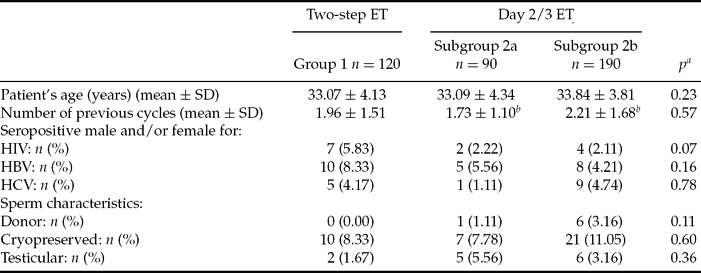
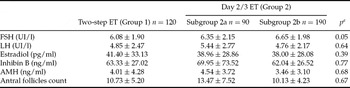
Female's age ranged between 22 and 42 years old. Mean age and infertility factors were comparable between groups. The gonadotropin-releasing hormone (GnRH) agonist long protocol was used in 69.5% of cases, whereas the antagonist multidose regimen in 26.2% and the short flare-up protocol in 4.3% of cases. Protocol types were similarly distributed between groups. Cycle day 3 ovarian reserve evaluation and sperm parameters were also comparable between groups. Laser hatching was performed in 29 (7.3%) cases uniformly distributed between groups (Tables 1 and 2).
Baseline characteristics of the population according to embryo transfer (ET) strategy
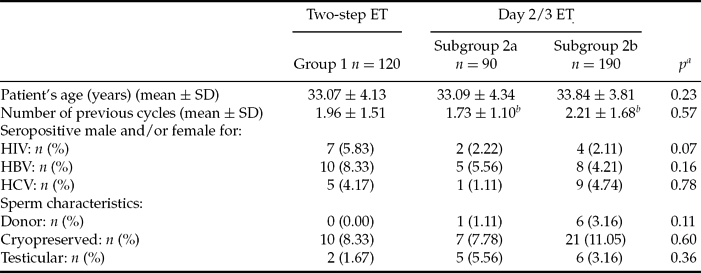
a p-values were calculated between groups 1 and 2 (analysis of variance (ANOVA) and Student's t-test).
b Significant level p < 0.05 between subgroups (Student's t-test).
HBV, hepatitis B virus; HCV, hepatitis C virus; HIV, human immunodeficiency virus; SD, standard deviation.
Ovarian reserve evaluation on cycle day 3 according to transfer strategy

a p-values were calculated between groups 1 and 2 (analysis of variance (ANOVA) and Student's t-test).
b Significant level p < 0.05 between subgroups (Student's t-test).
AMH, anti-Müllerian hormone; ET, embryo transfer; FSH, follicle-stimulating hormone; LH, luteinising hormone.
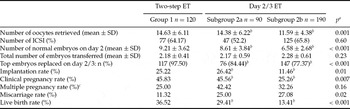
Patients who underwent a two-step ET had more oocytes retrieved (14.6 ± 6.1 versus 12.5 ± 5.2; p = 0.001), more embryos obtained on day 2 (9.2 ± 3.6 versus 7.2 ± 3.2; p < 10−4), and more top embryos available for transfer on day 2/3 (97.5% versus 79.6%; p < 10−4) than those who underwent a traditional day 2/3 ET. A subgroup analysis showed that these differences were observed mainly with patients who had a day 2/3 ET but no good quality blastocysts obtained on day 5/6 (subgroup 2b). However, the total number of embryos transferred was comparable between groups (Table 3).
Controlled ovarian hyperstimulation results in the two studied groups

a p-values were calculated between groups 1 and 2 (analysis of variance (ANOVA) and Student's t-test).
b Significant level p < 0.05 between subgroups (Student's t-test).
c Two triplet pregnancies reduced to twin, and all the remaining cases were twin pregnancies.
ET, embryo transfer; SD, standard deviation.
We observed a higher implantation rate (25.2% versus 16.3%; p = 0.01), clinical pregnancy rate (45.8% versus 31.8%; p = 0.007) and live birth rate (36.5% versus 18.6%; p < 0.001) in group 1 than in group 2. A subgroup analysis of day 2/3 ET patients showed that when no good quality blastocysts were obtained on day 5/6 (subgroup 2b), implantation and clinical pregnancy rates were lower than those of patients in group 1 and subgroup 2a. But miscarriage rate was lower (11.3% versus 25.0% and 27.1%) and live birth rate was higher (36.5% versus 29.4% and 13.4%) in group 1 than in subgroups 2a and 2b, respectively.
There was no difference between groups in the incidence of multiple gestations (two triplet pregnancies reduced to twin; and all other multiple pregnancies were twin pregnancies).
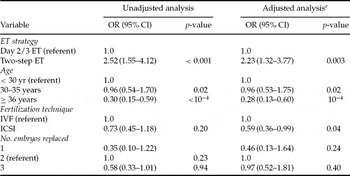
Adjustment for a range of characteristics and potential prognostic factors (ART recruiting centre, number of previous IVF failures, patient's age, basal FSH and anti-Müllerian hormone levels, fertilization technique, laser hatching, number of day 2 embryos issued from 2PN zygotes and number of embryos transferred) slightly attenuated but did not eliminate the significant relationship between the two-step ET strategy and live birth rate (Table 4). The output of the logistic-regression model expressed as the adjusted odds ratio of live births was estimated at 2.23; 95% confidence interval (CI): 1.32 to 3.77.
Unadjusted and adjusted odds ratios for live birth according to overall outcome characteristics

Number of observations used: 379; convergence criterion satisfied, LR < 10−4; R2 = 13.3%.
a These odds ratios (OR) and 95% confidence intervals (CI) were adjusted for patient's age, basal anti-Müllerian hormone (AMH), previous in vitro fertilization (IVF) failures, centre recruitment, fertilization technique and hatching, number of normal embryos obtained on day 2, and number of all and high grade embryos replaced.
ET, embryo transfer; ICSI, intracytoplasmic sperm injection.
Discussion
This study shows that, in an unselected IVF population, the two-step ET strategy is associated with higher implantation and clinical pregnancy rates and shows for the first time that this strategy is also associated with less miscarriages and higher live birth rates compared with the cleavage-stage ET. The likelihood of live birth is more than doubled when the consecutive ET strategy is adopted and this relationship persisted after adjustment for several prognostic factors. In addition, this study is the first to compare live birth rates after two-step or conventional ET strategies. There was no strong evidence of interaction between the ET approach and maternal age, fertilization technique or number of embryos replaced.
While previous studies on sequential embryo transfer did not find any differences in implantation or clinical pregnancy rates between two-step ET and conventional day 2/3 ET (Al-Hasani et al., Reference Al-Hasani, Van der Ven, Diedrich, Reinecke, Hartje and Krebs1990; Ashkenazi et al., Reference Ashkenazi, Yoeli, Orvieto, Shalev, Ben-Rafael and Bar-Hava2000), some recent studies have shown that this strategy seems to provide higher implantation and clinical pregnancy rates in low responders, after multiple IVF failures and in patients older than 37 years. It also avoids ET cancellation when no good quality blastocysts are available after extended culture and, by ‘rescuing’ cycles of patients whose embryos fail to reach the blastocyst stage in culture, can improve the overall pregnancy rate (Goto et al., Reference Goto, Takebayashi, Shiotani, Fujiwara, Hirose and Noda2003, Reference Goto, Shiotani, Kitagawa, Kadowaki and Noda2005; Phillips et al., Reference Phillips, Dean, Buckett and Tan2003; Machtinger et al., Reference Machtinger, Dor, Margolin, Levron, Baum, Ferber, Shulman, Bider and Seidman2006).
Our findings are consistent with these latest reports and can be partially explained by the advantages of blastocyst stage over cleavage-stage ET on implantation and birth rates (Gardner et al., Reference Gardner, Schoolcraft, Wagley, Schlenker, Stevens and Hesla1998; Blake et al., Reference Blake, Proctor and Johnson2004; Papanikolaou et al., Reference Papanikolaou, Camus, Kolibianakis, Van Landuyt, Van Steirteghem and Devroey2006). Moreover, the fact that implantation and pregnancy rates in the case of conventional ET with cryopreservation of blastocysts on day 5/6 were similar to those of the two-step ET suggests that the ability to obtain blastocysts in vitro may be a determinant prognostic factor of pregnancy and probably reflects the quality of the total embryo cohort. However, miscarriage rate was not reduced significantly in this situation, highlighting the fact that blastocyst transfer is associated with higher live birth rates than cleavage-stage transfer (Papanikolaou et al., Reference Papanikolaou, Kolibianakis, Tournaye, Venetis, Fatemi, Tarlatzis and Devroey2008). Another advantage of the two-step ET strategy is that the risk of ET cancellation is at least equivalent to that observed in a conventional day 2/3 ET strategy and is expected to be lower than the risk of cancellation in the case of an elective blastocyst-stage ET, which usually ranges from 2 to 43.3% (Gardner et al., Reference Gardner, Schoolcraft, Wagley, Schlenker, Stevens and Hesla1998; Scholtes & Zeilmaker Reference Scholtes and Zeilmaker1998; Alper et al., Reference Alper, Brinsden, Fischer and Wikland2001; Goto et al., Reference Goto, Shiotani, Kitagawa, Kadowaki and Noda2005). The blastocyst formation rate reported in the literature varies from 0 to 93%, depending on the population selected (Tomazevic et al., Reference Tomazevic, Korosec, Virant Klun, Drobnic and Verdenik2007; Frattarelli et al., Reference Frattarelli, Miller, Miller, Elkind-Hirsch and Scott2008), the number of cells of day 3 embryos and their fragmentation rate (Levron et al., Reference Levron, Shulman, Bider, Seidman, Levin and Dor2002; Weissman et al., Reference Weissman, Biran, Nahum, Glezerman and Levran2008) or the number of 8-cell embryos on day 3 (Racowsky et al., Reference Racowsky, Jackson, Cekleniak, Fox, Hornstein and Ginsburg2000).
In this study, less than half of the patients (42%) had no good quality blastocysts (which is different from not having any blastocyst) on day 5/6 but had a transfer on day 2/3 and 25.3% of them experienced a clinical pregnancy which finally improved the overall live birth rate.
Some authors concluded that sequential ETs increase multiple pregnancy rates (Goto et al., Reference Goto, Shiotani, Kitagawa, Kadowaki and Noda2005; Machtinger et al., Reference Machtinger, Dor, Margolin, Levron, Baum, Ferber, Shulman, Bider and Seidman2006). Our dissimilar results can be probably explained by the different populations studied and transfer policies: women included in previous studies were younger (mean age: 30.7 years) and had more embryos transferred (mean number ≥3), a finding that explains the high multiple pregnancy rates observed (50%). The limited value of morphological assessment on day 1, 2 or 3 to predict blastocyst development potential can also explain why a two-step ET strategy in this study was not responsible for more multiple pregnancies (Graham et al., Reference Graham, Han, Porter, Levy, Stillman and Tucker2000; Guerif et al., Reference Guerif, Le Gouge, Giraudeau, Poindron, Bidault, Gasnier and Royere2007). While early pronuclear breakdown and early cleavage may be used additionally to select embryos for transfer (Salumets et al., Reference Salumets, Hyden-Granskog, Makinen, Suikkari, Tiitinen and Tuuri2003; Fancsovits et al., Reference Fancsovits, Toth, Takacs, Murber, Papp and Urbancsek2005), reliable criteria to identify embryos destined to develop to viable blastocysts in vitro have not been established. In trials with good prognosis patients, the transfer of blastocysts has been shown to yield higher live birth rates than those achieved with transfer of equal numbers of early cleavage-stage embryos (Papanikolaou et al., Reference Papanikolaou, Kolibianakis, Tournaye, Venetis, Fatemi, Tarlatzis and Devroey2008). Consequently, transfer of multiple blastocysts can result in a high multiple pregnancy rate (ASRM 2006). In our practice, an effort was made to add only a single blastocyst transfer on day 5/6. This might have also contributed to the limited multiple pregnancy rate observed in the two-step ET group.
The success of the sequential transfer strategy suggests that the second transfer had no deleterious effects. In fact, this situation may be compared with a difficult ET requiring multiple sequential attempts. In such cases, it has been already shown that pregnancy rates and IVF outcome did not seem to be adversely affected (Tur-Kaspa et al., Reference Tur-Kaspa, Yuval, Bider, Levron, Shulman and Dor1998). In addition, some studies have shown that there is an embryo-maternal dialogue and that the presence of an embryo in the fallopian tube or in the uterus is able to induce biological changes which may increase endometrial receptivity to embryos and improve the implantation rate (Carlone et al., Reference Carlone, Rider, Gardner and Lane1993; Emiliani et al., Reference Emiliani, Delbaere, Devreker and Englert2005; Goto et al., Reference Goto, Shiotani, Kitagawa, Kadowaki and Noda2005). This finding highlights the hypothesis that the first embryo transferred could improve the receptivity of the endometrium to the blastocyst secondarily transferred.
The retrospective nature of this study carries some limitations, the most obvious being the dependence upon the data present in the medical records. However, we still obtained significant results after adjustment for main confounding factors. The two-step strategy was adopted as a pure centre policy given probable advantages of this procedure after the selection has been made for an extended culture. As our study population was selected after the decision of extended culture, potential selection bias is somehow limited. Moreover, higher pregnancy rates were reported with the two-step strategy even in patients with inadequate ovarian response and only two embryos available on day 2 (Goto et al., Reference Goto, Shiotani, Kitagawa, Kadowaki and Noda2005). This observation shows that the consecutive ET has its own efficacy, which is probably independent from ovarian response and the number of embryos obtained.
In conclusion, the two-step ET strategy has the advantages of a blastocyst-stage ET, thus providing higher implantation, clinical pregnancy and live birth rates. It prevents the loss of the total cycle when embryos fail to develop into blastocysts and thereby, offers an additional chance of pregnancy per cycle. Moreover, it does not increase the risk of multiple pregnancies if the number of embryos transferred is limited. In good prognosis patients, it can help to restrict the number of embryos transferred. With recent guidelines on number of embryos transferred, this second line strategy can be proposed to a relatively large IVF population.