Introduction
Cambrian Series 2 faunas of Laurentia are commonly dominated by olenelline trilobites, with other types of trilobites making up only a small portion of the assemblages. This is especially true in shale deposits (e.g., Hollingsworth, Reference Hollingsworth2005; McCollum and McCollum, Reference McCollum and McCollum2011; Webster, Reference Webster2011a, Reference Websterb, Reference Websterc, Reference Websterd; Webster et al., Reference Webster, McCollum and Sundberg2011), but less so in carbonates in which pagetiids, ptychoparioids and corynexochines can be locally abundant (e.g., Fritz, Reference Fritz1972; Hopkins and Webster, Reference Hopkins and Webster2009; Geyer and Peel, Reference Geyer and Peel2011; Webster, Reference Webster2011a, Reference Webstere). Whereas the endemic olenelline trilobites have become the major focus for biostratigraphic correlation of Series 2 strata in Laurentia, corynexochines—especially the oryctocephalids—have the potential to allow international correlations (e.g., Sundberg and McCollum, Reference Sundberg and McCollum1997; Sundberg et al., Reference Sundberg, Yuan, McCollum and Zhao1999, Reference Sundberg, Geyer, Kruse, McCollum, Pegel’, Żylińska and Zhuravlev2016; Fletcher, Reference Fletcher2001, Reference Fletcher2003, Reference Fletcher2007; Zhao et al., Reference Zhao, Yuan, McCollum, Sundberg, Yang, Guo, Zhu and Yang2001; Geyer and Peel, Reference Geyer and Peel2011; Lin et al., Reference Lin, Sundberg, Jiang, Montañez and Wotte2019; Peng et al., Reference Peng, Babcock, Ahlberg, Gradstein, Ogg, Schmitz and Ogg2020).
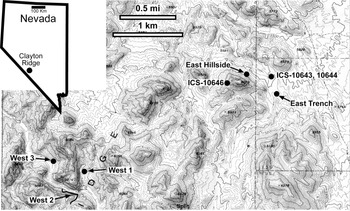
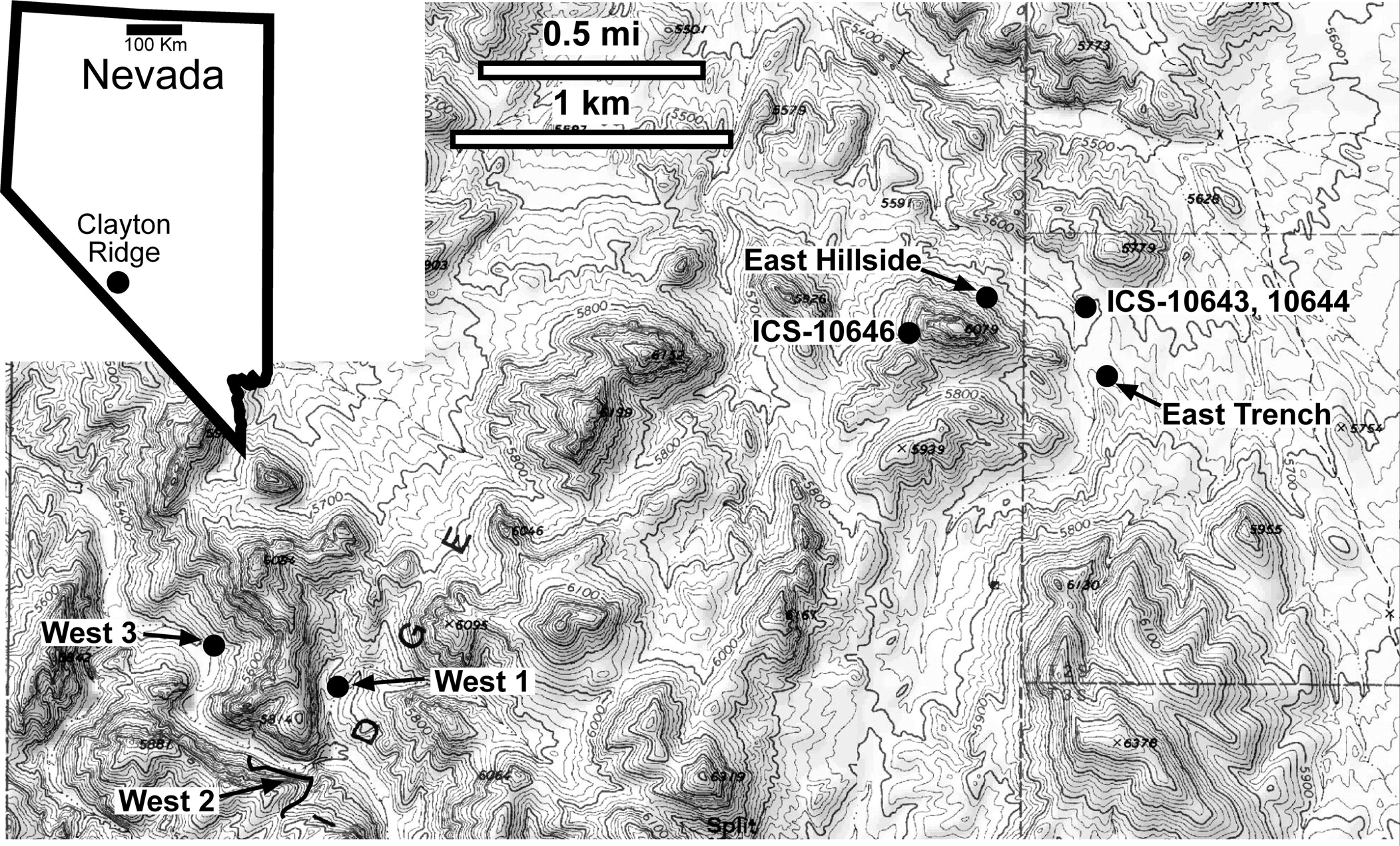
Described herein (corynexochines) and in a subsequent manuscript (ptychoparioids) are several non-olenelline trilobite taxa found in the upper Harkless to basal Emigrant formations, Clayton Ridge, Nevada (Figs. 1, 2), of the Dyeran Stage of Laurentia (Cambrian Series 2, Stage 4). The presence of oryctocephalids in the upper Harkless Formation assists in correlating the upper six olenelloid trilobite zones of the Dyeran to Greenland, the Siberian Platform, and South China, which will be the focus in a third paper.
Location map for trilobites from the Harkless Formation, Mule Spring Limestone, and basal Emigrant Formation in Clayton Ridge, in Nevada (part of the Split Mountain 7.5´ topographic quadrangle map, U.S. Geological Survey, 1991, 1:24,000 scale).
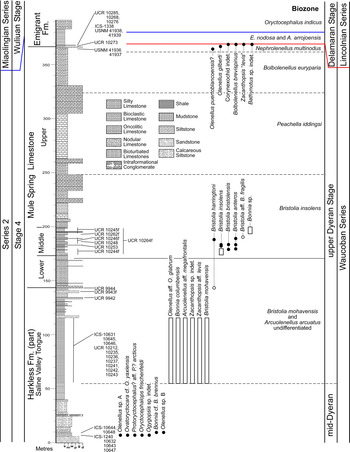
Composite stratigraphic section of the Saline Valley Tongue, Harkless Formation; Mule Spring Limestone; and lowermost Emigrant Formation, Clayton Ridge, Nevada. Section based on Sundberg and McCollum (Reference Sundberg and McCollum2003), Webster (Reference Webster2011b, Reference Webster2011d), Sundberg, (Reference Sundberg2018), and Mike and Linda McCollum (personal communication, 2020). Localities are superimposed upon the composite section from different areas in the region around Split Mountain (see Fig. 1). Open boxes indicate specific stratigraphic position is unknown; open circles indicate questionable species identification; “f” after collection number indicates material was float; vertical bars for these localities indicate most likely interval of stratigraphic occurrence of the material. Information of some taxa from the Mule Spring Limestone and the lowermost Emigrant Formation are derived from Webster (Reference Webster2011b, d) and Sundberg and McCollum (Reference Sundberg and McCollum2003). Blue line indicates the base of the global Miaolingian Series; red line indicates base of the Laurentian Lincolnian Series.

Geologic background
Clayton Ridge is a relatively small northeast-southwest trending fault block west of the Montezuma Range, near the town of Goldfield in southwestern Nevada. In the northern part of the ridge, in and around the Split Mountain area, exposures include strata that range in age from the pretrilobitic Cambrian (upper Deep Springs Formation; Albers and Stewart, Reference Albers and Stewart1972) to the uppermost Cambrian (upper Emigrant Formation; Sunwaptan to probably Skullrockian stages; see Sundberg et al., Reference Sundberg, McCollum and McCollum2011). The northernmost and southern portion of the ridge is dominated by Oligocene to Miocene volcanic tuffs (Albers and Stewart, Reference Albers and Stewart1972). This paper focuses on the biostratigraphy and corynexochines from the mid to upper Dyeran succession, comprising the uppermost Harkless Formation, Mule Spring Limestone, and lowermost Emigrant Formation in the Split Mountain area. The ptychoparioids from the same interval will be discussed in a subsequent paper.
Fossil localities reported herein are found in the “Split Mountain West” and the “Split Mountain East” areas (Fig. 1; same locations as Cordie et al., Reference Cordie, Dornbos and Marenco2020, “West Valley” and East Hill”). The Split Mountain West area consists of localities West 1 to West 3 and the East area consists of the East Hillside, East Trench, and three isolated localities (see Appendix 1).
Previous work
Work on the geology and paleontology of Clayton Ridge has been mostly limited to the Harkless Formation, Mule Spring Limestone, and Emigrant Formation. Albers and Stewart (Reference Albers and Stewart1972) undertook the regional mapping and geology of Esmeralda County, including Clayton Ridge. Their report included some faunal lists from the Cambrian to Mississippian formations in the county, but reported no fossils from Clayton Ridge.
Sundberg and McCollum (Reference Sundberg and McCollum2003) reported the first Cambrian trilobites from Clayton Ridge, which focused on the uppermost part of the Mule Spring Limestone and the basal Emigrant Formation. Paleontological and stratigraphic work was further expanded in 2011 to include reports on trilobites from the uppermost Harkless Formation and Mule Spring Limestone by Webster (Reference Webster2011d) and the Emigrant Formation by Sundberg (Reference Sundberg2011) and Sundberg et al. (Reference Sundberg, McCollum and McCollum2011). In these reports, faunas from the Arcuolenellus arcuatus to Nephrolenellus multinodus biozones of the Dyeran Stage and the Eokochaspis nodosa to Oryctocephalus indicus biozones of the Delamaran Stage were discussed. Additional trilobite faunas from the Glossopleura walcotti/Ptychagnostus praecurrens of the upper Delamaran Stage to the Crepicephalus brevifrons biozones of the Marjuman Stage were reported (Sundberg, Reference Sundberg2018) from the lower Emigrant Formation, which overlies the section described by Sundberg and McCollum (Reference Sundberg and McCollum2003). Sundberg et al. (Reference Sundberg, McCollum and McCollum2011) also reported conodonts and trilobites from the Sunwaptan to probably Skullrockian stages from the upper Emigrant Formation in Clayton Ridge. Small shelly fossils have been reported from the Nephrolenellus multinodus Biozone within the lower two meters of the Emigrant Formation by Skovsted (Reference Skovsted2006) and Wotte and Sundberg (Reference Wotte and Sundberg2017).
Facies analyses and depositional environments of the uppermost Harkless Formation and Mule Spring Limestone in Clayton Ridge have been discussed by Webster (Reference Webster2011a, Reference Websterd) and Cordie et al. (Reference Cordie, Dornbos and Marenco2020). The outer-shelf depositional setting and the highly condensed interval of the lower Emigrant Formation have been discussed by Sundberg and McCollum (Reference Sundberg and McCollum2003), Sundberg et al. (Reference Sundberg, McCollum and McCollum2011), and Sundberg (Reference Sundberg2011, Reference Sundberg2018). Stable isotope studies on the Mule Spring Limestone and lower Emigrant Formation have been reported and discussed by Wotte et al. (Reference Wotte, Strauss and Sundberg2011), Lin et al. (Reference Lin, Sundberg, Jiang, Montañez and Wotte2019), and Cordie et al. (Reference Cordie, Dornbos and Marenco2020). These studies included δ13Ccarb, δ13Corg, δ34SCAS, and δ18Ocarb, as well as Sr, Mn, V, Mo, U, Na+Cl, Mg, and Fe.
Stratigraphy
The Harkless Formation (Nelson, Reference Nelson1962) is a thick succession of siltstone, sandstone/quartzite, and minor carbonates that is typically mildly tectonized and extensively faulted. Ahn et al. (Reference Ahn, Babcock and Hollingsworth2011) subdivided the Harkless Formation into two members: the lower Weepah Member and upper Alkali Member. The upper portion of the Alkali Member contains ~100 m of pale brownish to gray crystalline limestones and thin sandstone beds, which are referred to as the Saline Valley Tongue (Ahn et al. [Reference Ahn, Babcock and Hollingsworth2011]; = Saline Valley Formation of Palmer [Reference Palmer1964, p. F1]). This unit directly underlies the Mule Spring Limestone in Esmeralda County, Nevada (Albers and Stewart, Reference Albers and Stewart1972) and is present in the Clayton Ridge area (= upper Harkless Formation of Webster, Reference Webster2011d). Material described in this study was collected from the ~145 m thick Saline Valley Tongue (Fig. 2) and horizons within the overlying Mule Spring Limestone.
The Harkless Formation is conformably overlain by the Mule Spring Limestone (Nelson, Reference Nelson1962). It is often characterized as being oncolitic (Nelson, Reference Nelson1962; Stewart, Reference Stewart1970; Albers and Stewart, Reference Albers and Stewart1972), although a substantial part of the unit lacks oncoids and is dominated by a fenestral texture and micropeloids (Webster, Reference Webster2011d; Cordie et al., Reference Cordie, Dornbos and Marenco2020). The transition between the Harkless Formation and the Mule Spring Limestone is gradational; Webster (Reference Webster2011d) placed the base of the Mule Spring Limestone at the base of the first major ledge-forming oncolitic limestone. The Mule Spring Limestone in the Split Mountain area has a total thickness of ~224 m (Webster, Reference Webster2011d).
Depositional setting
These formations were deposited on the outer shelf, close to the shelf edge and slope (Webster, Reference Webster2011d). Similar outer shelf deposits crop out elsewhere in Esmeralda County (Stewart, Reference Stewart1970; Albers and Stewart, Reference Albers and Stewart1972) and in the White-Inyo Mountains of Inyo County, California (Nelson, Reference Nelson1962, Reference Nelson1976; Nelson and Durham, Reference Nelson and Durham1966; Palmer, Reference Palmer and Holland1971). The Mule Spring Limestone represents predominantly shallow subtidal to intertidal, microbial mud flats developed on the seaward side of a carbonate bank (Webster, Reference Webster2011d; Cordie et al., Reference Cordie, Dornbos and Marenco2020).
Biostratigraphy
The Harkless Formation, Mule Spring Limestone, and lowermost Emigrant Formation represent part of the regional Dyeran Stage, Waucoban Series of Laurentia (Palmer, Reference Palmer1998b; Webster, Reference Webster2011a), which is equivalent to the global upper, but not uppermost, Series 2, Stage 4 (Sundberg et al., Reference Sundberg, Geyer, Kruse, McCollum, Pegel’, Żylińska and Zhuravlev2016, Reference Sundberg, Karlstrom, Geyer, Foster, Hagadorn, Mohr, Schmitz, Dehler and Crossey2020). The LAD of olenellines in the N. multinodus Biozone marks the traditional lower-middle Cambrian boundary of Laurentia (see Sundberg et al., Reference Sundberg, Geyer, Kruse, McCollum, Pegel’, Żylińska and Zhuravlev2016; Lin et al., Reference Lin, Sundberg, Jiang, Montañez and Wotte2019). The FAD of Eokochaspis nodosa Sundberg and McCollum, Reference Sundberg and McCollum2000 marks the lower boundary of the regional Delamaran Stage, Lincolnian Series (Palmer, Reference Palmer1998b; Sundberg and McCollum, Reference Sundberg and McCollum2003). Above that traditional boundary are the E. nodosa and Amecephalus arrojosensis biozones of the basal Delamaran Stage. Above these two biozones at Split Mountain is the FAD of Oryctocephalus indicus (Reed, Reference Reed1910), which marks the lower boundary of the global Wuliuan Stage, Miaolingian Series (Sundberg, Reference Sundberg2018; Lin et al., Reference Lin, Sundberg, Jiang, Montañez and Wotte2019, Zhao et al., Reference Zhao, Yuan, Babcock, Guo, Peng, Yin, Yang, Peng, Wang, Gaines, Esteve, Tai, Yang, Wang, Sun and Yan2019). Based on these biostratigraphic relationships, both the E. nodosa and Am. arrojosensis biozones are the uppermost biozones in the global Series 2, Stage 4 of Laurentia (Lin et al., Reference Lin, Sundberg, Jiang, Montañez and Wotte2019; Sundberg et al., Reference Sundberg, Karlstrom, Geyer, Foster, Hagadorn, Mohr, Schmitz, Dehler and Crossey2020; Fig. 2).
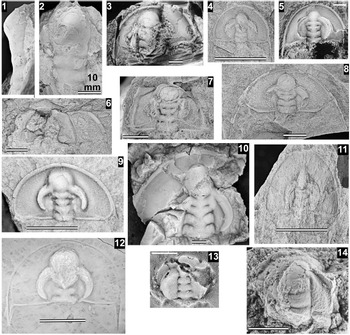
Trilobite assemblages from the upper Harkless Formation to lower Emigrant Formation in the Split Mountain area represent a portion of the mid-Dyeran Stage and the entire upper Dyeran Stage (Ar. arcuatus to N. multinodus biozones; Fig. 2). The lower 10 m of the Saline Valley Tongue, upper Harkless Formation, contains an assemblage that is presently part of the unzoned, middle Dyeran Stage (here referred to as mid-Dyeran). Only three olenelloids have been found in this lowermost portion: Olenellus sp. A (Fig. 3.12), Ol. sp. B (Fig. 3.10), and one immature cephalon of an undetermined species (Fig. 3.13). Trilobite assemblages from the 55–115 m interval in the Saline Valley Tongue are representative of the Ar. arcuatus and overlying Bristolia mohavensis biozones (Webster, Reference Webster2011a, Reference Websterb). Collections found in float and in situ from this higher interval (Webster, Reference Webster2011b, figs. 1, 2) contain Ar. aff. Ar. megafrontalis (Vaccari, Reference Vaccari1988) (Fig. 3.9), Bristolia mohavensis (Crickmay in Hazzard, Reference Hazzard1933) (Fig. 3.8), Olenellus clarki? (Resser, Reference Resser1928), Olenellus aff. O. glabrum (Resser and Howell, Reference Resser and Howell1938) (Fig. 3.11), Mesonacis aff. M. cylindricus (Palmer in Palmer and Halley, Reference Palmer and Halley1979), Zacanthopsis sp., Bonnia sp., and an unidentified ptychoparioid. The division between the two biozones is unclear due to talus deposits and extensive small-scale faulting of the Harkless Formation in this area. The age assignment of the fauna reported here from the Split Mountain West area is based on correlation to the upper Harkless in the Split Mountain East area.
Representative olenelloid trilobites and Bathynotus from the Harkless to Emigrant formations, Clayton Ridge, Nevada. Black and white scale bar represents 5 mm, unless otherwise marked. (1, 2) Bolbolenellus brevispinus Palmer, Reference Palmer1998a, glabella, UCR 10285-1, the Nephrolenellus multinodus Biozone, Emigrant Formation, lateral and dorsal view. (3) Olenellus sp., broken, partially testate specimen with right fixigena dislocated, USNM 517501, from USNM loc. 41939, Nephrolenellus multinodus Biozone, Emigrant Formation. (4) Olenellus gilberti Meek in White, Reference White1874, UCR 10273-1, the Nephrolenellus multinodus Biozone, Emigrant Formation. (5) Olenellus puertoblancoensis? (Lochman, Reference Lochman1952), USNM 517500, from USNM loc. 41936, Nephrolenellus multinodus Biozone, upper Mule Spring Limestone; photographic combination of latex cast (palpebral lobes, glabella, and right side) and mostly exfoliated cephalon. (6, 7) Bristolia insolens (Resser, Reference Resser1928) cephala from the Bristolia insolens Biozone, Harkless Formation; (6) UCR 10244-1; (7) latex cast of UCR 10244-4. (8) Bristolia mohavensis (Crickmay in Hazzard, Reference Hazzard1933) cephalon FMNH PE58616 from the Bristolia mohavensis and Arcuolenellus arcuatus undifferentiated biozone, Harkless Formation; ICS-10631. (9) Arcuolenellus aff. Ar. megafrontalis (Vaccari, Reference Vaccari1988), UCR 10214-1 from the Bristolia mohavensis and Arcuolenellus arcuatus undifferentiated biozones, Harkless Formation. (10) Olenellus sp. B, FMNH PE58754 from the mid-Dyeran, Harkless Formation, ICS-10647. (11) Olenellus aff. O. glabrum (Resser and Howell, Reference Resser and Howell1938) from Bristolia mohavensis and Arcuolenellus arcuatus undifferentiated biozones, Harkless Formation, tectonically stretched cephalon UCR 10212-75. (12) Olenellus sp. A, FMNH PE58753 from ICS-10623, the mid-Dyeran, Harkless Formation; latex cast. (13) Meraspid FMNH PE58752 from ICS-10647, the mid-Dyeran, Harkless Formation. (14) Bathynotus sp. indet., partial cranidium, UCR 10276-1, Nephrolenellus multinodus Biozone, Emigrant Formation.

The overlying Mule Spring Limestone contains trilobite faunas of the (in ascending order) Bristolia insolens, Peachella iddingsi, and probably the Bolbolenellus euryparia biozones (Webster, Reference Webster2011b). The lower biozone is recognized based on Bristolia insolens (Resser, Reference Resser1928) (Fig. 3.6, 3.7). The basal Emigrant Formation contains faunas of the (in ascending order): N. multinodus, E. nodosa, Am. arrojosensis, and Or. indicus biozones (Sundberg and McCollum, Reference Sundberg and McCollum2003; Webster, Reference Webster2011b; Sundberg, Reference Sundberg2018). The N. multinodus Biozone is recognized based on the co-occurrence of Bolbolenellus brevispinus Palmer, Reference Palmer1998a (Fig. 3.1, 3.2), Olenellus gilberti Meek in White, Reference White1874 (Fig. 3.4), and Bathynotus sp. indet. (Fig. 3.14). Olenellus puertoblancoensis? (Lochman, Reference Lochman1952) (Fig. 3.5) and an unidentified Olenellus (Fig. 3.3) also occur in this horizon.
Biostratigraphic correlations
The occurrence of oryctocephalids in the lower portion of the Saline Valley Tongue provides some important correlations to Greenland, Siberia, and South China. The occurrences of Ovatoryctocara cf. O. yaxiensis Yuan et al., Reference Yuan, Zhao, Peng, Zhu and Lin2009, Protoryctocephalus? aff. P.? arcticus Geyer and Peel, Reference Geyer and Peel2011, and Bonnia cf. B. brennus (Walcott, Reference Walcott1916) provide stronger ties between the Cordillera and Innuitian margins of Laurentia in equating the upper mid-Dyeran of the western United States to the base of the Bonnia-Pagetides elegans Biozone of North Greenland (Geyer and Peel, Reference Geyer and Peel2011). The occurrences of Oryctocephalops frischenfeldi Lermontova, Reference Lermontova1940 and Ovatoryctocara spp. also indicate that the upper mid-Dyeran of the western United States correlates to the Ovatoryctocara and lowermost Kounamkites biozones of the Siberian Platform (Korovnikov and Shabanov, Reference Korovnikov and Shabanov2008; Shabanov et al., Reference Shabanov, Korovnikov, Pereladov and Fefelov2008). The occurrences of O. cf. O. yaxiensis and P.? aff. P.? arcticus further suggest that the upper mid-Dyeran of the western United States correlates to the Protoryctocephalus arcticus Biozone of South China (Esteve et al., Reference Esteve, Zhao and Yang2019).
Prior to this report of oryctocephalids from the lower portion of the Saline Valley Tongue, it was unknown exactly how the olenelloid biozones in the upper part of the Dyeran of the western United States correlate with the biostratigraphic intervals in key paleogeographical areas (Sundberg et al., Reference Sundberg, Geyer, Kruse, McCollum, Pegel’, Żylińska and Zhuravlev2016). With the discovery of Ovatoryctocara, Protoryctocephalus, and Oryctocephalops frischenfeldi, it is now apparent that the uppermost portion of the mid-Dyeran, Upper Dyeran (Ar. arcuatus to N. multinodus biozones) and basal Delamaran (E. nodosa and Am. arrojosensis biozones) all occur above the FAD of Ovatoryctocara granulata Chernysheva, Reference Chernysheva and Shvedov1962 and below the FAD of Oryctocephalus indicus, the latter of which marks the base of the global Miaolingian Series and Wuliuan Stage. Full discussion of this biostratigraphic significance is a topic of a paper in development.
This study also indicates that species of Bonnia may be useful in developing additional Laurentian biozonation for the Dyeran, as suggested by (Fritz, Reference Fritz1991). At Split Mountain, Bonnia cf. B. brennus occurs in the lowermost Saline Valley Tongue and Bonnia columbensis occurs stratigraphically higher in the Ar. arcuatus and/or B. mohavensis biozones. Elsewhere, Bonnia brennus is known from mid-Dyeran assemblages of North Greenland (Blaker and Peel, Reference Blaker and Peel1997; Geyer and Peel, Reference Geyer and Peel2011), and Bonnia columbensis occurs in the mid- to upper Dyeran of the lower Pioche Shale, North Egan Range, Nevada (Fritz, Reference Fritz1968), the Sekwi Formation, Mackenzie Mountains, Northwestern Canada (Fritz, Reference Fritz1972), and unit 5 of the Illtyd Formation, Wernecke Mountains, Yukon Territory (Fritz, Reference Fritz1991).
Materials and methods
Materials
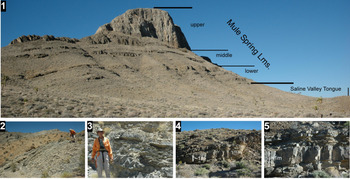
The specimens in this study are from the upper Harkless Formation, Mule Spring Limestone and lowermost Emigrant Formation (Fig. 2). The lowest interval (collections ICS-10647 and ICS-10643; Fig. 4.1, 4.2) yields trilobites preserved as silicified specimens in a laminated micrite. Olenellines are very rare (three specimens), ptychoparioids are common, oryctocephalids are rare, and Bonnia is absent. Specimens from the second, slightly higher, interval (collections ICS-10648 and ICS-10644; Fig. 4.4, 4.5) are preserved as testate material in bioclastic limestones without silicification. Fragments of olenellines are moderately rare with only one partial cephalon found, and ptychoparioids and Bonnia are moderately common. Specimens from ICS-10644 are slightly tectonically distorted and fractured. Most specimens from the 55–115 m interval of the Harkless Formation are preserved in shale and are slightly tectonically distorted (ICS-10645 and ICS-10631 and UCR collections 10212, 10235, 10236, 10237, and 10242), although an interbedded bioclastic limestone (ICS-10646) contains undistorted material and UCR 10241 contains non-compacted, silicified specimens. Specimens from the shale are preserved as internal or external molds, with the void formerly occupied by the exoskeleton sometimes infilled by a soft limonite that obscures any fine ornamentation. Olenellines are common, ptychoparioids are moderately common, and Bonnia is rare. Trilobites from the uppermost Harkless Formation and overlying Mule Spring Limestone and basal Emigrant Formation are preserved in bioclastic limestones and are, for the most part, undistorted.
Outcrop photographs of the Saline Valley Tongue, Alkali Member, Harkless Formation and Mule Spring Limestone in the Clayton Ridge. (1) Outcrop photo (view to the west) of the East Hillside displaying the Saline Valley Tongue and the overlying Mule Spring Limestone; (2) locality picture of ICS-10647 near the base of the Saline Valley Tongue; (3) outcrop photo of limestone beds near locality ICS-10647; (4, 5) outcrop photo of localities ICS-10644 and ICS-10643 near the bottom of the Saline Valley Tongue, Harkless Formation.

Methods
The trilobites from the lowest limestones of the Saline Valley Tongue, Harkless Formation reported here are preserved as finely silicified specimens in laminated clayey micrites. Mechanical splitting of the micrites and preparation of individual specimens generally destroys the specimens. Complete hydrochloric acid dissolution of the limestones generally destroys the specimens due to their fragile nature and compaction-related fracturing. Preparation of the specimens involves several steps: (1) limestone samples are placed in dilute hydrochloric acid until only a small portion of the sample is dissolved; (2) the samples are allowed to dry; (3) surfaces of the samples are microscopically examined for trilobite remains; (4) if no remains worth studying are found, then the surface is brushed off to remove the clay residuum and the surface is rescanned under magnification; (5) if a fossil of interest is found in either steps 3 or 4, then the sample surface is cleaned with a soft brush to remove the clay and to avoid breakage of the specimen; (6) the fossil is then coated with a very thin solution of polyvinyl butyral, which provides an acid-resistant protective coat; (7) the sample surface is subject to further acid dissolution; (8) the coating of polyvinyl butyral is mechanically removed from the fossil and some excess matrix is removed; (9) dilute hydrochloric acid is placed on top of the specimen and surrounding area to remove additional matrix from the specimen; (10) steps 5 through 9 are repeated until the fossil is completely exposed or there is a potential for specimen destruction with further acid dissolution; (11) once the fossil is exposed, the rock sample is placed in acetone to dissolve the polyvinyl butyral from the surface; (12) specimens are then lightly brushed with isopropyl alcohol to remove the thin coat of polyvinyl butyral and any clay residue that remains; and (13) if specimens of interest are not found in steps 3 and 4, the micrite sample is returned to the acid bath in step 1 and the process is repeated.
This process does damage specimens and can take a week or more to complete. It is typical for the specimen to be discovered after the underlying matrix has begun to dissolve, which will often break the delicate silicified exoskeleton. Attempts were made to “flip” specimens that were exposed with their ventral side up using epoxy to fill the ventral side and then dissolve the rock entirely. However, this method resulted in minimal success, with most specimens having the silicified exoskeleton coming loose from the epoxy.
Illustrated specimens have been coated with colloidal graphite and then ammonium chloride sublimate. Specimen orientation for photography and measurements is primarily with the cranidial anterior, librigenal, or pygidial borders horizontal.
Repositories and institutional abbreviations
Specimens discussed within this paper are housed in the Field Museum, Chicago (FMNH), the United States Natural History Museum (USNM), and the geology museum at the University of California, Riverside (UCR). Figured specimens from collections housed in the ICS (Institute for Cambrian Studies, University of Chicago) have been reaccessioned into the FMNH. Specimens from UCR collections are numbered sequentially using the collection number as a prefix (e.g. UCR 10273-1).
Systematic paleontology
Order Corynexochida Kobayashi, Reference Kobayashi1935
Remarks
The Corynexochida is probably polyphyletic, as suggested by Robison and Babcock (Reference Robison and Babcock2011), Sundberg (Reference Sundberg2014), and Paterson et al. (Reference Paterson, Edgecombe and Lee2019).
Family Dorypygidae Kobayashi, Reference Kobayashi1935
Genus Bonnia Walcott, Reference Walcott1916
Type species
Bathyurus parvulus Billings, Reference Billings1861, from the Forteau Formation at L'Anse au Loup, Labrador, Canada.
Bonnia cf. B. brennus (Walcott, Reference Walcott1916)
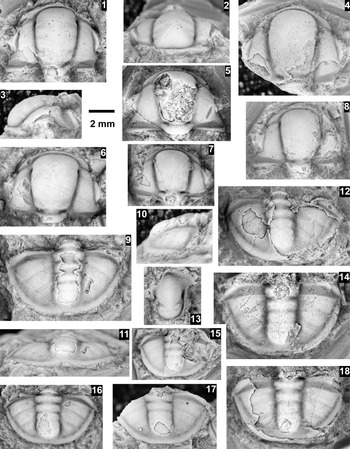
Figure 5
Occurrence
Upper portion of Harkless Formation (mid-Dyeran), Clayton Ridge, Nevada (see Appendix 1).
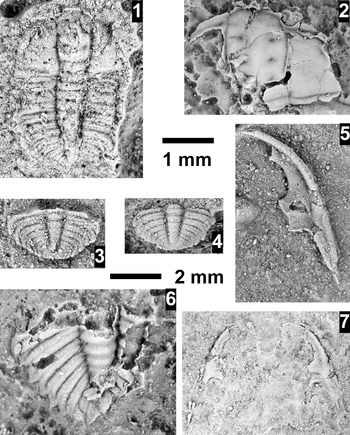
Bonnia cf. B. brennus (Walcott, Reference Walcott1916) from the mid-Dyeran, Harkless Formation, Clayton Ridge, Nevada. All figures use the 2.0 mm scale bar. (1–3) Mostly testate cranidium FMNH PE58614 from ICS-10644, dorsal, anterior, and lateral views; (4) mostly testate cranidium FMNH PE58604 from ICS-10648; (5) exfoliated cranidium FMNH PE58607 from ICS-10644; (6) mostly testate cranidium FMNH PE58608 from ICS-10644; (7) partially testate cranidium FMNH PE58609 from ICS-10644; (8) partially testate cranidium FMNH PE58615 from ICS-10644; (9–11) mostly testate pygidium FMNH PE58613 from ICS-10644, dorsal, lateral, and posterior views; (12) partially testate pygidium FMNH PE58610 from ICS-10644; (13) exfoliated partial hypostoma FMNH PE58611 from ICS-10644; (14) exfoliated pygidium FMNH PE58606 from ICS-10644; (15) mostly testate pygidium FMNH PE58603 from ICS-10648; (16) mostly testate pygidium FMNH PE58602 from ICS-10648; (17) mostly testate pygidium FMNH PE58612 from ICS-10644; (18) mostly exfoliated pygidium FMNH PE58605 from ICS-10644.

Remarks
The specimens of Bonnia from the lowermost portion of the Saline Valley Tongue are very similar to Bonnia brennus, but the former differs in the cranidium possessing a smooth exoskeleton except for terrace lines on the marginal borders (Fig. 5). Bonnia brennoides Rasetti, Reference Rasetti1948 was originally described as differing from B. brennus by having a smooth surface. However, Blaker and Peel (Reference Blaker and Peel1997) placed B. brennoides into synonymy with B. brennus based on the appearance of the Bertillon pattern occurring on non-illustrated type specimens of the former species (also visible on the posterior fixigenal area on the specimen illustrated by Rasetti, Reference Rasetti1948, fig. 4.4). The pygidia from the Saline Valley Tongue are also similar to B. brennus, but the latter generally has slightly shallower pleural furrows. These specimens are also similar to Bonnia columbensis in having a smooth surface of the exoskeleton and relatively shallow pygidial furrows. However, B. columbensis differs in having a cranidium with shallower axial furrows, abaxial portion of the anterior border furrow, and posterior border furrow and pygidia with shallower pleural furrows, border furrow, and axial furrows.
Bonnia columbensis Resser, Reference Resser1936
Figure 6
- Reference Walcott1916
Corynexochus senectus (Billings, Reference Billings1861); Walcott, p. 319, pl. 55, figs. 7, 7a–c. [non pl. 56, figs. 1, 1a-g].
- Reference Walcott1917
Corynexochus senectus; Walcott, p. 66, pl. 9, figs. 2, 2a–c [non pl. 9, figs. 1, 1a-d].
- Reference Resser1936
Bonnia columbensis Resser, p. 9.
- Reference Lochman1947
Bonnia columbensis; Lochman, p. 69.
- Reference Fritz1968
Bonnia copia Fritz, p. 194, pl. 36, figs. 17–24.
- Reference Fritz1972
Bonnia columbensis Fritz, p. 32, pl. 18, figs. 1–13.
- Reference Fritz1991
Bonnia columbensis Fritz, p. 21, pl. 7, figs. 1–12, pl. 8, figs. 1–20, pl. 9, figs. 1–15, text-figs. 5k, l.
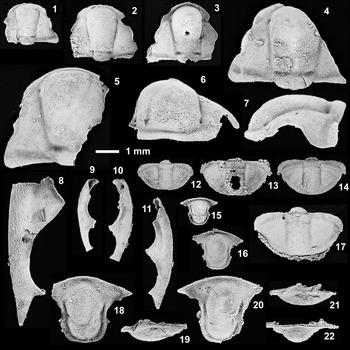
Bonnia columbensis Resser, Reference Resser1936 from the Bristolia mohavensis and Arcuolenellus arcuatus undifferentiated biozones, Harkless Formation, Clayton Ridge, Nevada. All figures use the 1.0 mm scale bar, and the specimens are silicified. (1) Cranidium UCR 10241-1; (2) cranidium UCR 10241-2; (3) possibly tectonically elongated cranidium UCR 10241-3; (4) cranidium UCR 10241-4; (5–7) cranidium UCR 10241-5, dorsal, anterior, and lateral views; (8) broken large librigena UCR 10241-57; (9) librigena UCR 10241-54; (10) librigena UCR 10241-55; (11) librigena UCR 10241-56; (12) pygidium UCR 10241-6; (13) pygidium UCR 10241-8; (14) pygidium UCR 10241-7; (15) hypostome UCR 10241-10; (16) hypostome UCR 10241-11; (17) pygidium UCR 10241-9; (18, 19) hypostome UCR 10241-13, ventral and lateral views; (20–22) hypostome UCR 10241-12, ventral, lateral, and anterior views.

Lectotype
Cranidium USNM 62722 assigned by Resser (Reference Resser1936) from Walcott (Reference Walcott1916) illustrated specimens of Corynexochus (Bonnia) senectus (Billings, Reference Billings1861), lower Cambrian (loc. 61d), Mount Whyte Formation, Mount Shaffer, British Columbia, Canada. Paralectotypes 62723-62725 are also from the same location and Walcott's (Reference Walcott1916) illustrations.
Occurrence
Harkless Formation (Bristolia mohavensis and Arcuolenellus arcuatus biozones, undifferentiated), Clayton Ridge, Nevada (see Appendix 1). Pioche Shale (upper Olenellus zone), Northern Egan Range, Nevada (Fritz, Reference Fritz1968). Sekwi Formation (Bonnia-Olenellus zone), Mackenzie Mountains, Northwestern Canada (Fritz, Reference Fritz1972). Mount Whyte Formation, British Columbia, Canada (Walcott, Reference Walcott1916). Illtyd Formation, Yukon (Fritz, Reference Fritz1991).
Remarks
The silicified specimens from bedded limestone nodules in the 55–115 m interval of the Saline Valley Tongue are here identified as Bonnia columbensis based on the elongated glabella that becomes progressively proportionally shorter on larger specimens, the axial furrows that also become shallower on larger specimens, lack of Bertillon pattern on the cranidia and pygidia (except for marginal terrace lines), and shallow pleural furrows and pygidial border furrow. Fritz (Reference Fritz1972) did not describe the surface of the cranidium, but only mentioned that the test was granular to nearly smooth. However, it is unclear if Fritz is either referring to the hypostome, which is described directly before the comment on the ornamentation, or the entire dorsal surface, given that the next sentence comments on terrace lines on the cranidial anterior border and pygidial border. The silicified specimens from the Harkless Formation show terrace lines on the anterior border, but they are not visible on the pygidial border. These silicified hypostomes from the Harkless Formation do show a granular surface in larger specimens (Fig. 6.18–6.22), but these smaller specimens appear to be smooth (Fig. 6.15, 6.16). Observation of Fritz's figured specimens indicate: (1) the cranidia and pygidia have a smooth external surface, except for the terrace lines as previously mentioned; and (2) the axial furrows and pleural furrows are much more shallow than is apparent in the high contrast photos published by Fritz (Reference Fritz1972, pl. 18, figs. 1–13).
The librigenae of B. columbensis are only known from the silicified material in the Harkless Formation. This material shows that smaller specimens have a poorly developed genal spine (Fig. 6.9, 6.10) to a short spine in larger specimens (Fig. 6.8, 6.11). The single librigena illustrated by Blaker and Peel (Reference Blaker and Peel1997, fig. 50.3) has a genal spine nearly twice the length of the larger specimens illustrated here; however, the Blaker and Peel specimen is approximately twice the size. The librigenae of Bonnia species are generally not illustrated, so further comparisons cannot be made.
Bonnia columbensis is also similar to B. tensa Resser Reference Resser1938a (illustrated in Rasetti, Reference Rasetti1948), but differs from the latter in having a higher lateral and anterior profile of the cranidium, better-defined axial furrows, and a more transversely wide pygidium. Bonnia laevigata (Rasetti, Reference Rasetti1948) is also similar to B. columbensis in having shallower cranidial axial furrows, but the latter differs in the cranidia lacking an occipital spine and pygidial furrows being evident on the external surface instead of being effaced.
Genus Ogygopsis Walcott, Reference Walcott1889
Type species
Ogygia klotzi Rominger, Reference Rominger1887, Stephen Formation, Mount Stephen, British Columbia, Canada.
Ogygopsis sp. indet.
Figure 7.3
Remarks
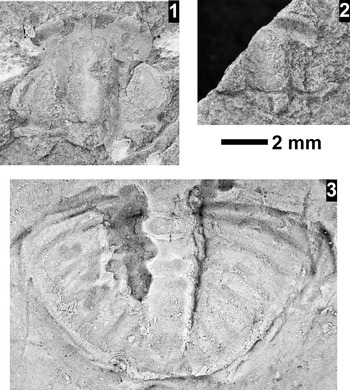
A single partial, poorly preserved pygidium from ICS-10632 is similar to that known from Ogygopsis batis (Walcott, Reference Walcott1916), which is also present in the Saline Valley Tongue, Alkali Member, Harkless Formation (Palmer, Reference Palmer1964; Sundberg, Reference Sundberg2014). The pygidium is similar in its outline, anterolateral spines, proportional axial length, and border width. Nomenclature is left open due to the poor preservation of the specimen.
Zacanthopsis sp. indet and Ogygopsis sp. indet. from the Harkless Formation, Clayton Ridge, Nevada. (1, 2) Zacanthopsis sp. indet. from the Bristolia mohavensis and Arcuolenellus arcuatus undifferentiated biozones: (1) cranidium UCR 10212-60; (2) cranidium UCR 10237-1. (3) Ogygopsis sp. indet., pygidium FMHN PE58755 from ICS-10623, mid-Dyeran.

Family Oryctocaridae Hupé, Reference Hupé1953
Subfamily Oryctocarinae Hupé, Reference Hupé1953
Genus Ovatoryctocara Chernysheva, Reference Chernysheva and Shvedov1962
Type species
Oryctocara ovata Chernysheva in Krys'kov et al.,Reference Krys'kov, Lazarenko, Ogienko, Chernysheva and Markovsky1960, from the Anabar Basin, Siberian Platform, Russia.
Remarks
Naimark et al. (Reference Naimark, Shabanov and Korovnikov2011, p. 407) stated in their diagnosis that the genus has 4–5 thoracic segments and 6–12 pygidial segments. However, the articulated specimen reported herein has seven thoracic segments and five pygidial segments. This indicates that the diagnosis needs to include an expanded range of 4–7 thoracic segments and 5–12 pygidial segments.
Ovatoryctocara cf. O. yaxiensis Yuan et al., Reference Yuan, Zhao, Peng, Zhu and Lin2009
Figure 8
Occurrence
Upper portion of Harkless Formation (mid-Dyeran), Clayton Ridge, Nevada (see Appendix 1).
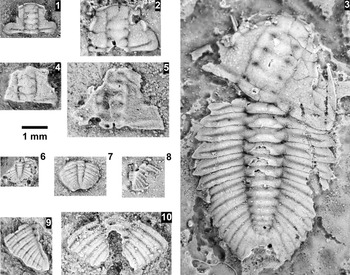
Ovatoryctocara cf. O. yaxiensis Yuan et al., Reference Yuan, Zhao, Peng, Zhu and Lin2009 from the mid-Dyeran, Harkless Formation, Clayton Ridge, Nevada. Specimens are silicified. All figures use the 1.0 mm scale bar. (1) Cranidium FMNH PE58771 from ICS-10647; (2) cranidium FMNH PE58774 from ICS-10647; (3) disarticulated, but nearly complete exoskeleton FMNH PE58775 from ICS-10647; (4) partial cranidium FMNH PE58778 from ICS-10623; (5) partial cranidium FMNH PE58780 from ICS-10623; ventral side; (6) small pygidium FMNH PE58777 from ICS-10647; (7) pygidium FMNH PE58779 from ICS-10623; (8) partial pygidium FMNH PE58776 from ICS-10647, ventral view; (9) partial pygidium FMNH PE58773 from ICS-10647; (10) partial pygidium FMNH PE58772 from ICS-10647.

Remarks
The slightly disarticulated specimen (Fig. 8.3) has seven thoracic and five pygidial segments (exclusive of the terminal piece). Granulations on the cranidium, thorax, and pygidium are present, but subdued. This species is most similar to Ovatoryctocara yaxiensis Yuan et al., Reference Yuan, Zhao, Peng, Zhu and Lin2009, particularly in the broad pygidial axis (see Geyer and Peel, Reference Geyer and Peel2011). However, the two taxa differ in that O. yaxiensis has a greater width of the L2 and L3 glabellar lobes and only four thoracic segments. This species is also similar to O. ovata in its glabellar and pygidial shapes and subdued granulation, but differs in the latter having wider and more angular termination to the posterolateral portions of the fixigena, fewer thoracic segments (four vs. seven), and more pygidial segments (10–12 rings versus five).
Shabanov et al. (Reference Shabanov, Korovnikov, Pereladov and Fefelov2008, pl. 2, fig. 1) and Korovnikov and Shabanov (Reference Korovnikov and Shabanov2008, pl. 1, fig. 1) illustrated an articulated specimen of O. granulata Chernysheva, Reference Chernysheva and Shvedov1962 (4.5 mm in length) from Siberia that is very similar to the articulated specimen from the Harkless Formation (Fig. 8.3; 6.7 mm in length), including in glabellar shape, a relatively short and rounded termination of the posterior area of the fixigena, subdued granulation, seven thoracic segments, and five pygidial axial rings. This Siberian specimen from the base of the Ovatoryctocara Zone (Shabanov et al., Reference Shabanov, Korovnikov, Pereladov and Fefelov2008), however, has less pointed thoracic pleural terminations and a proportionally narrower pygidial axis.
Family Oryctocephalidae Beecher, Reference Beecher1897
Subfamily Lancastriinae Kobayashi, Reference Kobayashi1935
Genus Protoryctocephalus Chow in Lu et al., Reference Lu, Chang, Chien, Chuy, Lin, Chow, Chien, Zhang and Wu1974
Type species
Protoryctocephalus wuxunensis Chow in Lu et al., Reference Lu, Chang, Chien, Chuy, Lin, Chow, Chien, Zhang and Wu1974, Guizhou Province, south-west China.
Protoryctocephalus? aff. P.? arcticus Geyer and Peel, Reference Geyer and Peel2011
Figure 9
Protoryctocephalus? aff. P.? arcticus Geyer and Peel, Reference Geyer and Peel2011 from the mid-Dyeran, Harkless Formation, Clayton Ridge, Nevada. All specimens are from ICS-10647 and silicified, unless otherwise mentioned; (1, 3–6) use the 1.0 mm scale bar; (2, 7) use the 2.0 mm scale bar. (1) Small exoskeleton FMNH PE58781; (2) partial cranidium FMNH PE58784; (3) pygidium FMNH PE58787 from ICS-10623; (4) pygidium FMNH PE58782; (5) librigena FMNH PE58783, ventral view; (6) partial pygidium FMNH PE58786, questionably assigned to the species; (7) articulated librigena and hypostome FMNH PE58785.

Occurrence
Upper portion of Harkless Formation (mid-Dyeran), Clayton Ridge, Nevada (see Appendix 1).
Remarks
Assignment of the specimens to Protoryctocephalus? arcticus is only tentative, based on their fragmentary condition and the shorter pygidial spines. The cranidia (Fig. 9.1, 9.2) have the circular glabellar pits with at least the S3 having a furrow extending nearly to the axial furrow and a moderately curved anterior border. The presence or absence of a sulcus in the anterior portion of the frontal lobe is unclear. The librigena (Fig. 9.5, 9.7) is also similar to the specimens illustrated by Geyer and Peel (Reference Geyer and Peel2011) in the length of the ocular suture and direction and thinness of the genal spine. In contrast, the fragmented larger pygidium questionably assigned to the species (Fig. 9.6) has shorter, broad-based spines that make the edge of the pygidium look serrated, unlike the long and thin pygidial spines typical of Protoryctocephalus? arcticus.
Protoryctocephalus? arcticus was questionably placed into the genus based on its intermediate position between the Protoryctocephalus and Lancastria subclades and the preservation of other species of Protoryctocephalus compressed in shales (Sundberg, Reference Sundberg2014). Esteve et al. (Reference Esteve, Zhao and Yang2019) also recognized the species from the middle and upper portions of the ‘Tsinghsutung’ Formation, Balang, South China.
Genus Oryctocephalops Lermontova, Reference Lermontova1940
Type species
Oryctocephalops frischenfeldi by original designation, Aldan region, Siberian Platform, Russia.
Oryctocephalops frischenfeldi Lermontova, Reference Lermontova1940
Figure 10
- Reference Lermontova1940
Oryctocephalops frischenfeldi Lermontova, p. 137, pl. 42, figs. 1, 1a–c.
- Reference Chernysheva and Shvedov1962
Oryctocephalops frischenfeldi; Chernysheva, p. 44, pl. 3, figs. 11–14.
- Reference Solov'ev1964
Oryctocephalops frischenfeldi; Solov'ev, p. 49, text fig. 1b, pl. 1, figs. 7–11.
- Reference Suvorova1964
Oryctocephalops frischenfeldi; Suvorova, p. 247, pl. 28, figs. 1–11, pl. 29, figs. 1–7.
- Reference Savitskiy, Evtushenko, Egorova, Kontorovich and Shabanov1972
Oryctocephalops frischenfeldi; Savitskiy et al., p. 77, pl. 15, fig. 9.
- Reference Egorova, Shabanov, Rozanov, Savitskiy, Chernysheva and Shishkin1976
Oryctocephalops frischenfeldi; Egorova et al., p. 96, pl. 44, fig. 14, pl. 45, figs. 17–19, pl. 46, figs. 13, 14; not? pl. 47, fig. 18.
- Reference Shabanov, Korovnikov, Pereladov and Fefelov2008
Oryctocephalops frischenfeldi; Shabanov et al., pl. 2, fig. 5, pl. 3, figs. 2, 3, pl. 5, fig. 10, pl. 6, figs. 4, 13; not pl. 10, fig. 11 (=Protoryctocephalus vicinus [Chernysheva, Reference Chernysheva and Shvedov1962]) and pl. 12, fig. 10 (=Oryctocephalus reticulatus [Lermontova, Reference Lermontova1940]).
- Reference Korovnikov and Shabanov2008
Oryctocephalops frischenfeldi; Korovnikov and Shabanov, p. 93, pl. 1, fig. 5, pl. 2, figs. 2, 3, pl. 4, fig. 10, pl. 5, figs. 4, 13; not pl. 11, fig. 10 (=Oryctocephalus reticulatus [Lermontova, Reference Lermontova1940]) and pl. 11, fig. 11 (=Protoryctocephalus vicinus [Chernysheva, Reference Chernysheva and Shvedov1962]).
- ?Reference Korovnikov and Shabanov2016
Oryctocephalops frischenfeldi; Korovnikov and Shabanov, pl. 2, fig. 3.
- Reference Korovnikov2018
Oryctocephalops frischenfeldi; Korovnikov, p. 80, pl. 13, figs. 1–7.
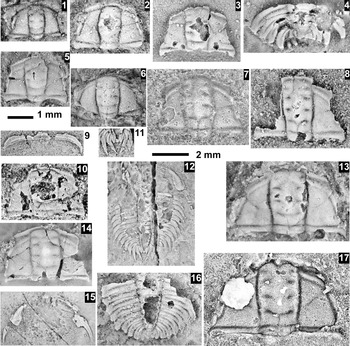
Oryctocephalops frischenfeldi Lermontova, Reference Lermontova1940 from the mid-Dyeran, Harkless Formation, Clayton Ridge, Nevada. All specimens are from ICS-10647 and silicified, unless otherwise mentioned; (1–9) use the 1.0 mm scale bar; (10–17) use the 2.0 mm scale bar. (1) Small cranidium FMNH PE58756; (2) small cranidium FMNH PE58770 from ICS-10623; (3) cranidium FMNH PE58765 from ICS-10643; (4) last four thoracic tergites and fragmented pygidium with three? segments FMNH PE58764; (5) small cranidium FMNH PE58763; (6) small cranidium FMNH PE58769 from ICS-10623, limestone specimen; (7, 8) cranidium FMNH PE58766 from ICS-10643, non-silicified negative (color inverted and flipped horizontally with Photoshop) and silicified positive; (9) isolated thoracic segment FMNH PE58760; (10) cranidium FMNH PE58757; (11, 12) exoskeleton missing cranidium FMNH PE58758, close-up of terminal segments; (13) cranidium FMNH PE58759; (14) cranidium FMNH PE58762; (15) librigena and partial hypostome FMNH PE58761; (16) pygidium and thorax FMHN PE58768 from ICS-10623; (17) cranidium FMNH PE58767 silicified negative (color inverted and flipped horizontally with Photoshop) from ICS-10623.

Lectotype
Lermontova (Reference Lermontova1940) did not select a holotype or provide specimen numbers for her new species. The holotype (lectotype) was selected by Chernysheva (Reference Chernysheva and Shvedov1962) as the nearly complete exoskeleton illustrated by Lermontova (Reference Lermontova1940, pl. 42, fig. 1) from black shales in the lower part of the middle Cambrian, Anabar district, of the Kuonamka Formation. This specimen is cataloged under CNIGR, collection 9182 and is presently housed at VSEGEI (Russian Geological Research Institute), Academician F.N. Chernyshev Central Geological Research Museum (TSNIGR Museum).
Occurrence
Kuonamka Formation (Cheiruroides arcticus-Pagetia horrida Zone, =Ovatoryctocara Zone), middle reaches of the Olenek River (Korovnikov, Reference Korovnikov2018) and Molodo River (Shabanov et al., Reference Shabanov, Korovnikov, Pereladov and Fefelov2008), Siberian Platform. Upper portion of Harkless Formation (mid-Dyeran), Clayton Ridge, Nevada (see Appendix 1).
Remarks
The specimens here assigned to Oryctocephalops frischenfeldi agree well to the specimens from the Ovatoryctocara Biozone of the Kuonamka Formation, Olenek Uplift of the Siberian Platform (Korovnikov and Shabanov, Reference Korovnikov and Shabanov2008; Shabanov et al., Reference Shabanov, Korovnikov, Pereladov and Fefelov2008). The cranidia (Fig. 10.1–10.3, 10. 5–10.8, 10.10, 10.13, 10.14, 10.17) have a medially expanded glabella with slit-shaped glabellar pits with only S4 furrow extending to that of the axial furrow, one transglabellar furrow (S1), a medial sulcus in the frontal lobe; anterior border moderately curved; and fixigena that is moderately narrow. The librigena (Fig. 10.12, 10.15) is also similar to illustrated specimens (Korovnikov and Shabanov, Reference Korovnikov and Shabanov2008; Shabanov et al., Reference Shabanov, Korovnikov, Pereladov and Fefelov2008) in the length of the ocular suture and genal spines that are slightly advanced, directed posterolaterally, and rounded in cross-section. The pygidium (Fig. 10.4, 10.11, 10.12, 10.16) shows at least two axial rings and pleurae with long, broad-based spines.
Specimens illustrated as O. frischenfeldi (Korovnikov, Reference Korovnikov2018, pl. 11, figs. 10, 11; Shabanov et al., Reference Shabanov, Korovnikov, Pereladov and Fefelov2008, pl. 12, figs. 10, 11) from their level 29 (lower Kounamkites Zone) are not included in this species due to their rounded glabellar pits, glabellar outline, and fixigenal width. These specimens probably represent Oryctocephalus reticulatus (Lermontova, Reference Lermontova1940) and Protoryctocephalus vicinus (Chernysheva, Reference Chernysheva and Shvedov1962), respectively. The single specimen illustrated by Korovnikov and Shabanov (Reference Korovnikov and Shabanov2008, pl. 2, fig. 3) is too poor to establish its identification. They reported the species from the middle of the Cheiruroides arcticus-Pagetia horrida Zone (=Ovatoryctocara Zone) from the Kuonamka Formation, middle reaches of the Olenek River, Siberia.
Family Zacanthoididae Swinnerton, Reference Swinnerton1915
Genus Zacanthopsis Resser, Reference Resser1938b
Type species
Olenoides levis Walcott, Reference Walcott1886 from the Cambrian Stage 4, Pioche Formation, near Pioche, Nevada.
Zacanthopsis aff. Z. levis (Walcott, Reference Walcott1886)
Figure 11
Occurrence
Harkless Formation (Bristolia mohavensis and Arcuolenellus arcuatus biozones undifferentiated), Clayton Ridge, Nevada (see Appendix 1).
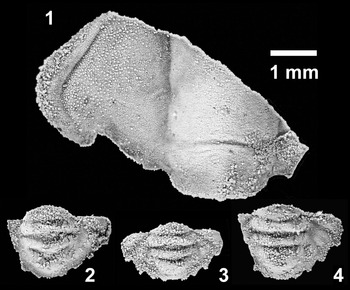
Zacanthopsis aff. Z. levis (Walcott, Reference Walcott1886) from the Bristolia mohavensis and Arcuolenellus arcuatus undifferentiated biozones, Harkless Formation, Clayton Ridge, Nevada. All figures use the 1.0 mm scale bar. (1) Partial cranidium UCR 10241-76; (2) pygidium UCR 10241-75; (3) pygidium UCR 10241-73; (4) pygidium UCR 10241-74.

Remarks
Only a fragmentary cranidium and four pygidia have been found in acid residues. The cranidium has a tapered palpebral lobe, similar to the type species, but a small occipital spine similar to Z. contractus Palmer, Reference Palmer1964. The pygidia are most similar to Z. levis in the axis and pygidial shape, but they differ in having a proportionally narrower pleural field and a longer axis.
Zacanthopsis sp. indet.
Figure 7.1, 7.2
Occurrence
Harkless Formation (Bristolia mohavensis and Arcuolenellus arcuatus biozones, undifferentiated), Clayton Ridge, Nevada (see Appendix 1).
Remarks
Only two partially complete cranidia have been found in shales and are left in open nomenclature.
Acknowledgments
Appreciation is given to L.B. and M. McCollum for their assistance in the field and permission to use a portion of their measured stratigraphic section in this paper. Field assistance was also provided to FAS by P.G. Scholten (Show Low, AZ), and to MW by M. Hopkins, C. Madison-Bell, E. Sperling, L. Webster, and the participants of the University of Chicago Spring Break Field Trip (2008). Constructive reviews were provided by G. Geyer and P. Ahlberg.
Appendix 1: localities
Split Mountain (general area)
Two bulk collections utilized herein include fossils pooled from more than one locality in the Split Mountain area. Although the stratigraphic provenance of each of those collections is constrained to some degree, the geographic point of collection of particular fossiliferous slabs within each collection cannot.
ICS-10631
Fossils collected from float in green shale in uppermost Harkless Formation, pooled from various areas around Split Mountain. From same stratigraphic interval as UCR 10212–10214, UCR 10234, UCR 10235, and UCR 10236. Within 60–0 m below base of measured section presented by Webster (Reference Webster2011d, fig. 2) and ~55–115 m above the base of the Saline Valley Tongue (86–26 m below base of Mule Spring Limestone). Collected by MW, Melanie Hopkins, and Erik Sperling, 3/17/2005. Bristolia mohavensis.
UCR 10264
Float blocks from middle unit of Mule Spring Limestone, pooled from various sites around Split Mountain. Collected by MW. Bonnia sp.
Split Mountain East hillside
The sections documented by Webster (Reference Webster2011d, p. 239–242, figs. 2, 3, 4.1–4.4, 5.1) were measured on the northern face of this hillside, spanning from the uppermost Harkless Formation to the middle unit of the Mule Spring Limestone. Extensive fossil collections have also been made from various horizons below the base of the measured section (see Webster, Reference Webster2011d; herein), but poor exposure and faulting mean that the stratigraphic positions of such collections can only be crudely estimated. Fossil collections mentioned herein are listed below.
ICS-10643
Upper part of exposure of dark gray, laminated limestone in upper part of Harkless Formation. Estimated to lie ~106.5 m below base of measured section presented by Webster (Reference Webster2011d, fig. 2) and ~3.5 m above the base of the Saline Valley Tongue (132.5 m below base of Mule Spring Limestone). Collected by FAS 10/13/2007. Oryctocephalops frischenfeldi.
ICS-10644
Uppermost part of exposure of dark gray, fractured, bioclastic limestone in upper part of Harkless Formation. Estimated to lie ~105 m below base of measured section presented by Webster (Reference Webster2011d, fig. 2), ~5 m above the base of the Saline Valley Tongue (130 m below base of Mule Spring Limestone). Collected by FAS 6/23/2018. Olenellus sp. B, Bonnia cf. B. brennus.
ICS-10645
Limestones interbedded with green shales on northern face of hillside. Probably from same stratigraphic interval as UCR 10212–10214 and UCR 10234–10236; estimated to lie within 60–0 m below base of measured section presented by Webster (Reference Webster2011d, fig. 2) and ~55–115 m above the base of the Saline Valley Tongue (86–26 m below base of Mule Spring Limestone). Collected by FAS 10/13/2007. Olenellid fragments, Bonnia cf. B. brennus.
ICS-10646
Green shales in uppermost Harkless Formation on western side of hillside. Probably from same stratigraphic interval as UCR 10212–10214 and UCR 10234–10236; estimated to lie within 60–0 m below base of measured section presented by Webster (Reference Webster2011d, fig. 2) and ~55–115 m above the base of the Saline Valley Tongue (86–26 m below base of Mule Spring Limestone). Collected by FAS 10/13/2007. Arcuolenellus aff. A. megafrontalis, Bristolia mohavensis, Olenellus aff. O. glabrum, Bonnia columbensis.
UCR 10212
Fossils collected as float from green shales in uppermost Harkless Formation on northern face of hillside, within 60–0 m below base of measured section presented by Webster (Reference Webster2011d, fig. 2) and ~55–115 m above the base of the Saline Valley Tongue (86–26 m below base of Mule Spring Limestone). Collected by MW 6/15/1999 and 6/18/1999. Olenellus aff. O. glabrum, Bonnia columbensis, Zacanthopsis sp. indet.
UCR 10236
Fossils collected as float from green shales in uppermost Harkless Formation on northern face of hillside, from spur on other side of gully several meters to west of UCR 10212, within 60–0 m below base of measured section presented by Webster (Reference Webster2011d, fig. 2) and ~55–115 m above the base of the Saline Valley Tongue (86–26 m below base of Mule Spring Limestone). Collected by MW. Bonnia columbensis.
Split Mountain East trench
The trilobite faunas in trench dug from the uppermost Mule Spring Limestone through the Emigrant Formation have been documented elsewhere (Sundberg and McCollum, Reference Sundberg and McCollum2003; Webster, Reference Webster2011d, p. 245–246, fig. 6.1). The following collections are mentioned herein.
ICS-1338 and UCR 10285
Limestone bed 1.13–1.28 m above base of Emigrant Formation. Collected by A.R. Palmer and MW, respectively. Bolbolenellus brevispinus.
Split Mountain West 1
The uppermost Harkless Formation is exposed in a small canyon just northeast of the narrow neck of the main western canyon. The overlying Mule Spring Limestone is also exposed in this small canyon, but the formational contact appears to have been modified by faulting and/or differences in competency between the two lithologies. Numerous fossil collections have been made throughout the upper Harkless Formation in this canyon, but the presence of numerous faults means that the stratigraphic positions of such collections can only be crudely estimated. Fossil collections mentioned herein are noted below.
ICS-1240 and ICS-10632
Silicified ptychopariid- and oryctocephalid-bearing, dark gray, laminated limestone in upper part of Harkless Limestone. Estimated to lie ~3.5 m above the base of the Saline Valley Tongue (132.5 m below base of Mule Spring Limestone). Collected by A.R. Palmer on 10/3/1998 and MW on 6/16/1999, respectively. Olenellus sp. A, Ogygopsis sp., Ovatoryctocara cf. O. yaxiensis, Protoryctocephalus? aff. P.? arcticus, Oryctocephalops frischenfeldi.
ICS-10647
Upper part of exposure of dark gray, laminated limestone in upper part of Harkless Formation. Equivalent to ICS-10643 on the Split Mountain East hillside, and thus estimated to lie ~3.5 m above the base of the Saline Valley Tongue (132.5 m below base of Mule Spring Limestone). Presumably exactly equivalent to ICS-10632. Collected by FAS 6/24/2018. Olenellid sp. indet., Ovatoryctocara cf. O. yaxiensis, Protoryctocephalus? aff. P.? arcticus, Oryctocephalops frischenfeldi.
UCR 10237
Fossils collected as float from green shales in uppermost Harkless Formation, within interval ~55–115 m above the base of the Saline Valley Tongue (86–26 m below base of Mule Spring Limestone). Collected by MW. Bonnia sp., Zacanthopsis sp. indet.
UCR 10241
Silicified fossils within carbonate nodules interbedded within green shales. Collected from same hillside as UCR 10237, but collected in situ. Faulting renders the stratigraphic position of this collection relative to the base of the Mule Spring Limestone (or any other marker bed) impossible to determine with any precision, but must lie within an interval ~55–115 m above the base of the Saline Valley Tongue (86–26 m below base of Mule Spring Limestone). Collected by MW. Arcuolenellus aff. A. megafrontalis, Bonnia columbensis, Zacanthopsis aff. Z. levis.
UCR 10242
Green shale interbedded with carbonate nodules of UCR 10241. Collected by MW. Bonnia sp.
Split Mountain West 2
Measured sections spanning the entire Mule Spring Limestone and into the Emigrant Formation from the southern wall of the main western canyon were presented by Webster (Reference Webster2011a, fig. 4.1; 2011d, p. 242–245, figs. 4.5, 4.6, 5.2, 6.2). Fossil collections (all made by MW) from those sections mentioned herein are noted below.
UCR 10244
Float block sourced from low in the middle unit of Mule Spring Limestone. Bristolia insolens.
UCR 10245
Float block sourced from high in the middle unit of Mule Spring Limestone. Bonnia sp.
UCR 10273
Shale 0.95 m above base of Emigrant Formation. Olenellus gilberti.
UCR 10276
Limestone ~1 m above base of Emigrant Formation. Collected by FAS, 8/2015. Bolbolenellus brevispinus, Olenellus sp. indet., Bathynotus sp. indet.
Split Mountain West 3
A single fossil collection was made from a previously unstudied exposure of the upper Harkless Formation at the northwestern end of the main western canyon.
ICS-10648
Uppermost part of exposure of dark gray, laminated limestone in upper part of Harkless Formation. Equivalent to ICS-10644 on the Split Mountain East hillside, and thus estimated to lie ~5 m above the base of the Saline Valley Tongue (103 m below base of Mule Spring Limestone). Collected by Mike and Linda McCollum, 12/1999. Olenellid fragments, Bonnia cf. B. brennus.