


Introduction
Several studies have shown that depressed individuals with greater social support are more likely to recover from depression, recover in less time, and are less likely to experience subsequent depressive episodes (e.g. Billings and Moos, Reference Billings and Moos1985; Dehle, Larsen and Landers, Reference Dehle, Larsen and Landers2001; Nasser and Overholser, Reference Nasser and Overholser2005; Sherburne, Hayes and Wells, Reference Sherburne, Hayes and Wells1995; Skarsater, Langius, Agren, Haggstom and Dencker, Reference Skarsater, Langius, Argen, Haggstrom and Dencker2005). Social support is a broad construct that refers to emotional aid (e.g. providing empathy, discussing feelings), informational help (e.g. advice, suggestions), instrumental help (e.g. assistance with tasks), and companionship (e.g. social interaction and inclusion) offered by one individual to another (Burleson, Reference Burleson1984; Cutrona and Russell, Reference Cutrona, Russell, Sarason, Sarason and Pierce1990; Newsom, Rook, Nishishiba, Sorkin and Mahan, Reference Newsom, Rook, Nishishiba, Sorkin and Mahan2005; Sarason, Levine, Basham and Sarason, Reference Sarason, Levine, Basham and Sarason1983). Several factors that influence whether a person offers support have been studied (e.g. Cauce and Srebnik, Reference Cauce and Srebnik1990; McKay and Barrowclough, Reference McKay and Barrowclough2005; Srebnik, Cauce and Baydar, Reference Srebnik, Cauce and Baydar1996), but factors that influence whether a person seeks social support are understudied. The purpose of the present study is to examine such factors in individuals with depressive symptoms.
Little literature exists regarding factors that influence willingness to seek social support in the context of depression, but correlates of professional help-seeking (e.g. seeking psychotherapy, medication) may provide useful information on potential deterrents. Research on professional help-seeking intentions suggests that people's attributions about the causes of depression may influence their willingness to seek professional help (Deacon and Baird, Reference Deacon and Baird2009; Goldstein and Rosselli, Reference Goldstein and Rosselli2003). Two attribution types that have been examined as correlates of professional help-seeking include biological and psychological attributions for depression. A biological attribution for depression suggests that depression is due to a chemical imbalance, hormone changes, or genetics, and a psychological attribution suggests that depression is caused by psychosocial factors, situation factors, cognitions, and behaviors (e.g. Deacon and Baird, Reference Deacon and Baird2009; Goldstein and Rosselli, Reference Goldstein and Rosselli2003). Researchers have found that when people attribute depression to biological factors rather than psychological or situational factors, they report greater likelihood of seeking help from professionals (Deacon and Baird, Reference Deacon and Baird2009). Other studies have found that biological attributions for depression are related to lower stigma and psychological attributions are related to greater stigma (Blais and Renshaw, Reference Blais and Renshaw2008b; Deacon and Baird, Reference Deacon and Baird2009; Gammell and Stoppard, Reference Gammel and Stoppard1999; Goldstein and Rosselli, Reference Goldstein and Rosselli2003; Schreiber and Hartrick, Reference Schreiber and Hartrick2002). Greater stigma, in turn, is related to decreased professional help-seeking (Barney, Griffiths, Jorm and Christensen, Reference Barney, Griffiths, Jorm and Christensen2006; Dinos, Stevens, Serfaty, Weich and King, Reference Dinos, Stevens, Serfaty, Weich and King2004; Sherwood, Salkovskis and Rimes, Reference Sherwood, Salkovskis and Rimes2007). On the other hand, biological attributions for depression are also associated with worse perceived prognosis and less belief that psychological treatment would be effective (Deacon and Baird, Reference Deacon and Baird2009). Thus, though biological and psychological attributions for illness appear related to help-seeking, the effects of these are somewhat unclear.
The lack of clarity regarding the associations of biological and psychological attributions for depression with help-seeking may be due, in part, to the current conceptualizations of biological and psychological attributions for depression. To date, researchers have defined biological attributions by physiological factors that are generally seen as uncontrollable (e.g. genetics, hormones) and psychological attributions by factors that are internal to the self (e.g. cognitions, behaviors). There is evidence that people who perceive others as responsible for their own problems are more likely to be blaming and less likely to offer support (MacGeorge, Reference MacGeorge2003; McKay and Barrowclough, Reference McKay and Barrowclough2005; Weiner, Perry and Magnussen, Reference Weiner, Perry and Magnussen1988). In addition, relatives of individuals with mental illnesses who make controllable, internal, and stable attributions regarding the problems of those individuals tend to have harsher attitudes toward them (review by Barrowclough and Hooley, Reference Barrowclough and Hooley2003). Based on these findings, it is possible that the typical operationalizations of biological attributions may be associated with less stigma primarily due to their perceived uncontrollability, whereas the typical operationalization of psychological attributions may be associated with more stigma due to the perceived internality (e.g. cognitions, behaviors, which are internal to the person). On the other hand, uncontrollable biological attributions may be seen as more stable and resistant to change, leading to less hope for improvement than psychological attributions. In this way, the overlap of biological and psychological attributions with these other attributional dimensions may be obscuring the relative effects of these variables.
There are other potential limitations that may weaken our understanding of the potential associations between attributions and social support seeking. For example, with few exceptions (see Sherwood et al., Reference Sherwood, Salkovskis and Rimes2007), studies of biological and psychological attributions for depression have consisted of healthy samples who were asked to imagine that they were depressed. However, research demonstrates that psychological distress itself is related to greater perceptions of stigma and greater reluctance to seek help (e.g. Hoge et al., Reference Hoge, Castro, Messer, McGurk, Cotting and Koffman2004), so the ability to generalize findings from studies using non-depressed participants to depressed individuals is limited. Thus, participants were enrolled in the current study only if they endorsed some level of current depressive symptoms. In addition, research has focused only on individuals’ own attributions for depression, without exploring their perceptions of others’ attributions. When examining an interpersonal phenomenon, such as willingness to seek social support, one's perceptions of how others think about depression may be even more influential than one's own attributions. Thus, we examined both personal and perceived attributions from a platonic friend in relation to participants’ willingness to seek social support from that friend.
Finally, little attention has been given to potential moderators of the associations of attributions with willingness to seek social support, such as gender or overall relationship satisfaction. Given the well-documented gender differences in seeking and providing social support, as well as the valence of social support (MacGeorge, Reference MacGeorge2003; Servaty-Seib and Burleson, Reference Servaty-Seib and Burleson2007; Verhofstadt, Buysse and Ickes, Reference Verhofstadt, Buysee and Ickes2007), we examined the potential impact of participants’ and friends’ gender on the association between attributions and willingness to seek social support. In addition, given that closeness in relationships may have an important impact on the correlates of support-seeking and provision (e.g. Cauce and Srebnik, Reference Cauce and Srebnik1990; Srebnik et al., Reference Srebnik, Cauce and Baydar1996), we examined relationship satisfaction as a moderator of the associations of attributions with willingness to seek social support. Finally, as there is evidence that depression is generally related to lower help-seeking from others (e.g. Sherwood et al., Reference Sherwood, Salkovskis and Rimes2007), we also examined depression severity as a possible moderator.
Aims
The current study was designed to address the aforementioned limitations. The primary aim was to examine the association of biological and psychological attributions for depression with willingness to seek social support from platonic friends. A secondary aim was to examine the associations of specific dimensions of biological (e.g. controllable vs. uncontrollable) and psychological (e.g. internal vs. external) attributions with willingness to seek social support. Controllable biological attributions would theoretically include factors that are physiological in nature but able to be addressed by the individual, such as diet and exercise. Such elements, although biological, are more consistent with the notion of physical problems that are potentially fixable by the individual. External psychological attributions would include factors that are generally considered psychosocial but not internal to the individual, such as difficult upbringing or the experience of traumatic events. These types of factors are psychosocial in nature, but more environmental and situational, rather than intra-individual. Based on these operationalizations, we assessed the more specific associations of controllable and uncontrollable biological attributions, and internal and external psychological attributions, with support-seeking intentions, in an attempt to tease apart the general associations of biological and psychological attributions with help-seeking that have been detected in prior literature. Finally, we sought to explore individuals’ own personal attributions, as well as their perceptions of their friends’ attributions. Our primary hypotheses were as follows: Hypothesis 1: Biological attributions for depression would be associated with greater willingness to seek social support, particularly those biological attributions that were uncontrollable; Hypothesis 2: Psychological attributions for depression would be related to lower willingness to seek social support, particularly those psychological attributions that were internal. Given the lack of research on controllable biological and external psychological attributions, there were no a priori hypotheses about the associations of controllable biological and external psychological attributions with willingness to seek social support; Hypothesis 3: Perceived attributions would have a stronger association with willingness to seek social support than personal attributions.
Method and materials
Participants
Participants were 86 undergraduate men (n = 37) and women (n = 49) enrolled in psychology courses at a large, intermountain west university who met criteria for at least mild depressive symptoms according to the depression subscale of the Depression Anxiety Stress Scale (Lovibond and Lovibond, Reference Lovibond and Lovibond1995). Their mean age was 21.06 (SD = 4.31). The majority (83.7%) of the sample identified themselves as White, with 7.0% identifying as Asian or Asian American, 5.8% as bi-racial, 1.2% as African American/Black, and 1.2% as Middle Eastern (1.2% failed to report their race). Twenty-three participants (26.7%) indicated that they had been previously diagnosed with a psychological disorder, and 15 participants (17%) indicated that they were currently in treatment. Eight participants (9.3%) were receiving medication, 2 participants (2.3%) were receiving psychotherapy, and 5 participants (5.8%) were receiving medication and psychotherapy. Twenty-eight participants (32.5%) indicated that they had undergone treatment in the past for a psychological disorder.
Measures
The Willingness to Seek Social Support Scale (WS4; Blais and Renshaw, Reference Blais and Renshaw2012) is a 13-item scale that asks participants to rate how likely they are to engage in 13 acts of social support seeking in regard to a specific person, using a Likert scale ranging from 1 (not at all likely) to 5 (extremely likely). Items were derived from a review of several scales assessing perceived social support, including the Positive and Negative Social Exchange Questionnaire (Newsom et al., Reference Newsom, Rook, Nishishiba, Sorkin and Mahan2005), Inventory of Socially Supportive Behaviors (Barerra, Sandler and Ramsey, Reference Barrera, Sandler and Ramsay1981), and Social Support Questionnaire (Sarason et al., Reference Sarason, Levine, Basham and Sarason1983). Scores range from 13 to 65, with higher scores indicating a greater willingness to seek social support. In an initial development sample of 401 participants, the WS4 demonstrated high internal consistency (Cronbach's α = .91), good test-retest reliability over 2 weeks (r(129) = .70), and strong factorial validity, with a principal components analysis with varimax rotation indicating the presence of a single factor that accounted for 49% of the variance in scores (Blais and Renshaw, Reference Blais and Renshaw2012). The mean score on the WS4 in the development sample was 49.10 (SD = 11.18). The measure again showed strong internal consistency in the present sample, with Cronbach's α = .92.
The Biological and Psychological Attribution Scale for Depression (BPASD; Blais and Renshaw, Reference Blais and Renshaw2008a, 2011) contains two separate scales: Biological and Psychological. Items contained in the BPASD were derived from a review of prior quantitative and qualitative research in the area of biological and psychological attributions (Coyne and Calarco, Reference Coyne and Calarco1995; Gammell and Stoppard, Reference Gammel and Stoppard1999; Goldstein and Rosselli, Reference Goldstein and Rosselli2003) and consultation with experts in the field. The BPASD-Biological scale contains six items that represent biological explanations of illness, three of which are theoretically controllable (e.g. diet, exercise, substance abuse) and three of which are theoretically uncontrollable (e.g. chemical imbalance, hormonal changes, genetics). The BPASD-Psychological scale contains seven items that represent psychological explanations of depression, four of which are theoretically internal (e.g. personal inadequacies, personality, behavior, and event interpretation) and three of which are theoretically external (e.g. family environment, upbringing, situational factors). Participants are asked to rate how much they believe each of the factors are causal in their depression, using a Likert scale ranging from 1 (not at all) to 5 (a great deal). Scores on the Biological scale range from 6 to 30, with higher scores indicating a greater belief in the biological model of depression. Scores on the Psychological scale range from 7 to 35, with higher scores indicating a greater belief in the psychological model of depression. After completing both scales in regard to their own beliefs, participants are given the same questions and asked to rate how they believe their platonic friend would answer these questions, thus providing a measure of perceived attributions. The perceived form is scored in the same manner as the personal form.
In an initial development sample of 132 participants, the personal form of the BPASD-Biological scale demonstrated good internal consistency (Cronbach's α = .74) and adequate test-retest reliability over 2 weeks (r(42) = .60). The perceived form demonstrated high internal consistency (Cronbach's α = .82), but test-retest reliability over 2 weeks was lower (r(41) = .48). Similarly, the personal and perceived forms of the BPASD-Psychological demonstrated high internal consistency (Cronbach's αs = .84 and .87) and adequate test-retest reliability over 2 weeks (r(44) = .63 and .75) (Blais and Renshaw, Reference Blais and Renshaw2012).
The Depression Anxiety Stress Scale (DASS; Lovibond and Lovibond, Reference Lovibond and Lovibond1995) is a 42-item self-report measure assessing depression, anxiety, and stress. Only the depression subscale was used in this study. The scale asks participants to rate how much each symptom has applied to them in the past week, with responses ranging from 0 (did not apply to me at all) to 3 (applied to me very much). The depression subscale (DASS-D) consists of 14 questions, and the total score is derived by adding responses on the 14 items. Scores range from 0 to 42, with scores of 10 or higher signifying at least mild depressive symptoms (Lovibond and Lovibond, Reference Lovibond and Lovibond1995). The DASS has been shown to have adequate test-retest reliability, internal consistency, and convergent and divergent validity (Antony, Bieling, Cox, Enns and Swinson, Reference Antony, Bieling, Cox, Enns and Swinson1998; Lovibond and Lovibond, Reference Lovibond and Lovibond1995). Internal consistency of the depression subscale in our sample was high, Cronbach's α = .88.
The Quality of Relationships Index (QRI; Pierce, Sarason, Sarason, Solky-Butzel and Nagel, Reference Pierce, Sarason, Sarason, Solky-Butzel and Nagle1997) is a 39-item self-report measure that assesses relationship satisfaction via three subscales: support, conflict, and depth. Participants rate how well each item applies to their relationship using a Likert scale, ranging from 1 (not at all) to 4 (a lot). Scores on the support subscale range from 7 to 28, scores on the conflict subscale range from 12 to 48, and scores on the depth subscale range from 6 to 24, with higher scores indicating higher levels on each subscale (as such, high scores on the conflict scale indicate lower quality of relationship). The QRI has good internal consistency and test-retest reliability (Pierce et al., Reference Pierce, Sarason, Sarason, Solky-Butzel and Nagle1997), and in the current sample, Cronbach's α was .84 for the overall scale, .80 for the support scale, .84 for the conflict scale, and .79 for the depth scale.
Procedure
All procedures were approved by a university Institutional Review Board (IRB). Participants provided consent and completed all measures online. Measures were administered in the same order for all participants, as there were no a priori reasons to expect an order effect. They were instructed to answer interpersonal questionnaires in regard to a specified close, non-romantic, non-familial friend. All participants received credit in partial fulfillment of a research requirement in a psychology class as compensation. In order to qualify for the study, participants had to be able to read English, have access to the internet, meet criteria for at least mild depressive symptoms (DASS-D ≥ 10), and have no documented history of bipolar disorder. There were no other inclusion or exclusion criteria. Three hundred and three participants initially expressed interest in participating in the study. Of those, 28.7% (n = 87) of the participants screened positive for at least mild depression, a rate that is consistent with other studies that recruit individuals with depressive symptoms at our university. One participant indicated a prior history of bipolar disorder, leaving 86 participants in the present sample. There were no significant differences in willingness to seek social support between participants who reported a current diagnosis of a mental illness and those who did not, nor between those who reported current psychological treatment and those who did not. As part of the email debriefing, all participants received information regarding psychological services that were potentially available to them (e.g. college counseling center). Any participant who did not complete the study was nevertheless emailed a general debriefing with referral information as a standard procedure.
Statistical analyses
Initial tests of hypotheses were conducted using bivariate correlations to assess the magnitude and direction of relationships between Willingness to Seek Social Support Scale (WS4) scores and all types of personal and perceived attributions for depression. WS4 scores were also regressed simultaneously onto biological and psychological attribution scores from the Biological and Psychological Attribution Scale for Depression (BPASD) to examine the unique effects of these attributions on willingness to seek social support. Any significant results for biological attributions were then followed up by examining the unique effects of controllable (e.g. diet, exercise) vs. uncontrollable (e.g. genetics, hormones, chemical imbalance) biological factors. Similarly, significant results for psychological attributions were followed up by examining unique effects of external (e.g. upbringing, family environment) vs. internal (e.g. cognitions, behaviors) psychological factors.
Separate regressions were conducted for the personal and perceived forms of the BPASD. As this area of research is relatively new, alpha was maintained at .05 in all analyses to preserve power. Also, we checked whether any significant results were influenced by the following covariates: depression severity, relationship satisfaction, participant and platonic friend's age, participant and platonic friend's gender, and length of time participant and provider knew one another. The potential influence of covariates was checked either by controlling for each in a partial correlation (when following up a significant bivariate correlation) or by entering each as an additional independent variable in a regression (when following up a significant result from regressions).
To test possible moderators of the association between attributions and willingness to seek social support, regressions with interactions were used, as recommended by Aiken and West (Reference Aiken and West1991). All continuous variables were centered (gender was dummy coded as 0 for female and 1 for male), and interaction terms were created by multiplying each centered attribution variable by the potential moderator. The moderator, attribution variable, and their interaction were then entered as predictors of willingness to seek social support. For moderation by gender, participant's gender and friend's gender were checked separately.
In all regressions, we checked for multicollinearity, normality of residuals, and undue influence of individual cases (outliers) via standard dfbetas (Rafter, Abell and Braselton, Reference Rafter, Abell and Braselton2003). No such problems were detected. A power analysis using G*Power 3.1 (Faul, Erdfelder, Lang and Buchner, Reference Faul, Erdfelder, Lang and Buchner2007) indicated that, with standard alpha, we had a power of .80 to detect medium effects with bivariate correlations, and small to medium effects with linear multiple regressions with two to four predictors.
Results
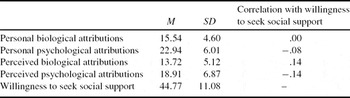
Means and standard deviations for all measures are presented in Table 1. Scores on the depression subscale of the Depression Anxiety Stress Scale – Depression subscale (DASS-D) indicated an average of moderate levels of depressive symptoms in this sample. A total of 27 individuals reported mild levels of depressive symptoms, 30 individuals reported moderate levels of depressive symptoms, and 29 individuals reported severe or extremely severe levels of depressive symptoms. Scores on the Willingness to Seek Social Support Scale (WS4) were slightly lower than those from the norm sample, as would be expected in a depressed sample.
Means, standards deviations, and intercorrelations for the subscales of the Biological and Psychological Attribution Scale for Depression (BPASD) and the Willingness to Seek Social Support Scale (WS4)

Personal attributions
Contrary to Hypotheses 1 and 2, bivariate correlations indicated that neither personal/biological nor personal/psychological attributions for depression were significantly related to willingness to seek social support (see Table 1). Also, when personal/biological and personal/psychological attributions for depression were entered as simultaneous predictors of willingness to seek social support, the regression was nonsignificant (F (2, 79) = .48, p = .62), and neither variable predicted willingness to seek social support (partial r = .05 and −.11, p > .05, respectively).
Perceived attributions
Bivariate correlations also indicated that perceived/biological and perceived/psychological attributions for depression were unrelated to willingness to seek social support (see Table 1). However, when perceived/biological and perceived/psychological attributions for depression were entered as simultaneous predictors of willingness to seek social support, the regression was significant (F (2, 77) = 4.76, p < .05). Consistent with Hypotheses 1 and 2, perceived/biological attributions were related to greater willingness to seek social support (partial r = .29, p < .05), and perceived/psychological attributions were related to decreased willingness to seek social support (partial r = −.30, p < .05). Controlling for covariates did not change the direction or significance of these relationships. Of note, the fact that significant results were obtained for perceived attributions but not for personal attributions was consistent with Hypothesis 3.
Perceived controllable/uncontrollable and internal/external attributions
The unique effects of controllable (e.g. diet, exercise) and uncontrollable forms (e.g. genetics, hormones, chemical imbalance) of perceived/biological attributions and internal (e.g. cognitions, behaviors) and external forms (e.g. upbringing, social environment) of perceived/psychological attributions were then examined by entering all four attributions as simultaneous predictors of willingness to seek social support. The regression was significant (F (4, 75) = 2.57, p < .05). In the regression, perceived/controllable biological attributions (e.g. diet, exercise) predicted greater willingness to seek social support (partial r = .25, p < .05), whereas perceived/uncontrollable biological attributions (e.g. genetics, hormones, chemical imbalance) were nonsignificant (partial r = .13, p = .28). Contrary to Hypothesis 1, this result suggested that the primary positive effect of biological attributions was due to controllable, rather than uncontrollable, biological factors. In this regression, perceived/internal (e.g. cognitions, behaviors) and perceived/external psychological (e.g. upbringing, family environment) attributions were both similarly nonsignificantly related to willingness to seek social support (partial r = −.18, p = .13; partial r = −.18, p = .11, respectively). This finding does not support the latter part of Hypothesis 2, that those psychological attributions that are considered to be internal would be related to lower social support seeking compared to those psychological attributions that are considered to be external. This pattern of results for the specific types of attributions did not change when controlling for covariates, with one exception: when relationship satisfaction was controlled, perceived/external psychological attributions (e.g. upbringing, family environment) for depression were also significantly related to willingness to seek social support (partial r = −.32, p < .01).
Moderation of associations
None of the interactions between proposed moderators (participant gender, platonic friend's gender, depression severity, relationship satisfaction) and attribution variables were significant in the prediction of willingness to seek social support (all ps > .05). This pattern held for both personal and perceived forms of the attribution variables.
Discussion
The purpose of the present study was to extend prior research on attributions and help-seeking behavior in the context of depression. Previous studies have been limited to psychological and biological explanations of illness, without attention to the potential influence of the dimensions of controllability or internality within those explanations. In addition, past studies have examined these variables primarily by asking non-depressed individuals to imagine how they would think and act if they were depressed, and only with regard to individuals’ own attributions, rather than their beliefs about others’ attributions. Furthermore, most studies have focused solely on professional help-seeking, with no investigation of willingness to seek social support. The present study addressed these limitations by: (1) assessing both personal and perceived attributions for depression; (2) focusing on individuals with at least mild levels of depressive symptoms; (3) assessing beliefs related to both controllable (e.g. diet, exercise) and uncontrollable (e.g. genetics, hormones, chemical imbalance) forms of biological attributions for depression, and to both internal (e.g. cognitions, behaviors) and external (e.g. upbringing, family environment) forms of psychological attributions for depression; and (4) examining these factors in relation to willingness to seek social support from platonic friends.
Several findings emerged from this study. There were no significant associations between participants’ beliefs about depression and their willingness to seek social support from a specific friend. In contrast, participants’ perceptions of friends’ biological and psychological attributions for their depressive symptoms showed moderate associations with their willingness to seek social support from those friends. This pattern suggests that it may be important to consider the influence of people's perceptions of others’ beliefs, rather than solely people's own beliefs, when attempting to understand their willingness to seek social support, particularly from more informal sources like friends. These findings are consistent with other studies that have shown that perceptions of distress in a close other, or in this case, perceptions about distress from a close other are more closely related to outcomes and functioning that actual distress or the beliefs about distress by the individual experiencing the distress (Renshaw, Rodrigues and Jones, Reference Renshaw, Rodrigues and Jones2008). No prior research has examined the distinction of personal versus perceived attributions; thus future research is needed to determine whether the findings replicate in other samples. Notwithstanding, the current findings suggest that changing an individual's cognitions about their own distress may not be as important as changing their perceptions of others’ cognitions about their distress. If this is the case, cognitive-behavioral interventions are well-suited to treat such issues.
More specifically, in this sample perceived biological attributions were related to greater willingness to seek social support, and perceived psychological attributions were related to lower willingness to seek social support. Although these attributions together accounted for less than 20% of the variance, the effect sizes were medium. These preliminary findings initially appear consistent with current anti-stigma efforts that promote a biological model of depression in the hopes of increasing help-seeking behavior, such as the psychoeducational materials provided by the National Alliance on Mental Illness (NAMI), which directly implicate the role of faulty neurotransmitter function as the primary cause of depression (NAMI, n.d.). Though NAMI agrees that depression is influenced by a number of psychosocial factors, they clearly explain that depression is a “biological, medical illness” (NAMI, n.d.).
Interestingly, however, in the current study, follow-up analyses revealed that, within perceptions of biological attributions, only the controllable (e.g. diet, exercise) aspects of these attributions were associated with greater willingness to seek social support from platonic friends, whereas the uncontrollable aspects of biological attributions (e.g. genetics, hormones, and chemical imbalances) were unrelated. This pattern is in contrast to current anti-stigma efforts that focus on portraying depression as a biological disease (e.g. NAMI, n.d.). Furthermore, it contradicts previous research that shows that, when people attribute someone's psychological symptoms to controllable factors, they react to that individual in a more negative manner (MacGeorge, Reference MacGeorge2003; McKay and Barrowclough, Reference McKay and Barrowclough2005; Weiner et al., Reference Weiner, Perry and Magnussen1988).
It is possible that controllable forms of biological attributions are less stigmatizing than controllable forms of psychological attributions, while still being associated with a stronger belief in the possibility of change, whereas uncontrollable biological factors are associated with worse perceived prognosis and, thus, less hope for change (see Deacon and Baird, Reference Deacon and Baird2009). This interpretation is, of course, speculative, and there are other interpretations. For example, it is possible that controllable biological attributions could also be associated with beliefs that depression can be changed with maintenance-like behaviors (e.g. behavior change) while uncontrollable biological attributions could be associated with beliefs that depression is caused by structural or organic brain abnormalities. Believing that depression is caused by maintenance-like behaviors may be more likely to lead to support seeking from non-professionals than believing that depression is caused by structural or organic brain abnormalities. Given that this is the first time, to our knowledge, that both dimensions of controllable and uncontrollable biological and psychological attributions have been studied, additional research is needed to further understand the associations found in this study. Notwithstanding the limitations, our results suggest that it is important to separate the dimension of controllability from biological models of depression to gain a better understanding of social support seeking intentions. Further, destigmatization efforts that take a more holistic approach to conceptualizing depression, such as the United Kingdom's Defeat Depression campaign (Paykel, Hart and Priest, Reference Paykel, Hart and Priest1998), may be more effective than campaigns that implement a more simplistic approach of defining depression as the result of a chemical imbalance.
The findings of the current study also have important clinical implications. Specifically, they demonstrate the importance of considering the potential influence of interpersonal perceptions on willingness to seek social support. In the context of clinical samples, our results suggest that it may be important to explore with clients the impact of their perceptions of how others attribute their depression and how this influences their decision to seek help from them. Exploring factors such as interpersonal perceptions is consistent with cognitive therapy for depression, as cognitive therapy teaches individuals to evaluate the accuracy of their beliefs, based on the notion that individuals who are depressed may interpret interpersonal behavior more negatively than individuals who are not depressed.
There are several limitations that should be acknowledged when considering the present findings. First, the use of a cross-sectional design prohibits the inference of any causal conclusions. Longitudinal data that examine relationships of these constructs over time could help address the directionality of relationships. Second, although this is the first study to include individuals experiencing at least mild depressive symptoms, the use of a college analog sample still limits the generalizability of the findings. Moreover, our sample was comprised of mostly White students, leaving open the question of how culture might influence the associations of attributions for depression with willingness to seek social support. Additionally, the participants were all students in psychology classes, and these students may have a unique understanding of depression and its causal factors. Further research of these variables in different cultures and in a clinical population of depressed individuals is needed. Third, these findings are limited to social support seeking intentions in platonic relationships. The impact of personal and perceived explanations of illness and willingness to seek social support may be different in romantic and familial relationships. Fourth, this study focused on help-seeking intentions, and there is evidence that intentions do not always translate into actual behaviors (Ajzen, Brown and Carvajal, Reference Ajzen, Brown and Carvajal2004). Although help-seeking intentions are an important variable, future studies are needed to also examine actual help-seeking behaviors. Finally, the test-retest reliability of the Biological and Psychological Attribution Scale was low, and additional research is needed to further examine the psychometric properties of this measure over time.
Despite the limitations, this study provides novel information regarding the association of attributions with willingness to seek social support in platonic relationships. In particular, the indication that people's perceptions of others’ attributions are more strongly related to their willingness to seek social support than are their own attributions highlights the need to include interpersonally-based perceptions in this area of research. Also, the finding that uncontrollable biological attributions (e.g. genetics, hormones) were not associated with willingness to seek social support implies that future research should focus on examining the differential impact of both controllable (e.g. diet, exercise) and uncontrollable biological attributions on willingness to seek social support, particularly if anti-stigma campaigns continue to present depression as a biological illness in the hopes of increasing help-seeking (professional help or social support). It is our hope that these findings will spur further research on these concepts to increase our understanding of the potential impact of attributions on willingness to seek social support. behaviors.



Comments
No Comments have been published for this article.