1. Introduction
The soft-bodied arthropods of the Lower Cambrian Zawiszyn Formation of Poland represent the oldest record of Burgess Shale-type metazoans in the fossil record (Conway Morris, Reference Conway Morris1989; Moczydłowska, Reference Moczydłowska2002; Gaines, Reference Gaines, Laflamme, Schiffbauer and Darroch2014). Lendzion (Reference Lendzion1975) described three soft-bodied arthropods from this fauna, namely ‘Pomerania’ infercambriensis, ‘Livia’ convexa and ‘L.’ plana. Both generic names were preoccupied, however, and replaced with Cassubia Lendzion, Reference Lendzion1977 and Liwia Dzik & Lendzion, Reference Dzik and Lendzion1988, respectively. Although the morphology and affinities of Liwia are fairly well understood (Dzik & Lendzion, Reference Dzik and Lendzion1988; Paterson et al. Reference Paterson, Edgecombe, García-Bellido, Jago and Gehling2010), opinion regarding Cassubia has been more equivocal.
In its original description, Cassubia was considered an aquatic chelicerate comparable to the Burgess Shale arthropod Leanchoilia (Lendzion, Reference Lendzion1975). The holotype was thought to consist of an 11 segmented thorax and an enlarged chelicera. The supposed thorax was subsequently reinterpreted as the proximal end of an anomalocaridid-type great-appendage and the chela as the distal region of the same appendage, showing ventral spines (Dzik & Lendzion, Reference Dzik and Lendzion1988). The appendage was compared to Anomalocaris nathorsti ( = Peytoia nathorsti sensu Daley & Bergström, Reference Daley and Bergström2012) (Dzik & Lendzion, Reference Dzik and Lendzion1988; Hou, Bergström & Ahlberg, Reference Hou, Bergström and Ahlberg1995; Delle Cave, Insom & Simonetta, Reference Delle Cave, Insom and Simonetta1998), with some workers suggesting Cassubia should be a junior synonym of Anomalocaris (e.g. Conway Morris & Robison, Reference Conway Morris and Robison1988; Conway Morris, Reference Conway Morris1989; Delle Cave & Simonetta, Reference Delle Cave, Simonetta, Simonetta and Conway Morris1991). At the time, Peytoia was considered a junior synonym of Anomalocaris (see Whittington & Briggs, Reference Whittington and Briggs1985; Collins, Reference Collins1996). Although anomalocaridid affinities for Cassubia were almost universally accepted, not everyone has accepted the morphological interpretation of Dzik & Lendzion (Reference Dzik and Lendzion1988), with some favouring Lendzion's (Reference Lendzion1975) original interpretation (e.g. Bousfield, Reference Bousfield1995; Delle Cave, Insom & Simonetta, Reference Delle Cave, Insom and Simonetta1998). Most recently, the frontal appendages of Cassubia have been interpreted as an incipient condition between the elongate frontal appendages of anomalocaridids and the ‘short-great-appendages’ of megacheirans and chelicerae (Bousfield, Reference Bousfield1995; Haug et al. Reference Haug, Waloszek, Maas, Liu and Haug2012), although given recent neurological data this hypothesis seems unlikely (Tanaka et al. Reference Tanaka, Hou, Ma, Edgecombe and Strausfeld2013; Cong et al. Reference Cong, Ma, Hou, Edgecombe and Strausfeld2014). To resolve this morphological and taxonomical confusion, a restudy Cassubia infercambriensis was undertaken.
2. Material and methods
The only known specimen of Cassubia infercambriensis (PIG 1432 II 22) was originally collected from a borehole drilled near Kościerzyna in northern Poland, approximately 60 km southwest of Gdansk (Lendzion, Reference Lendzion1975). The specimen was found in Kościerzyna IG1 borehole, at a depth of 4920.8 m. The matrix consists of medium grey, fine-grained mudstone, with the specimen preserved as a black, reflective carbon film. The specimen is deposited in the collections at the Geological Museum of the Geological Institute, Warsaw, Poland (PIG).
The age of the sediments containing the specimen was estimated as belonging to the Fallotaspis Zone of the Atdabanian, correlating to Cambrian Series 2, Stage 3. This age determination was based on the presence of Mobergella and acritarchs in the same interval and the presence of trilobites of the Schmidtiellus mickwitzi Zone found higher up in the core (Dzik & Lendzion, Reference Dzik and Lendzion1988). This is older than other Early Cambrian fossil Lagerstätten, namely the Chengjiang and Sirius Passet biotas (Dzik & Lendzion, Reference Dzik and Lendzion1988; Zhang et al. Reference Zhang, Shu, Li and Han2001).
The specimen was examined and photographed both dry and immersed in water, using incident and cross-polarized lighting to increase contrast. A polarizer was fitted to the camera lens in crossed orientation with a second polarized film at the light source. A Canon EOS 500D digital SLR Camera with Canon EF-S 60 mm Macro Lens was used for photography, and was controlled using the EOS Utility 2.8.1.0 program for remote shooting. Images were processed in Adobe Photoshop CS6, to make minor adjustments to contrast, exposure, colour balance and sharpness. Background was removed where necessary. Figures were made using Adobe Illustrator CS6.
3. Systematic palaeontology
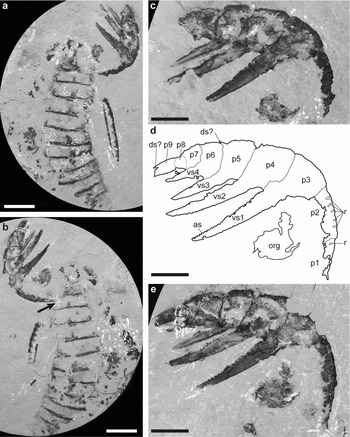
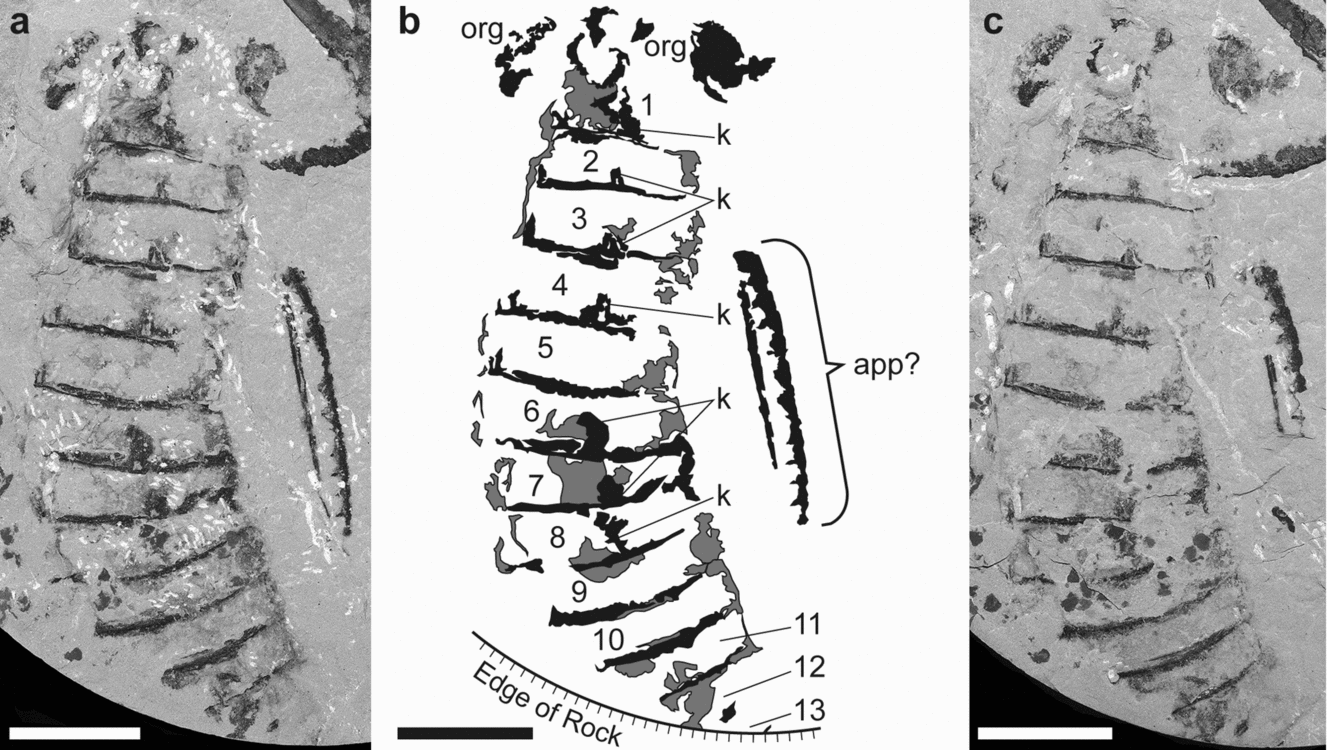
‘Cassubia’ infercambriensis (Fig. 1a, b) is a composite fossil consisting of a Peytoia-like anomalocaridid appendage (Fig. 1c–e) in close association with an unidentifiable arthropod body of non-anomalocaridid origin (Fig. 2). The anomalocaridid appendage is located on a different level of rock to the arthropod body, with separation of 1–2 mm, as indicated by the preparation marks delineating the anomalocaridid appendage from the arthropod body in the counterpart (arrow in Fig. 1b). Preservation of the appendage is darker, more complete and more highly reflective, as compared to the arthropod body. There are two elongated structures (app? in Fig. 2b) positioned next to the arthropod body on the same sediment level and with a similar style of preservation. They may be limbs associated with the arthropod body. Their elongated nature could be suggestive of anomalocaridid appendage ventral spines; however, the width is not comparable to that of the ventral spines of the anomalocaridid appendage on this slab.
Composite fossil from the Lower Cambrian Zawiszyn Formation of Poland, showing Peytoia infercambriensis comb. nov. with an arthropod of uncertain affinity. Photographs of entire specimen (a) part and (b) counterpart. Arrow in (b) indicates preparation marks delineating the anomalocaridid appendage from the arthropod body, which are found on slightly different levels in the rock. (c–e) Close-up of Peytoia infercambriensis comb. nov. Holotype specimen PIG 1432 II 22. (c) Photograph of part. (d) Composite drawing from both part and counterpart. (e) Photograph of counterpart mirrored for consistent orientation. All photographs taken under cross-polarized overhead lighting with specimen submerged in water. Abbreviations: ds – dorsal spines; org – unidentified organic material; p1–p9 – podomeres 1 to 9; r – raised oval ridges; vs1–4 – ventral spines 1 to 4. Scale bars represent 10 mm for (a–b) and 5 mm for (c–e).

Arthropoda gen. et sp. indet. from the Lower Cambrian Zawiszyn Formation of Poland. Photographs of (a) part and (c) counterpart mirrored for consistent orientation, and (b) composite drawing from both part and counterpart. All photographs taken under cross-polarized overhead lighting with specimen submerged in water. Numbers refer to body segments. Abbreviations: app? – possible appendage; k – medial keel-like ridges; org – unidentified organic material. Scale bars represent 10 mm.

Genus Peytoia Walcott, Reference Walcott1911
Type species. Peytoia nathorsti Walcott, Reference Walcott1911 (by original designation).
Emended diagnosis. Anomalocaridid with body subdivided into two distinct tagmata. The non-segmented front part bears large dorsolateral eyes on stalks set well back on the head; a dorsolateral carapace; frontal appendages consisting of 11 subrectangular podomeres with dorsal spines on most podomeres, and five to seven elongated, straight ventral spines with short auxiliary spines along length and straight distal tips; and anteroventral mouthparts consisting of a circlet of 32 radially arranged plates bearing short triangular spines, and with a square to rectangular central opening that lacks inner rows of teeth. The metameric trunk consists of a central body region bearing rows of setal blades, and 14 pairs of triangular body flaps with transverse lines that extend outward laterally and are broadest at segment 7 then tapering in size forwards and back to a blunt body posterior. Tailfan lacking (emended from Collins, Reference Collins1996).
Remarks. Pending a complete redescription of Peytoia, this diagnosis has been substantially emended from Collins (Reference Collins1996) based on detailed descriptions of the frontal appendages (Daley & Budd, Reference Daley and Budd2010; Daley, Budd & Caron, Reference Daley, Budd and Caron2013) and recent comparisons of Peytoia body structures such as the cephalic carapace (Daley et al. Reference Daley, Budd, Caron, Edgecombe and Collins2009), setal blades (Daley et al. Reference Daley, Budd, Caron, Edgecombe and Collins2009; Daley & Edgecombe, Reference Daley and Edgecombe2014) and oral cone (Daley & Bergström, Reference Daley and Bergström2012) with other anomalocaridid taxa.
Discussion. The anomalocaridid appendage described herein is similar to the appendages of taxa such as Peytoia and Hurdia (Daley et al. Reference Daley, Budd, Caron, Edgecombe and Collins2009; Daley, Budd & Caron, Reference Daley, Budd and Caron2013), which have long, wide ventral spines and a relatively low number of podomeres (11 or fewer, as compared to 13 or more in taxa with short ventral spines, such as Anomalocaris) (Daley & Edgecombe, Reference Daley and Edgecombe2014). In overall aspect this taxon is most similar to Peytoia nathorsti from the Burgess Shale, and is therefore referred to the same genus. Both appendages have straight ventral spines that do not curve at their distal tips, and which are angled forward distally (in contrast with Hurdia). Peytoia appendages often do not preserve dorsal spines (fig. 13A–D in Daley, Budd & Caron, Reference Daley, Budd and Caron2013) although rare specimens show they were present on all podomeres (fig. 13E, F in Daley, Budd & Caron, Reference Daley, Budd and Caron2013). A single specimen of Peytoia cf. P. nathorsti from the Balang Formation of China preserves only one dorsal spine on a middle podomere (fig. 3 in Liu Reference Liu2013). The lack of dorsal spines in P. infercambriensis could also be taphonomic. Only four ventral spines are preserved in P. infercambriensis, as compared to five in other species of Peytoia; however, the two more proximal podomeres in P. infercambriensis are highly incomplete, and it is possible that one or both may have had ventral spines that have not been preserved.
Peytoia infercambriensis comb. nov.
Figure 1
Holotype and only known specimen. PIG 1432 II 22.
Justification of type designation. The original description of the holotype specimen included both the anomalocaridid appendage and the arthropod body shown here to be non-anomalocaridid in origin. We designate the appendage specimen alone as the primary type, to the exclusion of the arthropod body found in close proximity. This is in agreement with Article 73.1.5 of The International Code of Zoological Nomenclature (ICZN). Our holotype designation stabilizes the species name and associates it with an identified group (Radiodonta: Hurdiidae: Peytoia), rather than having it attached to a taxonomically unidentified arthropod body.
Diagnosis. Appendage with ventral spines that are half as wide as the ventral margin of the podomere to which they are attached. Pronounced distalward decrease in ventral spine length, with most proximal ventral spine at least four times longer than most distal ventral spine. Auxiliary spines of ventral spines tiny and closely spaced, with as many as 24 per ventral spine.
Description. The anomalocaridid appendage has a mostly complete distal region, and a partial proximal region. The attachment region is completely unknown. Nine podomeres are visible, but the first two most proximal podomeres are highly incomplete and preserve only the dorsal margin, which bear 1 mm long oval ridges arranged perpendicular to the margin (r in Fig. 1d). One oval ridge is present on the first podomere, and five on the second. Podomeres 3 to 8 are roughly rectangular, with wider dorsal margins as compared to the ventral margins. Boundaries between podomeres consist of simple lines with no visible arthrodial membranes and are delineated along the dorsal margin by indentations at the boundary. Podomeres decrease in both height and length towards the distal end of the appendage, imparting a curved, tapering appearance to the appendage. The boundaries of podomere 8 are difficult to see, owing to old preparation marks (p8 in Fig. 1d). Podomere 9 is elongated and pointed, with a small triangular projection that may represent a dorsal spine (ds? in Fig. 1d). A small triangular projection is also seen on the most distal corner of the dorsal margin of podomere 5, which may be another dorsal spine (ds? in Fig. 1d).
Ventral spines project from the distal region of the ventral margins of podomeres 3 to 6 (vs1–vs4 in Fig. 1d). These are straight and angled forwards distally, forming a diminishing angle with the podomere ventral boundary from 60° for ventral spine 3 to 45° for ventral spine 6. Podomeres 7, 8 and 9 do not have visible ventral spines, although this region has undergone extensive preparation that may have obscured some features. The ventral spines are about half as wide at their base as the total width of the ventral margin of the podomere to which they are attached. They taper gradually to a point. The length of the ventral spines decreases towards the distal end, with ventral spine 3 being nearly three times as long as the height of the podomere to which it is attached, while ventral spine 6 is only as long as its podomere is high. The bases of auxiliary spines are visible along most of the distal margin of ventral spine 3 (as in Fig. 1d). These are closely spaced, with less than 1 mm of space between spine bases that are only about 1 mm in width. The tips of the auxiliary spines were not preserved, giving them a truncated appearance.
Remarks. P. infercambriensis differs from other species of Peytoia in the size and number of ventral spines, and the arrangement of auxiliary spines. In P. nathorsti, the ventral spine base is as wide as the ventral margin of the podomere to which it is attached (fig. 13A–E in Daley, Budd & Caron, Reference Daley, Budd and Caron2013), whereas the ventral spines in P. infercambriensis are only half as wide as their podomere (Fig. 1c–e). The distalward decrease in the length of the ventral spines is more pronounced in P. infercambriensis, with the most proximal ventral spine being at least four times longer than the most distal ventral spine. In P. nathorsti, the longest ventral spine is actually the second or third most proximal, which is still at most only twice as long as the shortest, most distal ventral spine (Daley, Budd & Caron, Reference Daley, Budd and Caron2013). The arrangement of auxiliary spines in P. infercambriensis also differs from that of P. nathorsti, which is known to have up to eight widely spaced auxiliary spines that are 1–3 mm in length, slender and projecting at an angle to the ventral spine margin. The length of the auxiliary spines in P. infercambriensis is unknown, but the spacing is tight. At least eight auxiliary spines (as in Fig. 1d) are visible on a well-preserved region of the most proximal ventral spine (vs1 in Fig. 1d), which accounts for only one third of the total length of the ventral spine, suggesting that as many as 24 auxiliary spines were present on that ventral spine. This high number of auxiliary spines is more similar to that seen in the ?Peytoia appendage (Daley & Budd, Reference Daley and Budd2010) from the Tulip Beds locality (Fletcher & Collins, Reference Fletcher and Collins1998, Reference Fletcher and Collins2003; O’Brien & Caron, Reference O’Brien and Caron2012) of the Burgess Shale Formation. This appendage has upwards of 17 auxiliary spines along the distal margin of its ventral spines, and these are also closely spaced (text-fig. 8A in Daley & Budd, Reference Daley and Budd2010) as is seen in P. infercambriensis. The ?Peytoia appendage differs from P. infercambriensis in relative size and arrangement of ventral spines (similar to that described for P. nathorsti above) and also in the details of the terminal end of the appendage, which bears three large, curved dorsal spines not present in P. infercambriensis.
P. infercambriensis could also be compared to the frontal appendages found in the Ordovician Fezouata Biota of Morocco (figs 1l, S3c-d and S4f in Van Roy & Briggs, Reference Van Roy and Briggs2011). The two published specimens from this site were originally compared to the frontal appendages of Peytoia (Van Roy & Briggs, Reference Van Roy and Briggs2011), sharing with this taxon and P. infercambriensis the presence of straight ventral spines angled towards the distal end, simple podomere boundary lines and similar shape and size of podomeres. One of the appendages has prominent dorsal spines that arch over the distal end of the appendage and closely spaced auxiliary spines on the ventral spines (fig. 1l, S4f in Van Roy & Briggs, Reference Van Roy and Briggs2011), similar to those in ?Peytoia (Daley & Budd, Reference Daley and Budd2010). The second appendage differs from P. infercambriensis in having a protracted distal end with numerous terminal spines and widely spaced auxiliary spines on the ventral spines.
Arthropoda gen. et sp. indet.
Figures 1a, b, 2
Description. The remaining material originally referred to ‘Cassubia’ is here putatively identified as the abdomen of an indeterminate arthropod. A total of 13 segments are preserved, each with a slight convexity. Segments appear to transversely widen towards the posterior of the abdomen, reaching their widest at the sixth segment, although the more posterior segments are incompletely preserved in this aspect. The more anterior segments, one to seven, have a straight posterior margin, which becomes more convex owing to the bending of the abdomen. This is most pronounced in segments eight and nine. In at least seven segments a medial keel-like structure can be observed. These keel-like structures extend between a third- and half-way into their associated tergites and taper to a point.
Anterior to the abdominal segments are several fragments of organic material (org in Fig. 2b) of unknown origin. The outermost of these fragments on both the left and right side are roughly oval or round in outline, though highly incomplete. They contain no distinct features, and are difficult to interpret owing to the extensive preparation marks in this region of the fossil. It is unknown if these organic fragments are associated with the arthropod abdomen described here.
A limb-like elongated structure is also associated with this material (app? in Fig. 2b), although its exact affinities are uncertain (see above). If this does indeed represent a limb then it possesses roughly 13 podomeres that taper towards the posterior of the specimen.
Remarks. The morphology of this putative arthropod abdomen is somewhat indistinct but shows some similarities to that of Cambrian bivalved arthropods, particularly Nereocaris (Legg et al. Reference Legg, Sutton, Edgecombe and Caron2012; Legg & Caron, Reference Legg and Caron2014). Nereocaris also possesses wide abdominal somites with straight posterior edges, and in some specimens possess spines on their posterior somites (Legg & Caron, Reference Legg and Caron2014), which may be compressed to resemble the keel-like structure in the material described herein.
The keel-like structure is also reminiscent of the sagittal ridge of mollisoniids. While Mollisonia possesses only 7 thoracic tergites (Briggs et al. Reference Briggs, Lieberman, Hendricks, Halgedahl and Jarrard2008; Zhang et al. Reference Zhang, Zhao, Yang and Degan2002), the mollisoniid Urokodia is characterized by 14 or 15 thoracic tergites (Zhang, Han & Degan, Reference Zhang, Han and Degan2002), in line with the 13 abdominal segments of the incomplete arthropod described here. Mollisoniid thoracic segments typically resemble each other in sagittal length and transverse width (Briggs et al. Reference Briggs, Lieberman, Hendricks, Halgedahl and Jarrard2008; Zhang et al. Reference Zhang, Zhao, Yang and Degan2002; Zhang, Han & Degan, Reference Zhang, Han and Degan2002; Caron et al. Reference Caron, Gaines, Aria, Mángano and Streng2014) and may have elongated lateral spines along their margins (Zhang, Han & Degan, Reference Zhang, Han and Degan2002; Caron et al. Reference Caron, Gaines, Aria, Mángano and Streng2014), but neither of these characteristics is present in the arthropod described here. The two roughly oval fragments of organic material located anterior of the abdomen are similar in relative size and location to the eyes of Mollisonia from the Marble Canyon locality in the Burgess Shale (Caron et al. Reference Caron, Gaines, Aria, Mángano and Streng2014), but the fragmentary nature of the material prevents a more conclusive identification of the anatomy of the anterior region.
Given the non-diagnostic nature of this material it is retained here in open nomenclature.
4. Discussion
Anomalocaridids with appendages bearing long ventral spines have been found in recent phylogenetic analyses (e.g. Vinther et al. Reference Vinther, Stein, Longrich and Harper2014; Cong et al. Reference Cong, Ma, Hou, Edgecombe and Strausfeld2014; Van Roy, Daley & Briggs, Reference Van Roy, Daley and Briggs2015) to be a monophyletic group including the taxa Peytoia (Whittington & Briggs, Reference Whittington and Briggs1985; Daley, Budd & Caron, Reference Daley, Budd and Caron2013), Hurdia (Daley et al. Reference Daley, Budd, Caron, Edgecombe and Collins2009; Daley, Budd & Caron, Reference Daley, Budd and Caron2013), Stanleycaris (Caron et al. Reference Caron, Gaines, Mángano, Streng and Daley2010) and Schinderhannes (Kühl, Briggs & Rust, Reference Kühl, Briggs and Rust2009; Legg, Sutton & Edgecombe, Reference Legg, Sutton and Edgecombe2013). P. infercambriensis has also been placed in this group (Daley & Edgecombe, in prep), which has been referred to as the family Hurdiidae (Vinther et al. Reference Vinther, Stein, Longrich and Harper2014). Previously, the geologically oldest member of the group was Peytoia cf. P. nathorsti from the Balang Formation of China, with an age of Cambrian Series 2, Stage 4 (Liu, Reference Liu2013). The presence of P. infercambriensis in the Cambrian (Series 2, Stage 3) of Poland extends the range of the Hurdiidae family back in time, making these the oldest anomalocaridids in the fossil record. Indeed, P. infercambriensis and the associated arthropod body represent the oldest known examples of Burgess Shale-type preservation (Gaines, Reference Gaines, Laflamme, Schiffbauer and Darroch2014). By Series 3, Stage 5 of the Cambrian, members of the family Hurdiidae are relatively abundant and diverse, including: Peytoia nathorsti, ?Peytoia, Hurdia and Stanleycaris from the Burgess Shale (Daley et al. Reference Daley, Budd, Caron, Edgecombe and Collins2009; Daley & Budd, Reference Daley and Budd2010; Daley, Budd & Caron, Reference Daley, Budd and Caron2013); Hurdia from the Spence Shale (Daley, Budd & Caron, Reference Daley, Budd and Caron2013); and Peytoia nathorsti from the Marjum Formation (Briggs & Robison, Reference Briggs and Robison1984). Aegriocassis benmoulae and other isolated anomalocaridid frontal appendages from the Fezouata Biota of Morocco show similarities to Peytoia and Hurdia appendages, and extend the range of the family Hurdiidae up into the upper Tremadocian and lower Floian of the Ordovician (Van Roy & Briggs, Reference Van Roy and Briggs2011; Van Roy, Daley & Briggs, Reference Van Roy, Daley and Briggs2015). The possible anomalocaridid Schinderhannes with its Hurdia-like frontal appendages extends the range even further into the early Emsian of the Devonian (Kühl, Briggs & Rust, Reference Kühl, Briggs and Rust2009). The morphology of anomalocaridid appendages with long ventral spines, as exemplified by P. infercambriensis, was therefore incredibly long-lived, existing for nearly 110 million years.
P. infercambriensis represents the only known example of an anomalocaridid from the East European Craton, the core of the Baltica continent. Throughout Early and Middle Cambrian time, Baltica is thought to have been a distinct continent located south of Laurentia, South China and Siberia (Landing et al. Reference Landing, Geyer, Brasier and Bowring2013). Peytoia appendages are found later in the Cambrian on both South China and Laurentia. The presence of P. infercambriensis on Baltica fills in a gap in the geographic range of the family Hurdiidae. Peytoia represents the second most geographically widespread morphology of anomalocaridid appendages, with only Anomalocaris being found on more continents in Cambrian time (Daley & Edgecombe, Reference Daley and Edgecombe2014).
5. Conclusions
The anomalocaridids have undergone numerous reinvestigations and interpretations of their anatomy; however, thanks to extensive restudy of pre-existing material and information from new specimens, a more complete and accurate understanding of their morphology and evolutionary history is starting to emerge. Our restudy of Peytoia infercambriensis demonstrates the longevity, both temporally and geographically, and conservative morphology of hurdiid anomalocaridids.
Acknowledgements
Specimen access was facilitated by the kind assistance of Tatiana Woroncowa-Marcinowska at the Geological Museum in Warsaw, Poland. We are grateful to Anna Żylińska at the University of Warsaw for discussions on the geological age of the material, and to Derek Siveter at the Oxford University Museum of Natural History (OUMNH) and Greg Edgecombe at the Natural History Museum for discussions on taxonomic nomenclature. Jonathan Antcliffe provided assistance during data collection and figure design. Comments from reviewers Greg Edgecombe and John Paterson greatly improved the manuscript. This research was funded by the OUMNH.