


Introduction
Randomized controlled trials (RCTs) have demonstrated the efficacy of cognitive behaviour therapy (CBT) for childhood anxiety disorders (Cartwright-Hatton, Roberts, Chitsabesan, Fothergill and Harrington, Reference Cartwright-Hatton, Roberts, Chitsabesan, Fothergill and Harrington2004). Nevertheless, over a third of children still meet diagnostic criteria for an anxiety disorder post-treatment. A stepped care approach may be an efficient, structured way to offer children who have not benefited enough from child focused CBT additional treatment. Stepped care models consist of several treatment phases and systematic assessment after each phase (Bower and Gilbody, Reference Bower and Gilbody2005). More intense treatment is only offered if the current treatment phase does not yield sufficient improvement. Stepped care models thus offer a structured but flexible approach for continued treatment for those who have not benefited from an initial course of treatment.
To our knowledge, no stepped care treatment for childhood anxiety disorders has been systematically evaluated. Ronan, Finnis and Johnston (Reference Ronan, Finnis, Johnston, Jacobs and Reyes2006) proposed a stepped care treatment for childhood post-traumatic stress disorder in which group CBT is first offered, followed by individual and family-based interventions. For adults with an anxiety disorder, studies evaluating stepped care treatment are scarce. Stepped care treatment was described as effective and cost-effective in a pilot study on obsessive compulsive disorder (n = 11; Tolin, Diefenbach, Maltby and Hannan, Reference Tolin, Diefenbach, Maltby and Hannan2005). Collaborative care (which often includes a stepped care approach) has been described as the most effective strategy to improve quality of primary care for adults with an anxiety disorder (Smolders et al., Reference Smolders, Laurant, Roberge, van Balkom, van Rijswijk, Bower and Grol2008). RCTs in primary care on the prevention of anxiety have demonstrated that collaborative care/stepped care is more effective in reducing anxiety symptoms than care-as-usual (Roy-Byrne, Katon, Cowley and Russo, Reference Roy-Byrne, Katon, Cowley and Russo2001; van ‘t Veer-Tazelaar et al., Reference van ‘t Veer-Tazelaar, van Marwijk, van Oppen, van Hout, van der Horst, Cuijpers, Smit and Beekman2009). Stepped care thus seems a promising approach for offering individuals additional therapy when initial treatment has not resulted in a positive outcome.
In the stepped care approach, the duration of treatment and addition of other interventions are relevant. A study of dose-effect relations with adults referred for a variety of problems suggests that symptoms of individuals improve linearly until a “good enough level” is reached (Barkham et al., Reference Barkham, Connell, Stiles, Miles, Margison, Evans and Mellor-Clark2006). Barkham et al. define the good enough level as “the level of improvement at which the client, in negotiation with the therapist and considering all situational factors, decides that he or she has had enough treatment and stops attending therapy”. In other words, at a certain point a person has improved to a level that is good enough. The optimum number of sessions differs per person depending on the type/severity of symptoms (Kopta, Howard, Lowry and Beutler, Reference Kopta, Howard, Lowry and Beutler1994). By increasing the duration of treatment, more children may be able to reach the good enough level. In addition to an increase in duration, treatment in a stepped care model can be intensified, i.e. other treatment components/formats can be included. The additional benefit of intensified parental involvement when treating childhood anxiety disorders has been studied by several authors (e.g. Kendall, Hudson, Gosch, Flannery-Schroeder and Suveg, Reference Kendall, Hudson, Gosch, Flannery-Schroeder and Suveg2008). Although results are inconclusive, some findings suggest treatment with increased parental involvement is more effective for a subset of children: for example, those with anxious parents or those troubled by family dysfunction (Cobham, Reference Cobham1998; Hughes, Hedtke and Kendall, Reference Hughes, Hedtke and Kendall2008). In a stepped care model, treatment with increased parental involvement would only be offered if insufficient improvement occurred after child focused CBT.
The primary aim of the present study was to investigate changes in children with an anxiety disorder during stepped care CBT. A multi-informant approach was used to describe changes in: (1) anxiety diagnoses, (2) symptoms of anxiety and depression, and (3) negative affect and anxiety sensitivity. Literature has demonstrated that some children improve early, i.e. during a child focused CBT, and some do not (Cartwright-Hatton et al., Reference Cartwright-Hatton, Roberts, Chitsabesan, Fothergill and Harrington2004). We investigated change rates during child focused CBT (early change) and change rates after child focused CBT or during additional treatment (late change). We hypothesized that if early improvements did not occur, later improvements may occur during additional treatment. In addition, we compared change rates of children participating only in the child focused CBT with those of children participating in one or both additional treatment phases to explore differences in the patterns of change. The first treatment phase consisted of evidence based CBT. A second and third treatment phase followed if children did not benefit enough from the previous phase. Parental involvement was intensified in treatment phases 2 and 3 to provide additional opportunities to reach a good enough level.
Method
Participants
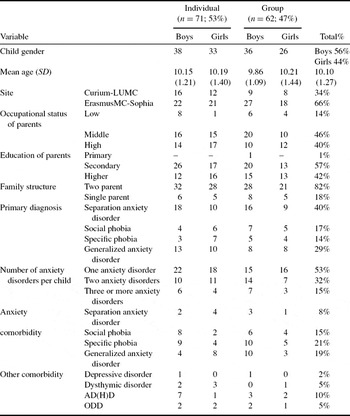
This nonrandomized stepped care study is part of a larger study that also investigated predictors and outcome of individual versus group treatment in the first phase of the treatment (see Liber et al., Reference Liber, van Widenfelt, Utens, Ferdinand, Van Der Leeden, van Gastel and Treffers2008). The current study focuses specifically on investigating changes in children during the additional stepped care treatment phases after the initial treatment outcome reported on by Liber et al. (Reference Liber, van Widenfelt, Utens, Ferdinand, Van Der Leeden, van Gastel and Treffers2008). The study was approved by the ethical committee of Leiden University Medical Center and Erasmus Medical Center. Children (8–12 years; N = 142) were included if they met criteria for a primary diagnosis of: separation anxiety disorder (SAD), social phobia (SOP), specific phobia (SP) or generalized anxiety disorder (GAD; American Psychiatric Association, 1994). Nine children declined participation, resulting in an Intention-To-Treat sample (ITT) of 133 participants. Children were referred to one of the participating departments of child and adolescent psychiatry in the Netherlands: Curium, Leiden University Medical Center (Curium-LUMC) or Erasmus Medical Center-Sophia (Erasmus MC-Sophia). Exclusion criteria were: IQ below 85, lack of proficiency in the Dutch language, serious physical disease, substance-related disorder, pervasive developmental disorder, selective mutism, mental disorder due to a general medical condition, schizophrenia or another psychotic disorder, obsessive compulsive disorder, post-traumatic stress disorder, acute stress disorder, medication for anxiety or concurrent psychotherapy within the last 4 months, or not living in a family context. Children with comorbid mood or behaviour disorders or on medication for Attention Deficit Hyperactivity Disorder (n = 5) were not excluded. One hundred and twenty-seven children were randomized to group or individual treatment during the first treatment phase. Six children were not randomized. Since no significant differences in outcome were found between the two treatment formats (Liber et al., Reference Liber, van Widenfelt, Utens, Ferdinand, Van Der Leeden, van Gastel and Treffers2008), the six non-randomized children were added to the n = 127 sample used in Liber et al., resulting in the current ITT sample of 133 children. For further details on participants see Table 1 and Liber et al. (Reference Liber, van Widenfelt, Utens, Ferdinand, Van Der Leeden, van Gastel and Treffers2008).
Demographics (n = 133)

Note: ADHD = Attention Deficit Hyperactivity Disorder; ODD = Oppositional Defiant Disorder.
Measures
Diagnosis. Children and parents were interviewed separately with the Anxiety Disorders Interview Schedule for DSM-IV: Child version (ADIS-C/P), a semi-structured diagnostic interview assessing anxiety, mood and behavioural disorders (Silverman and Albano, Reference Silverman and Albano1996; Dutch version: Siebelink and Treffers, Reference Siebelink and Treffers2001). The Clinician Severity Rating (CSR) ranging from 0 to 8 indicates impairment; 4 or higher indicates a clinically significant level of impairment meeting DSM-IV criteria. Good to excellent test-retest (κ = .62–1.00) and interrater reliability (κ = .65–1.00) are reported for combined diagnoses of the original version (Lyneham, Abbott and Rapee, Reference Lyneham, Abbott and Rapee2007; Silverman, Saavedra and Pina, Reference Silverman, Saavedra and Pina2001).
Child self-reports. The Multidimensional Anxiety Scale for Children (MASC), consisting of 39 items rated on a 4-point scale, was used to assess anxiety symptoms (March, Reference March1997; Dutch version: Utens and Ferdinand, Reference Utens and Ferdinand2000). The total anxiety score has satisfactory to excellent internal consistency (Cronbach's α = .89) and test-retest reliability (mean ICC = .88; Baldwin and Dadds, Reference Baldwin and Dadds2007; March, Sullivan and Parker, Reference March, Sullivan and Parker1999). The Dutch MASC also has satisfactory to excellent internal consistency and test-retest reliability (Cronbach's α = .93, r = .81; Utens and Ferdinand, Reference Utens and Ferdinand2000). Dutch cut-off scores were determined for separate age groups and gender. A score of 53 or above and 70 or above was determined as clinical for boys and girls respectively of 8 to 11 years old. For 12-year-old children scores of 44 versus 59 and higher for boys and girls respectively indicated clinical levels.
The 27-item Children's Depression Inventory (CDI) was administered to assess depression (Kovacs, Reference Kovacs1992; Dutch version: Koot and van Widenfelt). Children chose one of three sentences that best described their feelings over the past 2 weeks. Satisfactory to excellent internal consistency and test-retest reliability (respectively α = .71–.89; r = .56–.87) is reported for the total score of the CDI (Kovacs, Reference Kovacs1992; Sitarenios and Kovacs, Reference Sitarenios, Kovacs and Maruish1999). The Dutch CDI also has good internal consistency (Cronbach's α = .82 for the total score; Koot and van Widenfelt, Reference Koot and van Widenfelt2000).
The Negative Affect Self-Statement Questionnaire (NASSQ) addressed negative mood states by asking children to indicate the frequency of self-statements that occurred in the past week on a 5-point scale (Ronan, Kendall and Rowe, Reference Ronan, Kendall and Rowe1994; Dutch version: van Widenfelt and Treffers, Reference van Widenfelt and Treffers2000). The current version was shortened based on a factor analysis of a Dutch sample. Internal consistency and test-retest reliability of the original NASSQ total score are acceptable to good (total score α = .89–.96, r = .78–.96; Ronan et al., Reference Ronan, Kendall and Rowe1994). The 10-item negative affect subscale (NA) was used for the present study. Internal consistency of this subscale in the current sample was excellent (α = .90).
The Childhood Anxiety Sensitivity Index (CASI) assesses the fear of anxiety and beliefs about consequences of experiencing anxiety in children with 18 (3-point scale) items (Silverman, Fleisig, Rabian and Peterson, Reference Silverman, Fleisig, Rabian and Peterson1991; Dutch version: van Widenfelt, Siebelink, Goedhart and Treffers, Reference van Widenfelt, Franswa, Utens, van der Toorn and Liber2002). The total score of both the original and the Dutch CASI has adequate internal consistency (α = .77–.79) and test-retest reliability (r = .62–.79; Silverman et al., Reference Silverman, Fleisig, Rabian and Peterson1991; van Widenfelt, Siebelink et al., Reference van Widenfelt, Franswa, Utens, van der Toorn and Liber2002).
Parent reports. The Child Behavior Checklist (CBCL), consisting of 118 items rated on a 3-point scale, was used to assess anxious/depressed child behaviour and internalizing symptoms (T scores; Achenbach and Rescorla, Reference Achenbach and Rescorla2001; Dutch version: Verhulst, Reference Verhulst2002). Internal consistency and test-retest reliability are adequate for the original version (α = .84; r = .82 for the anxious/depressed subscale; α = .90; r = .91 for the internalizing subscale; Achenbach and Rescorla, Reference Achenbach and Rescorla2001). Preliminary results of the Dutch version indicate sufficient internal consistency and test-retest reliability (α = .73–.76; r = .79–81 for the anxious/depressed subscale; α = .82–.85; r = .84–.86 for the internalizing subscale; Tick, van der Ende and Verhulst, Reference Tick, Van Der Ende and Verhulst2007).
Treatment
Treatment phase 1. FRIENDS, a CBT for clinically anxious children consisting of 10 child and 4 parent sessions, was administered (Barrett and Turner, Reference Barrett and Turner2000; Dutch version: Utens, de Nijs and Ferdinand, Reference Utens, Nijs and Ferdinand2001). The core elements of CBT for childhood anxiety disorders are included: psychoeducation, somatic management, cognitive restructuring, problem solving, exposure, and relapse prevention. During the parent sessions, psychoeducation is given and the elements of the child program are explained and practised with the parents. Children received FRIENDS in group (n = 62) or individual format (n = 71). No significant differences in outcome were found between the formats in this study (Liber et al., Reference Liber, van Widenfelt, Utens, Ferdinand, Van Der Leeden, van Gastel and Treffers2008). If children completed phase 1 and did not participate in phase 2, two booster sessions were given 1 and 2 months later.
After completing the first treatment phase, children could step up to phases 2 and 3, which comprise the manual-based Parent-Child Treatment for Anxiety (PCTA) with increased parental involvement (van Widenfelt, Franswa, Utens, van der Toorn and Liber, Reference van Widenfelt, Franswa, Utens, van der Toorn and Liber2002). Parents and child participated in each PCTA session: some parts of the sessions were conjoint; other parts were for the child or parents only. Parental involvement in treatment was also increased by including additional strategies and interventions for parents.
Treatment phase 2. Treatment phase 2 consisted of PCTA sessions 1–5. During the first PCTA session an evaluation was conducted with child and parents about what had helped and not helped during treatment. During all PCTA sessions the child continued practising the skills and exposure exercises together with his or her parents. A new element introduced in the second PCTA session was the FEAR task (Barrett, Rapee, Dadds and Ryan, Reference Barrett, Rapee, Dadds and Ryan1996). During the FEAR task possible interpretation biases and avoidance tendencies that child or parents may have in ambiguous situations were tested and discussed. During PCTA session three, cognitions parents had about their child that may interfere with the child's progress were addressed (for example, overprotective thoughts). Cognitive restructuring of these thoughts was applied in PCTA session four. A key focus during PCTA session five was the communication between child and parents, including topics such as acknowledging and encouraging the child and solving problems together. While in the FRIENDS program psycho-education was given on some of the same topics, in the PCTA treatment these topics were discussed in more depth. Children and parents practised together during and outside the PCTA sessions while in the FRIENDS program the child conducted exercises alone (or with peers if the child had participated in group therapy).
Treatment phase 3. Treatment phase 3 included five additional sessions (PCTA 6–10). New elements for parents were introduced in PCTA session six on interparental communication and coping with parenting stress. From PCTA session seven onward no new topics were introduced. Instead, the focus was on transfer of control from therapist to parents to child (Silverman and Kurtines, Reference Silverman, Kurtines, Hibbs and Jensen1996). The role of the therapist shifted to the background as the role of parents in helping and supporting their child was emphasized. The child continued with exposure while parents continued exercises focused on observing and communicating. Finally, relapse prevention was addressed.
Treatment adherence
An average of 94% of the goals in the child sessions and 85% for the parent sessions of the first treatment phase were delivered as intended (Liber et al., Reference Liber, van Widenfelt, Utens, Ferdinand, Van Der Leeden, van Gastel and Treffers2008). For the PCTA an average of 73% of the session goals was delivered as intended for phase 2, 71% for phase 3. The lower adherence could be due to the more complex cases participating in the additional treatment (Perepletchikova and Kazdin, Reference Perepletchikova and Kazdin2005).
Procedure
For a description of informed consent and randomization of group versus individual treatment in the first treatment phase see Liber et al. (Reference Liber, van Widenfelt, Utens, Ferdinand, Van Der Leeden, van Gastel and Treffers2008). In total, the study encompassed six assessments including two pretests (Time T0 and T1), an assessment midway during treatment phase 1 (T2), an assessment after phase 1 (T3), an assessment after phase 2 (T4), and the final assessment a year after T1 (T5). Note, if treatment was completed after phase 1, T4 was conducted before the first booster session. For those children participating in all three treatment phases, T5 was at the same time an evaluation of the third treatment phase since the assessment after PCTA session 10 and T5 coincided.
The ADIS-C/P was administered before treatment started, after each treatment phase and at T5. The ADIS-C/P before treatment was administered by licensed psychologists or master level students supervised by licensed psychologists. Sequel interviews were conducted by trained master level students or psychologists. Training consisted of reading literature regarding the ADIS-C/P and anxiety disorders, observing and scoring live and videotaped interviews, and conducting an interview under supervision of first or fourth author. The MASC and CDI were administered on all occasions. The CASI and NASSQ were given at T1, T3 and T5.
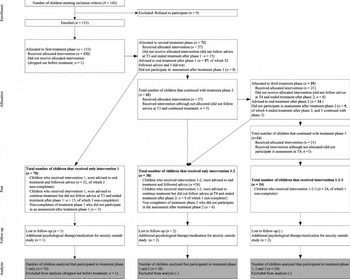
Children diagnosed with an anxiety disorder and/or who scored above the cut-off of the MASC after treatment phase 1 were advised to continue with the next phase; the same applies to assessments after phase 2. Flexibility was employed: some families (n = 23) decided to end treatment after completing a phase even though the child was still diagnosed with an anxiety disorder, and some (n = 5) wanted to continue with a next phase even though no childhood anxiety disorder was diagnosed. In retrospect, three groups were formed, based on the treatment phases the child had participated in, from here on referred to as intervention 1, 1–2 and 1–2–3. Of the ITT sample (n = 133) 70 children participated in intervention 1, 38 in intervention 1–2, and 24 in intervention 1–2–3. One child dropped out before receiving any treatment. Further details on participant flow, drop-out, children not following the advice, and children using medication for anxiety or seeking treatment after the stepped care treatment are presented in Figure 1.
Participant flow

Data analyses
The three interventions and two sites were compared on all demographic and pretreatment variables by conducting one-way ANOVA's, t-tests and χ2 analyses. To investigate changes in children during the stepped care CBT we determined the percentages of children free of any anxiety disorder after each treatment phase (based on composite diagnoses) and applied Multilevel Analysis (MLA) to model changes on the continuous variables. Results of the ITT sample are reported. Analyses were repeated for the 105 children that followed advice, thus excluding the 28 children that did not follow advice to continue or discontinue treatment.
As explained in the introduction, we studied two separate linear models for each measure: changes during phase 1 (early change; T0/T1-T3) and changes after the first phase (late change; T3-T5). Thus the data of T3 were included twice in the analyses. Two levels were included in the models representing repeated measures (level 1) nested within a person (level 2). Each model contained a dependent variable (representing changes on a specific measure) and independent variables. The main predictor/independent variable in each model was the parameter of the variable time (recoded into 0 and 1 or 0, 1, and 2) indicating the change rate. To control for baseline differences between the three interventions, the variable intervention (recoded into two dummy/indicator variables) was included as predictor. Interaction effects of time by intervention were included as predictors in order to compare change rates of children participating only in the child focused CBT and children participating in one or both additional treatment phases. In all multilevel models we controlled for age, gender, diagnosis, site and the pretreatment variables that were significant in the pretreatment comparisons by including these in the models as predictors if significant. Continuous pretreatment predictors were centered, i.e. the grand mean was subtracted.
Change rates were modelled as linear effects. Variance components regarding intercept and slope (of the time variable) were allowed in all models if significant. Fixed effects were tested using two-tailed z-tests, except for time where we explicitly used one-tailed z-tests because we expected a decrease. Variance components were tested with the χ2 distributed likelihood ratio test assessing significance of model improvement.
Results
Pretreatment comparisons
Several significant between group differences for the interventions were found for the pretreatment variables: number of anxiety disorders per child (pre-anxiety) F(2,129) = 3.18, p = .045, severity of SAD (pre-SAD) F(2,129) = 5.33, p = .006, CBCL internalizing T score of mothers (pre-CBCL-int-M) F(2,122) = 4.89, p = .009, CBCL anxiety score of mothers (pre-CBCL-anx-M) F(2,126) = 4.89, p = .009, and treatment format (individual or group) χ2(2,n = 132) = 6.02, p = .049. Bonferroni corrected post-hoc tests for pre-anxiety, pre-SAD, pre-CBCL-anx-M, and pre-CBCL-int-M indicated that values for all four variables were higher as treatment duration increased, but only children participating in intervention 1–2–3 had significantly higher scores than children in intervention 1 (p < .05). More children participating in intervention 1 only had received individual treatment (n = 44) rather than group treatment (n = 26). No significant differences were found between individual or group treatment format for the children participating in intervention groups 1–2 and 1–2–3 (for intervention group 1–2 n = 15 children received individual treatment, n = 23 group treatment; for intervention group 1–2–3 n = 11 children received individual treatment and n = 13 group treatment).
Significant between group effects for site were found for: pre-anxiety t(68) = −3.33, p = .001, comorbid AD(H)D/ODD χ2(1, n = 133) = 4.54, p = .046, severity of SP (pre-SP) t(73) = −2.05, p = .044, and CBCL internalizing T score of fathers (pre-CBCL-int-F) t(105) = −2.12, p = .036. Pre-anxiety, pre-SP and pre-CBCL-int-F were significantly higher in Curium-LUMC. More children had comorbid AD(H)D/ODD in Curium-LUMC. No significant differences were found for other pretreatment and demographic variables. In addition to age, sex, diagnosis, site and intervention, the pretreatment variables pre-anxiety, pre-CBCL-int-M and treatment format were included in the multilevel models if significant.
Main analyses
Changes in anxiety diagnoses. At T3, 60 of 70 children participating only in intervention 1 (86%; 45% of the ITT sample of 133 children) no longer met criteria for any DSM-IV anxiety disorder. At T4, 23 of 38 children (61%; 17% of 133) who participated in intervention 1–2 were free of any anxiety disorder. Of the 24 children who participated in intervention 1–2–3, 14 children (58%; 11% of 133) were free of any anxiety disorder. In total at T5, 98 children (74%) were free of any anxiety disorder.
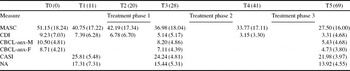
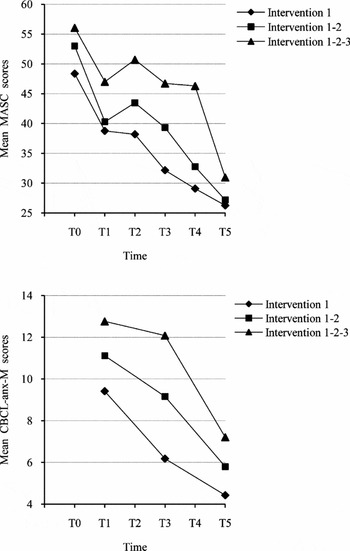
Early change in anxiety and depression. See Table 2 for the mean number of weeks between assessments, timing of the interventions, and means and standard deviations of the continuous variables (raw scores). In Figure 2 the changes over time of the MASC and CBCL-anx-M are depicted for each intervention. A pretreatment decrease in MASC and CDI scores was found for all interventions. To ensure we only described changes during treatment, we chose to model changes starting from T1.
Means (SD) of continuous measures (raw scores) at each timepoint (average week)

Note: MASC = Multidimensional Anxiety Scale for Children; CDI = Children's Depression Inventory; CBCL = Child Behavior Checklist; anx = anxious/depressed subscale; M = reported by mothers; F = reported by fathers; CASI = Childhood Anxiety Sensitivity Index; NA = Negative Affect subscale.
Patterns of change per intervention on the Multidimensional Anxiety Scale for Children (MASC) and the anxious/depressed subscale of the Child Behavior Checklist reported by mothers (CBCL-anx-M)

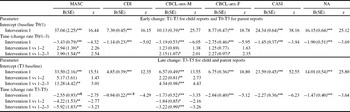
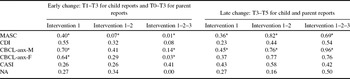
In Table 3, baselines are reported, with intervention group 1 as reference group. Differences in baseline between children participating in intervention 1 versus 1–2 and 1–2–3 are reported below. Differences in baseline were initially significant on the MASC, CDI, CBCL-anx-M, and CBCL-anx-F, but were no longer significant after adding interaction (time by intervention) and pretreatment variables. The parameters of the predictor time indicate the change rate for intervention 1. All measures showed a significant decrease over time on average (see Table 3). Corresponding standard errors and z-values are given for baseline, differences in baseline, and change rate. Significant pretreatment variables were pre-SAD, age and sex for changes on the MASC, pre-CBCL-int-M and severity of SOP (pre-SOP) for changes on the CDI, and pre-CBCL-int-M and severity of GAD (pre-GAD) for changes in CBCL-anx-M and CBCL-anx-F. Directions of effects of pretreatment variables were similar for all models, i.e. more severe disorders and older children predicted higher scores. If the child was a girl, this predicted a higher score on the MASC. In Table 4 effect sizes for changes over time for each intervention group are given.
Changes during and after treatment phase 1. Results for multilevel analyses: fixed effects for time, intervention, and interaction of time by intervention

Note: MASC = Multidimensional Anxiety Scale for Children; CDI = Children's Depression Inventory; CBCL = Child Behavior Checklist; anx = anxious/depressed subscale; M = reported by mothers; F = reported by fathers; CASI = Childhood Anxiety Sensitivity Index; NA = Negative Affect subscale.
*p < .05 **p ≤ .01 ***p ≤ .001
RRandom effects allowing individual slope variance were added to the model. The multilevel models were applied in the form of: Yij = B0ij + B1timeij + B2intervention2j + B3intervention3j + B4time.intervention2ij + B5time. intervention3ij where B0ij represents the intercept and consists of a fixed part B0 and random variation in of the scores of each subject u0j and observations over time e0ij. timeij represents the change rate. intervention2 and intervention3 are indicator variables of the three conditions. The time.intervention terms are the interaction variables representing differences in change rates across interventions. The subscript j refers to the subject level, the subscript i refers to the observations within subjects or the repeated measures. Full model information including deviance and variance component estimates and estimated parameters for the controlled for pretreatment variables is available on request. Random variation in intercept (allowing individual variance in baseline) was significant for all models. Random variation in slope was significant only for late changes on the MASC and CDI, resulting in an additional variance component for B1: B1jtimeij = B1 + u1j where B1j represents the coefficient of the change rate and consists of a fixed part B1 and random variation in the change rate of each subject u1j.
Effect sizes (d) of changes over time for each measure per intervention group

Note: Effect sizes were calculated by subtracting the pretest mean from the posttest mean, divided by the standard deviation of the pretest mean (A. Feingold, personal communication, 10 May 2010). The values are an indication of changes over time in each intervention group, but do not take into account maturation bias due to the lack of available data or a control group necessary to estimate the maturation effect
*Significant differences in change rate between intervention groups were found in the multilevel analyses.
Late change in anxiety and depression. Again, all measures decreased significantly over time on average (see Table 3). The difference in T3 baseline between all interventions was significant for the CBCL-anx-M. The difference in T3 baseline between intervention 1 and 1–2–3 was significant for the MASC. The difference between intervention 1 and 1–2 was not significant for the MASC and CBCL-anx-F after adding interaction and pretreatment variables. Pre-CBCL-int-M was a significant pretreatment variable in the prediction of changes on the MASC, pre-CBCL-int-M and pre-SOP for changes on the CDI, and pre-CBCL-int-M and pre-GAD for changes in CBCL-anx-M and CBCL-anx-F. More severe disorders/symptoms predicted higher scores.
Early change in negative affect and anxiety sensitivity. Means and standard deviations are reported in Table 2. Differences in baseline between children participating in intervention 1 versus 1–2 and 1–2–3 were not significant for the CASI or NA and were left out of the model. Both measures showed a significant decrease over time, as can be deduced from Table 3 by the significant change rates. Site and sex were significant pretreatment variables in the prediction of change on the CASI. Girls and children from Curium had higher CASI scores. Age, sex and pre-SOP were significant in the prediction of changes in NA. Directions of effects of the pretreatment variables corresponded with those in the models on early change.
Late change in negative affect and anxiety sensitivity. No differences in T3 baseline were found, indicating an overall baseline value for all three intervention groups was the best fit in the model. Again, both the CASI and NA decreased significantly over time on average. Site was included as significant pretreatment variable in the model on changes in the CASI score. Age, sex, pre-SOF, pre-SAD, and site were significant in the prediction of change in NA. Directions of these effects were similar to findings in the other models.
Differences in change rates during early and late change. Because differences in change rates (i.e. the interaction of time by intervention) during early change are clinically less relevant, we will focus on differences in change rates after T3 and refer to Table 3 for further details. The interaction effects of time by intervention were significant for all interventions for the MASC and CBCL-anx-M, indicating significantly stronger improvements for children participating in intervention 1–2 and 1–2–3 compared to 1.
Children following advice. Analyses were repeated for children that followed the advice to continue or discontinue treatment, thus excluding the 28 children that did not follow the advice. Results on the children following the advice were similar to the results on the ITT sample (74% was free of any anxiety disorder in the ITT sample; 79% was free of any anxiety disorder in the subgroup that followed the advice (n = 105)). Children improved significantly over time for early as well as late change on all measures. Similar results were also found for differences in baselines and change rates.
Discussion
In this nonrandomized clinical study changes in children with an anxiety disorder were investigated during a stepped care treatment. Parental involvement increased during the successive treatment phases. Pretreatment comparisons indicated that children who had participated in more treatment phases had more anxiety disorders, more severe SAD, higher mother-reported pretreatment internalizing or anxiety/depression symptoms and had more often participated in group treatment during the first phase. After the first treatment phase 45% of the children (ITT sample) no longer met criteria for any anxiety disorder; after the second phase an additional 17%, and after phase 3 an additional 11% was free of any anxiety disorder. In total, 74% of the children was free of any anxiety disorder. Child-reported anxiety, depression, negative affect and anxiety sensitivity as well as parent-reported child anxiety/depression symptoms decreased significantly. In addition, there were significant differences in average change rates for children participating in different treatment phases. The children who continued treatment improved significantly during the additional treatment phases.
The percentages of children free of any anxiety disorder in the present study are among the highest recovery rates reported in the literature to date, for example compared to the 56.5% remission rate reported in a review (Cartwright-Hatton et al., Reference Cartwright-Hatton, Roberts, Chitsabesan, Fothergill and Harrington2004). Compared to other studies, the decrease in raw MASC and CDI scores in the present study was larger (e.g. Kendall et al., Reference Kendall, Hudson, Gosch, Flannery-Schroeder and Suveg2008; Nauta, Scholing, Emmelkamp and Minderaa, Reference Nauta, Scholing, Emmelkamp and Minderaa2003; Wood, Piacentini, Southam-Gerow, Chu and Sigman, Reference Wood, Piacentini, Southam-Gerow, Chu and Sigman2006). When comparing effect sizes on the MASC used in the current study with the findings of Kendall et al. (Reference Kendall, Hudson, Gosch, Flannery-Schroeder and Suveg2008), effect sizes for the first treatment phase appear lower than those reported by Kendall et al. Effect sizes during the second and third treatment phase are higher than that reported by Kendall et al., who found small to medium effects of 0.36 and 0.41 respectively for the control slope for pre to post changes and post to follow-up changes. In the current study we found small to medium effect sizes for pre to post treatment phase 1 ranging from 0.01 to 0.40, and for post treatment phase 1 until the final assessment small to large effects of 0.36 to 0.82. The changes in negative affect found in this study are smaller than those reported in the RCT by Kendall et al. (Reference Kendall, Flannery-Schroeder, Panichelli-Mindel, Southam-Gerow, Henin and Warman1997). The decrease in CBCL internalizing T scores are similar to reports by Kendall et al. (Reference Kendall, Hudson, Gosch, Flannery-Schroeder and Suveg2008) and Nauta et al. (Reference Nauta, Scholing, Emmelkamp and Minderaa2003). Effect sizes for pre to post changes reported by Kendall et al. (0.49 for mother reports and 0.28 for father reports) are small to medium and seem similar to the pre to post treatment phase 1 changes found in the current study (0.14–0.70 for mother reports and.03–0.64 for father reports). Effect sizes for post treatment phase 1 until the final assessment (medium to large effects: 0.45–0.96 for mother reports and 0.37–0.77 for father reports) appear larger than effect sizes reported by Kendall et al. for both pre to post treatment changes and post to follow-up changes (medium effect sizes: post to follow-up mother reports: 0.41, father reports: 0.63). Results from pretreatment comparisons suggest children with more or more severe disorders needed more treatment. These results are in line with the findings of predictor studies on treatment outcome of childhood anxiety disorders (Berman, Weems, Silverman and Kurtines, Reference Berman, Weems, Silverman and Kurtines2000; Southam-Gerow, Kendall and Weersing, Reference Southam-Gerow, Kendall and Weersing2001). Pretreatment comparisons also indicated that children who were randomized to group treatment in phase 1 participated in more treatment phases in total. This finding does not seem in line with other studies, since results of previous studies (e.g. Manassis et al., Reference Manassis, Mendlowitz, Scapillato, Avery, Fiksenbaum, Freire, Monga and Owens2002) indicated no significant differences. Results on the current sample (Liber et al., Reference Liber, van Widenfelt, Utens, Ferdinand, Van Der Leeden, van Gastel and Treffers2008) indicated no clinically significant differences in outcome between individual and group treatment for childhood anxiety disorders. We hypothesized that more families randomized to individual treatment ended treatment against the advice because they felt confident enough to continue practising skills on their own. Families participating in individual treatment had received a first treatment phase that was tailored to their specific situation. Families participating in treatment in a group format may have decided, in accordance with the advice, that continuing with five individual parent-child sessions offered benefits, because it would provide more opportunities to discuss their own specific problems in more detail. To investigate this hypothesis, we calculated the Odds Ratio for individual and group treatment for the subgroup of families that had either stopped (n = 13) or continued (n = 5) after treatment phase 1 against the advice. If a family had ended treatment against the advice, it was 5.0 times more likely they had received individual treatment than group treatment, supporting our hypothesis.
Studies on the treatment of childhood anxiety usually end after the initial CBT and follow-up assessments. This is the first study to investigate changes in children during additional standardized, assessment based treatment for those not benefitting enough from child focused CBT. Spielmans, Pasek and McFall (Reference Spielmans, Pasek and McFall2007) report in a meta-analysis that change is often seen at the beginning of treatment. However, our results indicate that a subset of children only improve during later/additional treatment. Previous studies have written about early/rapid response but “delayed” responders may benefit from stepped care, which provides them more opportunities to reach their good enough level.
Although findings of this nonrandomized study support the use of stepped care for childhood anxiety disorders, conclusions about the efficacy of stepped care over care-as-usual or any other condition cannot be drawn, given the absence of a control condition and lack of randomization. The lack of control for natural improvement is partially inherent to the stepped care design, since it would be unethical to assign children to a waiting list after a first treatment phase if they needed further treatment. It remains uncertain whether children who did not respond initially would have improved during follow-up without additional treatment, as is found by Silverman et al. (Reference Silverman, Kurtines, Ginsburg, Weems, Lumpkin and Carmichael1999). Silverman et al. report that 64% of the children were free of their primary diagnosis at post-treatment, and 77% after 3-month follow-up (76% of the children participated in the assessment) indicating an increase of 13%. During 3 to 6 months follow-up the percentage of children free of their primary diagnosis increased a further 2% (82% of the children participated in the assessment). The 17% and 11% of children free of any anxiety disorder after the additional treatment phases found in the current study are higher than the percentages Silverman et al. reported. Although no firm conclusions can be drawn, the improvements found in the current study may exceed changes attributed to natural improvement.
Further interpretation of improvements in children during the second and third treatment phase is complicated by the fact that additional treatment was not only characterized by an increase in sessions but also by additional interventions for parents. Thus, we do not know if a mere increase in therapy is enough when offering continued treatment or whether intensive participation of parents during treatment is necessary. It is possible that different elements are beneficial depending on the anxiety disorder of a child and characteristics of parents. For example, the increased involvement of parents may be more efficacious for children with SAD, or parents with an anxiety disorder, or overprotective parenting style as Cobham (Reference Cobham1998) and Hughes et al. (Reference Hughes, Hedtke and Kendall2008) suggested. Finally, it should be noted that 22 families did not follow the advice to continue treatment after phase 1 or phase 2, and that five families were advised to stop treatment after phase 1 but asked if they could continue with treatment. The majority that did not continue, although advised to do so, faced practical or motivational difficulties. Given this was quite a large number of families it may have confounded the results. However, analyses were repeated with exclusion of this subgroup and indicated results were similar to the results of the entire ITT sample (74% of the children were free of any anxiety disorder in the ITT sample; 79% of the children were free of any anxiety disorder in the sample that followed the advice).
There are a number of possible limitations and considerations to keep in mind when interpreting the findings of the current study. First, although the Dutch version of the ADIS-C/P was made in close consultation with the original authors, no additional reliability rates have yet been established for the Dutch translation of the ADIS-C/P. Second, the interrater reliability of ADIS raters between the two sites was not assessed, though the trained master level students did receive regular supervision by the first and fourth author to maintain quality and prevent rater drift. The psychologists conducting the ADIS-C/P interviews at Time 1 also met regularly. Further, post treatment ADIS raters were not blind to the format (individual versus group) and amount of treatment a child had received. These limitations may have influenced the diagnostic outcomes.
In comparison to previous RCTs on the treatment of childhood anxiety disorder, several differences must be noted. The age range of the current study is limited to primary school aged children (8–12 years), whereas other trials usually include a wider age range (i.e. Kendall et al. (Reference Kendall, Hudson, Gosch, Flannery-Schroeder and Suveg2008) included children aged 7–14). The current sample may therefore include children with less or less severe anxiety disorders than the Kendall et al. study since, for example, prevalence rates of social phobia and generalized anxiety disorder increase with age (Grills-Taquechel and Ollendick, Reference Grills-Taquechel and Ollendick2007). Comorbidity rates for SAD, SOP, SP and GAD in the current sample were 8%, 15%, 21% and 19% respectively, whereas Kendall et al. (Reference Kendall, Hudson, Gosch, Flannery-Schroeder and Suveg2008) report 32%, 37%, 53%, and 24% respectively. In addition, comorbidity rates of depression were lower in our sample (5% dysthymia, 2% depressive disorder) compared to Kendall et al. (Reference Kendall, Hudson, Gosch, Flannery-Schroeder and Suveg2008; 6% dysthymia, 5% depressive disorder). These differences could be related to the lower age range of children in the current study, as prevalence of depression is higher during adolescence (American Academy of Child and Adolescent Psychiatry, 2007). Furthermore, children with SP were included in the current sample, while RCTs on childhood anxiety usually only include children with GAD, SOP and SAD.
The amount and type of treatment in the current study depended on individual child improvements. Compared to RCTs the strength of this design is that treatment is tailored to the child's needs. In order to determine if stepped care is more efficacious than treatment-as-usual or any other condition, future studies could randomize children to stepped care versus an alternative condition prior to treatment. To investigate the efficacy of additional treatment different stepped care models could be compared; e.g. a stepped care model with an increase in duration only versus a stepped care model with an increase in duration as well as an increase in parental participation in treatment. A design that may accelerate the search for efficacious treatment doses and components is a sequential, multiple assignment, randomized trial to study multiple treatment components and dosages at once (Collins, Murphy and Strecher, Reference Collins, Murphy and Strecher2007). Future studies could also determine if stepped care treatment is more cost effective than care-as-usual. To increase efficiency and reduce health care costs, a self-help component could precede the current child focused CBT as a less intensive but effective first treatment phase. Recent studies, that were not yet available when the current study started, have demonstrated that after bibliotherapy and CBT partially delivered through the internet, 18% and 52% respectively of the participating children were free of anxiety disorders (Rapee, Abbott and Lyneham, Reference Rapee, Abbott and Lyneham2006; Spence, Holmes, March and Lipp, Reference Spence, Holmes, March and Lipp2006). Modularized treatment and stepped care could be combined to tailor the treatment further with interventions for specific childhood anxiety disorders, comorbid disorders or parental characteristics. For example, additional treatment with more parental involvement could be offered to children with anxious or overprotective parents.
To the authors’ knowledge, this is the first study exploring changes in children during a stepped care treatment for childhood anxiety disorders. The decreases in diagnoses, symptoms and anxiety related cognitions and affect suggest that stepped care treatment may be of additional value to current child focused CBT available for childhood anxiety disorders. The current study demonstrated that the stepped care treatment provides therapists with a structured additional treatment if children are still diagnosed with an anxiety disorder after initial CBT. By providing a structured, additional treatment more children may reach their good enough level and will be able to continue their daily lives and development without the burden of an anxiety disorder.
Acknowledgements
This research was supported by a grant from the Netherlands Foundation for Mental Health. Clinical trials registry: ISRCTN48511871.



Comments
No Comments have been published for this article.