Introduction
In many wealthy countries, immigrants and ethnic minorities are exposed to multiple socio-environmental risk factors that can lead to health and health care disparities (Stanciole & Huber, Reference Stanciole and Huber2009; Grabovschi et al. Reference Grabovschi, Loignon and Fortin2013). As regards mental disorders, evidence on the prevalence among immigrant populations is inconsistent across epidemiological studies (Swinnen & Selten, Reference Swinnen and Selten2007; Bhugra et al. Reference Bhugra, Gupta, Bhui, Craig, Dogra, Ingleby, Kirkbride, Moussaoui, Nazroo, Qureshi, Stompe and Tribe2011) for several reasons, such as immigrant groups examined, disorders of interest, country of origin, host country-specific factors, duration of post-immigration process and generations investigated. However, it is well established that low socio-economic status, poverty, social deprivation, discrimination and isolation are frequent in the immigrant population (Patel et al. Reference Patel, Araya, de Lima, Ludermir and Todd1999; Allardyce et al. Reference Allardyce, Gilmour, Atkinson, Rapson, Bishop and McCreadie2005; Tinghög et al. Reference Tinghög, Hemmingsson and Lundberg2007; Lindert et al. Reference Lindert, Schouler-Ocak, Heinz and Priebe2008; Veling et al. Reference Veling, Susser, van Os, Mackenbach, Selten and Hoek2008; Bhugra et al. Reference Bhugra, Gupta, Bhui, Craig, Dogra, Ingleby, Kirkbride, Moussaoui, Nazroo, Qureshi, Stompe and Tribe2011; Koopmans et al. Reference Koopmans, Uiters, Devillé and Foets2012; Vick et al. Reference Vick, Jones and Mitra2012) and may enhance susceptibility to common mental disorders (Das-Munshi et al. Reference Das-Munshi, Leavey, Stansfeld and Prince2012) or, even more, to psychoses (Zolkowska et al. Reference Zolkowska, Cantor-Graae and McNeil2001; Cooper, Reference Cooper2005; Fearon et al. Reference Fearon, Kirkbride, Morgan, Dazzan, Morgan, Lloyd, Hutchinson, Tarrant, Fung, Holloway, Mallett, Harrison, Leff, Jones and Murray2006; Bresnahan et al. Reference Bresnahan, Begg, Brown, Schaefer, Sohler, Insel, Vella and Susser2007; Kirkbride et al. Reference Kirkbride, Barker, Cowden, Stamps, Yang, Jones and Coid2008; Weiser et al. Reference Weiser, Werbeloff, Vishna, Yoffe, Lubin, Shmushkevitch and Davidson2008).
Multiple vulnerability factors may increase the health care needs and are in turn associated with a lower access to health care services (Kirmayer et al. Reference Kirmayer, Weinfeld, Burgos, du Fort, Lasry and Young2007; World Health Organization, 2010; Grabovschi et al. Reference Grabovschi, Loignon and Fortin2013). Even in countries with universal health system coverage, such as Italy, the access to care of immigrants can be hampered by a number of social and cultural barriers. Barriers include language, stigma, suspiciousness towards health care and health care professionals, poor knowledge of the available services and administrative procedures to enrol in the National health system and, on the part of health services, lack of organisational resources or cultural competence to deal with immigrants' culture, beliefs and values (Kirmayer et al. Reference Kirmayer, Weinfeld, Burgos, du Fort, Lasry and Young2007; Fassaert et al. Reference Fassaert, Hesselink and Verhoeff2009; World Health Organization, 2010; Straßmayr et al. Reference Straßmayr, Matanov, Priebe, Barros, Canavan, Díaz-Olalla, Gabor, Gaddini, Greacen, Holcnerová, Kluge, Welbel, Nicaise, Schene, Soares and Katschnig2012). Moreover, health and access inequalities may result in difficulties to receive effective and appropriate treatment; it has been emphasised that minority groups are more likely to receive less effective treatment, high-dosage and outdated medications than majority groups (US Department of Health and Human Services, 2001; Carpenter-Song et al. Reference Carpenter-Song, Whitley, Lawson, Quimby and Drake2011). In Italy the immigrant population has been constantly increasing from 4.5% in 2005 to 7.5% in 2011 (ISTAT, 2011). The migratory flow has mainly headed in the last decade to the Northern Italian regions, among which Emilia-Romagna region was one of the most open to newcomers that currently total 11.9% of the population (http://statistica.regione.emilia-romagna.it/servizi-online/statistica-self-service/popolazione/popolazione-residente-straniera, accessed 1 December_2013). Despite these significant social and demographic changes, to our knowledge only few studies have been conducted on immigrants' mental health and service utilisation, some of which in Bologna (Tarricone et al. Reference Tarricone, Atti, Salvatori, Braca, Ferrari, Malmusi and Berardi2009, Reference Tarricone, Atti, Braca, Pompei, Morri, Poggi, Melega, Stivanello, Tonti, Nolet and Berardi2011, Reference Tarricone, Stivanello, Ferrari, Colombini, Bolla, Braca, Giubbarelli, Costantini, Cazzamalli, Mimmi, Tedesco, Menchetti, Rigatelli, Maso, Balestrieri, Vender and Berardi2012a , Reference Tarricone, Mimmi, Paparelli, Rossi, Mori, Panigada, Carchia, Bandieri, Michetti, Minenna, Boydell, Morgan and Berardi2012b ; Spigonardo et al. in press). In particular, differences in service use between Italians and immigrants have not been extensively investigated, with few exceptions (Gaddini et al. Reference Gaddini, Franco, Biscaglia and Di Lallo2008; Piazza et al. Reference Piazza, Bruschi, Donegani, Maisto, Orsoni, Tomelli, Verlato and Merini2010; Tarsitani et al. Reference Tarsitani, Pasquini, Maraone, Zerella, Berardelli, Giordani, Polselli and Biondi2012). In the 2011 European Parliament adopted a resolution on ‘Reducing health inequalities in the EU’Footnote 1 in which Member States are urged to focus on the needs of vulnerable groups.
The aim of this paper is to determine whether disparities exist in mental health care provision to immigrants and natives with severe mental illness treated in the Local Health Authority of Bologna, the capital of Emilia-Romagna region. In the last decade, a detailed training programme has been implemented in the region to increase the cultural competence of mental health staff. This programme has been accompanied by organisational and clinical efforts, aimed at achieving culturally competent and accessible services, closely integrated with the other segments of health and social systems, and also with local private or religious volunteer associations (Tarricone et al. Reference Tarricone, Atti, Salvatori, Braca, Ferrari, Malmusi and Berardi2009; Piazza et al. Reference Piazza, Bruschi, Donegani, Maisto, Orsoni, Tomelli, Verlato and Merini2010).
This paper is focused on psychosocial rehabilitation, residential care and hospital admissions, since these interventions are complex, entail continuity and coordination of care through different clinical teams, are provided to the most severe patients, often in long-term care, and account for a great part of resources allocated to the Department of Mental Health (DMH).
Materials and methods
The study was carried out at the Local Health Authority of Bologna, which includes rural and mountain areas, as well as the urban area and its industrialised suburbs. On 1st January 2011 inhabitants were 860 037 (732 162 adults), roughly one-fifth of the population of Emilia-Romagna. Non-Italian residents were 91 116 from 153 different countries, comprising 10.6% of the total population. A total 53% of the immigrant population was living in the city, compared with 43.1% of Italians. The treated point prevalence of all psychiatric disorders on 31.12.2010, standardised by age and gender, was 159.88/10 000 among Italians and 65.21/10 000 among immigrants (data source: the information system of the DMH).
Mental health care is provided free of charge to Italians and immigrants by the Department of Mental Health and Pathological Dependencies. Within the Department, Community Mental Health Centers (CMHCs) are in charge of delivering outpatient care for adult patients and coordinating treatments provided by day care centres and non-hospital residential facilities. In case of admission to hospital wards, continuity of care is ensured by CMHC through interactive work and close cooperation with inpatient teams.
CMHC interventions include outpatient clinical care (consultations with general practitioners or hospital services, medication, day-hospital sessions, clinical interviews, family interviews, psychoeducation to patients and families, home visits, psychotherapies, etc.) and psychosocial rehabilitation programmes. These can consist in vocational projects with work-related activities or supported employments, treatments in day care centres, individual projects aimed at supporting social integration and functioning (e.g., educational training in daily living skills, social worker help in housing search or in obtaining social security benefits) and rehabilitative groups (sports, physical and cultural activities, leisure time, recreational and socialisation opportunities).
Drug addiction treatment is provided by drug addiction services (SerT), and therapeutic communities. SerT mainly carry out outpatient treatment, and are part of the national health system. Within the SerT, integrated treatment is provided and reintegration programmes are also implemented. The majority of therapeutic communities are private and non-profit organisations. They provide inpatient treatment, but also semi-residential and outpatient treatment. Care for patients with a dual diagnosis (substance use disorder + any other axis-I disorder), is shared between community mental health services and drug addiction services.
Eleven CMHCs with 20 branch centres are distributed as widely as possible across the Local Health Authority catchment area. Acute in-patient wards for psychiatric admissions include three General Hospital Psychiatric Wards (45 beds), two licensed Private Hospitals (102 beds) and two Residential Intensive Units of the DMH (37 beds). Residential Intensive Units provide inpatient care, often to patients with major interpersonal or environmental problems, who need longer length of stay to have their psychosocial treatment carefully planned before discharge.
Only general hospital psychiatric wards are entitled to receive compulsory admissions. Residential care aimed at psychosocial rehabilitation is delivered in a sheltered facility of the DMH (18 beds) and in three licensed private facilities (60 beds). Moreover, a large variety of non-licensed facilities are available, from group homes, flats and hostels with part-time staff, to nursing homes and other private residential centres.
Patients being treated at the CMHCs on 31.12.2010 and receiving at least one intervention in 2011 were extracted from the local mental health information system. Data consisted of demographic characteristics, diagnosis (coded using International Classification of Diseases, 2008), age at first contact with CMHCs, duration of the current episode of care, number and type of interventions received in the year 2011 and days spent in acute wards and/or residential facilities.
Demographic characteristics are routinely collected and recorded in the information system at the first visit and updated when changes occur. The main diagnosis and two secondary diagnoses (if any) are typically recorded at the second/third visit when an intervention plan is made. Diagnoses can be updated at subsequent visits. The history of updates to demographic and diagnostic information can be traced in the system.
A definition of immigrants based on citizenship was adopted to aid classification. Immigrants were defined as non-Italian citizens, comprising regular immigrants, irregular (non-documented) immigrants, asylum seekers and refugees.
Because the goal of the analysis was to compare the provision of rehabilitative interventions, residential and hospital care between immigrants and Italians, patients with severe mental illness (78.6%), defined as a primary diagnosis of non-affective psychosis (295.xx, 298.xx), bipolar disorder (296.0x, 296.1x, 296.4x, 296.5x, 296.6x, 296.8x), depressive disorders and adjustment disorders with depressed mood (296.2x, 296.3x, 311, 300.4, 300, 309.0, 309.1), personality disorders (301.xx) or substance use disorders (291.xx, 292.xx, 303.xx, 304.xx, 305.xx), were included. Organic mental disorders and neurotic disorders, comprising 21.4% of the patient population, were excluded. We choose to use a broad diagnostic category for depressive disorders because of challenges in ascertaining the diagnosis in immigrant patients (Braca et al. Reference Braca, Berardi, Mencacci, Murri, Mimmi, Allegri, Mazzi, Menchetti and Tarricone2013; Sandhu et al. Reference Sandhu, Bjerre, Dauvrin, Dias, Gaddini, Greacen, Ioannidis, Kluge, Jensen, Lamkaddem, Puigpinós, Riera, Kósa, Wihlman, Stankunas, Straßmayr, Wahlbeck, Welbel and Priebe2013).
Comparisons between Italian and immigrant patients on demographic characteristics, diagnosis and number/type of interventions were performed using χ2 test, t-test or Mann–Whitney test as appropriate.
The likelihood of receiving each type of hospital, residential or rehabilitative intervention as a function of nationality was estimated using multiple logistic regressions. In these models, all variables that had a significantly different distribution between Italians and immigrants and that were significantly associated with the dependent variable were included as covariates to control for their confounding effects.
The relationships between nationality (Italian/immigrant) and days of hospitalisation, days spent in residential facilities, number of specific rehabilitation interventions and total number of CMHC interventions were analysed using Poisson regression and controlling for confounders. In a preliminary analysis, outcome variables proved to be only mildly correlated to each other (Spearman's ρ = 0.11–0.21). Therefore, separate models were fit for each outcome.
Analyses were carried out using Stata 12.0 (StataCorp LP, College Station, Texas, USA) and IBM SPSS Statistics, release 20.0.0 (SPSS, Chicago, IL, USA).
Results
Demographic characteristics of Italians and immigrants
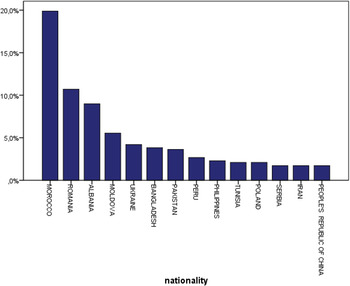
The study population includes 8990 patients, of whom 8602 (95.7%) were Italian and 388 (4.3%) immigrants from 72 countries; the largest groups were from Morocco (n = 80, 20.6%), Romania (n = 37, 9.5%), Albania (n = 37, 9.5%), Moldova (n = 25, 6.4%) and Ukraine (n = 15, 3.9%) (Fig. 1).
Distribution of immigrants in the study population by nationality.

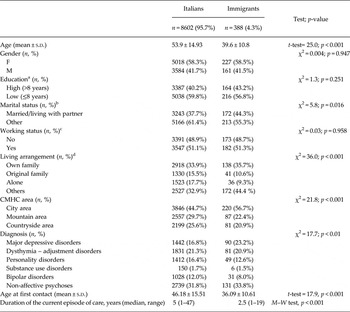
Italians and immigrants differed significantly on age, marital status, living arrangement, CMHC area, duration of contact and age at first contact with CMHC, but did not differ on gender in bivariate analyses (Table 1). Specifically, compared to Italians, immigrants were significantly younger, more likely to be married and to be living with people other than their original family. They had a lower mean age at first contact with CMHCs and had been in contact with CMHCs for a median of 2.5 years (range 1–19) v. 5 years (range 1–47) for Italian patients. Moreover, the majority of them lived in the city area and were treated at the CMHCs located there. The median number of contacts in the year 2010 was 14 for Italians and ten for immigrants. Examination of diagnostic profiles revealed that, compared to Italians, immigrants had significantly more frequently major depression, and less frequently bipolar disorders and personality disorders.
Characteristics of the study groups

a185 missing data.
b207 missing data.
cNot available.
dFive missing data.
Age, gender, marital status, living arrangement, CMHC area, education, diagnosis, duration of contact with the CMHC care and age at first contact were significantly associated with the study outcomes in bivariate correlation analyses. These variables, except for age at first contact, that was collinear with duration of contact, were included in the multivariate models to control for their confounding effects. Gender was included as well, although it did not differ between Italians and immigrants.
Interventions delivered to Italians and immigrants
We first examined whether Italians and immigrants had the same likelihood of receiving any type of intervention to identify possible variations in the pattern of care.
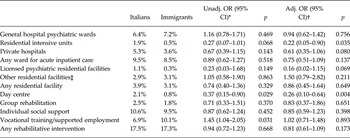
The percentages of patients receiving at least one intervention of psychosocial rehabilitation, admitted at least once to acute wards or treated in residential facilities throughout 2011 were similar between the two groups (rehabilitation: 17.5% among Italians v. 17.3% among immigrants, χ2 = 0.01, p = 0.91; acute admissions: 9.5 v. 8.5%, χ2 = 0.42, p = 0.52; residential care: 3.9 v. 3.1%, χ2 = 0.61, p = 0.43). In multiple logistic regression analyses, estimating the odds of receiving specific rehabilitation interventions and of being admitted to each type of facility, immigrants were significantly less likely to perform day centre activities and to be admitted to residential intensive units (Table 2).
Percentage of Italian and immigrant patients receiving at least one admission or one rehabilitative intervention and unadjusted and adjusted odds ratios obtained from logistic regression models

*Odds ratios <1 with a confidence interval including the unity indicate that immigrants have a lower likelihood of being admitted or of receiving a rehabilitation intervention, while the vice versa is true for odds ratios >1.
†Adjusted for age, gender, marital status, living arrangement, CMHC area, education, diagnosis, duration of CMHC care.
‡Not licensed for psychiatric care (supported housing, nursing homes, other social facilities, etc.).
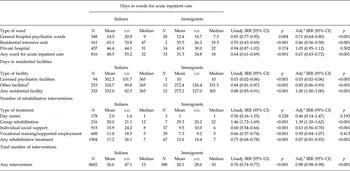
We then compared the length of stay in psychiatric wards and in residential facilities and the number of psychosocial interventions between Italians and immigrants to determine whether the duration and intensity of care was different in the two groups (Table 3). As regards the length of stay in psychiatric wards for acute episodes, the median length of hospitalisation was 32 days for Italians and 18 days for immigrants. Comparisons between the groups indicated that, among patients hospitalised for an acute episode, admissions were significantly longer for Italian patients in public general hospital psychiatric wards (a median of 9 days and 4% with a length of stay exceeding 50 days) but not in private hospitals in unadjusted and adjusted analyses.
Days of inpatient and residential care, number of rehabilitative interventions and total number of interventions. Comparison between Italian and immigrant CMHC patients with severe mental illness (N is the number of patients receiving at least one intervention or one day of hospitalisation in 2011)

aAdjusted for age, gender, marital status, living arrangement, CMHC area, education, diagnosis, duration of CMHC care.
bNot licensed for psychiatric care (supported housing, nursing homes, other social facilities, etc.).
The Italians receiving intensive residential treatments stayed in these facilities for a median of 47 days and the immigrants 35.5 days, respectively.
Moreover, Italians spent significantly more days of residential care in licensed psychiatric facilities and in other facilities compared with immigrants both in unadjusted and adjusted analyses. Still, because only 12 immigrants were admitted to these facilities, comparisons with Italian patients should be made with caution.
Psychosocial rehabilitation interventions accounted for 11% of the interventions provided. Examination of the pattern of these interventions showed significant differences between Italian and immigrants. Unadjusted and adjusted analyses revealed that immigrants received significantly more group rehabilitation interventions compared with Italians, while the reverse was found for interventions in individual projects supporting social functioning that were more frequent among Italians. Italians and immigrants received a median of 5 vocational rehabilitation and 1 day centre interventions with no significant differences in adjusted analyses. However, information on day-centre interventions is underestimated because these centres have been recently outsourced and interventions recorded are only those carried out by the CMHC staff.
Overall, the mean (± s.d.) number of all interventions delivered along 2011 was 26.6 ± 47.1 (median = 13) in Italians and 20.1 ± 28.6 in immigrants (median = 10). The difference was statistically significant both in unadjusted and adjusted analyses controlling for the demographic and diagnostic imbalance between groups.
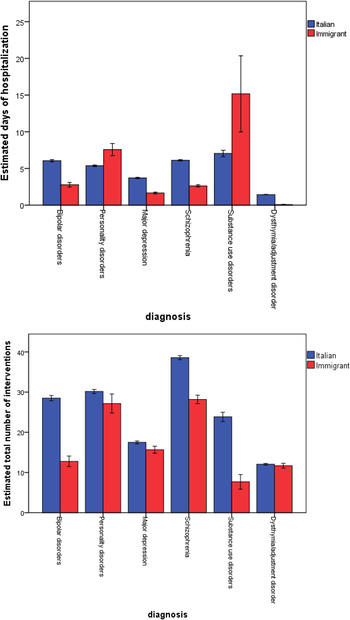
To further examine disparities in care provision between Italians and immigrants within diagnoses, we included the interaction term diagnosis × nationality in two Poisson models predicting respectively the number of days of hospitalisation in acute facilities and the total number of interventions. The interaction term was significant in both models (Fig. 2) indicating a treatment disparity across all the diagnoses. In the first model, immigrant patients with personality disorders and substance use disorder had significantly longer admissions compared with Italians, whereas the reverse was true for all the other diagnoses. In the second model, the total number of interventions proved to be higher for Italians across all the diagnoses. Poisson models for the other dependent variables failed to converge because of the small sample size and the sparseness of data.
Adjusted days of admission to acute inpatient facilities and total number of intervention by diagnostic group and nationality.

Discussion
Our findings indicate that the likelihood of receiving the diverse interventions provided to patients with severe mental illness, except for day centre care, was similar between immigrants and Italians. However, the total number of interventions delivered in 2011 was significantly lower in immigrants compared with Italians.
There is converging evidence that the immigrant status is generally associated with a lower use of mental health services, even in countries with universal health coverage (Lindert et al. Reference Lindert, Schouler-Ocak, Heinz and Priebe2008). Immigrants may find it more difficult to access and to maintain medium-long-term outpatient care for a number of impeding factors, including first practical reasons, such as less spare time or less mobility management by private or public transport. Second, they may have less information on opening hours of CMHC or on enrolling procedures in NHS. Third, they may face language and cultural barriers, including a different perception of their needs (Koopmans et al. Reference Koopmans, Uiters, Devillé and Foets2012), concerns about stigmatisation and discrimination, mistrust on caring skills and cultural competence of Italian services.
Other differences between natives and migrants in mental health care provision at the Department of Mental Health in Bologna include longer admissions to acute inpatient wards (except for private hospitals) and to residential facilities for Italian patients. Moreover, immigrants received significantly more group rehabilitation interventions, while natives received more interventions in individual projects aimed to improve social functioning.
This raises the question about whether inequality of treatment reflects different needs of immigrant patients or a lower ability of mental health services to address similar needs in the two populations.
In fact, the demographic characteristics of immigrant patients, who were on average 14 years younger than Italian patients, less frequently working, and had been in contact with mental health services for shorter periods of time compared with Italians suggest that their needs might be different from those of the Italians suffering from severe mental disorders. This would explain why psychosocial rehabilitation treatment in immigrants was more frequently oriented towards group rehabilitation activities that favour socialisation opportunities rather than rehabilitation in daily skills.
This interpretation would also be consistent with our finding that immigrants are hospitalised in general hospital psychiatric wards and residential intensive units for fewer days in a year. Acute hospitalisations in general hospital psychiatric wards last on average less than 10 days and residential intensive units admissions are often reserved for patients who do not recover after the usual period of acute hospitalisation or for those showing behavioural problems or problems with families, or lacking the needed support at the discharge. In these cases prolonged inpatient care in residential intensive units offers the possibility to restore family/environmental resources or to define an alternative rehabilitative or residential programme. Although just a small minority were admitted to residential intensive units during the index year, the difference between the two populations in the overall intensity of acute hospital treatment suggests that the interaction with social context is less frequently compromised for immigrants than for Italians.
The finding of a lower number of interventions and days of hospitalisation provided to immigrants should be interpreted in light of a possible bias. Immigrant might move elsewhere for work when they feel better, and this is not promptly recorded in the database. Alternatively, as some authors argued, ill immigrants might remigrate to their country of origin (the so-called salmon bias). Both cases lead to a mismatch between the numerator and the denominator when the incidence of health outcomes is calculated (Razum, Reference Razum2006). In this study, the short follow-up (1 year of observation) minimises this bias related to the mobility of immigrants.
The mental health database does not include information on years since migration of the study population. However, the Italian migratory flow is recent (ISTAT, 2011) and median length of contact with community mental health services (2.5 years) confirms that the study population comprises recent immigrants. In the first years after migration, the frequency and severity of disorders might be lower than expected in subsequent years, as a result of the increasing age and dissatisfaction related to the gap between expectations and actual achievements (Bhugra et al. Reference Bhugra, Gupta, Bhui, Craig, Dogra, Ingleby, Kirkbride, Moussaoui, Nazroo, Qureshi, Stompe and Tribe2011). Other authors argued that barriers to the access of health services by recent immigrants are contributing to relatively lower reported incidence of health conditions, giving the impression of relatively healthier immigrants (McDonald & Kennedy, Reference McDonald and Kennedy2004). Whether it is predominantly the case of health needs that have not yet been developed or instead of barriers, it is likely that our population of recent immigrants in the coming years will show an ever-increasing demand for care and planning of our services must take this into account.
Our results lend themselves to the alternative explanation that ‘ceteris paribus’, i.e., after controlling for demographic covariates and duration of contact, immigrant patients receive fewer attention from mental health services. This might depend on the limited experience, qualification and skills of the staff to face the cultural diversity of immigrants seeking treatment and may lead to early discontinuation of the treatment plan.
If this is the case, the increasing efforts put forward in recent years to increase the cultural competence of the mental health services (Piazza et al. Reference Piazza, Bruschi, Donegani, Maisto, Orsoni, Tomelli, Verlato and Merini2010) should be better targeted, through regular audits into treatment accessibility, acceptability and usage (Bhugra et al. Reference Bhugra, Gupta, Bhui, Craig, Dogra, Ingleby, Kirkbride, Moussaoui, Nazroo, Qureshi, Stompe and Tribe2011, Reference Bhugra, Gupta, Schouler-Ocak, Graeff-Calliess, Deakin, Qureshi, Dales, Moussaoui, Kastrup, Tarricone, Till, Bassi and Carta2014) and outreach programmes for marginalised groups (Priebe et al. Reference Priebe, Matanov, Schor, Straßmayr, Barros, Barry, Díaz-Olalla, Gabor, Greacen, Holcnerová, Kluge, Lorant, Moskalewicz, Schene, Macassa and Gaddini2012). Moreover, because the determinants of mental health often lie outside of the remits of the health system (Rucci et al. Reference Rucci, Piazza, Menchetti, Berardi, Fioritti, Mimmi and Fantini2012), social welfare and all other sectors of society have to be involved in the promotion of mental health to face the mental health effects of the economic crisis (Wahlbeck & McDaid, Reference Wahlbeck and McDaid2012). New approaches to improve quality of treatment for migrants and to increase ‘responsiveness to diversity’ are needed. Some tools recently developed to assess the implementation of intercultural health strategies, such as the ‘intercultural opening’ in Germany (Penka et al. Reference Penka, Kluge, Vardar, Borde and Ingleby2012), may contribute to future studies dealing with integration and cultural competence in mental health systems.
An important limitation of our analysis should be noted. Although our analytical strategy based on case mix adjustment sought to address the demographic imbalance between the study groups and the different duration of illness and of contact with MHS, it could not account for unmeasured variability related to patients' needs, severity of illness and disability that cannot be captured from mental health information system data.
In conclusion, our findings indicate that although the likelihood of receiving psychosocial rehabilitation, residential care and hospital treatment is similar for immigrants and Italians, the intensity of mental health care provision in terms of number of interventions and days of hospital and residential care, is lower for immigrants. Differences in demographic and psychiatric history between the two populations attending MHS suggest that inequality of treatment reflects different needs. In order to inform national and regional mental health care programmes and policies, data from mental health information systems should be complemented with ad hoc investigations collecting more accurate clinical and socio-environmental information. Furthermore, qualitative research should be performed to assess immigrants' needs from the immigrants' perspective. In this regard, a systematic review of qualitative studies on opinions of economic migrants about barriers and determinants of health services' accessibility, found that migrants faced a host of individual and structural barriers, especially those with undocumented situation and with idiomatic difficulties (Agudelo-Suarez et al. Reference Agudelo-Suarez, Gil-Gonzalez, Vives-Cases, Love, Wimpenny and Ronda-Perez2012). Best practices should therefore be targeted to tackle discrimination by ensuring coordination and continuity of care through culturally and geographically accessible community services, closely integrated with the other segments of social and health care systems.
Acknowledgements
None.
Financial Support
The research received no specific grant from any funding agency, commercial or not for profit sectors.
Conflict of Interest
None.
Ethical Standards
The study was carried out in conformity with the regulations on data management of the Regional Health Authority of Emilia-Romagna, and with the Italian law on privacy (Art. 20–21, DL 196/2003) (http://www.garanteprivacy.it/web/guest/home/docweb/-/docweb-display/docweb/1115480, published in the Official Journal no. 190 of August 14, 2004) which explicitly exempts the need of ethical approval for anonymous data (Preamble #8).