INTRODUCTION
Trypanosoma cruzi has a large genetic diversity (Brisse et al. Reference Brisse, Verhoef and Tibayrenc2001) classified into 6 Discrete Typing Units (DTUs), T. cruzi I-VI (Zingales et al. Reference Zingales, Andrade, Briones, Campbell, Chiari, Fernandes, Guhl, Lages-Silva, Macedo, Machado, Miles, Romanha, Sturm, Tibayrenc and Schijman2009). DTUs are distributed differentially among vectors, mammalian hosts and geographical regions. TcIII and TcIV usually occur in sylvatic transmission cycles; TcII, TcV and TcVI occur in domestic cycles, and TcI in both cycles (Yeo et al. Reference Yeo, Llewellyn, Sánchez, Adamson, Miles, López, González, Patterson, Gaunt, Rojas de Arias and Miles2005; Miles et al. Reference Miles, Llewellyn, Lewis, Yeo, Baleela, Fitzpatrick, Gaunt and Mauricio2009).
Dogs and cats are major reservoir hosts of T. cruzi in domestic transmission cycles throughout the Americas (Mott et al. Reference Mott, Mota, Sherlock, Hoff, Muniz, Oliveira and Draper1978; Gürtler et al. Reference Gürtler, Cecere, Lauricella, Petersen, Canale, Castanñera, Chuit, Segura and Cohen2005, Reference Gürtler, Cecere, Lauricella, Cardinal, Kitron and Cohen2007; Crisante et al. Reference Crisante, Rojas, Teixeira and Añez2006). Both host species usually display a large fraction of infectious individuals and persistent infectiousness to the vector (Gürtler et al. Reference Gürtler, Cecere, Lauricella, Cardinal, Kitron and Cohen2007). Dogs are also sensitive sentinels of domestic transmission (Castañera et al. Reference Castañera, Lauricella, Chuit and Gürtler1998; Cardinal et al. Reference Cardinal, Castañera, Lauricella, Cecere, Ceballos, Vazquez-Prokopec, Kitron and Gürtler2006) and the household presence of dogs and cats seropositive for T. cruzi increases the risk of parasite transmission to local vectors and humans (Gürtler et al. Reference Gürtler, Cecere, Lauricella, Petersen, Canale, Castanñera, Chuit, Segura and Cohen2005).
Despite the large contribution of both reservoir hosts to the domestic transmission of T. cruzi, very few studies have identified the DTUs infecting dogs and cats (Chapman et al. Reference Chapman, Baggaley, Godfreyfausset, Malpas, White, Canese and Miles1984; de Luca d'Oro et al. Reference de Luca d'Oro, Cardenal, Pret, Crisci and Montamat1993; Diosque et al. Reference Diosque, Barnabé, Padilla, Marco, Cardozo, Cimino, Nasserd, Tibayrenc and Basombrío2003; Cardinal et al. Reference Cardinal, Lauricella, Ceballos, Lanati, Marcet, Levin, Kitron, Gürtler and Schijman2008; Marcili et al. Reference Marcili, Lima, Valente, Valente, Batista, Junqueira, Souza, da Rosa, Campaner, Lewis, Llewellyn, Miles and Teixeira2009; Rimoldi et al. Reference Rimoldi, Tomé Alves, Ambrósio, Fernandes, Martinez, De Araújo, Cicarelli and Da Rosa2012). In the southern cone countries of South America, the main DTUs identified from humans, domestic dogs and triatomine bugs were TcI, TcII, TcIII, TcV and TcVI (de Luca d'Oro et al. Reference de Luca d'Oro, Cardenal, Pret, Crisci and Montamat1993; Barnabé et al. Reference Barnabé, Neubauer, Solari and Tibayrenc2001, Reference Barnabé, De Meeûs, Noireau, Bosseno, Monje, Renaud and Brenière2011; Diosque et al. Reference Diosque, Barnabé, Padilla, Marco, Cardozo, Cimino, Nasserd, Tibayrenc and Basombrío2003; Cardinal et al. Reference Cardinal, Lauricella, Ceballos, Lanati, Marcet, Levin, Kitron, Gürtler and Schijman2008; del Puerto et al. Reference del Puerto, Nishizawa, Kikuchi, Iihoshi, Roca, Alberto Gianella, Lora, Gutierrez Velarde, Renjel, Miura, Higo, Komiya, Maemura and Hirayama2010; Tomasini et al. Reference Tomasini, Lauthier, Monje Rumi, Ragone, Alberti D'Amato, Pérez Brandan, Cura, Schijman, Barnabé, Tibayrenc, Basombrío, Falla, Herrera, Guhl and Diosque2011; Yeo et al. Reference Yeo, Mauricio, Messenger, Lewis, Llewellyn, Acosta, Bhattacharyya, Diosque, Carrasco and Miles2011; Cura et al. Reference Cura, Lucero, Bisio, Oshiro, Formichelli, Burgos, Lejona, Brusés, Hernández, Severini, Velazquez, Duffy, Anchart, Lattes, Altcheh, Freilij, Diez, Nagel, Vigliano, Favaloro, Favaloro, Merino, Sosa-Estani and Schijman2012). In northern Argentina, domestic Triatoma infestans and dogs were very frequently infected with TcVI in Santiago del Estero and Chaco provinces (Diosque et al. Reference Diosque, Barnabé, Padilla, Marco, Cardozo, Cimino, Nasserd, Tibayrenc and Basombrío2003; Cardinal et al. Reference Cardinal, Lauricella, Ceballos, Lanati, Marcet, Levin, Kitron, Gürtler and Schijman2008).
As part of a multi-site research programme on the eco-epidemiology and control of Chagas disease in the Gran Chaco ecoregion, we sought to identify the DTUs infecting domestic dogs and cats to characterize the structure of transmission cycles of T. cruzi in a well-defined rural area of the Argentinean Chaco. Parallel efforts in our study area identified the occurrence of TcIII in Dasypus novemcinctus armadillos; TcI in Didelphis albiventris opossums and peridomestic Triatoma sordida; TcV and TcVI in domestic or peridomestic T. infestans, and TcVI in peridomestic T. sordida (Maffey et al. Reference Maffey, Cardinal, Ordóñez-Krasnowski, Lanati, Lauricella, Schijman and Gürtler2012; Alvarado-Otegui et al. Reference Alvarado-Otegui, Ceballos, Orozco, Enriquez, Cardinal, Cura, Schijman, Kitron and Gürtler2012). We found that TcVI was more prevalent in the study dogs and cats followed by TcV; and the occurrence of the typically sylvatic DTU TcIII in 2 domestic dogs.
MATERIALS AND METHODS
Study area
Field work was conducted in the municipality of Pampa del Indio (26° 2′ 0″ S, 59° 55′ 0″ O), Chaco Province, Argentina, located in the humid (eastern) Chaco, close to the transition to the dry (western) Chaco (Gurevitz et al. Reference Gurevitz, Ceballos, Gaspe, Alvarado-Otegui, Enríquez, Kitron and Gürtler2011). The study area included 13 contiguous villages with 323 houses inhabited by 2 ethnic groups, Creoles and Tobas. Houses were immersed in a landscape consisting of a mosaic of crops and small patches of native dry forest with different degrees of degradation. In most cases house compounds rarely had fences and domestic animals (dog, cat, cattle, goat and sheep) ranged freely in the nearby forest. Most houses were made of mud walls, with metal or thatched roofs, and included peridomestic structures that housed various domestic animals. A cross-sectional demographic and entomological survey of all study villages revealed that 40% of houses were infested with T. infestans; the prevalence of house infestation was 58·8% for Toba households and 43·5% for Creoles' (Gurevitz et al. Reference Gurevitz, Ceballos, Gaspe, Alvarado-Otegui, Enríquez, Kitron and Gürtler2011). Prior to community-wide residual spraying with pyrethroid insecticides in December 2007, 27·4% of bugs were infected with T. cruzi and bug infection was more frequent in Toba households (42·0%) than in Creoles (20·7%) (Cardinal et al. manuscript in preparation).
Study design
A demographic and sero-parasitological survey targeting all dogs and cats residing in 7 contiguous villages in August-December 2008 revealed that the overall prevalence of T. cruzi infection was 26% in dogs and 29% in cats examined by serological methods and/or xenodiagnosis and the distribution of infected dogs or cats was aggregated at the household level (Cardinal et al. manuscript in preparation).
Nested within this larger survey, for the present study we selected 2 villages (10 de Mayo and Las Chuñas) which had high prevalence of infection with T. cruzi in T. infestans (61%) before interventions. All houses that had at least 1 T. cruzi-infected T. infestans before interventions (38 of 60 inhabited houses) were selected and a xenodiagnostic survey of all dogs and cats was conducted. This procedure sought to increase the chances of isolating parasites from a large number of infected individuals. In addition, 7 dogs and 4 cats from 6 neighboring communities that had a positive xenodiagnosis were included. Each head of household was informed on the objectives and relevance of the study; informed oral consent was requested and obtained in all cases. Processing of dogs and cats was conducted according to the protocol approved by the ‘Dr. Carlos Barclay’ Independent Ethical Committee for Clinical Research from Buenos Aires, Argentina (IRB No. 00001678, NIH registered, Protocol N° TW-01-004).
Xenodiagnosis
Dogs were fitted with a muzzle (except newborn pups) and handled with the help of its owners when it did not entail any physical risk, whereas cats were captured by hand or with a net and anaesthetized as described elsewhere (Cardinal et al. manuscript in preparation). All available dogs and cats were examined by xenodiagnosis using 20 uninfected fourth-instar nymphs of T. infestans or 10 nymphs for small pups and kittens (Gürtler et al. Reference Gürtler, Cecere, Lauricella, Cardinal, Kitron and Cohen2007). All insects were mass-reared and provided by the National Coordination of Vector Control (Cordoba, Argentina). Xenodiagnosis boxes were exposed during 25 min on the belly of each individual animal, and a new re-exposure period of 10 min followed if most bugs had not blood-fed to repletion. The boxes were held in a cooler to avoid sudden temperature changes during field work, and bugs were kept until examination with no additional blood-feeding.
Feces from 2 insects fed on each animal were examined individually at optical microscope (OM) at 400X at 30 days post-exposure and, if negative, the remainder of insects fed on the same individual was analysed in pools of 4–5 insects each. When the first 2 bugs or any pool were positive, feces from of all insects in the positive pool were re-examined individually. Bugs negative at 30 days post-exposure were re-examined individually 30 days later.
Parasite isolation and DTU identification
Parasite culture in biphasic medium and isolation were performed as described elsewhere (Lauricella et al. Reference Lauricella, Stariolo, Riarte, Segura and Gürtler2005). Briefly, faeces from 2 OM-positive bugs from each xenodiagnosis-positive animal were separately inoculated into 2 culture tubes each containing biphasic medium. Parasite growth was monitored weekly during 4 months until reaching 3 × 10⁵ parasites/ml.
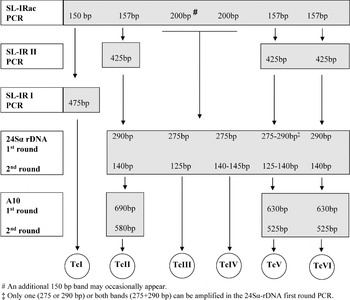
Parasites used for identification of DTUs were obtained from an aliquot of cultures at the time of cryopreservation or when a new subculture was initiated after cryopreservation (i.e. when parasite concentration was high). DNA was extracted by boiling parasite pellets as described by Marcet et al. (Reference Marcet, Duffy, Cardinal, Burgos, Lauricella, Levin, Kitron, Gürtler and Schijman2006). Trypanosoma cruzi DTUs were identified by polymerase-chain reactions (PCR) targeted to 3 genomic markers: spliced-leader (SL) DNA, 24Sα ribosomal RNA genes and A10 marker using Taq DNA polymerase (Invitrogen, USA) as described by Burgos et al. (Reference Burgos, Altcheh, Bisio, Duffy, Valdares, Seidenstein, Piccinali, Freitas, Levin, Machi, Macedo, Freilij and Schijman2007) (Fig. 1). PCR products were analysed in 2·5% agarose gels (Invitrogen, USA) for SL-IR I and SL-IR II, in 3% agarose gels for the remainder, and all UV visualization was done after staining with Gel Red (GenBiotech).
Decision key for discriminating T. cruzi DTUs following Burgos et al. (Reference Burgos, Altcheh, Bisio, Duffy, Valdares, Seidenstein, Piccinali, Freitas, Levin, Machi, Macedo, Freilij and Schijman2007).

Amplification of the SL-IR included the following 3 independent PCRs: SL IRac (using primers TCac and UTCC) to distinguish TcIII and TcIV (200 bp) from TcI (150 bp), TcII, TcV, and TcVI (157 bp); SL-IR I (using primers TC2 and UTCC) to identify TcI (475 bp); and SL-IR II (using primers TC1-UTCC) to identify TcII, TcV, and TcVI (425 bp) (Fig. 1).
Regarding the 24Sα ribosomal RNA genes, a dimorphic region within the D7 domain was amplified by hemi-nested PCR to distinguish TcV (125 or 125 + 140 bp) from TcII and TcVI (140 bp), and TcIII (125 bp) from TcIV (140 bp). The first round PCR was performed using D75 and D76 primers. The hemi-nested round was carried out using 1 μl of the first round PCR in a 30 μl vol. reaction using primers D71 and D76 (Fig. 1).
Finally, a hemi-nested PCR targeted to the A10 genomic marker was used to discriminate TcII (580 bp) from TcV and TcVI (525 bp). The first round was carried out using Pr1 and P6 primers, whereas the hemi-nested round was carried out using 5 μl of the first round PCR in a 30 μl vol. reaction with primers Pr1 and Pr3 (Fig. 1). In summary, 6 PCR assays were necessary to distinguish all UDTs.
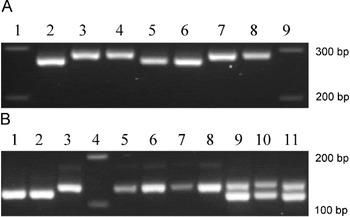
Burgos et al. (Reference Burgos, Altcheh, Bisio, Duffy, Valdares, Seidenstein, Piccinali, Freitas, Levin, Machi, Macedo, Freilij and Schijman2007) reported that some TcV-infected samples amplified both 125 and 140 bp ribosomal DNA bands in the hemi-nested 24Sα rDNA-PCR (primers D71 and D76) (Fig. 2B). When this pattern appeared, it was not possible to exclude an infection with TcVI (i.e., differentiate single infections with TcV from mixed infections with both TcV and TcVI). In our samples, all parasite stocks infected with TcV amplified both bands. Consequently, we also considered the results from the first round of the 24Sα rDNA-PCR (primers D75 and D76) to distinguish infections with TcV only (showing a 275 bp band only) from those with TcV and TcVI (275 and 290 bp bands) (Fig. 2A). T. cruzi reference stocks used as controls were TcI (X-10 and CA-1 K98); TcII (Tu 18); TcIII (M5631); TcIV (Can III); TcV (PAH 265); and TVI (Cl-Brener).
Example of 24Sα-rDNA PCR product size polymorphism A) First round PCR, primers D75 and D76 Lane (1) 100 bp ladder; lane (2) reference stock PAH 265 (TcV); lane (3) reference stock CL-Brener (TcVI); lane (4) reference stock Tu 18 (TcII); lane (5) sample of dog with identified DTU (TcV); lane (6) sample of cat with identified DTU (TcV); lane (7) sample of dog with identified DTU (TcVI); lane (8) sample of cat with identified DTU (TcVI); lane (9) 100 bp ladder. B) Heminested PCR, primers D71 and D76 Lane (1) sample of dog with identified DTU (TcIII); lane (2) reference stock M5631 (TcIII); lane (3) reference stock Can III (TcIV); lane (4) 100 bp ladder; lane (5) sample of dog with TcVI identified; lane (6) reference stock Tu 18 (TcII); lane (7) sample of cat with identified TcVI; lane (8) reference stock CL-Brener (TcVI); lane (9) reference stock PAH 265 (TcV); lane (10) sample of dog with TcV identified; lane (11) sample of cat with TcV identified.

RESULTS
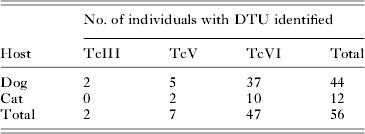
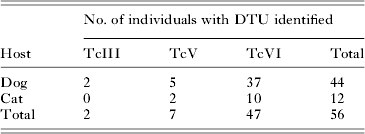
A total of 39 of 100 dogs and 8 of 29 cats examined with xenodiagnosis were positive at the two study villages. Parasites were successfully isolated from 37 of 39 dogs and from all 8 cats positive by xenodiagnosis, as well as from seven dogs and four cats residing in neighbouring communities. DTUs were identified in 56 culture-derived DNA samples (Table 1). TcVI was found in 37 of 44 dogs and in 10 of 12 cats. TcV was identified in five dogs and two cats, whereas TcIII was found only in two dogs. No mixed infections were detected.
Distribution of Discrete Typing Units (DTUs) of T. cruzi in isolates from dogs and cats, Pampa del Indio, Chaco, 2008
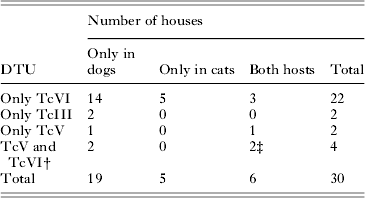
At the household level, TcVI predominated in 26 of 30 houses with DTUs identified in dogs or cats (Table 2). TcVI was found alone in 22 houses and co-circulated with TcV in four houses. TcIII and TcV occurred in two houses each, in none of which TcVI was identified.
Distribution of Discrete Typing Units (DTUs) in house compounds where T. cruzi was isolated from dogs or cats
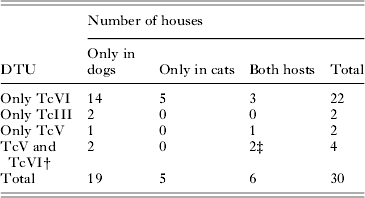
† Single infections with TcV and TcVI were identified in different hosts residing at the same house compound.
‡ Includes one house where TcV was identified in one cat and TcVI in both a cat and a dog, and another house with TcV in a dog and TcVI in a cat.
DISCUSSION
Our study documents the predominance of TcVI and the occurrence of TcV in xenodiagnosis-positive dogs and cats in a rural endemic area in the humid Argentinean Chaco, in the largest survey of DTUs infecting dogs and cats conducted so far. We also provide the first report of two cats infected with TcV.
Although previously reported in the Gran Chaco, the occurrence of TcV and TcVI has rarely been documented in non-humans hosts (Miles et al. Reference Miles, Llewellyn, Lewis, Yeo, Baleela, Fitzpatrick, Gaunt and Mauricio2009; Zingales et al. Reference Zingales, Miles, Campbell, Tibayrenc, Macedo, Teixeira, Schijman, Llewellyn, Lages-Silva, Machado, Andrade and Sturm2012). The predominance of TcVI in parasite stocks from dogs and cats is consistent with the predominance of TcVI in local T. infestans, especially in bugs collected from peridomestic kitchens and storerooms where they usually rested (Maffey et al. Reference Maffey, Cardinal, Ordóñez-Krasnowski, Lanati, Lauricella, Schijman and Gürtlerin press). The role of dogs and cats as sources of T. cruzi was also evidenced by the finding of a strong association between dog and bug infection at the household level (Gürtler et al. Reference Gürtler, Cecere, Lauricella, Petersen, Canale, Castanñera, Chuit, Segura and Cohen2005). Given the relevance of peridomestic foci in the process of house reinfestation with T. infestans after residual spraying with insecticides (Cecere et al. 2004; Gurevitz et al. Reference Gurevitz, Gaspe, Enriquez, Vassena, Alvarado-Otegui, Provecho, Mougabure-Cueto, Picollo, Kitron and Gürtlerin press), dogs and cats may be the first sources of infection for the bugs that re-invade the house compound, and their DTUs may be involved in renewed parasite transmission after interventions.
Most houses had dogs and cats infected with TcVI only, despite the study identified DTUs from up to 2–5 animals at the same house. The predominance of TcVI in domestic dogs also occurred in other areas in the dry Argentinean and Paraguayan Chaco (Chapman et al. Reference Chapman, Baggaley, Godfreyfausset, Malpas, White, Canese and Miles1984; Diosque et al. Reference Diosque, Barnabé, Padilla, Marco, Cardozo, Cimino, Nasserd, Tibayrenc and Basombrío2003; Cardinal et al. Reference Cardinal, Lauricella, Ceballos, Lanati, Marcet, Levin, Kitron, Gürtler and Schijman2008), suggesting an association between TcVI and peripheral blood infection of dogs and cats. We cannot exclude the occurrence of undetected mixed infections produced by histotropism within the mammalian host (Vago et al. Reference Vago, Andrade, Leite, d'Avila Reis, Macedo, Adad, Tostes, Moreira, Filho and Pena2000; Burgos et al. Reference Burgos, Diez, Vigliano, Bisio, Risso, Duffy, Cura, Brusses, Favaloro, Leguizamon, Lucero, Laguens, Levin, Favaloro and Schijman2010) or by selection of genotypes during parasite isolation and culture, as was revealed by parasite cloning in agar plates (Yeo et al. Reference Yeo, Lewis, Carrasco, Acosta, Llewellyn, Valente, Valente, Rojas de Arias and Miles2007).
DTUs typically associated with the sylvatic transmission cycle have been identified in dogs with very low frequencies. In the Argentinean dry Chaco, TcIII was identified in 3 of 31 infected dogs from Santiago del Estero Province (Cardinal et al. Reference Cardinal, Lauricella, Ceballos, Lanati, Marcet, Levin, Kitron, Gürtler and Schijman2008) whereas no TcIII infections were recorded in 16 infected dogs from Chaco and in two dogs from Santiago del Estero (de Luca d'Oro et al. Reference de Luca d'Oro, Cardenal, Pret, Crisci and Montamat1993; Diosque et al. Reference Diosque, Barnabé, Padilla, Marco, Cardozo, Cimino, Nasserd, Tibayrenc and Basombrío2003). In the Paraguayan Chaco, TcIII was identified in 3 of 7 infected dogs (Barnabé et al. Reference Barnabé, Neubauer, Solari and Tibayrenc2001, based on isoenzyme patterns in Chapman et al. Reference Chapman, Baggaley, Godfreyfausset, Malpas, White, Canese and Miles1984). Cats have been found to be infected only with TcVI prior to our current study (Cardinal et al. Reference Cardinal, Lauricella, Ceballos, Lanati, Marcet, Levin, Kitron, Gürtler and Schijman2008). In Pampa del Indio, parallel surveys identified TcIII in armadillos Dasypus novemcinctus and TcI in Didelphis albiventris and in adult T. sordida collected in peridomestic structures (Alvarado-Otegui et al. Reference Alvarado-Otegui, Ceballos, Orozco, Enriquez, Cardinal, Cura, Schijman, Kitron and Gürtler2012; Maffey et al. in press). In spite of the local occurrence of these DTUs, we only detected TcIII in two of 44 infected dogs. Regardless of the exact mode of transmission underlying such infections (i.e., oral transmission from hunting and eating armadillos, vector-mediated transmission or vertical transmission), these findings demonstrate the occurrence of a typically sylvatic DTU in domestic dogs and a potential risk of human infection with TcIII because T. infestans and other domestic bug species frequently blood-feed on dogs (Gürtler et al. Reference Gürtler, Cecere, Lauricella, Cardinal, Kitron and Cohen2007).
This study documents the finding of both domestic and sylvatic DTUs infecting domestic dogs. Previous studies in South America have rarely found TcIII in the domestic environment, where it is more prevalent in dogs than in humans, whereas TcIII occurs more frequently in domestic hosts than TcV or TcVI in sylvatic mammals (Miles et al. Reference Miles, Llewellyn, Lewis, Yeo, Baleela, Fitzpatrick, Gaunt and Mauricio2009; Zingales et al. Reference Zingales, Miles, Campbell, Tibayrenc, Macedo, Teixeira, Schijman, Llewellyn, Lages-Silva, Machado, Andrade and Sturm2012). These results imply a great versatility of the dog reservoir in harbouring a broad genetic diversity of T. cruzi, and the need for more research on the role of dogs in T. cruzi transmission across the Americas up to the US.
With the aim of fully describing the genetic diversity of T. cruzi, high-resolution methods have recently been applied to investigate parasite populations at the infra-DTU level, such as microsatellites (Llewellyn et al. Reference Llewellyn, Miles, Carrasco, Lewis, Yeo, Vargas, Torrico, Diosque, Valente, Valente and Gaunt2009) or multilocus sequence typing (Yeo et al. Reference Yeo, Mauricio, Messenger, Lewis, Llewellyn, Acosta, Bhattacharyya, Diosque, Carrasco and Miles2011). Our study may be considered a first step toward the understanding of the structure of T. cruzi transmission cycles through the distribution of DTUs in dogs and cats in a well-defined area. Those novel tools are needed to probe the local genetic structure of T. cruzi with greater detail, and examine the putative sylvatic origin of dog infections with TcIII and TcI.
Previous studies conducted in Argentina recorded TcI, TcV and TcVI in human patients affected by Chagas disease (Schijman et al. Reference Schijman, Vigliano, Viotti, Burgos, Brandariz, Lococo, Leze, Armenti and Levin2004; Burgos et al. Reference Burgos, Altcheh, Bisio, Duffy, Valdares, Seidenstein, Piccinali, Freitas, Levin, Machi, Macedo, Freilij and Schijman2007, Reference Burgos, Diez, Vigliano, Bisio, Risso, Duffy, Cura, Brusses, Favaloro, Leguizamon, Lucero, Laguens, Levin, Favaloro and Schijman2010; Cura et al. Reference Cura, Lucero, Bisio, Oshiro, Formichelli, Burgos, Lejona, Brusés, Hernández, Severini, Velazquez, Duffy, Anchart, Lattes, Altcheh, Freilij, Diez, Nagel, Vigliano, Favaloro, Favaloro, Merino, Sosa-Estani and Schijman2012). All of these human-infecting DTUs were found in domestic dogs and cats from Chaco and Santiago del Estero Provinces further evidencing their relevance as reservoir hosts of T. cruzi in the domestic transmission.
ACKNOWLEDGEMENTS
The authors are grateful to Marina Leporace, Francisco Petrocco, Laura Tomassone and Sol Gaspe for field and laboratory assistance. To Lucía Maffey, Julián Alvarado-Otegui, Pilar Fernández, Fernando Garelli, Juan Gurevitz, Yael Provecho, Jimena Gronzo, Carla Cecere and Romina Piccinali for valuable comments during the study, and two anonymous reviewers for helpful suggestions. Special thanks to the villagers of Pampa del Indio for kindly welcoming us into their homes and cooperating with the investigation. Reference strains of TcI-TcVI were kindly provided by Patricio Diosque, Miguel A. Basombrío and Michel Tibayrenc.
FINANCIAL SUPPORT
This study received partial financial support from International Development Research Center (Ecohealth Program); the UNICEF/UNDP/World Bank/WHO Special Programme for Research and Training in Tropical Diseases (TDR); the National Institutes of Health/National Science Foundation Ecology of Infectious Disease program award R01 TW05836 funded by the Fogarty International Center and the National Institute of Environmental Health Sciences (to Uriel Kitron and R.E.G.), University of Buenos Aires. R.E.G., M.V.C. and A.G.S. are members of CONICET Researcher's Career.