Introduction
Astrobiology lacks a clear definition of habitat types. Existing ecological habitat descriptions, of which there are many, are focused on the subdivision of habitats on the Earth that support life. For example, the forest habitat is divided into forest types that occupy different climatic and biological regimens such as boreal and temperate forest (IUCN 2012). Habitat schemes exist for both terrestrial (land-based) and marine environments.
On the present-day Earth, photosynthesis generates large quantities of organic carbon and oxygen (Field et al. Reference Field, Behrenfeld, Randerson and Falkowski1998), both of which are distributed globally in the hydrological cycle and the atmosphere. These two products of photosynthesis can be readily combined as a redox couple for aerobic respiration, so that a newly formed habitat, for example, one formed as a result of the deposition of new lava flows, or by the ponding of water in a depression from melting ice, becomes rapidly colonized by active organisms. Oxidized compounds, such as sulphate and nitrate, whose abundance is a consequence of the Earth's oxidized atmosphere and crust, also provide electron acceptors for the anaerobic oxidation of photosynthetically produced organic matter (Weber et al. Reference Weber, Achenbach and Coates2006; Muyzer & Stams Reference Muyzer and Stams2008).
The productive photosynthetic biosphere and the interconnectedness of the Earth's environments through the hydrological cycle and the atmosphere mean that almost all the habitats examined by ecologists are colonized. Where the habitats are devoid of life, such as on the surface of a newly formed lava flow that has just cooled to below the upper temperature limit for life, the period of sterility is so short as to rarely merit any discussion in the ecological literature. In other words, in studies of terrestrial biology there has always been an implicit assumption, almost a paradigm, of the coupling between habitability and the presence of life.
This paradigm might be more obviously invalid on other planetary bodies. For example, lifeless planets might harbour locations that have all the requirements for certain organisms, but the lack of an origin of life or the interplanetary transfer of life to the planet from a near-by life-bearing planet, assuming that this process if possible, could result in uninhabited, but habitable spaces (Cockell Reference Cockell2011). These spaces could include habitats that are completely devoid of organics or habitats that have abiotic organics, but no life. On sparsely inhabited planets with a weak hydrological cycle, a lack of connectivity between habitats could result in habitats in which there is no active life.
The potentially diverse habitat types that could exist on other planetary bodies suggest a need for greater clarity in describing them. In this review, I explore this problem with four purposes: (1) to use a ‘habitability triad’ for describing the different types of habitats that might be encountered by astrobiologists on the Earth and on other planetary bodies; (2) to identify habitat types that could exist elsewhere in the Universe, but that are rare on the Earth; (3) to provide an impetus to search for new examples of these rare habitat types on the Earth and elsewhere; (4) to identify testable hypotheses about the abundance of different types of habitats and the distribution of life in the Universe.
Definitions and examples of environments
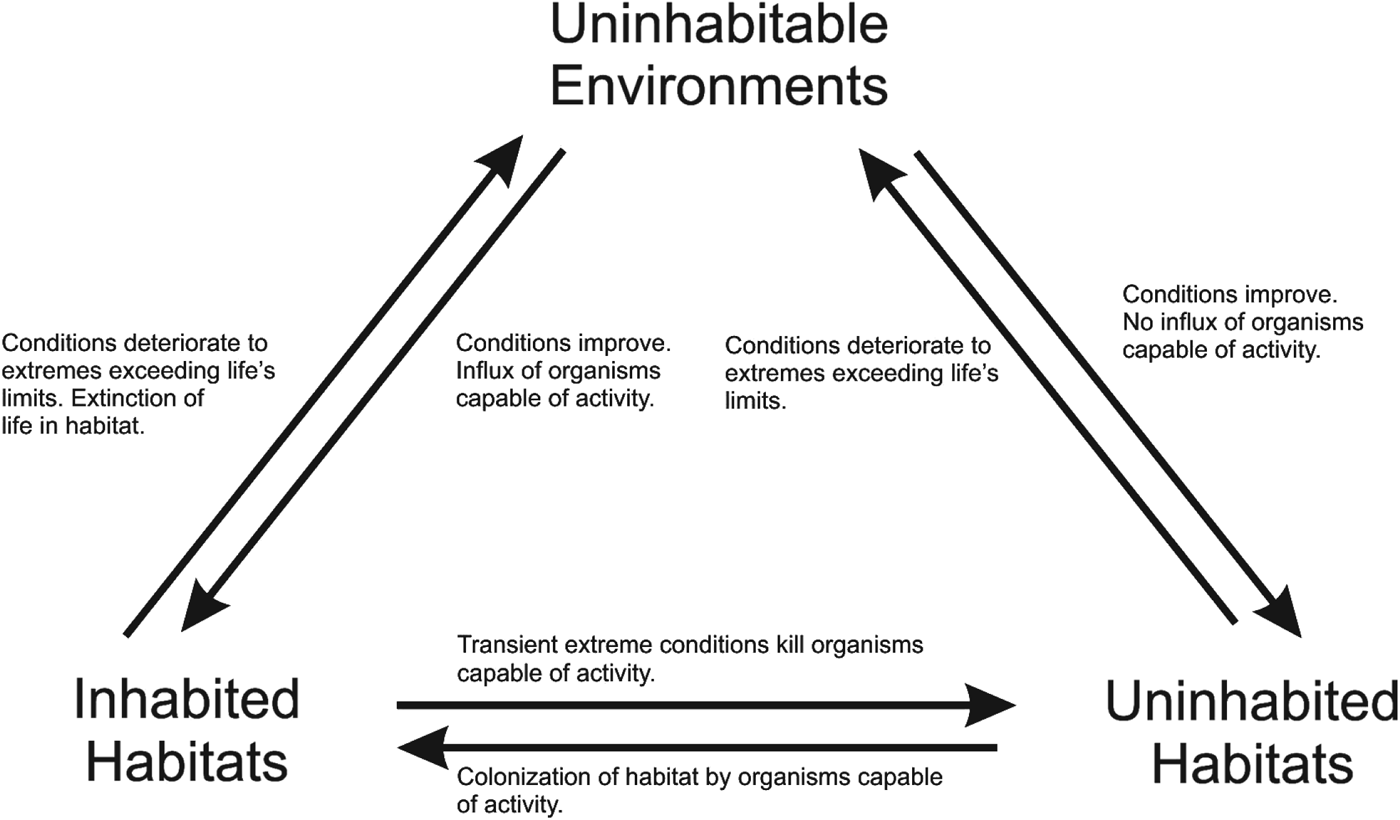
From a biological perspective, all the environments in the known Universe can be split into one of three types, which can be usefully summarized as a ‘Habitability Triad’ (Fig. 1) (Cockell et al. Reference Cockell, Balme, Bridges, Davila and Schwenzer2012).
An approach for categorizing environments in the Universe seen from a biological perspective (a ‘Habitability Triad’), showing the three types of environment in the Universe into which all environments can be binned and the events that can cause one environment type to transition to another (adapted from Cockell et al. Reference Cockell, Balme, Bridges, Davila and Schwenzer2012).

I define the term, ‘habitable’, here to mean ‘a location that has the necessary conditions for at least one known organism to be active’. Active is taken to mean metabolically active, where activity could include maintenance, growth or reproduction sustained by the habitat. A habitable environment need not support propagation of organisms (although this is an important problem for those concerned with planetary protection; see Kminek et al. Reference Kminek2010) as organisms might merely sustain themselves in an environment by active repair of damage without replicating.
The terms ‘habitable’ and ‘habitability’ necessarily are assessments defined, and limited, by our knowledge of life. It also follows that, assuming our knowledge of the limits of life in the Universe is not complete, we are likely to overestimate the extent of uninhabitable spaces and underestimate the extent of habitable spaces.
Given the extent of biologically deleterious interstellar space with its extreme conditions, of the three environments shown in Fig. 1, uninhabitable environments are the most common type of environment in the Universe.
The second two environment types discussed here are both types of habitat – inhabited and uninhabited habitats, in the former there is active life, in the latter there is not.
In some locations in the Universe, particularly on and in planetary crusts, these three environments can be interchangeable as local conditions alter (Fig. 1). The arrows in Fig. 1 are applied to a fixed point in or on a planetary body and represent the dynamic nature of the environments.
An important facet of defining habitats is the concept of the niche. A niche is a set of energy and nutrient conditions in a particular place that can be used by life. In simple terms it defines how an organism makes a living. It is a functional definition, so, for example, microbial iron reduction is a niche that might be available in an anaerobic extraterrestrial environment (Nixon et al. Reference Nixon, Cockell and Tranter2012). By contrast, a habitat is a physical space that contains niche(s). From a strict ecological perspective a niche is not a physical space, although this is a very common usage in the planetary science literature where the two terms, habitat and niche, are often erroneously used interchangeably.
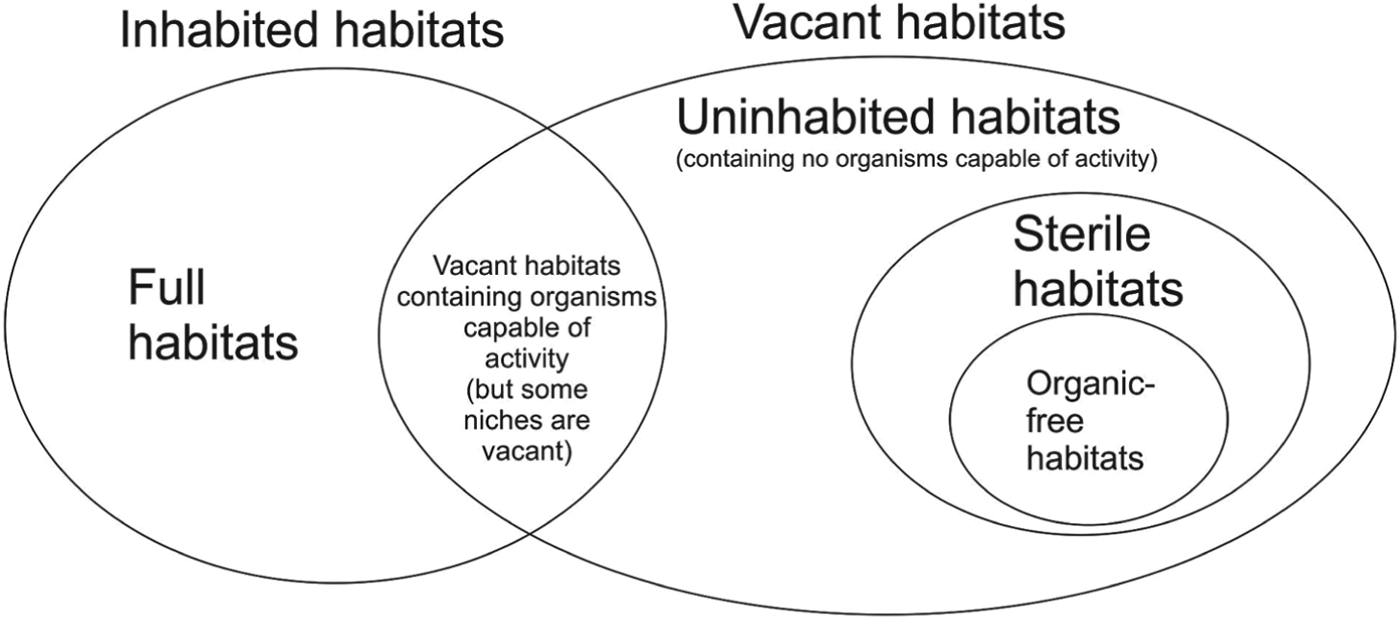
In the following sections, proposed definitions and explanations for the different environments are provided and they are summarized with the use of a Venn Diagram (Fig. 2). Examples are given of each of the types of environment. In particular, terrestrial examples are provided from the Eyjafjallajökull in Iceland. The volcano under the Eyjafjallajökull icecap in Southern Iceland erupted in March and April 2010 (Sigmundsson et al. Reference Sigmundsson2010; Gudmundsson et al. Reference Gudmundsson2012). The eruption generated fresh basaltic lavas that provide examples of the different types of habitat described in this paper.
A Venn Diagram depicting the relationship of habitat types to each other according to the definitions discussed here. Note that the area within each classification is arbitrary and not related to the area occupied by the habitat type in natural environments.
Uninhabitable environments
Uninhabitable environment
‘An environment in which no known organism can be active.’
The definition of an uninhabitable environment is contingent on knowledge of the diversity and limits of life. If the physical or chemical limits of known life change as a consequence of research, and an organism were discovered that could potentially occupy what was considered to be an ‘uninhabitable’ environment, then the environment would change to becoming a habitat of one of the types described below.
Examples
A volcanic environment in the subsurface where temperature conditions are above the maximum temperature for active life (i.e. at the current time 122 °C; Kashefi & Lovely Reference Kashefi and Lovley2003). At the Eyjafjallajökull, the rocks just beneath the surface of the active caldera are examples of uninhabitable environments (Fig. 3(A) and (B)). Temperatures at just a few centimetres depth exceed 200 °C. In the extraterrestrial case, the surface of Venus where the temperature is 464 °C and there is no liquid water is an example (Morowitz & Sagan Reference Morowitz and Sagan1967; Cockell Reference Cockell1999; Schulze-Makuch & Irwin Reference Schulze-Makuch and Irwin2002).
Examples of the three major types of environment discussed in this paper found in a volcanic environment, the Eyjafjallajökull in Iceland. The examples are located on and near the caldera within the area delineated by coordinates 63°38′13.20″N, 19°27′1.08″W and 63°38′23.10″N, 19°26′31.80″W. (1) Uninhabitable environment. The active caldera of the Eyjafjallajökull volcano (A) where temperatures exceed 230 °C at 5 cm depth (B), above the upper temperature limit for life. (2) Uninhabited habitat (sterile habitat). Newly formed lava flows 2 months after the eruption of the volcano (C). The interior of the lava flows is a habitat, but there was no evidence of colonization of the interior of the rocks as assessed by the lack of cells visualized using Sybr Green I DNA staining dye or a lack of culturable organisms (unpublished data), as compared with colonized lavas on the surface (D). (3) Artificially created uninhabited habitat. Another type of (artificially created) uninhabited habitat is a rock removed from the subsurface of the active caldera where temperatures exceed 230 °C (B) and left to cool (E). Minutes after removal, when the rock temperature reduces to below the upper temperature limit for life, the interior of the rock potentially becomes an uninhabited habitat for organisms such as nitrogen-fixing autotrophs that can persist in extreme volcanic rocks. (4) Inhabited habitat. The surface of the lava flow, colonized 2 months after eruption (D) by a functionally distinct, low diversity community of chemolithotrophs (Kelly et al. Reference Kelly, Cockell, Thorsteinsson and Marteinsson2013). (Image A credit to Sophie Nixon).
Testable hypothesis
An example of a testable hypothesis is: ‘The extent of uninhabitable environments in the Universe is less than that predicted using observations of terrestrial biology’. If our knowledge of the physical and chemical limits of life is incomplete then we would predict that there are environments classified as uninhabitable, but which could harbour active organisms yet to be discovered. This hypothesis can be tested by exploring putatively uninhabitable environments in the Universe to determine if they contain unexpected life forms. It can also be tested by extending our investigation of the biochemical limits of life on Earth to determine if an expansion of the boundaries of life leads to an increase in the predicted extent of habitable space in the Universe.
Uninhabited habitats
Uninhabited habitat
‘An environment capable of supporting the activity of at least one known organism, but containing no such organism.’
Uninhabited habitats could contain contaminant organisms whose activity cannot be supported by that environment. This includes the possibility of a cell remaining viable, even being active, in such an environment for a short period of time by virtue of internal energy supplies, for instance. However, if the environment itself cannot supply resources for the activity of these cells (including liquid water, energy and/or major nutrients), then with respect to these cells it is an uninhabitable environment (it is not a habitat to them) and they are therefore not inhabitants under this definition.
An environment can be demonstrated to be an uninhabited habitat by a number of means. It could be proven directly by showing that the environment will support the activity of an organism inoculated (potentially irreversibly) into that environment or by removing physical material from the environment and showing in a laboratory that it will support the activity of certain organisms under the same environmental conditions. It could be shown indirectly, by a comprehensive geochemical and environmental analysis that demonstrates that the environment has the necessary conditions to support the activity of at least one known organism.
Another term for an uninhabited habitat could be an ‘empty habitat’, although this term does not make it clear whether the habitat is empty of all life, or empty only of active life using the habitat. To avoid confusion it is not used here.
Examples
A newly formed volcanic lava flow in which conditions are suitable for certain organisms, but there are no actively metabolising cells or organisms capable of activity in that environment. The recent claim of a habitable environment on Mars (Grotzinger et al. Reference Grotzinger2013), but the lack of detection of organics associated with life (Ming et al. Reference Ming2013) could be evidence of an uninhabited habitat on Mars. Martian uninhabited habitats are discussed in Cockell et al. (Reference Cockell, Balme, Bridges, Davila and Schwenzer2012).
Testable hypothesis
‘Where there are habitats, there is life’. This hypothesis tests the general presumption that on any planet where there are habitable conditions, then life will be making use of them. Inherent in this hypothesis is that on an uninhabited planet the origin of life is inevitable or life will always be transferred from an inhabited planet if there is one in the same solar system, or on an inhabited planet it is generally the case that transfer mechanisms, such as a hydrological cycle, exist to ensure the colonization of new habitable environments from inhabited locations (Cockell et al. Reference Cockell, Balme, Bridges, Davila and Schwenzer2012).
There are two subcategories of uninhabited habitats:
(1) Sterile or lifeless habitat: ‘A habitat that is devoid of any lifeFootnote 1.’
In this subtype of an uninhabited habitat there is no life of any kind, including metabolically inactive life.
The term ‘lifeless habitats’ has already been used in the literature. The newly formed lava flows of Surtsey Island, Iceland, for example, were described as ‘lifeless habitats’ by Gudmundsson (Reference Gudmundsson1970). The phrase was used to describe environments that have no obvious megafauna, but studies of the microbial life or the possibility of inactive microbial life were not included. In this paper, the definition is used more strictly – a habitat in which there is not any kind of life, active or inactive.
Examples
A newly formed lava flow after the instant at which the temperature reduces to below the upper temperature limit for life, but in which there is no life. An example of such a habitat on the Eyjafjallajökull is the interior of the newly formed lava flows shortly after the eruption (Fig. 3(C)), which is presumed to be habitable since the same material in the surface of the lava flow is inhabited. Uninhabited habitats can be created artificially by taking material from an uninhabitable environment and changing the environmental conditions such that it becomes habitable. An example is the removal of a rock from an environment well above the upper temperature limit for life and allowing it to cool to temperatures compatible for life in an environment where liquid water (either as precipitation or high humidity) is available. An example of an artificially created uninhabited habitat on the Eyjafjallajökull active caldera is shown in Fig. 3(D).
Environments on ancient Mars in regions of sustained liquid water would have been sterile if the planet was lifeless or if it was inhabited, but life was localized and unconnected with newly formed habitats.
Testable hypothesis
‘Where there are habitats, there is life’. The hypothesis proposed above for the study of the link between habitats and life applies to the investigation of the extent of sterile habitats in the Universe, although the hypothesis, when applied here, also specifically tests for the presence of inactive life in habitats as well as active life.
(2) Organic-free habitat: ‘A habitat that is devoid of organic material1.’
An organic-free habitat is a subtype of sterile habitat that is not only devoid of life, but also devoid of organic material. Similar to other types of uninhabited habitat, this habitat type is rare on the Earth (there is no description of such a habitat in the literature), but it could be more common on a planet where there has been no origin of life and where the meteoritic input, or endogenous production, of organic material is very limited or localized, leading to physical spaces that are devoid of organic material. They might also exist in locations where organics are destroyed over long periods of time by chemical processes that otherwise would not preclude active life. These habitats would be uninhabitable to organisms that require organic matter (such as heterotrophic microorganisms), but they could constitute an uninhabited habitat for certain chemoautotrophs, for example.
Examples
A newly formed lava flow just after the instant at which its temperature is reduced to below the upper temperature limit for life. If the lava has previously been at a high temperature sufficient to drive off organics, then when it cools it will (transiently on the Earth) become an organic-free habitat. Such habitats could exist in the interior of new lava flows on the Earth or in extraterrestrial environments where there has been no time for organic input.
Testable hypothesis
‘Organic-free habitats exist in the Universe’. The hypothesis tests the proposal that habitats exist that are free of organics, whether biological, meteoritic or endogenous in origin.
Inhabited habitats
Inhabited habitat
‘An environment containing life whose activity can be supported by that environment.’
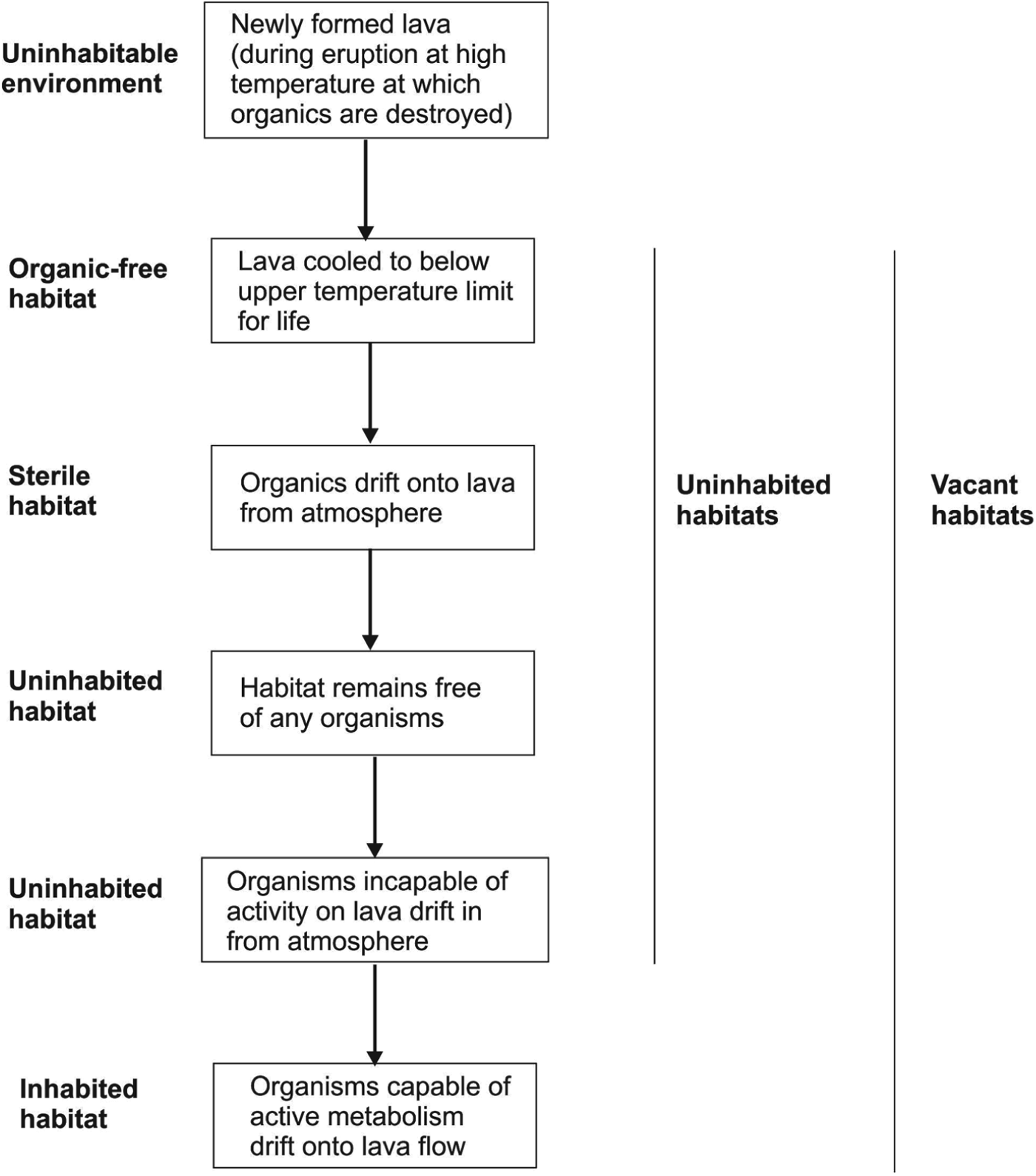
Inhabited habitats are places where one or more niches are being actively used by life or inactive life within the habitat is capable of using the available niches. These habitats dominate the habitable space of the Earth and explain why all existing habitat classification schemes in the ecological literature are focused on the description of inhabited habitats and their sub-divisions. Inhabited habitats can develop from environments that were previously uninhabitable or uninhabited (Fig. 4). Life within inhabited habitats can change local environmental and geochemical conditions and thus change the suitability of the environment for certain organisms. For example, if life within such a habitat used up a nutrient that it required and rendered itself unable to grow in that location, but other niches were still available and unoccupied, a biologically induced transition from an inhabited to uninhabited habitat could occur. Inhabited habitats could include places that contain only inactive life, but that life must be capable of activity supported by that environment such that it can be described as an inhabitant. An example could include dormant spores. Inactive life that cannot achieve any activity supported by the environment is not ‘inhabiting’ that environment. Rather the habitat merely contains contaminant organisms for which the environment does not constitute a potential habitat.
An example of a theoretical sequence of events that could occur on new lava flows that illustrates changes in conditions over time according to the environment descriptions in this paper.
Examples
Most habitats on the Earth including ocean and terrestrial habitats. An example at the Eyjafjallajökull is the colonized surface of lava flows (Fig. 3(E)). As we do not have empirical evidence for life beyond the Earth, we currently have no extraterrestrial examples of these habitats.
Testable hypotheses
‘There is life beyond the Earth’. The search for inhabited habitats tests one of astrobiology's most compelling questions – whether habitats containing active life exist elsewhere in the Universe.
Full habitat
‘A habitat in which all available niches are being used.’
A full habitat is an obvious corollary to an uninhabited habitat. It is a habitat where all the niches are being used (the use of one niche may limit the availability of substrate for another niche, thus a habitat could be ‘full’ in a variety of permutations). It is, from a practical point of view, very difficult to experimentally demonstrate. However, for completeness, the definition is included here.
Example
Habitats in extreme environments where a biota is using all the nutrients and energy supplies available.
Vacant habitats
Vacant habitat
‘An environment in which there are vacant niches for at least one known organism.’
Vacant habitats include both inhabited and uninhabited habitats and therefore circumscribe the hypotheses described above. They include habitats where there is active life, but there are still niches available for use (i.e. inhabited habitats) and uninhabited habitats, where there is life capable of activity and all the niches are available. Uninhabited habitats can therefore be regarded as a particular sub-category of vacant habitats. Full habitats are not vacant habitats, so not all inhabited habitats are vacant habitats.
Vacant and uninhabited habitats
There may not appear to be an obvious semantic difference between ‘vacant habitats’ and ‘uninhabited habitats’. However, in the ecological literature, there are many existing uses of the term ‘vacant habitat’ to mean a habitat available for a specific species. For example, Errington discusses the vacancy of habitats available for muskrats in Iowa, USA (Errington Reference Errington1940). The phrase is used to describe available habitat spaces for bobcats in South-Central Indiana (Johnson et al. Reference Johnson, Walker and Hudson2010) and mice in newly cleared forests (Sullivan Reference Sullivan1979). Thomas et al. (Reference Thomas, Thomas and Warren1992) investigated vacant habitats available for butterflies on Welsh hillsides as part of a study on the extent to which there exist islands of butterfly habitats. ‘Vacant habitat’ is also a phrase that has been used to describe available habitats to specific organisms following extinction events. For example, Steele-Petrović (Reference Steele-Petrović1979) discusses the relative rate at which different bivalves were capable of colonizing newly available marine vacant habitats after the Permian–Triassic and Triassic–Jurassic extinctions.
Although not formally stated, the implicit definition that arises from the previous literature is that ‘vacant habitat’ means a place where there are one or more vacant niches, with the literature usually focused on a niche(s) for one particular species of interest to the researcher. Here, the definition of a vacant habitat is worded to maintain consistency with the previous literature and it is defined to be a place that has one or more vacant niches, and where there can already be active life. An uninhabited habitat is therefore taken to be a specific type of vacant habitat where all the niches are vacant.
Effects of scale
Habitat types will vary at different scales. Consider, for example, two microorganisms of size ∼1 μm in water saturated sediment that are separated by a space ∼10 μm. What type of environment is the space between them?
If the organisms have removed essential elements such as phosphorus or carbon in their immediate vicinity as they grow, then they may have rendered the space between them uninhabitable as it lacks essential elements for the active growth of any known organisms. Similarly, if the space between them has localized extreme physical or chemical conditions, such as a high concentration of a heavy metal ion, then it may be uninhabitable on account of chemical conditions beyond the capacities of known biological adaptation.
If the environment is very dynamic, for example, a very perturbed sediment environment, then the space between the organisms could be an uninhabited habitat. The organisms do not have time to divide and fill the available habitat before the population is perturbed again, generating newly available uninhabited habitat.
An artificial example of this scenario would be a recently inoculated, shaking flask of microbial medium in a microbiology laboratory in which nutrients are replete, but the population has not had time to colonize all the available habitable space and use the available nutrients. In such a flask, the spaces between the organisms are uninhabited habitats to the inoculated organism (and to any other organisms that can grow in the medium).
These spatial variations at different scales raise obvious questions in describing contiguous environments at macroscopic scales. For example, is the inoculated microbiological flask an ‘inhabited habitat with uninhabited habitable spaces’ or an ‘uninhabited habitat containing localized inhabited spaces’? For clarity, a contiguous unit of environment is best defined by the term that conveys the most information about the status and conditions for active life in that environment as a whole. In the above example, the flask is best described as an inhabited habitat, with the additional information that it also contains uninhabited habitat between the organisms.
In previous discussions on identifying ‘uninhabited habitats’ on Mars (Cockell et al. Reference Cockell, Balme, Bridges, Davila and Schwenzer2012), the implicit assumption was that this refers to a search for contiguous uninhabited habitats at macroscopic scales, such as, for example, ancient lakes, hydrothermal systems and rivers on that planet. Such environments could contain uninhabitable environments within them, but not inhabited regions, because this would make the contiguous environment under consideration an inhabited habitat.
Conclusion
This paper provides a description of different habitat types, elaborating definitions for habitats rarely encountered on the Earth, but which may be more common on other planetary bodies. Clarifying habitat definitions in this way can improve efforts to find examples of these habitats on the Earth and on other planetary bodies by circumscribing the different forms of habitat and providing clarity to the proposed hypotheses on habitability.
Acknowledgments
This work was made possible with support from the UK Science and Technology Facilities Council (STFC); Grant No. ST/1001964/1.