Introduction
Since Johannes Mueller's 1838 description of ‘a layered pearly tumor of fat, which was distinguished from other fat tumors by biliary fat or cholesterin that is interspersed among sheets of polyhedral cells’,Reference Jahn1our understanding of cholesteatoma pathology and pathogenesis has undergone various modifications. Advances in surgical anatomy and surgical techniques have enabled standardisation of cholesteatoma treatment protocols; however, knowledge about the molecular and cellular defects that result in the clinical hallmarks of both acquired and congenital cholesteatomas (i.e. invasion, migration, uncoordinated proliferation, altered differentiation, aggressiveness and recidivism) is still in the early stages. We do know that two important pathogenetic features of cholesteatoma are invasion and proliferation of epithelial cells.
Several comparative studies have been performed to assess the epithelial cell kinetics of cholesteatoma, using normal meatal skin as a control. In recent years, it has been reported that various cytokines, such as interleukin-1 alpha, transforming growth factor-alpha and keratinocyte growth factor, are involved in the epithelial proliferation mechanism that results in middle-ear cholesteatoma.Reference Tanaka, Kojima, Miyazaki, Koga and Moriyama2 Various proliferative activity evaluations have been utilised, and many proliferation markers examined (e.g. cytokeratin,Reference Park, Park and Chun3 thrombomodulinReference Park, Park and Chun3 and proliferating cell nuclear antigenReference Park, Park and Chun3, Reference Bujia, Sudhoff, Holly, Hildmann and Kastenbauer4), in order to better understand the proliferative ability of keratinocytes in cholesteatoma.
A widely used proliferation (and prognostic) marker in tumours, Ki-67, has also been used to evaluate cholesteatoma. It has been described as a simple and reliable tool for assessment of cellular proliferation in routine formalin-fixed, paraffin-embedded specimens.Reference Cattoretti, Becker, Key, Duchrow, Schlüter and Galle5
The aggressiveness of cholesteatoma disease in children is well known and accepted by various authors. We designed the current study to evaluate paediatric and adult cholesteatoma by comparing the clinical and pathological characteristics of these two groups. We aimed to ascertain whether the difficulty in eradicating the cholesteatoma in children is attributable to it being immunopathologically different from adults.
Materials and methods
The study was conducted on 67 proven cases of aural cholesteatoma in a tertiary healthcare centre. The patients were evaluated in two groups: adults and children. There was also a control group (n = 16) that consisted of patients undergoing myringoplasty for dry central perforations. Deep meatal skin was taken from the individuals in the control group.
All patients received thorough general and otolaryngological evaluation and then underwent surgery under local or general anaesthesia. The type of surgery varied according to the patient profile and the surgeon's decision. Intra-operatively collected specimens (cholesteatoma in the study group and deep meatal skin in the control group) were fixed in formalin. Intra-operatively, the extent of disease was noted along with any bony dehiscence involving the sinus plate, dural plate, semicircular canals or facial canal. The number of ossicles eroded was also noted.
Formalin-fixed specimens were embedded in paraffin and examined using routine haematoxylin and eosin staining. For immunohistochemical analysis, 5-μm sections were placed on poly-L-lysine coated slides. Immunohistochemical staining was done with anti-Ki-67 secondary antibody, using the streptavidin biotin method and using 3,3′diaminobenzidine as the chromogen.
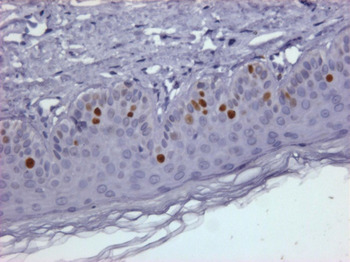
Histological evaluation was carried out by a pathologist. A total of 200 cells were counted per specimen at a magnification of ×400 (Figure 1). The ratio of Ki-67 positive cells to total number of cells counted was calculated in each case, and expressed as a Ki-67 labelling index. The labelling indices were compared between the two groups and the results were statistically analysed.
Photomicrograph showing anti-Ki-67 secondary antibody staining (streptavidin biotin method). Brown-stained cells were counted as positive. (×400)

All statistical analysis was done using the Statistical Package for the Social Sciences version 10 software program. Descriptive statistics were used to summarise the baseline data. The unpaired t-test was used to compare the scores in groups containing two variables (e.g. paediatrics and adults). A p value of less than 0.05 was considered significant.
Observations and results
A total of 67 patients with aural cholesteatoma were included in the study. Deep meatal skin specimens from the auditory canals of 16 patients undergoing myringoplasty for dry central tympanic membrane perforations served as the control group.
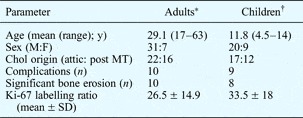
The demographic and disease profiles of the two case groups are summarised in Table I. There were no significant clinical or pathological differences between the adult and paediatric cholesteatoma patients.
Patient demographic and clinical data

*n = 38; †n = 29. Y = years; M = male; F = female; chol = cholesteatoma; post MT = posterior mesotympanum; SD = standard deviation
Ten of the 38 adult patients had a history of complications, and nine of the 29 paediatric patients had intratemporal or intracranial complications. Significant bone erosion outside the confines of the mastoid cortex (i.e. erosion of the dural plate, sinus plate, facial canal or semicircular canals) was present in 10 adults and eight children. Neither of these results represented statistically significant differences.
The Ki-67 labelling index was available for 53 cases and 12 controls. Adequate results were unavailable for 14 cholesteatoma and four control specimens because of inadequacy of the specimen, no epithelium seen on staining or other reasons; these 18 specimens were therefore excluded from the analysis.
The 53 cholesteatoma cases evaluated yielded a Ki-67 labelling ratio ranging from six to 80 per 200 cells, with a mean of 29.2/200, giving a mean labelling index of 14.6 per cent. The labelling ratio standard deviation (SD) was 16.6. In the 12 controls that yielded a positive result, the mean Ki-67 labelling index was 9.5 per cent (mean labelling ratio ± SD = 19 ± 7.78). The Ki-67 labelling index was higher in cases than controls (for whom normal auditory meatal skin was assessed), and this difference was statistically significant (p = 0.033).
Results for Ki-67 labelling were available for 28 adult and 25 paediatric cases. The mean Ki-67 labelling index ± SD was 33.5 ± 18.0 per 200 in paediatric cases and 26.5 ± 14.9 per 200 in adult cases. There was no significant difference in the Ki-67 labelling index between the paediatric and adult groups (p = 0.13).
The correlation between age and Ki-67 score was assessed using Pearson's correlation. A negative correlation was obtained which was not significant (r = –0.184, p = 0.188). These results are shown in Table I.
Discussion
Epidermoid cholesteatoma is a disorder in which keratinising squamous epithelium becomes displaced into the middle ear, with an accumulation of desquamated keratin. The presence of cholesteatoma in the middle ear is associated with chronic and recurrent infection and with bone resorption. The factors involved in the process of epithelial migration, differentiation and proliferation are complex and numerous, and are not yet fully understood.
Previous studies have demonstrated the hyperproliferative behaviour of cholesteatoma epithelium.Reference Park, Park and Chun3, Reference Bujia, Sudhoff, Holly, Hildmann and Kastenbauer4, Reference Ergun, Carlsoo and Zheung6–Reference Sudhoff, Bujia, Fisseler-Eckhoff, Holly, Schulz-Flake and Hildmann9 One of the major goals of various cholesteatoma studies has been to determine the cholesteatoma proliferative potential. This is especially important as the identification of patients with aggressive cholesteatoma may help identify important clinical parameters, such as the intensity of bone destruction and the tendency of cholesteatomas to recur.
Many studies have attempted to clarify the process by comparing cholesteatoma with normal aural and retroauricular epidermis. In agreement with previous authors, our study found a higher proliferation index in cholesteatoma epithelium compared with control epithelium. We found a mean proliferation index of 14.6 per cent in cholesteatoma patients and 9.5 per cent in controls.
A literature search revealed a consensus among authors that paediatric cholesteatoma differs clinically from adult cholesteatoma. Most previous studies have focused on disease prognosis, and have found paediatric cholesteatoma to have a poorer prognosis. The rates of paediatric recurrence reported in most studies were almost twice those found in adults.Reference Dornelles, Costa, Meurer and Schweiger10 The general consensus is that cholesteatomas are more aggressive and harder to eradicate in children than in adults.
There is limited literature on the histological differences between paediatric and adult cholesteatoma cases. Quaranta et al. Reference Quaranta, Ressa and Santangelo11 evaluated the histomorphological characteristics of paediatric cholesteatomas compared with adult tumours. They found more mononuclear elements in the perimatrix of paediatric cholesteatoma compared with adult tumours.
Dornelles et al. Reference Dornelles, Meurer, Selaimen da Costa and Schweiger12 evaluated the histological characteristics of paediatric and adult cholesteatomas. They found no differences in the number of cell layers in the matrix, the matrix hyperplasia, and the perimatrix characteristics of the two groups. However, a greater level of indirect markers of aggression (i.e. matrix metalloproteinases 2 and 9 and cluster of differentiation 31 glycoprotein) has been found in paediatric compared with adult cholesteatomas.Reference Dornelles Cde, da Costa, Meurer, Rosito, da Silva and Alves13 The literature on the subject is however limited and further studies are warranted.
Bujia et al. Reference Bujia, Holly, Antoli Candela, Tapia and Kastenbauer8 have shown a significantly higher proliferation index in paediatric cholesteatoma cases (42 per cent) compared with adults (28.2 per cent). Mallet et al. Reference Mallet, Nouwen, Lecomte-Houcke and Desaulty7 correlated cholesteatoma aggression, bone erosion, inflammation, patient age, cholesteatoma origin and cholesteatoma entry point; they found the proliferation index to be higher in children than adults, but this correlation was not statistically significant.
• Middle-ear cholesteatoma epithelium is hyperproliferative compared with normal skin
• Cholesteatoma in children is more aggressive and harder to eradicate than that in adults
• In this study, the histopathological characteristics of paediatric and adult cholesteatoma (e.g. proliferation index) did not differ
• The aggressiveness of paediatric cholesteatoma is probably due to nonhistopathological factors
Our study findings matched those of Mallet et al. with regard to patients' age. However, we found no significant clinicopathological differences between the two groups, nor any significant difference in proliferation index. Our results suggest that paediatric cholesteatoma does not differ histologically from that found in adults.
The reasons for the more belligerent nature of the disease in children may be manifold, and need to be identified by further clinical and pathological studies. Pure physical and morphological factors, such as eustachian tube dysfunction, are likely to contribute to frequent cholesteatoma recurrence in children. Moreover, trends found in recent studies suggest that some genetic factors may contribute to the development and progression of paediatric cholesteatoma. James et al. Reference James, Chadha, Papsin and Stockley14 have demonstrated one or more gap junction beta-2 variants in certain paediatric cholesteatoma cases. These, along with other genetic factors, may be a focus for future research into the subject.
Conclusion
There are no differences in the proliferation potentials of paediatric and adult cholesteatoma. The clinical aggressiveness of cholesteatoma in children is not attributable to immune-histopathological factors.