

I. Introduction
This article explores the evolution in shareholder and creditor protection that has taken place in Australia over the 40 years from 1970 to 2010. The changes in the level of protection afforded to Australian shareholders and creditors are compared and contrasted with the changes that have taken place over the period 1970 to 2005 in five other countries—the UK, US, France, Germany and India. The data for these five countries is drawn from the research of Armour, Deakin, Lele and Siems.Footnote 1
The changes in the level of shareholder and creditor protection are measured by the adoption of a ‘leximetric’ methodology, which has been adapted from the pioneering work of La Porta, Lopez-de-Silanes, Shleifer and Vishny.Footnote 2 The leximetric methodology is a quantitative approach to measuring law and legal evolution.Footnote 3 It has been particularly influential in recent debates in the law and economics literature, where it has been used to explore the development of legal rules and the effects of different styles of regulation on a range of economic outcomes—the legal origins debate.Footnote 4 To examine shareholder protection, the leximetric methodology adopted in this article draws from a 2007 study by Lele and Siems in which they developed an index measuring shareholder protection and applied it longitudinally to five countries over the period 1970 to 2005.Footnote 5 We use Lele and Siems’ shareholder protection index and apply it in the Australian context for the period 1970 to 2010. To examine creditor protection in Australia, we have adopted the creditor protection index from the 2009 study by Armour et al into the evolution of legal rules for shareholder, creditor and worker protection.Footnote 6
We place our findings in an international context by comparing the Australian case with the experience of the five countries included in the original Lele and Siems study. Our data suggests there was a sustained upward trend in the level of shareholder protection in Australia during the period 1970 to 2010, but not in the case of creditor protection. Compared to the five other countries in the Armour et al study, the level of protection afforded to shareholders under Australian law was relatively high.Footnote 7 We also found that the level of creditor protection in Australia is high when compared to other countries.
Finally, we examined the extent of convergence and divergence in shareholder and creditor protection among the six countries in the study. We found persistent divergence in shareholder protection, with the extent of divergence in 2005 similar to that in 1970. For creditor protection, we found increasing divergence among the countries over the period of study. Our findings also allow us to contribute to the legal origins debate.
This article is part of a larger international study examining the relationship between a country's legal origins and the extent and character of business regulation, including labour law, and shareholder and creditor protection. Other publications authored by a group of labour law scholars, and which are part of the larger study, examine the evolution in labour law in Australia during the period 1970 to 2010.Footnote 8
The structure of the article is as follows. Section II briefly sketches the legal origins debate which is the theoretical framework on which the larger project is based and provides the background to the legal origins analysis of shareholder and creditor protection. Section III outlines the methodology used and the limitations of this methodology. Sections IV and V place the Australian findings in an international context, and explain the similarities and differences. Section VI concludes.
II. the legal origins debate and shareholder and creditor protection
A. Overview of the Legal Origins Debate
The legal origins debate emerged in the 1990s with the pioneering work of La Porta et al.Footnote 9 These authors argue that the regulatory style of a particular country is principally influenced by its legal origins. The legal origins debate identifies at least four important legal families: common law systems originating in England; civil law systems derived from France; civil law systems derived from Germany; and socialist legal systems.Footnote 10 Legal families are categorized into either common law or civil law legal origins in much of the empirical work and secondary literature. Another categorization that is commonly used in the legal origins literature is that of ‘transplant countries’, which are those countries where a European model legal system was adopted, either voluntarily or through conquest.Footnote 11
Countries that take on a legal tradition or have one imposed on them may alter and adapt the legal tradition to suit the cultural values and other local circumstances of the adoptive country. However, legal origins theory posits that the underlying style of regulation that is associated with the originating country will persist over time, despite any changes that may be made. A certain ‘path dependency’ occurs as a result of the complementarity that exists between legal and economic institutions.Footnote 12 This ensures that distinct differences that are associated with the different types of legal system remain, despite alterations made to take account of local conditions.Footnote 13
Two arguments have been advanced to explain the relationship between a country's legal origins and its regulatory style.Footnote 14 The first is that the common law is more able to adapt to changing economic circumstances than civil law because it relies more on judicial decision-making than on legislation. The second is that the concept of judicial independence that underpins the common law means that the common law is less susceptible to regulatory capture than the civil law, which relies more on legislative change.
The legal origins debate is not purely a theoretical exercise. Scholars have utilized the legal families categorization to explain key differences that arise between countries in a broad range of legal and economic institutions.Footnote 15 For example, one of the findings of the legal origins literature is that countries with a common law legal origin have a less interventionist form of regulation than do civil law countries. Common law countries rely more on markets and dealings at arm's length than do civil law countries. Civil law countries, on the other hand, are subject to more extensive and restrictive regulation than are common law countries.Footnote 16 Legal origins theory suggests that the performance of a national economy is influenced by the style of its legal system and, in particular, by the way in which its legal system deals with market failures.
La Porta et al have drawn several conclusions about the relative merits of common law and civil law systems. They have deduced that the interventionist regulatory style found in civil law countries tends to have an adverse impact on business enterprises and markets, leading to lower productivity and economic growth and higher unemployment. Rules and regulations produced by common law countries, on the other hand, are more responsive to market conditions because they are better able to protect property rights and provide for the enforcement of contracts. Across a range of factors, it is more likely that common law countries will have efficient rules for establishing and regulating markets than will countries of civil law origin.Footnote 17 La Porta et al summarize the implications of their findings in the following way:
Compared to French civil law, common law is associated with (a) better investor protection, which in turn is associated with improved financial development, better access to finance, and higher ownership dispersion, (b) lighter government ownership and regulation, which are in turn associated with less corruption, better functioning labor markets, and smaller unofficial economies, and (c) less formalized and more independent judicial systems, which are in turn associated with more secure property rights and better contract enforcement.Footnote 18
These findings have been highly influential and have been drawn upon in the World Bank's policy recommendations for economic reforms in developing and transition countries.Footnote 19 Legal origins theory has also proved controversial, however. There has been an ongoing debate about its core propositions and the arguments that have developed based on the theory. Furthermore, there have been questions raised about the validity of its methodologies.Footnote 20
B. Shareholder and Creditor Protection and the Legal Origins Debate
One of the earliest attempts to quantify the law protecting shareholders was the coding exercise undertaken by La Porta et al.Footnote 21 Their measure of shareholder protection consisted of eight items, each capturing a legal attribute that they believed indicative of shareholder protection. The authors examined 49 countries and coded the existence or otherwise of each of the eight items at a given point in time. The results were compared across countries according to the legal family in which the country fell.
La Porta et al found that the strongest protection for shareholders existed in common law countries and that the weakest protection existed in French civil law countries.Footnote 22 Minority shareholders faced a greater threat of having their shares expropriated by majority shareholders in civil law countries than they did in common law countries. The authors also identified a negative relationship between the level of shareholder protection provided by a given legal system and the concentration of share ownership in large public companies. In other words, countries with high share ownership concentration tend to have lower levels of shareholder protection provided by the legal system compared with countries where share ownership is less concentrated. The authors also argued that the level of protection available to shareholders is a strong predictor of financial development.Footnote 23
The coding techniques used by La Porta et al have been applied and adapted by other researchers. Pistor, Raiser and Gelfer extended the scope of the measure of shareholder protection for transition countries by increasing the number of items used to measure the quality of the law.Footnote 24 In a later study, Berkowitz, Pistor and Richard expanded the earlier project to include 49 countries.Footnote 25 They found that, in transition countries, the effectiveness of legal institutions had a stronger impact than did the law on the books with respect to improved shareholder rights. More recently, Lele and Siems have noted that the index developed by La Porta et al has been subject to criticism for a variety of reasons. The number of items used to measure the law was limited and the study examined shareholder protection at a single point in time only.Footnote 26 In addition, Armour et al have noted that ‘the broad brush descriptions [that La Porta et al] provide of common law and civilian regulatory “style” are over-stylized to the point of being inaccurate’.Footnote 27
In order to capture the significant aspects of the law protecting shareholders more fully, Lele and Siems developed a new shareholder protection index containing 60 items, which they coded longitudinally for five countries (Germany, France, the UK, the US and India) over a period of 35 years (1970 to 2005).Footnote 28 They discovered that shareholder protection improved between 1970 and 2005 in the five countries studied, with the US providing the weakest level of protection. The protection of minority shareholders against the majority was stronger in France, Germany and India. They also found that since 1993 there had been an increasing convergence in shareholder protection. Unlike La Porta et al, Lele and Siems did not find strong support for the hypothesis that the strength of shareholder protection was dependent on legal origins.Footnote 29
In 2009, Armour et al published the results of a further study in which shareholder protection consisted of 10 items. This enabled them to measure shareholder protection for a sample of 20 countries over the ten-year period 1995 to 2005.Footnote 30 The countries examined included developed, developing and transition countries. The authors chose the period of the study because it was a time during which many countries were undergoing a move to liberalize their economies and when law reform for the purpose of strengthening shareholder protection was on the agenda.Footnote 31 While these authors found some evidence to support the argument that the content of a country's substantive law is affected by its legal origins, with common law countries having stronger shareholder protection, they discovered that the civil law countries examined were catching up. They did not find evidence to support the claim by La Porta et al that strong legal protection of shareholders is important for financial development.Footnote 32
Creditor protection has also been coded in a series of leximetric studies. The 1997 La Porta et al study employed a four-item index, aggregating the rights of creditors in liquidation and reorganization.Footnote 33 In 2007, Djankov et al gathered data on 133 countries.Footnote 34 They followed the La Porta et al methodology, with minor differences relating to the coding of insolvency procedures. The analysis of creditor protection presents special difficulties. As La Porta et al pointed out, secured and unsecured creditors have different interests, so protecting the rights of one may diminish the rights of others.Footnote 35 Creditor rights come to the fore at times of liquidation and reorganization, which can see a shift between the priorities accorded to secured and unsecured creditors, especially where reorganization is predicated on a stay on the rights to repossess security. La Porta et al found that both liquidation and reorganization are used to some extent in almost all the countries they surveyed,Footnote 36 so a creditor rights index must accommodate a diversity of protections. A weakness in one form of protection is often found to be compensated for by strength in another: for example, La Porta et al observed that the legal reserve requirement, which triggers an automatic liquidation for the benefit of unsecured creditors when breached, is a substitute for other weaker unsecured creditor protections in civil law countries.Footnote 37 Similarly, a strong ex post insolvency system could act as a substitute for ex ante weakness, for example, in terms of the ability to contract with valuable information.Footnote 38
In a second article published in 2009, Armour et al consolidated earlier work and reported on time-series evidence of trends in both shareholder protection and creditor protection.Footnote 39 The authors examined 10 items to measure the law for the period 1995–2005 in 25 developed, developing and transitional countries, and also examined 60 items for the period 1970–2005 for France, Germany, India, the UK and the US. They discovered that the legal origins theory provides little help in explaining trends in the law with respect to shareholder protection. Time-series analysis does not support the argument of La Porta et al that financial development is fostered by an increase in shareholder rights. Nor does it support the suggestion that a country's legal origins operates as an external force that shapes the content of its laws and its economic outcomes. Rather, in relation to shareholder protection, Armour et al found that the legal system evolves in parallel with economic and structural changes. However, in the context of developments in the law with respect to creditor protection, the classification of legal systems into origin-based families had greater explanatory force.Footnote 40
III. aims, methodology and limitations of the study
The research undertaken for this article involved coding Australian corporate law for shareholder and creditor protection over a 40-year period, in accordance with the leximetric methodology discussed above. We then compared our results with the results for five other countries and we provide possible explanations for similarities and differences. This section outlines the methodology, examines various problems associated with it and discusses how it has therefore been approached in our study.Footnote 41
The indices of shareholder and creditor protection used in this study are those of Lele and Siems in their 2007 publication and Armour et al in their 2009 publication, and the reasoning behind the development of the indices is explained in the respective publications.Footnote 42 It is important to note that they have chosen a functional approach rather than focusing on strict legal rights. In other words, the intention of the coding is to include as many of the rules as possible that have the effect of protecting shareholders and creditors. The rules include not only statutes but also judgments of courts and ‘self-regulatory’ rules such as the Australian Securities Exchange Corporate Governance Council's Corporate Governance Principles and Recommendations. This means that our focus is on companies whose securities are listed on the securities exchange.
Each item is coded by its absence or presence, with a score between 0 and 1. The index of shareholder rights consists of 60 items in total. It is divided into two discrete sub-indices based on two types of agency costs that can harm shareholders—directors and management versus shareholders and majority versus minority shareholders. Thus the first sub-index measures shareholder protection against various forms of expropriation by boards of directors and management and the second measures the protection that shareholders have against other shareholders. Creditor protection is addressed by coding 44 items across three discrete sub-indices.Footnote 43 The first sub-index measures control of debtor behaviour that might harm the creditors while the company is a going concern; the second measures credit contract rules that allow self-protection; and the third measures rights during insolvency (or external administration).
There are undoubtedly limitations to the leximetric methodology, despite the significant growth in the sophistication of the approach since the first studies were published more than ten years ago. Siems observes that quantitative legal research can usefully reduce the complexity of legal systems and more readily allows for comparison between countries and over time.Footnote 44 However, condensing complex laws to a number necessarily involves the exercise of subjective judgment and may result in an arbitrary simplification that can distort reality. Compounding the subjectivity problem is that coding is done by different people in different countries. The original choice of the items to measure the law is also a subjective matter, which may result in some aspects of the system being overlooked or an incorrect judgment being made of an item's relative strength or weakness.Footnote 45 Moreover, the items and coding process may fail to capture ‘law in practice’ or that some other mechanism may compensate for a missing piece of legal protection.Footnote 46
Despite these limitations, we maintain that using the leximetric methodology allows us to make international comparisons in relation to how shareholders and creditors are protected, to learn about the Australian shareholder and creditor protection regulatory style, to detect trends over time in shareholder and creditor protection, and to contribute to the legal origins debate that is, in part, based on leximetric research methodology.
Our purpose in the next section of the article is to report on our findings concerning the evolution of Australian shareholder and creditor protection over the past four decades, using the indices described above, and to place our findings in the context of the results recorded in the 2009 Armour et al study for the UK, the US, India, Germany and France. Whereas the data from that study spanned the period 1970–2005, we have chosen to extend our analysis of Australian corporate law to 2010, so as to take full account of the changes made by recent reforms and therefore to improve the relevance and timeliness of our study.
IV. international comparisons
In this section, we outline our Australian findings and compare them with the findings for five other countries—the US, the UK, Germany, France and India. The data for these five countries has been provided by the Cambridge University research team who undertook the coding for these countries. We have analysed this data and, for the purposes of our comparisons, present it here in graphic form. Armour et al observe that the five countries are of particular interest because they include:
• three common law and two civil law countries;
• three countries that were important in terms of having their laws adopted by other countries (the UK, France and Germany);
• the country that is the world's largest democracy and that is also an important developing economy (India); and
• the country with the world's largest economy (the USA).Footnote 47
Two issues arise from a comparative assessment of Australian shareholder and creditor protection with the data for the five other countries. The first is the relative strength of Australian law. The second is what the data indicate about legal origins theory. In this section we make a number of observations relating to these two issues in the context of comparing our results with the five countries studied by other scholars.
A. Shareholder Protection
As noted above, the shareholder protection index is divided into two sub-indices—the first measures shareholder protection against various forms of expropriation by boards of directors and management and the second measures the protection that shareholders have against other shareholders. The first consists of 42 items that measure the power of shareholders in the general meeting to amend the articles of association/company constitution and to approve or disapprove of mergers, divisions, increases or decreases in share capital, the sale of substantial assets of the company and the payment of dividends. This sub-index also measures whether shareholders have pre-emptive rights in relation to new share issues, are required to approve directors’ remuneration, and have the ability to appoint and remove directors, demand extraordinary general meetings, put items on the agenda for meetings of shareholders, appoint proxies, obtain information and communicate with other shareholders. It moreover measures the division of power between the board and shareholders, the duration of director's appointments, the imposition of directors’ duties, the applicability of corporate governance codes and the level of public enforcement of corporate law. Each item is given an equal weight in the aggregate index measure.
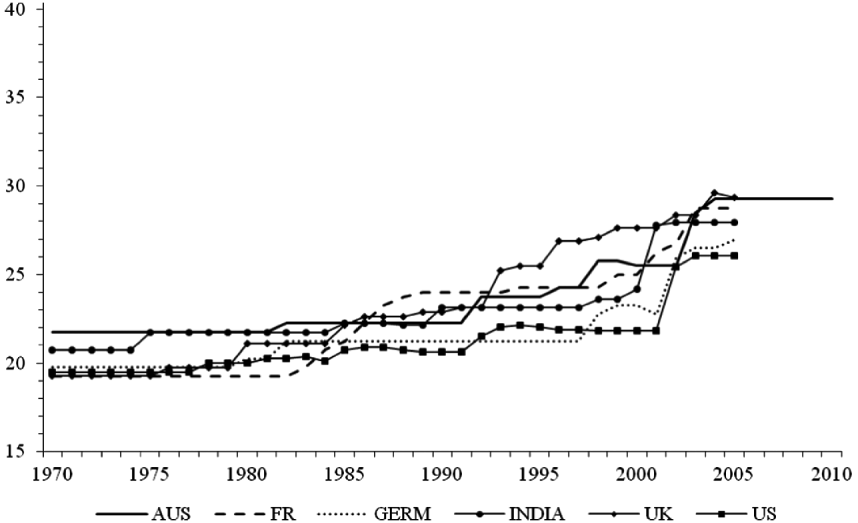
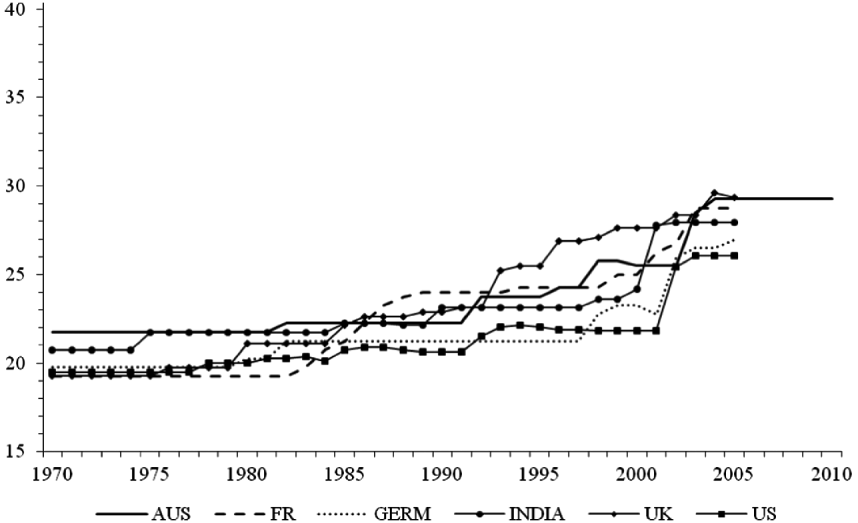
Figure 1 represents the level of shareholder protection against boards in Australia and the five other countries that were the subject of the 2007 study by Lele and Siems.Footnote 48 It indicates an upward trend in the level of shareholder protection against boards in all six countries over the period of the study. Australia had the highest level of protection in 1970, followed by India. From the mid 1970s until the early 1980s the level of protection in India increased to be equal to that of Australia. France, Germany, the UK and the US had similar levels of shareholder protection against boards from 1970 until the early 1980s. Apart from a period in the late 1970s and early 1980s when France had the lowest level of protection, Germany and the US recorded the lowest levels of protection of all of the six countries examined during the entire period of the study. In the mid 1980s the level of protection in the UK and France rose significantly and exceeded the level of protection in Australia until the early 2000s. By 2005 the UK and Australia had the highest level of protection, followed closely by France. India had the next highest level of shareholder protection, followed by Germany and the US.
Protection Against Boards (42 Items), Six-country Comparison, 1970–2005
The second sub-index in the longitudinal shareholder protection index measures the protection that shareholders have against other shareholders. It contains 18 items that measure a number of matters relating to meetings of shareholders, including shareholder's rights to vote, quorums, supermajority requirements and cumulative voting rights. The items also measure whether shareholders are required to disclose major share ownership, whether minority shareholders are able to be squeezed out by majority shareholders, whether appraisal rights exist following mergers or alterations of the articles of association/company constitution, and if there is a remedy available for oppressed minority shareholders. The sub-index also measures whether shareholder protection is mandatory (for example, whether it is possible to exclude the duty of care owed by directors).
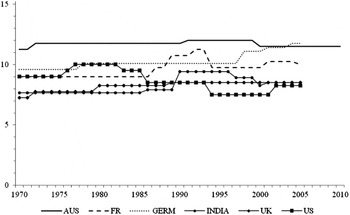
Figure 2 displays the level of shareholder protection against other shareholders in Australia and the other five countries. Unlike Figure 1, it shows no overall sustained upward trend. The level of shareholder protection against other shareholders in Australia and the UK was stable during the period of the study, with similar levels of protection being available in 1970 and 2005. However, this is the only similarity between the two countries. The level of protection in Australia was the highest of all six countries examined in 1970 and the UK was the lowest. In 2005 the level of protection in Australia was the second highest, behind Germany, and the level of protection in the UK was the second lowest, ahead of the US.
Protection Against Other Shareholders (18 Items), Six-country Comparison, 1970–2005

Compared with Australia and the UK, there was greater variation in the level of protection over the period of the study in France, India and the US. In Germany, the level of protection was stable until the late 1990s when it commenced an upward trend, culminating in 2005 in the highest level of protection of all six countries. The level of protection afforded to shareholders in the US was similar to that in France in 1970 and both countries were situated at the mid level when compared to the four other comparator countries. The level of protection in France remained at a moderate level, whereas in the US the level of protection dropped to the lowest level by 2005. The US is the only country in which the level of protection afforded to shareholders against other shareholders was lower in 2005 than it was in 1970.
In their 2007 article, Lele and Siems note that, while the level of protection afforded to shareholders against boards had risen significantly in the five countries that they examined, the level of protection against other shareholders had not done so. They reason that this may have been caused by a growth in the importance of capital markets during this period, which in turn led to increased diversity of share ownership. They argue that diversity in share ownership would have led to increased pressure for greater levels of shareholder protection against boards.Footnote 49 Conversely, diversity in share ownership would have decreased the need for protection against other shareholders.
Lele and Siems argue that the need for protection against other shareholders is greatest in countries where public companies are dominated by holders of large blocks of shares who may be inclined to exploit minority shareholders.Footnote 50 They argue that public companies in India, France and Germany are often dominated in this way and it is therefore not surprising that those countries performed better in relation to shareholder protection against other shareholders than did the UK and the US, where dispersed shareholder ownership is more common.Footnote 51 However, in more recent published research on these same five countries, Armour et al observe that, while India, France and Germany (where blockholder ownership is prevalent) all exhibit higher levels of protection against other shareholders than is the case for the US and the UK, the difference between these countries in terms of the level of protection is modest.Footnote 52
Armour et al also refer to the argument that in countries where dispersed share ownership is the norm it would be expected that the level of protection against boards would receive greater attention than it would in countries where dispersed share ownership is not the norm.Footnote 53 They note, however, that the data indicate that this expectation had not been realized. While the UK exhibited high levels of protection against boards, the US was consistently near or at the bottom of the five countries examined. Armour et al observe that ‘[t]his seems to run contrary to the claim in the law and finance literature that strong protection against boards of directors is associated with dispersed stock ownership’.Footnote 54
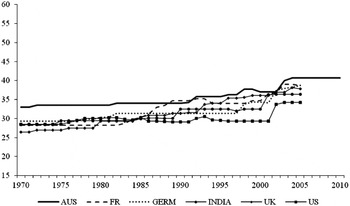
Figure 3 reports the aggregate index of shareholder protection against both boards and other shareholders in the six countries examined. Apart from a short period of time in the late 1980s and early 1990s when the level of protection in France exceeded that in Australia, the highest level of protection was found in Australia. The level of protection in the UK in 1970 was the lowest of all of the countries examined. However, by 2005 it had risen to be almost equal to that of France and Germany, which were situated immediately below Australia. In 1970 the level of protection afforded to shareholders in the US exceeded that in the UK and India, but by 2005 the figures for the US were the lowest of the six countries examined.
Aggregate Shareholder Protection Index (60 Items), Six-country Comparison, 1970–2005

In their 2007 study, Lele and Siems noted that the overall level of shareholder protection had improved between 1970 and 2005 in all the countries that they had considered.Footnote 55 The same has occurred in Australia. Lele and Siems noted that there had been particular improvement between 2000 and 2005, which they reasoned was not suprising given the attention paid to good corporate governance during this period. Australia, too, shows a sharp rise in the level of protection of shareholders in this same period. Lele and Siems noted that, although there was a general upward trend, for several of the countries examined there were periods in which the aggregate level of protection afforded to shareholders decreased, notably in the 1980s and 1990s. This they attributed to ‘the desire to make law more flexible as it is believed to be more business friendly’.Footnote 56 A fall in the level of shareholder protection was not evident in Australia in the 1980s and 1990s.
When compared to the other five countries for which we have comparable data, it is notable that Australia generally provided the highest level of protection to shareholders over the entire period. Even more striking is the high level of protection provided to shareholders in Australia against the actions of other shareholders when compared to other countries. The existing literature has noted the influential argument that countries with high blockholder levels of share ownership should have high levels of legal protection for minority shareholders who would otherwise be subject to possible exploitation by the blockholders.Footnote 57 Australia therefore appears anomolous, given that it does not have the levels of blockholder share ownership that exist in countries such as Germany and France. There is research that indicates that Australia sits somewhere between countries regarded as having dispersed share ownership (the UK and the US) and those seen as having high levels of blockholder share ownership (Germany and France).Footnote 58 However, Australia does not sit between these two country categories in terms of the level of protection provided to shareholders against the actions of other shareholders. Rather, for almost all of the period studied, it provides the highest level of such protection.
To illustrate the difference in shareholder protection in more detail, if we compare Australia and the US, it is undoubedly the case that shareholder protection is much stronger in Australia than in the US. When compared with shareholders of corporations incorporated in the State of Delaware, shareholders of Australian public companies have greater rights under the Corporations Act to:
• call meetings of shareholders;
• remove directors;
• disapprove of transactions whereby directors receive financial benefits from the company;
• disapprove of certain share capital transactions (such as reductions in share capital); and
• participate in an advisory vote on the adoption of the remuneration report at the annual general meeting of a listed company.Footnote 59
What explanation can be provided for the finding that, of the countries studied, Australia has the highest level of shareholder protection? Any possible explanation would need to focus on statutory changes rather than court judgments because, as we document below, the former, rather than the latter, have been the source of most of the changes in that protection.
Court judgments are not irrelevant, however. The coding that we have undertaken incorporates court judgments and we have observed differences between countries in some aspects of shareholder protection derived from court judgments. For example, when we compare shareholder protection in Australia and the UK, there are instances where Australian courts have provided superior protection to shareholders. Prior to the introduction of the shareholder's statutory derivative action in Australia,Footnote 60 the circumstances when shareholders could commence litigation for claims that properly belonged to the company, such as a claim for breach of duty by a director, were governed by the English case of Foss v Harbottle Footnote 61 and the exceptions to the principle established in that case—that the company, rather than a shareholder, is the proper plaintiff to bring a legal action for a wrong done to it. A leading English company law scholar compared the approaches of both UK and Australian judges and found Australian judges to be more willing to allow shareholders to commence litigation under one of the exceptions to Foss v Harbottle.Footnote 62 This trend continued.Footnote 63 However, despite some differences in shareholder protection based on court judgments, this is not where most differences occur, so we therefore return to considering statutory protection of shareholders.
This leads to a possible political explanation for the high shareholder protection in Australia when compared to the other countries included in our analysis. The Australian Parliament has, over an extended period of time, shown a strong inclination to protect the rights of shareholders, and this is evident when we consider both protection of shareholders against the board and protection of shareholders against the actions of other shareholders. However, it is important to note that this would not seem to be the result of influence by shareholders on the political process. Retail shareholders have not exercised strong political influence and they suffer a collective action problem, despite having a representative organization—the Australian Shareholders Association—that has worked to promote the interests of retail shareholders in recent years. In addition, the influence of insitutional shareholders has not been as prominent in Australia as in some other countries, although this is changing as representative organizations such as the Australian Council of Superannuation Investors and the Financial Services Council (previously the Investment and Financial Services Association) grow in influence.
So if the high level of shareholder protection in Australia is not the result of the political influence of shareholders, it might instead be the result of a notion underlying corporate law reform and adopted by Parliament that one way of responding to corporate collapses and failures in corporate governance is to empower shareholders. In other words, increasing the powers available to shareholders is seen as a means of constraining directors and majority shareholders, and this might in some circumstances prevent future corporate collapses and improve corporate governance. A trend of shareholder empowerment is seen in a number of countries,Footnote 64 and it has generated controversy.Footnote 65 However, our data suggest that this trend is stronger in Australia than in the other countries included in our study.
We see empowerment of shareholders as a theme of much Australian corporate law reform over the last two decades. These reforms include legislative amendments that, in certain circumstances, require financial benefits provided by public companies to their related parties—including directors and their associates—to be approved by shareholders.Footnote 66 We also find this theme in the extensive legislative changes, extending over many years, that have increased the information required to be provided to shareholders.Footnote 67 There are features of the Australian legislative framework protecting shareholders that are particularly distinctive. For example, 100 shareholders are entitled to have the directors call a meeting of shareholders and this right extends to shareholders in listed companies.Footnote 68 A law reform body examined the right of shareholders to call meetings in 18 countries and in none of these countries did the law allow only 100 shareholders to call a meeting.Footnote 69
The theme of empowerment of shareholders is evident in a series of influential law reform reports—some of them by Parliamentary Committees. In 1991, the House of Representatives Standing Committee on Legal and Constitutional Affairs published a report titled Corporate Practices and the Rights of Shareholders. In 2000, the Companies and Securities Advisory Committee (the federal government's independent corporate law reform advisory body) issued Shareholder Participation in the Modern Listed Company. In 2008, the Parliamentary Joint Committee on Corporations and Financial Services published Better Shareholders—Better Company: Shareholder Engagement and Participation in Australia. Each of these reports contained recommendations to enhance shareholder protection.Footnote 70
There are several aspects to shareholder protection when examined as part of leximetric research. One of these is shareholder empowerment: that is, granting powers to shareholders, such as the power to approve or disapprove of certain corporate transactions. However, shareholders can also be protected without necessarily being granted specific powers. For example, corporate law might enhance the protection of shareholders by reducing the powers of directors in some way or by requiring directors to act in specific ways. In terms of corporate law reform in Australia, we have seen both these aspects of shareholder protection. It has been observed that favoured corporate law reform and corporate governance strategies in Australia in recent years have included linking managerial pay to company performance; using boards of independent directors to monitor managerial action; and facilitating an active market for corporate control (that is, takeovers) to sanction managers who fail to promote shareholder value.Footnote 71 These strategies have a strong shareholder focus.
Takeovers are a particularly important corporate transaction because they result in the change of control of the target company. The Australian Corporations Act provides strong protections for shareholders in the context of a takeover, for example by requiring a bid for outstanding shares when a shareholder acquires more than 20 per cent of the existing shares unless there is a statutory exemption, and by imposing disclosure requirements on both the bidder and the target company. These requirements can operate as a significant constraint on blockholder shareholders who are considering acquiring the shares of others.
An important difference between Australia and the US in relation to the balance of power between shareholders and directors, and to shareholder protection, exists in the context of takeovers. In particular, directors of US companies have much greater freedom than Australian directors to implement defensive tactics against hostile takeovers. With regard to the US, Roe observes that in the 1980s the hostile takeover became popular as a means of aligning the interests of shareholders and directors/managers—a board that was not performing could be dismissed by new owners following a hostile takeover.Footnote 72 However, US managers were able to thwart this development by lobbying to have laws enacted to stop hostile takeovers and by implementing changes to the corporate structure that raised the costs of hostile takeovers, such as poison pills and staggered boards of directors.Footnote 73 In Australia, by contrast, there are strong limits on the defensive tactics that can be employed by directors who have the intention of thwarting a hostile takeover. For example, Australian Securities Exchange Listing Rule 7.9 deals with issues of shares during a takeover. A defensive tactic when confronted with a hostile takeover is for the board of the target company to issue shares to someone who is friendly to the board—a so called ‘white knight’. However, Listing Rule 7.9 provides that a listed company must not issue or agree to issue shares without the approval of existing shareholders in the company for three months after the company is told in writing that a person is making, or proposes to make, a takeover.Footnote 74 In the US, directors of target companies have broad powers to commence litigation to thwart a hostile takeover. In Australia, on the other hand, concerns about litigation being used as a defensive tactic by target company directors led to the establishment of the Takeovers Panel, which decides matters promptly—generally in a matter of days—and access to the courts is usually not permitted while a takeover is underway.Footnote 75
In summary, it might be the case that an explanation for the high level of shareholder protection in Australia lies with the pull of shareholder empowerment as an important theme of corporate law reform. However, to say that shareholder empowerment is a theme of Australian corporate law reform leaves unanswered the question of why this might be the case. Might it have something to do with the type of democracy that exists in Australia? Locating explanations for particular types of corporate governance laws or systems in the sphere of politics and the types of democracy that exist around the world has been explored by Roe.Footnote 76 He has argued that ‘social democracies’ (which he defines as countries committed to private property but whose governments (1) have a large role in the economy, (2) emphasize distributional considerations, and (3) prioritize employees over investors of capital when the two conflict) are typically countries in which the interests of shareholders are downplayed.Footnote 77 He writes that ‘[s]trong social democracies raise the pressure on managers to abandon their shareholders and side with employees to do what managers want to do all along: expand, avoid risk, and avoid rapid change’ and ‘the institutions that would help shareholders—securities laws, corporate laws, and stock exchanges—have not commanded such governments’ attention as important to strengthen’.Footnote 78 In these countries, shareholders have sought to control managers by block ownership of shares.Footnote 79
Roe tests his theory by examining data for the world's 16 richest democracies, including Australia, and finds a correlation between the political placement of the countries (on what he terms a left to right scale) and share ownership concentration for the largest 20 public companies in these countries. In other words, left-leaning countries tend to have more concentrated share ownership. However, the data for Australia raise questions. Roe classifies Australia as the third most left-wing of the 16 countries. As Cheffins observes, for anyone familiar with Australia's political situation, this ‘looks odd’.Footnote 80 Cheffins also questions whether Roe underestimates the extent of share ownership concentration in Australia.Footnote 81 In addition, Roe's theory has been questioned in terms of its application to the UK.Footnote 82
An alternative theory has been advanced by Christopher Bruner to explain why shareholders are more powerful (or, to use the phrase we have employed for this article, have more protection) in the UK than in the US.Footnote 83 He argues that stronger social welfare policies in the UK that protected the interests of employees and other stakeholders allowed the corporate governance system to promote the interests of shareholders without giving rise to a political backlash. By contrast, in the US, pressure was brought to bear on companies to provide social welfare, and this restricted the promotion of the interest of shareholders. He summarizes his argument as follows:
I argue that left-leaning politics and the construction of the post-war welfare state in the United Kingdom actually facilitated the emergence of shareholder-oriented structures within its corporate governance system by deflecting stakeholder-oriented political pressures that might otherwise have been directed toward the corporate structure itself. Conversely, I argue, the reliance on private employers in the United States to provide the sorts of social welfare protections provided by government in the United Kingdom resulted in stakeholder-oriented political pressures being focused on the corporate structure itself, inhibiting the development of a strongly shareholder-centric corporate governance system in the United States.Footnote 84
We can see how this contrast with Roe's thesis. According to Roe, left-leaning countries are associated with a corporate governance system that downplays the interests of shareholders. In contrast, Bruner argues that the left-leaning policies of the UK in the post-war period resulted in a shareholder-focused corporate governance system.
As we conduct further research for this project and, in particular, combine the results of our research with that of colleagues who have been conducting leximetric research on Australian labour law,Footnote 85 we expect to be able to evaluate these competing theories in the context of Australia. However, some preliminary observations can be made. Australia had a conservative federal government from 1949 to 1972, from 1975 to 1983 and from 1996 to 2007. It had a Labor government from 1972 to 1975, from 1983 to 1996 and from late 2007 to the time of writing. There were several important corporate law reforms passed in the first half of the 1990s by the Labor government that strengthened shareholder protection.Footnote 86 In addition, the Takeovers Panel was established under the Labor government.Footnote 87 However, much corporate law reform strengthening shareholder protection occurred under the conservative government that was in power from 1996 to 2007.Footnote 88 The conservative government also amended the Corporations Act to protect the entitlements of a company's employees from agreements and transactions intended to defeat recovery of those entitlements.Footnote 89 There is therefore no obvious relationship between the political party in power and corporate law reform that increases shareholder protection. However, more detailed research that we are currently undertaking on the history of shareholder protection in Australia may shed light on this issue.
B. Creditor Protection
The creditor protection index is divided into three sub-indices: restrictions on debtor activities, creditor contract rights and creditor rights in insolvency.
1. Restriction on debtor activities
The first sub-index relating to creditor protection measures the extent to which rules restrict or deter debtor companies from entering into transactions that might harm creditors’ interests while the company is a going concern. It has 15 items and these include minimum capital requirements, dividend restrictions, equitable subordination, piercing the corporate veil, transaction avoidance, directors’ liability and public enforcement.
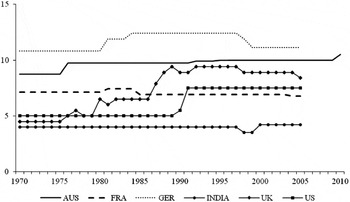
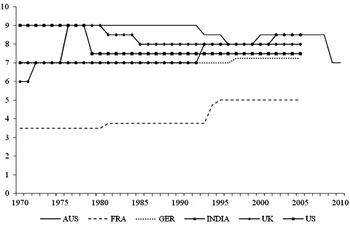
Figure 4 reports the results of the six-country comparison for the restrictions on debtor activities index. It shows that Australia is second only to Germany in these restrictions, indicating its strength against other countries. It also shows relative stability over the period. Australia's comparative strength and stability is in contrast to other common law countries. The UK has clearly improved significantly, with both legislative changes and judicial decision-making responsible. The US, which began more strongly than the UK, has also improved significantly, but remained weaker than the UK at the end of the period for which we have comparative data. India, while quite stable over the period, began weakest and remained so through to 2005. The civil law countries—France and Germany—show much smaller changes than the US and the UK, but the difference between these two countries in terms of our measure of restrictions on debtor activity remained large for the entire period of the study.Footnote 90
Restrictions on Debtor Activities (15 Items), Six-country Comparison, 1970–2005

Some examples illustrate the variations, both between and within families of law and over time. A requirement that a company maintain a minimum share capital has been used extensively in European civil law countries,Footnote 91 but Australia has no such requirement. However, this distinction is not clear-cut: private and public companies generally have separate and dissimilar rules. For example, in France the law changed in 2003, removing the requirement for a private company to maintain a minimum capital,Footnote 92 whereas other civil law systems have retained or improved their capital maintenance requirements.
The US has consistently had weak laws in relation to maintenance of capital.Footnote 93 In contrast, in the UK capital maintenance has been contentious over the past decade. The Department of Trade and Industry White Paper entitled Company Law Reform considered capital maintenance ‘largely irrelevant’ for private companies and their creditors.Footnote 94 The Companies Act 2006 (UK) saw a significant relaxation of the requirements in relation to reductions of share capital for private companies, although their obligations with respect to legal capital under article 6 of the Second Company Law Directive restrain any further changes for public companies.Footnote 95
Even within legal families, significant variation can occur. An example is the insolvent trading liability of holding companies. In Australia, section 588V of the Corporations Act renders a holding company liable for the subsidiary's debt when the subsidiary has traded while insolvent, where the holding company's directors were aware or should have been aware of reasonable grounds for suspecting insolvency. This change to the law in 1992 was not based on an equivalent English provision, as the Cork Report in 1982 had refused to recommend holding company liability in such circumstances. Cork's reluctance was due to fears about effects on entrepreneurship and apportionment of liability. In addition, there were fears that such a duty might expose directors of the holding company to a position of conflict between their duties to their own company and their responsibilities to other companies in the group.
Australia's new dividend definition also differs from the present English law. The new section 254T of the Corporations Act prohibits a public or proprietary company from paying a dividend unless its assets exceed its liabilities immediately before the dividend is declared and the excess is sufficient for the payment of the dividend. Further, the payment of the dividend must be fair and reasonable to the company's shareholders as a whole and not materially prejudice the company's ability to pay its creditors. This wording is similar to the creditor protection tests in other capital maintenance provisions in the Corporations Act. Prior to this, Australian law had required only that the dividend be paid from profit, leaving the definition of profit to a generous and sometimes contradictory common law. In contrast, the Companies Act 2006 (UK) retains the general permission to pay dividends from profits but then provides statutory guidelines for its definition that resemble some of the Australian common law tests. However, in relation to public companies, further restrictions apply. These are based on the company's net assets, and a variety of calculations are required, taking into account uncalled capital and undistributable reserves. These reserves include the share premium account, a concept that was made redundant in Australia with the abolition of par value in 1995.Footnote 96
The lack of influence of legal origin is apparent with regard to equitable subordination of shareholder loans to the company. Equitable subordination occurs where the payment of debts owed by a company to shareholders is deferred behind the payment of outside creditors. Both the US and Germany adhere to this doctrine. Its origins in the US lie in the leading 1939 cases of Taylor v Standard Gas & Electric,Footnote 97 known as the ‘Deep Rock’ case, and Pepper v Litton.Footnote 98 The doctrine was codified in 1978.Footnote 99 German courts have also permitted the subordination of shareholder debtFootnote 100 since the late 1950s,Footnote 101 and Germany's rules on equitable subordination were then codified in 1980.Footnote 102 However, despite the apparent similarities between these two jurisdictions, the substance of their laws differs.Footnote 103 The other jurisdictions under consideration do not allow for the subordination of shareholder debt. The UK Cork ReportFootnote 104 advocated subordination in a limited form,Footnote 105 but this proposal was not implemented.Footnote 106
2. Creditor contract rights
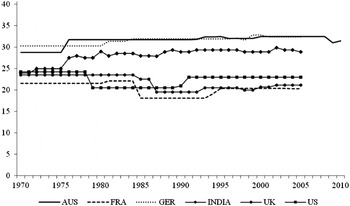
The second index measures creditor contract rules. It has 10 items and these include set-off, enforcement of contracts, the availability of security interests and retention of title. Figure 5 represents changes in creditors’ mechanisms for self-protection outside of insolvency proceedings, either under the law or through their own contracts with the debtor. Generally creditors may self-protect through a variety of non-possessory security interests and can appoint a receiver to enforce their claims. This has been a relatively stable area of the law over the survey period. The graph shows the results of the six-country comparison for the creditor contract rights index. Australia is again seen to perform strongly over time and in comparison to the other countries studied. France begins and remains the weakest of all the jurisdictions. Armour et al account for France's result as an outlier rather than an indication of inherent weakness in civil law countries, although they recognize that Germany, which was very stable throughout the period, also ends weaker than the common law countries.Footnote 107 The comparative strength of the common law countries is not, however, attributable to the legal origin effect. The reduction in the US score is explained by the introduction of the US Bankruptcy Code in 1978,Footnote 108 which made a number of adverse changes, for example to set-off rights.Footnote 109 On the other hand, the improvement in India's score is attributable to two pieces of legislation to improve recovery of debts.Footnote 110
Creditor Contract Rights (10 Items), Six-country Comparison, 1970–2005

The changeability of the UK position is explained by a number of court judgments, principally in relation to retention of title (RoT) clauses. The 1976 Romalpa decisionFootnote 111 was responsible for the upward movement in its index. As in Australia, subsequent decisions moderated its application. However, in Australia the question has now been settled with the passage of the Personal Property Securities Act 2009, which introduced the registration of some RoT clauses. The Act was based on legislation in New Zealand that was itself copied, almost verbatim, from Canadian laws. In the UK, on the other hand, RoT clauses do not have to be registered. A series of committees has considered the matter: in 1982, the Cork Report recommended a disclosure requirement for some of the terms of an RoT clause; in 2001, the Company Law Review Steering Group suggested that complex RoT clauses should be registered in a proposed notice-filing system for registrable charges. However, the 2005 Law Commission Report deferred consideration of registration of RoT clauses.
3. Creditor rights in insolvency
This index consists of 19 items, including structure (does the law provide for both liquidation and rehabilitation), trigger mechanisms, the parties in control, voting on exit and the subordination of priorities.
Figure 6 shows the results of the six-country comparison for the creditor rights in insolvency index. It is characterized by a series of downward turns, with the exception of Australia and Germany, which both begin strongly and end up more highly placed. The increase in the level of protection that occurred in Australia in 1993 is explained by the introduction of voluntary administrationFootnote 112 as an alternative to liquidation. The UK completes the trio at the top of the index.Footnote 113 Again, the influence of legal origin is not apparent. The ranking of the US as weakest reflects its pro-debtor, anti-creditor stance in times of insolvency as a result of the automatic stay on assets, preventing secured creditors from taking possession of their security. However, this can improve the chances of successful reorganization to the benefit of unsecured creditors, and exemplifies the challenges of a leximetric analysis of creditor protection. The right of management to seek Chapter 11 protectionFootnote 114 without the consent of creditors and to remain in charge of the company while reorganization is attempted also thwarts the secured creditors. However, it may ultimately advantage unsecured creditors if management's familiarity with the affairs of the company assists them in their attempts to rescue the business.Footnote 115 In contrast, Australia's rescue mechanisms displace management; while there has been a statutory moratorium on enforcement of security without administrator permission or leave of the court since 1993,Footnote 116 the administration period is relatively short.
Creditor Rights in Insolvency Index (19 Items), Six-country Comparison, 1970–2005

The significant decline in the French position is explained by the enactment of its insolvency laws in 1985.Footnote 117 These are now codified in the Commercial Code and are expressly designed to save workers’ jobs using creditors’ money.Footnote 118 Despite the different legal families, the French laws have a similar underlying philosophy to India's Sick Industrial Companies Act 1985 (SICA), which aims to save the company by severely restricting the rights of creditors to enforce their claims.Footnote 119 Thus the US finds itself closely positioned with France and India on the index, despite the US laws being underpinned by a different rationale.
C. Concluding Observations Regarding Shareholder and Creditor Protection
Our findings do not offer support for legal origins theory. In relation to the level of shareholder protection against boards, despite Australia and the US being in the same legal origin category, over the 35-year period of study Australia had the highest protection for shareholders and the US had the lowest. Despite being in different legal origin categories, Australia and France had the highest protection for shareholders. When we examine the level of protection of shareholders against other shareholders, despite being in different legal origin categories, Australia and Germany had the highest protection for shareholders. Although Australia, the US and the UK are in the same legal origin category, over the period of study Australia had the highest protection for shareholders yet the US and the UK generally had the lowest level of protection. When all 60 shareholder protection items are combined, over the period of the study Australia generally had the highest level of shareholder protection and the US the lowest, despite both counties being in the same legal origin category.
In relation to creditor protection, Armour et al and Siems make a number of observations about the creditor protection data of the five countries they surveyed and these will only be summarized here briefly. Siems observes ‘unambiguous differences’ between the UK and the US despite their common law legal category, which he explains by way of regulatory competition within the US.Footnote 120 He cautions against finding a legal origin effect between the UK and India: while there are similarities between ‘law on the books’, these must be understood in the context of serious delays in the enforcement of creditor rights in India,Footnote 121 only partly remedied by the SARFAESI Act 2002. Siems notes the lack of similarities between the US and India, which is accounted for by the differing political and legal cultures of the two countries.Footnote 122
What is striking about the aggregate index is the way in which the three groups of items ‘even out’ once combined. Armour et al observe ‘no clear pattern of difference … between the overall scores of civil and common law jurisdictions … [and] the nature of change over time again looks remarkably similar across the common law/civil law divide’.Footnote 123 They further observe that ‘[o]nce the main indices are broken down into their component parts, we can see that countries can arrive at similar levels of protection overall, through different methods’.Footnote 124
Figure 7, which is the aggregate creditor protection index for the six-country comparison, shows Australia as a leader in creditor protection with a persistently high ranking, but its score mirrors Germany more than it does the UK. Thus its relative strength is confirmed on an agreggate level, but not its adherence to, or convergence with, other countries in its legal origin category.
Aggregate Creditor Protection Index (44 Items), Six-country Comparison, 1970–2005

When we consider both shareholder and creditor protection over the period of the study, there are increases in both shareholder protection and creditor protection in Australia, the UK and Germany. However, when we consider the other three countries—France, India and the US—although they each had stronger shareholder protection over the period of the study, the level of creditor protection declined. These findings do not support legal origins theory.
V. convergence and divergence among countries
A major debate in comparative analysis of legal evolution has been the extent to which legal rules across different countries have, over time, converged on a similar model or level of protection for creditors and shareholders. The generation of indices such as those we use here provides a useful means by which such an assessment can be made, although any comparison is not without difficulties.
A key issue of concern has been the nature of the convergence observed. Across different academic literatures and disciplines, the concept of convergence has been defined somewhat ambiguously. As Drezner points out ‘the scholarly work on this subject is spread across multiple disciplines, including law, economics, political science and sociology. The problem leads to a certain redundancy in theory building, as disciplinary boundaries prevent ideas from spreading across fields.’Footnote 125 In general terms, as the concept is used in the social sciences, ‘convergence’ has commonly been taken to mean ‘the tendency of societies to grow more alike, to develop similarities in structures, processes and performances’.Footnote 126 More specifically, regulatory convergence can be defined as the isomorphic tendency towards a concordance of rules and policy mechanisms governing a given transaction, such as share ownership, across national jurisdictions.Footnote 127
Researchers examining patterns of convergence have typically distinguished between both ‘strong’ and ‘weak’ forms of convergence, and ‘formal’ and ‘functional’ convergence. While strong convergence is taken to mean a merging of some common attribute towards the same form or level, weak convergence refers to a more general tendency towards becoming more similar without any expectation that a complete convergence is likely to be observed. In this sense, convergence is viewed as: ‘a process of “becoming” rather than a condition of “being” more alike … In comparative research, therefore, the essential theoretical dimension is temporal rather than spatial.’Footnote 128 The distinction between formal and functional convergence recognizes that different types of policy instrument are likely to be used in different jurisdictions, and also recognizes the possibility of ‘functional equivalence’ in rules or institutions across different countries.Footnote 129
While the quantitative coding of legal rules provides us with a powerful tool to assess the relative strength of the convergence across countries, the lack of data on actual practices does not allow us to assess functional equivalents that may result in convergence at the functional level.Footnote 130 In this section we report a common measure of convergence—the co-efficient of variation for the aggregate measures of creditor and shareholder protection for the period 1970 to 2005.Footnote 131
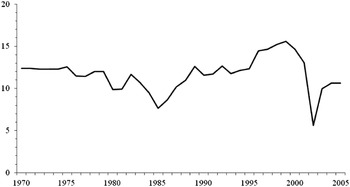
Figure 8 reports the co-efficient of variation for the aggregate shareholder protection index for the six countries. It indicates a marked degree of persistent divergence among countries, with the exception of two distinctive periods of sharp convergence (in the early 1980s and in the early 2000s). This persistent divergence occurred despite the generally increasing level of protection afforded to shareholders in all countries in this period (see Figure 3). Indeed, between 1985 and 2000 the level of protection afforded to shareholders diverged among the countries included in our sample, before experiencing a sharp convergence in subsequent years, before again diverging in the final years of the study period. By the end of the period for which we have data, the difference between countries was roughly similar to that in 1970.
Divergence in Shareholder Protection, Six Countries, 1970–2005

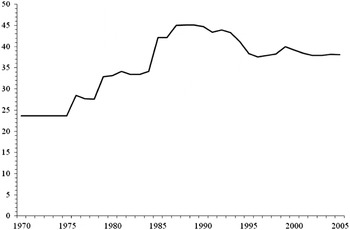
Figure 9 reports the co-efficient of variation for the aggregate creditor protection index for the six countries. This graph reinforces the observations made in relation to the evolution of creditor protection at the country level, which suggested that there was no discernable pattern among countries. It indicates that, over the period from 1970 until the early 1990s, laws governing creditor protection were actually diverging rather than converging, at least for the countries for which we have comparable data. From the early 1990s, however, there is a weak trend towards convergence; and by the mid 1990s no trend is evident. By the end of the period for which we have data, the extent of divergence in the level of protection afforded to creditors was significantly higher than was the case in 1970. That is to say, while the average level of protection had increased, there was a growing divergence among countries in the strength of the law.
Divergence in Creditor Protection, Six Countries, 1970–2005

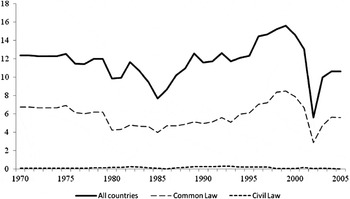
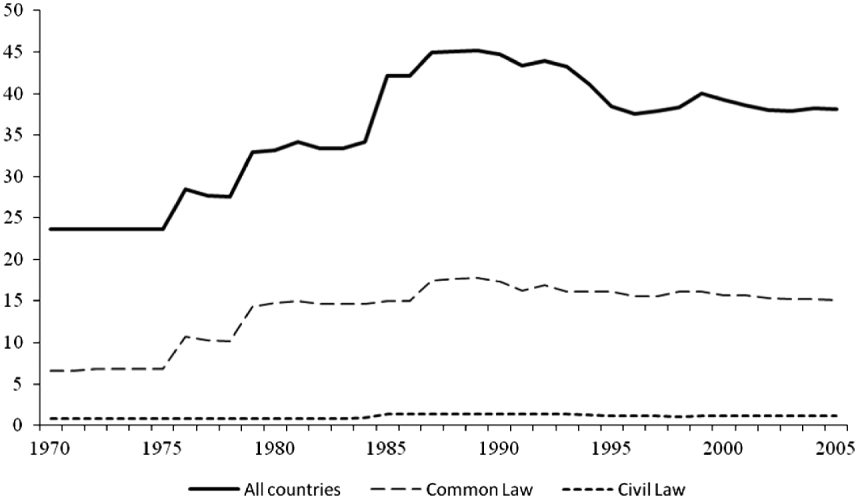
As we indicate above, this aggregate measure of convergence might in fact render trends among countries of different legal origins difficult to detect. Persistent differences between countries may in fact hide a trend of convergence within legal origin type. To test for this possibility, Figures 10 and 11 report the co-efficient of variation for common law and civil countries separately. We stress that some caution needs to be taken in interpreting this data for the reason that our sample of countries is small—and it includes only two civil law countries.
Divergence in Shareholder Protection, Common Law and Civil Law Countries Compared, 1970–2005

Divergence in Creditor Protection, Common Law and Civil Law Countries Compared, 1970–2005
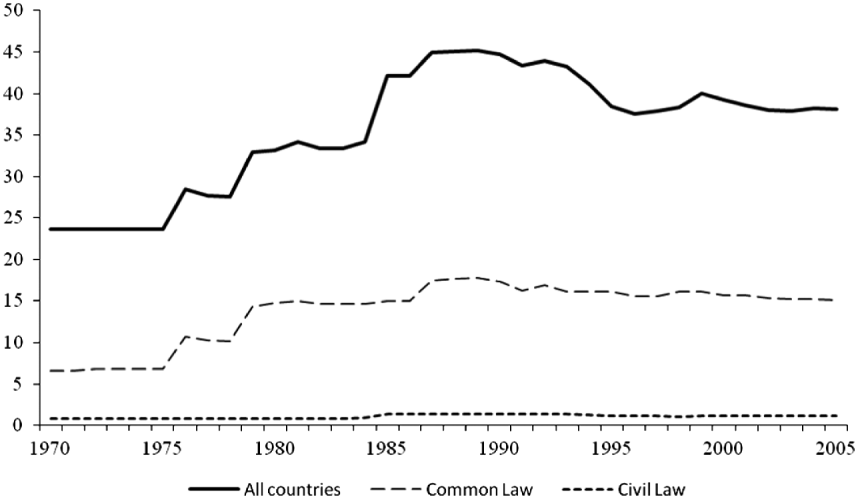
Figure 10 shows that the extent of divergence in the level of shareholder protection was lower for both common law and civil law countries than for the sample overall. However, the extent of divergence in the level of shareholder protection for common law countries was significantly higher than for the two civil law countries included in our study. Moreover, between the mid 1980s and the late 1990s, the extent of divergence among common law countries in the level of shareholder protection actually increased. This compares with a high degree of convergence between the two civil law countries included in our analysis, with little change over the entire period.
Figure 11 reports the same measures with respect to creditor protection. Again, the extent of divergence in the level of protection is greater for the whole sample than for common law and civil law countries separately. The graphs also shows that, from the mid 1970s through to the mid 1980s, there was a growing divergence among common law countries, and then little change in the extent of divergence thereafter. In the case of the two civil law countries, a higher degree of convergence is evident for the entire period for which we have data.
What then can we conclude in respect of debates around convergence in corporate law? Again, we need to be mindful that we have data for a limited sample of countries. Moreover, our measure of the protective strength of shareholder and creditor protection allows us to examine the degree of formal convergence, not functional convergence. Overall, the data show no trend towards formal convergence—indeed, the trend has been towards greater divergence for much of the period. In the case of shareholder protection, although the level of protection increased in all six countries over the period of study (see Figure 3), there was a marked degree of persistent divergence among the countries during this time. In the case of creditor protection, three countries had increases in the level of protection and three had decreases over the period of the study (see Figure 7), and there was increasing divergence among these countries overall.
When we test for a legal origins effect, the data do indicate a bifurcation in trends based on legal origin: the level of protection is markedly similar for civil law countries than for common law countries, and for both groups compared with the degree of divergence for the group as a whole.
VI. conclusion
In this article we have presented the findings of the first longitudinal leximetric study of shareholder and creditor protection in Australia. Our study has covered an extensive period of time—1970 to 2010. The leximetric methodology allows us to make international comparisons in relation to how shareholders and creditors are protected, to learn about the Australian shareholder and creditor protection regulatory style, to detect trends over time in shareholder and creditor protection, and to contribute to the legal origins debate that is, in part, based on leximetric research methodology.
Our research has identified a sustained upward trend in shareholder protection in Australia, but not in the case of creditor protection. We have compared our findings with those for five other countries—France, Germany, India, the UK and the US. Compared to those countries, the level of protection afforded to shareholders under Australian law was relatively high and this was also the case for the level of protection afforded to creditors.
In addition to examining how the level of shareholder and creditor protection has changed over time in the six countries, we also examined the extent of convergence and divergence in shareholder and creditor protection among the countries in the study. We found persistent divergence in shareholder protection, with the extent of divergence in 2005 similar to that in 1970. For creditor protection, we found increasing divergence among the countries over the period of study.
Our research findings add to those of other scholars who have located leximetric research in the context of the legal origins debate. Armour et al summarize some of their research by observing: ‘We do not find that shareholders and creditors are better protected in common law countries than in civil law ones. Nor does the pace of change seem to differ with regard to these two broad categories of legal system.’Footnote 132 We have not sought to establish whether levels of protection translate into certain outcomes for the particular countries in terms of their financial development or other economic consequences. That is a separate question and will be the subject of further research. The development of quantitative measures of the strength of law provides a new opportunity to assess these relationships empirically.
Our findings for Australia, a common law country, indicate that with only small exceptions Australia has provided, over the period of time of the study, the highest level of protection for shareholders. However, this is in the context of all six countries increasing their protection for shareholders—no matter whether the country is a common law or a civil law country. Australia (a common law country) and Germany (a civil law country) have the highest levels of creditor protection over the period of the study, so it cannot be said that the legal origin of the country appears to make a difference in terms of the extent of creditor protection. Therefore, in addition to identifying trends in shareholder and creditor protection in Australia and placing these trends in an international context, an important conclusion of our research is that, apart from some small evidence when we test for divergence in shareholder and creditor protection among the six countries in the study, our findings do not provide support for legal origins theory.
 , where
 is the sum of the differences in aggregate value of our index measuring creditor or shareholder protection between countries c i and c j at time t, and μt is the mean value of the index across all countries at time t.