Long QT syndrome is the most common inherited arrhythmogenic disorder. Several hundreds of different mutations in at least 10 different genes that code for key cardiac ion channels, structural membrane scaffolding proteins, and cardiac channel interacting proteins have been identified. Approximately 95% of all mutations are found in KNCQ1, KCNH2 (HERG), or SCN5A genes, which are responsible for the subtypes 1–3 of long QT syndrome. For these three subtypes, a phenotype–genotype correlation has been described.Reference Crotti, Celano, Dagradi and Schwartz1 Commonly, patients with subtype 1 exhibit syncope during swimming; long QT syndrome 2 patients are most susceptible to syncope after startling events such as auditory triggers, which result in arousal and emotional distress, whereas arrhythmic events in patients with long QT syndrome 3 occur during sleep.Reference Crotti, Celano, Dagradi and Schwartz1 In addition, there are increasing genetic data correlating the coding type of the mutation, the distinct location within the gene, and the topology with the risk for sudden cardiac events.Reference Shimizu, Moss and Wilde2
However, clinical presentation varies, and definite diagnosis of long QT syndrome may be difficult. We report the case of a 12-year-old girl with long QT syndrome who presented for the first time with a prolonged syncope due to a documented torsades de pointes tachycardia.
Case report
A 12-year-old Caucasian girl had an uneventful medical history so far; the family history was also unremarkable. She attended a school with an emphasis on physical education and was not on medication. Her first syncope occurred during school when she was criticised by the teacher for talking to a classmate. After having found her pulseless and cyanotic, she was resuscitated by a layperson using an automatic external defibrillator. On arrival of the emergency team, she was in sinus rhythm, but still in reduced vigilance. She was therefore intubated, ventilated, and treated with hypothermia for 24 hours. After weaning from the ventilator, no neurological sequelae were noted. Laboratory tests were normal, the drug screen was negative, and the patient was not on medication. An echocardiographic study was within normal limits.
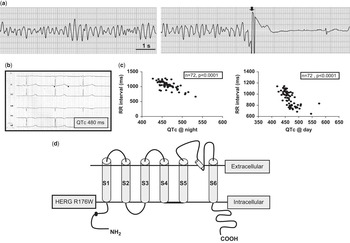
The electrocardiogram recorded by the external automatic defibrillator showed the typical morphology of a torsades de pointes tachycardia (Fig 1a). The electrocardiogram on admittance showed a rate-corrected QT interval of 480 milliseconds (Fig 1b), whereas repeated electrocardiograms in the further course showed rate-corrected QT intervals ranging from 410 to 460 milliseconds. Manually analysed QT intervals – six single beats every hour – from 12-channel Holter monitoring demonstrated a highly significant negative correlation of QTc with RR intervals for the day and night period, respectively (Fig 1c). No T-wave abnormalities or T-wave alternans were seen. The QTc interval of the mother was normal, but the father had a slightly prolonged QTc interval of 470 milliseconds. Therefore, her Schwartz score was 7 – 3 points for intermittent QTc prolongation of 480 milliseconds, 2 for a torsade de pointes tachycardia, 2 for the syncope with stress – making a long QT syndrome clinically very likely.Reference Schwartz, Moss, Vincent and Crampton3 The patient was started on a β-blocker (propranolol 3 milligrams per kilogram per day) and an internal automatic defibrillator was implanted subsequently. During 6 months of follow-up, no episodes of syncope or ventricular tachycardia were noted.
(a) Recording of the electrocardiogram by the external defibrillator. A torsades de pointes tachycardia is terminated by electrical discharge (arrow). (b) Surface electrocardiogram of the patient recorded during her hospital stay. Rate-corrected QT interval using the Bazett formula was 480 milliseconds. (c) Plot of QTc and RR intervals from 12-lead Holter monitoring. There is a highly significant negative correlation of rate-corrected QT and RR intervals during the day and at night. (d) Location of the identified R176W mutation in the human ether-a-go-go-related gene channel subunit. Topology of a single HERG channel subunit with six transmembrane domains (S1–S6) that span the cell membrane.

Genetic testing was performed including 61 exons, adjacent intron regions, and splicing sites of KCNQ1, KCNH2, KCNE1, KCNE2, and SCN5A genes by repeated polymerase chain reactions followed by double-strand sequencing. A quantitative analysis of the above-mentioned genes was included in respect of deletions and duplications by multiplex ligation-dependent probe amplification. In addition, all 17 exons and adjacent introns of CAV3, KCNE3, KCNJ2, and SCN4B genes were sequenced.
We found a heterozygous point mutation c.526C > T (p.Arg176Trp, R176W) in exon 4 of the KCNH2 (HERG) gene. This mutation leads to an exchange in amino acid arginine to tryptophan in the amino terminal region of the HERG protein (Fig 1d). Except for a very common heterozygous SCN5A polymorphism (H558R), no further mutations were detected.
Discussion
The case presented here illustrates some characteristic features of long QT syndrome 2, but also highlights the unpredictable course of cardiac channelopathies. The life-threatening arrhythmia as first clinical manifestation of long QT syndrome 2 occurred after an emotionally unpleasant event, which is common in this subtype.Reference Crotti, Celano, Dagradi and Schwartz1
On admittance to the hospital and during follow-up, the girl had normal serum electrolytes, no hypothyroidism, and did not take any medication that might have aggravated the genetic predisposition for arrhythmia. In particular, the girl did not follow a special potassium-wasting diet and had no diarrhoea when she exhibited the ventricular tachycardia.
Only one of five surface electrocardiograms showed a prolonged QTc interval, emphasising the low sensitivity of single electrocardiograms in the diagnosis of long QT syndrome.Reference Tester, Will, Haglund and Ackermann4 The absence of clear T-wave abnormalities found on the Holter monitoring is typical for the localisation of the mutation at the N terminus, whereas mutations in the core domain are more often associated with T-wave notches.Reference Lupoglazoff, Denjoy and Berthet5
The decision for implantation of a cardioverter-defibrillator is based on a survived cardiac arrest due to haemodynamically unstable sustained ventricular tachycardia. The cause of the event could be identified and reversibility excluded. Therefore, according to current guidelines for device-based therapy, a class I A indication was fulfilled.Reference Epstein, DiMarco and Ellenbogen6
At present, the human ether-a-go-go-related gene R176W mutation found in our patient was reported in 8% of Finnish long QT syndrome patients, of whom 16% were symptomatic,Reference Fodstad, Bendahhou and Rougier7 whereas this mutation was found in less than 1% of Finnish blood donors and was not detected in 305 black individuals.Reference Marjamaa, Salomaa and Newton-Cheh8, Reference Ackerman, Splawski and Makielski9 This mutation causes only mild rate-corrected QT prolongation ranging from 406 to 460 milliseconds.Reference Fodstad, Bendahhou and Rougier7In vitro experiments by heterologous expression of the mutant protein in COS-7 cells showed a slight acceleration of the deactivation kinetics and a reduction in current density.Reference Fodstad, Bendahhou and Rougier7
Compound heterozygotes having the human ether-a-go-go-related gene R176W mutation in combination with a distinct mutation in the KCNQ1 gene (G589D or IVS7-2A > G) seem to have a more severe phenotype with longer QT intervals and a higher percentage of symptoms.Reference Marjamaa, Salomaa and Newton-Cheh8 As the clinical presentation of our patient was rather significant, we analysed the whole KCNQ1 gene for further mutations. However, we could exclude further mutations and single-nucleotide polymorphisms in the KCNQ1 gene. In addition, no further mutations were found in other regions of the KCNH2 gene and KCNE1, KCNE2, KCNE3, KCNJ2, SCN5A, SCN4B, and CAV3 genes. The heterozygous SCN5A polymorphism H558R occurs in 30% of healthy Caucasians and may have disease-modifying effects on other sodium channel mutations only.Reference Ackerman, Splawski and Makielski9 Considering the fact that in spite of the increasing numbers of known mutations causing long QT syndrome about 30% of detected mutations are still new and 5–10% of all patients have more than one mutation, a yet unknown mutation might have contributed to the phenotype in our patient.Reference Kapplinger, Tester and Salisbury10 In addition, the aggravating role of single-nucleotide polymorphisms in conjunction with the identified mutation for a prolonged cardiac repolarisation might play a role.Reference Newton-Cheh, Guo and Larson11 Alternatively, the identified mutation is sufficient to cause this clinical phenotype in a woman. This hypothesis is supported by a recent study analysing the relationship between localisation of the long QT syndrome 2 mutation and gender, demonstrating that women have a high rate of life-threatening events regardless of mutation location, whereas men had a higher risk if the mutation is in the pore loop.Reference Migdalovich, Moss and Lopes12
The significant clinical presentation of our patient and the detection of a long QT syndrome mutation that was regarded to cause a rather mild phenotype highlight the complex situation in counselling such families.