Introduction: defining and treating the object of social interventions
In recent years, international development institutions have begun to pay increasing attention to the role of faith-based organisations (FBOs) in poverty reduction in developing countries (Clarke and Jennings, Reference Clarke, Jennings, Clarke and Jennings2008; Tyndale, Reference Tyndale2006). This interest has been spurred partly by the need to find new avenues to promote measures of social protection in light of the impending deadline for the Millennium Development Goals (Clarke and Jennings, Reference Clarke, Jennings, Clarke and Jennings2008; Gough and Wood, Reference Gough and Wood2004).
The presence of religion in the sphere of social policy also has a long documented history in the advanced capitalist democracies of the Western world dating back to the Middle Ages in Europe (Midwinter, Reference Midwinter1994). In the USA, religion continues to have a special place in public lifeFootnote 1 (Erwin, Reference Erwin2008). Indeed, the welfare reform initiatives of the last decade or so both in the USA and the UK confirm that there is an increasingly hospitable climate for more engagement between social policy and religious groups in the West. Bill Clinton and Tony Blair are respectively seen as the architects of these reforms, starting with the 1996 charitable choice law in the USA, then the White House Office of Faith-Based and Community Initiatives (set up by George W. Bush in 2001), and, in the UK, the Home Office's Faith Communities Unit (established by Blair in 2003) (Bacon, Reference Bacon, Milligan and Conradson2006; Erwin, Reference Erwin2008).
In similar recognition of the key role of religion in social welfare, this article sets off from a slightly different premise: the study of social welfare practices beyond Europe and OECD countries remains poorly developed and, to a large extent, religious welfare is an essential component for understanding the dynamics of social policy in developing countries.
The Arab region constitutes a major gap in this regard, often being noted for its so-called ‘exceptionalism’ to world trends (Clark, Reference Clark2004). Burgeoning interest in Islamic welfare has further emphasised this situation. Yet Islamic welfare is a central force behind the alleviation of poverty in the Arab region (UNDP, 2002). Religious identity has itself long constituted a major driving force behind many of the most enduring political, social and pro-poor movements (Esposito, Reference Esposito, Esposito and Tamimi2000; Clarke and Jennings, Reference Clarke, Jennings, Clarke and Jennings2008). Nevertheless, the study and practice of social policy have remained marginal to the dominant geo-political concerns which more commonly consume the Middle East (Jawad, Reference Jawad2008). Indeed, the literature on the region has maintained a narrow economically focused conceptualisation of social policy based on the notion of the ‘Rentier’ state (Luciani, Reference Luciani and Luciani1990; Karshenas and Moghadam, Reference Karshenas and Moghadam2006).
This term refers to the almost exclusive dependence of the state in the Middle East on revenues from natural resources (namely gas and oil) in order to finance social and public services. This has hampered the development of citizenship or social rights as the basis of the social contract between state and society. The ‘Rentier’ state thus refers primarily to the oil-producing countries of the Middle East (the Gulf countries, Iraq, Iran and Algeria) to the generalised exclusion of a variety of other countries in the Middle East; other actors in civil society, the family, community and at the international level; and a broad array of historical, cultural and political forces which influence human wellbeing (Jawad, Reference Jawad2002, Reference Jawad2005).
Other authors such as Bugra (Reference Bugra2007) who work on the welfare regime of Turkey link the social security context of this particular national setting to the corporatist regimes of Southern Europe. But less attention is given to the growing influence of Islamic welfare in Turkey.
By highlighting the role of religion in social policy in the Middle East, this article can offer important insights on the political dynamics of the region, as well as help explain how and why religion continues to exercise public influence. Some well-known illustrations of this include the Muslim Brotherhood in Egypt, the Justice and Development Party (AK Party) in Turkey, Hamas in the Occupied Palestinian Territories and Hizbullah in Lebanon (Harb, Reference Harb, Clarke and Jennings2008; Shadid, Reference Shadid2001).
As the case study upon which this article is based, Lebanon provides a suitable empirical setting because it has the most active multi-faith non-state sector in the Middle East. In exploring how religious values shape the conceptualisation and practice of social policy, this article will highlight what role FBOs in Lebanon effectively play in poverty reduction and therefore, how far social welfare has scope to act beyond short-term or instrumental goals.
There are five sections in this article. The first outlines the research method. The second offers a brief profile of Lebanon's sectarian political structure and thus why it is that FBOs figure so strongly in social welfare. Section 3 identifies the object of social policies and programmes in Lebanon, as defined by both the Muslim and Christian FBOs. It explores the key points of contention in policy-making at both state and FBO levels which are framed in terms of dilemmas in defining the social problems policy-makers sought to solve. This illustrates how moral concerns dominate faith-based welfare. The fourth section examines the extent to which religious FBOs are reaching the poor and treating the causes of poverty. This is briefly linked to the historical role of private and corporate charity in the UK and USA. The conclusion highlights that the FBOs studied in Lebanon need to reconsider the way in which they interpret the needs of their service-users and clarify the place of poverty in their interventions. Broadly speaking, the Lebanese case may highlight the importance of ethical considerations for our understanding and design of social policies.
Research method
The article draws from my Ph.D. researchFootnote 2 on Lebanon, which has been further updated in 2008 by research I carried out in the Middle East following a new ESRC award. My research in Lebanon involved a qualitative study of the Ministry of Social Affairs (MSA) and five of the most prominent FBOs in Lebanon. These organisations are: Dar Al Aytam (Sunni), Emdad and Al-Qard Al-Hassan (Shi'a - affiliated to Hizbullah), Caritas (Catholic), Antonine Nuns (Maronite) and Urfan (Druze). The organisations have nationwide coverage as well as varying degrees of religiosity and political activism.
Based on focused interviews and field observations, the research involved 140 participants. Interviews targeted primarily senior-, middle- and junior-level staff at the Ministry and NGOs, but also included a number of service-users for each of the programmes studied. The logic of the enquiry entailed describing and understanding interviewees' subjective perceptions of what it was that they did. This was supplemented by my own field observations. Because of the concern with social policy in the research, the data reported here reflect primarily the views of service providers. The research explored how FBOs conceptualised, packaged, delivered and evaluated their work through two types of programmes: social care (institutional and family based) and programmes that had an element of financial transaction. These were micro-credit programmes (for promoting small businesses) and non-repayable cash handouts (such as family allowances or orphan sponsorship).
Following core principles of qualitative research, the base of data sources and the volume of data gathered were adapted according to the data's logical coherence. This involved the use of purposive sampling and also snowball sampling since the research remained open to emergent themes which had not been anticipated. Data analysis involved building thematic networks (Attride-Stirling, Reference Attride-Stirling2001): a three-tier process of abstraction from the raw data. This entailed constructing, in an iterative manner, a social scientific account of the original lay accounts given by interviewees of the research subject matter.
When citations are used in the article, interviewees are denoted by their job title and the name of organisation they work for. The citations represent unanimity of views among the Christian and Muslim FBOs.
Politics and religion in Lebanon
No official population census has been conducted in Lebanon since 1932. Nevertheless, the country is home to the most concentrated mix of religious sects (totalling 17) living in close proximity in the Arab region (Choueiri, Reference Choueiri1999). Of these, an estimated 60 per cent are Muslims constituted of Sunnis, Shi'as and Druze. The Lebanese Christians, on the other hand, constitute 25 per cent of the population and are mostly Maronites. The sects in Lebanon are geographically segregated from each other, even within the capital city.
In contradiction to its constitution, Lebanon has a sectarian political system which reserves the highest government posts to the three largest sects: Maronite, Sunni and Shi'a. Lebanon also has a highly unregulated free market system. Sectarianism and capitalism combined lethally with international political forces to erupt in civil war in 1975, ending in 1991.
Today, religious organisations are a fixture of the NGO sector in Lebanon, accounting for 80–90 per cent of the local voluntary sector (author's own estimate), and representing key platforms of social and political expression (Esposito, Reference Esposito, Esposito and Tamimi2000). Moreover, the Lebanese government actively encourages local FBOs to offer welfare services. This is strengthened by two highly poignant forces operating on Lebanese society today: culturally, religious norms dominate the moral fabric of society; and politically, as a laissez-faire economy Lebanon has a ‘productivist’ (Luciani, Reference Luciani and Luciani1990) approach to social policy.Footnote 3
Key policy dilemmas
As the title suggests, this section explores the extent to which the system of service provision in Lebanon adequately defines the object of its interventions. It presents definitions of the following core concepts which were common across the organisations studied: human need, poverty and the social case, social care and development. These definitions are framed as conceptual and practical dilemmas which lead to inconsistencies in policy elaboration. The definitions described below share some common features with the theoretical literature in social policy and development studies.
The policy dilemmas discussed also reflect the views of policy-makers and staff (both senior and junior) at the MSA and the FBOs, which I verified through field observations. The significance of these policy dilemmas lies in how they help us understand why faith-based welfare in Lebanon does not always treat the core causes of poverty; indeed, that its focus sometimes shifts to preserving the moral order. Nevertheless, these policy dilemmas confirm that poverty has become an urgent concern there.
Fulfilling human need
In both social policy and development studies, human need has been used extensively as a measure of poverty and an indicator for policy-making. Need signifies a problem expressed as a form of material suffering which is not necessarily dependent on low income (Sen, Reference Sen1999; Spicker, Reference Spicker2007). An important dimension of need is that it is socially constructed: needs are defined in relation to the social norms of a given society (Spicker, Reference Spicker2007). Based on the views expressed by all interviewees in this research, and confirmed by my own observations, human need also plays a pivotal role in the conceptualisation of social policy in Lebanon.
We help the needy and the poor so that they become more able, gain capabilities. (Care for Elderly People Programme Manager, Antonine Nuns)
Need was expressed by interviewees in two ways: individual short-term deficits such as eating or paying school and hospital bills; and structural or qualitative deficits such as emotional, spiritual and psychological needs. This led to a definition of needs as outcomes as opposed to processes. In the Lebanese context, the term used to denote vulnerable or deprived social groups is ‘needy’ or ‘in need’ (the Arabic term is muhtajun). This is illustrated in the citation which follows. This term applied to older people, people with disabilities, problem drug users, social cases, orphans, AIDS victims, young women regarded as deviant, rejected groups, the marginalised and, finally, a vague category called poor.
Thus, the needs discourse was underscored by concerns to protect social morality. Need signified a deficiency in all the essential matters of daily living and manifested itself through deviance and delinquency. According to two programme managers when needs were fulfilled the person became a ‘correct individual’. In some instances, need also became another name for poverty. Indeed, the association was constantly made between lack of income and unsatisfied needs.
I don't like the word poor . . . we never use that word, we just say needy or deprived. (Social Care Programme Manager, Caritas)
At the same time, for some FBOs, a focus on need meant that their beneficiaries did not always have to be among the poorest, since some categories of people may have had a need stemming from a physical or social disability, but they may have been financially well off: people with a disability, widows and the particular case of older people fell into this category. Indeed, some of the FBOs ran schools which were fee-paying. This is illustrated below.
We always say the most needy and the poorest because sometimes people need your service, but they may not be very, very poor: for example, the handicapped or school drop-outs. Although the majority are poor. (Care for Elderly People Programme Manager, Antonine Nuns)
Political interference and personal favours (wasta), as well as sectarian discrimination were recognised by social actors (including high-ranking officials at the MSA) as key impediments to the needs discourse across all of the welfare organisations that were researched.
There may have been whimsical distinctions made in offering services to people who were affiliated to particular political factions or religions. That is natural due to the absence of government in reaching all society. (Former minister of social affairs in Lebanon)
From the point of view of service users, the needs with which they were most concerned were immediate material needs such as feeding and educating their children or, where possible, receiving financial assistance. They also valued the moral support FBOs gave them. The spiritual and moral dimensions of human needs were introduced by the FBOs as a result of their basic religious philosophy, although sometimes service users did request religious guidance classes.
Integrating poverty and the social case into policy
One of the main policy dilemmas I will discuss here was the difficulty which the MSA and FBOs faced in defining poverty and integrating it into their policies. Spicker (Reference Spicker2007) argues that although poverty might be the most researched and analysed subject in the social sciences, it is impossible to give it any single meaning. The ‘moral position’ suggested by Spicker (Reference Spicker2007: 8) and adopted in this article is to understand poverty as a multi-faceted experience encompassing problems of material needs, economic resources and social relationships. Poverty as a moral concept is one of the more controversial definitions in modern-day social science because of the complicated nature of defining social responsibility and the personal responsibility of the poor for their own situation (Spicker, Reference Spicker2007).
According to my research participants, poverty was also defined as a multi-dimensional concept with particular emphasis on ignorance (or poverty of the mind) and lack of income. This focus on ignorance is similar to ideas about the personal responsibility of the poor which existed in nineteenth-century England. Nevertheless, I would argue that the operationalisation of the concept of poverty by social actors in Lebanon to inform policy and programmes remained lacking. For, not only was the MSA in a dilemma as to whether or not to fully take on board the problem of poverty, but the FBOs themselves did not always deal directly with the issue of poverty, or reach the poorest of the poor.
In the Lebanese case, there was consensus across the welfare organisations that there had been increased impoverishment and socio-economic polarisation. Yet in their policy discourses, the concept of poverty appeared to have not quite achieved the legitimate status of a social problem which had to be addressed directly. Indeed, although the use of the concept was prevalent in the language used by interviewees, its place in policy was undermined by other considerations, notably social care, the social case and, most importantly, need. The concept of poverty was replaced altogether by others which were felt to be kinder such as ‘needy’ or more comprehensive such as istid‘aaf (meaning oppression or disempowerment).
Ever conscious of their limited resources, and convinced that a family could not be trusted to use financial assistance wisely, the FBOs preferred to offer in-kind social care services. As a result, by far the most important indicator of poverty and indeed the one that received most attention from social services was the inability of parents to pay for their children's education, followed by health and nutrition. This shifted the focus of social policy to the symptoms of poverty.
The relationship (or lack of) between poverty and the social case was the key problematic of social policy. As the key unit of analysis which the MSA's social care policy sought to correct, the social case had had to undergo a change in definition mainly during and after the civil war due to the urgency of dealing with the problem of poverty and financial hardship. As the citation below shows, the objective of the MSA when it first started was to provide shelter for orphans and children who had no chance at all of living within a family (termed by the MSA as social cases).
a child who is unable to stay with their family due to a specific problem in the family such as addiction, divorce and there's no one to take care of the child . . . a very sick father or mother . . . imprisonment of one of the parents. (Social Care Programme Director, MSA)
The social case arose primarily from the incidence of family breakdown due to the reasons mentioned above, although equal emphasis was placed by interviewees on the immoral behaviour of parents, such as gambling or sexual misconduct. The key problem was family breakdown because what the FBOs held as supremely important was family unity and morality.
Strong opinions were voiced among interviewees for and against the conflation between poverty and the social case with all nevertheless agreeing that poverty was the principal cause of the social case. Thus, almost 90 per cent of applications for social care were due to financial hardship. This meant that children were being removed from fairly stable family environments only for lack of household income.
We can't differentiate between poverty and these cases because poverty is one of the reasons for divorce, drug-addiction; they are all linked together. (Admissions Director and Social Care Director, Dar Al Aytam)
Social care: institutional care versus family care
Social care is part of a wider array of personal social services which are offered to vulnerable groups in society who cannot work to support themselves, such as children, older people and people with a disability (Becker, Reference Becker and Millar2003). The literature highlights the varied debate on social care which includes the gendered division of social care responsibilities (Graham, Reference Graham2007) and the increasing incidence of informal care-giving (Arksey and Glendinning, Reference Arksey, Glendinning and Powell2007).
In the Lebanese context, the problematic of social care rested primarily on the tension between family care and institutional care, both of which were valid policies though imperfectly applied. As things stood, there was excessive dependence on institutional care because this was the cheaper and easier option for both FBOs and parents alike. This called into question how adequate was the quality of care for children in residential care institutions and how accurate was the assessment of service users' needs.
The pre-eminence of social care in Lebanon's welfare context also relates to a much broader concern with the preservation of the family unit as the basis of the good society. This adds a particularly ethical dimension to the understanding of social policy in Lebanon and is comparable to similar concerns with family cohesion and welfare, which Prochaska (Reference Prochaska1988) argues has been an enduring attribute of modern British philanthropy since the nineteenth century.
In Lebanon, the concept of social care was used by service providers in two ways: the more dominant meaning was as a social programme aimed at providing an alternative home for dependent social groups such as children, older people and widows, with orphans taking precedence; and as a general approach to social service which was based on needs satisfaction implying a rather paternalistic relationship between providers and users of welfare.
The option of institutional care was presented as a necessary though difficult choice. Its proponents argued that the welfare organisation did and could substitute for the natural family. The key sticking points concerning the quality of institutional care were the following:
• the ability of the organisation to provide the child with enough affection and personal attention
• the size of the organisation
• the length of the child's stay in the organisation
• how valid the need was for the child to enter institutional care, and
• the responsibilities of family members towards the person going into care
This situation highlighted a key contradiction: social care institutions were acting as boarding schools. Indeed, proponents of institutional care as well as many parents pointed out that children lived much better in social care institutions than they did at home. In the case of older people, it also highlights the way in which social care simply turned into private nursing homes for older people whose children were not available to take care of them, or who were well off and independent enough to want to live alone.
Conversely, among the FBOs that strongly supported family care, there was evidence suggesting that family care was an ideal which was difficult to apply. The rationale for family care was clear for all interviewees both as a matter of ideological conviction to maintain the family unit, and also as a matter of what would ensure the best outcome measures for children. What was needed, therefore, was a reassessment of the eligibility criteria that allowed children to be put into institutional care.
Development: social care versus social investment
Like poverty, the concept of development has been much debated to encompass a whole variety of definitions, such as the growth of gross national product, the rise of personal incomes, industrialisation, technological advance or social modernisation (Sen, Reference Sen1999: 5). Sen's definition of development is based on expanding human freedom, which also involves developing human capabilities.
In low-income or ‘developing’ countries such as Lebanon, much of the work which is called social welfare or social security in Europe and North America would fall within the boundaries of the array of development projects funded by international institutions such as the World Bank and UN agencies (Davis, Reference Davis2004). Tyndale (Reference Tyndale2006) goes further by arguing that modern-day development has an almost religious character whereby high-income countries act from a moral high ground to extend aid to poorer countries. This common denominator of moral concern or duty ties in well with the present discussion on religious welfare in Lebanon. Indeed, it questions the validity of our instinctive mistrust of faith-based welfare since moral concerns for human wellbeing also underpin secular public action.
It was thus necessary during fieldwork to consider the role of development in the work of the FBOs. Although this was found to be still an endeavour in its infancy, discussion about development had the positive impact of fine-tuning the issues relating to the elaboration of social policy in Lebanon. Indeed, development posed the single biggest challenge of policy-making in the post-war era. Acting as the new organising axis for progressive social change, it posed serious questions about the traditional monopoly of social care over welfare services provision in the country.
Development was broadly understood by my research participants to mean a progressive social vision based on building productive and self-sufficient individuals living in a society that promoted social justice and equality. Development in this sense inherently depended on long-term planning for positive social transformation. But the reality of development work at the FBOs raised two points of contention. These related to the way that social actors defined where their organisation was located in terms of achieving the goals of development: developing capabilities or socio-economic investment; and individual or social development. For some of the FBOs, development was annexed to social care, as expressed below:
Development is part of comprehensive social care. We do not have social care as it is used generally in Arabic society to mean ‘shelter’ (iwa') . . . Comprehensive care is for us, the main heading. (Deputy Director, Dar Al Aytam)
For other FBOs, the appeal of the concept of development for social actors lay in its intrinsic correlation to human autonomy, as the citation below illustrates. This can be attributed to the philosophy of transformational social change towards which some of FBOs were working.
[Development is] about work with the human being in all their dimensions so that they become autonomous. (Women's Village Bank Programme Manager, Caritas)
The interviewee cited above argued that a focus on development necessarily meant a move away from charity and dependency to the cultivation of notions of rights and obligations among service users. Thus, although development was considered to achieve results that were more sophisticated or structurally transformational than social care, the final objective remained social care for the organisations. The synergy between development and social care was called ‘developing capabilities’, as expressed below.
If we don't develop their knowledge capabilities, we would not have done anything. It is not just about eating and drinking in the end . . . our concern is more than just their natural rights. It is so that they too become agents of development in their local community. (Deputy Director, Dar Al Aytam)
they [women and children] are disempowered . . . Are you going to work with men who can work and help themselves? (‘Al-Aman’ Social Care Programme Manager, Dar Al Aytam)
The focus on developing capabilities contrasted with the other main definition of development which was recognised by the FBOs but which most noted was outside their remit. This was development conceptualised as socio-economic investment based fundamentally on employment creation and economic development. Development was here understood as a process intrinsically dependent upon long-term planning, a dimension of policy-making which was considered to be lacking at government level in Lebanon. At the heart of this understanding of development was that it treated the root causes of social problems, as illustrated below.
We don't give help that solves the symptoms. The concern is much more far-sighted to solve the big problem. (Women's Village Bank Programme Manager, Caritas)
Treating causes or symptoms of poverty
The argument now considers the extent to which social care and micro-credit programmes treated the causes or symptoms of human impoverishment. To a certain extent, I argue that this depended on how the social actors defined the social problems they sought to solve. Nevertheless, the overarching claim I shall seek to illustrate is that the focus on social care meant that the FBOs and the MSA were primarily involved in preventative services through health, education and social care services. These dealt indirectly with the problem of poverty by seeking a solution based on moral argument. This did not preclude, though, the existence of programmes that did deal with poverty more directly.
Poverty, morality and reaching the poor
Responses were mixed regarding the extent to which social actors thought their organisations were dealing directly with the issue of poverty or indeed reaching the poorest of the poor. This was hampered by three main issues: the emphasis paid to responding to human need which competed directly with reducing poverty; the very construction of certain programmes which by their very nature excluded certain categories of poor; and qualifying the condition of poverty with other variables.
All interviewees agreed that only government could reduce poverty by creating jobs. The FBOs providing social care services thought that education and awareness raising dealt directly with the poor, although they treated poverty in an indirect way. In that sense, not only were the FBOs educating Lebanon's future generations, but they were also helping to reduce the burden of poverty from parents who could no longer afford to pay for their children's education.
What was also noteworthy in welfare actors' conceptualisation of the role of poverty in policy was that the condition of poverty had to be qualified by other variables, such as absence of the male breadwinner or the beneficiary's sex, age and health status. Thus, none of the organisations had actual programmes for unemployed male earners apart from some of the micro-credit programmes which basically lent money to anyone who could pay the loan back.
While the FBOs did help service users find employment, the main social groups they focused on were the dependents of male breadwinners. Otherwise, they argued, they would have to cater for ‘three-quarters’ of the Lebanese population who, according to them, were poor. As a result, the approach to poverty tended to be palliative in most of the FBOs, except among those that had income-generating projects.
There were thus reasons to question the extent to which the FBOs truly were addressing the issue of poverty or indeed reaching the poor. What all interviewees confirmed was that there were members of the public who were in need but did not always access services. This is illustrated by the citation below.
It is possible that a part of them, their place should have been taken by those destitute ones outside. (Social Care Programme Director, URFAN)
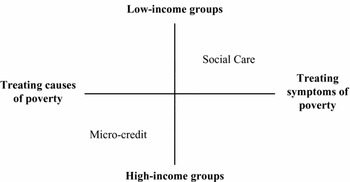
Figure 1 presents a taxonomy of the rationale underpinning the two main programmes that were researched: social care and micro-credits. It suggests that from the outset, the make-up of such programmes limited their ability to directly treat poverty. This was especially evident in the micro-credit programmes where the FBO's concern that borrowers should pay back loans immediately excluded social groups with no initial capital against which they would borrow.
Treating causes or symptoms of poverty: taxonomy of social care and micro-credit programmes

At Caritas, it was evident that not all beneficiaries were truly among the poorest of the poor. The case of the micro-credit village banks for women illustrated this. The following conversation highlights how service users were spread out along varying degrees of need, whereby the most destitute had access to direct social assistance and those who experienced sporadic financial hardship had access to micro-credit facilities.
Author: Were you in need of work? Of the extra income?
Service user: No.
Author: So you had an income and you were comfortable anyway. You didn't need the money to feed your children.
Service user: No, not to that extent. There are cases . . . with us to whom $200 really meant something, like for opening a small kiosk. But our work had already started so $200 helped us buy tights [for our shop], for example
Treating causes or symptoms
This section synthesises the above discussion by arguing that social actors' perceptions of how far they were treating the causes or symptoms of poverty ultimately rested upon how they defined what social needs were.
With respect to the extent to which social actors thought they were treating the causes of poverty, the general view expressed was that the FBOs were primarily ‘relieving service users of a burden’, meaning that they were merely alleviating the pressures of poverty and deprivation on the lives of poor people as opposed to actually solving the causes of poverty. This was confirmed by their views that only government had the resources and mandate to fully tackle the problem of poverty. In this sense, the FBOs in Lebanon have similar concerns to those expressed by church organisations in the USA in the mid-1990s when the congressional election heralded a reduction in welfare services provided by federal states in favour of increased provision by community (and religious) organisations (Whelan, Reference Whelan1996).
As a ministry, the MSA's mandate was restricted to social care which alone could only act as a form of preventative treatment for poverty or, as has already been argued above, could only deal with poverty indirectly. Moreover, it was the very ethos of work at the MSA which meant that it dealt with social problems in an ad hoc and unplanned way, as expressed in the following citations.
What I am doing isn't development. Health, education in a neighbourhood, that's a dimension of development. You do lightweight things, so the problem recurs because the essential problem is still the same. (Director, MSA Local Development Centre)
Institutional care isn't sustainable . . . because it is not treating the causes of the problem. (Lebanon Poverty Programme Director, UNDP)
Yet critics of institutional care at the MSA and the FBOs thought that such a system of social care caused more problems than it solved. As the taxonomy above illustrates, the micro-credit services (including some of the widows/orphans sponsorship schemes) did deal more directly with the issues of impoverishment by promoting income-generation, vocational training and job creation.
Thus, solutions to human impoverishment were depicted by all interviewees as being first and foremost about job creation and, therefore, the state's responsibility. Development was a major angle of this line of argument. This was reinforced at Caritas, where development was described as being the only way of dealing directly with the roots of social problems because it entailed service users reaching self-sufficiency (in contrast to social care). This is illustrated by the citation below.
There should be next to it or above it or greater than it, policies that eliminate the problem and the demand for social care. But that isn't effective yet . . . That's why the services are facing today the fact that there are no general policies working to limit poverty which are effective. (Poverty Programme Director, UNDP, Beirut)
In another sense, many interviewees argued that the major problem from which the Lebanese population suffered was the inability to afford health and education services. As such, they considered that social care services were responding to these key problems. This led some FBOs to argue that they were indeed treating the causes of poverty.
Conclusion: needs re-interpretation and policy focus
Using the example of five prominent faith-based organisations in Lebanon, the aim of this article has been to contribute new insights to our understanding of social policy in the Middle East, and faith-based welfare more broadly.
The article has engaged with the key issues involved in the formulation, implementation and evaluation of the social programmes offered by faith-based organisations in Lebanon. The key question I have sought to answer is to what extent policy implementation adequately defined the object of its interventions and, thus, responded to the causes of human impoverishment as opposed to its symptoms.
In answer to this question, I have attempted to show that human need, the social case and poverty are three core concepts directing the formulation of social interventions in Lebanon. However, they also serve to confuse the definition of the object of social policy.
I have argued that needs interpretation was a source of deep contention in the policy-making process since the lack of clarity in defining the object of policies hampered the effective impact of services. The example in point was how institutional care was presented as a remedy when the family's problem was income poverty, not childcare. While institutional care created new needs deficits at the emotional and psychological levels, at the heart of the FBOs' concern with social care lay an equally fundamental concern with social cohesion and the unity of the family. This helps to explain why the formulation of policy became torn between social care as a paternalistic and short-term solution to the symptoms of poverty, in contrast to development as a more long-term solution promoting equal partnership and self-sufficiency.
As a result, I would argue that social policy in Lebanon remained focused more on palliative services and it was the smaller number of service users who benefited from programmes providing solutions to their root problems. There is a need to review the way in which human needs were interpreted and how best to focus policy in the light of resource constraints. This is crucial if social policy in Lebanon is to deliver more than just relieving poor people of a burden. For, what the latter does is underpin how the moral preservation of society, with the family at its heart, is a top priority in the work of faith-based organisations. This is reminiscent of voluntary and philanthropic charity in the UK and USA. However, it should be noted that FBOs in Lebanon do go beyond charity because of their more complex political identities, as exemplified by Hezbollah.
In conclusion, the overarching argument is made for social policy to engage more directly with the ethical implications of contemporary social welfare concerns. This links more broadly to two issues: the concept of the ‘Rentier’ state which has dominated the literature on social policy in the Middle East is narrowly focused on the economics of state social provision and misses out a much larger universe of local and international non-state actors as well as cultural, moral and political forces; and faith-based welfare is still relevant to social policy in high-income secular societies such as the USA and Britain, which reinforces the importance of studying the contribution of faith-based welfare to human wellbeing. Thus, the analysis of the nature and impact of faith-based welfare has much to contribute to debates in comparative social policy.
Acknowledgement
I would like to thank the ESRC for awarding me a post-doctoral fellowship which supported me during the writing of this paper, and funded new research which I carried out in the Middle East in 2008.