In parliamentary democracies with multiparty systems, in which none of the parties obtains an absolute parliamentary majority, party coalitions are crucial in determining the composition and policies of the government. The study of coalition politics has consequently been one of the most dynamic fields of research in political science. Recently, this field has also started to explore the causes and consequences of the coalitions formed before the election.Footnote 1 However, systematic comparative research on the formation of these electoral alliancesFootnote 2 has so far mostly focused on established democracies, while the formation of electoral coalitions in newer democracies – including post-communist countries – has been limited to insightful case studies and/or anecdotal evidenceFootnote 3 and theoretical models.Footnote 4 This research seeks to fill this gap by examining the causes of the formation of electoral coalitions (more specifically, joint candidate lists) in eleven democracies in Central and Eastern Europe (CEE) from 1990–2012.
The study of pre-electoral coalitions is important for several reasons. Electoral alliances affect the composition of government coalitions and, ultimately, the policies that are implemented by democratic governments. This is because members of such alliances are very likely to also govern together after the election if they win.Footnote 5 Electoral alliances may also affect government formation outcomes more indirectly by changing parties’ legislative seat shares. By joining forces through alliances, parties may be able to obtain a higher share of seats even if their share of the vote does not change. By contrast, a failure to form an alliance could lead to lower (or no) legislative representation. Furthermore, pre-electoral coalitions also affect other important aspects of government coalition politics. They reduce the duration of government formation and produce more ideologically compact governments,Footnote 6 and, at least under certain conditions (for example, when the whole government is formed by parties that co-operated in the preceding election), increase the stability of coalition governments.Footnote 7
Several contextual features of young democracies further increase the importance of electoral coalitions (especially those that involve joint candidate lists or nominations) in comparison to established democracies. Specifically, party systems in young democracies tend to be more fragmented than those in most established democracies. Consequently, there is a high risk that some parties will miss out on legislative seats (leaving their voters with no representation), and in many cases the potential outcomes of government formation are uncertain. The impact of electoral alliances (or their absence) on the composition of the legislature and government, and ultimately the representativeness of enacted public policies, is therefore potentially stronger than in most established democracies. Particularly if party co-ordination across the political spectrum is unequal, a non-representative government may be formed. For example, as a result of the lack of co-ordination among rightist parties, the centre-left parties won the 1993 Polish election and formed a government with only slightly more than one-third of the vote. Had centre-right parties formed an electoral coalition, they likely would have been able to form a government as well.Footnote 8
Moreover, party systems in newer democracies are less structured programmatically, at least in the first few electoral periods, when parties and the electorate are still learning about each other’s policy preferences. Less constrained by their voters’ policy preferences, parties may be tempted to form opportunistic alliances with ideologically dissimilar partners in order to obtain legislative representation, and dissolve those coalitions after the election. The resulting flux in party alignments may impede the process of party system stabilization and reduce the quality of democracy. In the absence of party stability, voters are unable to form attachments to parties and learn about their policy positions. Furthermore, electoral alliances that dissolve while in government may also impede voters’ ability to identify these parties as part of the government, and to hold them accountable for their performance. Yet electoral coalitions frequently lead to party mergers,Footnote 9 which means that alliances can also make a positive contribution to party system consolidation.
Thus depending on various contextual factors, electoral coalitions may have both positive and negative consequences for the quality of democracy and public policy. These effects are further accentuated by the fragility of many young democracies. The failure of parties to agree on electoral co-operation, or unstable alliances between ideologically different parties, could lead to democratic breakdown or erosion as a result of voters’ disappointment with the chaotic democratic electoral process or the ability of anti-democratic elites to capture power. Stable alliances between ideologically close parties, on the other hand, could greatly contribute to the consolidation of democracy by facilitating the formation of a stable party system.
Yet another reason to study electoral coalitions in newer democracies is their empirical importance. Empirical evidence from the original dataset collected for this study shows that, on average, 1.8 alliances were formed in sixty-four democratic elections in eleven post-communist democracies. Almost half of the post-election governments included an electoral alliance: sixteen elections resulted in a government formed by an electoral alliance, and a further eleven post-election governments included a pre-electoral coalition as a junior partner. Out of thirty electoral coalitions that participated in these governments, seventeen did not survive until the next election, thus underscoring the potentially negative consequences of the instability of alliances to electoral accountability. Considering all electoral coalitions in the sample, at least 30 per cent of the dyads of parties that were in an alliance were not re-formed as electoral alliances in the next election. Therefore electoral coalitions, as well as their instability, are an important phenomenon in many post-communist democracies. This is also demonstrated by the fact that electoral laws in a number of post-communist democracies (for example, in Poland and Slovakia) specify higher legal thresholds for alliances than for individual parties, or outlaw explicit coalitions completely (in Estonia since the late 1990s). The adoption of these higher thresholds was justified by the alleged negative consequences of electoral alliances for the consolidation of the party system and democracy. However, in some cases opposition parties resisted those thresholds by accusing government parties of trying to maintain power (for example, in Slovakia before the 1998 election).Footnote 10
To understand the formation of electoral alliances, this study examines the potential electoral and office costs and benefits of alliances for parties. It explores how electoral and office benefits, emphasized previously in the literature, affect the formation of electoral coalitions in the context of the specific characteristics of the electoral and party systems in CEE countries. The study also develops an explanatory logic about how electoral and office costs affect the formation of alliances. Specifically, it formulates several new hypotheses about the factors that (1) decrease the electoral compatibility of electoral coalitions and (2) increase the costs of sharing election candidacies and office positions.
The study proceeds as follows. The next section reviews the current theoretical accounts of coalition formation. This is followed by a discussion of the explanatory framework developed here to explain coalition formation in CEE countries. The last three sections discuss measurement and data issues, present the statistical analyses, and summarize the main findings and their implications.
Explaining Electoral Coalitions: State of The Art
The existing explanations of electoral alliances can be clustered based on their emphasis on their different costs and benefits in terms of votes, office and policy.Footnote 11 This section reviews the electoral and office benefits and then costs of coalitions, and concludes with a discussion of their costs and benefits in terms of policy.
Alliances provide electoral benefits if parties are more likely to exceed electoral thresholds and attract strategic voters than if their member parties were running individually.Footnote 12 This account suggests that electoral alliances are more likely when they improve parties’ vote-seat ratio through the electoral economies of scale created by disproportional electoral institutions.Footnote 13
While most studies assume that such electoral benefits are a goal in themselves, Golder suggests that constituent parties can use alliances to improve their chances of entering government,Footnote 14 and that forming a coalition can provide office benefits even in the absence of electoral gains if the alliance emerges as the largest legislative bloc and becomes a government formateur.Footnote 15 According to this account, coalitions that are large but not too large, and coalitions composed of parties of a similar size, are more likely to form.
Golder’s theory, however, is applicable to parties that ‘are large enough to realistically have an eye toward entering government’.Footnote 16 While this assumption is justifiable in the context of many older democracies in which parties’ viability is well established, many newer party systems include both small parties that seek alliances to gain legislative representation and larger parties that aim to increase their chances of gaining access to the government through alliances. The literature does not provide a clear answer about how, in these contexts, electoral and office incentives interact to affect the formation of coalitions. The next section fills this gap in the scholarship by arguing that in CEE countries, small parties have strong incentives to form alliances among themselves, and that these small parties are also attractive partners to medium-sized and large parties, which seek to increase their chances to enter government by ‘saving’ small but important coalition partners.
A second contribution of the present research is that it advances understanding of how electoral and office costs affect the formation of coalitions. The literature suggests two types of such costs: (1) the lack of electoral compatibility, manifested by the defection from the coalition of voters who would have voted for member parties if they ran individually and (2) the cost of sharing election candidacies and office positions.Footnote 17 Both of these costs remain under-researched. Specifically, the distance between member parties on the main dimension of competition has been identified as the key factor of electoral compatibility.Footnote 18 Thus it is commonly argued that ideologically diverse coalitions are less likely to form, since their supporters may find themselves too distant from the alliance’s policy positions. However, this account of coalition formation, while parsimonious, does not consider how the multidimensionality of the political space and the valence competition affect the electoral costs of alliances. The present study contributes to the literature by accounting for the effect of these factors.
In addition, the costs of sharing election candidacies and office positions have been argued to be higher if parties have to agree on a single candidate, as in the case of presidential elections.Footnote 19 The present research builds on this logic and proposes two relevant yet under-researched factors that reduce the distributional costs of alliances: closed-list proportional representation (PR) systems and previous electoral co-operation.
In addition to electoral and office goals, the scholarship also indicates that parties’ policy concerns matter in the formation of coalitions. Ideological differences not only increase the electoral costs of the coalition, but also make policy compromises more costly for the member parties, especially if the coalition wins the election and participates in the government.Footnote 20 Yet a coalition may be beneficial if it helps to prevent the formation of an alternative government with very different policy positions from those of the parties in the potential electoral alliance.Footnote 21 This research acknowledges this account and controls for the latter factor, as well as for several other factors, as discussed in the section on measurement and data.
Understanding Electoral Alliances in Cee
To explain the formation of electoral alliances in CEE, this study proposes an explanatory framework emphasizing their benefits related to electoral and office economies of scale and the costs involved in electoral incompatibility and the sharing of election candidacies and office positions. The next three sub-sections discuss these factors in detail.
Electoral and Office Economies of Scale
Characteristics of the electoral system and the party system interact to shape incentives for electoral alliance formation in CEE countries. Starting with the second democratic election, countries in the region have used the PR electoral system, or variants of the mixed system with a predominant PR tier.Footnote 22 In all countries, the main institutional barrier to proportional representation is the legal threshold of between 3 and 5 per cent, applied (in all elections considered here, with the exception of Croatia since 2000) at the country level. By contrast, other elements of the electoral system have had only a limited effect on the disproportionality of electoral outcomes: for example, the average district magnitude in most countries has been relatively high, and in some countries smaller parties benefit from the existence of compensatory upper tiers.Footnote 23 Consequently, the most substantial increase in parties’ vote-seat ratio occurs when they overcome formal thresholds, while further increases in size, on average, bring only marginally higher seat returns.
Moreover, the average fragmentation of party systems in CEE countries is high,Footnote 24 meaning that many small parties have been unable to overcome formal thresholds when running on their own. For these parties, electoral economies of scale provided by coalitions are substantial, and create strong incentives to form alliances.
Medium-sized and large parties that are more certain about their chances of reaching formal thresholds use coalitions to increase their chances of participation in government. The presence of relatively high formal thresholds and high levels of party system fragmentation combine to provide, on average, the highest ‘office economies of scale’ (that is, better chances of entering government) for coalitions that include a mix of small and medium-sized or large parties. Such coalitions can expect to obtain a higher share of seats than the member parties would gain individually. This is because the electoral support of the small party, which is below the formal threshold, is translated into legislative seats when this party participates in the electoral alliance. Thus while the larger party may not increase its individual share of seats, the electoral alliance allows it to obtain a potential partner in a government coalition.Footnote 25 Given that the levels of party system fragmentation in CEE countries are high, these seat gains may allow the coalition to emerge as one of the largest legislative blocs and play the role of government formateur, or even obtain an outright legislative majority. In contrast, alliances between medium-sized or large parties are less seat super-additive because all member parties would be able to overcome electoral thresholds on their own, while other elements of the electoral system (for example, district magnitude) provide only limited seat bonuses to large parties. In the absence of substantial electoral gains, the incentives to form electoral coalitions are scarce. Moreover, the incentives for medium-sized or large parties to co-operate in order to obtain a plurality of seats are also limited, given that each of them can achieve this goal through alliances with small parties.
There is anecdotal evidence that office motivations indeed mattered for the formation of coalitions in CEE. For instance, despite its large lead in opinion polls, the Alliance of Democratic Left formed a coalition with the small Labour Union (UP) before the 2001 Polish election because ‘the three to five percent contributed by UP may guarantee the coalition a majority in the Sejm [the lower legislative chamber in Poland]’.Footnote 26 Similarly, the main competitors in the 2004 Romanian election (the Social Democratic Party and the alliance between the National Liberal Party and Democratic Party) sought an alliance with the electorally vulnerable Humanist Party in order to increase their chances of obtaining a parliamentary majority.Footnote 27 Also, in the 1990s several countries in the region witnessed broad alliances between medium-sized and small centre-right parties that sought to prevent a wastage of the centre-right vote; the most prominent examples were Bulgaria (the Union of Democratic Forces), Poland (the Solidarity Electoral Action), Romania (the Democratic Convention) and Slovakia (the Democratic Coalition).
The argumentation above suggests two hypotheses related to the benefits of electoral coalitions. Alliances between only small parties are driven by pure seat maximization motivations, while coalitions including a mix of small and larger parties may give parties both electoral and office benefits.
Hypothesis 1: Electoral alliances that include only small parties are more likely.
Hypothesis 2: Electoral alliances between small and medium-sized or large parties are more likely.
Electoral Compatibility
While forming a coalition could give its constituent parties electoral and office economies of scale, the alliance may also imply substantial electoral costs if it is not supported by the voters who would otherwise vote for member parties running individually. To better understand the factors that affect coalitions’ electoral compatibility, the present research draws on several other theories of party competition that go beyond the unidimensional spatial model used in the existing scholarship. Specifically, according to the salience theory of party competitionFootnote 28 and the theory of ‘issue ownership,’Footnote 29 parties stress the issues that provide them with an electoral advantage, and de-emphasize other issues. These theories imply that spatial distance in parties’ positions is less likely to result in vote sub-additive alliances and costly policy compromises if different issues are important for parties and their supporters.Footnote 30 By the same token, alliances of parties with close positions on the issue that is salient to all of them are more likely to be electorally beneficial, because the alliance partners can obtain or strengthen their ownership of that issue and limit the ability of parties outside the alliance to claim the issue for themselves.
In post-communist countries, both classical left-right issues (such as welfare state spending or levels of taxation) and non-economic issues (nationalism, religion, democratization and communist legacy) structure political competition.Footnote 31 Mainstream parties with broad ideologies (such as social democratic, liberal and conservative parties) stress economic issues first and foremost, but also attempt to subsume the most important non-economic issues to the broad left-right dimension. By contrast, parties that target a certain niche category of the electorate (nationalist, extreme left, green, ethnic, regional, agrarian and, arguably, Christian democratic parties),Footnote 32 stress narrow non-economic issues that are core to their identity.Footnote 33
The narrowness of niche party appeals makes them more attractive coalition partners to both mainstream parties and other niche parties. Electoral losses are less likely (and policy compromises, if the coalition enters government, are less costly) when the alliance includes the mainstream party and the niche party that stresses issues of lower importance to the mainstream party and the majority of the electorate (for example, regionalism, the environment and rural-urban divisions). For example, green parties participated in electoral alliances with both centre-left (the Common Choice coalition in Slovakia in 1994) and centre-right parties (the Democratic Convention coalition in Romania in 1996). Niche parties are also likely to co-operate if they do not emphasize the same issues, as peasant and green parties in Latvia have done since 2002.
However, if the issues stressed by the parties in the alliance overlap at least partially, the probability that they will co-operate depends on how similar their positions are on these issues. Thus coalitions between mainstream parties are more likely if they belong to the same ideological family. Similarly, coalitions between mainstream and niche parties are more likely if the mainstream party holds a similar position on the issue stressed by the niche party, as would be the case for alliances between conservative and Christian democratic parties.Footnote 34 By contrast, coalitions between mainstream and niche parties are unlikely if they hold different positions on the issue that is salient to the niche party (for example, pro-democracy mainstream parties are unlikely to co-operate with nationalist parties due to their disagreements on the issues related to democratization). Finally, niche parties can also co-operate with other niche parties if they stress the same issues and hold similar positions on them (as happens when niche parties belong to the same ideological family).
Thus overall, both spatial proximity and the salience of the issues on which parties compete matter for the electoral and programmatic compatibility of the alliance. This argumentation leads to the following hypothesis:
Hypothesis 3: A coalition between parties with different policy positions is less likely, but only if the parties stress the same issues.
In addition to parties’ issue positions and salience, valence competition also affects the compatibility of parties’ electorates. Specifically, new parties hold an important advantage over established parties by being able to present themselves as fresh, more competent and/or less corrupt alternatives to established parties. This is especially the case in CEE countries for three reasons: (1) party ‘newness’, rather than innovative policy appeals, has frequently been an important factor for the electoral success of new parties,Footnote 35 (2) the electorate is inclined to support parties that have not yet governedFootnote 36 and (3) corruption is a highly salient issue.Footnote 37 Genuinely new parties in particular can build on their newness appeal since they, unlike splinter parties formed by members of established parties, do not have a significant connection to the latter.Footnote 38 A coalition with an established party(-ies) would, however, dilute the image of the genuinely new party as new, and could therefore undermine its electoral appeal. By contrast, splinter parties are ‘less new’, as their elites would have usually actively participated in politics as members of parent parties. The lack of the newness appeal implies that electoral coalitions should be less electorally damaging for splinter parties. These arguments lead to the following hypothesis:
Hypothesis 4: An electoral coalition is less likely to form if one of the parties is genuinely new.
Sharing Election Candidacies and Office Positions
Another type of costs related to the formation of electoral coalitions is the divisibility of office benefits and election candidacies. This research proposes two factors that affect the distributional costs of alliances, in addition to those suggested in previous research. The first factor concerns the control that parties (as opposed to voters) have over the translation of agreed candidate quotas into legislative seats, as determined by the intraparty dimension of the electoral system.Footnote 39 Specifically, under a closed-list PR system, plurality or two-round system, the division of candidacies among parties should be close to the parties’ actual seat shares as long as parties have reasonable expectations about the strength of the coalition in each district. This is because voters cannot express their preference for the candidates of one party in the coalition. By contrast, in flexible or open-list PR systems, the seat shares of the parties in the coalition may differ substantially from the shares of candidacies agreed before the election, as voters can disrupt the ranking of candidates suggested by the parties in the coalition. This is especially likely if the voters have varying inclinations to cast preferential votes. Party leaders may seek to strategically adjust the order and shares of the coalition’s candidacies. However, such adjustments are likely to be challenged by candidates and activists in their parties, and may not be credible, as individual parties could campaign for the support of their candidates rather than those of coalition partners. Also, preferential votes may simply be too important in determining candidates’ identity for any strategic adjustments by partner parties to have a sufficient compensatory effect.
Two examples illustrate how the preferential voting system seemed to prevent the formation of electoral alliances in Poland and Latvia. Before the Polish election of 1993, a representative of the Democratic Union stated that one consequence of the preferential voting system was that ‘particular parties cannot set up an agreement as to the distribution of parliamentary seats’.Footnote 40 In Latvia, the Farmers and Greens’ Union was unwilling to form an alliance with the nationalist right party For Fatherland and Freedom (LNNK) for the 2010 parliamentary election, due to the perceived popularity of the candidates of the latter party.Footnote 41
There is further evidence of how preferential votes can substantially change the distribution of seats among coalition partners. For instance, in the Czech legislative election in 2002 (held under a flexible-list system), the Christian and Democratic Union–Czechoslovak People’s Party (KDU-CSL) and the Freedom Union–Democratic Union (US-DEU) parties shared list positions equally. However, due mainly to the greater propensity of KDU-CSL supporters to use preference votes, this party obtained twenty-two seats while US-DEU was left with only nine.Footnote 42 The All for Latvia (VL) and LNNK parties shared candidacies equally before the 2010 election in Latvia, but the former obtained six of the eight seats of the alliance. Moreover, ‘there were rumours that VL had instructed its voters to cross out TB/LNNK candidates from their ballots’.Footnote 43 Also, in the 2010 Slovak election, the Freedom and Solidarity and Most-Hid formed coalitions with small groups, which unexpectedly obtained a significant number of legislative seats.Footnote 44
Voters are also more inclined to disrupt the order of coalition lists in the case of electoral alliances than when single parties are involved. In a sample of five CEE countries, the share of deputies elected due to preference votes from otherwise unelectable positions was 15.5 per cent for individual parties and 23.4 per cent for electoral coalitions.Footnote 45 This suggests that voters indeed respond to electoral alliances by supporting the candidates of their preferred parties.
Hypothesis 5: Electoral alliances are less likely under open- or flexible-list PR systems.
In addition to electoral institutions, the experience of previous co-operation also affects the costs of reaching agreements on the division of election candidacies and expected office benefits. The literature on government coalitions in particular has shown that incumbent governments are more likely to re-form, even when controlling for a variety of other factors, including the size and preferences of parties. Some causal mechanisms explaining this effect suggest that previous experience of governing together creates inertia that reduces bargaining costs, and increases parties’ familiarity with (and trust in) each other, thus decreasing uncertainty about partners’ behaviour in a coalition government.Footnote 46 A similar argument is applicable to electoral coalitions as well. Re-running a previously formed coalition is less costly, because parties can follow a previous agreement on the division of election candidacies, or at least use the existing mechanisms for reaching a new agreement. Overall, electoral coalitions should be more likely to re-form if parties also co-operated in the previous election.
Hypothesis 6: Electoral alliances are more likely if parties formed an alliance in the previous election.
Data and Measurement
In order to test theoretical expectations, a new dataset on national-level pre-electoral coalitions was built for this study. The dataset covers alliances involving joint candidate lists in eleven CEE member states of the EU in parliamentary elections between the second parliamentary election after the transition to democracy and 2012.Footnote 47 Thus public commitments to govern together are not considered, since several causal mechanisms of the theoretical framework would not be applicable to such coalitions.Footnote 48 In excluding these loser forms of co-operation, this study also follows the suggestion of Allern and AylottFootnote 49 on distinguishing between different types of electoral alliances when studying their causes. The low number of public commitments to govern together further justifies the focus on joint candidate lists only. Furthermore, the dataset also covers the agreements on nominating joint candidates under mixed electoral systems, provided that such agreements cover all single-member districts in the country. This is because in the given sample, such comprehensive agreements coincided with the formation of joint candidate lists in the PR tier. Nomination agreements that covered only some districts are therefore not considered, unless parties also co-operated by forming joint candidate lists.
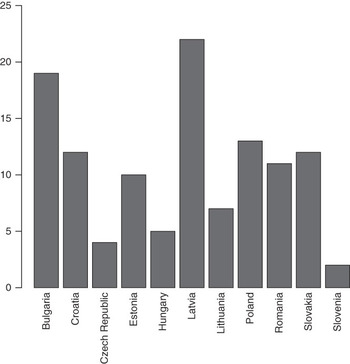
The dataset includes a total of 117 electoral alliances that were formed in forty-eight (or 75 per cent) of the sixty-four parliamentary elections included in the sample. Thus on average, 1.8 coalitions were formed per election, which is substantially higher than 0.7 alliances per election in older Western democracies, as reported by Golder.Footnote 50 The higher number of coalitions is a reflection of the consolidation process that the party systems in these countries have undergone since their transitions to democracy. The (slow) consolidation process is also evident in the decrease in the number of alliances per electoral cycle. Specifically, the average number of electoral coalitions decreased from 2.1, 2.3 and 2.1 in the second, third and fourth elections, respectively, to 1.6 in the fifth and 1.5 in the sixth election. The number of alliances, however, substantially varies at the country level, as shown in Figure 1. More specifically, Bulgaria, Croatia and Latvia have the highest number of coalitions, while in Slovenia they have been much rarer.
Number of pre-electoral coalitions

Following Golder, the dataset is organized in a dyadic way; the unit of analysis is party dyad in an electoral period. The dependent variable is dichotomous and takes a value of 1 if the two parties in the dyad formed a coalition, and 0 otherwise. The dataset includes parties with at least 1 per cent of the vote, either in the parliamentary election before the coalition was formed or in the most recent previous election.Footnote 51
In order to test Hypotheses 1 and 2 related to party size, two dichotomous variables are coded using information on parties’ vote shares and the size of legal thresholds. The first variable takes a value of 1 if both parties in the dyad have a vote share below the threshold, indicating two small parties that cannot gain legislative representation individually. The second variable takes a value of 1 if only one of the parties in the dyad is small, meaning that its share of the vote is below the legal threshold. The research uses the shares of the vote in both the most recent previous election and in the election before the parties could form coalitions.Footnote 52 The first way to measure parties’ electoral support temporally precedes the formation of coalitions, but it does not provide an estimate of the expected support of new parties, which leads to the exclusion of these parties from the analysis. The second method of measuring parties’ support addresses this shortcoming, and is in line with other studies that have used actual electoral support to capture pre-election expectations about parties’ electoral support.Footnote 53
Party family estimates are used to estimate ideological differences between political parties. Other, more conventional measures of party ideology, such as estimates provided by the Comparative Manifest Project or expert surveys, are less applicable to CEE because they exclude numerous elections or parties. Similarly, these datasets usually treat electoral alliances as single entities, thus they cannot be used to measure ideological differences between parties in order to test Hypothesis 3.Footnote 54
Specifically, each party in the dataset has been categorized as belonging to one of eleven party families (agrarian, Christian democratic, communist, conservative, ecological, ethnic, liberal, regional, far right, social democratic or special-issue parties).Footnote 55 The dichotomous variable indicating ideological similarity is coded following the logic outlined above. Specifically, a pair of mainstream parties (social democratic, conservative or liberal) is assumed to be ideologically close only if they belong to the same ideological family. Dyads that include one mainstream party (a social democratic, liberal or conservative party) and one niche party that stresses issues that are less relevant to other parties or to most voters (that is, an agrarian, green, regional or special-issue party) are also coded as ideologically similar. Moreover, the pairs of conservative and Christian democratic parties are coded as ideologically similar because their positions on issues related to religion tend to be similar. Finally, two niche parties are considered to be similar if (1) they belong to the same ideological family or (2) if they are affiliated with different families, but either stress different issues or hold similar positions if they stress the same issues.Footnote 56
The analyses also include a number of control variables. As mentioned above, electoral coalitions are more likely if they help prevent the formation of an alternative government with very different policy positions from those of the parties in the potential electoral alliance.Footnote 57 The analysis controls for this factor by including interaction effects between the two dichotomous variables capturing electoral and office benefits and the measure of party system polarization with regard to parties’ attitudes to the democratic regime (as mentioned above, democratization issues have been controversial in most countries in the region). Polarization is measured by the combined share of the vote gained by extreme left and right parties in the election before the alliance formed. Higher support for extremist parties should increase the probability of forming electoral coalitions (conditional on the electoral and office benefits of these alliances) by moderate parties that seek to prevent the erosion of democracy, but possibly also by extremist parties themselves.
Another control variable is the presence of communist and extreme right parties in pre-electoral coalitions. The broader government formation literature suggests that governments that include extremist parties are less likely to form,Footnote 58 and in the context of post-communist democracies the EU has further constrained the participation of extreme parties in government, especially during the accession period. It is likely that similar restrictions would have been present in the case of electoral coalitions as well.
The analysis also controls for the age of democracy, the presence of communist successor parties (CSPs) in the potential coalition and the interaction effect between the two. The age of democracy controls for the possibility that parties’ propensity to form alliances could decrease over time, as increasing voter partisanship increases the costs of alliance formation. The inclusion of the CSP variable controls for complex effects of former authoritarian parties on the new democratic party systems. Specifically, CSPs sought alliances with other parties in order to legitimize themselves (both domestically and in the eyes of international and European federations of social democratic parties) and to unite the centre-left forces under their leadership.Footnote 59 Elites of other parties, however, were reluctant to co-operate with CSPs due to their authoritarian past and potential electoral backlash.Footnote 60 The effect of CSPs on the formation of electoral alliances is also likely to have changed over time. As CSPs established themselves as democratic players, the usefulness of alliances for them may have decreased. On the contrary, as the cost of co-operation with CSPs decreased for other parties, CSPs’ stronger local organizations, greater financial resources, and perceived competence and experienceFootnote 61 may have made them more attractive partners to other parties.
Finally, the analysis also controls for the presence of higher thresholds for electoral alliances, which could reduce some coalitions’ chances of obtaining legislative representation. The measure for these thresholds is the continuous variable that captures the additional share of the vote (compared to a single party) that the alliance of two parties would need in order to be eligible for representation. Thus if the regular legal threshold is 5 per cent and the threshold for the alliance of two parties is 7 per cent, the measure takes a value of 2.Footnote 62
Analysis and Results
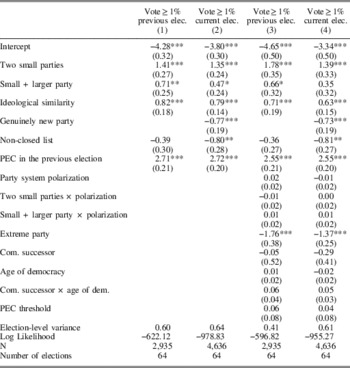
Table 1 presents four specifications of the statistical model predicting pre-electoral alliances. Models 1 and 3 provide the results of the analyses that use parties’ vote shares in the previous election to estimate their expected support relative to the electoral threshold. Thus they exclude all parties that did not obtain 1 per cent of the vote in the previous election. Since all new parties fall into this category, these two models do not include the dichotomous variable for genuinely new parties. Models 2 and 4 use parties’ vote shares in the current election, and include those with an estimated share of the vote of at least 1 per cent. Control variables are included in Models 3 and 4, but not in Models 1 and 2. Similarly to Golder’s research,Footnote 63 which used random-effects probit models with random effects clustered by election, this study uses random-effects logit models with intercepts clustered at the level of elections.
Random-effects Logit Models of Pre-electoral Coalition Formation

***p<0.001, **p<0.001, *p<0.05.
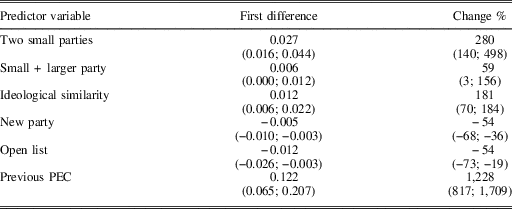
The results largely support the theoretical expectations. Coalitions that are more likely to provide electoral and office benefits are more likely to form. In line with Hypotheses 1 and 2, dyads that include two or one small parties are more likely to result in electoral alliances than dyads that do not include small parties. Specifically, Table 2 shows that, all else being equal, the probability of a coalition between two small parties is 280 per cent, and the probability of an alliance between one small and one medium-sized or large party is almost 60 per cent higher than a coalition between two medium-sized or large parties.
Substantive Effect of Independent Variables

Note: all predictor variables whose effects are reported in this table are dichotomous. The values of other independent variables are held constant at their sample means or modes depending on the type of the variable; 95 per cent confidence intervals of the estimates in parentheses. All effects based on the estimates of Model 2.
Furthermore, electorally incompatible coalitions are less likely to form. First, ideological similarity has a statistically significant effect on the probability of electoral coalition formation. Table 2 shows that when the values of other variables are held constant, the probability of ideologically similar coalitions is more than two times higher than the probability of an ideologically heterogeneous coalition forming. Secondly, electoral alliances that involve one genuinely new party are also less likely. All else equal, the probability of such a coalition is more than 50 per cent lower than that of a dyad that does not have one genuinely new party.
Finally, the effect of the variables that capture the costs related to the distribution of election candidacies and office positions is also in line with theoretical expectations. While the variable indicating the use of the preferential or open-list voting system is not statistically significant in Models 1 and 3, Models 2 and 4 (which use the full sample) suggest that coalitions are less likely to form under such systems. Table 2 shows that the presence of this institutional feature reduces the probability of coalition formation by 54 per cent. All else being equal, a previous alliance increases the probability of electoral coalition formation by more than thirteen times. This result is in line with Hypothesis 6, and supports the notion that previous co-operation reduces the costs of forming an alliance.
With regard to the control variables, Models 3 and 4 show that the alliances that include one small and one larger party are more likely to form when the support of extreme parties is higher. For example, according to Model 4, when the share of the vote of extreme parties is at its mean value (12 per cent), the probability that a coalition between small and larger parties will form is more than 60 per cent higher. However, when the electoral support of extreme parties is very low, the combination of larger and small parties does not increase the probability of electoral alliance formation. Yet the substantive size of the variable capturing two small parties does not increase with the level of party system polarization. These results further emphasize different motivations for smaller and larger parties to participate in coalitions. For small parties, an alliance is a way to avoid electoral oblivion; for larger parties, by contrast, the goal of rescuing small partners becomes highly important only if there is a risk that, in the absence of electoral co-operation, a government with very different policy preferences would form. Moreover, electoral co-operation between extreme and moderate parties is also less likely. Specifically, the probability that a coalition between such parties will form decreases by more than 70 per cent if one of the parties is an extreme party.
Coalitions that include CSPs are also more likely to form, but only in the later years of the democratic regime (approximately fifteen years since the democratic transition). This result attests to the complex patterns of co-operation between CSPs and other parties, and calls for more systematic research on this question. The age of democracy, however, does not have a significant effect on the formation of alliances that do not include CSPs.
The expectation of a negative effect of a higher electoral threshold for electoral alliances is not supported by empirical evidence. Two factors may explain this result. First, it may simply be the case that most special thresholds for coalitions are not sufficiently high. In almost all elections in the sample, the combined share of the vote that parties have to obtain in order to gain legislative representation when running independently is higher than the threshold they need to clear when running in an alliance. For example, if the regular legal threshold for individual parties was 5 per cent, the threshold for two-party alliances in most cases was 7 or 8 per cent, which means that the parties still have a better chance of exceeding the threshold as a coalition. Furthermore, special thresholds may not have been successful in limiting the formation of coalitions because parties were able to circumvent them, for example, by running under the name of one of the coalition partners.
Conclusion
This study contributes to the emerging literature on the formation of electoral alliances both theoretically and empirically. In theoretical terms, while drawing on the existing explanations of the formation of electoral alliances that mostly stress the potential electoral and office benefits of these coalitions, the study also adapts them to the features of party and electoral systems in CEE. Two of these features are the large number of small and very small parties and the pre-dominance of nationwide legal electoral thresholds as the key institutional aspect reducing the proportionality between votes and seats in most elections held in the region. Consequently, electoral alliances in CEE countries are more likely to be formed between small parties with insufficient support to reach the threshold on their own, or between small and medium-sized or large parties, thus allowing the former to gain access to the legislature and the latter to ‘save’ an important coalition partner.
Furthermore, this research also provides a better understanding of the costs of electoral alliances in relation to the compatibility of parties in terms of voters’ inclination to support a coalition and the divisibility of the potential benefits of an alliance. With regard to the first factor, this study argues that coalitions are less likely between parties that stress the same issues but hold different positions on them, and between established and genuinely new parties. With regard to the second factor, this research argues that closed PR electoral systems and previous electoral co-operation reduce the costs related to sharing election candidacies and office positions. These new hypotheses therefore provide important insights into when (even potentially beneficial) coalitions may not be formed because of their high costs.
In empirical terms, the study provides one of the very first systematic comparative analyses of the formation of electoral alliances in new democracies. In line with previous accounts in the literature based on anecdotal evidence, the study shows that electoral alliances in CEE states are frequent. There are important differences in time and space though, and these differences are systematically related to the costs and benefits of alliances described above.
These results provide evidence of the notion that electoral alliances overall have quite positive implications for democracy in CEE countries. Since they are formed by small parties with similar ideological positions, they can reduce the wastage of votes and increase party-voter congruence, but only if the level of co-ordination across the political spectrum is similar. The finding that genuinely new parties are less likely to co-operate in elections can also be seen in a positive light, as it suggests that established parties are unlikely to co-opt new challengers to their rule. Finally, electoral coalitions are not as fluid as some earlier accountsFootnote 64 of post-communist politics have suggested. While a substantial number of alliances fall apart by the next election, overall, co-operation in the previous election strongly increases the probability of parties re-forming their alliance.
Future research on electoral coalitions could investigate whether the factors driving their formation vary with the type of coalition. While the present research suggests that electorally viable parties are unlikely to co-operate by presenting joint candidate lists, it has not examined cases in which such parties have publicly declared their intention to govern together after the election (for example, the Slovenian Spring alliance formed before the 1996 Slovenian election, and the alliance between the Social Democratic, Labour and ‘Order and Justice’ parties in Lithuania before the 2012 election). Comparative research on pre-electoral coalitions in Western democracies, on the other hand, examines multiple types of coalitions together.Footnote 65 Thus future comparative research, possibly including both sets of democracies, could examine whether parties choose the type of coalition depending on whether all of them are electorally viable as individual entities. Moreover, such analyses could also test whether the hypotheses on the costs of alliances developed in this study also apply to established democracies.
More research is also needed on the effect of higher thresholds on electoral alliances. Insofar as our results with regard to this factor hold, they suggest that institution builders’ attempts to limit the formation of electoral coalitions in post-communist democracies have been largely misguided. The increase in thresholds for electoral alliances that many countries in the region have implemented since their democratic transitions did not reduce the probability of electoral coalition formation. At the same time, designers of institutions could change the intraparty system dimension of the electoral system in order to increase or decrease incentives for parties to form alliances.