During the First World War, tens of thousands of parcels were sent from France via neutral Switzerland to German and Austrian businesses, even though commercial relations were officially forbidden between these warring nations.Footnote 1 French perfumes, books, pharmaceuticals, textiles, and even accessories for pianos arrived the same way in Latin America, sent to German or other firms with which commerce was forbidden. These goods came via Switzerland or Scandinavia, to the great concern of the French consul in Valparaíso and his counterparts in Brazil.Footnote 2 In the meantime, parcels travelled both ways between homelands and the battlefronts or prisoners-of-war camps.Footnote 3 In January 1919, an inspector of the postal service serving United States troops in Europe proclaimed that ‘the American soldier [was] undoubtedly the world's champion letter writer’, but he acknowledged that the American soldier was also a champion in sending parcels full of German helmets and other ‘souvenirs’ from Europe, sometimes dangerous and explosive.Footnote 4 The war uncovered the reach and use of transnational postal infrastructures as well as the difficulties encountered in controlling them. But the channel of parcel post had emerged from three decades of global expansion and had already proved transformative.
Since the 1880s, parcel post had functioned as an agent of globalization. By 1900 it was clear to postal experts that ‘the speed of postal transports and cheapness of new rates have completely transformed and improved the prior state of affairs and it is nowadays as simple to ship a small parcel from Paris to Saint Petersburg, Mexico City or Sydney, as it was before from Paris to Lille or Marseille’.Footnote 5 Behind the seemingly low-tech small boxes lay a sophisticated service, subject to national and international negotiations between a large set of actors, with wide-ranging effects on post offices, transport networks, and commercial circuits. Although the high-tech and ‘revolutionary’ electric telegraph has become a favourite topic for communication historians, it alone cannot epitomize the first modern age of globalization.Footnote 6
Postal networks in general and parcel post services in particular have not ranked high on historians’ lists of agents of the first modern age of globalization. Although they materially connected people and firms over long distances, they are usually taken for granted as evidence of global phenomena. Most specific literature on postal services still views the ‘postal age’ through a national lens.Footnote 7 Some of – if not the largest – business organizations of the nineteenth century, post offices were national institutional and industrial machineries with an extensive workforce to cope with massive logistical challenges and manage huge cash flows.Footnote 8 As an ‘arm of the state’, they contributed worldwide to creating the nation-state as a sovereign and integrated sociopolitical space.Footnote 9 This made it all the easier for historians to box them into national containers. However, post offices interacted heavily with one another while expanding their own national networks. In close cooperation, they developed new operational practices and services. They moved information, in the form of letters and newspapers, but also money and goods within and across borders.Footnote 10
From 1874 and the founding of the Universal Postal Union (UPU) onwards, post offices pioneered the collective governance of globalization.Footnote 11 Together with its sister organization, the International Telegraph Union (ITU), the UPU was one of the first intergovernmental organizations with a global mission.Footnote 12 In the field of communication networks, a techno-political elite collectively wrote the rules governing globalization as a process divided into different sectors of interaction such as disease, statistics, and weights and measures.Footnote 13 In 1880, some UPU member states signed a convention on parcel post, opening a new channel in the world of commerce. By the end of the nineteenth century, millions of packages poured into post offices and railway stations, crossed countries, and created all sorts of transnational connections from family to business to humanitarian relations.
The development of parcel post itself has attracted little historical attention. Some literature on war experiences or particular commercial products or markets, such as mail ordering, mentions parcels.Footnote 14 However, these works generally examine the content of the parcels, rather than the containers themselves, which are more or less taken for granted. Compared to letters, parcel post was on the margins of postal traffic and culture until the e-commerce boom; heavy freight overshadowed it in the transportation of goods, and it was secondary to tariff negotiations in international trade. Yet, negotiations over parcel post occurred at the intersection of the three fields of communication, transportation, and commerce. And such a location, I argue, deserves much more historical attention precisely because it points to the nexus between communications and capitalism that this special issue addresses.
This article explores the origins and impact of this new, jointly created and expanded parcel post service from the end of the 1870s to the eve of the First World War. It is based mainly on French and UPU archives and printed materials, together with newspapers articles and a highly informative worldwide inquiry conducted by the United States Senate at the beginning of the 1910s, during discussions about creating a similar service in the US. The debates focused on American exceptionalism: why was there no parcel post in the US, while ‘the parcel post had become known in political divisions as far apart in physical position and civilization as Switzerland, Honduras, and the Friendly Islands’?Footnote 15 ‘Even such a backward State as Russia has adopted the system, while small countries, such as Siam and the Balkan States, are using it’, observed a typical Progressive-era reformer, James L. Cowles, the founder and secretary of the American Postal Progress League.Footnote 16
Taking the box seriously, this article aims to turn the question the other way round: why and how did parcel post become global? I argue that the creation and further expansion of the service reflected strong transnational postal connections, which in turn prompted debates and specific regulations at national and international levels, including in other fields such as customs regulation. I first examine the founding international convention on parcel post in 1880 and the creation of national services, explaining how the UPU's rationale of building a single postal territory worldwide shaped a service with unique, attractive features in terms of cost and ease for users. Second, I explore the impact of the service, showing how the growing demand for parcel post tended to reshape commercial circuits. Parcel post was a new kind of free trade institution that sparked hefty debates about moral and political economy at national and international levels. Third, I focus on Great Britain, the United States, and the northern Atlantic backbone of global commerce, which was seemingly excluded from the UPU's parcel post framework but in fact became increasingly connected to it from 1900 onwards. Most historians portray the period around 1900 as a moment of increased national and imperial competition. Yet, at the same time, those very same states became more invested in multiple fields and forms of international cooperation, such as parcel post. Small boxes can open up very large new perspectives on global interactions.
Materializing a global vision: the transnational ‘postalization’ of parcels
Parcels existed before they became postal – that is, before post offices handled them. In many countries, their acceptance by post offices occurred in the early 1880s. This synchronous change occurred not by chance but because of a transnational dynamic, arising from a new global vision for postal services as facilitators of global trade and interactions, embodied in the UPU.
The diplomatic conference which produced a convention on parcel post was pivotal for the service's global expansion. It took place from 9 October to 3 November 1880 in Paris. At the end of the sometimes acrimonious discussions, the delegates promulgated a convention of eighteen articles, a protocol, and a set of regulations to introduce a new international parcel post service among the signatories by October 1881. Nineteen post offices signed these documents (those of Austria, Belgium, Bulgaria, Denmark, Egypt, France, Germany, Hungary, Italy, Luxembourg, Montenegro, Norway, Portugal, Romania, Serbia, Spain, Sweden, Switzerland, and Turkey). As I will explain further, some participants did not sign in the end (Great Britain and Ireland, British India, the Netherlands, and Persia). They indicated, however, that they would be willing to do so in the near future.
The system enabled the secure circulation of parcels under postal supervision and responsibility (article 1). Signatory countries could not hinder the transit circulation of international parcels destined for third countries on their domestic lines (article 2). The rate system was intended to be as simple as possible, for users and postal clerks alike (articles 3 and 4). Mr. Günther, a German delegate, insisted that a simple rate system would facilitate commercial applications, because users would be able to calculate the rate themselves.Footnote 17 Regardless of a parcel's precise weight and the distance it travelled, each post office participating in shipping a parcel added a flat fee of FFr0.50, plus some maritime taxes if the parcel travelled by sea. The agreement was endangered when some countries demanded the right to add some additional taxes, arguing that the FFr0.50 charge was too low to cover costs. To facilitate an agreement, the majority agreed to allow Great Britain, British India, Sweden, and Persia to add those taxes, unilaterally and under strict restrictions. In the end, the conference succeeded in reaching an agreement which set a completely new landscape for the shipment of objects via postal networks. Before they left, the French Foreign Minister, Barthélémy Saint-Hilaire, thanked all delegates ‘in the name of France, in the name of Europe, and in the name of humanity, who will so largely benefit from the new progress’.Footnote 18
Backing from the UPU was critical for creating an agreement on international parcel post. Though the convention itself did not fall under the UPU's remit, international negotiations leading to the convention occurred within the UPU framework.Footnote 19 At first called the General Postal Union, the organization was founded in Bern in 1874 thanks to the commitment of the Prussian officer previously in charge of the Postverein, Heinrich von Stefan.Footnote 20 It came after an earlier postal conference in Paris in 1863, which aimed to extend the American postal administration's civic mandate to strengthen international relations, at least for US promoters.Footnote 21 The UPU dealt with regulatory and operational issues in international postal relations. Its congresses regularly gathered a small but growing community of postal officers around a core mission: facilitating the worldwide circulation of mail across political borders in ‘a single postal territory’ (article 1).Footnote 22 The idea of ‘a single postal territory’ sought to harmonize international postal services offered to users throughout member countries on a consensual, non-binding basis.
The UPU's perspective radically changed the former international regime of postal relations in terms of institutions, regulations, and goals. At the institutional level, multilateralism emerged and took shape, with a congress which met periodically as the constituent body, and a permanent international bureau located in Bern as an executive body. Eugène Borel, a Swiss lawyer and politician trained in Heidelberg and Munich, became the first secretary of the international bureau. He had no formal power but could influence and accelerate decisions. Adolphe Cochery, then French minister of posts and telegraphs, would later deem Borel the ‘true apostle’ of international parcel post, as he campaigned across Europe for a special convention.Footnote 23
At the regulatory level, the vision of a single postal territory shaped rules oriented towards uniformity and harmonization. Every member country was required to develop uniform services and rates, regardless of the originating or destination countries. All participating countries were also meant to develop the same uniform services and rates to promote harmonization. For instance, delegates in 1874 decided, first, that a post office should have one rate and one weights system for outgoing correspondence mailed to all countries participating in the UPU, and, second, that rates and weights should be harmonized to converge towards a common norm. Uniformity, simplicity, equalization, and reciprocity became the watchwords.
International postal relations no longer meant the ‘commerce of letters’, where post offices exchanged letters as if buying incoming and selling outgoing mail to their counterparts. This previous system had created bilateral bargaining, where each post office had aimed to gain the financial upper hand. Under the UPU, by contrast, officials took the earth as their unit of geography. They aimed to enforce reforms globally that had already prevailed nationally in many countries since the landmark ‘penny postage’ reform inaugurating cheap and uniform postal rates in Great Britain in 1840.Footnote 24 Many countries followed Britain's lead in creating a national penny post, adjusting it to their own conditions, but each clearly shifted towards a public service mandate. Free traders and pacifists alike had long insisted on the importance of postal reform in international relations both to lower the cost of access to international information and to build international society through the cheap exchange of information.Footnote 25
By 1914, the UPU had succeeded in framing an almost universal international postal rate. This was a huge achievement considering the situation before 1874, when the charge for a letter from Germany to Rome for instance varied depending on the route taken. It would have cost 48 pfennigs via Austria or 67 pfennigs via Switzerland. Transmission via France would have cost 85 pfennigs but this was the only route where customers could pay the total amount in advance, thanks to a special agreement with the Papal States.Footnote 26 Some reformers after 1874 pleaded for even deeper rate cuts and simplification but acknowledged the enormous progress since 1874.Footnote 27
The shared values and vision of the postal service among the participating delegates provided this new institutional machinery with solid foundations. At the 1897 Washington postal congress, Camille Delessert, its most senior member, concluded that ‘Where [the UPU] ends, the darkness and misery of Barbary start’.Footnote 28 Delegates praised communication as the essence of civilization using classical Enlightenment vocabulary.Footnote 29 They further argued that cooperation between administrations, connecting technological progress with international law, could better govern the world than the sum of unilateral national policies and bilateral agreements. Officials typically envisioned postal networks functioning as if ‘the entire universe was only one and the same people’.Footnote 30 Postal networks would strengthen economic and cultural interdependence, which would in turn integrate peoples separated by spatial and political contingencies into a family of humankind.Footnote 31
The UPU first discussed a parcel post service in 1878, when France, which was simultaneously organizing a Universal Exposition, convened the second UPU congress. Since its formation, the Union had already grown extensively. First Great Britain and France, then Spain, the Netherlands, Portugal, and Denmark agreed to incorporate their colonies as members. By 1878, Persia, Brazil, and Japan had also joined. Given its spatial expansion, delegates in Paris decided to change the organization's name from General Postal Union to Universal Postal Union.Footnote 32 To foster both closer cooperation and UPU expansion, an article of the founding convention allowed interested members to create deeper integration through special bilateral or multilateral conventions. Some delegates thus signed a special arrangement on international postal orders in 1878. Some, led by Germany, also contemplated the ‘introduction of a uniform rate of postage for small parcels in international relations’, but a UPU vote postponed negotiations. Interested members would meet separately to create a special convention on parcels.Footnote 33
If thoughts and money could travel through the fiction of a ‘single postal territory’, why not objects too? The main problem stemmed from the weight of parcels: much heavier parcels would be too expensive if they travelled at the same rates as letters, and they could not simply be mixed with the traffic of letters.Footnote 34 Several countries had already implemented a successful international parcel post service, simplifying and standardizing their parcel post relations. Germany was the main driving force, as it had been for the UPU's creation. For his contemporaries like the US Postmaster General, Heinrich von Stefan was the ‘Bismarck of the Post Office’.Footnote 35 A crucial postal law in 1871 was a vital element in the foundation of the German Reich, establishing, among other things, a domestic parcel post. Post offices had processed parcels in several German states from the early nineteenth century. While the idea of sending parcels was not new, the novelty resided in ‘the granting of so low a rate on merchandise shipments’ (and not just for lighter samples, which had long been sent by mail, as Alexander Engel's article in this special issue explores).Footnote 36 Because railways were public property in Germany, the new law was easy to enact. Political and economic conditions converged to make this new service available, starting in 1873. It boomed immediately, thanks to its relatively low cost.
Von Stefan soon contracted with bordering countries which operated a domestic parcel post service to develop an international service. Germany together with Switzerland, Austria-Hungary, Belgium, and Denmark had just revised procedures and lowered rates in their parcel post relations when von Stefan proposed a larger and separate arrangement for parcel post at the UPU.Footnote 37 Together, these countries represented a convincing example of an international service. But the proposal was neither a pure duplicate of German national legislation nor of its bilateral agreements with adjacent countries. It was something new, strongly inspired by the UPU's idea of a ‘single postal territory’. Von Stefan proposed low rates and favourable conditions for transporting parcels, irrespective of distance, as well as dividing revenue equally between participating offices as was the case with letters.
Germany took the lead for several reasons. First, the Zollverein (Customs Union) and the Postverein (postal union) before German unification in 1871 had given Prussian officials theoretical and practical experience in managing multilateral techno-political reforms. Second, the regulations could serve German interests, for the lowering of transit rates would enable mail to travel between Germany and the US via French ports cheaper and faster than if the post left from German ports. Third, von Stefan and others probably saw the extension of parcel post beyond German-speaking states as a way to increase Prussian, and later German, commercial and cultural influence in Europe.
The major obstacle facing delegates was that many post offices did not offer a parcel post service at home. The question was not how to connect national domestic services, or to harmonize various pre-existing international services, but in many cases how and why to create national services in the first place. Having a country participate in an international agreement without its own domestic service was contrary to the standards of the time. It meant that sending something inside national borders would either cost much more than sending it abroad or would simply be impossible, although parcels could reach foreign destinations. The British Post Office, for instance, had no parcel post service. It calculated that if it participated in the international convention without creating a domestic service simultaneously, a parcel weighing up to 3 kg would cost 10 pence to be transported from London to Paris. If it terminated in Dover, it would cost ten times that amount, as the parcel would be sent at the rate of a letter. To the British delegate this would have been an unacceptable ‘anomaly’.Footnote 38 Post offices had to offer privileged conditions for domestic over international services, as the opposite was politically untenable. Their foreign counterparts within the UPU would also not allow it. In 1878, the British Indian Post Office asked to join the newly created international postcard service. Other participants refused because it did not provide a domestic service.Footnote 39 The precedent was clear: in countries with no parcel post service, such as the United States, France, Great Britain, Italy or the Netherlands, participating in the convention required establishing a service for domestic as well as international purposes. The creation of global and national networks intertwined.
Moving and delivering parcels was an older business, which had brought handsome profits to railway companies in the nineteenth century. The novel step lay in integrating parcels into postal traffic and, above all, making the service as simple and cheap as sending a letter. The movement of goods became part of frameworks that had previously dealt almost solely with the movement of information.
In countries where parcels had not previously been ‘postalized’, operational and political questions were raised. Postal services were not properly equipped to handle this new, heavy traffic. They would need expensive buildings and transport facilities. The political debate revolved around whether it was appropriate to remove a business, or at least part of it, from private hands into state ownership. In France, for instance, discussions about nationalizing part of the railway network fuelled a harsh campaign against state interventionism in the late 1870s. Opponents of the young republican regime fulminated against its rampant ‘state socialism’.Footnote 40 And everything coming from Germany, less than ten years after the Franco-Prussian war, was regarded as suspicious, particularly when it became increasingly clear that the success of the German parcel post relied heavily on government ownership of railways. In the Netherlands, the impression that the parcel post was part of ‘pan-Germanist tendencies’ also cast a shadow during parliamentary debates.Footnote 41
Despite initial hesitation, France finally decided to participate in the negotiations and even to organize the founding conference in Paris. For the French government, the conference had two purposes. First, it warned railway companies that part of their business could be nationalized. Second, it signalled the commitment of the newly formed Post and Telegraph Ministry (1879) to the UPU, which France had only joined in 1875. The international bureau's activism and the French decision convinced other countries without a parcel post system to participate, as the Dutch delegate Joan Pieter Hofstede later indicated.Footnote 42
In practical terms, governments with no parcel post had two different solutions available after they signed. One was to assign the creation of parcel post to the national post office, as occurred in Great Britain, Bulgaria, the Netherlands, and Portugal. The post office had to contract with railway and other companies for transportation, but the administration would operate the service itself. The other solution was to concede this public postal service to private operators, namely railway and maritime companies, who would operate it under the auspices of the post office, as happened in Egypt, France, British India, Italy, the Ottoman Empire, Persia, and Spain. The final protocol of the international convention acknowledged that:
Any country where the post does not now undertake to carry parcels and which adheres to the above-mentioned convention shall have the faculty to intrust the execution of the clauses thereof to railway and navigation enterprises. It has at the same time the faculty of limiting that service to parcels coming from or destined for places served by said enterprises.Footnote 43
While the first solution extended the realm of public postal undertakings, the second regulated anew a field of private business.
All in all, international proposals and negotiations provided leverage for national reform and reframing sometimes previously blocked negotiations. Whatever the practical solution, the international service agreed in November 1880 prompted the creation of national services in almost half of the participating post offices. One cannot therefore understand the opening of parcel post services almost simultaneously in France, Great Britain, British India, the Ottoman Empire, Spain, the Netherlands, Italy, and so on without the dynamics of international conventions. This transnational dynamic simultaneously created domestic services and a new internationally integrated infrastructure for circulating light goods, moulded in the specific global institutional and visionary framework of the UPU. A new era had begun.
Opening Pandora's box: regulating a free trade institution
Because it was cheaper and easier than preceding systems, the new parcel post regime responded to frustrated needs and unleashed innovative uses. Numerous users found a new way to send goods to distant consumers or family members. But it also displeased many people because it interfered with existing commercial circuits and facilitated customs fraud.
Parcel post soon became widely used. The heaviest traffic was in and between countries where parcel post existed before the 1880 international convention. Americans saw Germany as ‘the greatest parcel-post country of the world’, with 173 million parcels posted in 1900 and 237 million in 1908.Footnote 44 In this country, ‘the people regard the parcel post as they do the regular letter post’, making the increase part and parcel of the general growth in the exchange of information.Footnote 45
Traffic proved very sensitive to outside circumstances. Over and above prior habits, fashion thus unexpectedly spurred the growth of parcels in Austria-Hungary. By 1906, the Austro-Hungarian post office distributed 62 million parcels and then 80 million in 1909. In 1908 and 1909, Austrian ladies wore oversized hats and private carriers decided to raise their rates for transporting the hats. Such boxes flooded post offices, together with the other three traditional types of mailings: samples and mail-ordered goods, farm products, and travellers’ luggage.Footnote 46
French parcel post started in May 1881. By 1900, 50 million postal packets circulated domestically, and this had reached 65 million by 1906. Even the most optimistic forecasts had not anticipated such enthusiasm. Forwarding a packet became standard practice.Footnote 47 However, the traffic of railway parcels stagnated or decreased. As in many countries, the post office was not granted a monopoly in this field. ‘The great amount of business done by the Government in the transportation of parcels is therefore not due to restrictive legislation, but because it offers better facilities, greater safety and cheaper rates’, an Austro-Hungarian observer wrote.Footnote 48 Private companies could still offer their own services, but it was difficult for them to grow.
The transnational dynamic at play did not stop in 1880. The following UPU congresses regularly discussed the international parcel post convention, and decided to extend its range. The 1885 and 1891 congresses increased the weight limit from 3 to 5 kg; in 1897, delegates discussed an increase of up to 10 kg but could not reach an agreement. Exchanging parcels over 5 kg was optional in international postage, subject to special agreements between interested administrations. The Lisbon congress created a new category of ‘cumbersome parcels’ in 1885 for oversized and fragile parcels necessitating precautions, such as those containing ‘plants and shrubs in baskets, empty cages or containing live animals, empty cigars boxes, … wooden hatboxes, furniture, basketry, jardinières, kids cars, spinning wheels, bicycles, bees in boxes, etc.’Footnote 49
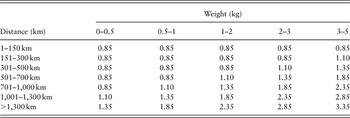
In the French case, UPU decisions and discussions clearly shaped national legislation for domestic as well as international services. This was not the case in countries such as Germany, where parcel post predated the international convention and kept specific domestic features. In France, a law authorized parcels (including cumbersome ones) up to 5 kg in 1892, after the Vienna congress, and up to 10 kg in 1897, just before the postal congress discussed the matter in Washington. The French post office passed complementary agreements with neighbouring Switzerland, Luxemburg, and Belgium to exchange parcels up to 10 kg. Pricing also followed UPU principles with a flat rate irrespective of distance in domestic and foreign relations. Up to 3 kg, a packet of any weight and from any part of the country to the other required a single FFr0.60 tax (FFr0.85 for home delivery). Sending a parcel of up to 3 kg cost the same as sending a letter of 0.06 kg. It was clearly an improvement over the complex system previously proposed by railway companies, with its thirty-five distance/weight combinations in total, starting at FFr0.85 and going up to FFr3.35 (see Table 1).
Unified rates (in FFr) for ‘petite messagerie ferroviaire’ (railway parcel service) within France, March 1878.

Source: W. Laurent, Les transports par colis postaux, Paris: Domois-Dijon, 1906, p. 11.
Parcel post enlarged the consumption spectrum and lowered living costs through direct producer-to-consumer relations.Footnote 50 In Au Bonheur des dames (1883), Emile Zola described the mail-order service of the Bon Marché department store in Paris, where thirty employees opened and processed incoming mail while ‘a team of workmen nailed shut and tied up from morning till night’ in an atmosphere of ‘perpetual fever’.Footnote 51 Newspapers commonly featured advertisements from producers who proposed shipping everything from seeds to butter to grapes. A cheese-producing area around Laguiole decided to reshape its typical fourmes so that they could fit into parcel packaging and easily reach urban markets.Footnote 52 PhD dissertations in law discussed at length questions of delays, insurance, commercial disputes, and responsibilities in parcel post traffic.Footnote 53
This increased use of parcel post fuelled protests too. In Australia, postal authorities reported that ‘the system enables people to do their shopping by post’ and that ‘a certain section of small shopkeepers in country towns always oppose the system on the grounds that residents of their towns procure articles from the larger shopping centers of the capital cities’.Footnote 54 Shopkeepers had to lower their prices and diversify their commercial offerings to compete. Even if they represented ‘only a small section of the community’, they might lobby to stop the parcel post expanding.Footnote 55 In Britain, too, smaller retail traders opposed the introduction of parcel post, but there was a ‘preponderating body of public opinion in its favor’ and the service opened in 1883.Footnote 56 Afterwards, however, a proposal to implement a cash-on-delivery system, allowing the addressee to pay when receiving goods, ‘excited such strong protest from villages and small towns’ that it was abandoned.Footnote 57 This postal service threatened business in small-town and rural areas all over the globe, where small shops feared and felt the arrival of department store mastodons such as the Parisian Bon Marché, Louvre, and Samaritaine in France. Distance no longer protected local commercial and industrial businesses. Parcel post was a powerful integrative force on the market. According to a fierce opponent, harsh competition from Paris and large businesses brought millions of retailers in clothing, lingerie, silk, haberdashery, shoes, jewellery, stationery, sewing materials, hardware, clocks and watches, perfumery, furniture, and saddlery to the verge of bankruptcy.Footnote 58 The secretary of the Chamber of Commerce in Agen argued that parcel post cut out the middlemen and propelled an ‘inner economic revolution’ that would concentrate power in a few industrial and commercial monopolies.Footnote 59
In some cases, the fear of monopoly even became an argument for candidates running in parliamentary elections. Some in France concluded that parcel post endangered traditional commercial ties. Maximizing competition, it led to a kind of ‘communism’ as opposed to the individualism embodied in small shops and businesses.Footnote 60 Opponents saw the Republic's moral and political economy in danger. Parcel post raised crucial questions: did the government want to build a republic of sellers or of buyers? Did it want to make the country more vulnerable than ever, with quotidian social and economic activities increasingly relying on complex systems of transportation and communication?Footnote 61
French critics and pessimists were, however, in the minority. Ultimately, there was no strong, institutionalized movement against parcel post, perhaps because many smaller retailers adapted and discovered how to take advantage of the service. They realized that they could diversify their offerings and show new items to local customers. The debate turned more towards increasing the service's accessibility, notably to the rural population. Nevertheless, the weight limit did not increase from 1897 until the late 1930s. The limit was 10 kg in France, while it was 50 kg in Germany, for instance. Depending on national contexts, tensions, and debates led to diverging domestic regulations. These regulations would frame later international negotiations.
Internationally, the parcel post dramatically fostered circulation across borders because it was much easier and cheaper than previous systems. A UPU inquiry at the end of the 1870s found that sending a packet between a country with parcel post and another without was difficult and very expensive.Footnote 62 The parcel post administration had to deal with various private or governmental transport companies, depending on the parcel's precise origin or destination, and to combine rates from various frameworks. Before 1881, rates for sending a packet from Germany to France, the Netherlands, or Great Britain differed depending on the German administration's partner, whether the French Eastern railway company, the Van Gend and Loos, the English Continental, or the Elkan & Co. companies. In most cases, distances affected pricing. Lastly, but somewhat obviously, the postal offices of the countries with no parcel post were not places where one could send or pick up a packet, and postal clerks did not administer the parcels at customs – customs brokers did. This explained the difference in traffic between Germany and France (around 215,000 packets) and Germany and Switzerland (around 900,000 packets) in 1878.Footnote 63 These constraints also explained the cost of sending a 1 kg packet from Germany to Portugal in 1880: at best, one could pay in advance when boats from Hamburg stopped at the parcel's destination (13 Marks, or around FFr16.25 to Lisbon, for instance), but sometimes it was impossible to estimate the cost, because this depended on brokers and local transport companies.Footnote 64
Unsurprisingly, exporters had pushed for an international parcel post service. The Paris Chamber of Commerce, under pressure from the corset-makers’ professional organization, insisted that competitors abroad took advantage of such facilities on export markets.Footnote 65 It was vital, they said, that the French post office offer the same service. Parcel post seemed a critical transnational infrastructure that they needed to access to compete in the world market. International commercial competition propelled demand from merchants and producers.
Once instituted, the service radically changed how parcels circulated, as the service was far more competitive than any other transportation for small shipments. A parcel from any corner of France to any in Germany, for instance, would be charged at FFr1 (compared to FFr1.80 previously between Paris and Berlin, and multiple different rates for other combinations of origin and destination). It would cost 1.8 Marks (FFr2.25) for a 5 kg parcel from Berlin to Lisbon in the 1890s. The decrease in cost, typically a 50–90% drop, was all the more noticeable when distance increased. Under German, British, and internal pressure from the public works ministry, French maritime companies finally agreed on a common maritime rates system more favourable to transoceanic parcel users. In the 1890s, long-distance shipment for light freight dropped amazingly, from 19 Marks between Hamburg and Algiers to 1.2 Marks from anywhere in Germany to anywhere in Algeria, as well as from 22 to 2 Marks between Germany and Réunion Island for a 5 kg parcel.Footnote 66 French maritime companies charged FFr3 for shipping a parcel to China or Japan – the price of a twenty-word short-distance telegram from Paris to Bern, and a fraction of the cost of a cable to China.Footnote 67 On top of attractive charges, parcel post featured additional convenient services for traders. On a bilateral basis, some post offices enabled the sender to pay at the exchange office for customs, which normally the receiver covered.Footnote 68 Another feature, almost unique to parcel post, was that duty was refunded on parcels which could not be delivered. This mitigated against uncertainty in global trade.
Depository railway stations and post offices increased territorial connectivity and became entry points to global commercial networks. New channels opened for exporters and importers. By 1888, 225 million parcel packets circulated inside UPU countries, and 25 million between them. The estimated total value of the merchandise crossing borders was about FFr17 billion, a ‘huge figure’ according to contemporaries.Footnote 69 On the eve of the First World War, two billion postal packets circulated globally, 2.5% of which travelled internationally (55 million).Footnote 70 Mostly light and relatively expensive goods were transported in this way. While such goods had been traded for centuries, parcel post made them easier and cheaper to ship. It not only opened a new commercial channel but also favoured a new division of labour through complex production circuits. A specialist of the ostrich-feather trade showed that, in the early 1900s, ‘higher grades of ostrich plumes’ could be exported to London ‘from the Sahara by parcel post and trans-Atlantic steam ship via Lagos’, before sometimes being re-exported to Tripoli for processing.Footnote 71 Diamonds also came to London sealed in insured tin postal packets from southern Africa; from London they could travel to remote places in the Jura mountains in France, where cutters would finish them and send them back to merchants.Footnote 72
Between 1882 and 1892, international parcel post traffic to and from France tripled, and then doubled again in the following decade. By 1900, metropolitan France exchanged 7 million postal packets with its colonies and with foreign countries. Of this total, 10% was transit traffic. Much of the remaining 90% was exports, with over 4 million packets going abroad. Many outgoing packets from France conveyed metals and jewellery, money and titles, or luxury items.Footnote 73 French customs estimated that international parcel post channelled more than FFr200-million-worth of exports in 1898, half of which originated from Paris. This represented around 6% of total exports from metropolitan France. By 1913, figures had risen steadily: the international regime accounted for 21% of the total traffic in France, with 16 million packets crossing borders.Footnote 74
An important drawback, however, was the fraudulent introduction of prohibited goods, or those submitted at an incorrect customs rate. In 1848, postal circulars already pointed out in France that fraud was common practice, and asked postal managers to check incoming small packets of samples to verify their exact content – not an easy task knowing that they were forbidden from opening any correspondence.Footnote 75 The international parcel post service worsened the situation. It so greatly facilitated the circulation of goods and capital that some contemporary observers defined it as a ‘commercial treaty’ of a special nature, because it was both universal in scale (every country could join freely, as many did) and undifferentiated in scope (no differentiation between types of goods).Footnote 76 It was a new kind of free trade institution in global commerce.
The postal regime's development moved contrapunctually to global trends regarding free trade and protectionism. During the economic depression from 1873 to the late 1890s, most governments, except Britain and the Netherlands, erected protectionist tariffs barriers.Footnote 77 The more tariffs rose, the more attractive fraud became, particularly through parcel post. Many tried to hide products prohibited or highly taxed at customs in parcels, behind solid packaging and false declarations. International parcel post regulation was strict on packaging: to make transport safer, sealing with lead was compulsory. This further complicated checking packages. For this reason, the carrier would not be considered criminally responsible in case of fraud, contrary to the law in other commercial relations.Footnote 78 Additionally, if international packets were subject to a written customs declaration, checking the veracity of millions of declarations seemed impossible. Discovering an offence was ‘almost always the result of fortuitous circumstances’.Footnote 79 Post offices and railway stations receiving postal packets were entry points to global commercial networks and also new sensitive points of the economic border. As conceived by post offices, parcel post made borders more permeable, even as tariffs tried to restrict the movement of goods within borders.
Before long, the French postal administration felt compelled to complain to its foreign counterparts about a booming traffic of small consignments of counterfeit and pirated products.Footnote 80 In China, the English, French, Japanese, Russians, and Germans opened post offices across the empire, arguing that the Chinese postal services were too poor. These post offices soon became the best way to skirt around newly created Chinese customs, which sparked official protest from the Chinese government.Footnote 81 It seemed impossible both to accelerate the circulation of parcels and to prevent fraudulent imports. Customs control was a point of tension between the two goals of achieving the postal promise (speed and smoothness) while securing borders.
Responses varied.Footnote 82 In Austria, Belgium, British India, Egypt, Great Britain, the Netherlands, and Switzerland, customs made random checks; postal speed took precedence over customs. Some countries, such as Bulgaria, Chile, Spain, Italy, Luxemburg, Norway, Portugal, Romania, Russia, and Sweden decided to check systematically: customs officers opened each and every parcel without exception. In France, they checked 80% of incoming parcels, and more in suspicious cases.Footnote 83 Thus customs took precedence over postal speed. The customs services in Paris even tried a revolutionary system with X-ray apparatus screening parcels as early as 1897.Footnote 84 This would enable them, they hoped, to inspect parcels without opening them. Cigars and cigarettes, matches, and lacework proved to be favourite smuggled goods. But they also proved beyond the reach of radioscopic apparatus.
Another problem was the certification of origin.Footnote 85 How could a postal administration certify claims that a product originated from a particular country? This was important for customs and consumers alike. Asking for a certificate held up circulation, but also helped to stop false declarations; not asking facilitated postal traffic, but also facilitated fraud. Depending on the strength of the customs administration within the state apparatus, and on governmental policy towards free trade, countries chose one option or the other. While Austria, British India, Bulgaria, Egypt, Luxemburg, the Netherlands, Russia, Romania, and Sweden made official certificates compulsory, others such as Chile, Great Britain, Japan, Italy, Norway, Portugal, Spain, and Switzerland did not ask for such papers. In Germany, Belgium, and France, it depended on the merchandise and its origins. In the French case, the French consul in the exporting country had to sign the certificate. To strengthen commercial relations with French colonies, colonial postal officers could sign the certificate instead.
These matters became the subject of discussion and negotiation not only within the UPU but also in new international arenas. A survey and a session on customs and parcel post was organized during the international congress on customs regulation in Paris in 1900. Delegates agreed that every nation should retain the ability to check parcels as it liked, but the report suggested that parcel post should be exempted from certificates of origin.
A seemingly harmless object and service, parcel post proved to be a powerful instrument of change in the market. At the intersection of communication, transportation, and commerce, it acted as an integrative factor on national and international scales. It raised a mixture of questions about access, competition, and fraud worldwide. In the very large majority of countries where parcel post did not exist before 1880, it challenged the equilibrium of moral and political economy. Once created, parcel post generated national debates and regulations, which created a framework for international negotiations that soon extended to new fields such as customs. In turn, international decisions could influence the national development of the service. Parcel post opened a Pandora's box and became one of the important issues surrounding national economic policies and their integration into global networks of trade.
Sealing the package of universalism: Great Britain and the United States
While 25 post offices provided a parcel post service at the end of 1881, 180 did so by 1900.Footnote 86 In the late 1880s, several new, mostly colonial, offices joined the UPU convention on parcel post: Tunisia, Tonkin, Annam, French settlements in China, Cameroon, Congo, Danish colonies, Assab and Massawa, Portuguese establishments in the Azores and Madeira, Argentina, Tripoli, and Malta. Many more joined during the following years, from Bolivia to Japan, Russia, Siam, the Italian colonies, and Greece.Footnote 87 Two important countries were still absent, although they were founding members of the UPU: Great Britain, with most of its dominions and colonies, and the United States. Even if absent, I argue, they were connected with parcel post's expansion through their constant scrutiny of the parcel post convention and through bilateral agreements.
The British General Post Office (GPO) officially participated in the 1880 conference but preferred to leave a blank space on the signature page of the convention. Small traders and railway companies opposed any postal intrusion into the parcel market. The GPO and Parliament would not settle the case until 1882, when they offered 55% of the gross postage of all ‘rail-borne’ parcels to railway companies, which eventually agreed. ‘Never before did any Commercial House leap all at once into so gigantic a concern, … never before, it is thought, was a Government department put to so severe a test’ as by the new service, warned a journalist.Footnote 88 The new service began in August 1883. For the Encyclopaedia Britannica of 1885, ‘at the outset, it checked railroad abuses, both of overcharge and excessive delays, and in its results it will probably prove a public boon of unexampled magnitude’.Footnote 89 No doubt the international dynamic at play three years earlier had served as an agenda-setting factor and a discursive resource for the GPO to achieve this long-awaited reform.Footnote 90 But the blank space remained, and the UK did not join the international convention.
The GPO was not satisfied with its conditions, above all regarding rates. During the 1880 conference, it had a tough debate with Germany and other uniformist partisans about charging a unilateral surtax on incoming and outgoing parcels. The FFr0.50 granted by the majority was probably not enough, considering local operating conditions, particularly the arrangement with railway companies. The GPO preferred to negotiate bilaterally for its external service. It did so with France in 1886, after the postal reformer Henniker Heaton, an Australian, agitated for it.Footnote 91 At the beginning of the 1900s, the two countries exchanged around half a million packets yearly, while Great Britain and Germany exchanged some 800,000. Keeping its hands free also probably allowed the GPO to articulate its domestic, imperial, and maritime interests better. Traffic with foreign countries probably subsidized low rates within the United Kingdom, the British empire, and the Commonwealth.Footnote 92 In this case, national and imperial concerns prevailed over ‘universal’ plans. At the same time, however, British India did participate in the universal convention. Seen from this side of the British empire, participating in the convention proved more positive than staying outside it. By 1900, foreign and colonial parcel post from Britain increased steadily, reaching destinations including German post offices in China, Portuguese East Africa, the Ottoman empire, and agencies of the Japanese Post Office in Korea.Footnote 93 In 1902, larger increases occurred in exchanges with parts of the world from Cape Colony, Germany, India, Italy, Malta, New Zealand, and Switzerland to the West African colonies. Still, one destination was missing: ‘It is intolerable that, while we have a parcel post to nearly every part of the world, including Samoa, the Cameroons, and the wilds of Bechuanaland, we have none to or from the United States’, deplored Henniker Heaton.Footnote 94
Domestic circumstances made the situation in the United States different. There was no domestic parcel post service until 1913. The best historical studies of the move towards the creation of such a service pay no attention to transnational connections.Footnote 95 Yet demand was clear by 1910: the American Postal Progress League argued for the importance of ‘Giving to Americans a parcels post at least as extended and as cheap as that which the President and the Postmaster General have provided for foreigners’.Footnote 96
The idea of expanding the postal civic mandate to parcels had provoked tense debates from the late 1870s onwards. Along with postal savings and a postal telegraph and telephone service, parcel post became one of the hottest topics for a large coalition ranging from ‘former Populists from the heartland, cosmopolitan progressives from the cities, bureaucrats from the government's largest department, and journalists from both muckraking and consumer magazines’.Footnote 97 Agitators constantly compared the US with the situation abroad. In 1894, the New York postmaster declared after a visit to London that the British system of parcel post provided far greater ‘promptness, ease, and convenience’ than the American private express companies. He hoped to find a way of testing a similar system in the US.Footnote 98 A pro-parcel-post manufacturer, Charles Ingersoll, even spent four months in Europe studying parcel post systems.Footnote 99
Yet there were major obstacles. Some thought that parcels would obstruct letters and prevent the post office from fulfilling its core mission. Others feared that it would cost too much for a post office already making losses, unless railways asked less to carry the mail, which was hardly feasible.Footnote 100 When the post office reduced rates on heavier and cheaper so-called fourth-class mail, country merchants argued that it was ‘class legislation’ militating against them to benefit a few capitalists and large department stores working from big cities by mail and express.Footnote 101 Wholesalers also feared being bypassed by direct producer-to-consumer relations. Last but not least, express companies were extremely reluctant to let the post office enter their highly profitable market.Footnote 102 Parcel post was thus part of the anti-monopoly debate targeting railways and express companies.Footnote 103 In this case, regulation was insufficient for many supporters, who asked for direct federal involvement through the post office.
An active and founding member of the UPU, the American post office participated in the discussions on parcel post in 1878. But in 1880 it could not take part officially in the dedicated conference. Although the US post office had no domestic service and thus could not join the international convention, it signed bilateral arrangements with some countries in the following years to open cross-border routes for parcels. In 1880, the Postmaster General, David M. Key, wrote to his German counterpart that a bill was on the floor of Congress that would soon authorize the post office to deliver incoming parcels.Footnote 104 It took some time, but the Postmaster eventually signed an arrangement with Canada in 1887.Footnote 105 Agreements with neighbouring Mexico, Barbados, Hawai‘i, Colombia, Salvador, Costa Rica, Bahamas, British Guyana, Jamaica, Newfoundland, and Honduras followed. Thus the US built up a system to exchange goods with neighbouring nations, retaining a regional focus.
Later on, pressure came from the other side of the Atlantic. Germany first, followed by France, Belgium, Italy, and Great Britain, had asked since at least the early 1890s for the US to participate in international parcel post.Footnote 106 The American Chamber of Commerce secretary in Paris claimed on the first day of 1900 in the New York Times that, if increasing commercial flow across the ocean between the United States and France was a goal, then two institutional innovations had to occur. One was a classic in international trade negotiations: a treaty to stabilize commercial relations in the long run. The other was perhaps more surprising: a parcel post service. ‘The advantages of the former are unquestionable, the latter has been tried in many countries – notably in Great Britain and France – and has been an important factor in the development of the export trade’, the article concluded.Footnote 107 At the end of the nineteenth century, the United States was highly protectionist. By allowing easier and cheaper shipment from Europe, the parcel post could pose a double problem, first for customs control and second for protected firms. Protectionist concerns seemed clear from the French perspective: ‘the advantages that parcel post rate provides us with are so strong that, in order to fend off French competition, the USA had refused, with a significant obstinacy, any kind of arrangement with us on that matter’, wrote a French analyst.Footnote 108 Despite many attempts, supported by French winemakers and the ‘articles de Paris’ industry alike, the French post office would not reach an agreement with the US until 1908.
This deadlock was all the more contested in France as Germany had secured an agreement in September 1899, opening a service between New York, Bremen, and Hamburg. This concluded two decades of lobbying and formed a communicational counterpart to the large waves of German immigrants to the US and the economic and informational ties that they had built up between the two countries.Footnote 109 The French Chamber of Commerce in New York immediately warned the recently created American Chamber of Commerce in Paris (1894) about a risk of distorted competition. The latter then appointed a special committee to examine the question of establishing a parcel post service between the United States and France. Of the eighty-three replies to its circulars, seventy-three favoured an agreement.Footnote 110 The Chamber forwarded a proposal to the US authorities that ‘would tend to facilitate and greatly increase the commercial relations and exchange between these two said countries’.Footnote 111 It also started campaigning in American newspapers. But in April 1901, despite new attempts, the French post office bitterly noted that ‘the American government seems willing to carry on refusing to France the advantages it gave to Germany’.Footnote 112 The British experienced the same rebuff.Footnote 113
The French and British governments thus changed their strategy. The French government had already tried in the 1890s to contract with American Express, one of the big private companies for parcel service operating in the US. But the project had failed because of insurance problems.Footnote 114 While Great Britain and Switzerland had recently been successful in contracting with this private carrier, the French post office opened new discussions and finally reached an agreement. The British Cunard Line and the French Compagnie Générale Transatlantique would now receive parcels from post offices and take charge of maritime shipment to the US, while American Express would collect packets in New York and distribute them to recipients. This created ‘a packet which is a postal parcel at one end of the line and a private parcel at the other’.Footnote 115
Traffic developed with some unexpected consequences. Again, fraudulent valuations were at stake, as some officials feared that mislabelled goods would compete with ‘honest importers’.Footnote 116 US postal officials soon offered new conditions to their European counterparts, intended to prevent smuggling and under-valuations. From 1903 onwards, Theodore Roosevelt's Postmaster General, Robert Wynne, proposed decreasing rates on packets at American customs in compensation for a drastic service limitation in comparison with the international convention's standards.Footnote 117 Packets were not to exceed 2 kg (less than half the standard) and would not benefit from related services attached to them arising from the international convention (responsibility in case of loss, delay or damage, express delivery, and so forth). Belgium and Germany agreed. The US post office sent William Shallenberger, Second Assistant Postmaster General, and John Masten of the railroad division, on an overseas mission to convince partners in Paris and London, who were now reluctant, as they considered this offer backward-looking.Footnote 118 The French Chamber of Commerce in New York pleaded against the project as too bold. It actively defended big local importers of French products who had long-standing and stable relationships with French producers and traders.Footnote 119 Writing to the French Ministry of Commerce, the Chamber worried that the parcel post would bring competition from opportunistic small retailers and that it would be unfair to favour them. In Venezuela, for instance, ‘the small dealers are thereby enabled frequently to compete with large importers, since they can introduce into the country the same goods as the large houses, without the necessity of bringing in quantities beyond their capacity to handle’.Footnote 120 In this context, large importers acted against parcel post to protect their position in the market. Again, the potential reshaping of commercial circuits was at stake. This lobbying complicated negotiations. The two parties finally reached an agreement in June 1908, though the new service was far less advantageous than the multilateral UPU one.
With international parcel postage operating between numerous countries, the situation became rather strange in the US: it was almost simpler and definitely cheaper to receive a packet from abroad than to send it domestically. James L. Cowles, a fierce advocate for the parcel post, together with recently created mail-order firms such as Montgomery Ward (1872) and Sears and Roebuck & Co (1887), and agrarian organizations including the National Grange, had predicted the situation: ‘one will be able to send a parcel from London to Chicago for just about half what it costs to send the same parcel from New York to Chicago’.Footnote 121 The US Post Office did not seek to join the multilateral convention, but the decoupling between international and domestic services went against UPU members’ shared vision of harmonious postal relations. Domestically, too, the situation became untenable and the Postmaster General George Meyer, appointed in 1907, soon presented it as a serious problem, arguing that citizens should be able to exchange parcels within the US for ‘as liberal a rate as that at which they are allowed to send them to a foreign country’.Footnote 122
This argument gave even more weight to parcel post advocates. With rising living costs, railways and parcels post became a favourite topic during the 1910 elections campaign. Congressman Sulzer introduced the Parcels Post bill and the newly elected Congress started parcel post hearings with the support of President Taft. The Senate Committee on Post Offices, chaired by the Progressive Republican from Oregon Jonathan Bourne, launched an international inquiry in 1911 with the assistance of the State Department.Footnote 123 The inquiry itself not only reflected the exception of the United States, as one of the few countries with no parcel post, but also its connections to the rest of the world.
At this point, political support, together with muckraking reports on express and railway companies, and the post office's successful entry into the new postal savings business, made parcel post ‘inevitable’.Footnote 124 Inaugurated in January 1913, the service immediately became extremely popular. The weight limit of domestic parcel post first corresponded with the ‘international standard’ for foreign mailing in the UPU convention.Footnote 125 One year after the service had begun, the academic observer Chester L. Jones continued to advocate for introducing a European-style service.Footnote 126 Contrary to what some had agitated for, the post office had no monopoly, and express companies were still in the business, though the boundaries between the two were shifting. Another development was the signature of many new bilateral conventions with foreign post offices: forty-four in total by 1914.Footnote 127 Like Great Britain, the United States opted for this way of managing international connections, despite Cowles's hopes that his country would eventually reform the UPU convention to make it even more advantageous for users.Footnote 128 Instead of participating in the multilateral UPU convention on parcel post, the US preferred to negotiate on a case-by-case basis to better secure American commercial and public finance interests.
The establishment of American parcel post did not just emerge from domestic factors. The Atlantic world had a real (though typically underplayed) influence on American communication.Footnote 129 Internal demand and pressure arose simultaneously with or even after international pressure to exchange parcel post with countries which had themselves experienced a boom in their parcel post traffic.Footnote 130 France and Great Britain, which had no parcel post service before the advent of the multilateral convention in 1880, became ardent lobbyists for the service in transatlantic relations in the 1890s and 1900s and passed bilateral international exchange agreements with the US, which would dramatically contribute in turn to a major national reform in that country. In a process exemplary of transnational dynamics, international postage, closely linked with the UPU framework, enabled the US post office and other advocates to push for the adoption of a service which changed the daily lives of millions of people.
Conclusion
By 1900, parcel post had greatly facilitated the buying, selling, trading, and forwarding of goods, both nationally and internationally. It turned post offices and railway stations into even stronger points of connection to commercial flows. There are two different ways to understand the global implications of parcel post. Most obviously, institutional arrangements enabled users to send and receive parcels almost everywhere on earth at relatively low cost. Post offices were important actors in the first modern age of globalization, for circulating not only news but also money and material things. But the expansion of the service itself emerged from a transnational trend through which, in a less intuitive causal chain, international arrangements fostered national institutions. Domestic traffic quickly surpassed international traffic by many orders of magnitude, overshadowing the global process which had domesticated parcel post in the first place.
The key actors were a cosmopolitan community of postal officers. After embarking on a new process of international cooperation with the UPU, these officers voluntarily coordinated the introduction of a new service for the international circulation of light merchandise. Some of them had to establish domestic systems to be able to participate. This offers another view on the work of international organizations, suggesting that institutionalization does not just occur from the national to the international, but also via the reverse trajectory. This kind of transnational dynamic was typical of the time, occurring in fields such as industrial and intellectual property too. The 1883 Paris convention on industrial property not only facilitated the circulation of innovations across borders thanks to a new harmonized framework, but also enabled advocates of patents to secure or even implement contentious domestic legislation.Footnote 131 Similarly, the 1886 Berne convention on intellectual property regulated the international circulation of literary products and imposed national standards.Footnote 132
Uniformity, low rates, and simplicity were the hallmarks of the new paradigm of international parcel post. Because of these features, it became so widely used that it challenged established commercial circuits and control over economic borders. Both domestic and foreign services continued to interact over the regulation of seemingly separate national and international domains. This case suggests that the creation of more integrated and interconnected national markets went hand in hand, and resulted from a complex mix of domestic, bilateral, and multilateral factors. This happened on a global scale, with countries apparently on the margins of the system eventually connected to it, as shown by the British and American trajectories. Long before shipping containers ‘made the world smaller’ in the twentieth century, parcel post had created boxes with a global impact, making the world bigger than the sum of its parts.Footnote 133
Although the Internet seems to epitomize a new phase of dematerialized globalization, postal services and parcel post still play an active role today. A Washington Post article recently explained that Chinese producers could now sell directly to American consumers via Internet platforms and international parcel post thanks to a ‘decades-old arrangement, which is overseen by an agency of the United Nations and has participation from nearly every country’. The journalist called it ‘a quirk in an international treaty that makes it possible for an individual to send a pound of stuff from Hong Kong to D.C. for less than it would cost to send the same package from, say, Seattle’.Footnote 134 This system is no quirk. It emerged from a late nineteenth-century vision and practice firmly linking and co-constructing the national and the universal.
Léonard Laborie is a research fellow at the Centre National de la Recherche Scientifique (CNRS), UMR Irice 8138 (Paris), where he participates in the LabEx EHNE project ‘Writing a new history of Europe’. He holds a PhD in contemporary history from Paris-Sorbonne (Paris-IV) University.