Introduction
The construct of expressed emotion (EE) has been shown to be a robust predictor of relapse in both chronic (Vaughn et al. Reference Vaughn, Snyder, Freeman, Jones, Falloon and Liberman1982; Marom et al. Reference Marom, Munitz, Jones, Weizman and Hermesh2005) and first-episode psychosis (FEP) patients (King & Dixon, Reference King and Dixon1999). However, the origins of the two major components of EE, critical comments (CC) and emotional over-involvement (EOI), remain unclear. Although family interventions aimed at reducing EE have proven to be effective in reducing relapse rates in patients with chronic schizophrenia (Pilling et al. Reference Pilling, Bebbington, Kuipers, Garety, Geddes, Orbach and Morgan2002), these interventions have yielded mixed results early in the course of the illness (Linszen et al. Reference Linszen, Dingemans, Van der Does, Nugter, Scholte, Lenior and Goldstein1996). As a result, it has been posited that EE-based interventions need to be refined to be effective in FEP patients (Gleeson et al. Reference Gleeson, Jackson, Stavely, Burnett, McGorry and Jackson1999). It is therefore essential to study the development of EE in relatives of FEP patients to optimize family interventions in the early phase of psychosis.
Recent investigations that have included FEP patients suggest that psychotic symptoms may have a limited impact upon carers' EE (Heikkila et al. Reference Heikkila, Karlsson, Taiminen, Lauerma, Ilonen, Leinonen, Wallenius, Virtanen, Heinimaa, Koponen, Jalo, Kaljonen and Salakangas2002; Raune et al. Reference Raune, Kuipers and Bebbington2004). Conversely, patient symptoms have been shown to predict burden of care in relatives of both FEP and chronic patients (Moller-Leimkuhler, Reference Moller-Leimkuhler2005; Roick et al. Reference Roick, Heider, Toumi and Angermeyer2006, Reference Roick, Heider, Bebbington, Angermeyer, Azorin, Brugha, Kilian, Johnson, Toumi and Kornfeld2007). Furthermore, although EE has been linked to family burden of care, carers' stress and depression (Scazufca & Kuipers, Reference Scazufca and Kuipers1998), the direction of this relationship is unclear. This raises fundamental questions regarding the causes of EE and its direction of influence.
Two main explanatory models have been proposed to account for the nature of EE in relatives of FEP patients. It has been argued that EE is a coping strategy that reduces the perceived stress and burden of the caring role (Raune et al. Reference Raune, Kuipers and Bebbington2004; Kuipers et al. Reference Kuipers, Bebbington, Dunn, Fowler, Freeman, Watson, Hardy and Garety2006). According to this model, carers' negative appraisals of their living situation results in negative emotional states such as anxiety, precipitating high EE among carers in an attempt to neutralize these emotions. An alternative model suggests that EE may be understood as an adaptive reaction to grief and perceived loss (Patterson et al. Reference Patterson, Birchwood and Cochrane2005). This model proposes that, during the early stage of adaptation to the illness, families may fear the loss of the young person developing psychosis, which, according to attachment theory, is fundamental in the development of an anxious attachment style (Bowlby, Reference Bowlby1980, Reference Bowlby1988). Carer's EE could then be deemed as a particular form of anxious attachment that is likely to lead to stress, maladaptive relationships and, consequently, burden of care (Wynne, Reference Wynne1981).
There is growing evidence that the components of EE are uncorrelated and related to different variables (Scazufca & Kuipers, Reference Scazufca and Kuipers1998; van Os et al. Reference van Os, Marcelis, Germeys, Graven and Delespaul2001). Carers' CC has been linked to carers attributing their relative's symptoms and behaviour to internal and controllable factors as opposed to ‘external’ illness factors (Hooley, Reference Hooley1998, Reference Hooley2007). In addition, longer duration of untreated psychosis (DUP) has been associated with CC (Macmillan et al. Reference Macmillan, Crow, Johnson and Johnstone1987), whereas carers' EOI has been suggested to be a main feature of burden of care (Patterson et al. Reference Patterson, Birchwood and Cochrane2005). There is also an indication that EE is not a stable characteristic and is likely to fluctuate throughout the course of the disorder (Bentsen et al. Reference Bentsen, Boye, Munkvold, Notland, Lersbryggen, Oskarsson, Ulstein, Uren, Bjorge, Berg-Larsen, Lingjaerde and Malt1996; Wuerker et al. Reference Wuerker, Haas and Bellack2001; Patterson et al. Reference Patterson, Birchwood and Cochrane2005). However, little research has focused on delineating the specific relationships of EOI and CC with relevant predictors over time. Identification of these differential associations has the potential to refine theoretical models and also to guide clinical practice (Patterson et al. Reference Patterson, Birchwood and Cochrane2005).
This study sought to investigate the differential relationships between EOI and CC and carer's distress, burden of care and patients' attributes in relatives of FEP patients who had reached remission on positive symptoms of psychosis and were followed up for 7 months. This provided a unique opportunity to study the specific relationships of CC and EOI in a homogeneous sample of FEP patients controlling for the severity of psychotic symptoms. We hypothesized that EOI and CC would be associated with differential variables, and that although carers' CC would be better explained by a coping strategy model (i.e. as a response to carers' stress, burden of care and treatment delay), carers' EOI would be better accounted for by an anxious attachment model (i.e. EOI would induce carers' stress and burden of care). Finally, we postulated that relatives' burden of care would be a function of both carers' EOI and patients' symptoms.
Method
Participants
The study sample comprised participants recruited for the EPISODE II trial (Australian Clinical Trials Register no. 12605000514606) and their immediate carers. The EPISODE II trial is a prospective, assessor blinded, randomized controlled effectiveness trial of cognitive-behavioural therapy and family intervention designed to test a number of hypotheses regarding both clinical outcomes and psychological processes linked with psychosis for patients and their carers. A detailed description of the EPISODE II rationale, sample and methodology is provided elsewhere (Gleeson et al. Reference Gleeson, Wade, Castle, Gee, Crisp, Pearce, Newman, Cotton, Alvarez-Jimenez, Gilbert and McGorry2008).
Patients from the Early Psychosis Prevention and Intervention Centre (EPPIC) in Melbourne and Barwon Health were recruited between November 2003 and May 2005. Inclusion criteria for entry to the trial were: age between 15 and 25 years; meeting DSM-IV criteria for a first episode of a psychotic disorder (APA, 1994); <6 months of prior treatment with antipsychotic medication; and remission of positive psychotic symptoms, defined as ⩾4 weeks of scores of ⩽3 (mild) on the Brief Psychiatry Rating Scale (BPRS) items hallucinations, unusual thought disorder, conceptual disorganization and suspiciousness (Lukoff et al. Reference Lukoff, Liberman and Nuechterlein1986). Patients who fulfilled the eligibility criteria were invited to participate as soon as possible after they had reached remission on positive psychotic symptoms for at least 1 month. Patients with carers who were in frequent contact with them were also invited to provide additional consent for participation of their family members. These carers were then approached to participate in the trial.
Design
This study was a prospective controlled trial. Data on patients were collected during the baseline phase of the trial, before allocation. The data on carers were obtained at baseline and at the 7-month follow-up.
Participant assessments
Symptoms measures and psychosocial functioning
Participants' symptom measures included the Montgomery–Åsberg Depression Rating Scale (MADRS; Montgomery, Reference Montgomery1979), a measure of the severity of depressive symptoms, the BPRS (Lukoff et al. Reference Lukoff, Liberman and Nuechterlein1986), which provides severity ratings across a broad range of psychotic and non-psychotic symptoms, and the Scale for the Assessment of Negative Symptoms (SANS; Andreasen, Reference Andreasen1984), a scale specifically developed to measure negative symptoms. Psychosocial functioning was measured via the Social and Occupational Functioning Assessment Scale (SOFAS; Goldman et al. Reference Goldman, Skodol and Lave1992).
Treatment delay
Treatment delay, or DUP, was defined as the time from onset of psychosis to initiation of adequate treatment. Onset of psychosis was equated to the first manifestation of continuous psychotic symptoms corresponding to a score of ⩾5 on any one of three BPRS items (unusual thought content, hallucinations or conceptual disorganization). Adequate treatment was defined as the start of structured treatment with either antipsychotic medication or intensive psychosocial intervention (provided by EPPIC outreach teams), or the start of hospitalization in a specialized psychiatric ward. DUP was assessed by a consensus process involving three clinical psychologists (J.F.G., D.W. and M.A.-J.) and a research assistant using all available sources including medical records and semi-structured clinical interviews with patients and relatives.
Carer assessments
Expressed emotion (EE)
EE status was assessed with the Family Questionnaire (FQ; Wiedemann et al. Reference Wiedemann, Rayki, Feinstein and Hahlweg2002), which comprises 20 items, each measured on a 4-point scale ranging from ‘never/very rarely’ to ‘very often’. This measure consists of two subscales assessing both EOI and CC. The FQ has excellent psychometric properties including a clear factor structure, good internal consistency of subscales and good inter-rater reliability in relation to the Camberwell Family Interview (CFI; Vaughn & Leff, Reference Vaughn and Leff1976). Unlike other questionnaire measures, the FQ has further yielded consistent significant correlations with CFI EOI. In addition, the FQ has displayed a similar level of accuracy and substantially higher sensitivity compared to the Five Minute Speech Sample (Magana et al. Reference Magana, Goldstein, Karno, Miklowitz, Jenkins and Falloon1986), another widely used measure to assess EE.
Burden of care
The Experience of Caregiving Inventory (ECI; Szmukler et al. Reference Szmukler, Burgess, Herrman, Benson, Colusa and Bloch1996) was used to assess burden of care. The ECI consists of 66 items measuring eight salient negative areas of caregiving (difficult behaviours, negative symptoms, stigma, problems with services, effects on the family, need to provide back-up, dependency and loss) together with two areas of positive experiences (positive personal experiences and positive aspects of the relationship). The negative subscales are combined to generate a total scale of burden of care. This study focused on the total negative scale.
Carer symptoms
Carer symptoms were assessed using the 28-item version of the General Health Questionnaire (GHQ-28; Goldberg, Reference Goldberg1972). This measure comprises four subscales assessing stress, somatic symptoms, depression and social functioning. For the purposes of this study, the stress, somatic symptoms and depression subscales were used.
Data analysis
The data analysis involved several steps. First, Williams' t test was adopted to establish whether EOI and CC showed significantly different correlations at baseline with patients' and carers' variables. This statistic tests the hypothesis that there will be no statistical difference between two correlations from dependent samples (May & Hittner, Reference May and Hittner1997). For example, Williams' t test can be used to determine whether a correlation of 0.60 is significantly higher than a correlation of 0.40.
Second, to test the hypothesis that CC at the 7-month follow-up would be predicted by carer's stress, burden of care and DUP, two sets of logistic regression analyses were performed. Baseline predictive variables were first entered into successive univariate models to test their association with CC (high versus low). Subsequently, separate multi-level logistic regression models for multiple predictor variables were fitted in an attempt to find the most stable and meaningful predictive model for CC. The performance of the models was assessed by using the Mallows' Cp statistic (a measure of goodness of fit of the model) and the Nagelkerke R 2 statistic (a measure of the proportion of explained variation in the logistic model) (Nagelkerke, Reference Nagelkerke1991). The same sequence of analysis was performed examining CC as a continuous variable using multiple regression analysis. In addition, in order to falsify the study hypothesis CC at baseline was included as a predictor variable to examine its association with carers' stress and burden of care at 7-month follow-up.
Third, separate univariate multiple regression models were fitted to test the hypothesis that EOI would predict carers' stress and burden of care at follow-up. Subsequently, following the above procedure, multiple regression analysis was performed to identify additional significant baseline predictors of burden of care at follow-up. Moreover, with the purpose of falsifying the study hypothesis a series of univariate logistic regression models were performed including baseline carers' stress and burden of care as predictors to examine their association with EOI (high versus low) at follow-up.
Finally, results from previous analyses regarding the relationship between EOI, burden of care, carers' stress and patient symptoms were further tested using structural equation modelling (SEM). SEM encompasses the use of path models that mathematically represent the casual influences on the variables of interest. Constructed models are tested for fit against the data. To quantify the overall fit of the hypothesized models to the empirical data, the maximum likelihood method is used, generating a χ2 goodness-of-fit statistic. For any proposed model, a lower, non-significant (p⩾0.05) χ2 value indicates minimum significant differences between the hypothesized model data and the empirical data. Model fit was further examined by using two additional indices of goodness of fit, the Comparative Fit Index (CFI; Bentler & Bonett, Reference Bentler and Bonett1980) and the Root Mean Square Error of Approximation (RMSEA; Browne & Cudeck, Reference Browne, Cudeck, Bollen and Long1993). Good to excellent model fit is indicated if the following criteria are met: χ2 difference test ⩾0.05, CFI>0.95 and RMSEA<0.05 (Browne & Cudeck, Reference Browne, Cudeck, Bollen and Long1993).
Correlations and regression analyses were conducted using the Statistical Package for Social Sciences (SPSS) for Windows, version 16.0 (SPSS Inc., Chicago, IL, USA). SEM was carried out using AMOS 7.0 SEM software from SPSS.
Results
Participants
Sixty-three patients and carers were initially recruited for this study. A further 145 eligible patients refused to participate. The main reasons recorded for their refusal included: not interested in the study (n=80); did not want to change case manager (n=41); already a participant in another research project (n=3); patient refused family involvement (n=11); family did not consent (n=7); and other (n=3). Of those carers who were enrolled at baseline, 15 were non-contactable 7 months later, leaving a sample of 48 families available for the follow-up analysis. The drop-out families did not significantly differ from the remainder on demographic measures, burden of care or symptom indices.
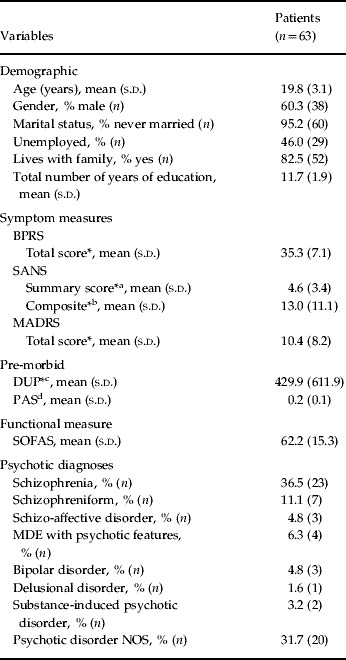
Table 1 reveals that this study recruited a group of young patients who were predominantly residing with their families and who presented with a heterogeneous spread of psychotic diagnoses. The sample was typical in terms of age, marital status, gender breakdown and living arrangements in relation to other FEP cohorts (Gleeson et al. Reference Gleeson, Wade, Castle, Gee, Crisp, Pearce, Newman, Cotton, Alvarez-Jimenez, Gilbert and McGorry2008).
Pre-morbid, demographic and clinical characteristics of patients (n=63)

BPRS, Brief Psychiatric Rating Scale; SANS, Scale for the Assessment of Negative Symptoms; MADRS, Montgomery–Åsberg Depression Rating Scale; DUP, duration of untreated psychosis; PAS, Premorbid Adjustment Scale; SOFAS, Social and Occupational Functioning Assessment Scale; MDE, major depressive episode; NOS, not otherwise specified; s.d., standard deviation.
* Due to positive skewness these variables were transformed using logarithmic transformation. Untransformed scores are displayed in the table.
a Based on scoring recommendations from Andreasen (Reference Andreasen1984) : total of five global items.
b Based on scoring recommendations from Andreasen (Reference Andreasen1984) : total of 20 individual items.
c Estimated on the basis of time between onset of symptoms and entry into the service.
d Scores range from 0.0 to 1.0, with higher scores indicative of ‘healthier’ levels of adjustment.
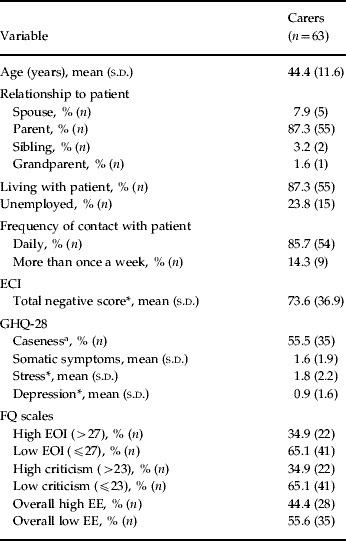
Table 2 shows that nearly half of carers' communication styles were within the high EE category. Approximately one-third of carers had a high rating for EE on the basis of either EOI or CC. The majority (56%) of carers scored at or above a total mean of 5 on the GHQ-28, considered as the standard threshold for ‘caseness’ (Goldberg, Reference Goldberg1972). The ECI negative score shows families reported high levels of burden of care.
Characteristics of carers (n=63)

ECI, Experience of Caregiving Inventory; GHQ-28, 28-item General Health Questionnaire; FQ, Family Questionnaire; EOI, emotional over-involvement; EE, expressed emotion; s.d., standard deviation.
* Due to positive skewness these variables were transformed using logarithmic transformation. Untransformed scores are displayed in the table.
a ‘Caseness’ estimated according to a subthreshold of ⩾5 points.
Differential correlations of EOI and CC with carer and patient variables
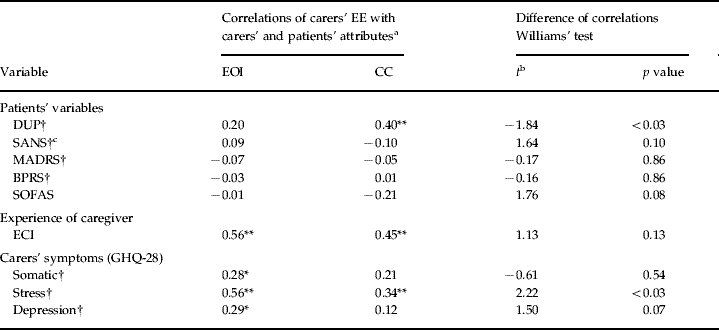
Williams' test compared differences between EOI and CC in their relationships with baseline patients' and carers' characteristics. Carers' EOI was more strongly correlated to carers' stress compared with carers' CC. Conversely, the association between carers' CC and DUP was statistically significant and significantly stronger than the association between EOI and DUP (Table 3).
Differential baseline correlations of EOI and CC with carer and patient variables

EOI, Emotional over-involvement; CC, critical comments; EE, expressed emotion; DUP, duration of untreated psychosis; SANS, Scale for the Assessment of Negative Symptoms; MADRS, Montgomery–Åsberg Depression Rating Scale; BPRS, Brief Psychiatric Rating Scale; SOFAS, Social and Occupational Functioning Assessment Scale; ECI, Experience of Caregiving Inventory, total negative scale; GHQ-28, 28-item General Health Questionnaire.
* p<0.05, ** p<0.01.
† Due to positive skewness these variables were transformed using logarithmic transformations.
a Spearman correlations were estimated for all variables.
b Williams' t test of statistical difference between two correlations from dependent samples.
c Based on scoring recommendations from Andreasen (Reference Andreasen1984) : total of five global items.
Baseline predictors of carers' CC at follow-up
The univariate logistic regression analysis showed that carers' CC at follow-up was not significantly predicted by baseline patients' symptoms (BPRS, p=0.30; SANS, p=0.58; MADRS, p=0.77), DUP (p=0.15), carers' baseline symptoms (stress, p=0.32; somatic symptoms, p=0.64; depression, p=0.89) or carers' baseline burden of care (p=0.11). Likewise, the multivariate model that included burden of care, stress and DUP did not account for a significant proportion of variance in CC at follow-up (R 2=0.10, p=0.44). Similar results were obtained analysing CC as a continuous variable using multiple regression analysis. Again, the multivariate model including burden of care, carers' stress and DUP did not significantly predict CC at follow-up (R 2=0.04, F=1.26, p=0.30). In addition, multiple regression analysis showed that CC at baseline did not predict either carers' stress (F=2.21, df=1, p=0.14) or family burden (F=2.74, df=1, p=0.10) at follow-up.
EOI as a predictor of family stress and burden of care
Next, we tested whether baseline EOI predicted carers' stress and burden of care at follow-up. The univariate multiple regression models showed that EOI significantly predicted both carers' stress (F=5.76, df=1, p<0.02) and burden of care (F=8.53, df=1, p<0.01) at follow-up. Furthermore, logistic regression analysis showed that EOI at follow-up was not significantly predicted by either baseline carers' stress (p=0.06) or burden of care (p=0.14).
Burden of care as a function of EOI and patients' symptoms
Subsequently, we tested the hypothesis that burden of care would be a function of patients' symptoms and also carers' EOI. Carers' EOI (p<0.005), carers' stress (p<0.016), BPRS (p=0.10) and MADRS (p=0.07) showed moderate to high associations with burden of care in the univariate multiple regression analysis. The multivariate model with best predictive performance explained a substantial proportion of variance in burden of care at follow-up (R 2=0.28, F=5.76, df=0, p<0.001) and included the baseline variables MADRS (p<0.004) EOI (p<0.04) and carers' stress (p<0.04) as predictor variables.
Multivariate relationship between EOI, burden of care and patients' symptoms
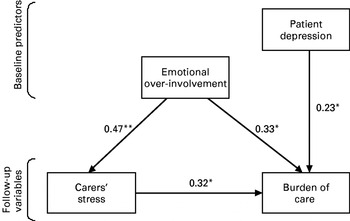
Finally, given that the results from the multivariate analysis suggested that EOI may precipitate family stress and burden of care, which would also be predicted by patients' depressive symptoms, we applied SEM to test the model mathematically. The hypothesized model is presented in Fig. 1. Baseline EOI, conceived as a particular form of anxious attachment, was predicted to play a casual role in the development of family stress and burden of care. In addition, patient depressive symptoms at baseline and carers' stress would predict burden of care at follow-up.
Hypothesized model of the relationship between carers' emotional over-involvement (EOI), patients' symptoms and burden of care (* p<0.05, ** p<0.01).

The hypothesized model provided an excellent fit for the data as suggested by a non-significant χ2 (χ2=2.47, df=2, n=48, p<0.29) and the CFI and RMSEA indices (0.98 and 0.05 respectively) (Fig. 1).
Discussion
The present study sought to clarify the differential associations of the two major components of EE, namely CC and EOI, with potential predictors in relatives of clinically remitted FEP patients. It was postulated that CC and EOI represent distinct constructs as shown by differential associations with patient and family variables. We hypothesized that carers' EOI, conceived as a form of anxious attachment, would predict carers' stress and burden of care, whereas carers' CC, conceived as a coping strategy, would be predicted by carers' stress, burden of care and treatment delay. Consistent with the predictions, CC and EOI yielded differential associations with family and patients' attributes at baseline. Although EOI was more strongly correlated with family stress, CC showed a stronger association with DUP. Multivariate and SEM analysis provided support to the former assumption as baseline EOI predicted family stress and burden of care at follow-up. Conversely, the latter hypothesis was partially supported; although DUP was associated with CC at baseline, the multivariate analysis showed that CC at follow-up was not directly related to either baseline family stress or burden of care. Finally, findings from the present study showed that patients' symptoms and functioning were uncorrelated with both CC and EOI which indicates that functioning and symptom-related variables may have a limited impact upon carers' EE.
EOI, anxious attachment and family grief
Results from SEM and multivariate follow-up analysis suggested a direct relationship between EOI, carers' stress and family burden. This association is consistent with predictions and previous cross-sectional findings (van Os et al. Reference van Os, Marcelis, Germeys, Graven and Delespaul2001; Patterson et al. Reference Patterson, Birchwood and Cochrane2005; Kuipers et al. Reference Kuipers, Bebbington, Dunn, Fowler, Freeman, Watson, Hardy and Garety2006). Taken together, these data lend support to the notion that EOI may be a type of anxious attachment/caregiving (Wynne, Reference Wynne1981). According to previous research, an anxious attachment style is likely to induce stress (West et al. Reference West, Rose, Verhoef, Spreng and Bobey1998; Bottonari et al. Reference Bottonari, Roberts, Kelly, Kashdan and Ciesla2007) and may be an important correlate of adult psychopathology (West et al. Reference West, Rose and Sheldon1993). The distress experienced by relatives may exacerbate the burden of care.
The question remains as to the cause of an anxious attachment style in carers of FEP. According to Bowlby's work on representational models, the feared loss of the security achieved through the relationship with the relative is essential in the development of anxious attachment (Bowlby, Reference Bowlby1980). In situations of severe distress, such as illness or interpersonal loss, this attachment pattern is either generated or intensified (Bowlby, Reference Bowlby1988). Bowlby also proposed that anxious attachment styles could stimulate the development of cognitive biases that may affect the interpretation of interpersonal experiences such as loss (Bowlby, Reference Bowlby1988; Patterson et al. Reference Patterson, Birchwood and Cochrane2005). It can be postulated that, when families are informed about their relative's diagnosis, they may experience a grief process leading to ‘controlling’ attitudes and behaviours in an attempt to mitigate the loss (Patterson et al. Reference Patterson, Birchwood and Cochrane2005). This psychological process would be closely linked to the burden and stress experienced by relatives of FEP patients. Nonetheless, whether this pattern of relationships is phase specific (i.e. reactive to the new family situation) or reflective of enduring personality traits/attachment styles (that may be intensified by the illness) remains to be elucidated.
CC, attributional beliefs and DUP
Contrary to our predictions, findings from SEM and multivariate analysis suggested that carers' CC was not primarily related to either carer stress or burden of care. These results are consistent with some recent findings (Patterson et al. Reference Patterson, Birchwood and Cochrane2005; Kuipers et al. Reference Kuipers, Bebbington, Dunn, Fowler, Freeman, Watson, Hardy and Garety2006), but in contrast to other studies that have reported cross-sectional associations between EE as a whole and family burden (Scazufca & Kuipers, Reference Scazufca and Kuipers1996; Raune et al. Reference Raune, Kuipers and Bebbington2004). Conversely, carers' CC at baseline was positively associated with longer DUP, although this association did not remain significant at the 7-month follow-up. This latter finding replicates those of Macmillan et al. (Reference Macmillan, Crow, Johnson and Johnstone1987) and Patterson et al. (Reference Patterson, Birchwood and Cochrane2005), who found a positive relationship between DUP and baseline CC.
When taken together, these findings suggest that carers' CC may not be a function of the stress and burden of the caring role. Alternatively, carers' CC may be linked to attributional beliefs about the deterioration manifested by the young person developing a psychotic disorder. In the absence of adequate treatment and information about the disorder, carers are likely to attribute psychotic symptoms to the patient. As a result, relatives who hold the young person responsible for his or her behaviour may react with criticism in an attempt to reduce the manifestations of the disorder (Hooley, Reference Hooley1998; Weisman et al. Reference Weisman, Nuechterlein, Goldstein and Snyder1998; Hooley & Campbell, Reference Hooley and Campbell2002). After treatment is initiated and information is provided to carers, some may adjust their causal attributions and view these behaviours as a result of the illness. This would explain the reason why longer DUP was not associated with carers' criticism at follow-up. On the other hand, it is also plausible that carers' criticism would be less intense at follow-up as a result of intervention commencement which may explain these findings. Nevertheless, the relationship between CC and DUP over the course of the illness needs to be further investigated.
Clinical implications
The present findings have important clinical implications. First, results from this study suggest that EOI and CC may be distinct constructs and therefore warrant distinct therapeutical approaches early in the course of psychosis. Although the grieving process and feelings of loss experienced by some relatives may be central in the therapeutic management of EOI, the causal attributions concerning the emerging psychotic symptoms may be the focus of an intervention aimed at reducing CC. Alternatively, as noted above, treatment commencement – both family and individual –may be sufficient to reduce carers' criticism over time in some families. Failure to deliver flexible interventions adapted to the current status of both EOI and CC may result in adverse clinical outcomes. For example, structured EE interventions aimed at changing communications patterns could interfere with the grieving process or the adaptation to the disorder in some families, which may increase their distress (Linszen et al. Reference Linszen, Dingemans, Van der Does, Nugter, Scholte, Lenior and Goldstein1996). In the latter case, interventions should assist relatives to progressively accept the new family situation with the purpose of preventing the development of anxious attachment patterns. However, delay in providing adequate treatment for FEP patients may induce beliefs in families that the young person is responsible for his or her behaviour, which would generate, in turn, relatives' criticism (Weisman et al. Reference Weisman, Nuechterlein, Goldstein and Snyder1998; Hooley & Campbell, Reference Hooley and Campbell2002). As a result, prompt delivery of effective treatments for FEP patients may assist families in the early adaptation to the illness, which may contribute to prevent the development of CC.
Limitations
This study has some limitations. First, the number of statistical techniques used to test the study hypotheses was high, and therefore the results should be interpreted with some caution. Nonetheless, all statistical analyses were hypothesis driven and follow-up regression analyses were consistent with those of SEM techniques. Second, it could be argued that the study did not have enough power to perform SEM. However, the model tested was of theoretical relevance and was hypothesis based. A combination of procedures including several goodness-of-fit indexes was used to assess the models' performance, and SEM results were further confirmed using multivariate follow-up data. Furthermore, previous studies have shown that SEM techniques can be reliably used in relatively small samples when the models are of theoretical significance (Lenior et al. Reference Lenior, Dingemans, Schene and Linszen2005; Sergi et al. Reference Sergi, Rassovsky, Nuechterlein and Green2006). Finally, this study used a self-report measure, the FQ, to assess carers' EE. Although this questionnaire has shown excellent psychometric properties in relation to interview procedures (Wiedemann et al. Reference Wiedemann, Rayki, Feinstein and Hahlweg2002), this limitation must be noted.
Conclusions
This study provides preliminary support to the postulate that EOI and CC may be distinct constructs and warrant future research and therapeutic interventions as separate variables. Further studies should investigate the different psychological processes linked to the development of both components of EE to refine the targeting of early family interventions. In the meantime, effective interventions for FEP should be provided promptly and family interventions should target EOI and CC separately.
Acknowledgements
The EPISODE II trial was funded by an independent research grant from Eli Lilly through the Lilly Melbourne Academic Psychiatric Consortium. The present study was further funded by a grant from the Marqués de Valdecilla Public Foundation – Marqués de Valdecilla Research Institute (FMV-IFIMAV), Santander, Spain. We thank J. Buckby, S. Gook and S. Bendall of ORYGEN Research Centre, University of Melbourne, and Dr C. Gonzalez-Blanch of The University Hospital ‘Marques de Valdecilla’, Santander, Spain, for helpful comments on an earlier draft of this paper.
Declaration of Interest
None.