INTRODUCTION
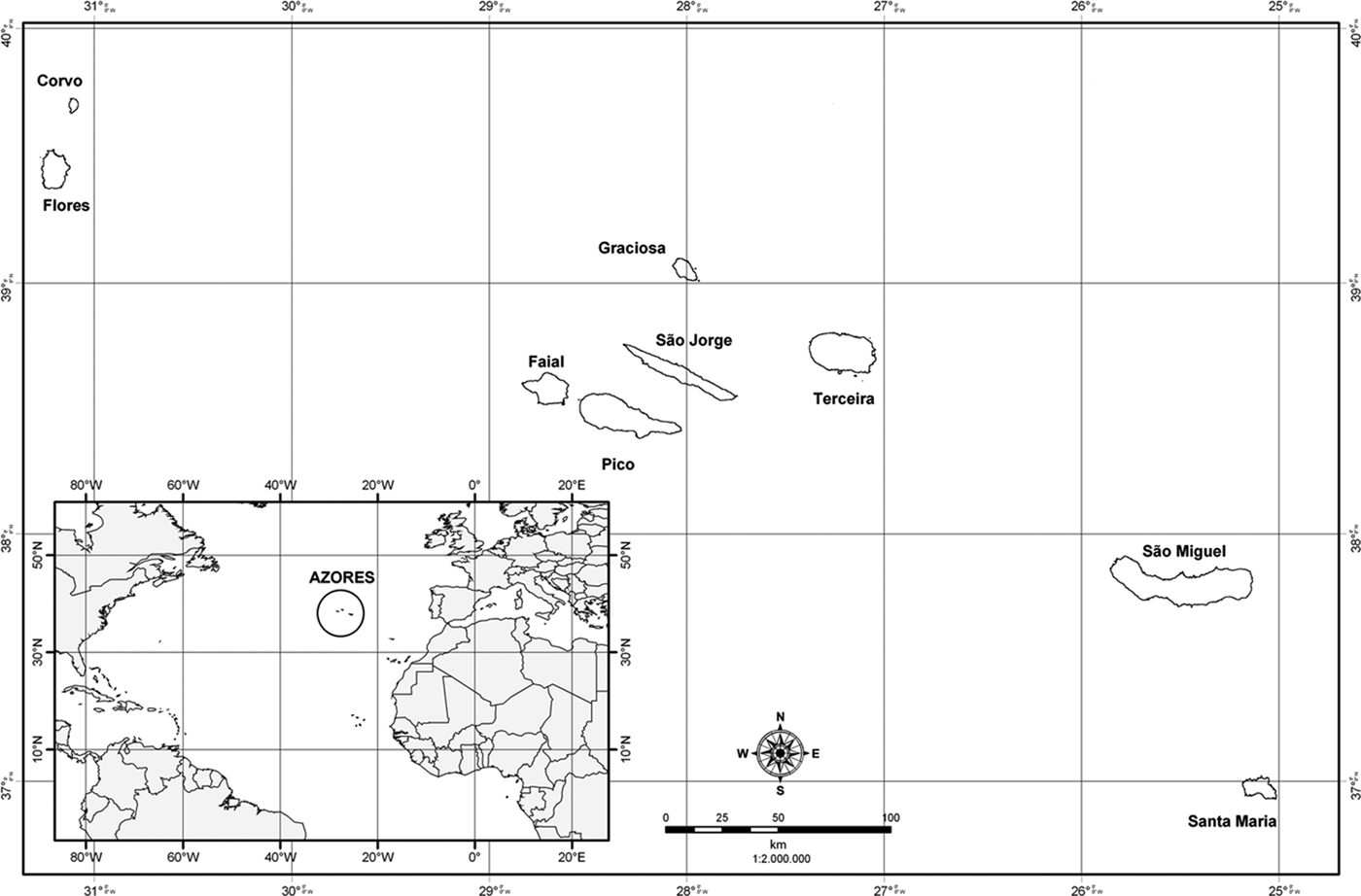
The marine molluscs of the Archipelago of the Azores (located in the north-east Atlantic Ocean; Figure 1) have been studied intensively over the past 20 years (see Ávila, Reference Ávila2000, Reference Ávila2005 and references therein). Furthermore, in recent years, a special attention has been given to the diversity of opisthobranchs, which resulted in 144 species recorded for the archipelago (see Cervera et al., Reference Cervera, Calado, Gavaia, Malaquias, Templado, Ballesteros, García-Gómez and Megina2004 and references therein; Chan & Gosliner, Reference Chan and Gosliner2007; Malaquias et al., Reference Malaquias, Calado, Padula, Villani and Cervera2009, Reference Malaquias, Calado, Cruz and Jensen2011; Carmona et al., Reference Carmona, Malaquias, Gosliner, Pola and Cervera2011; Pedro et al., Reference Pedro, Malaquias, Costa and Ávila2011).
Archipelago of the Azores.

The present work for the first time documents the ocurrence of the opisthobranch gastropods Diaphana globosa (Lovén, 1846), Hermaeopsis variopicta A. Costa, 1869, Doris bertheloti (d'Orbigny, 1839), Rostanga rubra (Risso, 1818), Janolus cristatus (delle Chiaje, 1841) and Flabellina bulbosa Ortea & Espinosa, Reference Ortea and Espinosa1998 in the Azores.
MATERIALS AND METHODS
Diaphana globosa and Doris bertheloti were collected in July 2006 during the 3rd International Workshop of Malacology and Marine Biology, held on São Miguel Island, in which the sublittoral benthos in the area off Vila Franca do Campo was intensively sampled by dredging and SCUBA diving. The samples collected were sorted and the specimens found were measured, photographed, fixed in ethanol for later identification, and deposited in the DBUA collection (Department of Biology of the University of the Azores).
In 2010, between March and April, a ludic-scientific SCUBA diving survey in the Azores, focused exclusively on opisthobranchs, found several specimens of Hermaeopsis variopicta and Rostanga rubra. Diving took place on various sites on Faial, Flores and Corvo Islands, where different habitats were inspected. None of the opisthobranchs found were collected, only photographed, but the date, location, depth and habitat of each specimen found were registered.
Images of the species Janolus cristatus and Flabellina bulbosa were found in Facebook. They were taken by experienced and well-known divers operating or linked to SCUBA diving clubs in the Archipelago of the Azores. The authors of the images were contacted in order to confirm the origin of the images and to obtain additional information such as the date, location and depth where the specimens have been found. The original sources of the data are considered highly reliable by the authors of this work and show a putative new and interesting role for web-based social networks in the buildup and dissemination of scientific knowledge.
RESULTS
We here report for the first time the presence of the opisthobranch species Diaphana globosa, Hermaeopsis variopicta, Doris bertheloti, Rostanga rubra, Janolus cristatus and Flabellina bulbosa in the Azores.
SYSTEMATICS
MOLLUSCA Linnaeus, 1758
GASTROPODA Cuvier, 1795
CEPHALASPIDEA P. Fischer, 1883
DIAPHANIDAE Odhner, 1914
Diaphana globosa (Lovén, 1846)
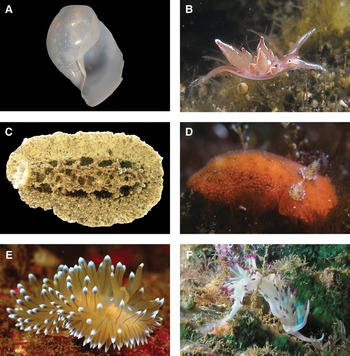
(Figure 2A)
(A) Diaphana globosa (Vila Franca do Campo, São Miguel Island); (B) Hermaeopsis variopicta (Piscinas Naturais de Santa Cruz, Flores Island); (C) Doris bertheloti (Vila Franca do Campo Islet, São Miguel Island); (D) Rostanga rubra (Baía de Entre-Montes, Faial Island); (E) Janolus cristatus (Baixa das Castanhetas, São Miguel Island; © Carlos Morais); (F) Flabellina bulbosa (Baixa do Enxudreiro, Graciosa Island; © Rolando Oliveira).

MATERIAL EXAMINED
One specimen (maximum shell length = 4 mm; DBUA 1062), collected in July 2006 from sediments dredged between 167 and 189 m off Vila Franca do Campo (37°41′34.00″N 25°27′34.00″W, south coast of São Miguel Island).
REMARKS
The shell length can reach a maximum of approximately 4 mm; it is umbilicated, thin, transparent, globose and smooth, with a wide aperture without parietal callus. The protoconch is mammillate with a brownish colour and does not protrude beyond the last whorl. Martins et al. (Reference Martins, Borges, Ávila, Costa, Madeira and Morton2009) cited the occurrence of Colpodaspis pusilla M. Sars, 1870 in the Azores based on the same specimen, yet the reassessment of this material showed it to be Diaphana globosa.
DISTRIBUTION
Found along the Northern European coasts from Scandinavia to mainland Portugal (Hansson, Reference Hansson1998; Cervera et al., Reference Cervera, Calado, Gavaia, Malaquias, Templado, Ballesteros, García-Gómez and Megina2004; Sneli et al., Reference Sneli, Schiøtte, Jensen, Wikander, Stokland and Sørensen2005) and Azores Islands (present study).
SACOGLOSSA Ihering, 1876
HERMAEIDAE H. Adams & A. Adams, 1854
Hermaeopsis variopicta A. Costa, 1869
(Figure 2B)
MATERIAL EXAMINED
Twenty-eight photographs from four specimens, taken in April 2010 in a large intertidal pool at Piscinas Naturais de Santa Cruz (39°27′30.72″N 31°7′32.82″W, east coast of Flores Island); specimens found at 1.5–2 m depth on algae.
REMARKS
Small animals with less than 5 mm in length, characterized by the pale violet colour of the body and cerata, with an orange horseshoe crab mark behind the eyes which are inserted in conspicuous unpigmented areas.
DISTRIBUTION
Known from the south coasts of the British Isles, southwards to the Mediterranean Sea, including the Canary Islands (Heppell et al., Reference Heppell, Smith, Picton, Howson and Picton1997; Cervera et al., Reference Cervera, Calado, Gavaia, Malaquias, Templado, Ballesteros, García-Gómez and Megina2004; Cossignani & Ardovani, Reference Cossignani and Ardovani2011) and the Azores Islands (present study).
NUDIBRANCHIA Cuvier, 1817
DORIDIDAE Rafinesque, 1815
Doris bertheloti (d'Orbigny, 1839)
(Figure 2C)
MATERIAL EXAMINED
One specimen (maximum animal length = 20 mm; DBUA 1063), collected in July 2006 at the Vila Franca do Campo Islet (37°42′13.76″N 25°26′34.23″W, south coast of São Miguel Island); specimen found at 5 m depth, on algae.
REMARKS
This species can be distinguished by its brown-greenish mantle covered with tubercles of different sizes and presence of two conspicuous dark lines extending dorsally from the rinophores to the gills.
DISTRIBUTION
Present in the Mediterranean Sea, Canaries and Madeira archipelagoes (Cervera et al., Reference Cervera, Calado, Gavaia, Malaquias, Templado, Ballesteros, García-Gómez and Megina2004; Cossignani & Ardovani, Reference Cossignani and Ardovani2011), and Azores Islands (present study).
DISCODORIDIDAE Bergh, 1891
Rostanga rubra (Risso, 1818)
(Figure 2D)
MATERIAL EXAMINED
Eleven photographs from two specimens, taken in March 2010 at Baía de Entre-Montes (38°31′21.67″N 28°37′19.62″W, south-eastern tip of Faial Island) and at Praia da Fajã Grande (39°27′35.85″N 31°15′42.54″W, west coast of Flores Island); specimens found at 9 and 4 m depth, respectively, on algae.
REMARKS
This is the only species of the genus Rostanga present in the north-east Atlantic waters. It has a distinct colour pattern of orange with little brownish blotches spread over the mantle, and usually a white line between the rinophores. The mantle is coated with well-developed cariophylidae tubercles.
DISTRIBUTION
Present on the Northern European coasts, British Isles, Iberian Peninsula, Mediterranean Sea, Madeira Islands, Canary Islands (Heppell et al., Reference Heppell, Smith, Picton, Howson and Picton1997; Hansson, Reference Hansson1998; Cervera et al., Reference Cervera, Calado, Gavaia, Malaquias, Templado, Ballesteros, García-Gómez and Megina2004; Cossignani & Ardovani, Reference Cossignani and Ardovani2011) and the Azores Islands (present study).
PROCTONOTIDAE Gray, 1853
Janolus cristatus (delle Chiaje, 1841)
(Figure 2E)
MATERIAL EXAMINED
One photograph taken in April 2008 at Baixa das Castanhetas (37°42′17.70″N 25°30′12.39″W, south coast of São Miguel Island); specimen found at 16–18 m depth on algae.
REMARKS
Janolus cristatus is an unmistakable species of the north-east Atlantic fauna of opisthobranchs. Its numerous and large translucent cerata showing a diverticulum of the digestive gland with whitish apical ends and a subapical ring made of turquoise blue dots are diagnostic features of this species.
DISTRIBUTION
Found along the Northern European coasts, British Isles, Iberian Peninsula, Mediterranean Sea, Madeira Islands, Canary Islands (Heppell et al., Reference Heppell, Smith, Picton, Howson and Picton1997; Hansson, Reference Hansson1998; Cervera et al., Reference Cervera, Calado, Gavaia, Malaquias, Templado, Ballesteros, García-Gómez and Megina2004; Cossignani & Ardovani, Reference Cossignani and Ardovani2011) and the Azores Islands (present study).
FLABELLINIDAE Bergh, 1889
Flabellina bulbosa Ortea & Espinosa, Reference Ortea and Espinosa1998
(Figure 2F)
MATERIAL EXAMINED
One photograph taken in September 2011 at Baixa do Enxudreiro (39°0′ 37.11″N 27°59′ 46.43″W, south coast of Graciosa Island); specimen found at 8–10 m depth on algae.
REMARKS
In the Atlantic Ocean, Flabellina bulbosa is unique in its colour pattern with a white body, white cerata with purple apical endings, and white oral tentacles with bulbous proximal regions.
DISTRIBUTION
Previously was only known from the islands of Cape Verde (Ortea & Espinosa, Reference Ortea and Espinosa1998; Rolán, Reference Rolán2005). Azores Islands (present study).
DISCUSSION
The occurrence of Diaphana globosa, Hermaeopsis variopicta, Doris bertheloti, Rostanga rubra and Janolus cristatus in the Azores is not surprising since these species are known from the Northern European coasts southwards, including other Macaronesian archipelagoes. On the other hand, the occurrence of Flabellina bulbosa represents a discontinuity in the known geographical distribution for the species, which has been considered until now endemic to the Cape Verde Islands. Rolán (Reference Rolán2005) questioned the validity of this species, because it was described based on a single, likely juvenile specimen (see Ortea & Espinosa, Reference Ortea and Espinosa1998). However, the colour pattern of this species is unique among Atlantic species of Flabellina, and since its original description several adult specimens corresponding to the description of Ortea & Espinosa (Reference Ortea and Espinosa1998) have been found and documented (e.g. Breton, Reference Breton2003; Hoesel, Reference Hoesel2003; Martins, Reference Martins2011). The geographical discontinuity found in this species has two possible explanations: either it corresponds to a natural distribution and the species has not yet been found in the Canary and Madeira Islands, located between Cape Verde and the Azores, or alternatively, we are in the presence of an anthropogenic introduction likely by shipping. Due to its strategic location in the North Atlantic, the leisure and commercial maritime traffic has increased during the past decades in the Azores Islands, which have boosted the susceptibility to the introduction of marine alien species (Cardigos et al., Reference Cardigos, Tempera, Ávila, Gonçalves, Colaço and Santos2006; Amat et al., Reference Amat, Cardigos and Santos2008; Amat & Tempera, Reference Amat and Tempera2009; Torres et al., Reference Torres, Costa and Dionísio2011).
The most recent inventory of the opisthobranch fauna of the Azores (Cervera et al., Reference Cervera, Calado, Gavaia, Malaquias, Templado, Ballesteros, García-Gómez and Megina2004) included 133 species. Since then, several works have increased the number of opisthobranchs known in the archipelago: Chan & Gosliner (Reference Chan and Gosliner2007), one record; Malaquias et al. (Reference Malaquias, Calado, Padula, Villani and Cervera2009), eight records; Pedro et al. (Reference Pedro, Malaquias, Costa and Ávila2011), one record; and Malaquias et al. (Reference Malaquias, Calado, Cruz and Jensen2011), one record. With the present work (six new records) the total number of opisthobranch species known in the Azores is raised to 150 (111 shallow-water species—of which 10 are pelagic species—and 39 species living below 50 m depth), which represents an increase of 11.3% since the Cervera et al. (Reference Cervera, Calado, Gavaia, Malaquias, Templado, Ballesteros, García-Gómez and Megina2004) revision.
We analysed the geographical distribution of the 101 shallow-water benthic opisthobranchs reported from the Azores (considering the occurrence of Thuridilla hopei (Vérany, 1853) instead of T. picta (A.E. Verrill, 1901); Carmona et al., Reference Carmona, Malaquias, Gosliner, Pola and Cervera2011) and concluded that 72.3% are eastern Atlantic related, 14.9% are amphi-Atlantic, 6.9% have a worldwide distribution, 4% are western Atlantic related and 2% are endemic to the Azores. These results are consistent with the general biogeographical pattern that has been described for the marine organisms present in the Azores. Despite the archipelago being under the influence of the southern branch of the Gulf Stream, several works on different taxonomic groups, including the recent and Pleistocene littoral molluscs, have shown that the Azorean marine biota is predominantly related to the shores of the eastern Atlantic and Mediterranean Sea (see Ávila, Reference Ávila2000, Reference Ávila2005 and references therein; Ávila et al., Reference Ávila, Amen, Azevedo, Cachão and García-Talavera2002, 2009, Reference Ávila, Rebelo, Medeiros, Melo, Gomes, Bagaço, Madeira, Borges, Monteiro, Cordeiro, Meireles and Ramalho2010). Therefore, there is no correspondence between the present-day sea surface currents in the North Atlantic and the biogeographical affinities of the Azores. Despite several hypotheses about the processes and routes of colonization of the marine biota of the Azores (Ávila et al., Reference Ávila, Silva, Schiebel, Cecca, Backeljau and Martins2009), there is still no full understanding about this biogeographical paradox.
Notwithstanding the efforts that have been made in recent years, new records of opisthobranchs for the Azores continue to be found which demonstrates the need for further biodiversity surveys. We consider that future fieldwork campaigns should concentrate on islands poorly studied and geographically closer to the colonization sources (i.e. Santa Maria, Flores and Corvo Islands), in order to enhance the potential discovery of new records.
ACKNOWLEDGEMENTS
The authors are indebted to Carlos Morais and Rolando Oliveira for providing the photographs and related information. The authors are grateful to Juan L. Cervera for providing useful references and help with the taxonomic identification. We are also thankful to António Monteiro for providing the image included in Figure 1. Thanks are due to two anonymous referees for their valuable comments. R. Cordeiro holds a PhD grant from the Fundação para a Ciência e a Tecnologia (FCT, Portugal, SFRH/BD/60366/2009). S.P. Ávila acknowledges his Ciência 2009 research contract funded by FCT.