INTRODUCTION
Pathological cognitive ageing is an increasing problem worldwide, with 850,000 cases of Alzheimer’s disease (AD) at present in the United Kingdom alone. With prevalence expected to double within the next 20 years (Alzheimer’s Society, 2016), understanding the risk factors associated with dementia is crucial. The apolipoprotein E (APOE) epsilon 4 (ε4) allele is the leading genetic risk factor for late-onset Alzheimer’s disease (Corder et al., Reference Corder, Saunders, Strittmatter, Schmechel, Gaskell, Small and Pericak-Vance1993; Farrer et al., Reference Farrer, Cupples, Haines, Hyman, Kukull, Mayeux and van Duijn1997). This variant of the APOE gene constitutes one of the three APOE alleles (ε2, ε3, and ε4), present in approximately 25% of the population (Mahley, Reference Mahley1988).
Systematic reviews of studies including healthy older adults support an association between possession of an ε4 allele and cognitive impairment in ageing more generally (Small, Rosnick, Fratiglioni, & Bäckman, Reference Small, Rosnick, Fratiglioni and Bäckman2004; Wisdom, Callahan, & Hawkins, Reference Wisdom, Callahan and Hawkins2011), although not all studies are consistent in reporting this effect (Bunce et al., Reference Bunce, Bielak, Anstey, Cherbuin, Batterham and Easteal2014; Bunce, Kivipelto, & Wahlin, Reference Bunce, Kivipelto and Wahlin2004; Caselli et al., Reference Caselli, Chen, Locke, Lee, Roontiva, Bandy and Reiman2014). The association between ε4 and healthy cognitive ageing suggests the effects of this variant are not solely linked to neuropathology, and so a dimensional approach is needed to consider the overlap between healthy and pathological ageing (Walhovd, Fjell, & Espeseth, Reference Walhovd, Fjell and Espeseth2014). Potentially accounting for inconsistency within the older-adult literature, meta-analyses of study effect sizes suggest APOE-related differences are small and limited to certain classes of cognitive task, including global cognition, episodic memory, perceptual speed, and executive function (EF) (Small et al., Reference Small, Rosnick, Fratiglioni and Bäckman2004; Wisdom et al., Reference Wisdom, Callahan and Hawkins2011). Age and gene-dose are also implicated as important moderators of ε4 effects (Small et al., Reference Small, Rosnick, Fratiglioni and Bäckman2004). These factors are important for how we approach understanding APOE genotype differences.
Curiously, the detrimental effects of APOE ε4 are not consistent across the lifespan, muddying attempts to explain the causality of this risk factor for decline. In naturalistic research, ε4 carriers (henceforth ε4+) were reported to have higher IQ and greater educational achievement than ε4 non-carriers (henceforth ε4−) (Hubacek et al., Reference Hubacek, Pitha, Škodová, Adámková, Lánská and Poledne2001; Yu, Lin, Chen, Hong, & Tsai, Reference Yu, Lin, Chen, Hong and Tsai2000). This led to the hypothesis that ε4+ may show cognitive advantages earlier in life, with performance advantages similarly being demonstrated in some (Alexander et al., Reference Alexander, Williams, Gatt, Dobson-Stone, Kuan, Todd and Gordon2007; Han et al., Reference Han, Drake, Cessante, Jak, Houston, Delis and Bondi2007; Schultz et al., Reference Schultz, Lyons, Franz, Grant, Boake, Jacobson and Kremen2008), although not all (Bunce et al., Reference Bunce, Bielak, Anstey, Cherbuin, Batterham and Easteal2014; Bunce, Anstey, Burns, Christensen, & Easteal, Reference Bunce, Anstey, Burns, Christensen and Easteal2011; Jorm et al., Reference Jorm, Mather, Butterworth, Anstey, Christensen and Easteal2007) studies assessing genotype differences with neuropsychological batteries. Importantly, no steps have been taken to explore the potential moderating effects of early-life IQ and education on the trajectory of cognitive ageing in ε4+ through longitudinal research.
A meta-analytic review found no conclusive support for an ε4+ advantage in younger years (Ihle, Bunce, & Kliegel, Reference Ihle, Bunce and Kliegel2012); however, the authors acknowledge conclusions may stem from the predominant inclusion of studies using quick to administer behavioral assessments. Such assessments are typically used for detecting clinically relevant cognitive differences rather than the subtle changes expected in young healthy adults. When considering evidence from research paradigms designed to sensitively index select cognitive processes, ε4+ advantages have been reported. Young ε4+ showed behavioral advantages compared to ε4− on a delayed episodic memory measure (Mondadori et al., Reference Mondadori, de Quervain, Buchmann, Mustovic, Wollmer, Schmidt and Henke2007). Furthermore, Marchant, King, Tabet, and Rusted (Reference Marchant, King, Tabet and Rusted2010) demonstrated an ε4+ advantage in 18- to 30-year-olds across several domains including prospective memory, decision-making and sustained attention. Advantages in sustained attention were replicated in a further study (Rusted et al., Reference Rusted, Evans, King, Dowell, Tabet and Tofts2013), which also reported ε4+ advantages in covert attention (Rusted et al., Reference Rusted, Evans, King, Dowell, Tabet and Tofts2013). In addition, ε4+ show EF advantages up until age 50 (Taylor et al., Reference Taylor, Boyd, Turner, McQuoid, Ashley-Koch, MacFall and Potter2016). While carrying an ε4 allele might promote cognitive advantages in youth, it is important to understand how early differences cumulatively impact on the ageing trajectory of ε4+.
This review attempts to unravel the development of APOE ε4 cognitive effects by considering studies recruiting healthy mid-age volunteers. Mid-adulthood, as well as being influenced by the cumulative impact of APOE ε4 in younger years, may represent a stage when the detrimental effects of carrying this gene are first appearing. Additionally, mid-adulthood represents a period of emergence for further risk factors for dementia (e.g., declining vascular health), which may modulate the trajectory of cognitive ageing. By studying the impact of risk factors for cognitive decline during mid-adulthood, there is the potential to facilitate the early identification and prevention of cognitive decline. In combination, these motivations emphasize the theoretical interest of studying the effects of APOE ε4 at mid-age.
Here, we present a systematic review of research investigating APOE differences in mid-adulthood, including studies administering neuropsychological assessment measures, process-specific paradigms, and those assessing change in cognition over time. In addition, ε4+ differences in individual cognitive domains are subject to a meta-analytic review.
METHODS
Selection of Studies
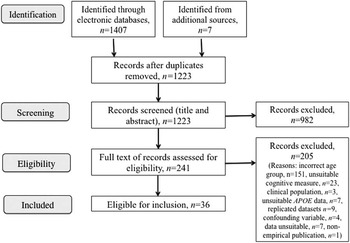
This review was conducted in accordance with the Helsinki declaration. A literature search of three databases (PsychInfo, Web of Science, and Scopus) was conducted, using search terms including “APOE”, “Apolipoprotein”, “cognitive”, “cognition”, and “performance”.Footnote 1 The search was limited to articles published post-1993 as this was when the link between APOE and detrimental cognitive ageing was first identified (Corder et al., Reference Corder, Saunders, Strittmatter, Schmechel, Gaskell, Small and Pericak-Vance1993). Articles referenced by included papers were also considered if they aligned with the search criteria of this review. The last update for the search was conducted in July 2016. An overview of the search procedure is given in Figure 1.
Flow chart of study selection process for this review of APOE effects in mid-adulthood.

Eligibility Criteria
Studies were included in the review if they met the following criteria: (1) The study included volunteers grouped by APOE genotype, enabling the comparison of ε4+ to an ε4− group. (2) The mean age of volunteers in the study falls between 35 and 60 years. If no mean was available, the entire age range included must fall within 35–60 years. (3) The study included cognitively healthy adult volunteers. Studies including clinical groups, for example diagnosed with dementia, neural trauma or a psychiatric condition were excluded. (4) At least one objective measure of cognition must be included. (5) The study was published in English. In some cases, studies overlapped in reporting cognitive performance of the same sample, and so some papers were omitted from the review (e.g., Caselli, Chen, Lee, Alexander, & Reiman, Reference Caselli, Chen, Lee, Alexander and Reiman2008; Zuelsdorff et al., Reference Zuelsdorff, Engelman, Friedman, Koscik, Jonaitis, La Rue and Sager2013).
Papers were included in the meta-analytic review if sufficient statistical data were provided for calculating the standardized effect size of carrying an ε4 allele on cognitive performance [mean, standard deviation (SD)] compared to an ε4− group. Study outcomes were included if task performance could be summarized by a measure of accuracy. Authors were contacted where insufficient data were provided.
Organization of Studies
Thirty-six studies met criteria for being included in this review, 23 of which were included in the meta-analysis. Separate meta-analyses were completed for performance in seven cognitive domains (global cognition, memory, executive abilities, verbal fluency, language, visuospatial processing, and processing speed). For the narrative review, studies were considered more broadly as those using neuropsychological assessment measures, those that administered more detailed research paradigms and longitudinal assessments.
Statistical Analysis
For the outcome of each task included in the meta-analytic review, Hedge’s g was calculated as the difference in mean performance between ε4+ and ε4−, divided by the pooled sd. The unbiased estimate (Hedge’s d) was used in the analysis, with a positive effect size indicating stronger performance by the ε4+ group. In studies reporting multiple performance outcomes per cognitive domain, effect sizes were averaged across tasks (Borenstein, Hedges, Higgins, & Rothstein, Reference Borenstein, Hedges, Higgins and Rothstein2009; DeCoster, Reference DeCoster2009) to prevent the overall effect size for any cognitive domain being over-biased by one sample. Multiple effect sizes were included when studies included more than one sample of ε4+ and ε4− grouped by another variable such as ethnicity or age (e.g., Blair et al., Reference Blair, Folsom, Knopman, Bray, Mosley and Boerwinkle2005; Shin et al., Reference Shin, Kweon, Choi, Lee, Nam, Park and Jeong2014). For each domain, a random-effects meta-analysis was completed. Tests of homogeneity were completed for each domain (Q T, and I 2 ) to check the validity of the model. A significant Q statistic indicates a non-homogenous distribution of effect sizes. The I 2 was used to further validate this statistic, as it is not dependent on the number of studies included. Where heterogeneity was detected, data were screened for outliers based on the standardized weight of residuals and the difference excluding a study made to heterogeneity.
RESULTS
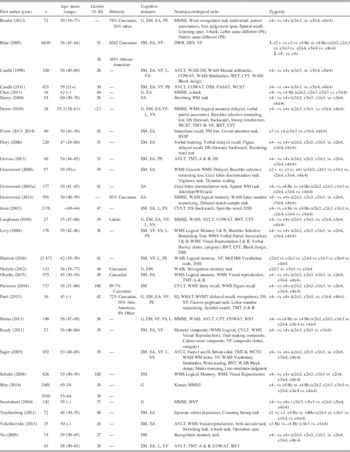
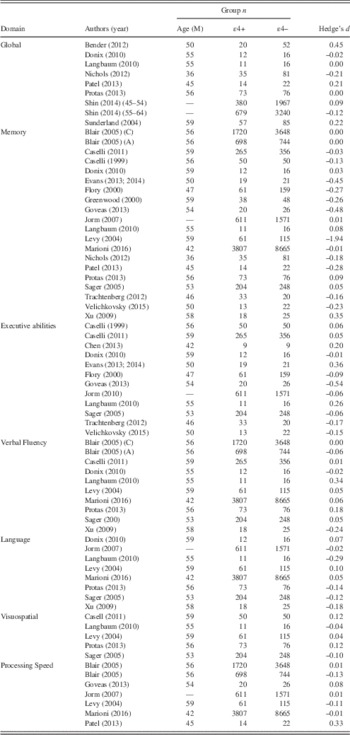
Table 1 presents a summary of cross-sectional studies included in this review, including details of the sample demographics and cognitive tasks administered. A further summary of the studies included in each meta-analysis and the associated effect sizes are shown in Table 2.
Overview of cross-sectional studies investigating APOE genotype differences in mid-adulthood

Domains: G=global; M=memory; EA=executive abilities; VF=verbal fluency; L=language; VS=visuospatial processing; PS=processing speed. Tasks: MMSE=Mini-mental State Examination; WRAT=Wide Range Achievement Test; DWR=Delayed Word Recall; BVMT=Brief Visuospatial Memory Test; AVLT=Rey’s Auditory Verbal Learning Task; CVLT=Californian Verbal Learning Test; DS=Digit span; PASAT=Paced Auditory Serial Attention Task; PM=Prospective memory; RVIP=Rapid Visual Information Processing task; TMT=Trails-Making Test; WCST=Wisconsin Card Sort task; CFT=Complex figure test; COWAT=Controlled oral association task; BNT=Boston Naming Task; DSS=Digit-symbol Substitution. Zygosity: He=heterozygous; Ho=homozygous.
Average effect size per study organised by cognitive domain, where a positive effect size represents better performance by the ε4+ group

C=Caucasians; A=African-Americans.
Meta-analyses
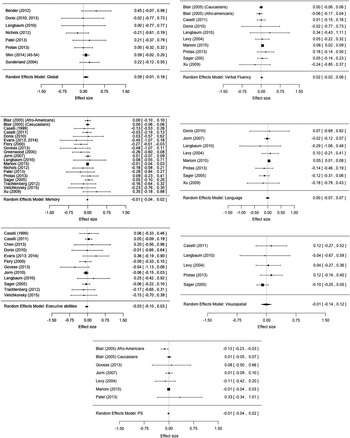
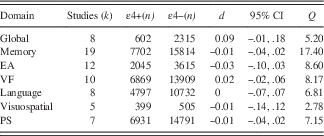
A summary of the results from each meta-analytic model is provided in Table 3. Forest plots demonstrating the distribution of effect sizes per domain are shown in Figure 2.
Forest plots of weighted effect sizes by cognitive domain. For each study, effect size is reported as Hedge’s d (95% confidence interval), where a positive effect size represents greater performance by the ε4+ group. PS=Processing Speed.

Summary of findings for the meta-analysis within each cognitive domain.

Global
A meta-analysis of effect sizes from nine studies assessing global cognition found carrying an ε4 allele had a non-significant effect on performance, d=.03, p>.05. Tests for homogeneity indicated moderate heterogeneity in the individual studies’ effect sizes, Q(8)=15.88, p=.044, I 2=48.36%. Data were screened for outliers, with a sample aged 55–64 years (Shin et al., Reference Shin, Kweon, Choi, Lee, Nam, Park and Jeong2014) identified as substantially increasing heterogeneity. With this effect size removed, carrying an ε4 allele had a positive effect on global cognitive performance in mid-adulthood, with the effect size approaching significance, d=.09, p=.066 (Q(7)=5.20; p>.05; I 2 = 0%).
Memory
Effect sizes from 20 studies were included in a meta-analysis of APOE ε4 effects on memory; ε4+ status had a non-significant effect on performance (d=-.01; p>.05). Again, there was moderate heterogeneity in the sample of effect sizes, Q(19)=48.38, p<.001, I 2=10%. After screening for outliers, the effect size from Levy et al., (Reference Levy, Bergeson, Putnam, Rosen, Cohen, Lalonde and Sunderland2004) was removed, but the average effect size remained non-significant (d=-.01; p>.05)(Q(18)=17.40; p>.05; I 2=0%).
Executive Abilities
Effect sizes from 12 studies were included in a meta-analysis of APOE ε4 effects on executive skills. ε4+ status did not significantly influence performance (d=−.03; p>.05). There was no significant heterogeneity in this collection of effect sizes, Q(11)=8.60, p>.05, I 2=0%.
Verbal Fluency
Ten studies contributed effect sizes to a meta-analysis of ε4+ effects on fluency performance. The average effect of APOE genotype was non-significant (d=.02; p>.05). There was no significant heterogeneity in this sample of effect sizes, Q(9)=8.17, p>.05, I 2=21.25%.
Language
Effect sizes from eight studies were included in a meta-analysis which found no significant effect of carrying an ε4 allele on language performance (d=.00; p>.05). There was no significant heterogeneity in this sample of effect sizes, Q(7)=6.81, p>.05, I 2=26.65%.
Visuospatial
Effect sizes from five studies were included in the meta-analysis. There was no significant effect of carrying an ε4 allele on visuospatial performance (d=−.01; p>.05), with non-significant heterogeneity reported in the sample of effect sizes, Q(4)=2.78, p>.05, I 2=11.96%.
Processing Speed
Seven studies contributed effect sizes to a meta-analysis of genotype differences in processing speed. The average effect of carrying an ε4 allele was non-significant (d=−.01; p>.05). There was no significant heterogeneity in this sample of effect sizes, Q(6)=7.15, p>.05, I 2=0%.
SYSTEMATIC REVIEW
Neuropsychological Assessment
The majority of studies examining the effect of APOE ε4 in mid-adulthood have chosen to administer a compilation of neuropsychological assessment measures. These studies report limited effects of APOE ε4 in mid-adulthood (e.g., Jorm et al., Reference Jorm, Mather, Butterworth, Anstey, Christensen and Easteal2007; Marioni et al., Reference Marioni, Campbell, Scotland, Hayward, Porteous and Deary2016; Sager, Hermann, & La Rue, Reference Sager, Hermann and La Rue2005; Shin et al., Reference Shin, Kweon, Choi, Lee, Nam, Park and Jeong2014; Zhao et al., Reference Zhao, Brunner, Kumari, Singh-Manoux, Hawe, Talmud and Humphries2005). Indeed, in a large community-based sample, the effect of APOE status was non-significant in both mid-adulthood (40–44 years), as well as groups aged 20–24 years and 60–64 years (Jorm et al., Reference Jorm, Mather, Butterworth, Anstey, Christensen and Easteal2007), leading authors to conclude there are no preclinical effects of APOE genotype on cognition. Of interest, however, other studies suggest sample age is a key determinant in the expression of preclinical APOE ε4 effects. Age×APOE interactions were found both for scores on the Korean MMSE (Shin et al., Reference Shin, Kweon, Choi, Lee, Nam, Park and Jeong2014), and performance on measures of declarative memory and processing speed (Marioni et al., Reference Marioni, Campbell, Scotland, Hayward, Porteous and Deary2016). In both studies, detrimental effects of ε4+ status emerged when analyses isolated volunteers aged in the latter half of the 5th decade (55+ years and 60+ years, respectively).
Mid-age studies investigating APOE differences across a broad range of neuropsychological measures typically observe ε4+ effects, when present, within a select domain. For example, in the research of Sager et al. (Reference Sager, Hermann and La Rue2005) ε4+ selectively showed worse performance on visuospatial processing tasks, driven by decrements on block design performance. In contrast, detrimental effects of ε4+ status were limited to female participants on tasks probing memory and semantic fluency (Zhao et al., Reference Zhao, Brunner, Kumari, Singh-Manoux, Hawe, Talmud and Humphries2005), whereas ε4+ advantages were reported in verbal fluency and language across the adult lifespan by Marioni et al. (Reference Marioni, Campbell, Scotland, Hayward, Porteous and Deary2016). While the selectivity of effects agrees with reports of genotype effects in older adulthood (Small et al., Reference Small, Rosnick, Fratiglioni and Bäckman2004; Wisdom et al., Reference Wisdom, Callahan and Hawkins2011), failure to identify a consistent pattern of ε4 effects within a cognitive domain in mid-adulthood makes interpretation difficult.
Results within the domain of memory offer the clearest profile of cognitive differences in ε4+, with several studies associating possession of an ε4 allele with poorer memory performance (Caselli et al., Reference Caselli, Graff–Radford, Reiman, Weaver, Osborne, Lucas and Thibodeau1999; Flory, Manuck, Ferrell, Ryan, & Muldoon, Reference Flory, Manuck, Ferrell, Ryan and Muldoon2000; Goveas et al., Reference Goveas, Xie, Chen, Li, Ward, Franczak and Li2013; Levy et al., Reference Levy, Bergeson, Putnam, Rosen, Cohen, Lalonde and Sunderland2004; Schultz et al., Reference Schultz, Lyons, Franz, Grant, Boake, Jacobson and Kremen2008). Attempts have been made to link differential memory performance with neural differences. In adults aged 44–65 years, ε4+ showed a trend of worse performance on the Rey Auditory Verbal Learning Test (AVLT) (Goveas et al., Reference Goveas, Xie, Chen, Li, Ward, Franczak and Li2013). Performance on this task correlated with observed reductions in the functional connectivity of medial temporal lobe (MTL) circuits, as well as differential connectivity of the default mode network (Goveas et al., Reference Goveas, Xie, Chen, Li, Ward, Franczak and Li2013; Li et al., Reference Li, Antuono, Xie, Chen, Jones, Ward and Li2014), offering a possible neurobiological basis of genotype differences.
In addition, two studies report an altered BOLD response in ε4+ during episodic memory tasks, despite no detectable genotype difference in behavioral performance (Trachtenberg et al., Reference Trachtenberg, Filippini, Cheeseman, Duff, Neville, Ebmeier and Mackay2012; Xu et al., Reference Xu, McLaren, Ries, Fitzgerald, Bendlin, Rowley and Johnson2009). Although this raises the question of how neural activations relate to cognition, identifying the neural basis of APOE differences will further mechanistic explanations of how APOE ε4 influences cognitive ageing.
Research has started to explore how carrying an APOE ε4 allele interacts with environmental factors in influencing performance on neuropsychological measures. Education was found to interact with APOE status in a cohort of adults aged 45–54 years, in that only ε4+ with no formal education showed cognitive advantages on a measure of global cognition compared to their ε4− peers (Shin et al., Reference Shin, Kweon, Choi, Lee, Nam, Park and Jeong2014). In contrast, APOE, education, and socio-economic status were reported to independently affect cognition (Zhao et al., Reference Zhao, Brunner, Kumari, Singh-Manoux, Hawe, Talmud and Humphries2005).
Considering cardiovascular health factors, an APOE x Blood Pressure interaction has been reported for cognition in mid-adulthood. Although there was no main effect of APOE status or systolic blood pressure on performance across three cognitive domains (episodic memory, visual memory or EF), in ε4+ only, high blood pressure was associated with worse episodic memory performance (Oberlin et al., Reference Oberlin, Manuck, Gianaros, Ferrell, Muldoon, Jennings and Erickson2015). High blood pressure was also found to enhance the negative association of APOE ε4 with processing speed and working memory (WM), as well as reduced white matter integrity in frontal regions (Bender & Raz, Reference Bender and Raz2012). In both studies, the relationship between blood pressure and cognition was absent in the ε4− group, suggesting cardiovascular health factors may exaggerate cognitive effects in ε4+.
Behavioral Paradigms
Paradigms designed to detect subtle differences in cognition have predominantly been used to explore the sensitivity of executive abilities, including WM and attention, to APOE effects in mid-adulthood. On a measure of covert attention, there was a non-significant effect of APOE genotype on overall performance, and on the ability to benefit from valid cues in mid-adulthood (Greenwood, Sunderland, Friz, & Parasuraman, Reference Greenwood, Sunderland, Friz and Parasuraman2000). ε4+, however, showed increased response time costs following an invalid cue, relative to ε4− peers, interpreted as a deficit in attentional disengagement. In contrast, a more recent study reported equivalent performance between genotype groups on this task (Evans et al., Reference Evans, Dowell, Tabet, Tofts, King, Gray and Rusted2013, Reference Evans, Dowell, Tabet, Tofts, King and Rusted2014). Control of visual attention was explored in an attentional scaling task (Greenwood et al., Reference Greenwood, Sunderland, Friz and Parasuraman2000; Greenwood, Lambert, Sunderland & Parasuraman, Reference Greenwood, Lambert, Sunderland and Parasuraman2005). The dynamic scaling task measures the ability to constrict one’s attentional spotlight in response to top-down information cueing the spatial location of a target stimulus. ε4+ did not show the same benefit as their ε4− peers in response times following more precise cues.
Executive attention was explored in a cross-sectional comparison of mid-age (aged, 43–58 years) and young adults (aged, 18–30 years) (Evans et al., Reference Evans, Dowell, Tabet, Tofts, King, Gray and Rusted2013, Reference Evans, Dowell, Tabet, Tofts, King and Rusted2014). On a measure of sustained attention, a trend of higher accuracy, coupled with slower reaction times, was found in mid-age ε4+ relative to their ε4− peers. When compared to the data from the young group, the mid-age ε4+ group showed exaggerated age-related slowing. In comparison, a second study found no effect of APOE genotype on a similar task in adults aged 50+ (M=59 years) (Greenwood et al., Reference Greenwood, Sunderland, Friz and Parasuraman2000). A comparable pattern of results was seen on a prospective memory task, probing attentional monitoring and switching between goals. ε4+ demonstrated greater accuracy but slower response times on the prospective memory paradigm, suggestive of a speed-accuracy trade-off (Evans et al., Reference Evans, Dowell, Tabet, Tofts, King, Gray and Rusted2013, Reference Evans, Dowell, Tabet, Tofts, King and Rusted2014). Corresponding functional activations during this task indicated greater recruitment of frontal regions, but reduced recruitment of parietal and extrastriate visual regions in ε4+ relative to their ε4− peers. Specifically, left inferior frontal gyrus activity correlated with prospective memory accuracy in ε4+ only, consistent with an early compensatory shift toward reliance on more frontal systems.
Genotype effects were explored using a selection of cognitive paradigms designed to probe the three components of executive function identified by Miyake et al. (Reference Miyake, Friedman, Emerson, Witzki, Howerter and Wager2000): inhibition, switching and updating in WM (Velichkovsky, Roschina, & Selezneva, Reference Velichkovsky, Roschina and Selezneva2015). No genotype differences were recorded on either an anti-saccade inhibition measure, or two WM paradigms (n-back test, the operation span task). A non-significant effect of APOE ε4 status on n-back performance has previously been reported in middle-aged adults (Chen et al., Reference Chen, Chen, Wu, Chi, Chen, Liao and Hu2013; Yan, Wu, Chao, Chen, & Tseng, Reference Yan, Wu, Chao, Chen and Tseng2015). Both studies, however, reported a differential pattern of neural change in ε4+, with this group showing an absence of neural activation increases in correspondence to greater WM load (Chen et al., Reference Chen, Chen, Wu, Chi, Chen, Liao and Hu2013; Yan et al., Reference Yan, Wu, Chao, Chen and Tseng2015). This was interpreted as ε4+ maximally recruiting processing resources at a lower level of load, which cannot be further increased under greater demands. Hence, it may be that on more demanding tasks, significant effects of carrying an ε4 allele may be observable. On the switching paradigm administered by Velichovsky et al. (2015), ε4+ showed significantly larger switching costs than their ε4− counterparts.
Greenwood, Lambert, et al. (Reference Greenwood, Lambert, Sunderland and Parasuraman2005) assessed spatial WM in adults, aged 41–85 years. Relative to ε4−, only homozygous ε4+ displayed a disadvantage on spatial WM tasks, driven by performance on trials placing the greatest load on spatial WM. In a further study of spatial WM, no genotype difference was seen in mid-age adults (Greenwood, Espeseth, Lin, Reinvang, & Parasuraman, Reference Greenwood, Espeseth, Lin, Reinvang and Parasuraman2014)
Longitudinal Assessments
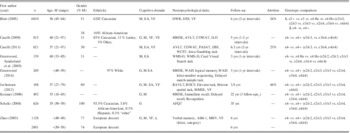
Several studies have explored how cognition changes longitudinally as a function of APOE genotype (Table 4). Schultz et al. (Reference Schultz, Lyons, Franz, Grant, Boake, Jacobson and Kremen2008) compared the cognitive test performance of army cadets in the 6th decade of life, to their scores on the same measure at age 20, and found ε4+ showed greater decline. Across a period of 6 years, relatively limited effects of APOE genotype were reported across a selection of cognitive domains (Zhao et al., Reference Zhao, Brunner, Kumari, Singh-Manoux, Hawe, Talmud and Humphries2005), with only semantic fluency being negatively associated with ε4+ status in females aged 40–49 years; this study reported no genotype differences in a slightly older sample (aged, 50–59 years).
Summary of longitudinal studies investigating APOE differences in mid-adulthood

Domain: G=global; M=memory; EA=executive ability; VF=verbal fluency; L=language; VS=visuospatial. Tasks: MMSE=Mini-Mental State Examination; WAIS=Weschler Adult Intelligence Scale; WMS=Weschler Memory Scale; DWR=Delayed Word Recall; AVLT=Rey’s Auditory Verbal Learning Task; COWAT=Controlled Oral Word Association Task; DSS=Digit-Symbol Substitution; PASAT=Paced Auditory Serial Attention Task; WCST=Wisconsin Card-Sorting Task; AFQT=Armed Forces Qualification Task; ROFC=Rey-Osterrich Complex figure; JLO=Judgement of Line Orientation; MHV=Mill Hill Vocabulary test. Zygosity: He=heterozygous; Ho=homozygous.
The dominant focus of longitudinal research has been establishing if ε4+ show a differential rate of memory change over time. Several studies suggest that ε4+ show significantly greater memory decline from mid-adulthood (Caselli et al., Reference Caselli, Dueck, Osborne, Sabbagh, Connor, Ahern and Reiman2009; Kozauer, Mielke, Chan, Rebok, & Lyketsos, Reference Kozauer, Mielke, Chan, Rebok and Lyketsos2008), with this effect isolated to delayed memory in two studies (Greenwood, Sunderland, Putnam, Levy, & Parasuraman, Reference Greenwood, Sunderland, Putnam, Levy and Parasuraman2005; Greenwood et al., Reference Greenwood, Espeseth, Lin, Reinvang and Parasuraman2014). Performance change across an average of 3.8 years was investigated for measures of memory (Jochemsen, Muller, van der Graaf, & Geerlings, Reference Jochemsen, Muller, van der Graaf and Geerlings2012), with participants stratified by age. Of interest, it was found ε4+ aged 47–57 years showed improvements in recall performance, whereas ε4+ aged 58–67 years showed significant decline by the follow-up assessment. How change in memory is influenced by the interaction between APOE genotype, ethnicity and cardiovascular health has also been explored over a 6-year interval (Blair et al., Reference Blair, Folsom, Knopman, Bray, Mosley and Boerwinkle2005). Negative associations between ε4+ and memory change were small and limited to Caucasian adults. There was no interaction between cardiovascular health factors (diabetes, hypercholesterolemia, hypertension), APOE genotype and memory change.
Two papers found a non-significant effect of APOE genotype on change in executive abilities over time (Greenwood et al., Reference Greenwood, Espeseth, Lin, Reinvang and Parasuraman2014; Jochemsen et al., Reference Jochemsen, Muller, van der Graaf and Geerlings2012). There is support, however, for the ε4 allele being associated with greater decline in processing speed (Blair et al., Reference Blair, Folsom, Knopman, Bray, Mosley and Boerwinkle2005; Caselli et al., Reference Caselli, Dueck, Locke, Hoffman-Snyder, Woodruff, Rapcsak and Reiman2011). In a group of Caucasian adults, ε4+ also diagnosed with hypercholesterolemia or diabetes showed increased decline on the digit-symbol substitution measure of processing speed (Blair et al., Reference Blair, Folsom, Knopman, Bray, Mosley and Boerwinkle2005). No APOE×Hypertension interaction was found for change in processing speed. Verbal fluency scores were maintained in both the Caucasian and Afro-American groups included in Blair et al. (Reference Blair, Folsom, Knopman, Bray, Mosley and Boerwinkle2005).
Longitudinal measures (Greenwood et al., Reference Greenwood, Espeseth, Lin, Reinvang and Parasuraman2014) revealed no genotype difference across trials with relatively low WM demand. On trials incorporating a mismatch between encoded and target stimuli, and hence placing greater demand on WM resources, however, performance of ε4+ improved over 3 years, whereas performance of the ε4− group remained stable. The observed practice effects in ε4+ were interpreted by the authors to represent compensatory mechanisms during mid-adulthood, and as a result of the increased cognitive effort in this group, some ε4+ benefits were still observed.
DISCUSSION
This review highlights the inconsistencies reported for APOE ε4 effects on cognition in mid-adulthood. Synthesizing the results through meta-analyses, the effect of carrying an ε4 allele was non-significant across the seven cognitive domains examined (global cognition, memory, executive ability, verbal fluency, language, visuospatial processing, and processing speed). Closer inspection of individual studies, however, indicates ε4+ effects may emerge under certain conditions, and when probed with measures designed to maximize sensitivity.
The results of the meta-analyses offer limited support for ε4+ showing cognitive differences in mid-adulthood; performance of ε4+ and ε4− appears equivalent until the end of the 5th decade. This is not inconsistent with the antagonistic pleiotropy position whereby the ε4 allele has opposing effects on fitness across the lifespan (Han & Bondi, Reference Han and Bondi2008), with mid-adulthood as a transition point between ε4+ behavioral advantages in youth switching to disadvantages in older adulthood.
When considering individual studies in more detail, the age range of participants is a likely factor in the inconsistency between study outcomes. Critically, existing research lacks a precise and consistent definition of mid-adulthood, reflected in the diverse and often broad age ranges of volunteers participating in the research reviewed here (see Table 1). For example, mid-adulthood was defined as 24–69 years in one study (Flory et al., Reference Flory, Manuck, Ferrell, Ryan and Muldoon2000) and 41–85 years in another (Greenwood, Lambert, et al., Reference Greenwood, Lambert, Sunderland and Parasuraman2005). To draw conclusions of genotype effects at any precise window of the lifespan is difficult with such large age inclusion criteria, and the disparity in age groups may relate to the inconsistency of results presented. In cases where samples were stratified by age, Age×APOE interactions were reported, indicating emergence of the detrimental effects of APOE ε4 in the latter half of the 5th decade (Jochemsen et al., Reference Jochemsen, Muller, van der Graaf and Geerlings2012; Marioni et al., Reference Marioni, Campbell, Scotland, Hayward, Porteous and Deary2016; Shin et al., Reference Shin, Kweon, Choi, Lee, Nam, Park and Jeong2014). This highlights the importance of controlling for age. Age was not included as a moderator in the current meta-analyses due to the small number of studies in each domain, but this is certainly an important avenue for future research.
A key question for this review was whether process-specific cognitive measures show sensitivity to APOE genotype effects in mid-adulthood. Although the results of the meta-analyses failed to report a robust effect of ε4+ status on memory, looking across studies, there is a relatively consistent pattern of emerging decrements in ε4+ performance (11/20 studies). Detrimental effects of ε4+ status on memory were also supported by longitudinal studies, suggesting this genotype group shows an accelerated trajectory of memory decline (Caselli et al., Reference Caselli, Dueck, Osborne, Sabbagh, Connor, Ahern and Reiman2009; Greenwood, Sunderland, et al., Reference Greenwood, Lambert, Sunderland and Parasuraman2005; Greenwood et al., Reference Greenwood, Espeseth, Lin, Reinvang and Parasuraman2014; Kozauer et al., Reference Kozauer, Mielke, Chan, Rebok and Lyketsos2008). The sensitivity of memory to the effects of APOE ε4 from mid-adulthood is further supported by imaging evidence of genotype differences in MTL regions, implicating this region as a neural basis for behavioral changes (Goveas et al., Reference Goveas, Xie, Chen, Li, Ward, Franczak and Li2013; Li et al., Reference Li, Antuono, Xie, Chen, Jones, Ward and Li2014). Memory is over-represented in studies probing the effects of APOE, and with more careful consideration of other cognitive domains, other effects may emerge.
It is important to consider that many of the study outcomes included in the meta-analyses were based on neuropsychological assessment performance. It may be that the preclinical effects of APOE ε4 are too subtle for detection with neuropsychological measures, more commonly used for the detection of clinically relevant symptoms. In support of this, studies using computerized paradigms designed to target specific cognitive processes report APOE ε4 differences in mid-adulthood within the domains of EF, attention, and WM (Evans et al., Reference Evans, Dowell, Tabet, Tofts, King, Gray and Rusted2013, Reference Evans, Dowell, Tabet, Tofts, King and Rusted2014; Greenwood et al., Reference Greenwood, Sunderland, Friz and Parasuraman2000, Reference Greenwood, Espeseth, Lin, Reinvang and Parasuraman2014; Greenwood, Lambert, et al. 2005; Velichkovsky et al., Reference Velichkovsky, Roschina and Selezneva2015). These domains have also been linked to ε4+ cognitive advantages in early adulthood (Marchant et al., Reference Marchant, King, Tabet and Rusted2010; Rusted et al., Reference Rusted, Evans, King, Dowell, Tabet and Tofts2013; Taylor et al., Reference Taylor, Boyd, Turner, McQuoid, Ashley-Koch, MacFall and Potter2016), and so may show early sensitivity to genotype effects. Future research should focus on specific cognitive processes to establish the pattern of age-related change more clearly. Identifying replicable cognitive markers of those at heightened risk of poor cognitive ageing would make a substantial contribution to the development of early intervention strategies, independently and in association with the study of biomarkers and additional risk factors for dementia.
An additional methodological issue is the role of individual differences in moderating the effects of APOE. Several studies attempt to control for differences in ethnicity, education, socio-economic status (SES), and health factors; however, these factors are not uniformly included. Investigation of how these factors interact with APOE ε4 to alter the initial stages of ageing is limited to date. Although methodological shortcomings contribute to the inconsistency of findings, it is important to recognize that mid-age itself will play an important role. Mid-age brings with it other risk factors for poor cognitive ageing (e.g., hypertension, high cholesterol, and diabetes) (Atzmon et al., Reference Atzmon, Gabriely, Greiner, Davidson, Schechter and Barzilai2002; Köhler et al., Reference Köhler, Baars, Spauwen, Schievink, Verhey and van Boxtel2014; van Exel et al., Reference van Exel, de Craen, Gussekloo, Houx, Bootsma-van der Wiel, Macfarlane and Westendorp2002; Whitmer, Sidney, Selby, Johnston, & Yaffe, Reference Whitmer, Sidney, Selby, Johnston and Yaffe2005), and interactions between vascular health, APOE, and cognition are reported (de Frias, Schaie, & Willis, Reference De Frias, Schaie and Willis2014; Peila et al., Reference Peila, White, Petrovich, Masaki, Ross, Havlik and Launer2001; Puttonen, Elovainio, Kivimäki, Lehtimäki, & Keltikangas-Järvinen, Reference Puttonen, Elovainio, Kivimäki, Lehtimäki and Keltikangas-Järvinen2003; Zade et al., Reference Zade, Beiser, McGlinchey, Au, Seshadri, Palumbo and Milberg2010).
Current behavioral research is neither considering the potential modifying effects of wider risk factors nor adequately controlling for them, though they undoubtedly contribute to the cognitive ageing trajectory (Herrup, Reference Herrup2010). One account for the role of APOE ε4 in cognitive ageing is that this allele represents a genetic susceptibility, increasing vulnerability to both detrimental and protective factors in cognitive ageing (Wirth, Villeneuve, La Joie, Marks, & Jagust, Reference Wirth, Villeneuve, La Joie, Marks and Jagust2014). Mid-adulthood represents a period of the lifespan where ε4+ are particularly susceptible to cognitive insults and benefits, and this underlines the need to consider the cognitive profile of ε4+ in relation to other potential modulators for cognitive health when establishing the preclinical effects of this gene.
CONCLUSIONS
It remains difficult to untangle the effects of APOE ε4 on cognition in mid-adulthood; methodological issues including imprecise criteria for age of volunteers and differential sensitivity of the measures used make it hard to form concrete conclusions. Results reviewed here suggest the cognitive performance of ε4+ in mid-adulthood is broadly comparable with their ε4− counterparts. Subtle differences in memory and executive abilities are reported, however, where more sensitive measures of cognition are used, suggestive of the beginnings of a differential ageing trajectory in ε4+. Future research should focus on administering cognitive paradigms specifically chosen for their ability to sensitively measure the more nuanced processes in each particular domain, rather than relying on assessment measures more traditional of clinical settings. Since mid-age is a time when the trajectory of cognitive ageing will be influenced by multiple factors, these must also be incorporated when modeling the effects of APOE ε4 across the lifespan. Through the consideration of these factors in future study design reliable cognitive markers for exposing accelerated cognitive ageing in mid-adulthood may be developed.
ACKNOWLEDGMENTS
There are no conflicts of interest to disclose.