
Introduction
Haemoparasites infect a wide range of vertebrate hosts, such as amphibians, reptiles, birds and mammals (Valkiūnas, Reference Valkiūnas2005), thereby being causative agents of malaria and malaria-like diseases in temperate and tropical regions (Valkiūnas and Iezhova, Reference Valkiūnas and Iezhova2018). In birds, there are 3 main genera of haemoparasites, transmitted by different vectors: Plasmodium (transmitted by mosquitos), Haemoproteus (2 subgenera transmitted by biting midges and louse flies) and Leucocytozoon (transmitted by black flies) (Valkiūnas, Reference Valkiūnas2005; Santiago-Alarcon et al., Reference Santiago-Alarcon, Palinauskas and Schaefer2012; Lotta et al., Reference Lotta, Pacheco, Escalante, Gonzalez, Mantilla, Moncada, Adler and Matta2016; Santolíková et al., Reference Santolíková, Brzonová, Čepička and Svobodová2022). Despite the wide geographic distribution of both vectors and parasites, bird orders show highly variable rates of infection and parasite prevalence (e.g. Atkinson and van Riper, Reference Atkinson, van Riper, Loye and Zuk1991; Scheuerlein and Ricklefs, Reference Scheuerlein and Ricklefs2004; Quillfeldt et al., Reference Quillfeldt, Arriero, Martínez, Masello and Merino2011) and infection risk varies considerably across zoogeographical regions (Fecchio et al., Reference Fecchio, Clark, Bell, Skeen, Lutz, De La Torre, Vaughan, Tkach, Schunck, Ferreira, Braga, Lugarini, Wamiti, Dispoto, Galen, Kirchgatter, Sagario, Cueto, González-Acuña, Inumaru, Sato, Schumm, Quillfeldt, Pellegrino, Dharmarajan, Gupta, Robin, Ciloglu, Yildirim, Huang, Chapa-Vargas, Álvarez-Mendizábal, Santiago-Alarcon, Drovetski, Hellgren, Voelker, Ricklefs, Hackett, Collins, Weckstein and Wells2021). Some avian lineages (e.g. many passerines) are heavily infected, while others (e.g. raptors, storks, cormorants) show low rates of infection (Martinez-Abraín et al., Reference Martinez-Abraín, Esparza and Oro2004). This inter-specific variation is thought to emerge from global and region-scale drivers (Fecchio et al., Reference Fecchio, Clark, Bell, Skeen, Lutz, De La Torre, Vaughan, Tkach, Schunck, Ferreira, Braga, Lugarini, Wamiti, Dispoto, Galen, Kirchgatter, Sagario, Cueto, González-Acuña, Inumaru, Sato, Schumm, Quillfeldt, Pellegrino, Dharmarajan, Gupta, Robin, Ciloglu, Yildirim, Huang, Chapa-Vargas, Álvarez-Mendizábal, Santiago-Alarcon, Drovetski, Hellgren, Voelker, Ricklefs, Hackett, Collins, Weckstein and Wells2021) linked to differences in both biotic and abiotic factors, such as climate, host population density or feeding behaviour (Sol et al., Reference Sol, Jovani and Torres2000; Zamora-Vilchis et al., Reference Zamora-Vilchis, Williams and Johnson2012; Sehgal, Reference Sehgal2015; Zagalska-Neubauer and Bensch, Reference Zagalska-Neubauer and Bensch2016). Despite interactions between these parasites and their hosts being complex, species with higher infection risk may be subject to stronger parasite-driven selection pressure, which may reduce their competitive ability, body condition, reproductive success or survival (van Riper et al., Reference van Riper, van Riper, Goff and Laird1986; Sorci and Møller, Reference Sorci and Møller1997; Marzal et al., Reference Marzal, de Lope, Navarro and Møller2005; Knowles et al., Reference Knowles, Palinauskas and Sheldon2010).
Host–parasite interactions have received considerable scientific interest for decades (Loye and Zuk, Reference Loye and Zuk1991; Ricklefs et al., Reference Ricklefs, Fallon and Bermingham2004; Garcia-Longoria et al., Reference Garcia-Longoria, Marzal, de Lope and Garamszegi2019) and avian blood parasites have long been considered an excellent model to study host–parasite dynamics and coevolution at both the intra- and inter-specific level (Atkinson and van Riper, Reference Atkinson, van Riper, Loye and Zuk1991; Rivero and Gandon, Reference Rivero and Gandon2018). Although data on host infection rates should best be set within a broad phylogenetic framework to allow robust inferences, research effort has so far, however, been unevenly allocated, focusing mostly on passerine birds (Murdock et al., Reference Murdock, Foufopoulos and Simon2013; Fecchio et al., Reference Fecchio, Clark, Bell, Skeen, Lutz, De La Torre, Vaughan, Tkach, Schunck, Ferreira, Braga, Lugarini, Wamiti, Dispoto, Galen, Kirchgatter, Sagario, Cueto, González-Acuña, Inumaru, Sato, Schumm, Quillfeldt, Pellegrino, Dharmarajan, Gupta, Robin, Ciloglu, Yildirim, Huang, Chapa-Vargas, Álvarez-Mendizábal, Santiago-Alarcon, Drovetski, Hellgren, Voelker, Ricklefs, Hackett, Collins, Weckstein and Wells2021), with ca. 85% of records within a global database for avian haemoparasites coming from passerines (MalAvi; Bensch et al., Reference Bensch, Hellgren and Pérez-Tris2009). At the same time, information on the prevalence and diversity of blood parasites is still limited in other avian groups (Valkiūnas, Reference Valkiūnas2005; Quillfeldt et al., Reference Quillfeldt, Arriero, Martínez, Masello and Merino2011), possibly reflecting lower research effort in non-passerines, since even the development of molecular techniques that allow highly efficient haemoparasite screening, and resolution of their molecular diversity across divergent avian lineages (Bensch et al., Reference Bensch, Stjerman, Hasselquist, Östman, Hansson, Westerdahl and Pinheiro2000), did not mitigate this phylogenetic bias.
The aim of our study was to assess the prevalence of the 3 main blood parasite genera (Plasmodium, Haemoproteus and Leucocytozoon) in 2 colonial bird species from the Laridae family (Charadriiformes): the black-headed gull (Chroicocephalus ridibundus) and the common tern (Sterna hirundo), and to study a potential link between these prevalences and ecological and life history traits, including habitat choice, colony size and migration distance. So far, data on the occurrence of haemosporidians in Charadriiform birds are scarce (only 0.4% of all records in the MalAvi database), despite a relatively high phylogenetic diversity of this avian group (more than 370 species classified into 90 genera according to Winkler et al., Reference Winkler, Billerman and Lovette2015). In fact, the MalAvi database contains no molecular information on haemosporidians detected in our study genera (Chroicocephalus and Sterna).
Both the black-headed gull and common tern are medium-sized colonial waterbirds with a Holarctic distribution and large population sizes (BirdLife International, 2021). They occupy divergent types of aquatic habitats (rather freshwater in the black-headed gull, both freshwater and marine in the common tern) and feed on a wide range of small prey items including fish, crustaceans, insects and their larvae (Snow and Perrins, Reference Snow and Perrins1998). During the breeding season, black-headed gulls prefer shallow, inland waterbodies with abundant vegetation, whereas terns breed mainly on sandy islands lacking plant cover, situated both at the coast and in large river valleys (Snow and Perrins, Reference Snow and Perrins1998). Moreover, our study species show strong variation in their migratory behaviour; the common tern being a long-distance migrant (e.g. Kürten et al., Reference Kürten, Schmaljohann, Bichet, Haest, Vedder, González-Solís and Bouwhuis2022) and the black-headed gull migrating only relatively short distances (e.g. Christmas et al., Reference Christmas, Christmas, Gosling and Parr1986; Jelínek, Reference Jelínek, Cepák, Klvaňa, Formánek, Horák, Jelínek, Schröpfer, Škopek and Zárybnický2008). This variation is especially apparent in the European populations, where the black-headed gull usually overwinters in Western Europe and in the Mediterranean region, while the common tern spends winter on the coasts of Western Africa, passing across different climatic zones and likely being exposed to diverse local parasite communities. Gulls and terns also differ in their stop-over behaviour during migration. Common terns migrate rather quickly, both over sea and across land, using only few stopover sites located generally at the coast (Kürten et al., Reference Kürten, Schmaljohann, Bichet, Haest, Vedder, González-Solís and Bouwhuis2022). In contrast, black-headed gulls migrate using broad migratory flyways, as they can refuel at diverse stopover sites, often located far from the coast (Cramp and Simmons, Reference Cramp and Simmons1983; Wernham et al., Reference Wernham, Toms, Marchant, Clark, Siriwardena and Baillie2002).
So far, most field research on passerine species has shown that long-distance migrants carry a higher diversity of blood parasites and show higher infection rates than resident individuals (Pérez-Tris and Bensch, Reference Pérez-Tris and Bensch2005), although this general pattern may not necessarily be preserved across all parasite genera or geographical regions (Fecchio et al., Reference Fecchio, Clark, Bell, Skeen, Lutz, De La Torre, Vaughan, Tkach, Schunck, Ferreira, Braga, Lugarini, Wamiti, Dispoto, Galen, Kirchgatter, Sagario, Cueto, González-Acuña, Inumaru, Sato, Schumm, Quillfeldt, Pellegrino, Dharmarajan, Gupta, Robin, Ciloglu, Yildirim, Huang, Chapa-Vargas, Álvarez-Mendizábal, Santiago-Alarcon, Drovetski, Hellgren, Voelker, Ricklefs, Hackett, Collins, Weckstein and Wells2021). Despite this, phylogenetic diversity of haemoparasites was also positively associated with avian host migratory strategy at the inter-specific level (Jenkins et al., Reference Jenkins, Gavin, Thomas, Hellgren and Owens2012). However, migratory passerines usually fly over land and refuel more often than large bird species (e.g. gulls, ducks, waders), which likely increases their exposure to haemoparasite vectors. Taking this into account, migratory behaviour or habitat preferences during migration, rather than migratory distance per se, could explain differences in the species-specific vulnerability to parasite infections in birds.
Here, we sampled 623 black-headed gulls and common terns from several Central European breeding populations and used molecular approaches for haemoparasite detection and identification. As infected individuals could be non-randomly distributed across populations and infection rates could be associated with the size of social groups, we also tested for an association between haemoparasite prevalence and colony size in black-headed gulls.
Materials and methods
Sample collection
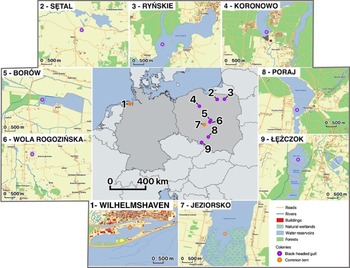
We collected samples from 2 breeding colonies of common terns and 7 breeding colonies of black-headed gulls. One tern colony was located at the North See coast in northern Germany, Wilhelmshaven (690–740 breeding pairs), and the second in central Poland, at Jeziorsko reservoir (260–380 breeding pairs) (Fig. 1). All gull colonies were scattered across different regions of Poland (Fig. 1) and the number of breeding pairs varied between 100 and 2800 per colony. Samples from the common tern were collected in 2014–2019, whereas black-headed gulls were sampled exclusively in 2018. In total, we collected 483 samples from terns and 140 samples from gulls (Table 1). Blood samples were obtained from adult breeders, either via puncture of the ulnar vein with a disposable needle (following capture) or non-invasively, using artificial eggs with bloodsucking bugs (Dipetalogaster maximus) (for common terns from Wilhelmshaven, details in Becker et al., Reference Becker, Voigt, Arnold and Nagel2006). This method allows to obtain blood samples without any negative impact on genetic material (DNA), which can be used as a high-quality source for molecular analyses (e.g. Vedder et al., Reference Vedder, Moiron, Bichet, Bauch, Verhulst, Becker and Bouwhuis2021). Samples were stored in 95% ethanol or phosphate-buffered saline before DNA extraction.
Location of black-headed gull (violet) and common tern (orange) colonies used for sampling. Maps created based on templates from OpenStreetMap.

Occurrence of haemoparasites in black-headed gulls and common terns at 9 sites across Poland and Germany

Sample size (N amp) and the number (proportion) of infection-positive individuals positive for infection (as confirmed with PCR amplifications) are shown for each location. Sample size of birds selected for sequencing (N seq) and the number of individuals positive for either Haemoproteus or Plasmodium infection (as confirmed with molecular lineage identification) are also shown.
1 Sample sizes include coinfections.
DNA extraction, amplification and sequencing
Nuclear DNA was extracted from blood samples using Bio-Trace DNA Purification Kits (EURx, Gdansk, Poland). We used a nested polymerase chain reaction (PCR) approach to amplify the cytochrome b (Cyt b) gene according to the methodology developed by Hellgren et al. (Reference Hellgren, Waldenström and Bensch2004), which allows a parallel detection of Leucocytozoon, Plasmodium and Haemoproteus. Moreover, it allows the detection of parasites in different phases of infection even during subpatent infections with low intensity of parasites present in peripheral blood (Hellgren et al., Reference Hellgren, Waldenström and Bensch2004). In the first step, the conserved primers HaemNFI and HaemNR3 were used to amplify the Cyt b gene across all parasite genera. In the second PCR reaction, we used primers that allowed specific amplifications of Cyt b in Haemoproteus/Plasmodium (HaemF and HaemR2) and Leucocytozoon (HaemFL and HaemR2L) (Hellgren et al., Reference Hellgren, Waldenström and Bensch2004). All PCRs were conducted in 20 μL total volume, which contained 2 μL of template DNA, 10 μL of DreamTaq PCR Master Mix (Thermo Fisher Scientific Inc., Waltham, MA, USA), 0.5 μL of each primer, 1.4 μL of 25 mm MgCl2 and 5.4 μL of water. Each PCR run contained a positive control (DNA from previously genotyped individuals with a confirmed infection) and non-template negative control (ddH2O). The thermal profile of the PCR reactions followed Hellgren et al. (Reference Hellgren, Waldenström and Bensch2004), although we increased the number of cycles in the second PCR to 35 and used 2 μL of the product from the first PCR as a template for the second one. Amplicons were electrophoresed on a 1.5% agarose gel stained using the SYBR Safe DNA Gel Stain (Thermo Fisher Scientific) at 132 V for 20 min to detect parasite-specific bands. All positive samples were confirmed with an electrophoresis of amplicons from independent PCRs to avoid false positives.
To identify haemoparasite lineages, we selected all samples positive for Leucocytozoon (n = 5) and 50% of samples positive for Haemoproteus/Plasmodium (n = 42). We expected this sample size to facilitate a reliable characterization of haemoparasite lineage composition in our study species, allowing for cost optimization at the same time. All amplicons were sequenced in both forward and reverse directions. All sequences were assembled, edited and aligned in Geneious 10.0.5 software (Biomatters Ltd., Auckland, New Zealand). Next, we blasted all unique sequences against reference haemoparasite sequences from the MalAvi database (Bensch et al., Reference Bensch, Hellgren and Pérez-Tris2009). Morphospecies and molecular lineages were identified based on maximum and 100% pairwise nucleotide similarity, respectively. Sequences showing any nucleotide mismatches with available data were recognized as novel lineages and submitted to MalAvi. Phylogenetic clustering of query and reference lineage sequences was conducted using Bayesian inference method in MrBayes 2.2.4. (Huelsenbeck and Ronquist, Reference Huelsenbeck and Ronquist2001) installed as a plugin in Geneious 10.0.5. The analysis was run with 120 000 chain length, 20 000 burn-in length and a general time-reversible (GTR) substitution model.
Statistical analyses
Differences in prevalence rate between species and parasite genera were tested with G tests. An association between parasite prevalence and colony size of gulls was tested using a Spearman's rank correlation coefficient (r). All analyses were performed with Statistica 12 (StatSoft, Tulsa, OK, USA).
Results
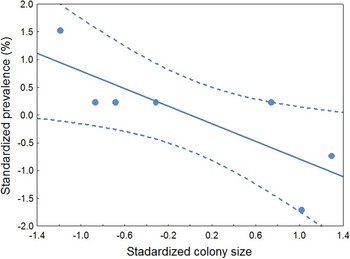
All 3 haemoparasite genera were detected in the black-headed gull, whereas only Leucocytozoon was recorded in the common tern (Table 1). The overall prevalence of Haemoproteus/Plasmodium in gulls was 59.3%, being significantly greater than the 2.8% prevalence of Leucocytozoon (G = 64.13, P < 0.001). Plasmodium infection was less common compared to Haemoproteus infection (17 vs 44% prevalence, as estimated with molecular lineage identification). The prevalence of Leucocytozoon in the common tern was marginally low (<0.5%; Table 1) and not significantly different from the prevalence in the black-headed gull (G = 1.61, P = 0.205). Within the black-headed gull, there were significant differences in Haemoproteus/Plasmodium infection rate between colonies (G = 4.86, P = 0.028) and there was a negative correlation between haemoparasite prevalence rate and colony size (r = −0.87, N = 7, P = 0.011; Fig. 2).
Relationship between haemoparasite infection rate and colony size in the black-headed gull. For the purpose of presentation, both variables were standardized to z scores, so that the correlation coefficient equals the regression slope (shown with its 95% confidence intervals).

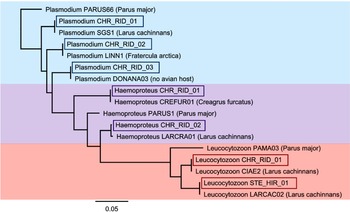
Phylogenetic analyses of Cyt b sequences obtained from our samples revealed an occurrence of multiple lineages within each parasite genus (Fig. 3). All detected Haemoproteus and Leucocytozoon lineages were identical to, or showed highest pairwise similarity to, lineages previously described in other larid hosts. A Haemoproteus lineage dominant within our sample (96% of infections) was not found in MalAvi database, but showed highest pairwise similarity (99.5%) to the LARCRA01 lineage described previously in the Caspian gull (Larus cachinnans). This lineage was classified as Haemoproteus (Parahaemoproteus) valkiūnasi (98.6% similarity to FREAND01; Merino et al., Reference Merino, Hennicke, Martínez, Ludynia, Torres, Work, Stroud, Masello and Quillfeldt2012). The second Haemoproteus lineage (CREFUR01) was previously reported only in tropical larid species (e.g. swallow-tailed gull Creagrus furcatus) and classified as Haemoproteus jenniae (Levin et al., Reference Levin, Valkiūnas, Iezhova, O'Brien and Parker2012).
Bayesian phylogenetic tree of haemoparasite cytochrome b sequences isolated from black-headed gulls (CHR_RID) and common terns (STE_HIR). Reference sequences (blast hits with maximum pairwise identity and 1 randomly selected lineage from the great tit Parus major) were retrieved from MalAvi database (Bensch et al., Reference Bensch, Hellgren and Pérez-Tris2009). Node tips are labelled with the parasite genus, reference lineage name (MalAvi) and previously reported avian host species. The tree was rooted in Plasmodium PARUS66 lineage. Clusters corresponding to each haemoparasite genus were marked in different colours, and all sequences generated in this study were marked in frames.

Two detected Leucocytozoon lineages were also previously reported in the Caspian gull, but they showed a host specificity within our samples, as the CIAE02 lineage was found exclusively in the black-headed gull, while the LARCAC01 lineage was found in the common tern (Fig. 3). These lineages showed highest pairwise similarity to Leucocytozoon californicus (99.5% similarity with FASPA02; Walther et al., Reference Walther, Valkiūnas, Wommack, Bowie, Iezhova and Sehgal2016) and Leucocytozoon polynuclearis (96.6% similarity with COLAUR01; Groff et al., Reference Groff, Lorenz, Iezhova, Valkiūnas and Sehgal2022).
Plasmodium parasites showed slightly higher lineage diversity (N = 3), and the most common lineage (SGS1, Plasmodium reticulum; Palinauskas et al., Reference Palinauskas, Kosarev, Shapoval, Bensch and Valkinas2007) found in gulls (67% of Plasmodium infections) was previously reported, among the others, in 4 larid species, 2 of them (Caspian gull and herring gull Larus argentatus) breeding within the range of our study species. Another lineage (LINN1, Plasmodium matutinum; Valkiūnas et al., Reference Valkiūnas, Ilgūnas, Bukauskaitė, Palinauskas, Bernotienė and Iezhova2017) was previously reported in an avian host from the order of Charadriformes (Atlantic puffin Fratercula arctica) (Fig. 3). The third lineage (DONANA03) was identical to sequences identified only in a vector species (Culex sp.) (Fig. 3). This lineage showed high pairwise similarity (95.8%) to Plasmodium circumflexum (TURDUS1; Palinauskas et al., Reference Palinauskas, Kosarev, Shapoval, Bensch and Valkinas2007).
Finally, our analyses revealed 3 cases of gulls being co-infected by different haemoparasite genera. Specifically, we recorded 2 cases of Haemoproteus/Leucocytozoon coinfections and 1 Plasmodium/Haemoproteus coinfection.
Discussion
We found considerable differences in blood parasite prevalence between 2 larid species, and the pattern may be primarily driven by variation in habitat selection rather than differences in distance covered during migration. The black-headed gull, which mostly breeds in vegetated freshwater habitats, showed a much higher prevalence and diversity of haemoparasites than the common tern, which breeds in coastal areas and less vegetated freshwater habitats. More than half of all examined gulls (59.3%) were infected with Haemoproteus or Plasmodium, and we recorded several cases of co-infections in this species. In contrast, we detected only 1 genus of haemoparasite (Leucocytozoon) in the common tern, with marginally low prevalence (<0.5%). Molecular lineage identification indicated that Haemoproteus in gulls was more prevalent when compared to Plasmodium. We also found among-colony variation in gull infection rates, as infected individuals were more prevalent in smaller colonies.
Despite limited empirical data, haemoparasite prevalence in Laridae seems to be rather low compared to that in many other bird orders, especially passerines (e.g. Bensch et al., Reference Bensch, Hellgren and Pérez-Tris2009; Dunn et al., Reference Dunn, Stockdale, Bradford, McCubbin, Morris, Grice, Goodman and Hamer2017; Fecchio et al., Reference Fecchio, Clark, Bell, Skeen, Lutz, De La Torre, Vaughan, Tkach, Schunck, Ferreira, Braga, Lugarini, Wamiti, Dispoto, Galen, Kirchgatter, Sagario, Cueto, González-Acuña, Inumaru, Sato, Schumm, Quillfeldt, Pellegrino, Dharmarajan, Gupta, Robin, Ciloglu, Yildirim, Huang, Chapa-Vargas, Álvarez-Mendizábal, Santiago-Alarcon, Drovetski, Hellgren, Voelker, Ricklefs, Hackett, Collins, Weckstein and Wells2021; Ilahiane et al., Reference Ilahiane, De Pascalis, Pisu, Pala, Ferrario, Cucco, Rubolini, Cecere and Pellegrino2022). However, even within larids, infection rates can be strongly variable at the intra- and inter-specific level (Quillfeldt et al., Reference Quillfeldt, Arriero, Martínez, Masello and Merino2011). Our results are highly consistent with existing information, suggesting that gulls (Larinae) in general show much higher infection rates than terns (Sterninae). Different populations of yellow-legged gull (Larus michahellis), for example, showed Haemoproteus prevalences between 39 and 100% (Ruiz et al., Reference Ruiz, Oro and Gonzales-Solis1995; Bosch et al., Reference Bosch, Figuerola, Cantos and Velarde1997). In contrast, most examined tern species showed zero prevalence of Plasmodium and Haemoproteus (as reviewed by Quillfeldt et al., Reference Quillfeldt, Arriero, Martínez, Masello and Merino2011 and Fecchio et al., Reference Fecchio, Clark, Bell, Skeen, Lutz, De La Torre, Vaughan, Tkach, Schunck, Ferreira, Braga, Lugarini, Wamiti, Dispoto, Galen, Kirchgatter, Sagario, Cueto, González-Acuña, Inumaru, Sato, Schumm, Quillfeldt, Pellegrino, Dharmarajan, Gupta, Robin, Ciloglu, Yildirim, Huang, Chapa-Vargas, Álvarez-Mendizábal, Santiago-Alarcon, Drovetski, Hellgren, Voelker, Ricklefs, Hackett, Collins, Weckstein and Wells2021), although minor infection rates were reported in little terns (Sternula albifrons) (Kairullaev, Reference Kairullaev1986), Forster's terns (Sterna forsteri) (Coatney, Reference Coatney1938) and gull-billed terns (Sterna nilotica) (Fecchio et al., Reference Fecchio, Clark, Bell, Skeen, Lutz, De La Torre, Vaughan, Tkach, Schunck, Ferreira, Braga, Lugarini, Wamiti, Dispoto, Galen, Kirchgatter, Sagario, Cueto, González-Acuña, Inumaru, Sato, Schumm, Quillfeldt, Pellegrino, Dharmarajan, Gupta, Robin, Ciloglu, Yildirim, Huang, Chapa-Vargas, Álvarez-Mendizábal, Santiago-Alarcon, Drovetski, Hellgren, Voelker, Ricklefs, Hackett, Collins, Weckstein and Wells2021). Haemoproteus larae was also detected in a Kazakhstan population of the common tern (Kairullaev, Reference Kairullaev1986).
Higher infection rates in gulls than terns are inconsistent with the migration hypothesis (Alerstam et al., Reference Alerstam, Hedenström and Åkesson2003; Møller et al., Reference Møller, Garamszegi, Peralta-Sánchez and Soler2011), assuming that long-distance migration (as performed by the common tern) should increase exposure to diverse parasites (and their vectors). Thus, our results clearly indicate that migration is not a key factor in parasite transmission within our study system, despite extensive comparative evidence showing that migrant bird species harbour greater diversity of parasites compared to non-migratory taxa (e.g. Ricklefs et al., Reference Ricklefs, Fallon, Latta, Swansson, Bermingham, Greenberg and Marrra2005; Jenkins et al., Reference Jenkins, Gavin, Thomas, Hellgren and Owens2012; Ricklefs et al., Reference Ricklefs, Medeiros, Ellis, Svensson-Coelho, Blake, Loiselle, Soares, Fecchio, Outlaw, Marra, Latta, Valkiūnas, Hellgren and Bensch2016). Consequently, it seems reasonable to conclude that other ecological characters, such as habitat preferences, should primarily determine differences in haemoparasite prevalence between our study species. Common terns often spend a large part of their annual cycle in coastal habitats and breed in more open areas with little or no vegetation (e.g. sandy islands or beaches). In contrast, black-headed gulls prefer inland swampy habitats with shallow stagnant water and abundant macrophyte or reed plants (Snow and Perrins, Reference Snow and Perrins1998). The latter habitats are often associated with large numbers of mosquitos, which are crucial for transmission of Plasmodium haemoparasite (Valkiūnas, Reference Valkiūnas2005), and which should enhance high local infection rates in birds. In Poland, gull colonies are often located within lowland river valleys that represent a mosaic of oxbow lakes and river creeks, which are also suitable for other haemoparasite vectors (e.g. black flies or biting midges). Such habitats, rich in a variety of biting insects, can increase the probability of infection with Leucocytozoon or certain Haemoproteus lineages (e.g. from Parahemoproteus subgenus; Santiago-Alarcon et al., Reference Santiago-Alarcon, Palinauskas and Schaefer2012). For example, a breeding colony of yellow-legged gulls and herring gulls located in habitats with high densities of blackflies (Vistula valley) showed unusually high haemosporidian (mostly Leucocytozoon) prevalence (up to 95%) in both species (Zagalska-Neubauer and Bensch, Reference Zagalska-Neubauer and Bensch2016). Haemoparasite prevalence in passerines and pigeons varied with vector abundance, regardless of host species (Apanius et al., Reference Apanius, Yorinks, Bermingham and Ricklefs2000; Sol et al., Reference Sol, Jovani and Torres2000) and exposure to vectors was also recognized as the main factor responsible for the habitat-related differences in malaria occurrence among Charadrii shorebirds (Mendes et al., Reference Mendes, Piersma, Lecoq, Spaans and Ricklefs2005). Specifically, species from freshwater inland habitats had significantly higher prevalence of blood parasites than species occupying marine coastal habitats (Mendes et al., Reference Mendes, Piersma, Lecoq, Spaans and Ricklefs2005). Low haemoparasite prevalences in marine environments were also reported for another long-distance migrant, the Eleonora's falcon (Falco eleonorae) (Gutiérrez-López et al., Reference Gutiérrez-López, Gangoso, Martínez-de la Puente, Fric, López-López, Mailleux, Muñoz, Touati, Samraoui and Figuerola2015). It is worth noting that seasonal peaks in vector abundance are likely to coincide with the breeding season of many European avian species, when resources are allocated to reproduction and host immune function can be reduced (Cosgrove et al., Reference Cosgrove, Wood, Day and Sheldon2008; Knowles et al., Reference Knowles, Nakagawa and Sheldon2009). This may result in higher host susceptibility to infection and, thus, habitat choice during the breeding season should drive variation in infection rates between species. Consistent with this prediction, common terns from the only coastal colony within our dataset (Wilhelmshaven, Germany) showed zero haemoparasite prevalence, despite the largest number of birds (N = 322) screened.
In our study, haemoparasite prevalence was negatively related to colony size in the black-headed gull. Haemoparasites are unlikely to be transmitted directly between birds and, thus, infection rates should not increase with host density (or social group size), as expected for contagious diseases (Brown, Reference Brown2016). Instead, higher haemoparasite prevalence in gulls from smaller colonies fits the model of an ideal despotic distribution, where less dominant individuals of poor phenotypic quality are relegated to less attractive breeding sites (Fretwell, Reference Fretwell1972; Drzewińska-Chańko et al., Reference Drzewińska-Chańko, Włodarczyk, Gajewski, Rudnicka, Dunn and Minias2021). Small colonies are often located in suboptimal habitats, which may be associated with higher vector densities and thus pose a higher risk of infection. Alternatively, individuals infected during the pre-breeding season may be in a relatively poor condition and not be able to effectively compete for nesting sites in large colonies, which are better protected against predators (via communal defence) and are likely to have better access to food resources (Ward and Zahavi, Reference Ward and Zahavi1973; Krause and Ruxton, Reference Krause and Ruxton2002; Jungwirth et al., Reference Jungwirth, Josi, Walker and Taborsky2015). An important role of intraspecific competition during settlement decisions was demonstrated for a number of colonial birds, including gulls and terns (e.g. Oro, Reference Oro2008; Minias, Reference Minias2014; Indykiewicz et al., Reference Indykiewicz, Podlaszczuk, Kamiński, Włodarczyk and Minias2019). Despite these considerations, we are aware that the robustness of our findings is limited by a small number of sampled gull colonies (N = 7) and our analyses should be replicated across more colonies and more diverse geographical locations to confirm our conclusions. To test a possible role of habitat selection for host–parasite interactions in larids, it would be also valuable to study mixed breeding colonies of terns and gulls from a single location.
Our phylogenetic analyses of Cyt b sequences revealed low molecular diversity of haemoparasites within our sample, as we recorded only 2–3 lineages per parasite genus. The majority of examined black-headed gulls was infected with a single dominant lineage of Haemoproteus, consistent with patterns observed in other gull species (e.g. Kram et al., Reference Kram, Kram, Suraka, Rattiste, Ābolins-Ābols, Krama, Rantala, Mierauskas, Cırule and Saks2012; Zagalska-Neubauer and Bensch, Reference Zagalska-Neubauer and Bensch2016). Blood parasites are generally known to be evolutionarily conserved in terms of host choice, although recent molecular studies suggest that host switching may occur relatively frequently in some lineages (Bensch et al., Reference Bensch, Stjerman, Hasselquist, Östman, Hansson, Westerdahl and Pinheiro2000; Ricklefs and Fallon, Reference Ricklefs and Fallon2002). Comparative analyses of diverse bird species suggest that Haemoproteus tends to be more host-specific than Plasmodium, which is recognized as a host generalist (Beadell et al., Reference Beadell, Gering, Austin, Dumbacher, Peirce, Pratt, Atkinson and Fleischer2004; Dimitrov et al., Reference Dimitrov, Zehtindjiev and Bensch2010). This is consistent with our molecular analyses, as all Haemoproteus (and Leucocytozoon) lineages detected within our sample were previously identified in other larid species. In contrast, 2 out of 3 Plasmodium lineages isolated from black-headed gulls matched lineages previously found in other non-passerines (alcids Alcidae) or not detected in avian hosts.
In conclusion, this is one of the few studies providing information on the prevalence and molecular diversity of haemoparasites in representatives of Laridae family. It reveals contrasting infection rates between 2 species with divergent ecological niches (habitat choice), although long migratory distance did not enhance higher haemoparasite prevalence. We conclude that larids may show great diversity in haemoparasite infection rates and that the ecological factors that drive this variation should be further explored under a broader phylogenetic coverage. Moreover, the general pattern of marginal infection rate of haemosporidians in terns suggests a possible presence of unique immunological or immunogenetic adaptations (e.g. structure of immune receptors) that needs further examination.
Data availability
All sequences generated and used in this study have been deposited in MalAvi database, while the single novel sequence has also been submitted to GenBank (Haemoproteus CHR_RID_02 (ON950078)).
Acknowledgements
We thank Kamila Gach, Andrzej Górski, Mateusz Ledwoń, Maciej Kamiński, Jarosław Kowalski, Paweł Knozowski, Jacek Nowakowski, Karolina Skorb and Anna Maria Stawicka who participated in fieldwork and sample collection. We thank Magdalena Zagalska-Neubauer for providing positive controls for Leucocytozoon infection. We thank 2 anonymous reviewers for constructive comments on the earlier draft of the manuscript.
Author contributions
R. W., S. B., C. B. and P. M. designed the study, analysed the data and wrote the manuscript; P. I., B. D., J. B., T. J. and P. M. collected data; R. W., P. P. and A. Ch. performed laboratory analyses; all authors revised the manuscript.
Financial support
The study was financially supported by a research grant of the National Science Centre in Poland (2016/23/B/NZ8/02374). R. W. visit to the Institute of Avian Research in Wilhelmshaven (Germany) was financed by the Dean of the Faculty of Biology and Environmental Protection, University of Lodz.
Conflict of interest
None.
Ethical standards
All applicable institutional and/or national guidelines for the care and use of animals were followed and all blood sampling procedures were conducted with permission of the Local Bioethical Commission for Experiments on Animals and Regional Environmental Protection Directorate in Łódź and Bydgoszcz, Poland.