The United States governs the financial-services industry through a system of executive departments, independent agencies, commissions, and the Federal Reserve. Banks select their own regulator under the “doctrine of choice.”Footnote 1 The complex and confusing system for financial firms poses myriad opportunities for regulatory arbitrage at both the federal and state levels. As it has developed throughout American history, it has simultaneously fostered innovation and served as a source of financial instability from the political system.Footnote 2 Episodic crises occur that could ultimately threaten the payment system of the entire national economy—meaning that if the banking system fails, businesses and individuals would not be able to pay their bills and production would nearly halt. Recovery from a financial crisis takes longer than from other than other economic contractions, and such crises have a deep and lasting effect on asset prices, output, and employment.Footnote 3 Given the significant role of the American economy in the global financial system, the American regulatory framework has substantive implications for both domestic and international economic stability.
Historical literature on federal independent regulatory agencies in law, politics, and sociology explores regulation, the rise of the regulatory state, and the institutional evolution of regulatory agencies.Footnote 4 Many authors have explored the creation of the Federal Reserve and the late Progressive Era politics that produced it.Footnote 5 Much of the historical work on finance examines only one era because that particular period might have been when the most important institutions were destroyed, created, or altered.Footnote 6 Yet the literature does not ask what makes finance distinct from other industries or compare how new regulatory agencies emerged in different periods and market structures?
In response, I make a structured comparison across three sequential cases of federal regulatory agency creation in the United States: the Securities and Exchange Commission (SEC), the Office of Thrift Supervision (OTS), and the Consumer Financial Protection Bureau (CFPB). These cases are major federal financial service regulators, and they were all created subsequent to the Progressive Era and the establishment of the Federal Reserve as a central bank. Each emerged after a different crisis, and within a different historical context and market structure. Looking at cases compared across time periods contributes to policy history because the investigation uncovers historical circumstances leading to the same result. Moreover, it speaks to the contemporary dilemmas of agency creation following the 2008 crisis. The method is “structured” in that general questions reflect the research objective. It is “focused” in that it concentrates on individual aspects of the legislative histories examined.Footnote 7
A financial crisis gives rise to a two-stage regulatory response. In the first, the government intervenes to maintain the operations of private financial institutions while they teeter on the brink of insolvency to prevent the potentially disastrous collapse. Here, the government employs a wide array of emergency powers and authority that allow it to rescue the system during an emergency, even in the absence of explicit statutory authorization. But the temporary arrangements imposed in such periods must eventually be rationalized into a permanent regulatory system that can restore confidence and offer some consistency to the private sector. In the second stage, the regulatory system is restructured in order to create more or less routine expectations with respect to the exercise of regulatory authority. Hence, a recovering financial sector influences the creation of the reformed, permanent regulatory agencies and changes the designs imposed in the earlier period. The political actors—and thus corporate interests involved in creating the agency—do not play the same role in each step of the sequence, and each holds different institutional leverage at each stage: the state has access to massive resources in the short term, whereas banks retain political power in the longer term that grows stronger as the crisis subsides.
The article proceeds in four sections. The first reviews the existing approaches to American political development and the connection between crises and institutional creation in finance since the rise of the regulatory American state. The next three sections cover the case studies of the creation of the SEC, OTS, and CFPB. The Conclusion compares the cases and argues that the regulation of finance will require constant reformation to meet new market challenges.
The American Political Development and Finance: Immediate Needs and Institutional Solutions
The study of American political development makes important contributions to understandings of welfare policy and administrative capacities, particularly those associated with regulation.Footnote 8 Moreover, the importance of understanding how politics unfolds across time is accepted within existing theories in the field.Footnote 9 Thelen points out that institutions reflect neither the tastes of their creators nor the distribution of power at their inception.Footnote 10 Their coalitional base is renegotiated over time. They are transformed through institutional layering, wherein new elements are grafted onto an otherwise stable framework, and through conversion, where new goals or groups are embraced by coalitions anchoring those already built.Footnote 11 Eisner and Rabin show how institutions can persist with long periods of stability until the configuration is upset by some exogenous shock. Such a shock forces new issues on the policy agenda, mobilizes new interests, and raises concerns about the prevailing approach.Footnote 12
Administrative agencies are created to manage crises, redress social problems, or handle matters of government concern that extend beyond the expertise of legislators. Gilardi defines an independent regulatory agency as a public organization with regulatory powers that are neither elected by the people nor directly managed by elected officials.Footnote 13 Other authors distinguish among types of administrative agencies. With executive agencies, the president can remove the chief executive without cause. With an independent regulatory agency, the president cannot.Footnote 14 Since the 1960s, independent regulatory agencies have grown not only in the United States but also in Europe.
The emergence of regulatory agencies in the financial sector differs from other economic sectors because it is central to the national economy. If banks fail en masse, the economy fails. To prevent such a catastrophe, a central bank or government must supply money to the very elements of the economy that provoked collapse, and action needs to be immediate to maintain confidence in the system. The required political activity can provoke outrage from citizens not participating in the process through existing channels. Decisions require actions from unelected bankers and financiers. For these reasons, financial services is often among the most regulated national industry to prevent behavior that could cause an economic crisis in the first place.
New Regulatory Agencies and the Construction of the Administrative State
Most authors connect the appearance of new regulators with some kind of a crisis.Footnote 15 Nonetheless, the literature debates the degree to which the administrative state responded to, or opposed, large corporate interests. One side sees regulator and corporate interests as aligned with each other. The administrative state arose from concerted efforts by corporate interests to create and control a government-enforced cartel to reduce industrial competition, discourage new entry, mandate minimum prices, and adopt other anticompetitive policies.Footnote 16 For example, in Kolko’s examination, business leaders understood that they had no vested interest in a chaotic industry where their profits and existence could be challenged.Footnote 17 The other side sees modern bureaucratic states as emerging from a triangular contest among reformers seeking a scientific morality, partisans threatening to gain complete control of the federal government, and advocates of majoritarian democracy—none of whose ideals ultimately prevail.Footnote 18 Wallach provides evidence for evolving interpretations of statutory text becoming a source of institutional change.Footnote 19
Without reaching agreement on the nature of the relationship between the rise of the administrative state and large corporate interests, the literature argues over the role of the agency with respect to the industry it serves. Herbert Hoover saw the federal administrator as a facilitator of cooperative private enterprise. When Congress expanded the authority of the Interstate Commerce Commission in 1920, the added regulatory authority made industry more efficient, helping to solve the problem of market failure.Footnote 20 The Great Depression marked a clear break with this earlier, more constrained era where the agency promotes industry. New Deal programs conceived government activity as Americans’ guard against the structural problems of a market economy.Footnote 21 It supervises the economic integrity of industries. Rather than acting as industry’s promoter, the agency acts more as industry’s police.Footnote 22
Regulatory Agencies in American Finance and Politics in Time
The topic of agency creation to regulate finance after the Great Depression thus contributes to the study of policy history in two respects. First, it offers insight into the distinctive nature of a financial crisis. The adversary in a war is another state. While war has certainly played a role in the expansion of financial regulation in the United States—particularly during the Civil War through the creation of the national banking system—the state does not supply money to the enemy in a war. In a natural disaster, the enemy is exogenous to the state system because with acts of nature there is no enemy that the government could supply with financial resources. Yet in a financial crisis, banks and financial market participants are within the state, not considered to be the “enemy,” and their cooperation is essential to restore confidence in, and preserve, the system. Second, the study of agency creation in finance adds a time dimension to our understanding because the response is both immediate and protracted. When a panic is imminent or has just commenced, the state must deploy resources quickly to prevent or limit its spread to prevent a total collapse. Governments maintain armies to respond to external attacks in war. Since the 1970s, the Federal Emergency Management Agency (FEMA) responds to natural disasters. But armies and FEMA were not created to end the problem of war or earthquakes and hurricanes. Nor do they deploy resources to adversarial states (in the case of the army) or nature (in the case of FEMA).Footnote 23
In a financial panic, the government must deploy resources directly to many of the actors that caused it; thus the government is uniquely bound to them from the outset. Moreover, it is not always clear which government agency should provide aid. Hence, the bifurcated sequence associated with the politics of a financial crisis allows different political actors varying degrees of leverage in each stage. The first instance is acute and requires immediate action to prevent collapse. Government demonstrates its commitment to act and must use resources it can deploy quickly. These can come from private financial institutions themselves, the Federal Reserve, or other sources such as the Exchange Stabilization Fund—a fund at the Treasury created in the depression era to support intervention in foreign-exchange markets. The second instance is an institution-building phase that attempts to address rebuilding confidence in the financial intermediaries within the existing regulatory structure. Here, the existing bureaucracy becomes an actor as agencies compete for mandates and politicians pursue electoral goals in the executive branch and legislature.Footnote 24 As Terry Moe argues, political actors build the bureaucracy that is not necessarily the most effective, but one designed by organized interests selecting a particular set of bureaucrats who follow their expert judgment free of explicit instructions.Footnote 25
Therefore, the answer to the historical question of whether or not the administrative state supports or opposes large corporate interests must be considered with respect to the phases of a financial crisis. The cases will show that political actors must walk a fine line between the demands of those attempting to reign in the financial entities that were responsible with new regulatory structures, and those attempting to protect and nurture their own bureaucratic interests. Moe expects political players to do this by writing legislation that imposes rigid constraints on the agency’s mandate and decision-making procedures and placing the agency in a friendly location within the scheme of government.Footnote 26 Legislators tend to value arrangements where they can intervene quickly and inexpensively to protect or advance the interests of particular clients.Footnote 27
The Securities and Exchange Commission: Letting the Buyer Beware
The Great Depression marks a major crisis point for theorists of the rise of the regulatory state.Footnote 28 Prior to the depression, the financial-services industry had been characterized by its geographic restrictions and segmentation into regulatory niches.Footnote 29 The major ones were those created for commercial banks, thrifts, credit unions, and securities dealers. However, the New Deal securities legislation was the first to attempt to address the lack of regulation at the federal level in the securities area. Therefore, the first of the three case studies was not the first regulatory agency created in the financial-services area, since federal regulation already existed for various depository institutions. The story of the creation of the SEC is part of the New Deal regulatory state when the Roosevelt administration committed to government construction of a solution to the problem without an effective apparatus through which to do so.
The timing related to the establishment of the SEC commenced with the stock market crash. Between September 1, 1929, and July 1, 1932, the stock market lost 83 percent of its value. No immediate government response was possible because no federal entity existed to manage securities markets. Herbert Hoover argued that any government control of the stock exchange might be unconstitutional.Footnote 30 What response occurred was ineffective and originated in the private sector. On October 24, 1929, bankers group organized by J.P.Morgan & Company’s Thomas Lamont purchased $20–30 million in securities to attempt to stabilize the market. The effort failed within days.Footnote 31 In the years from 1929 to 1933, the U.S. financial system was subjected to a series of shocks that culminated with the banking crisis that threatened the stability of the entire system.
In Roosevelt’s administration, James Landis was a regulatory theorist, practitioner, law professor, and dean. His is a technocratic argument for agencies as political institutions able to solve the Great Depression’s dual industrial and market problems in ways common law courts could not.Footnote 32 Whereas courts operate as umpires determining the merits of a case based on the record established by the parties to a case, experts staff agencies and judge a case absent a formal record its parties produce. In theory, agencies judge controversies as “rightly” as possible.Footnote 33
The specific legislation on the stock market in the early New Deal proceeded in two parts: the Securities Act of 1933, reforming the way securities were sold, and the Securities Exchange Act of 1934, reforming the exchanges themselves. Material interests and bureaucratic actors contributed to the compromise that produced the new, independent SEC.
The Securities Act of 1933
Prior to the collapse in 1929, no existing federal legislative structures existed upon which to build new securities regulation. States regulated securities under “blue-sky” laws, and the competition among institutions resulted in a regulatory race to the bottom. Thus, prior to the Great Depression, stock exchanges were private associations that could have performed regulatory functions. The New York Stock Exchange (NYSE) never encouraged even basic regulations.Footnote 34
After the stock market collapse, there were numerous bank runs that threatened the stability of the system. During the Hoover administration, the Senate Banking Committee under the chairmanship of Peter Norbeck (R-S.D.) began hearings to determine their cause. Although the hearings were not off to an illustrious start, Norbeck was determined to resume them after Roosevelt’s election and eventually hired Ferdinand Pecora as the committee’s counsel.Footnote 35 Pecora had served as a prosecutor and was known to be a dramatic cross-examiner.Footnote 36 Roosevelt supported the notion of securities regulation during his first presidential campaign. Hours after he was elected, he began work on securities policy, together with FTC commissioner Houston Thompson. The men planned for a securities bill that would be submitted to Congress and allow Roosevelt to get a quick vote while he still had the extraordinary political support that the banking crisis had generated.Footnote 37 The proposed draft legislation from Thompson rested heavily on the concept of disclosure and registration while giving extraordinary powers to the FTC.Footnote 38 The financial-services community recognized the necessity of some legislation, but investment bankers strongly resisted the initial bill and the concept of registration and disclosure when hearings were held.Footnote 39
In April 1933, the Roosevelt administration proposed a new bill, drafted under the leadership of Felix Frankfurter, a professor and friend of Roosevelt’s. The political supporters of this bill were political moderates who recognized that securities legislation under national administration was necessary, but it would have to preserve both an individual’s freedom to make investment decisions and state regulation.Footnote 40 The NYSE preferred voluntary self-regulation and some reform. The broader business community was disgusted with the exchanges and supported some notion of regulation, but nothing specific.Footnote 41 Thus, the Securities Act of 1933 was passed as part of the “Hundred Days” initial rush of legislation in the New Deal. Its passage is generally attributed to the Pecora Commission hearings. In the rush of this early legislation, the chair of the House Interstate Commerce Committee, Sam Rayburn, was confident in the recommendations made by Frankfurter and his colleagues.
The Securities Exchange Act of 1934 and the Independence of the SEC
A year later, the political landscape changed considerably. The banking committees sought more involvement in the drafting and provisions in new legislation. The stock exchanges were mobilized to oppose regulation, albeit they were internally divided.Footnote 42 Although the Securities Act of 1933 was quite modest in scope, the business community was hostile to it. In October, the FTC set up a special division to enforce it.Footnote 43 The ultimate enforcement vehicle would be an independent regulatory agency established in later legislation, the Securities Exchange Act of 1934.
Independent administrative agencies can be understood to be part of a broader shift in the 1930s wherein the administrative process would make it possible for the economic processes of the state to function efficiently. They act both as industry’s promoter and police. According to Landis’s and Frankfurter’s understanding, the purpose of an independent regulatory agency was to allow an experienced staff to resolve specifics of highly technical regulatory problems, as opposed to using the courts to arbitrate private rights. Landis concurred with Frankfurter that neither the legislature nor the courts were effective regulators because legislation required compromise and vague language—courts have broad jurisdictions. Effective regulation requires knowledge of the details of industry in such a way that experts are required.Footnote 44
When the political effort shifted to regulation of securities markets, Landis sought a commission that would be autonomous from the financial establishment and yet contain knowledge of industry. Since a division of the FTC initially administered the Securities Act, he favored continuing its existing jurisdiction. However, certain aspects of the next piece of legislation threatened the Federal Reserve Board because the existing arrangements would allow the FTC to move into the area of credit supervision.Footnote 45 By June 1933, momentum for securities legislation slowed. When discussions about an Exchange Act commenced, the NYSE members remained unified in their opposition.Footnote 46
Moreover, the Roosevelt administration was itself divided on the issue. In addition to the NYSE and Treasury Department, regional exchanges likewise opposed a legislative proposal Senator Duncan Fletcher (D-Fla.) and Representative Sam Rayburn (D-Tex.) put forward. Assistant Secretary of Commerce John Dickinson opposed it as well. The Federal Reserve Board opposed the provision in the legislation that would remove its control over credit for stock-market margin loans.Footnote 47 When Roosevelt became personally involved, the bill was redrafted and meetings were held with the Federal Reserve Board and Treasury.Footnote 48 After these meetings, the landscape within the administration shifted. Morgenthau at Treasury and Eugene Black at the Federal Reserve Board approved the revised plan. Nonetheless, the exchanges remained opposed to the bill. When it was reported out, many suggestions made publicly by Richard Whitney of the NYSE were included as amendments.
Supporters of an independent agency came from different quarters. Many involved, including the business community, shared the perception that New Dealers controlled the FTC, making it a poor choice to enforce the securities laws. In the Senate, Carter Glass played a major role in crafting an independent agency. One of the primary architects of the Federal Reserve, Glass had opposed the New Deal.Footnote 49 He thus retained a special interest in the Federal Reserve and sought to preserve its independence. Glass wanted to keep the Federal Reserve away from the stock exchanges and was aligned with Whitney and the request from the NYSE for a separate commission. Therefore, Glass proposed an amendment that would create a new three-person Securities Exchange Commission (later changed to a five-person commission), and the Senate Banking Committee replaced the role of the FTC and Federal Reserve Board with an SEC to enforce the act in its version of the bill.
Thus, the birth of the SEC as an independent agency was somewhat accidental. The financial community was split on Glass’s compromise.Footnote 50 Eugene Black at the Federal Reserve and Roosevelt opposed this solution. Roosevelt preferred that the FTC enforce the Exchange Act. His administration concurred that it would save money and avoid a set-up delay. Yet Glass held firm. When he was not selected as a member of the conference committee, he resigned from the Banking Committee. The majority leader would not accept his resignation and Glass continued to play a role.Footnote 51 The final version of the bill that emerged from the conference committee allowed for the creation of a separate five-person commission to administer both the exchange legislation and the earlier Securities Act. Roosevelt signed the bill into law on June 6, 1934.Footnote 52
The Securities Exchange Act that resulted was thus a compromise measure that rejected the most radical proposals and deferred others. The House gave up the FTC as enforcer of the act, and the Senate gave up a provision for the Federal Reserve in its version. An enforcement mechanism was created without an agreement with the New York financial community that any member of the commission would be a stock exchange member, as Whitney and Glass had urged.Footnote 53 It would have five commissioners, with no more than three from the same party, who would serve terms of five years.Footnote 54 Despite its reservations, the business community hoped that the new agency could remedy the worst abuses of the 1920s and restore public faith in the institutions. Yet key questions remained concerning what further reforms would come through the administration and to what degree the SEC would share regulatory power with private groups.Footnote 55
The regulatory model that was adopted when the SEC was formed was therefore one of government-supervised self-regulation.Footnote 56 This model is one where the government supervises commercial entities that act as surrogate regulators for their members. In drafting both pieces of legislation, Landis sought to give executives, accountants, brokers, lawyers, and bankers a role in enforcing the law through the production and use of information, therefore putting the burden of telling the whole truth on those who sell securities.Footnote 57 Sunlight is considered to be the best disinfectant. The SEC regulates the NYSE, which in turn regulates its members. It also regulates an association for the over-the-counter dealers, which regulates its members.
The Office of Thrift Supervision: Shoring up the Failing Thrift Industry
Financial-industry regulation history neither began nor ended with the New Deal. Recall that unlike securities dealers, banks take deposits and make loans. In the early 1970s, all deposit-taking and loan-making entities did not fall under the same regulatory restrictions, depending on how they were chartered. When entities not regulated as banks offered products that competed with those of the heavily regulated banks, political pressure mounted to allow financial institutions to compete with one another on a more level playing field. The S&L crisis of the 1980s and early 1990s therefore originated in a new economic environment characterized by inflation and limits on interest rates that put pressure on the New Deal regulatory structure.
The American public did not understand the magnitude of the crisis or its threat to the country’s deposit base. Hence, pressure to do something about the S&L problem came from those who did understand, specifically the George H. W. Bush administration in the government, and parts of the financial industry that understood the inherent weaknesses of the regulatory and deposit insurance structure as it had evolved.
The Origins of the S&L Crisis
The S&L, or thrift, industry arose in the nineteenth century to serve the public purpose of promoting home ownership, an area not well served by banks at the time. As seen with the previous case of securities legislation, reforms during the Great Depression distinguished depository institutions from securities firms and regulated stock exchanges according to principles of transparency and disclosure. Thrifts crossed regulatory lines since, unlike banks, they could be owned by industrial companies. Moreover, unitary thrift holding companies could engage in many insurance, securities, and real estate powers that were forbidden to banks.Footnote 58
Although the industry evolved during the depression, changes to federal chartering, regulation, and deposit insurance that were part of the New Deal propelled expansion and prosperity afterward.Footnote 59 In 1934, the National Housing Act created the Federal Savings and Loan Insurance Corporation (FSLIC) to provide deposit insurance for thrifts along the lines of the Federal Deposit Insurance Corporation’s for banks. Regulations imposed ceilings on interest rates that could be paid on time and checking deposits.Footnote 60 In 1955, the thrift regulatory agency (the Federal Home Loan Bank Board) was established from its predecessor as an independent agency. Even after the restrictions on interest payments were extended to cover thrift institutions and credit unions in 1966, these institutions held an advantage insofar as they could pay a higher rate of interest than their competitors.
Nonetheless, the thrift industry was always vulnerable to the differential between interest rates paid out on short-term deposits and those paid for long-term, fixed-rate mortgages. Were interest rates paid out to increase, profit would vanish. However, interest rates were regulated. Moreover, premium levels on thrift deposit insurance had always been low since premiums did not vary according to the risk profiles of banks. Thus, Congress did not create deposit insurance along the lines of “true” insurance when it created deposit insurance, which would have depended on the risk profiles of banks.Footnote 61 When interest rates rose, thrifts could not compete with the new financial products that could get around existing regulations and pay higher rates, such as certificates of deposits and money-market mutual funds. As the industry experienced higher and higher losses between 1980 and 1982, and thrifts failed in large numbers, Congress perceived the problem to be the thrifts’ specialized nature.
The regulatory boundaries around segments of the financial-services industry eroded gradually during the 1970s and 1980s for many reasons.Footnote 62 Whereas the New Deal regulation represented efforts by political leaders to address broad social ills, the “public interest” era that followed left the New Deal legislation in place, but expanded it into health, safety, and conservation schemes.Footnote 63 Rabin argues that the congressional embrace of deregulation at the end of the twentieth century stalled growth in the federal administrative system and provoked a fundamental reassessment of the need for regulatory institutions as a mechanism for policing the market.Footnote 64
One early move toward banking deregulation was the passage of the Depository Institutions Deregulation and Monetary Control Act (DIDMCA) in 1980. DIDMCA allowed thrifts to invest up to 20 percent of their assets outside of mortgages. By 1980, all depository institutions could offer Negotiated Order of Withdrawal (NOW) accounts that paid interest on checking. However, DIDMCA was passed too late for many S&Ls to regroup, given the differential between high interest rates, their real estate portfolios, and the recession of the 1980s.Footnote 65 In 1982, the Garn–St. Germain Act further expanded the types of loans and investments federally chartered thrifts could market.Footnote 66 They could issue credit cards and offer consumer loans as well. Hence, with the passage of DIDMCA and Garn–St. Germain, all depository institutions began to look the same to customers. Yet thrifts continued to fail. Regulators overlooked the industry’s bankrupt condition by allowing for more lax accounting standards and lightening up on their supervision.Footnote 67
Nonetheless, DIDMCA raised the insured amount on thrift deposits from $40,000 to $100,000 per account with important implications for the thrift industry. The higher insured amounts attracted more deposits; at the same time, the deposits were used to fuel increasingly shoddy loans. Hence, the industry grew, despite its internal problems. Deposit brokers gathered funds from individual investors and placed them in bundles in FSLIC-insured thrifts. These brokered deposits became a primary source of funds to support growth.Footnote 68 Riskier industries benefited, such as oil and gas production, residential and commercial real estate, and leveraged buyouts of companies.Footnote 69
Effective lobbying by the S&L operators and the U.S. League of Savings Institutions (the industry’s largest trade group) effectively worked the political system to the advantage of the thrifts. Given their geographic distribution, nearly every member of Congress received campaign contributions from the S&L executives. The U.S. League also put together a coalition of housing, construction, realtors, unions, and consumer groups that sought low-cost funds for homes.Footnote 70
The Financial Institutions Reform, Recovery, and Enforcement Act
The first sign of this new environment was when real estate bubbles began to burst in Texas and then the Southeast and Mid-Atlantic regions. In the acute phase of the crisis, from 1985 to 1992, more than 2,000 banks and thrifts failed, with a peak of 534 in 1989.Footnote 71 Approximately 20 percent of the banking system’s assets were tied to institutions that either closed or required financial assistance.Footnote 72 FSLIC’s reserves dropped by $1.1 billion, and by 1987 had dwindled to about $2 billion. The low level of the reserves compelled the thrift regulator to delay closing or liquidating thrifts that would have cost the fund many times more than it had on reserve. Proposals to recapitalize the insurance fund emerged from the Treasury and the Federal Home Loan Bank Board (FHLBB) but failed to make it through Congress. Some argued that the costs imposed on the industry would be too high, and that remaining thrifts would convert their charters to bank charters in order to avoid them. Other thrifts within the U.S. League opposed the plan because they questioned the ability of regulators to crack down on speculators operating within the industry. As a result, these thrifts feared that they would be responsible for billions of dollars to support a recapitalization that did not resolve the underlying problem.Footnote 73
The government responded to the acute phase. In August, Congress passed the Competitive Equality Banking Act (CEBA) of 1987, which authorized a new intermediary vehicle, the Financing Corporation, to issue debt securities to raise capital for investment in FSLIC. The Financing Corporation would be capitalized by assessments on the Federal Home Loan Banks. In October of that year, FSLIC raised an additional $500 million by selling bonds as part of its $10.8 billion recapitalization program.Footnote 74 At the same time, institutions terminating their FSLIC-insured status and converting to Federal Deposit Insurance Corporation (FDIC) insurance would pay an exit fee assessed by the Financing Corporation. Yet as the crisis wore on, the Reagan administration appeared to lose track of the problem, albeit Reagan did form a task force on regulation headed by George H. W. Bush, who was then vice president. Some suggestions included a mandate that any S&L expanding beyond its traditional expertise convert to a bank charter, bringing tougher regulation and supervision. However, the S&L industry opposed the solution and the administration did not object.Footnote 75
Despite its magnitude, the issue did not become a major issue in the 1988 presidential campaign. Some speculated that the Democratic Speaker of the House, Jim Wright, who was tied to many S&L executives, urged the Democratic candidate, Michael Dukakis, not to. Most likely, many Democrats as well as Republicans did not want to see it become an issue because the finance industry gave so heavily on both sides of the aisle.Footnote 76 Nonetheless, the crisis persisted and the need for a broader institutional solution was apparent. Regardless of lack of attention during the campaign, George H. W. Bush understood the problem because he had headed the task force on deregulation in the Reagan administration. Two weeks after he took office, his administration introduced legislation to strengthen regulation and clean up the thrift industry.Footnote 77
Six months later, a solution was provided in the form of the Financial Institutions Reform, Recovery, and Enforcement Act of 1989 (FIRREA), which further addressed the ongoing crisis. The FIRREA authorized $50 billion in additional borrowing to deal with the costs of disposing of the remaining insolvent thrifts. It abolished the thrift regulatory structure and replaced it with the new Office of Thrift Supervision (OTS), which would charter and regulate federal thrifts within the Department of the Treasury. Thrift deposit insurance was increased by $125 billion and transferred to the FDIC, albeit the FDIC sought to prevent this shift.Footnote 78 FIRREA tightened other regulations as well.Footnote 79 It created the Resolution Trust Corporation, which was responsible for liquidating or selling insolvent thrifts with assets of as much as $400 billion.Footnote 80
White argues that Congress and the Bush administration passed FIRREA out of anger at the amount of money necessary for the government to clean up the problems of insolvent thrifts. Congress was also frustrated over the industry’s lobbying, particularly the 1987 effort to reduce funding for the CEBA to $5 billion, and instances where individual thrifts persuaded individual members of Congress to intercede on specific regulatory matters.Footnote 81 Since the displeasure was directed at the industry, it did not distinguish between the fraudulent and solvent thrifts. Congress punished the FHLBB by abolishing it and distributing its powers to other agencies. At the time, placing the OTS within Treasury was considered to make it less susceptible to thrift industry lobbying or individual congressional pressure. Treasury would be a beneficial guiding influence on the OTS.Footnote 82
While FIRREA strengthened the thrift charter, and sought to enhance regulation of thrifts to restore confidence in the system, the provisions in the act continued to homogenize the banking and thrift industries by allowing bank holding companies to buy thrifts and opening the Federal Home Loan Bank System to banks.Footnote 83 When Congress passed FIRREA, the diminishing political power of the thrift industry was also evident. With the 1989 law, thrifts were subject to some provisions that they had resisted, such as tougher capital standards, additional FDIC powers to forbid certain activities, some new regulations on real estate appraisers, and some new disclosure requirements for bank-lending practices.Footnote 84
The Independence of the OTS
When the OTS was created out of the former FHLBB regulatory structure, there was the perception that the Treasury had “won” or taken over thrift regulation. Nonetheless, in the reformed system the weakened private financial interests returned. The first head of the OTS was the former chair of the Federal Home Loan Bank Board, M. Danny Wall. He continued in his former role for sixty days while the agency was wound down. Wall brought baggage from his former position, including his mistakes in handling one of the more notorious S&L executives, Charles Keating.Footnote 85 Moreover, the same examiners remained in the new agency. Wall joined the board of the FDIC, which was enlarged from three to five members under the provisions in FIRREA.Footnote 86
Almost as soon as the OTS opened, there were calls to close it. The U.S. League argued that since the FIRREA required the OTS to set comparable standards for thrifts as for national banks, Congress reduced the OTS to being an intermediary between thrifts and the Comptroller of the Currency, which regulates national banks. At the time, Charles Schumer (D-N.Y.) and Jim Leach (R-Iowa) proposed that the Federal Reserve take over supervision of thrift holding companies.Footnote 87 When the George H. W. Bush administration proposed T. Timothy Ryan as a replacement for Wall in March 1990, calls to abolish the new agency persisted.Footnote 88
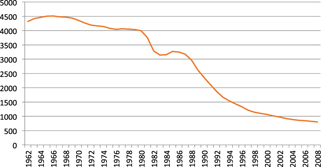
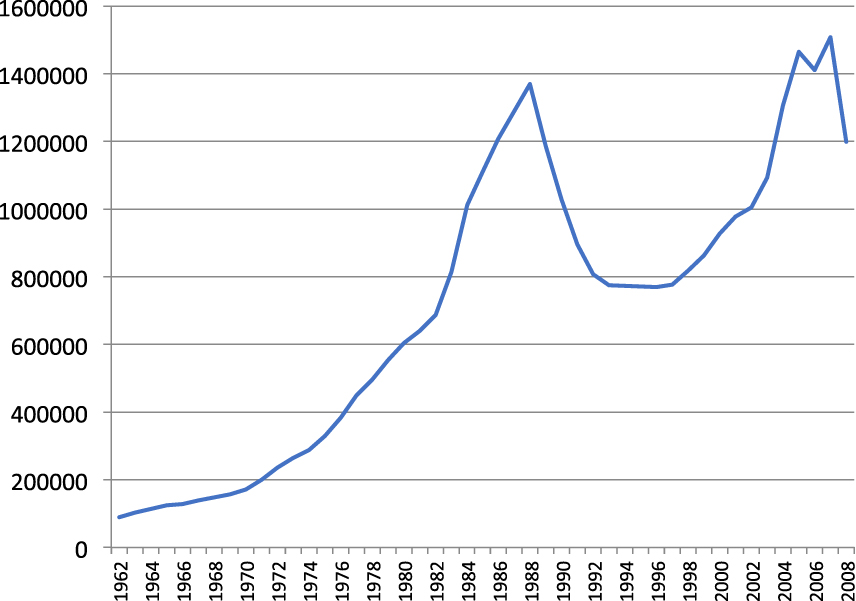
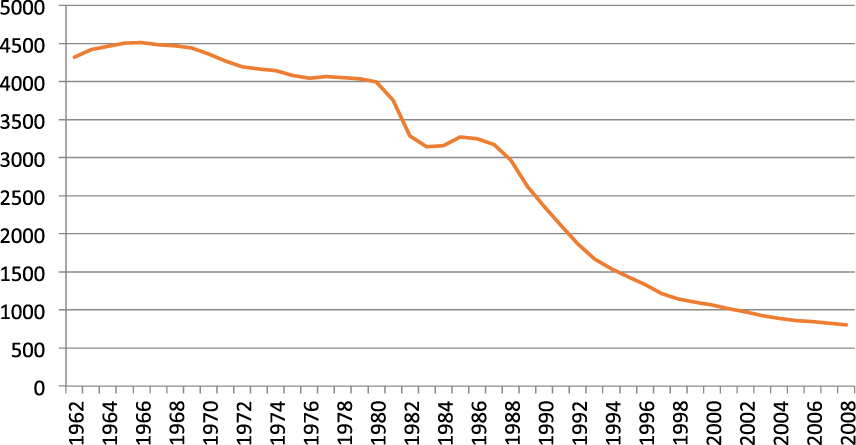
In the years that followed, many S&Ls flipped their charters and operated under state savings bank charters. Many indicated they did so because the thrift agency’s examiners were too tough and its fees were too high. With fewer S&Ls to regulate, the new OTS was threatened with a full merger into the Treasury Department Office of the Comptroller of the Currency (OCC).Footnote 89 By 2002, the number of federal thrifts fell below 1,000 to 994. Figures 1 and 2 show the growth and decline of the thrift industry. Since S&Ls and thrifts funded the OTS by examination fees, each charter conversion cut into its budget. Once again, proposals to merge the OTS with other regulators emerged, but the remaining thrifts fought to preserve their own regulator. Even as it remained distinct, the OTS was forced to reduce its workforce by 20 percent when the industry shrank.
Number of thrifts.
Assets in thrift industry (in millions of $).
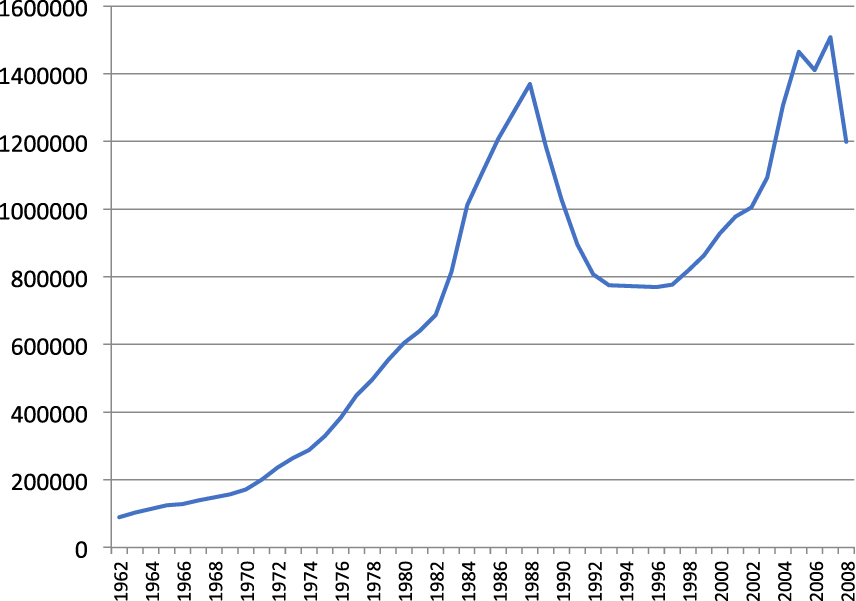
Unlike the SEC, the OTS was eventually eliminated with a provision in the Dodd-Frank reform bill in 2010. It met with little resistance. Why didn’t the private interests return on behalf of exercising regulatory authority in this instance? In short, the thrift industry merged into the others. As it continued to shrink in numbers, it experienced a considerable degree of consolidation. A group of very large S&Ls such as Washington Mutual, IndyMac, and Countrywide Financial remained. In 2000, the boards of America’s Community Bankers (the thrift trade association) voted to merge with the American Bankers Association. What was left of the industry collapsed with the failure of the large remaining thrifts in the 2008 financial crisis. At the beginning of 2006, the OTS oversaw 863 S&Ls with assets of almost $1.5 trillion. By March 2010, the total number of thrifts lowered to 757, yet with assets of only $950 billion as losses were disproportionate to the largest institutions’ failure. Even though the head of the OTS objected to the closure of the agency, there was effectively no independent trade association or industry with an interest in saving it, though a thrift charter survived.Footnote 90
In the case of the thrifts, we see a similar two-step pattern where government intervenes to prevent widespread insolvency, and then the government and private sector developed new expectations with respect to how regulatory authority would be exercised in the future. In this case, the changes in industry and the financial collapse of 2008 undercut future actions because thrifts were no longer segmented within the financial-services industry and represented in Washington as they had been.
The Consumer Financial Protection Bureau: Regulation and the Consumer
The 2008 financial crisis eclipsed the S&L crisis as the “most severe” one to follow the Great Depression. Theories of its cause proliferate.Footnote 91 Almost all explanations, however, include notions of changes in industry practice. Models of bank lending shifted from those wherein the bank issues debt to hold it to those where it issues debt to distribute it to other investors. Hence, the crisis hit both systemic, or bank-to-bank, risk and consumer, or citizen-to-citizen, risk.Footnote 92 Unlike other agencies that acted as promoter and police for industry, the CFPB that emerged from this crisis regulates markets for consumer financial products such as mortgages and credit cards on behalf of consumers in the new regulatory and market environment. Given space limitations and the enormity of the collapse, this retelling of the sequence associated with the 2008 crisis will focus on its consumer aspect and the construction of the Consumer Financial Protection Bureau (CFPB) to regulate it.
The legislative responses that addressed the consumer aspect of the crisis came in two parts: the immediate need to prevent ordinary depositors from losing their assets, and the protracted need to restore routine expectations to those consumers borrowing money and saving for retirement. With respect to the former, the George W. Bush administration infused the financial system with resources in late 2008 through numerous programs, the most politically significant being the Troubled Asset Relief Program (TARP). The Federal Reserve likewise responded with even larger financial resources. With respect to the latter, the Obama administration proposed a new financial agency that would focus directly on consumers. The new CFPB consolidates responsibilities with a specific mandate to accomplish the goal of consumer protection in the financial-services marketplace.
The Troubled Asset Relief Program
Risky mortgage-backed securities were at the heart of the 2008 crisis. As the market for securities grew in the low-interest-rate environment of the early 2000s, investors sought riskier products that paid higher rates of return. When credit dried up and consumer loans went into default, many citizens realized that they had taken on debt that they did not understand and could not handle. In some cases there was outright fraud, but in others, lenders had taken advantages of gaps in the consumer protection system to design mortgages and other financial products that were incomprehensible to consumers and investors as well. The inherent weaknesses of these products contributed to the bankruptcy of the investment bank Lehman Brothers the week of September 14, 2008, after Secretary of the Treasury Henry Paulson and Federal Reserve Bank of New York (FRBNY) head Timothy Geithner failed to engineer a rescue that would not directly use government monies. The same week, insurance giant AIG teetered toward collapse due to weak derivative financial products attached to the mortgage-backed securities. The FRBNY loaned AIG $85 billion and took an 80 percent stake in the firm.Footnote 93
The AIG bailout changed the dynamics of the crisis because it revealed the size of the government’s response that had not been approved by any publicly elected representatives. Members of Congress began to question the degree of discretionary power held by the Federal Reserve.Footnote 94 After the bailout, Paulson and Bernanke met with Christopher Cox of the SEC, Vice President Dick Cheney, and President George W. Bush to seek the legal authorization to purchase the securities in order to remove them from the books of the floundering banks. Treasury would purchase the securities with funds provided by Congress, and not the Federal Reserve.Footnote 95 This change might make the program more politically acceptable.
Thus, in the acute phase of the 2008 crisis, the financial system needed massive infusions of money to replace what had evaporated in the collapse of the housing market. The Emergency Economic Stabilization Act of 2008, which established the Troubled Asset Relief Program (TARP), was one instance where elected officials were forced to take public stands on government bailouts. TARP was only one among a series of bailouts organized by different government agencies in response to the massive amounts lent by the Federal Reserve. Oversight of the TARP program provided a public forum for the disclosure of the government’s activities and justification for action.
The Economic Stabilization Act went through two rounds in Congress. The first version did not pass. The effect on financial markets was immediate. Stock prices dropped, with the Dow Jones Industrial Average going down 777.68 points, its biggest drop in a single day. The OTS seized Washington Mutual (WaMu), then the largest bank in U.S. history to fail. Provisions were added to the bill in order to secure its passage. When it did pass, the stock market turned around. The original intent of the bill was that the Treasury Department would purchase problem assets from the troubled institutions in order to reconcile their balance sheets. Once created, the program inserted money directly into the banks by purchasing stock.Footnote 96
The Consumer Financial Protection Bureau
Barack Obama was elected president six weeks after the passage of the Emergency Economic Stabilization Act, and the Democrats retained control of the House and Senate. As the crisis wore on, anger over the original rescues and collapsing economic circumstances led to calls for longer-term solutions that would restore confidence in the system. The idea for a CFPB came from Harvard law professor Elizabeth Warren, the principal staff member for the 1994 National Bankruptcy Review Commission. Warren was selected to chair the congressional oversight panel and grew in national prominence in her role. In addition, a network of organizations had promoted consumer protections in banking. They created a new group, Americans for Financial Reform, to try to counter industry groups’ lobbies that were trying to limit reform.Footnote 97 Other early supporters of the proposal included Senator John Edwards (D-N.C.) who was a Democratic candidate for president at the time, and Hillary Clinton (D-N.Y.).Footnote 98 Barney Frank (D-Mass.), the chair of the House Committee on Financial Services, was more skeptical and preferred to allow state governments to provide protection. However, once he was convinced, he became an advocate for the proposal.Footnote 99
When the Obama administration released its legislative proposals to reform the financial system, a consumer agency was one major element.Footnote 100 The proposal was not well received. In addition to the American Bankers Association (ABA), those objecting to some aspects of the proposal included the Federal Reserve and FDIC. They would lose their consumer-protection functions should they be transferred to the new agency.Footnote 101 Sheila Bair of the FDIC suggested that a five-person board—including two bank regulator representatives—run the new agency and share responsibility with the regulators for examinations and enforcement of rules on banks.Footnote 102 The ABA saw it as a new federal bureaucracy that would harm the safety and soundness of insured depository institutions. Ed Yingling, the ABA’s head, sought to mobilize the community banks to lobby their own members.
The Independent Community Bankers of America (ICBA) felt differently. While the membership of the ICBA and ABA overlapped, the ABA’s identity was more homogenous since it did not include the large Wall Street firms.Footnote 103 In Robert Kaiser’s telling, they resisted their association with the large firms that had, in this view, caused the financial crisis.Footnote 104 When hearings were held on the idea for a consumer agency, the ICBA head did not testify and reminded the committee chair that only the ICBA spoke for community banks.Footnote 105 When the drafting of the CFPB progressed, Frank and Cam Fine (the ICBA head) brokered a compromise that would limit the jurisdiction of the new agency’s examiners to larger banks. Its supervisory authority would extend only to banks whose assets exceeded $10 billion, and eliminated all but four of the banks in Fine’s organization. Although rules of the agency would apply to banks of all sizes, the traditional regulators would enforce those regulations at the smaller banks.Footnote 106 Frank neutralized one of the most influential interest groups by making them a partner.
In addition to supervision, preemption was another contentious issue during the drafting stage. Preemption is a legal term referring to the displacement of U.S. state law by federal law. With many federal and state regulators, banks operating across jurisdiction do so with the understanding that federal law takes precedence over state laws and regulators. As initially drafted, the consumer agency would have left national banks subject to the individual jurisdictions. Hence, the states could write different consumer protections than those in federal law. However, national banks lobbied heavily on this issue and won. The New Democrat Coalition in the House—sixty-eight moderate members—argued that it was inefficient for so many different sets of rules to function.Footnote 107
New opposition emerged when the bill moved to the Senate and interests debated where to place the new agency within the federal bureaucracy. At first, Senator Christopher Dodd (D-Conn.) appeared willing to consider strengthening a consumer-protection division of an existing federal agency.Footnote 108 He later supported the idea of making the new agency a division of the Federal Reserve. It would be funded automatically using a percentage formula from the Federal Reserve, and not subject to an annual congressional appropriation. The director would have wide discretion to run the agency. Hence, the new agency would technically be a part of an existing regulator, but with the same autonomy as an independent agency.Footnote 109 The eventual Senate version directed it to be housed at the Federal Reserve.
There were differences between the House and Senate versions, chiefly over its independence and who would be subject to its rules. Both versions allowed state consumer financial protection laws to be preempted. The final version placed the new agency in the Federal Reserve and exempted auto dealers. It would be “independent” in a new way insofar as its budget would not be subject to the annual congressional budget process. However, its director would report only to the president (who could remove them from office), and not to a board along the lines of the SEC.
The Independence of the CFPB Following Its Creation
Once the Dodd-Frank Act passed, the immediate question turned to who would become the first head of the CFPB. The relevant interest groups did not miss the significance of the choice. Just as Franklin Roosevelt had faced a political dilemma over appointing Joseph Kennedy to head the SEC, or George H. W. Bush over Wall and then Ryan at the OTS, Obama faced pressure from advocates of the agency and its opponents. Consumer groups had lobbied heavily for Warren, who had advocated for a bureau at the outset. Her appointment was bitterly opposed by industry. In September 2010, President Obama appointed Warren as the Assistant to the President and Special Adviser to the Secretary of the Treasury on the CFPB, rather than agency head, to avoid an unpleasant Senate confirmation process.Footnote 110 The position of director remained open.
Republicans took control of the House in the next Congress. Unhappy with the provision for the bureau in the bill, they sought to change its structure substantively, by subjecting it to the annual appropriations process and altering the authority of other regulators over which regulations the bureau will issue. Spencer Bachus (R-Ala.), chair of the Financial Services Committee, introduced a bill to establish a five-member board of directors for the agency in place of a single director. Forty-four Republican senators wrote Obama in May 2011 stating that they would not consider any nominee until the bureau was restructured.Footnote 111 Eventually, Obama put forward former Ohio attorney general Richard Cordray, who had been one of the nation’s leading prosecutors of the financial industry. However, on September 6, when Cordray appeared before the Senate Banking Committee for his confirmation hearing, the Republican senators affirmed their pledge to block any nomination until their demands were met.Footnote 112 Eventually, Obama installed Cordray as director through a recess appointment. The Senate confirmed Cordray as part of a bipartisan effort to avert a showdown over filibuster rules, ending the more than two-year struggle in July 2013.
Conclusion
These cases demonstrate that since the rise of the regulatory state after the Progressive Era, government must generally confront a financial crisis in two steps where private interests have different stakes and opportunities in the outcome. In the first stage, the system verges on collapse and immediate assistance is necessary. Unlike a war or natural disaster that compels an instant response, government assistance to the financial sector provides assistance to the actors that caused the crisis in the first place. The political calculations change in the legislative process that follows in the next stage. Other bureaucratic actors enter the negotiations in order to secure their place in the outcome. In addition, private actors play a role in restoring some kind of routine expectations about the way regulatory authority will be exercised over all parties concerned.
The time dimension in finance matters to studies of policy history because the administrative agencies that are created to restore confidence in the system reflect differing efforts by large corporate interests at each step. Moreover, each case has seen this two-step process played out in slightly different ways, depending on the fate of the underlying financial-services industry in the interim and the existing bureaucratic context. During the depression, the stock market remained at historic lows despite a few momentary surges. In the first case, the SEC charted new ground in regulating the industry at the federal level and was created as a legislative compromise. Industry viewed the SEC as a way to restore confidence in the market. In the second case, during the S&L crisis, failing thrifts were carried along despite a lack of adequate funds in the FSLIC deposit insurance scheme. The OTS was created out of the failed regulator, the FHFB, and placed at Treasury in an attempt to “punish” it. Yet the industry continued to decline. In the third case, during the 2008 crisis, a series of programs through the Federal Reserve, FDIC, and Congress, namely TARP, kept the immediate crisis from causing a complete collapse. The interim period allowed the industry to partially recover, but the recession that followed and sustained public attention propelled the Dodd-Frank reform legislation forward.
Each of the three institutions created in these case studies was the product of a political compromise during the legislative process, itself driven by public attention to the government’s initial response, a presidential election, and the perceived need to change the institutions to achieve real success. The SEC could have been placed at the FTC, the thrift regulators could have remained at the FHFB, and the CFPB could have been independent of the Federal Reserve and subjected to the annual budget process. The time lag between the government’s initial response and the legislative phase changes the dynamics of political action. However, the private-sector participants do not necessarily grow stronger in the interval, depending on what happens to the underlying industry in the interim.
In the first case, during the Great Depression, the stock market recovered a certain amount of its value and then crashed again. Therefore, the government did not commit itself to act until the Roosevelt administration took office. The Pecora Commission focused attention on those responsible for business practices on Wall Street. However, when the second stage of securities legislation commenced, the J. P. Morgan hearings had ended. Congressional players and the stock exchanges were able to assert themselves more. The final bill regulating the exchanges passed, but the regulator was not located where Roosevelt preferred in the bureaucracy. In addition, the exchanges exerted considerable influence once they turned the new SEC into an ally.
In the second case, during the S&L crisis, thrifts continued to fail and the industry was divided over the depletion of the FSLIC insurance fund. The government did not infuse cash directly at first but did so indirectly by allowing failed thrifts to remain open and operate alongside healthy ones. The industry was eventually subjected to a new regulatory structure when FIRREA was passed. The good and bad entities were punished the same. And although the industry eventually came to support the OTS as a distinct regulator for S&Ls, it did not support it initially. The regulator was eventually subsumed completely into the Treasury after 2008.
In the third case, during the 2008 crisis, the interim between the government’s initial infusion of cash and legislation affected more regulations than just the new CFPB discussed here. Moreover, some political constituencies, such as auto dealerships, were able to extract key exemptions.Footnote 113 Therefore, the shape of the agency was affected by what occurred. However, it is also important to note that during the negotiations for the Dodd-Frank bill, the independent community banks also played a role.
The result of these three cases thus shows that a financial crisis has a distinctive nature compared to other policy areas and is not consistent. Rather, it is contingent on the historical context of existing regulatory arrangements and the structure of the financial-services industry. Additional work in this area would extend the analysis backward in time to explore the relationship between creation of the OCC and the Civil War, the Federal Reserve and the Panic of 1907, and the FDIC and the Great Depression.