“Art is not created by a single will, a single genius. The individual as creator is only a geometric locus of intersecting lines, or forces born outside of itself.”
Viktor Shklovsky—Literature and Cinematography—(1923)In the global transitions away from socialism, cultural production across the former “second world” underwent fundamental changes. As socialist structures of culture fell away, lost influence, or were otherwise felt to be inadequate, a number of new formations began to shape literature. From market forces to independent prizes to online and social media, new aspects of the literary environment changed what it meant to be a writer, while those responding to this new environment reimagined the writer's place in society and the tasks of literature itself. In much of the research on this period of transition, authors are placed at the center of these processes.Footnote 1 They are most often configured as the active agents who understand their environment and make willful decisions about how to navigate and innovate within that environment.Footnote 2 Without denying those authors their agency, this article decenters the writers themselves, in fact it decenters human agency altogether, and instead tells the story of postsocialist literature through a different kind of protagonist: the cultural category of the “bestseller,” specifically, the post-Soviet Russian bestseller.
The term—not translated but simply transliterated as “bestseller,” and used to describe specifically a top-selling book—was adopted into the Russian cultural sphere in the very late Soviet and immediate post-Soviet years. As it made its way into the post-Soviet book market, the bestseller became an essential category in Russian publishing's self-analysis and self-representation. Over a few years in the early 1990s, this category gained cultural prominence and power, transforming the relationships among publishers, readers, and writers and even generating new modes of authorship and collective creativity. Not incidentally, during the same years, the Russian book market began to take on the familiar contours of a capitalist market for cultural goods, beginning to form a system that I call “cultural capitalism,” or, a system of cultural production and consumption based on the capitalistic models of market value, fungibility, and exchange. The marketization of culture, as has often been remarked, is one of the central characteristics of postsocialism not only in Russia, but more broadly across the post-Soviet space, as well as in other transitions away from managed economies from eastern Europe all the way to contemporary China.Footnote 3 Such market transformations—whether in culture or in the broader economy—are generated not exclusively by producers, consumers, or capitalism's exporters. They are the results of more complex rhetorical, material, and institutional interactions. The bestseller as a cultural category plays a central role in these transitions, and examining that role helps reveal the cultural logic of postsocialism in all its complexity.
By focusing on the bestseller, this article aligns itself with early Soviet attempts to produce a literary “history without names,” but instead of denying authors’ roles entirely, I propose a “flat ontology” of literature, or a view of literature that does not assign a priori primacy to any single aspect of the literary undertaking.Footnote 4 Following Bruno Latour's injunction to find where “the structural effects are actually being produced,” I argue that the bestseller emerges as an important locus of such effects in literature, a powerful “mediator” (in Latour's terminology) that translates and transforms effects across new market formations, authors, readers, publishers, and broader social changes.Footnote 5 But more than that, the category of bestseller takes on a power of its own, such that it begins to resemble what object-oriented ontology (OOO) calls a “real object.” For OOO, a “real object” describes any phenomenon that is irreducible either to its constituent parts or to its effects (without necessarily implying the materiality or “thingly” character often associated with the word “object”).Footnote 6 Analogously, the bestseller as a postsocialist cultural phenomenon is irreducible to the actual bestselling books that comprise its rankings, and it is also more than simply its effects on the rest of literature. It has an essence all its own, and the emergence and lifecycle of that essence is the subject of this article. Conceptualizing the postsocialist bestseller in this way, I argue, suggests the methodological potential of a “flat ontology” of literature, one that recognizes not only writers, readers, and publishers, but also cultural categories, social changes, and, perhaps most important, literary works themselves, as real objects with both immanent agentive power and a real essence irreducible to their constituents or effects.
This approach is particularly fitting for analyzing Russia's postsocialist transformation for several reasons. First, the transition to a market-based cultural industry was so rapid and chaotic that a category like the bestseller was quickly able to exercise significant influence through its promises of objectivity and rationality as reliable ways of understanding and responding to market forces. Second, the transition in general, and the bestseller specifically were so hotly debated that they left an abundance of published traces over a relatively short period of time. Third, socialism had explicitly endowed terminology with revolutionary power (mobilized especially in ubiquitous propaganda slogans), while the more recent longing for a western lifestyle energized foreign terms with a connection to what post-Soviet Russians called “normal countries.”Footnote 7 These two somewhat conflicting legacies of socialism intersected in terms like “bestseller,” giving western-inflected market terminology a transformational, almost revolutionary power in the post-Soviet transition. Terms like bestseller seemed able to exercise an active power over human and institutional actors, such that they could reconstitute the relationships among those actors. Something so apparently small as a cultural category proved able to exert active influence over the transition happening around it. As a methodological intervention, this article argues that a cultural category can reconstitute its environment to make itself feel at home. A category can create a system, and not just the other way around.
In what follows, I take the term “bestseller” as my case study as I investigate the active power of cultural categories.Footnote 8 I begin by tracing early uses of the term as it entered the professional (and professionalizing) lexicon of the late- and post-Soviet publishing industry. Through the pages of trade publications and other periodicals, I trace how the term transformed from a relatively empty signifier, indicating vague notions of quality and imagined reader interest, into a statistically-substantiated index of consumer demand. I argue that this transformation, which took place between 1991 and 1994, coincided with and energized larger trends within Russian cultural analysis. Those trends reoriented the terms of cultural and artistic evaluation away from expert opinion and towards popular acclaim and restructured the book market around the new category of the bestseller. Just as the bestseller reached its “maturity” as a cultural category and gained statistical substantiation, it also became a site of contestation on which Russian literature's ambivalence about cultural capitalism was staged. Bestseller lists in the mid-1990s sometimes include a subcategory of “intellectual bestseller” alongside more traditional subcategories, while the very term itself energized critiques of the marketization of culture (at times informed by the legacy of Soviet Marxism). In the second half of the article, I turn to how the bestseller, along with the new book market it had formed, changed not only economic, but also aesthetic practices across the literary world. The category of bestseller, I demonstrate, legitimized the import of mass literature, while the pursuit of homegrown bestsellers cultivated new practices of imitation, innovation, and parody on the basis of imported genre models. I conclude with the launch of “The National Bestseller” literary prize in 2001, which both extended the meaning of the term to include literary fiction with higher cultural aspirations, and, at the same time, emptied the term of its statistical content. As such, the National Bestseller represents the apotheosis of the bestseller—both its detachment from a real-world foundation in statistics and simultaneously its expansive rhetorical power.
The Bestseller as Post-Soviet Import
In the early 1990s, The Book Review (Knizhnoe obozrenie), the major trade publication of the book industry throughout the late- and post-Soviet years, brought a host of new terms into Russian publishing. Nearly every week, the paper published an “operational glossary” (operativnyi slovar΄), a set of terms useful for business in the field. The first such section, published in February 1991, almost a full year before the official end of the Soviet Union, includes several entries borrowed from English market terminology, such as konversiia (“conversion”), privatizatsiia (“privatization”), and reiting (“rating”), many of which would become important for understanding and articulating not only the book market, but also the larger economy, in the years to come.Footnote 9 The introduced terms were not only operational, they were aspirational, describing a book business that had not yet formed. Perhaps no other term was as influential in forming that business as the term “bestseller.”
The term cannot be found in any of the major Soviet-era Russian-language dictionaries, though it did appear occasionally in Soviet publications.Footnote 10 It was used sparingly and exclusively applied to foreign books, but its use grew slowly in the last years of the Soviet Union.Footnote 11 Thus, when the term came into broad use in the early 1990s, it was not entirely new. Nevertheless, The Book Review found it necessary to provide a precise definition when introducing the term in early 1991:
BESTSELLER [Engl. bestseller <best> best, big, biggest of all + sell to sell]—in a number of countries, especially in the USA and England, the most salable book printed in a large print run.
The Dictionary of Foreign Words. 15th ed., corr. (Moscow: Russian Language, 1988).Footnote 12
With its introductory clauses about Anglophone origins and its prominent source citation, this definition defamiliarizes the term for its audience and repositions it as a specifically imported market indicator, one with an intrinsic connection to Anglo-American cultural markets. A short piece of editorial commentary immediately following the definition further exoticizes the term by contrasting the bestseller's native environment (“in other countries”) with the late-Soviet book industry:
Defining the bestseller in our country is a difficult task, almost hopeless. For in other countries the most bought, the most read, the most printed book, and the book most desired for reading, all of these are one and the same concept: the BESTSELLER. With us, all too often one thing is desired for reading, another is read, a third is published, and as for what people buy, well…Footnote 13
This editorial comment posits the word “bestseller” (written in all caps in the original) as more than a measure of sales. The term becomes the central mechanism—akin to a factory whistle or a stock market ticker—that synchronizes production, distribution, and consumption in a mature market of culture. The difficulty in defining Russia's bestsellers, by this logic, is not only a symptom of the book market's broader dysfunction, it also points to the cure. The category of bestseller is framed as the missing node, the lynchpin that could pull the market into sync. If only Russia could clearly define the bestseller, the implication is, then the book market would run much better, much more like its western counterparts. The very introduction of the term here begins to invest it with a power beyond simple mediation in the imagined future book market and endows it with the potency of a real object, able to exert direct influence on the culture on its own terms.
Over the following years, the category of bestseller would develop in precisely this direction: it would become the central concept charged with transforming Soviet literature into a mature market of culture. The envisioned market stood in contrast to late-Soviet publishing, which was governed largely by subjective expert opinion, had few consistent or reliable feedback mechanisms, and showed little interest in measuring statistical success.Footnote 14 The few popularity measures that existed during the Soviet era, such as lists of “Best Books” chosen by readers of various periodicals, were themselves entirely subjective, asking readers what they most valued, not what they actually read or bought.Footnote 15 In this environment, when the term “bestseller” began to gain currency in the early 1990s, its common usage at first implied vague notions of quality rather than any connection to the English term's statistical provenance. The term, for instance, appeared as the title of a section, “Bestseller-91,” which contained information on the publishing industry based not on sales statistics, but on subjective expert opinion. The first piece under the “Bestseller-91” heading is called “The Opinion of Publishers” (Mnenie izdatelei) and asks the heads of various publishing houses “Which books from your press are intended for high reader demand?” The answers are illuminating both for their bold use of the new terminology, and for their lack of interest in statistical substantiation. The first, for instance, reads:
In the category of bestsellers, undoubtedly, will be Treatises on Eternal Peace; the book contains the humanistic works of Erasmus of Rotterdam, John Amos Comenius, Immanuel Kant, Vasilii Malinovskii, and others. Other books, which, of course, will be successful, include the collection Memories of Russian Army Soldiers. 1812, and N. Kostomarov's book Russian History.Footnote 16
What this publisher calls “the category of bestsellers” does not seem to indicate anything about sales. Rather, it seems to stand in for literary quality or some subjective “value” of the text. Other publishers’ answers followed similar reasoning. Some betrayed a continued adherence to a paternalistic model of the book industry: “In our times, when the question of national identity is so important, readers will find it useful to encounter L. Mints's brilliant work One Hundred Peoples, One Hundred Languages”; while others evinced a purely aspirational understanding of book sales: “We hope that our almanac Patriot will become a bestseller,” without apparent consideration for how that status might be achieved or verified.Footnote 17
In the coming years, as the term grew in influence, The Book Review developed statistical indicators that moved away from subjective value judgments and closer to measuring reader demand. Such indicators included “Publishing in the Mirror of Book Statistics,” “The Pyramid of Print Runs,” and most lastingly, the “Hit-Parade of Print Runs.”Footnote 18 These statistics ranked the number of copies appearing over the last month, under the assumption that print runs accurately reflected not only publishers’ expectations, but readers’ actual demand.Footnote 19 Notably, none of them invoked the term “bestseller,” which continued to act as a statistically empty signifier indicating vague notions of attractiveness or literary quality. When the word “bestseller” finally headed up a new rubric in November 1993, it brought with it the post-Soviet book market's first statistics on actual sales numbers. This rubric, “Bestsellers of Moscow,” divided its rankings into fiction and nonfiction, bringing it into alignment with western lists like the New York Times or Publisher's Weekly bestsellers. Not only was the word “bestseller” now imbedded in a more familiar (to the western eye) context, it had also built a data-gathering operation around itself. A methodology note at the bottom of the rankings reads: “The list of bestsellers of Moscow reflects the pace of sales of first edition books and it is compiled from the results of a survey of fifteen bookstores and fifty newsstands in Moscow.”Footnote 20 The imported term “bestseller” had created a system in its new host country to make itself feel at home. More than any individual human agent, the power of the very term bestseller had drawn together bookstores, newsstands, surveys, and data processors into a network that had never existed in Russia before.
As the bestseller developed its data-gathering apparatus, it also revealed some surprising trends in the literary marketplace. Actual reader demand, it turned out, was not always well anticipated by the intuitions of publishers. The new rankings were populated not by the literary, philosophical, and historical works publishers anticipated, but by anonymous novelizations of popular television shows, pulp fiction, self-help, and celebrity biographies. In March 1994, for instance, the bestseller lists showed the leader for fiction to be an anonymous novelization of the popular Mexican telenovela, Simplemente Maria, while the non-fiction leader was Michael Jackson's autobiography Moonwalk: Ili lunnaia pokhodka Maikla Dzheksona.Footnote 21 Neither could be found in that month's “Hit-Parade of Print Runs,” exposing the disconnect between publishers’ expectations and readers’ interests. By revealing the disjunctions between supply and demand, the bestseller made visible the possibility of closing those gaps, and in this way, it began to play the synchronizing role that the editors of The Book Review envisioned when they introduced the term three years before.
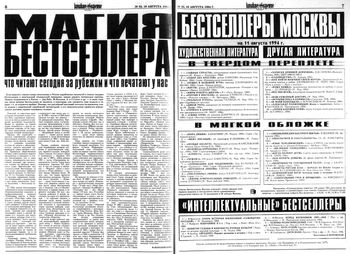
Over the following years, the bestseller lists grew, ballooning from a small notice in a bottom corner to a full-page feature in the middle of every issue of The Book Review. At the same time, the term itself became a kind of gravitational center. The full-page bestseller lists featured the term printed in a font size that rivaled the newspaper's name on the masthead, while opposite the lists ran a series of articles discussing bestsellers, their importance, and how the status of bestseller might be achieved. As the very word “bestseller” physically grew, so did the apparatus around it. By October 1995, another five bookstores and another two hundred newsstands were added to the survey, specific bookstores were named, and the rankings were further disaggregated to indicate hardback and paperback subdivisions within the fiction and non-fiction lists. As the bestseller grew its network, the term came into its closest alignment with its Anglo-American models; both its presentation and its data-gathering apparatus maximally resembled the system for compiling the New York Times Bestseller lists in the pre-Nielsen Bookscan era. One might say, the imported term “bestseller” had refashioned the publishing industry around itself to fit its needs. More than a simple mediator in a dynamic network of exchange, the bestseller as a cultural category had exerted active influence over the formation of post-Soviet publishing. It had shown itself to be a real object, capable of exerting its power to bring the Russian book market into closer alignment with the term's native English-language environment. (See figure 1).
Russian bestseller lists for Aug 16, 1994 on the right, including (from top) hardcover, softcover and “Intellectual” bestsellers. The article facing is titled “The Magic of the Bestseller.”

The power of the bestseller, however, also led to a certain ambivalence about the term and its potentially deleterious effects on cultural production. Concerns about the bestseller's prominence appeared throughout the literary press in the early 1990s, just as The Book Review's apparatus for representing the bestseller developed. The only way to publish intellectual literature anymore, as Aleksandr Potupa pointed out in a 1992 round table published in The Literary Gazette (Literaturnaia gazeta), is to “first publish a commercial book, and then take a risk on one that will bring a loss, but will nevertheless uphold a certain cultural level.”Footnote 22 The problem with this strategy, another round table participant replied, is that it relies on a model of cultural guardianship that many new publishers have abandoned in the naked pursuit of profits.Footnote 23 In hopes of counteracting the power of the bestseller, many in the publishing industry called for government intervention.Footnote 24 These efforts culminated in an International Congress in Defense of the Book (Mezhdunarodnyi kongress v zashchitu knigi), held in Moscow on June 8, 1993, which demanded tax breaks for publishers and a government “program in support of publications with high social and cultural value,” including academic publications and “classical national literature.”Footnote 25 The suggestion of state intervention calls on Soviet traditions of cultural patronage: it implicitly recognizes that the bestseller might threaten certain types of (especially “intellectual”) cultural production and appeals to the state as the only force strong enough to counteract the power of the market. Even if the Soviet legacy informed the terms of these critiques, however, outcomes reflected the wholesale rejection of that legacy. Few state actors participated in these debates, and none had either the appetite or the mandate to intervene.Footnote 26 Instead, the market, as embodied in the bestseller, was allowed more or less free reign. The bestseller, in turn, did not curb its own power, but instead extended its reach, simultaneously expressing and subsuming the critiques advanced.
If many in the book industry saw the tension between intellectual culture and the market as something of a pitched battle in which the market would eventually and inevitably quash intellectual culture, then the bestseller itself presented this tension as something closer to a dialectic. From its very early incarnations, the post-Soviet bestseller did not simply ignore critiques about the death of intellectual publishing, or even attempt to directly overcome them. Instead, in the style of classic Gramscian hegemony, it subsumed them. Just six months after the very first bestseller lists appeared, the two traditional categories of fiction and nonfiction were joined by a third: “‘Intellectual’ Bestsellers.” The new category could include fiction, poetry, drama, philosophy, literary criticism, or general non-fiction, though only of an undefined “intellectual” character. The list published on July 26, 1994, for example, includes all of these categories, with Céline's Journey to the End of the Night (no. 7), Ol΄ga Sedakova's Poems (no. 4), Eugene Ionesco's Theatre (no. 6), the first volume of Edmund Husserl's collected works (no. 3), Iurii Lotman's Conversations on Russian Culture (no. 2), and a book called Winnie the Pooh and the Philosophy of Everyday Language, featuring stories by A. A. Milne and “articles and commentary” by V. P. Rudneva (no. 8).Footnote 27
The “intellectual bestseller” list appeared alongside the bestsellers with varying frequency and used a similar, though more limited, data-gathering methodology, conducting its surveys among only three retailers of mostly academic publications. On its face, the new rubric used the power of the word “bestseller” to bring attention to “intellectual” cultural production. In this way, the appearance of the “intellectual bestseller” rubric seems to argue against critiques that market hegemony over culture would lead to the exclusive production of genre literature, self-help, and pop psychology. If “intellectual bestsellers” can claim cultural prominence just like fiction and nonfiction, the implicit reasoning goes, then the market must be capable of supporting high culture. But even as the “intellectual bestseller” brings difficult poetry, high literary fiction, and philosophy into the same conversation as pulp and genre sales leaders, it imposes the logic of the bestseller onto “intellectual” cultural production. Put differently, the label of “intellectual bestseller” appears to rescue what might have been the victims of the bestseller, but it does so not by asserting their intrinsic value, but rather by labeling them bestsellers in their own right. Instead of clearing space for a system of cultural value that would exist outside of the statistically-substantiated, market-determined paradigm of cultural capitalism (as government subsidies might have done), the bestseller swallows its potential Other, making the “intellectual” publications that might otherwise have fallen outside of a capitalistic paradigm into nothing more than a subcategory of the bestseller.
These combined lists, it should be noted, strayed from the Anglo-American model of bestsellers otherwise largely reproduced (and discussed) in the pages of The Book Review. No equivalent of the “intellectual bestseller,” has been part of British or American rankings. In this way, the inclusion of “intellectual bestsellers” should be understood as a specifically postsocialist phenomenon; however, instead of seeing this development as a concession to the traditions of the Soviet era, or an affirmation of the continuing value of high culture, I would argue that the inclusion of “intellectual bestseller” is actually an assertion of the postsocialist bestseller's extraordinary power. The new category suggests the bestseller's confidence that it can direct not only mass culture, but intellectual culture as well. The combined lists, which apparently present a conversation between mass and high culture, printing the two side-by-side on putatively equal terms, actually effect a fusion of the two, bringing intellectual publications under the market hegemony of mass culture. In this way, the postsocialist bestseller distinguishes itself from its western counterparts not by being domesticated to fit local traditions. On the contrary, emplaced within a society undergoing sweeping and uncertain market transitions, the postsocialist bestseller is invested with extraordinary, almost revolutionary power to impose its logic broadly and indiscriminately. In postsocialism, the bestseller introduces a market logic that pervades not only the book market, but all of literature, and even the broader culture.
By the middle of the 1990s, the new publishing industry, oriented around the term bestseller, had largely replaced expert opinion with statistical indicators as the key metrics of cultural relevance. This postsocialist model of culture—the neoliberal vision that I call “cultural capitalism”—defers to the market not only by lifting restrictions on the production, circulation, and consumption of cultural products, but also by privileging terms like “bestseller” both as apparently transparent reflections of the market and simultaneously as indicators of cultural importance. In this way, the term “bestseller” typified larger trends in postsocialist culture that put almost boundless faith in statistics as an apparently objective measure of social truth. Perhaps best represented by the All-Russian Center for the Study of Public Opinion, (or VTsIOM in its Russian acronym), this statistical turn in broader post-Soviet culture specifically rejected authoritative opinion in favor of broad-based numerical metrics. “Under the conditions of general, acutely expressed and practically ungoverned disintegration” that characterized postsocialism, write Boris Dubin and Lev Gudkov, two of the founding researchers at VTsIOM, only direct statistical data could serve as a “reasonable foundation” for the type of research that would attempt to capture the “workings of the objective Spirit.”Footnote 28 With a goal no less lofty than the Hegelian “objective Spirit,” VTsIOM published a monthly journal of sociologically rigorous public opinion surveys under the tagline “From Opinions Towards Understanding,” which included—among other data such as presidential approval ratings and metrics on consumption habits—surveys of reading preferences, many of which were analyzed and republished in the pages of The Book Review.Footnote 29 Such surveys made pervasive a type of market reasoning that privileged popularity as an implicit proxy for cultural relevance. Within this paradigm, the category of bestseller maintained a special power. By directly reflecting consumption patterns, the bestseller uniquely bridged the cultural field and the capitalist market. In other words, if VTsIOM attempted to divine the “workings of the objective Spirit” through broad statistical analysis, then the bestseller firmly located that “objective Spirit” in the market itself.
The Bestseller as Literary and Social Practice
More than a focal point of postsocialist publishing, the bestseller began to be seen as a powerful cultural force that became an object of investigation in its own right. Several features printed opposite the full-page rankings with titles like “What is the Bestseller?” “Anatomy of a Bestseller,” and “The Life of the Bestseller,” attempted to understand the apparently mysterious potency of the category.Footnote 30 These articles make clear that the bestseller was not simply a tool of commercialization; like a “real object,” it had an essence of its own that eluded the grasp of publishers, authors, and booksellers. According to one article, bestsellers “owe their success to some kind of internal power, inherent in the work and its author .… Neither the writer, nor the publisher, nor the book store can predict which books will sell millions of copies.”Footnote 31 In hopes of a better understanding of this phenomenon, another feature asked readers to write in describing their experiences with a particular bestseller. A letter from a reader named Nadezhda Konstantinovna describes how, after her husband died and her children left home, she began filling her time reading and sharing bestsellers with her neighbors. They would buy books together and pass them around, accumulating a small communal library.Footnote 32 The occasion for her letter, however, is an exception to the general practice of collective consumption:
But as for The Bridges of Madison County by Richard James Walter—each of us has a copy. That is, at first we bought just one copy, but having read the novel, we decided that each should have her own. Why we decided that, it's hard to say. It's just that, when the book is nearby, in the same room, it seems that you're not quite so alone, that you're with friends whom you can tell about the very innermost things in your life.Footnote 33
Another reader, a long-haul trucker named Boris Kudriashkov, had a similar experience with the same novel. He originally intended to give the book to his wife, as he had with other bestsellers, but after he read it, he found himself unable to part with it: “I've read books that were more powerful, better written, more remarkable or interesting. But … the love story of those two not very young people has stayed in my memory as if it were a part of my own life.…For some reason I never gave the book to my wife. It sits there in the truck, traveling with me. Even though, to some, that might seem strange.”Footnote 34
For both readers, The Bridges of Madison County wields a strong affective power that moves them in unexpected and unplanned ways. Both readers hold the book physically nearby as an almost talismanic object; both represent it as something close to human. For these readers, the book seems to radiate a mysterious power that, to borrow from Graham Harman, “runs deeper than any coherent meaning, and outruns the intentions of author and reader alike.”Footnote 35 Harman, a leading theorist of OOO, suggests that literary works should be seen as real objects with immanent power over their surroundings. “Rather than emphasize the social conditions that give rise to any given work, we ought to do the contrary, and look at how works reverse or shape what might have been expected in their time and place.”Footnote 36 Both the bestseller and The Bridges of Madison County act as such real objects in the lives and consumption practices of these readers. Each reader had already formed regular consumption practices around the bestseller, which led to reading this book, but which this book then disrupted. (Nadezhda Konstantinovna's group did not share the book, as usual, but each member bought an individual copy, and Boris Kudriashkov did not gift the book as planned.) But in transcending the category of the bestseller, The Bridges of Madison County reinforces it. The readers thank The Book Review for “convincing me to buy this book,” and promise to continue consuming other bestsellers in hopes of finding the next Bridges.Footnote 37 In this way, the power of the category derives from the particular bestseller, or rather, its various powers derive from various bestselling books. While this feature discusses the particular magic of The Bridges of Madison County, others discuss bestselling imports from John Grisham novels to Gone with the Wind.Footnote 38 The category's power as distinct from any single instance comes in its capacious ability to collect the energies of various artifacts under a single term, and, through that term, to suggest a direct relationship between the particular, irreducible power of specific books and the apparently objective expression of market forces. In this way, neither the category nor any individual bestseller is reducible to the other; both are real objects with real immanent power over readers and the publishing world more broadly. Both have a specific power of their own and at the same time both are essential, mutually reinforcing constituents of the other.
The two sides of the bestseller's power—that of individual books and that of the category—meant that both aspects were simultaneously subject to analysis. While features like “The Life of the Bestseller” examined individual books, many others focused on the category. One such article, titled “The Magic of the Bestseller,” reassured its audience that, even if an individual book's success was unforeseeable, the status of “bestseller,” once generated, could be used to create even more sales.Footnote 39
By attracting the public's attention, books begin to sell well and they land on the bestseller list, which in turn is used in future advertising: additional print runs include the word “Bestseller” or “National Bestseller” on the cover … . The advertising stimulates sales, attracting the attention of buyers and reviewers, and the circle closes. The goal has been achieved—the bestseller has been created.Footnote 40
Leaving aside how the bestseller attracts attention in the first place, this article instead suggests that the category label itself can generate sales. As if in direct response, several publishers throughout the 1990s used the term to launch series under banners like “World Bestsellers,” “Bestsellers of Bygone Days,” and “World Library of the Bestseller,” many of which included works that had never appeared on actual bestseller lists.Footnote 41 In these publishing ventures, the word's mere presence takes on the prescriptive power to make itself come true—or, at least, so hope the publishers.
In such uses, the category of “bestseller”—and not individual bestsellers—is represented as something fungible, whose power can be transferred across contexts without losing value. The Book Review encouraged such a view, printing, alongside its own rankings, bestseller lists from abroad, and category analyses of what makes a bestseller, all under a long-running rubric entitled “Formula for Success.”Footnote 42 While translated works continued to top the charts, the “formula for success” provided a roadmap for the creation of new homegrown bestsellers, largely in imitation of the imports that had proven so popular. Some of these new bestsellers were written by Russian authors who successfully adapted genre conventions to local contexts, but others were produced according to a different formula.Footnote 43 As one article put it, there are certain conditions that facilitate commercial success, which are “easier to predict than the internal strength of an author. They can even be artificially created.”Footnote 44 Among those conditions were the apparent foreignness of settings or characters, a certain “mysterious character” of the author, and seriality (along with recommended levels of sex and violence).Footnote 45 Many in the publishing industry chose to follow this formula, creating a new breed of imitative bestsellers that also gave rise to new creative practices.
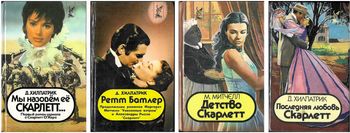
In an article entitled “How We Wrote Bestsellers,” the writer Lev Lobarev describes the rise of collective authorship—a hallmark, incidentally, of early Soviet creativity, but this time for nakedly commercial gain.Footnote 46 Author collectives, like the one Lobarev joined, would produce volume after volume of what sounded like the imported mass literature that was topping bestseller lists at the time. For instance, when the popular Mexican telenovela Simplemente Maria (Prosto Maria, in Russian translation) reached its conclusion, Lobarev's collective produced a work called Forgive Me, Maria! (or Prosti, Maria!), published as a “translation” of a work by an “author” named Amanta Santos. The book spent several months on the bestseller list in late 1994. Another collective, based in Minsk and inspired by the late-Soviet popularity of Gone with the Wind (and the more recent sequel Scarlett by the (real) American author Alexandra Ripley), produced several volumes of (unauthorized) prequels and sequels to Margaret Mitchell's original story, including We'll Call Her Scarlett, Rhett Butler's Son, and Scarlett's Last Love, all released under the pseudonymous and western-sounding name Julia Hillpatrick (Dzhuliia Khilpatrik). At least four of “Hillpatrick”’s works made their way onto The Book Review's bestseller rankings in the mid-1990s. (See fig. 2)
Collectively authored continuations of Gone with the Wind, published under the pseudonym Dzhuliia Khilpatrik.

These collectively authored bestsellers not only represent works that would not exist without the category and cultural apparatus of bestsellers introduced in the years before, they represent modes of creativity, collective behavior, interpersonal interaction, and economic exchange that all found their genesis in the category of the bestseller. In other words, these were not collectivities launched primarily by individual human agency—as a “flat ontology” of literature makes visible—rather, they were induced by the power of the bestseller and the market forces it transmitted. Many authors involved represent themselves as objects acted upon (rather than as agents) as they recall being inspired to new ways of thinking and writing. Natalia Smirnova, for instance, remembers her experience with collective authorship as, “such a broadening of horizons” for her as a writer. The anonymity made it feel like she was taking part in “some kind of game” where she could write from the perspective of a different genre, a different gender, or a different nationality. The “masses of mystification possibilities” opened up creative paths she had never before explored.Footnote 47 For Liliia Gushchina, the “workshop logic” (tsekhovaia logika) of the bestseller made her think about publishing entirely differently. Instead of understanding a novel as a self-contained work of art, she began to think in “production terms” (proizvodstvennye poniatiia): “seriality” instead of “novel cycles,” and literary “projects” instead of works and authors.Footnote 48 Both Smirnova and Gushchina see themselves as being drawn in by a new kind of writing, rather than as forging something new themselves. It is worth noting, too, that Gushchina's word choice here draws on Soviet-era terminology, but it betrays not so much a subconscious reliance on past forms as an acknowledgment of the revolutionary transformations in intellectual labor in the 1990s that were produced by the bestseller, and that invite analogies with early-Soviet revolutionary precedents.
As many of the collectively produced works made their way onto the bestseller lists published in The Book Review, they appeared to demonstrate the bestseller's ultimate reproducibility. The bestseller's mysterious power seemed to be revealed as a formula that could be broken down into its constituent parts and reassembled for profit. But many of these collective works in fact relied on external references for their success. Through their titles, authorial pseudonyms, or seriality, they gestured to either specific bestsellers or other cultural phenomena with proven affective power over their audiences. Titles often either pointed directly towards a known bestseller or advertised themselves as translations of bestsellers from abroad. In this way, even as these collective bestsellers tried to reproduce the “formula for success,” part of that formula was a borrowing, an opening outward toward the affective power of existing bestsellers, foreign authorship, or even the bestseller status of an imagined original.
By the end of the 1990s, the collectively authored bestseller, as well as the well-known rules and limitations of the “formula for success,” became fodder for further creative play. In 2000, the Russian writers Viacheslav Rybakov and Igor΄ Alimov created the patently ridiculous pseudonym Khol΄m van Zaichik, meant to be a bestselling Chinese author of mystery novels set in an alternate reality. Rybakov and Alimov's multi-volume project, titled The Eurasian Symphony, indicates how the naked profit motives of earlier author collectives could be turned into irony and postmodern play not by clearing away the structures built in pursuit of the bestseller, but on the contrary, by relating self-consciously to the implicit deceit of those structures. The Khol΄m van Zaichik series, for instance, lists the actual authors as “consultants” on the Russian translation, and includes an extensive “translator's introduction,” which provides a detailed intellectual biography of the “late van Zaichik.”Footnote 49 A website created for the series even includes credulous reviews from independent outlets that apparently took van Zaichik at face value as the novels’ true author.Footnote 50 Such authorial strategies develop the aesthetic (and not just commercial) potential of both the foreign pseudonym and the absent original. If the authors behind “Dzhuliia Khilpatrik” and “Amanta Santos” hoped that readers’ belief in their foreignness (and foreign success) would drive sales, then those behind “Khol΄m van Zaichik” had different goals in mind. The references to the “original” Chinese author (and his bestseller status) were not meant to be believed, otherwise the true authors likely would not have included their own names so often and so prominently. In the case of van Zaichik, the references to a self-consciously imaginary and therefore inaccessible original had the effect of deferring meaning, creating depth, and opening up space for play with genre conventions. In a similar way, Alimov and Rybakov's patently false pseudonym transformed the created authorial persona from an act of profit-seeking misdirection into an integral part of a carefully crafted aesthetic object.
Deferred meaning, genre play, and imagined authorial personae—each of these elements was developed (at least in part) through the practice of creating formulaic, often collective bestsellers. But given a self-conscious twist, each became an intentional aesthetic effect that would give Russian postmodernism—which had been developing throughout the late-Soviet period—its specifically postsocialist incarnation. Indeed, the authorial strategies developed through parodies like Khol΄m van Zaichik also informed much more influential works of the era, perhaps most prominently those of “Boris Akunin,” the pseudonym of literary critic and scholar Georgii Chkhrtashvili. Akunin appeared in the late 1990s with a professionally designed website that presented him as an author not from elsewhere, but from another time (the footer on an early website read, “© Boris Akunin, 1856–2001”).Footnote 51 His mystery novels combined genre tropes from imported mass literature with references to nineteenth-century Russian classics, and they became emblematic of the kind of “light” postmodernism that dominated mainstream Russian fiction throughout the early 2000s. Though analyses of post-Soviet literature often mention Akunin and other similar writers, few follow their roots in the 1990s bestseller to broader arguments about the bestseller's pervasive influence.Footnote 52 In fact, surprisingly few accounts of Russian literature or culture in the 1990s and 2000s grapple with the economic realities of postsocialism or the introduction of capitalist markets of culture.Footnote 53 This is particularly remarkable when such analyses mobilize the terms of postmodernism and specifically cite thinkers like Fredric Jameson and Jean-François Lyotard, for whom postmodernism is inseparable from capitalism.Footnote 54 More often, accounts of post-Soviet literature focus on the discursive legacies of the Soviet Union, including pervasive propaganda, logocentrism, and the manipulability of the historical record.Footnote 55 These legacies are indeed essential to a full understanding of postsocialist culture, but they are not sufficient. Any analysis that attempts to understand literature's specifically postsocialist manifestations cannot ignore the economic aspects of culture, the formation of what I have been calling cultural capitalism. The postsocialist transition was at least as much economic as it was political or ideological. The immediate and long-term effects of capitalism were both more jarring and more transformational than the shift from single-party communism to putative democracy. For a full understanding of postsocialist literature, it is essential to consider the effects of capitalism on both the economics of literature and on its aesthetic forms and content. An economically grounded consideration of 1990s–2000s literature in Russia shows that many of the aesthetic forms and concerns of post-Soviet Russian literature emerge from direct engagement with the writing and publishing practices associated with the bestseller. In unexpected but powerful ways, the development of cultural capitalism—embodied in the bestseller—has influenced not only the economics, but also the aesthetics of literature. Put differently, the cultural logic of postsocialism derives, in large part, from the logic of the bestseller.
Conclusion. The Apotheosis of the Bestseller
By the early 2000s, the bestseller's influence had become so pervasive that even authors with more lofty literary aspirations experimented with its major tropes of seriality, genre conventions, and historically- and geographically-distant settings. Leonid Yuzefovich, for instance, an “intelligent, refined, and artistic” author (according to one critic) who wrote under his own name and was seen as a writer of “serious literature,” published work in the 1990s and 2000s that bears all the traces of the bestseller's influence.Footnote 56 A 2000 novel called The Prince of the Wind, to take one example, was the last in a series of nineteenth-century murder mysteries starring detective Ivan Putilin. This installment features a cameo by Ivan Turgenev and includes a secondary plotline that explores social upheavals in Mongolia at the time of the 1917 revolution.Footnote 57 Aside from its obvious borrowings from genre conventions (often via Akunin), this novel is remarkable because it presents a refracted and distanced vision of the Russian Revolution within a murder mystery, using the trappings of the bestseller to explore aspects of postsocialism's historical trauma. In this and other works, the genre conventions developed under the economic conditions of cultural capitalism begin to inform and shape the ways that postsocialism represents itself and how it works through its most pressing historical, cultural, and social issues. Though this is only one of many novels to combine aspects of the bestseller with literary aspirations and serious content, I mention Yuzefovich's The Prince of the Wind specifically because it was also the first winner of a new literary prize in 2001: the “National Bestseller.”
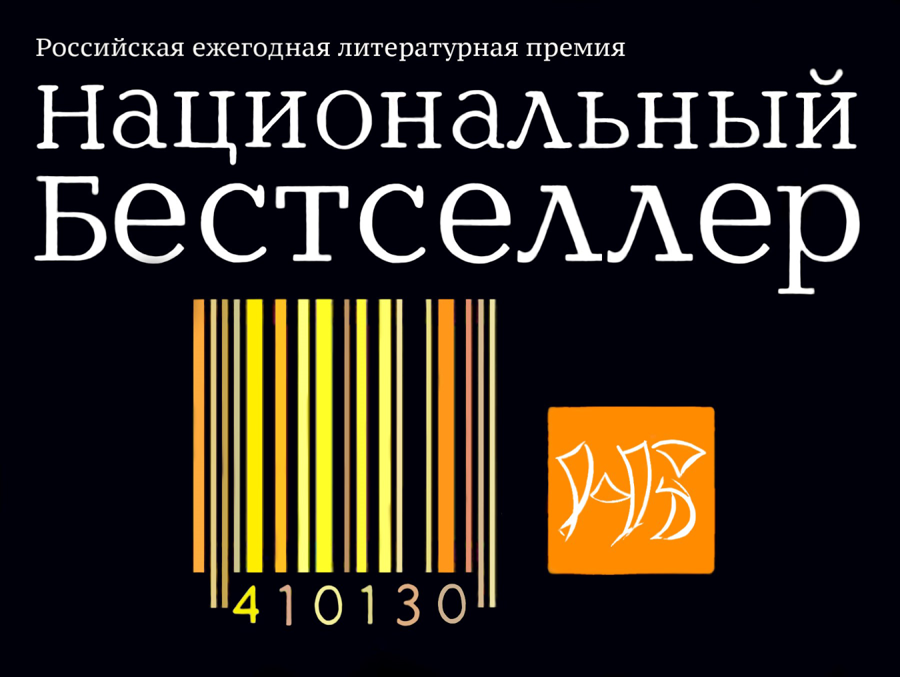
Unveiled with a logo that was simply a barcode, the prize was established explicitly to bring the cultural capitalism of the book market into contact with high-brow literary fiction, raising market principles to a new level of cultural prestige. Despite its name, the award did not recognize the year's bestselling book. Instead, it chose a winner based on merit, and then aspired to make that book into a bestseller. Along with the prize money, the laureate was promised a print run of at least 50,000 copies and an intensive multi-media advertising campaign aimed at the kind of market manipulation thought necessary to manufacture a bestseller.Footnote 58 Bringing the market logic of the bestseller into prize culture, according to the prize's founder, Tatiana Nabatnikova, was motivated by a “naively revolutionary conviction” that market forces can be manipulated in order to make “real literature” into bestsellers. Nabatnikova continues: “The task, as you see, is imperial. And for that reason contemporary. And most importantly, we have financial structures (not the government!) that are ready to support the development of culture precisely on an imperially broad field, which means that they see in this a higher meaning.”Footnote 59 Though the “higher meaning” Nabatnikova intends is likely one of supporting literary fiction, the resulting “imperialism” is not so much that of high culture as that of the bestseller. In other words, the prize will not help literary fiction overtake the realm of the bestseller, as perhaps intended, but the other way around. By mobilizing the word “bestseller” in its title, the barcode in its logo, and promises of market success for its laureates, the prize becomes an agent of the bestseller's imperialism, colonizing the frontiers of literary fiction for the bestseller, market forces, and the logic of cultural capitalism. (See figure 3).
Original logo of the National Bestseller literary prize, launched in 2001.

Though the prize intended to make bestsellers out of its winners, it often did not succeed. The promised print runs of 50,000 were nowhere near the 500,000–1,000,000 copies needed to top Russian bestseller lists.Footnote 60 As the prize self-consciously pulled literary fiction into the market-dictated realm of the bestseller, it simultaneously began to empty the term of its statistical meaning. The “National Bestseller” of the prize's title was not a statistically substantiated or putatively objective reflection of market forces, but rather the subjective judgment of the experts on the jury. While the prize's attempts at market manipulation seem to institutionalize many of the strategies advocated in The Book Review's “Formula for Success” and other venues, their general failure suggests something else. The term bestseller was no longer seen as a transparent market indicator, entrusted with synchronizing supply and demand in the book industry. Neither was it a statistically significant category to be attained through clever marketing and publishing strategies. Instead, the “National Bestseller” prize makes the term once again into an empty signifier, almost completely detached from statistical content and direct correlation with the market. As in the early 1990s, the term once again represents not a reality of sales, but the aspirations of publishers and prize committees.
Nevertheless, something had changed over the intervening decade. If, in the early 1990s, the term bestseller stood for some normative understanding of prestige and quality that readers should recognize, then by the end of the decade, the term had taken on a distinctly market orientation. It came to mean works that might contain the distilled characteristics of the bestseller: compelling plot (often borrowing from subgenres like mystery, romance, or thriller), seriality, international flair, and a potential for market manipulation. That the term could be applied to prize-winning novels of high literary aspirations meant not only that this market orientation had become pervasive. It also meant that the very relationship between literary quality and the market had changed diametrically. If, in the early 1990s, publishers expected books to become bestsellers because they were good or important, then by the next decade, the National Bestseller prize assumed readers would believe a book was good if it was called a bestseller. Put differently, cultural capitalism had completely flipped the causal vector between the market and literary quality. Instead of quality leading to sales, as had been hoped at the beginning of the decade, by now the “bestseller” imprimatur was used to indicate quality.
Just before the prize was launched, the bestseller lists began to disappear from the pages of The Book Review, appearing first irregularly, then disappearing altogether in June 1999.Footnote 61 The statistical apparatus—which had substantiated the term, brought it closest to its western models, and seemed capable of fulfilling the promise of the bestseller as a powerful synchronizer of cultural markets—had by now vanished entirely.Footnote 62 Nevertheless, the power of the word “bestseller” remained. In many ways, the 2000s became the decade of the bestseller, when the prize bearing its name had the most influence on the literary world, and when the term was discussed most actively and market metaphors were most often invoked in book reviews and literary essays.Footnote 63 In this way, the bestseller's statistical debasement coincided with its rhetorical spread. No longer substantiated by statistics or supported by weekly rankings, the bestseller became a phantom of the now-lost faith in the boundless power of statistics, a specter of the naïve belief in the transparency of markets, and a shadow that pointed to the system of cultural capitalism, a system that it had helped to build and that remained in place.
Throughout the first post-Soviet decade, the postsocialist bestseller was a mediator of sorts, working as a central node that connected particular books, the intricate workings of the market, preferences of readers, and practices of writers, publishers, and others in the literary world. But this mediator was something much more than a transparent connector, and even something more than Latour's nuanced understanding of “mediator.” The postsocialist bestseller was a potent “real object,” irreducible to either its constituent parts or to its position in larger networks of exchange. As a real object, the category exerted a power that went beyond the bestselling books it contained or the human agents around them. The bestseller should not be seen simply as a marketing tool with clear commercial purposes to be manipulated by interested parties (or, like Heidegger's broken hammer—a touchstone of OOO—if it was a tool, it quickly transcended its tool-ness and made itself noticed on its own terms). To recall Harman once again, the bestseller's powers ran “deeper than any coherent meaning, and out[ran] the intentions” of publishers, editors, and authors alike.Footnote 64 The category itself exercised an enormous influence over patterns of production, distribution, and consumption of literature throughout the decade. By suggesting publishing strategies, by introducing creative collectives and genre schema, and by reconstituting reading practices, the bestseller actively shaped the cultural logic of postsocialism in Russia and beyond.
That cultural logic becomes legible in complex and surprising ways through careful attention not only to human agents, but to all the constituents that make up the literary undertaking. A “flat ontology” of literature reveals the power of cultural categories, showing how a term like “bestseller” can absorb streams of authority from surrounding forces (both from individual works and from larger cultural shifts) and in turn can exercise that authority to actively influence a variety of agents—institutional, human, and otherwise. Such a flat ontology can account not only for economic and political forces; it can also trace aesthetic and affective powers as they disseminate through cultural networks, transforming readers’ behavior, publishers’ priorities, and writers’ creative practices. Treating the bestseller as a real object within a flattened network reveals not only how postsocialist culture was actively restructured by the power of an important category. It also provides a more nuanced account of the multidirectional and mutually-constitutive relationships between texts and social formations, creative practices and market demands, and aesthetics and cultural capitalism.