INTRODUCTION
Acute gastroenteritis (AGE) is a leading cause of morbidity and mortality, especially in paediatric age in developing countries (Ramani and Kang, Reference Ramani and Kang2009). In developed countries, it is estimated that AGE affect one-third of the population, children also being the most affected group (Verdu and Riddle, Reference Verdu and Riddle2012). In Portugal, AGE is considered the second most common cause of paediatric hospital admissions (Lima and Dias, Reference Lima and Dias2010), although information concerning its aetiology is scarce. Entamoeba histolytica, Giardia duodenalis, Cryptosporidium parvum and Dientamoeba fragilis are the four most commonly occurring diarrhoea causing parasitic protozoa (Stark et al. Reference Stark, Al-Qassab, Barratt, Stanley, Roberts, Marriott, Harkness and Ellis2011); out of these, G. duodenalis is considered the most frequent (Schuurman et al. Reference Schuurman, Lankamp, van Belkum, Kooistra-Smid and van Zwet2007). Initially, D. fragilis was considered a harmless commensal due to the absence of clinical symptoms in infected individuals. However, an increasing number of reports show that D. fragilis is a potential pathogenic human intestinal protozoan parasite (Stark et al. Reference Stark, Barratt, Robert, Marriott, Harkness and Ellis2010, Reference Stark, Roberts, Ellis, Marriott and Harkness2014), and if a patient with gastrointestinal disturbances harbour D. fragilis and no other pathogen, the parasite should be considered the aetiological agent and the patient treated for this infection (Barratt et al. Reference Barratt, Harkness, Marriott, Ellis and Stark2011). Clinical symptoms associated with D. fragilis include: diarrhoea, abdominal pain, vomiting, fever, anorexia, nausea and flatulence, which usually disappear with the eradication of the parasite (Girginkardeşler et al. Reference Girginkardeşler, Coskun, Cuneyt Balcioglu, Ertan and Ok2003).
The frequency of Dientamoeba varies by clinical groups, as well as the diagnostic techniques used. The frequency in children using light microscopy and culture varies between 0·2 and 82·9%, whilst frequency measured using PCR diagnosis in all types of fecal specimens, from both asymptomatic and symptomatic individual's ranges between 4 and 32% (Barratt et al. Reference Barratt, Harkness, Marriott, Ellis and Stark2011). The aim of the present study was to estimate the frequency of D. fragilis in a cohort of hospitalized Portuguese children presenting with AGE, by multiplex real-time PCR.
MATERIAL AND METHODS
Patients
The study population, comprised of children under 18 years old, were admitted as inpatients to the paediatric hospital of Lisbon urban centre (hospital A) or to the paediatric service of a district general hospital located in the suburban Lisbon area (hospital B), between May 2011 and May 2013, with a diagnosis of AGE. Children who were taking antibiotics at the time of admission were excluded from the study. For each child, a stool specimen was collected in a sterile container and in a transport swab, with gel Cary-Blair (Oxoid, Hants, UK). The specimens were sent to the Infectious Diseases Department of the National Institute of Health, within 24 h of collection. A questionnaire with demographic, clinical and epidemiologic data followed the sample. Ethical approval for the study was obtained from the two ethical committees of the involved hospitals.
Parasite DNA amplification
DNA was extracted with the Specific B protocol, on the NucliSens easyMAG system using the NucliSens magnetic kit (bioMérieux, Marcy l’ Étoile, France). Before DNA extraction, feces samples were pre-treated, by mixing the sample (500 µL) with Lysis buffer 1 (1·5 mL), followed by vortexing and centrifugation at 13 000 rpm, in order to recover at least 200 µL of supernatant fraction, to be used for DNA extraction.
A commercial multiplex real-time PCR assay targeting the 18S-ITS was performed for the qualitative detection and differentiation for G. duodenalis, C. parvum and E. histolytica, with fluorogenic target-specific hydrolysis probes and D. fragilis detection with an intercalating dye followed by melting curve analysis (RIDA®GENE Parasitic Stool Panel, R-Biopharm AG, Germany), according to the manufacturer's instructions. In each PCR reaction, the four DNA parasites were used as positive control and water as a negative control. Within each sample, an internal amplification DNA control was co-amplified for the detection of possible PCR-inhibitions after standardized adjustments of the analysis parameters (RIDA®GENE Color Compensation Kit, R-Biopharm AG) in the LightCycler®480II thermocycler (Roche Diagnostics, GmbH, Germany).
The PCR reactions were performed in a 20 µL reaction mixture consisting of 19·9 µL of the reaction mix, 0·1 µL Taq-polymerase (RIDA®GENE Parasitic Stool Panel, R-Biopharm AG) and 5 µL of template DNA. PCR Conditions consisted of an initial denaturation during 1 min at 95 °C, followed by 45 cycles of denaturation (95 °C for 15 s), annealing and extension (60 °C for 30 s). Fluorescence data were collected at the end of each cycle as a single acquisition. The melting curve program was performed at the end of each reaction and consisted of 60 °C for 5 s, and heating to 95 °C with continuous acquisition (0·14 acquisitions per degree Celsius).
Bacteria and virus detection
The transport swab was used for the detection of other potential aetiological agents, surveyed as follows: (a) multiplex real-time PCR for detection of the enteric virus Norovirus GI and GII, Astrovirus, Rotavirus, Adenovirus and Sapovirus, including an internal control (FTD Viral Gastroenteritis, Fast TrackDiagnostics, Luxembourg), according to the manufacturer's instructions; (b) culture on specific media for detection of Campylobacter spp., Salmonella spp., Shigella, Yersinia and Escherichia coli, and detection of E. coli pathogenicity factors by conventional multiplex PCR (Fujioka et al. Reference Fujioka, Otomo and Ahsan2013).
Statistical analyses
All statistics analyses were performed with SPSS version 22 (IBM®SPSS Statists, Chicago, USA). Results were analysed by the Fisher Exact test, and differences between two proportions were compared. A probability under 0·05 was considered significant. The variables were calculated with their adjusted odds ratios (OR), 95% confidence intervals (CI) and significance levels.
RESULTS
A total of 176 children with AGE were included in the study, 65·3% (115/176) were from the urban hospital, 103/176 children (58·5%) were male and the patients’ mean age was 3·14 years (ranging from 10 months to 17 years). Most of the specimens (144/176; 81·8%) were obtained from children aged between 0 and 5 years and only 32 (18·2%) specimens from children aged above 6 years old.
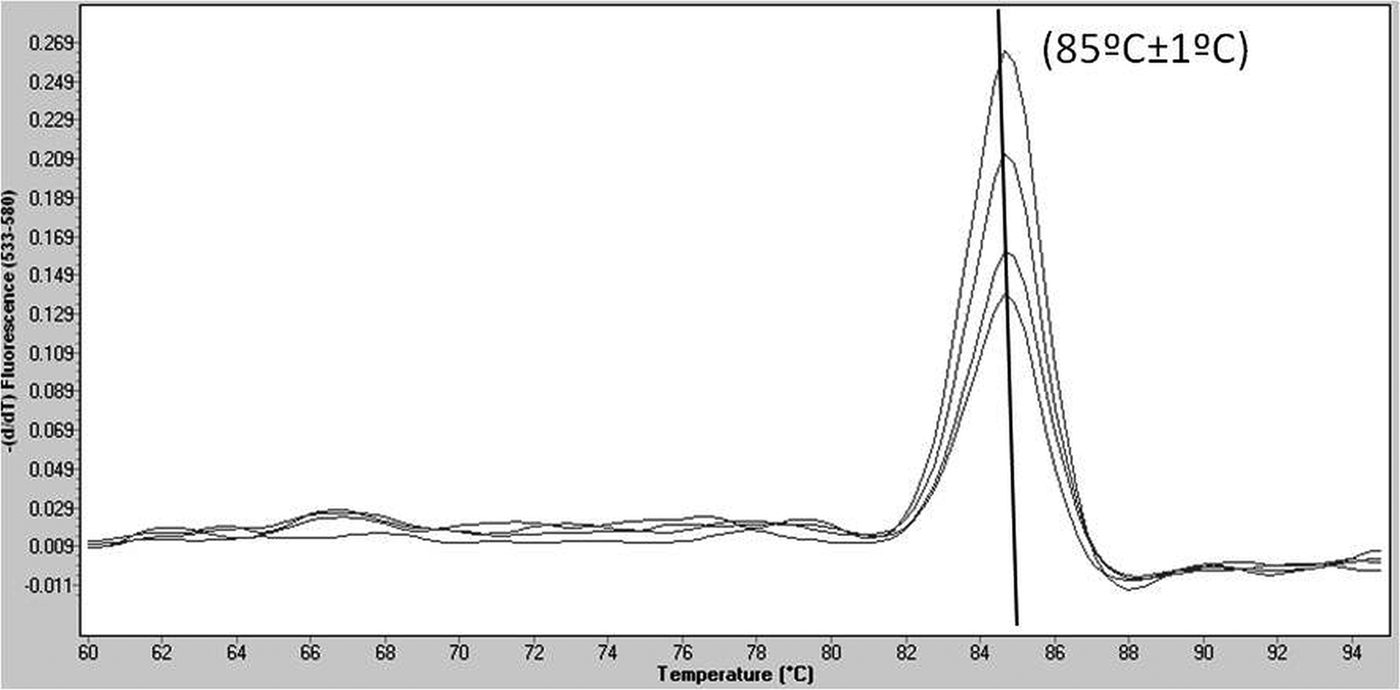
The overall protozoa frequency, detected by PCR, of the four tested microorganisms was 8·5% (15/176), and the most frequently found was D. fragilis (Fig. 1), with a frequency of 6·3% (11/176). Two specimens were positive for G. duodenalis and another two for C. parvum (2/176, 1·1%, for each), while no positive specimens were found for E. histolytica. The four children with positive results for G. duodenalis and C. parvum were aged <4 years old and all presented diarrhoea among other symptoms.
Melting curve analyses of the PCR products obtained from the amplification of the Dientamoeba fragilis DNA with Lightcycler 480. The temperature (°C) is indicated on the x-axis, and the derivative of the fluorescence is indicated on the y-axis. The peaks indicate the melting points of the respective amplicons.

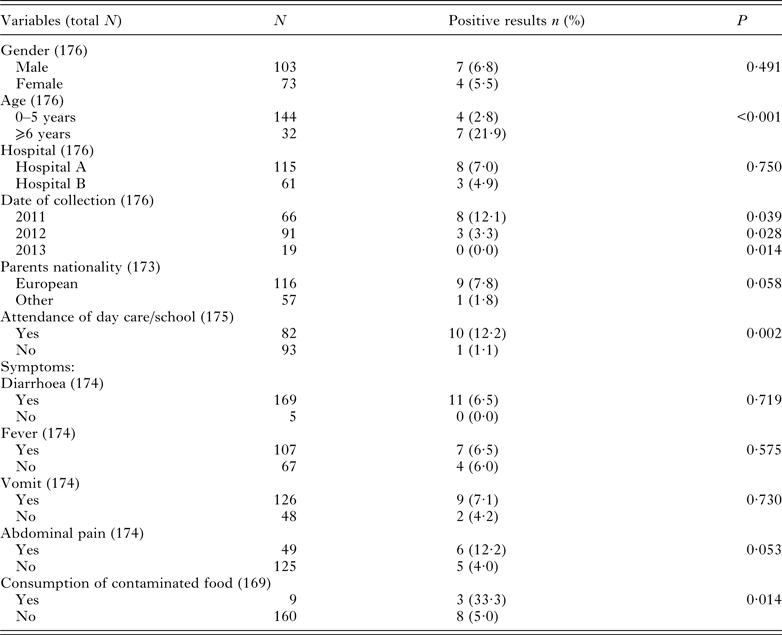
Dientamoeba fragilis was significantly more frequent among older children (⩾6 years) than among younger children (21·9 vs 2·8%, P < 0·001; OR = 0·102; CI = 0·03–0·37). Boys had a higher percentage of infection (6·8%, 7/103) when compared with girls (5·5%, 4/73), with a 1/1·75 ratio, although not statistically significant (Table 1).
Frequency of Dientamoeba fragilis infection according to demographic data and family characteristics

Most of the children (169/174; 97%) enrolled in this study presented with diarrhoea; vomiting (72·4%; 126/174) and fever (61·5%; 107/174) were also reported. Among children positive for D. fragilis those three symptoms were also the most frequent, as well as abdominal pain (28%; 49/174), although none of the symptoms was significantly associated with this infection (Table 1).
Among the other variables analysed, Dientamoeba infection showed to be associated with school attendance (P = 0·002; OR = 12·78; CI = 1·59–102·14) as well as with consumption of certain contaminated foods (P = 0·014; OR = 9·5; CI = 2·00–45·10) such as cakes with crème and ham (Table 1).
A possible association of D. fragilis infection with ethnicity or recent travel abroad was also evaluated, but no correlation was found. Out of the 11 children who tested positive for D. fragilis, 10 were European descent and only one child who tested positive reported a recent travel history to Guinea and Senegal.
During 2011 and 2012, a seasonal trend for D. fragilis frequency was identified, with a higher frequency in the autumn (7/11; 64%) compared with the average for the rest of the year (4/11; 36%).
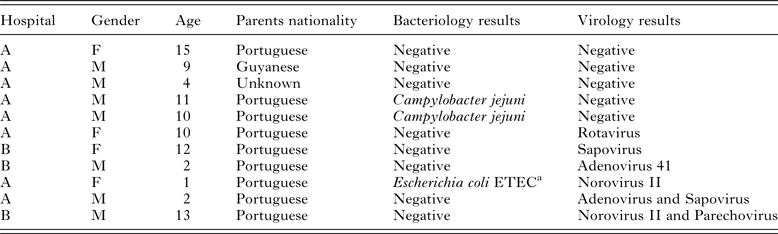
The fecal samples were also tested for bacterial and viral enteric agents (Table 2). Among the 11 positive samples for D. fragilis, three (27·3%) were negative for the other enteric agents. The remaining eight cases were positive for other enteric agents, with the following distribution: two specimens were positive for Campylobacter jejuni, one was positive for rotavirus, one for sapovirus, one for adenovirus 41, one specimen had a co-infection with E. coli enterotoxinogenic and norovirus GII, another had adenovirus 41 and sapovirus and the remaining specimen was positive for both norovirus GII and parechovirus.
Results for bacterial and viral enteric agents among the positive children for Dientamoeba fragilis

a Enterotoxinogenic.
DISCUSSION
To the best of our knowledge, the present study was the first study of diantamoebiasis in Portuguese children hospitalized with AGE. The multiplex real-time PCR protocol is considered an additional diagnostic tool for the rapid, sensitive and specific, detecting the most common protozoa pathogens (Stark et al. Reference Stark, Al-Qassab, Barratt, Stanley, Roberts, Marriott, Harkness and Ellis2011).
In our study, the frequency of protozoa found was high, largely attributable to the frequency finding of D. fragilis. This frequency was higher in comparison with the frequency of C. parvum and of E. histolytica and of G. duodenalis, usually considered the most frequent protozoa.
Nevertheless, the frequency of D. fragilis observed in our study was lower than that observed at several other studies from across the world, including some developed and industrialized countries, with few cases parasite-related outbreaks and, with excellent hygiene standards (Stensvold et al. Reference Stensvold, Arendrup, Mølbak and Nielsen2007). Frequency was recorded as 46% in Denmark (Röser et al. Reference Röser, Simonsen, Nielsen, Stensvold and Mølbak2013), 32·2% in Sweden (Norberg et al. Reference Norberg, Nord and Evengård2003), 66·7% in Italy and 61·9% in the Netherlands (Maas et al. Reference Maas, Dorigo-Zetsma, de Groot, Bouter, Plötz and van Ewijk2013). Comparison with the findings of these studies is limited due to differences in the study design and diagnostic technique used. Similar values of frequency to those found in our study have been reported from Belgium 6·3% (Vandenberg et al. Reference Vandenberg, Peek, Souayah, Dediste, Buset, Scheen, Retore, Zissis and van Gool2006), Italy 6·9% (Lacasella et al. Reference Lacasella, Brandonisio, Capolongo, Marangi and Giangaspero2013) and Tunisia 5·5% (Ayadi and Bahri, Reference Ayadi and Bahri1999) using light microscopy. In Australia, the reported frequency was about 5% using a PCR protocol (Stark et al. Reference Stark, Barratt, Robert, Marriott, Harkness and Ellis2010). At a global level, the large variation on the frequency of D. fragilis reported makes difficult to interpret the results of our study. Nevertheless, our findings suggest that this protozoan should be included in the laboratory diagnosis of diarrhoeal.
Frequency was higher in older children (>6 years; n = 7), most of the cases occurring in children aged between 9 and 12 years (n = 5), following other studies which also reported higher frequency in Dutch children aged between 5 and 14 years (de Wit et al. Reference de Wit, Koopmans, Kortbeek, Wannet, Vinjé, van Leusden, Bartelds and van Duynhoven2001) and in Turkish children between 8 and 15 years (Girginkardeşler et al. Reference Girginkardeşler, Coskun, Cuneyt Balcioglu, Ertan and Ok2003). In common with a large Danish study, frequency in Portuguese children with AGE showed a strong association with age, although Danish children presented a very well-defined peak at 7 years old (Röser et al. Reference Röser, Simonsen, Nielsen, Stensvold and Mølbak2013), while in our study the age ranged between 9 and 12 years old.
Females are more likely to harbour D. fragilis than males (Barratt et al. Reference Barratt, Harkness, Marriott, Ellis and Stark2011) although in children one study report that this protozoan is more frequently encountered in boys aged 16–20 years when compared with females of the same age, a trend which was not observed in our study as well as in other studies (Lagacé-Wiens et al. Reference Lagacé-Wiens, VanCaeseele and Koschik2006). The different distribution of Dientamoeba between genders could be linked to the different roles of males and females in different cultural groups or societies (Barratt et al. Reference Barratt, Harkness, Marriott, Ellis and Stark2011). Our study found that Dientamoeba infection was almost twice as common in males compared with females although the association with gender was not statistically significant.
Co-detection of protozoa occurs relatively frequently especially with Blastocystis hominis (Lagacé-Wiens et al. Reference Lagacé-Wiens, VanCaeseele and Koschik2006; Yakoob et al. Reference Yakoob, Jafri, Beg, Abbas, Naz, Islam and Khan2010; Maas et al. Reference Maas, Dorigo-Zetsma, de Groot, Bouter, Plötz and van Ewijk2013) and to a lesser extent with E. histolytica (Steinitz et al. Reference Steinitz, Talis and Stein1970; Sargeaunt et al. Reference Sargeaunt, Williams, Kumate and Jimenez1980), G. duodenalis and Cryptosporidium sp. (Maas et al. Reference Maas, Dorigo-Zetsma, de Groot, Bouter, Plötz and van Ewijk2013), suggesting a similar mode of transmission (Barratt et al. Reference Barratt, Harkness, Marriott, Ellis and Stark2011). In our study, no co-detection with G. duodenalis and Cryptosporidium sp. was found within the patients and we did not test specimens for B. hominis.
Pathogenic enteric parasites include, among others, Cryptosporidium sp., D. fragilis, E. histolytica and G. duodenalis (Stark et al. Reference Stark, Roberts, Ellis, Marriott and Harkness2014). The most frequent symptoms presented by the infected patients are: abdominal pain, diarrhoea, vomiting, nausea, anorexia, weight loss and fever (Stark et al. Reference Stark, Barratt, Robert, Marriott, Harkness and Ellis2010). There are numerous reports from all over the world reporting an association between D. fragilis infection and various clinical symptoms, most commonly diarrhoea and abdominal pain (Norberg et al. Reference Norberg, Nord and Evengård2003; Johnson et al. Reference Johnson, Windsor and Clark2004; Vandenberg et al. Reference Vandenberg, Souayah, Mouchet, Dediste and van Gool2007). In our study, no statistical association was observed with diarrhoea, vomiting, fever and abdominal pain, although all these symptoms were common among infected children.
The diagnosis of D. fragilis was not associated with a history of foreign travel for the majority of children studied; however, one had a history of travel outside Portugal to Guinea Bissau and Senegal. In addition, with the fact that most of the children are descended from European parents (82%), seems to indicate that most of the D. fragilis infections were probably acquired in Portugal.
The mode of transmission of this parasite is still unknown. Our results indicated a 12 times greater risk of acquiring this infection for children who attend school, suggesting probable human-to-human transmission. Despite further statistical analysis needed, our results are according to Bøås et al. (Reference Bøås, Tapia, Sødahl, Rasmussen and Rønningen2012) also showing that 27% of infected children have a family member with same symptoms. Otherwise, a statistically significant association between the consumption of particular food items and D. fragilis frequency was also found leading us to consider food contamination as a potential source of the parasite.
Seasonality was associated with the risk of D. fragilis carriage in Denmark patients, showing a small increase in autumn (Röser et al. Reference Röser, Simonsen, Nielsen, Stensvold and Mølbak2013). Our study also showed a slight increase in the number of D. fragilis-positive cases in autumn, especially during 2011 and 2012, with no statistical association. The incidence of cryptosporidiosis follows a seasonal pattern in Europe, with a peak during late summer and autumn (ECDC, 2013), it is possible that D. fragilis also follows a seasonal pattern, although further research is needed to confirm this findings.
ACKNOWLEDGEMENTS
We would like to thank to all the dedicated staff of the Hospital Fernando Fonseca and Hospital D. Estefânia and to all the children and their parents for participating in this study. We would also like to thank Inês Costa and João Carlos Rodrigues for having carried out virology and bacteriology analyses.
AUTHOR CONTRIBUTION
C.J. planned, performed laboratory work and wrote the manuscript; C.F. provided epidemiological support and critical revision of the manuscript; R.R. performed laboratory work; M.J.B. and C.E. performed the children inclusion on the study and collected the samples; M.O. was involved with conception of the study and critical revision of the manuscript.
CONFLICT OF INTEREST
None.
FINANCIAL SUPPORT
None.