Introduction
Seabirds are one of the most threatened bird groups in the world, with nearly half of all species known or suspected to be declining (Croxall et al. Reference Croxall, Butchart, Lascelles, Stattersfield, Sullivan, Symes and Taylor2012). Grey petrels Procellaria cinerea Gmelin, like many seabird species, have suffered population declines due to incidental capture in commercial fisheries (Barbraud et al. Reference Barbraud, Delord, Marteau and Weimerskirch2009) and depredation by introduced mammals at breeding islands (Newton & Fugler Reference Newton and Fugler1989, Zotier Reference Zotier1990, Schulz et al. Reference Schulz, Robinson and Gales2005, Cuthbert et al. Reference Cuthbert, Louw, Lurling, Parker, Rexer-Huber, Sommer, Visser and Ryan2013). When introduced mammals have been eradicated from breeding sites, bird populations and communities have typically benefited (Schulz et al. Reference Schulz, Robinson and Gales2005, Ryan & Ronconi Reference Ryan and Ronconi2011, Dilley et al. Reference Dilley, Schramm and Ryan2016).
Introduced mammals historically occurred in all nine island groups on which grey petrels breed (ACAP 2009). Grey petrels are large, winter-breeding, burrowing seabirds that breed on islands in the southern Indian, Atlantic and Pacific oceans and forage pelagically throughout the Southern Ocean, predominantly between 32° and 58°S (Brooke Reference Brooke2004, p. 261, Torres et al. Reference Torres, Sutton, Thompson, Delord, Weimerskirch, Sagar, Sommer, Dilley, Ryan and Phillips2015). Grey petrels have been classified as Near-Threatened (BirdLife International 2012), a Priority Species (ACAP 2009) and Naturally Uncommon (Robertson et al. Reference Robertson, Dowding, Elliott, Hitchmough, Miskelly, O’Donnell, Powlesland, Sagar, Scofild and Taylor2013). Robust population estimates exist for only two of the nine islands at which grey petrels breed (ACAP 2009).
As a winter breeder, grey petrel chicks and eggs are susceptible to high rates of predation from introduced mammalian predators because there are fewer food sources available to those predators in winter (Newton & Fugler Reference Newton and Fugler1989, Cuthbert & Hilton Reference Cuthbert and Hilton2004). For example, cats Felis catus L. on Macquarie Island and Marion Island had a significant impact on grey petrels prior to cat eradication, seemingly extirpating the species completely from Macquarie (Schulz et al. Reference Schulz, Robinson and Gales2005) and severely reducing the population on Marion (Newton & Fugler Reference Newton and Fugler1989). On the main island in the Iles Kerguelen group, Grande Terre, grey petrels are assumed to have been extirpated by the expansion of cats (Say et al. Reference Say, Gaillard and Pontier2002). Norway rats Rattus norvegicus Berkenhout and cats greatly limit the grey petrel population on Amsterdam Island (ACAP 2009). No grey petrel chicks were detected during studies in the 1940s or 1980s on Campbell Island, presumably due to predation of eggs and chicks by Norway rats (Bailey & Sorenson Reference Bailey and Sorenson1962, Taylor, personal communication 2015). Ship/black rats R. rattus L. prey on grey petrel chicks on Iles Crozet (Jouventin et al. Reference Jouventin, Stahl, Weimerskirch and Mougin1984) and are assumed to negatively impact the species on Tristan da Cunha (Angel & Cooper Reference Angel and Cooper2006). It appears that house mice Mus musculus L. are negatively affecting populations on Gough Island (Cuthbert et al. Reference Cuthbert, Louw, Lurling, Parker, Rexer-Huber, Sommer, Visser and Ryan2013).
Introduced mammalian predators have been eradicated from two of the nine islands where grey petrels breed. Cats were eradicated from Macquarie in 2000 (Robinson & Copson Reference Robinson and Copson2014) and all other invasive mammals were declared eradicated in 2014 (Hunt Reference Hunt2014). Cats have been eradicated from Marion Island (Bester et al. Reference Bester, Bloomer, van Aarde, Erasmus, van Rensburg, Skinner, Howell and Naude2002), but mice remain. On Campbell Island, Norway rats were successfully eradicated in 2001 (Towns & Broome Reference Towns and Broome2003).
In the Australasian region, grey petrels breed on Antipodes, Campbell and Macquarie islands (Heather & Robertson Reference Heather and Robertson2015, p. 264). On Macquarie Island a small grey petrel population was rediscovered in 2000, after an absence of 100 years (Hunt Reference Hunt2014). It is noteworthy that grey petrels recolonized Macquarie despite the presence of ship rats. In 2012, surveyors recorded 152 active grey petrel burrows on Macquarie Island (Pyrke & Hunter Reference Pyrke and Hunter2012), and 183 burrows in 2013 (DPIPWE 2013). At Campbell Island, the status of grey petrels 14 years after the rat eradication is unknown. There has never been quantitative data for the Campbell Island breeding population, but Taylor (Reference Taylor2000) suggested the breeding population on main Campbell Island may be up to 100 pairs, mostly located at Eboulé Peak.
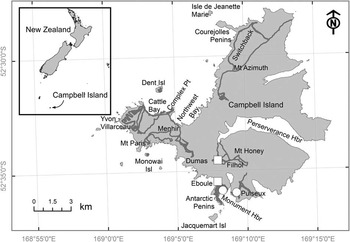
In recent history, grey petrels have been confirmed to breed in only two locations on Campbell Island: the north side of Eboulé Peak and on the upper slopes of Filhol Peak (Fig. 1) (Bailey & Sorenson Reference Bailey and Sorenson1962, Thorpe in Taylor Reference Taylor1986). Possible grey petrel burrows have been observed in other areas but not confirmed, for example on the Antarctic Peninsula (Torr in Taylor Reference Taylor1986), Puiseux Peak (Charteris, personal communication 2015) and Courejolles Peninsula (Amey, personal communication 2015). There are records of high numbers of burrowing seabirds on the offshore islands surrounding Campbell that remained rat-free, for example Dent, Monowai (formerly Lion), Jacquemart and Isle de Jeanette Marie. Although the grey petrel population on these islands is reportedly small (Heather & Robertson Reference Heather and Robertson2015, p. 264), it has not been systematically quantified, similar to the case for the main island.
Grey petrel survey transects (lines) and colonies (white squares/circles), Campbell Island, New Zealand. Squares represent historically reported colonies that are still active. Circles represent colonies not previously reported.

Rats were eradicated from Campbell Island in 2001 and more than a decade has elapsed. Therefore, there has been sufficient time for the grey petrel population to potentially show signs of recovery, both in terms of numbers and area occupied. The eradication of introduced mammals has repeatedly been shown to result in population recoveries of Procellaria burrowing petrels. For example on Macquarie Island, just eight grey petrel burrows were found in 2000, shortly after the eradication of feral cats, but this increased rapidly to 58 in 2003 (Schulz et al. Reference Schulz, Robinson and Gales2005). Spectacled petrels P. conspicillata Gould have increased 5–7% per year since pigs were eradicated in the 1930s (Ryan & Ronconi Reference Ryan and Ronconi2011), and white-chinned petrels on Marion Island have increased 3.3-times since 1973, in which time cats were eradicated (Dilley et al. Reference Dilley, Schramm and Ryan2016). For the conservation management of grey petrels, it is important to quantify to what extent Campbell Island contributes to the New Zealand and global population. It is also of broader interest to investigate recovery rates of Procellaria petrels after a successful eradication of introduced predators. To address this, the spatial extent of grey petrel colonies on Campbell Island and surrounding islets is defined, and a quantitative estimate of the breeding population size has been produced.
Methods
Campbell Island is the southernmost of New Zealand’s sub-Antarctic islands, located at 52°33'S, 169°09'E, c. 700 km south of the New Zealand mainland (Fig. 1). The total area of the island and islets is 11 400 ha and the highest point is Mount Honey at 569 m. The dominant vegetation on Campbell Island consists of Poa litorosa Cheeseman, P. foliosa Hook.f. and Chionochloa antarctica (Hook.f.) Zotov tussock grasslands, Coprosma, Myrsine and Dracophyllum-dominated scrub, and herb fields at higher elevations.
The study group operated from a 15 m yacht during two trips to Campbell Island, anchoring predominantly in Northwest Bay and Monument and Perseverance harbours. Research was conducted during the winter, 12 July–5 August 2014, and continued in January 2015. Grey petrels breed in colonies, so the first aim was to locate breeding colonies and count all burrows in the time available (13 July–6 August 2014). This corresponds to the early chick-rearing phase; therefore, early breeding failures were not accounted for (Parker & Rexer-Huber Reference Parker and Rexer-Huber2016). Nevertheless, grey petrel burrows on Campbell are conspicuous and at least a proportion of burrows from failed breeding attempts were still readily identified. The study group returned to Campbell Island in the summer (19–29 January 2015) and expanded our surveys for grey petrel colonies. While breeding birds are not present at this time of the year, the burrows remain conspicuous. The only potential confusion is with burrows of white-chinned petrels and sooty shearwaters Ardenna grisea Gmelin which breed over summer. Grey petrel burrows are smaller and dryer than white-chinned burrows (Bell et al. Reference Bell, Bell, Sim and Imber2013) and larger than sooty shearwater burrows, but an infrared burrowscope (Taupe, Sextant Technologies, New Zealand) was used to confirm the species present if a burrow was occupied.
Spatial extent
Surveys for grey petrel burrows were conducted by one or two people walking on separate, parallel line transects spaced 20 m apart to locate breeding colonies within historical breeding areas (Table I). Data from parallel line transects conducted by two observers were pooled for analyses. The 2 m transect width was scanned for any evidence or sign of grey petrel burrows. Evidence was considered as any combination of the following: fresh digging or trampled vegetation indicating a potential concealed burrow entrance, conspicuous burrow entrances, seabird guano or feathers on the ground or vegetation, seabird corpses and eggs or egg fragments that may have been expelled from a burrow. Only burrows extending beyond 400 mm (elbow depth) were included because grey petrels do not breed in shallower burrows. As grey petrels are known to use natural cavities such as rock overhangs and caves, all of these were thoroughly inspected during all surveys. If any signs were noted, a 1 ha survey area centred on the burrow was established to determine whether further burrows were present. Any accessible habitat was surveyed in all areas.
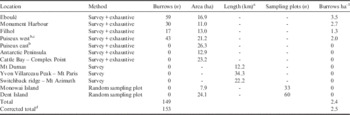
Grey petrel distribution and abundance on Campbell Island.

a Length is the distance of survey line transects, indicating search effort where effort could not be quantified as an area.
b Puiseux exhaustive search not complete coverage of area.
c Two adults found underneath separate rock overhangs.
d Including correction factor of + 3% calculated from validation transects.
Priority was placed on surveying the areas where grey petrels were recorded historically in the southern portion of the island (Fig. 1, Table I). The surveys were then expanded, firstly, to surrounding areas with habitat features similar to known grey petrel habitat (primarily altitude, vegetation type and structure, and aspect) in the south-west of the main island and, secondly, around the main ridge and cliff tops in the north-west of the island (Table I). Thirdly, possible ‘overflow’ areas were surveyed, i.e. habitat on the main island adjacent to offshore islands with high numbers of burrowing seabirds. These overflow surveys were restricted to areas opposite larger islands that have remained rat-free through Campbell’s history (e.g. Jacquemart, Monowai and Dent islands; Fig. 1, Table I) and that reportedly have large numbers of burrowing seabirds (Heather & Robertson Reference Heather and Robertson2015). Finally, the small Monowai (8 ha) and Dent (23 ha) islands were also surveyed in their entirety.
Grey petrels are diurnally active in flight around colonies (Bell Reference Bell2002) and at-sea in areas offshore from breeding colonies (Zotier Reference Zotier1990). Birds in flight over land, or rafts of birds offshore, could indicate a nearby colony. For this reason any grey petrels observed while conducting survey transects, during coastal circumnavigation (within 0.5–2.5 n miles of shoreline) and at anchorages were recorded.
Estimating burrow numbers
To estimate burrow numbers on the main island a combination of two techniques were used: random transect sampling (e.g. Lawton et al. Reference Lawton, Robertson, Kirkwood, Valencia, Schlatter and Smith2006) and exhaustive strip searches (Table I). Because Taylor’s (Reference Taylor2000) estimate of breeding pairs of grey petrels on Campbell Island was not based on quantitative sampling, it was not possible to replicate the survey method used for that work. Exhaustive strip searches were conducted by one person walking strip transects spaced c. 15–20 m apart running parallel across the slope. When walking transects the entire width until the next line was searched for burrows, making the effective transect width 7.5–10 m. For both random transect and exhaustive strip-search methods, transects stopped at the top and bottom of the slope when no further grey petrel burrows were detected on an entire transect spanning the available habitat at that elevation. To estimate a correction factor quantifying the number of burrows missed in strip transects, validation transects were conducted by resampling the area covered in strip transects. Validation transects ran perpendicular to the strip transects or, when the topography was too steep to walk straight up the slope, at a 45° angle. To remove observer bias, all exhaustive searches were conducted by GCP.
The small size of Monowai and Dent islands meant that initial survey to locate burrows before quantifying burrow numbers was not necessary. Exhaustive sampling, as used on the main island, was not an option due to very limited time on the small islands. Therefore, randomized plots were used to sample Monowai and Dent islands (Table I) since replicate line transects would overlap in these small areas. Sampling plots were distributed randomly over each island using a random numbers table and a minimum separation of 20 m. At each plot, all petrel burrows within a 275 cm diameter plot were counted. At least half of a burrow entrance had to occur within the sampling plot for it to be counted.
To determine the proportion of burrows that contained breeding grey petrels (burrow occupancy), the contents of every third burrow found was assessed using an infrared burrowscope. All burrowscoping was conducted by GCP. For the purposes of this study, burrows with eggs and chicks were considered a breeding attempt and thus recorded as occupied. The presence of an adult and whether they were with chicks, eggs or a second adult was also recorded. Hand-held GPS units (Garmin Map 62s and 60Csx) with topographical mapping software were used to record all line transect surveys and strip transects, the start and end or central point of randomized transects, and the locations of all burrows detected.
Results
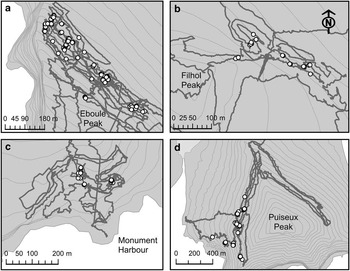
Over a total of 23 days (17 days in winter and six in summer), 124.5 ha of exhaustive search coverage was conducted (Table I) and a total of 219 km of survey line transects were walked (Fig. 2). Grey petrel burrows were found in four areas: the north-east slopes of Eboulé Peak, the northern slopes of Filhol Peak, above Monument Harbour and on the western slopes of Puiseux Peak (Fig. 1, Table I).
Burrows were distributed between 100 and 280 m a.s.l. Field observations suggested that grey petrel burrows were more commonly found on small steep and well-draining spurs dominated by the tussock grass P. litorosa and the fern Polystichum vestitum (G.Forst.) C.Presl. In addition, the tussocks C. antarctica and P. foliosa, interspersed with Coprosma spp. and Myrsine divaricata A.Cunn shrubs, were common in the general altitudinal band associated with grey petrel nesting areas.
During the winter visit, when grey petrels were in the chick-feeding phase of the breeding season, the vessel had 13 anchor nights at Perseverance Harbour, nine nights at Northwest Bay and three nights at Monument Harbour. No grey petrels were observed flying or sitting on the water singly or in rafts at any of these locations. In addition, 54 n miles of coastline within 0.5–2.5 n miles of the shore were surveyed by yacht over a two week period during the mid-chick-rearing phase, and grey petrels were not observed on any occasion. Grey petrels were observed in flight from land on just four occasions, twice in the largest grey petrel colony, Eboulé, and once in each Filhol and Puiseux colony areas. All were recorded from land in the late afternoon.
A total of 149 burrows were found in four colony areas on Campbell Island (Fig. 2, Table I). The mean grey petrel burrow density across all colony areas on Campbell Island was 2.37 burrows ha-1 (standard deviation 0.94, 95% CI: 1.45, 3.30). The Eboulé colony contained the highest number and highest density of grey petrel burrows, with 59 burrows at a density of 3.49 burrows ha-1.
Thirty-three plots were sampled on Monowai Island and 60 were sampled on Dent Island. No grey petrel burrows were found on either island (Table I), although a large number of sooty shearwater burrows (Dent) and white-chinned petrel burrows (Dent and Monowai) were recorded. Grey petrels were not detected in any areas surveyed in the south-west and north of Campbell Island, despite substantial search effort in those areas (Fig. 1, Table I).
Validation transects within exhaustive search areas covered a total of 1.3 km. At Eboulé, one unrecorded burrow was detected during 713 m of validation transects. At Monument Harbour, two burrows were detected from 500 m of validation transects. On Filhol, a single 112 m validation transect did not detect any previously unrecorded burrows. The correction factor, calculated as the total number of burrows detected in validation transects divided by the total number of burrows found in all areas (excluding Puiseux), is therefore + 3% (3/109). This correction factor was multiplied by burrow numbers found to estimate the total number of burrows present (Table I). Overall, 63% of burrows contained a breeding attempt (egg, broken egg or chick; 25/40 burrows that could be fully inspected), and of those, 48% contained chicks alone. Chicks appeared to be a similar age, fully downy and approximately two-thirds the size of adults. Four burrows contained non-breeding adults (two with single birds and two with a pair) and a further four burrows that could not be inspected in full were excluded.
In total, 149 burrows were located with a detection probability of 97% and an occupancy rate of 63%. Therefore, there was an estimated c. 96 (95% CI: 83, 109) pairs of grey petrels in the four colonies located and surveyed on Campbell Island.
Discussion
Despite extensive searches totalling 212 km of survey transects, grey petrels were only found breeding in four areas on Campbell Island. Two were at previously known locations, Eboulé and Filhol peaks, and two were at newly found colonies, Monument Harbour and Puiseux Peak. In total, an estimated c. 96 (95% CI: 83, 109) pairs of grey petrels breed on Campbell Island, including burrow density from the two new colonies, and adjusting for burrow occupancy. Since the only previous estimate of grey petrel numbers on Campbell Island (Taylor Reference Taylor2000) was not quantitative, insight into the population trend for the species cannot be provided.
Our study underestimates the number of breeding pairs since breeding attempts that failed earlier in the season are not included, but data to estimate the proportion of breeding failures prior to survey (at the large chick phase) are not available. It is also unclear if the year of our study was representative of breeding success on Campbell Island. However, chick survival is clearly improved relative to the 1940s (Bailey & Sorenson Reference Bailey and Sorenson1962) and 1980s (Taylor, personal communication 2015), when observations suggested all chicks were depredated by rats.
Campbell Island is a large island (11 700 ha) so it is possible that grey petrels occur in some areas that were not detected. However, no grey petrels were observed at sea or anchorages and only four individuals were observed in flight terrestrially over 24 days on and around the island during the chick-rearing phase. Grey petrels are frequently seen in flight ashore during early and late daytime hours on Antipodes (Bell et al. Reference Bell, Bell, Sim and Imber2013) and Gough islands (GCP, personal observation). Similarly, grey petrel rafts are common in waters close to the breeding grounds on the Kerguelen Islands during the breeding season (Zotier Reference Zotier1990). The absence of grey petrels at-sea and on land over Campbell Island suggests that it is unlikely that large breeding colonies were missed.
Since grey petrel habitat on the offshore islands is spatially limited and survival there was not constrained by rats (rats were only present on the main island), it was expected that there might be a ‘spillover’ of grey petrels to the main island. As such, it was anticipated that prospecting grey petrels would be attracted to existing colonies, where the presence of calling and displaying conspecifics, or other breeding sign, would act as a lure (Brooke Reference Brooke2004, p. 42). Therefore, it is surprising that recently established (or previously unnoticed) colonies were found.
It is not clear whether newly found colonies on Puiseux Peak and at Monument Harbour are new colonies or existing colonies that had not been noticed before. While surveying sooty shearwater burrows, Matt Charteris recorded ‘odd’ looking burrows on the western slopes of Puiseux, with possible grey petrel feathers on the surface, in October–November 1996. This general area was visited regularly by researchers studying southern royal albatrosses Diomedea epomophora (Forster) (Charteris, personal communication 2015). It would be assumed that burrows would have been noted since grey petrel burrows and colonies are conspicuous due to the large burrow entrances and clustering of burrows. However, since southern royal albatrosses nest at a higher elevation to grey petrels the researchers may not have passed directly through the burrowed area so an existing colony could have been missed. Furthermore, the albatross studies were conducted outside of the peak of the grey petrel winter breeding season. Sheep were hunted on the eastern slopes of Puiseux in the mid-1980s, but not on the western slopes where grey petrel burrows were recorded during this study. It seems probable that Charteris discovered the few grey petrel burrows in that area, and that there has been an increase in burrows since. While our surveys on Puiseux were not complete, combined with other evidence (see below) it is unlikely that there are many hundred more burrows in the area.
Historic observations from the offshore islands record large numbers of burrowing seabirds (Taylor Reference Taylor1986). Our surveys of Monowai and Dent islands confirmed high numbers of burrowing petrels, but no evidence of grey petrels. Grey petrels are no longer breeding by January, and the larger burrows on Monowai and on the lower slopes of Dent were very wet, muddy and occupied by white-chinned petrels. However, it should be noted that burrow sharing can occur. Despin (Reference Despin1976) reported a white-chinned petrel in a burrow containing a grey petrel chick, and grey petrels have been found in burrows with sooty shearwaters on Campbell (Bailey & Sorenson Reference Bailey and Sorenson1962) and on Antipodes Island (Bell et al. Reference Bell, Bell, Sim and Imber2013). However, the asynchronous breeding seasons would not allow a burrow to be used by both species in every year. We could not land on Jacquemart Island, so it remains a possibility that grey petrels are present there. However, even if grey petrels are breeding on Jacquemart (19 ha) and burrows are at higher densities than on the main island (3.5–1.3 burrows ha-1), it would not significantly increase the size of the Campbell Island grey petrel population.
As the only winter-nesting burrowing seabird on Campbell Island, chick predation and general interference with breeding by rats would probably have resulted in nil or very low chick survival before rats were eradicated. Breeding success for the summer-nesting sooty shearwater was nil on main Campbell Island in the mid-1980s in the presence of rats (Taylor, personal communication 2015). In the presence of cats, grey petrel chick survival was negligible on Marion Island (Newton & Fugler Reference Newton and Fugler1989). For the closely related white-chinned petrel, higher incidences of divorce and burrow-switching were attributed to disturbance by rodents, leading to missed breeding years (Bried & Jouventin Reference Bried and Jouventin1999). Grey petrels are a long-lived seabird that start breeding late; while age at recruitment is not known, it will probably be similar to other Procellaria petrels (6.1 years in white-chinned petrels, Barbraud et al. Reference Barbraud, Marteau, Ridoux, Delord and Weimerskirch2008, and 7.7 years in the Westland petrel P. westlandica (Falla), Waugh et al. Reference Waugh, Barbraud, Adams, Freeman, Wilson, Wood, Landers and Baker2015). In combination with nil breeding success in the presence of rats, deferred maturity is probably still contributing to the population recovery rate of grey petrels on Campbell after rodent eradication.
Grey petrels on Marion Island have not increased since cats were eradicated in 1991 (Dilley et al. Reference Dilley, Schramm and Ryan2016). It is possible that house mice on Marion Island are attacking grey petrels, given evidence that they attack other winter-nesting seabirds on the island such as wandering albatross D. exulans L. (Jones & Ryan Reference Jones and Ryan2010). In contrast, grey petrel populations on Macquarie Island have recovered markedly since cats were eradicated in 2000, even while ship rats were still present (now eradicated). Grey petrels were rediscovered breeding on Macquarie in 2000 (Schulz et al. Reference Schulz, Robinson and Gales2005). There were 74 pairs in 2007 (ACAP 2009), 152 pairs in 2012 (Pyrke & Hunter Reference Pyrke and Hunter2012) and 183 pairs in 2013 (DPIPWE 2013). Similarly, there has been population recovery in other Procellaria petrels after eradication of mammalian predators (Ryan & Ronconi Reference Ryan and Ronconi2011, Dilley et al. Reference Dilley, Schramm and Ryan2016). The grey petrel population was not extirpated on Campbell as it was on Macquarie, but may be similar in that the Campbell population is also recovering from a very small base. However, further data is required to determine population trends.
In conclusion, the Campbell Island grey petrel population is small 14 years after rats were eradicated from the island. However, it is promising that two previously unknown colonies appear to have established, or possibly expanded, since rats were eradicated. Our work provides a baseline to understand population trends, and adds to the body of understanding of how seabird populations recover following island restoration. Further research into this small grey petrel population is recommended, including tracking studies to compare with the much larger Antipodes Island population, genetic studies and a re-survey to detect population trends.
Grey petrel burrows (white circles) detected during exhaustive strip searches in the four colonies located during surveys on Campbell Island. a. Eboulé Peak, b. Filhol Peak, c. Monument Harbour and d. Puiseux Peak.

Acknowledgements
This work was funded by New Zealand’s National Institute of Water and Atmospheric Research (NIWA) and Department of Conservation (DOC), and conducted under a permit from DOC Southern Islands Area. Carlos Olavarria Barilla, Henk Haazen, Keith Jacob and Penny Pascoe were enormously helpful field assistants. We are grateful to Captain Henk Haazen and First Mates Keith and Kali for excellent transport and hosting on the Tiama. Graeme Taylor, Matt Charteris, Nick Torr, Rick Thorpe, Jacinda Amey and Peter Moore provided valuable historical information. We thank Graeme Taylor and two anonymous reviewers for their efforts to improve this manuscript.
Author contribution
Conceived and designed the study: GCP and DT. Performed the field study: GCP and KRH. Analysed the data: GCP and KRH. Wrote the paper: GCP, KRH and DT.