Introduction
Alzheimer disease (AD) is a progressive and the commonest form of dementia. The course of AD is variable and factors that influence or predict progression are not well understood (Kraemer et al., Reference Kraemer, Tinklenberg and Yesavage1994; Marra et al., Reference Marra, Silveri and Gainotti2000). The ability to differentiate rates of decline would help patients and caregivers plan for future, and physicians plan for appropriate treatment (Gauthier et al., Reference Gauthier, Vellas, Farlow and Burn2006). Disease progression is measured, most commonly, by change in cognition over time (Kraemer et al., Reference Kraemer, Tinklenberg and Yesavage1994; Marra et al., Reference Marra, Silveri and Gainotti2000). However, clinical and neuropsychological measures may lack sensitivity to change, are subject to day-to-day variability, and are influenced by behavioral fluctuations and inter-current illness and medications (Sluimer et al., Reference Sluimer2008).
Olfactory dysfunction in general and impaired odor identification in particular have been reported in AD and are found to be occurring at early stages of the disease (Mesholam et al., Reference Mesholam, Moberg, Mahr and Doty1998). It has been indicated that involvement of the olfactory bulb and tract is one of the earliest events in the degenerative process on the central nervous system in AD (Christen-Zaech et al., Reference Christen-Zaech2003) and also that tau pathology in the olfactory bulb increases with severity of AD (Attems et al., Reference Attems, Konig, Huber, Lintner and Jellinger2005).
There are no published reports of smell identification in AD which have failed to find deficits relative to healthy elderly (Rahayel et al., Reference Rahayel, Frasnelli and Joubert2012). Smell identification tests have demonstrated high sensitivity and specificity for detecting Alzheimer's patients from controls (Morgan and Murphy, Reference Morgan and Murphy2002). Olfactory dysfunction has been suggested to be included in the diagnostic criteria of AD (Foster et al., Reference Foster, Sohrabi, Verdile and Martins2008). However, a recent systematic review concludes that although there is evidence suggesting an association between decreased olfaction and AD, rigorously designed longitudinal cohort studies are necessary to clarify the value of olfactory identification testing in predicting the onset of AD (Sun et al., Reference Sun, Raji, Maceachern and Burke2012). A recent meta-analysis (Rahayel et al., Reference Rahayel, Frasnelli and Joubert2012) suggests that AD even more than Parkinson's disease (PD) affect more strongly smell identification and then smell detection, suggesting that AD patients are more strongly impaired on higher order olfactory tasks involving specific cognitive processes.
Studies have reported association between olfactory impairment and subsequent cognitive decline (Wilson et al., Reference Wilson, Arnold, Tang and Bennett2006; Reference Wilson, Schneider, Arnold, Tang, Boyle and Bennett2007; Schubert et al., Reference Schubert, Carmichael, Murphy, Klein, Klein and Cruickshanks2008; Sohrabi et al., Reference Sohrabi2012) and also been studied as a marker for predicting conversion from mild cognitive impairment (MCI) to AD (Devanand et al., Reference Devanand2000; Reference Devanand2008).
However, there is little known about association of olfactory identification impairments and cognitive decline with illness progression in AD patients. In view of the common anatomical substrate for memory deficits and the olfactory function in AD, we hypothesized that olfactory identification ability at baseline would correlate with the cognitive ability and also predict altered cognitive function in a follow-up assessment. The specific questions examined by the current study were the following: (1) What is the difference between olfactory identification function between patients with mild to moderate AD and non-demented controls (NDC)? (2) Does olfactory function deteriorate with time period and do they differ for AD and NDC? (3) Is there any association between olfactory function and cognition in mild to moderate AD and can olfactory function predict future cognitive decline? (4) Is there any association between olfactory function and other non-cognitive symptoms in AD?
Subjects and methods
Subjects
AD participants: Late onset, mild to moderate AD participants (Mini-Mental State Examination (MMSE) score: 15–25) (n = 64) were recruited from Mental Health for Older Adults (MHOA) services of the South London and Maudsley (SLaM) NHS Foundation Trust and Mental Health Services for Older People (MHSOP), Leicestershire Partnership NHS Trust, United Kingdom. Diagnosis of probable late onset Alzheimer's disease was made according to the National Institute of Neurological and Communicative Disorders and Stroke and the Alzheimer's Disease and Related Disorders Association (NINCDS–ADRDA) criteria (McKhann et al., Reference McKhann, Drachman, Folstein, Katzman, Price and Stadlan1984). The exclusion criteria were dementia other than AD; history of psychiatric disorder, including substance abuse; medical conditions that may alter cerebral functioning, or other conditions known to affect olfactory functioning (e.g. common cold, blocked nasal passages, polyps, etc.). Patients had either no history at all of cigarette smoking or had stopped smoking for 20 years or more. Informed consent or assent as appropriate was taken from all the patients. Participants received cholinesterase inhibitor therapy; either donepezil 5 mg/day (n = 21) or galantamine 8 mg/day (n = 15) for initial four weeks, which was then increased to 10 mg/day (donepezil) or 24 mg/day (galantamine) by their respective clinical teams, as per the local Trust policy. Some patients (n = 28) were not on cholinesterase inhibitors because of reasons such as cardiac contraindications, intolerance, patients not willing for therapy, or compliance issues.
Non-demented control patients
Eligible and interested NDCs were recruited from the on-going AD biomarker studies at the center for this olfaction study. As part of these biomarker studies, patients with AD and MCI, and NDCs were recruited and assessed as per standard protocol described previously (Thambisetty et al., Reference Thambisetty2010; Velayudhan et al., Reference Velayudhan2012). Inclusion criteria: MMSE score range between 24 and 30, Clinical Dementia Rating (CDR; Hughes et al., Reference Hughes, Berg, Danziger, Coben and Martin1982) scale score of 0, age 65 years or above, medication stable, and good general health. Exclusion criteria: Meet the Diagnostic and Statistical Manual of Mental Disorders (DSM)-IV criteria for dementia, significant neurological or psychiatric illness, significant unstable systematic illness, or organ failure.
Assessments
Baseline assessments were performed with a follow-up assessment after three months.
Assessment included cognitive testing with MMSE (Folstein et al., Reference Folstein, Folstein and McHugh1975); non-cognitive symptoms using Neuropsychiatric Inventory (NPI; (Cummings et al., Reference Cummings, Mega, Gray, Rosenberg-Thompson, Carusi and Gornbein1994), daily activities with Bristol Activities of Daily Living Scale (BADL; Bucks et al., Reference Bucks, Ashworth, Wilcock and Siegfried1996), and smell identification function using University of Pennsylvania Smell Identification Test (UPSIT; Doty et al., Reference Doty, Shaman, Kimmelman and Dann1984; Reference Doty, McKeown, Lee and Shaman1995). UPSIT is a standardized test of smell identification with good test–retest reliability (r = 0.95) and strong correlation with detailed olfactory threshold tests (r = 0.80; Doty et al., Reference Doty, Shaman, Kimmelman and Dann1984). This “scratch ‘n sniff” olfactory test consists of four booklets containing ten odorants apiece; one odorant per page. The stimuli are embedded in 10–50-micron diameter microcapsules fixed in a proprietary binder and positioned on brown strips at the bottom of each page. Above each odorant strip is a multiple-choice question with four response alternatives for each item. The UPSIT has been used in British population to differentiate dementia patients from normal elderly British patients tested in their homes (Gray et al., Reference Gray, Staples, Murren, Dhariwal and Bentham2001) and as a treatment response marker (Velayudhan and Lovestone, Reference Velayudhan and Lovestone2009).
Patients were classified as AD Rapid Cognitive Decliners (RCD), based on a decline of ≥2 points at baseline in the previous six months of MMSE, a commonly used cognitive test to assess severity and decline in clinical settings (Behl et al., Reference Behl, Stefurak and Black2005).
Using a median split, AD participants were further divided into two groups: those with more olfactory dysfunction, i.e. Rapid Olfactory Progressors (ROP; UPSIT ≤ 15) and Slow Olfactory Progressors (SOP), i.e. those with lesser impaired olfaction (UPSIT ≥ 16).
SPSS 20.0, STATA 10 and Excel 2010 were used for statistical analysis of the data and graphs. Comparisons were made on demographic information, clinical characteristics, and cognitive and behavioral test results with parametric (students t-tests) and nonparametric (Chi-square test, Mann–Whitney tests, Spearman rank correlations) statistics, as appropriate. Alpha level was set at 0.05; corrections for multiple comparisons were not made, given the exploratory nature of the study. Linear regression was performed with the MMSE scores over follow-up as the dependent variable and baseline UPSIT scores, age, baseline MMSE scores, duration of illness, gender, education, and follow-up time as predictive variables within the AD cohort.
Results
Sixty-four AD patients were eligible and agreed to participate in the study; however, 57 successfully completed both the baseline and follow-up assessments. Seven patients dropped out owing to developing stroke, being hospitalized, or moving to institutional care in a different locality. Of the 28 NDCs recruited, 24 completed the study and four dropped out owing to physical ill health. The study includes 57 AD patients and 24 NDCs who completed both baseline and follow-up assessments. None of the AD patients reported subjective impairment in olfaction. All participants were white Europeans, except for one male and a female in each group.
Comparison of AD patients and NDCs
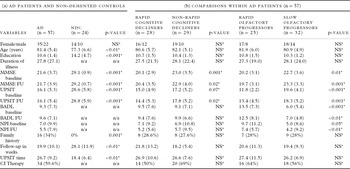
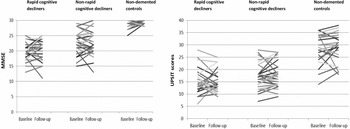
The socio-demographic and clinical comparison between the AD patients and NDCs are as described in Table 1a. The NDCs were younger and had higher education. They scored higher on the baseline MMSE and UPSIT measures. The AD patients took longer to complete the UPSIT, and more AD patients had a family history of dementia. At follow-up, the MMSE and the UPSIT loss was not different from baseline within the groups (Table 1a, Figure 1). The patients who dropped out were similar to the patients in main data in their demographic and baseline data. The seven AD patients had a mean age of 84.6 years (±5.5 years), 12.8 years of education (±2.7 years), mean MMSE scores 21 (±4), and mean UPSIT scores 14.4 (±7.3). The four NDCs had a mean age of 77.5 years (±11.5 years), 15 years of education, mean MMSE scores 28.8 (±0.5) and mean UPSIT scores 26.5 (±11.8).
Comparison of socio-demographic–clinical parameters between the groups. (a) AD patients and NDCs; (b) within AD cohort: rapid cognitive decliners (RCDs) and non-rapid cognitive decliners (NRCDs) and rapid olfactory progressors and slow olfactory progressors

Note: Values are mean (SD) or n (%); acalculated using the χ2 test, bcalculated using the t-test, *Wilcoxon paired test.
AD: Alzheimer's disease; NDC: non-demented controls; MMSE: Mini-Mental State Examination; UPSIT: University of Pennsylvania Smell Identification Test; CI: cholinesterase inhibitor; FU: follow-up; BADL: Bristol Activities of Daily Living; NPI: Neuropsychiatric Inventory; n/a, not applicable.
Line plot representation of baseline and follow-up MMSE and UPSIT scores between patients with Alzheimer's disease (RCD and NRCD) and non-demented controls.

Comparison of rapid cognitive decliners and non-rapid cognitive decliners
As described above, the AD patients were classified as RCD (n = 28) and Non-Rapid Cognitive Decliners (NRCD; n = 29), based on a decline of ≥2 MMSE points in the previous six months at the baseline. The two groups were not different in age, gender, duration of illness, follow-up period, family history, or the number of patients on cholinesterase inhibitors therapy. However, the RCD had lower baseline MMSE (statistically significant) and UPSIT (statistically not significant) measures compared with NRCD (Table 1b, Figure 1; Mann–Whitney U test). The follow-up MMSE and UPSIT scores were low for RCD compared with NRCD (statistically significant) (Table 1b, Figure 1; Mann–Whitney U test).
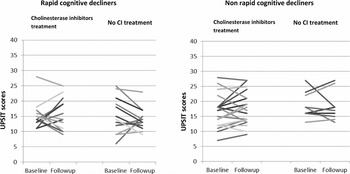
The baseline UPSIT score correlated with both baseline and follow-up MMSE (p < 0.01, r = 0.4) and follow-up UPSIT scores (p < 0.001, r = 0.6). The UPSIT scores improved in AD patients on cholinesterase inhibitor treatment although this was not statistically significant (Figure 2).
Line plots representation of UPSIT scores between RCD and NRCD patients with and without cholinesterase inhibitor (CI) treatment.

UPSIT progressors
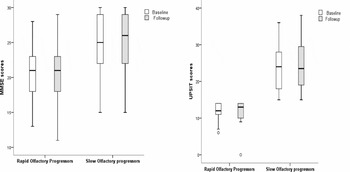
Using a median divide, the AD participants were further classified into ROP (UPSIT ≤ 15; n = 25) and SOP (UPSIT ≥ 16; n = 32). The two groups were similar in their socio-demographic data, family history, follow-up time, and cholinesterase inhibitors treatment (Table 1b). However, the ROP patients had lower MMSE and lower UPSIT, implying more cognitive and olfactory impairment (Table 1b, Figure 3). They also had higher BADL and NPI scores, reflecting more functional deficits and more non-cognitive behavioral and psychological symptoms (Table 1b).
Box plot representation of baseline and follow-up MMSE and UPSIT scores between Rapid Olfactory Progressors and Slow Olfactory Progressors.

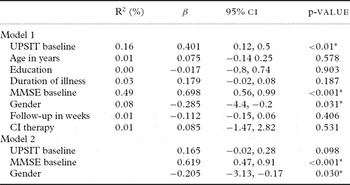
Linear regression analysis in unadjusted models showed baseline UPSIT scores, baseline MMSE scores, and gender as a better predictor factor for follow-up MMSE scores than variables such as age, gender, duration of illness, education, and follow-up time (Table 2). However, in the adjusted model, baseline UPSIT score was not significant (Table 2). Further, a linear mixed effects model using STATA 10 was fitted to investigate whether baseline UPSIT score was associated with overall MMSE levels measured in the two visits. The average baseline MMSE and the average change in the MMSE over follow-up time was calculated for all patients as a group (fixed effects) and subject-specific intercept and slope terms which reflected deviation from the group average (mixed linear effects) were calculated. The calculation included adjustment for follow-up time, age, disease duration, gender, and cholinesterase inhibitor treatment. A significant interaction between baseline UPSIT score and follow-up time (visit) was used to test the null hypothesis that there was no difference in the rate of cognitive decline, i.e. in slopes for different baseline UPSIT scores. We found that although baseline UPSIT was associated with lower MMSE at the baseline, the interaction between baseline USPIT and time was not significant (p = 0.201), indicating no association between baseline UPSIT and MMSE change (decline) over the two time points.
Linear regression analysis with the follow-up MMSE scores as the dependent variable and baseline UPSIT scores, age, baseline MMSE scores, duration of illness, gender, follow-up in weeks, and cholinesterase therapy alternatively (Model 1) or simultaneously (Model 2) entered as predictive variables within the whole Alzheimer's disease sample

Note: R2 (%): Percentage R2 value for the overall model; *p < 0.05; CI: confidence interval; MMSE: Mini-Mental State Examination; UPSIT: University of Pennsylvania Smell Identification Test; CI: cholinesterase inhibitor.
Discussion
Olfactory dysfunction has been studied as a diagnostic marker as well as a marker of conversion in AD. This is the first empirical attempt to investigate olfactory dysfunction as a severity and progression marker in AD. AD participants were deliberately chosen in the early stages (mild to moderate) of the disease so that there is little question of their ability to understand and perform the smell test. None of the AD participants had speech or language difficulties.
Olfaction in patients with AD and NDCs
AD patients had lower olfactory identification scores compared with NDCs, reported previously (Doty et al., Reference Doty, Reyes and Gregor1987; Richardson and Zucco, Reference Richardson and Zucco1989; Serby et al., Reference Serby, Larson and Kalkstein1991; Larsson et al., Reference Larsson, Semb, Winblad, Amberla, Wahlund and Backman1999; Bahar-Fuchs et al., Reference Bahar-Fuchs, Moss, Rowe and Savage2011; Makowska et al., Reference Makowska, Kloszewska, Grabowska, Szatkowska and Rymarczyk2011; Sun et al., Reference Sun, Raji, Maceachern and Burke2012). The median UPSIT scores in the study for the AD cohort and NDCs were similar to previous reports (Serby et al., Reference Serby, Larson and Kalkstein1991; Gray et al., Reference Gray, Staples, Murren, Dhariwal and Bentham2001; Velayudhan and Lovestone, Reference Velayudhan and Lovestone2009; Li et al., Reference Li, Howard and Gottfried2010). As a group there was no difference in the olfactory performance between the genders as reported previously (Westervelt et al., Reference Westervelt, Carvalho and Duff2007).
Olfaction and cognition
This study showed clear evidence of a relation of olfactory function with cognition: (a) Olfactory identification function was correlated with baseline and follow-up cognition. (b) The rapid and slow olfactory progressors correlated with the rapid and non-rapid cognitive decliners group.
Previous studies have found strong correlations between olfactory identification and cognitive performances (Serby et al., Reference Serby, Larson and Kalkstein1991; Larsson et al., Reference Larsson, Semb, Winblad, Amberla, Wahlund and Backman1999; Hidalgo et al., Reference Hidalgo, Chopard, Galmiche, Jacquot and Brand2011). Olfactory discrimination and identification have been more closely associated with higher cognitive functions and subsequent cognitive decline in community-dwelling elderly individuals (de Wijk and Cain, Reference de Wijk and Cain1994; Wilson et al., Reference Wilson, Arnold, Tang and Bennett2006; Sohrabi et al., Reference Sohrabi2009). A large-scale study in older adults (n = 1920) on the relationship between olfactory identification ability and general cognitive functioning (as measured by MMSE) indicated that olfactory dysfunction at baseline was significantly predictive of future cognitive impairment after five years (odds ratio (OR) = 6.62; confidence interval (CI) = 4.36–10.04; Schubert et al., Reference Schubert, Carmichael, Murphy, Klein, Klein and Cruickshanks2008). A strong association between cognitive functions and olfactory functioning has been reported and it has been concluded that compared with the ability to detect odors, identification of odors is more challenging, perhaps due to a lack of access to verbal or visual representations of odors (Richardson and Zucco, Reference Richardson and Zucco1989). Similarly, Schab (Reference Schab1991) noted that odor identification might represent a semantic memory function. Some researchers suggest that olfactory identification is primarily predictive of memory decline (Swan and Carmelli, Reference Swan and Carmelli2002). A recent meta-analysis (Rahayel et al., Reference Rahayel, Frasnelli and Joubert2012) suggests that AD affects more strongly odor identification and odor detection, suggesting AD patients are more strongly impaired on higher order olfactory tasks involving specific cognitive processes. In a functional magnetic resonance imaging (fMRI) study, the blood oxygen level-dependent (BOLD) signal at primary olfactory cortex (POC) was found to be weaker in AD than in healthy control participants (Wang et al., Reference Wang2010). At the lowest odorant concentration, the BOLD signals within POC, hippocampus, and insula significantly correlated with UPSIT, MMSE, and CDR scores, demonstrating that olfactory fMRI is sensitive to the AD-related olfactory and cognitive functional decline (Wang et al., Reference Wang2010).
Olfaction and non-cognitive symptoms
The present study showed that higher olfactory impairment was associated with more dependence in functional abilities at the baseline. Olfactory function has been associated with functional dependence previously in patients with MCI and normal elderly participants (Wilson et al., Reference Wilson, Schneider, Arnold, Tang, Boyle and Bennett2007). A previous report from our cohort had shown that olfaction scores predicted improvement better than cognitive scores as indicated by global and functional improvement in AD patients receiving cholinesterase inhibitor therapy (Velayudhan and Lovestone, Reference Velayudhan and Lovestone2009).
Interestingly, the present study also found an association in the olfactory rapid decliners group with behavioral symptoms (NPI; Table 1b). This has not been reported previously. This could be, as most of the previous studies have focused, an association of olfaction with cognition. This needs to be explored further in future studies.
On the whole, the study results reflect that higher olfactory impairment is indicative of more symptomatic illness or severity, i.e. lower cognition, higher functional dependence, and presence of behavioral symptoms.
The baseline UPSIT scores predicted the follow-up MMSE in an unadjusted model, however, losing this effect in adjusted model with MMSE and gender. Further, a linear mixed effect model showed that although baseline UPSIT was associated with MMSE at the baseline, there was no association between baseline UPSIT and MMSE change (decline) over the two time points. This could have been influenced by the cholinesterase inhibitors therapy in some patients which influences UPSIT scores more than the cognitive scores (Velayudhan and Lovestone, Reference Velayudhan and Lovestone2009) and also the short follow-up period. Also, there were more females than males in the cohort, who perform better on the olfactory tasks than men (Murphy et al., Reference Murphy, Schubert, Cruickshanks, Klein, Klein and Nondahl2002; Mullol et al., Reference Mullol2012).
Main limitations of the study are its small sample size and single point follow-up over a short duration. Longer follow-up with multiple point testing and assessments of cognitive, functional and behavioral changes, would be more informative of predictive ability of the olfactory function for illness progression in AD.
Gender was predictive of lower follow-up MMSE scores, with women losing more MMSE points over follow-up period. The possible explanation could be that women have a higher risk of developing AD above 80 years of age (Copeland et al., Reference Copeland1999). The present AD cohort had a mean age of above 80 years (81.5 years), so the progression too must have been faster in women than in men.
A diminished sense of smell has practical implications in relation to AD, such as decreased appetite, with resultant weight loss and poor nutritional status. Other problems may be the inability to detect noxious odors such as gas and smoke. Both patient and family should be made aware of this deficit and the potential problems this may cause.
In conclusions, the study confirms associations of olfaction with cognition in mild to moderate AD and supports the utility of the smell identification function as an adjunct clinical measure to assess severity in AD. Further work, including larger longitudinal studies, is needed to explore its value in predicting AD progression.
Conflict of interest
None.
Acknowledgments
This work was supported by the National Institute for Health Research, Specialist Biomedical Research Centre for Mental Health at the South London and Maudsley NHS Foundation Trust and the Institute of Psychiatry, King's College London.
Description of authors’ roles
Latha Velayudhan designed the study, carried out the data collection, and performed statistical analysis and interpretation. Megan Pritchard contributed to the data collection. Petroula Proitsi contributed to the statistical analysis. Latha Velayudhan wrote the paper with contributions from all the authors. Latha Velayudhan had full access to all of the data in the study and takes responsibility for the integrity of the data and the accuracy of the data analysis.