Tornadoes are one of the most catastrophic types of natural disaster and are characterized by an enormous number of casualties and massive destruction of infrastructure during a short period of time. In China, a total of 165 significant tornadoes were recorded during the 50-year period from 1961 to 2010, with an average of 3.3 significant tornadoes each year. Most tornadoes occur on plains, with higher frequencies in the Jianghuai Plain, South China, the Northeast China Plain, and the North China Plain than elsewhere in China.Reference Fan and Xiaoding1 Jiangsu Province, located on the lower reaches of the Yangtze River along the eastern coastline of China, has suffered from frequent tornadoes because of its low-lying plain, its many rivers and lakes, and its location in a transition zone between the subtropical and warm temperate zones. According to the records of the China Meteorological Administration, Jiangsu has experienced by far the largest number of significant tornadoes of any Chinese province between 1961 and 2010.Reference Xue, Zhao and Wang2
At 2:30 PM on June 23, 2016, a violent tornado occurred in Funing and Sheyang Counties, Yancheng City, located in northern Jiangsu Province. The tornado was rated an EF4, with maximum sustained wind speeds greater than 240 feet per second, or 266 km/h.Reference Jia and Pan3 The Enhanced-Fujita (EF) scale is the damage scale used to rate tornadoes from 0 to 5, with 0 being the weakest and 5 being the strongest.Reference Doswell, Brooks and Dotzek4 The event occurred in a relatively densely populated area, causing 99 fatalities and injuring 846 people, including 152 in critical condition. The direct economic losses to industry and agriculture caused by the disaster were approximately 2.816 billion yuan.Reference Jia and Pan3 This tornado was the deadliest tornado to occur in China in half a century.Reference Xue, Zhao and Wang2 However, the epidemiology of tornado-related injury and mortality in China has not been well described. The tornado in Jiangsu Province has important research value as a case study of a catastrophic event.
Yancheng City No.1 People’s Hospital, the largest medical center in the city, with 3100 beds, a Level II trauma center and 3 intensive care units (ICUs), treated a large number of individuals who suffered traumatic injuries during the tornado. In response to the disaster, a field study of the epidemiology of tornado-related injury was conducted. The main objectives of the study were to collect medical data on tornado injuries systematically and to investigate the patterns and severity of injuries, causes of injuries, and outcomes of patients.
The study protocol was approved by the Ethics Committee of Yancheng City No.1 People’s Hospital. Due to the retrospective nature of the study, informed consent was waived.
PATIENTS AND METHODS
Data Collection
We reviewed and collected the clinical records of 144 patients who were admitted to our hospital from June 23, 2016 to June 25, 2016 for injuries related to the tornado. All outpatients and inpatients injured by other causes were excluded. The primary data for the investigation included basic demographic and medical information (including the types and severity of injuries) and the specific causes of the injuries. Information was also collected regarding treatment, infections, hospital stay, and prognosis.
Trauma Scoring Systems
The site and severity of each injury were identified according to the Abbreviated Injury Scale (AIS, 2005 version).Reference Lopes and Whitaker5, Reference Gennarelli and Wodzin6 The injured sites were categorized based on the body region affected (head, neck, face, chest, abdomen, spine, upper limbs, lower limbs and pelvis, body surface, or other). The severity index ranges from 1 to 6, with 1 being a minor injury and 6 being maximal. The Injury Severity Score (ISS) was the sum of the squares of the 3 highest AIS regional scores, ranging from 1 to 75. ISS values were categorized into 3 strata: mild/moderate injury (ISS < 16), severe injury (ISS 16-24), and very severe/critical injury (ISS > 24).Reference Salottolo, Settell and Uribe7
Statistical Analysis
All data collected by means of the questionnaires and medical records were entered into an Access database and then converted into Excel files. Descriptive statistics were calculated for all numerical variables, including the means and SDs; percentages were calculated for all categorical variables. Continuous variables with normal distributions were expressed as the means ± SDs. Categorical variables were expressed as absolute values and percentages. Excel software was used for statistical analysis.
RESULTS
Demographics
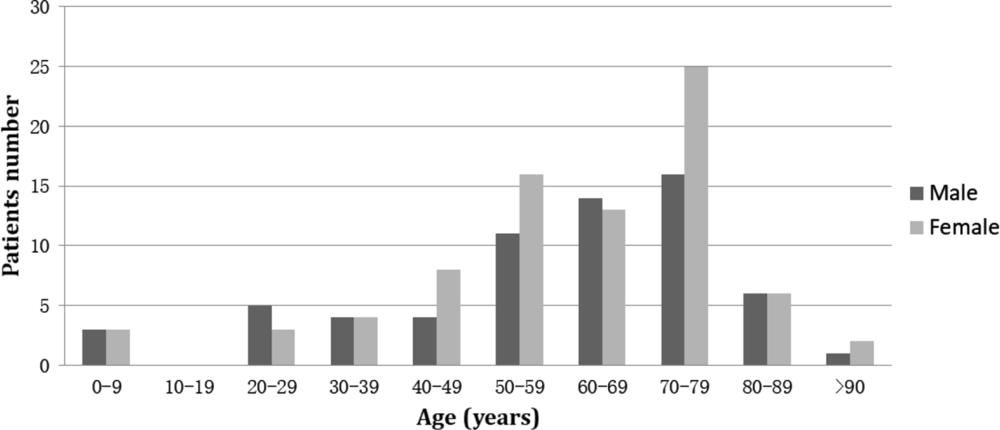
There were 144 injured patients admitted to the hospital between June 23 and June 25, 2016 after the tornado. The mean age of all hospitalized patients was 59.7 ± 20.0 years (range: 2 months to 94 years). Of these patients, 64 (44.4%) were male with a mean age of 58.41 ± 20.88 years, and 80 (55.6%) were female with a mean age of 60.85 ± 19.38 years. Of the hospitalized patients, 6 (4.2%) were younger than 18 years, 55 (38.2%) were aged between 18 and 59 years and 83 (57.6%) were aged 60 years or older. The age and gender distributions of the hospitalized patients are shown in Figure 1.
Age and gender distribution of the tornado-related patients admitted to hospital.

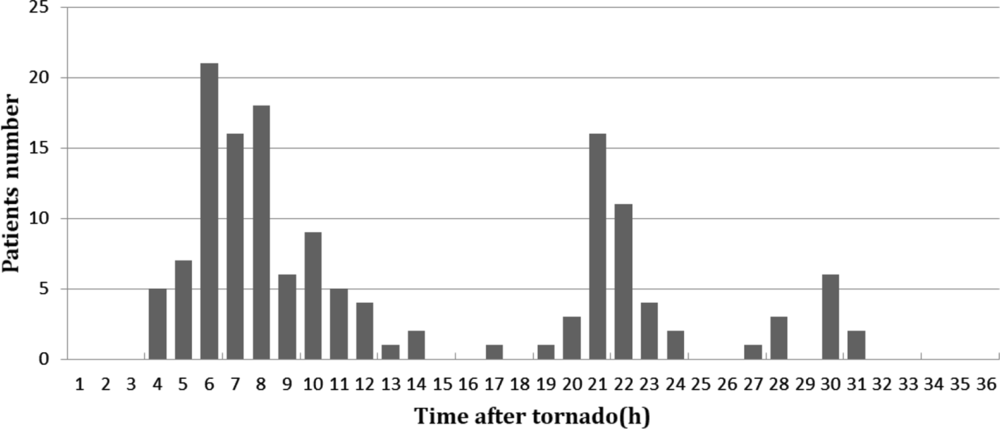
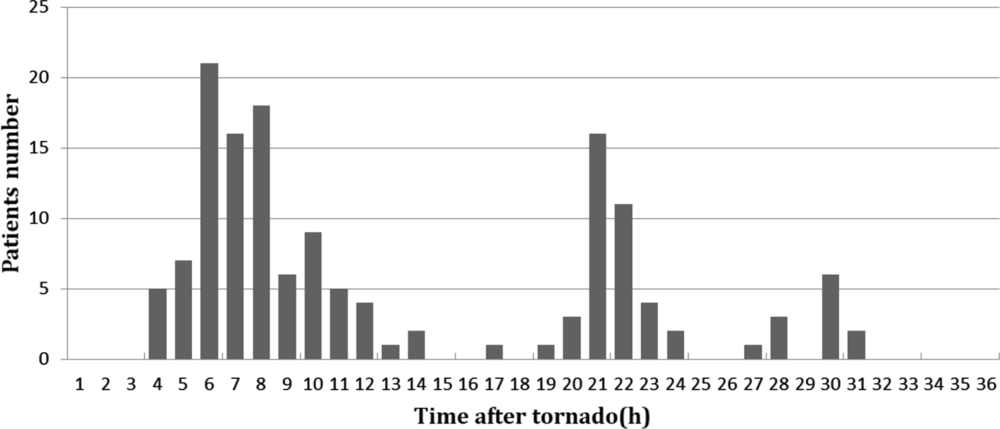
All 144 of the injured patients admitted to the hospital had specific records of their admission times. Of these patients, 91 (63.19%) were admitted within the first 12 h after the disaster, and 132 (91.66%) were admitted within the first day. The dynamic variation in admissions of the 144 patients is shown in Figure 2.
Dynamic variation of admissions of the tornado-related patients.
Pattern of Injuries
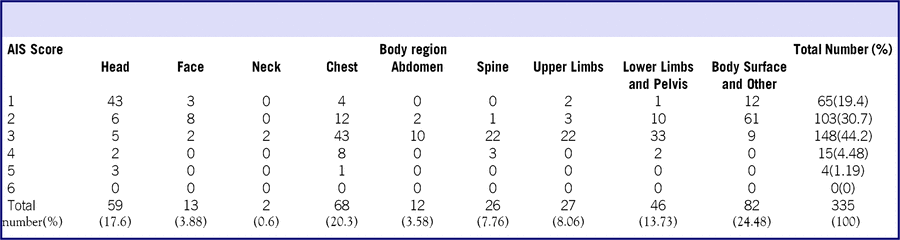
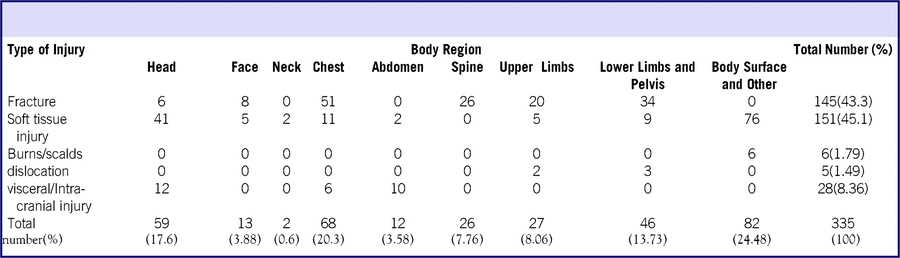
A total of 335 injury diagnoses were recorded in 144 patients. Hospitalized persons sustained an average of 2.3 injuries per person. Table 1 shows the distribution of injuries by body region. Among these injured patients, the sites with the most injuries were the body surfaces (24.48%), followed by the limbs and pelvis (21.79%), the chest (20.3%), the head (17.6%), and the spine (7.76%). Only 2 (0.6%) injuries occurred in the neck. Injuries with AIS scores of 1, 2, 3, 4, and 5 accounted for 19.4%, 30.7%, 44.2%, 4.48%, and 1.19% of the total, respectively. There were 103 patients suffering from multiple injuries. Fifty-seven (55.3%) patients presented with 2 injuries. Patients with 3 injuries were the second most common, accounting for 32.1%, followed by 4 injuries or more (12.6%). Among the patients with multiple injuries, 46.6% had ISS values below 16, 36.9% had ISS values between 16 and 24, and 16.5% had ISS values above 24.
Distribution of Injuries Based on Body Region in Admitted Patients

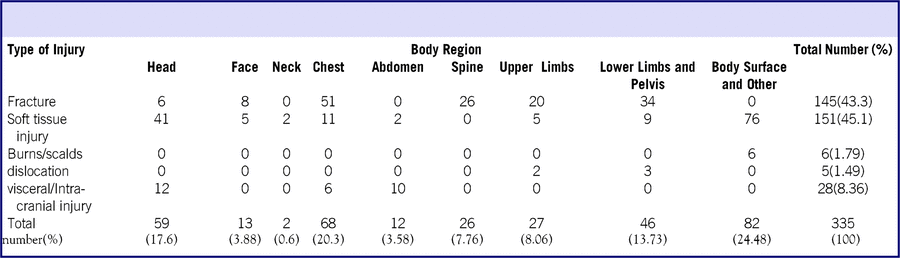
The most common type of injury was soft-tissue injury (45.1%), including abrasion, contusion, and laceration. Fractures were the second most common type of injury (43.3%). A total of 109 patients suffered 159 fractured bones among them. Forty-four hospitalized persons had multiple fractures (2 to 4 fractures per person). The predominant locations of fractured bones were the chest/ribs, the lower limbs and pelvis, and the spine and upper limbs (Table 2).
Types of Injuries Based on Body Region in Admitted Patients
Fifty-nine patients suffered brain injuries. Forty-three persons suffered mild brain injuries, 10 suffered moderate brain injuries, and 6 suffered severe brain injuries. Contusion and laceration were the most frequent types of injury among patients with mild brain injuries. Moderate to severe brain injuries included skull fractures, brain contusions and hemorrhages, and cerebral hernia. Thirty-five persons hospitalized with brain injuries were 60 years or older; 3 children suffered severe brain injuries, and 2 of them died within a week after tornado.
Causes of Injury
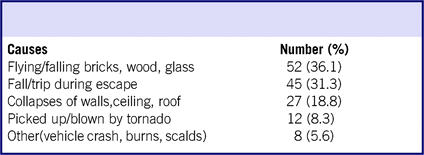
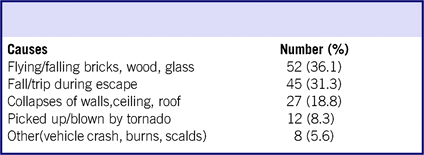
The causes of the survivors’ injuries were categorized using information from medical records (Table 3). The most common cause of injury among hospitalized persons was flying/falling bricks, wood, and glass, followed by falling/tripping during escape, and wall, ceiling, or roof collapses. Additional injuries resulted from being lifted up/blown by the tornado, motor vehicle crashes, burns, and scalds.
Causes of Injuries of the Tornado-Related Patients
Infections and Microbiological Cultures
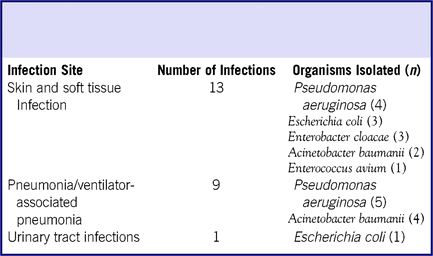
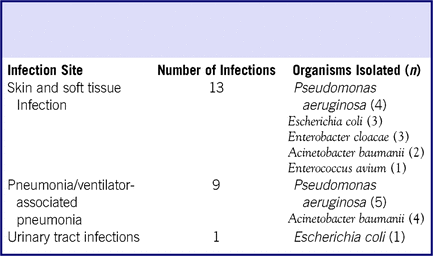
There were 23 (15.9%) patients diagnosed with infections according to microbiological culture and clinical manifestations. The main infection sites included the skin and soft tissues exposed in the open injuries, as well as the lungs and the urinary tract. The microbiological samples were processed using standard laboratory protocols. The most common gram-negative organism isolated was Pseudomonas aeruginosa, followed by Acinetobacter baumannii and Escherichia coli. Gram-negative organisms were resistant to most antibiotics tested. The 1 gram-positive species isolated was Enterococcus avium, which was sensitive to vancomycin/linezolid/teicoplanin. The pathogens isolated from the various infections are listed in Table 4.
Pathogens Identified in the 23 Hospitalized Patients With Infections
Analysis of Hospitalization Time and Mortality
The median duration of hospitalization was 22.65 ± 12.3 days (range, 1-90 days). A total of 26.4% of patients were hospitalized 1-14 days, 47.2% were hospitalized 15-28 days, and 26.4% were hospitalized more than 28 days. Eighteen patients were admitted to the ICU, and the median length of ICU stay was 9.33 ± 7.84 days (range, 1-30 days).
A total of 4 patients died during hospitalization, including 2 children and 2 patients over 70 years old. The hospital mortality was 2.78%. The 2 child fatalities were caused by severe traumatic brain injuries; the elderly fatalities were caused by pneumonia-induced septic shock. Of the 4 deceased patients, 1 died within 24 h after the tornado, 2 died 7 days after the tornado, and 1 died 30 days after the tornado.
DISCUSSION
Tornadoes are rare in China, and the average number of tornadoes per year nationwide is estimated to be under 100, less than one-tenth of the frequency of tornadoes in the United States.Reference Fan and Xiaoding1 The effects of tornadoes on human health have been well described in the United States. The risk of tornado-related death and injury is attributable to many categories of factors, such as geophysical factors, building factors, individual human characteristics related to the ability to respond to the tornado, and the efficiency and organization of the rescue operations. Reference Daley, Brown and Archer8–Reference Millie, Senkowski and Stuart10 However, there has not been enough research focused on tornado-related injuries and mortality in China. Thus, it is essential for us to share the experiences and lessons from our medical aid operations.
After the tornado, local government agencies, the military, and nongovernmental organizations (NGOs) responded within hours, setting up treatment camps to assist the wounded. The Jiangsu Provincial Health Administration organized the rescue and selected the most highly qualified medical specialists to form a national expert medical team to guide the rescue operations. In terms of decreasing mortality and morbidity, the prompt evacuation of severely injured patients to nearby hospitals has, perhaps, been the most important aspect of medical aid operations. In the aftermath of the tornado, cooperation between the government and NGOs in disaster relief played an exceedingly important role in the process of transferring injured victims, and it ensured that most of the injured were admitted to peripheral hospitals within a few days.Reference Guo, Chen and Cao11, Reference Sarani, Mehta and Ashburn12 All of the victims were relocated by land transportation, such as ambulances, private cars, and buses. A total of 144 victims were admitted to our hospital in the first 3 days, of which 63.19% (n = 91) were admitted in the first 12 h and 91.66% (n = 132) were admitted in the first day. In the rush phase, the hospital emergency department was flooded with large numbers of casualties, causing inadequate triage, disorganized care, and incomplete medical records. This chaos was overcome by reorganizing the triage process and implementing multidisciplinary cooperation.
The majority of the injured were middle-aged and elderly, with 57.6% over the age of 60, and 55.6% of the injured were women. The disaster-stricken areas, consisting of towns and villages in Funing and Sheyang Counties, had relatively undeveloped economies. The young men were mostly working in large cities, leaving mainly elderly people, children, and women in rural areas. The latter 3 demographics lack awareness of weather phenomena and are vulnerable due to their poor ability to preserve themselves from disasters.Reference Marchigiani, Gordy and Cipolla13 In addition, the lack of a warning system and underground bunkers, as well as the population density, may have contributed to the heavy casualties.Reference Jia and Pan3
In the present study, most of these injuries were less than severe. Single injuries with AIS scores of 1-3 accounted for 94.3% of the injuries. Among the patients with multiple injuries, 46.6% had ISS values below 16, 36.9% had ISS values between 16 and 24, and 16.5% had ISS values above 24. However, in the 2011 Alabama tornadoes, most (n = 1111; 79.5%) injuries treated were not life threatening (ISS ≤ 15). Obviously, in this study, the ISS values of the injured patients were higher and the injuries were more serious. This difference was probably because the present study contains a higher proportion of elderly patients (57.6%) than the population injured by the Alabama tornado (16.5%).Reference Niederkrotenthaler, Parker and Ovalle9 Compared with the population at large, elderly people may have a decreased probability of taking effective protective actions, and comorbid medical conditions can lead to slowed reactions and increased risks of morbidity and mortality.Reference Marchigiani, Gordy and Cipolla13
Injury patterns from the Jiangsu tornado involved multiple systems. Commonly injured anatomical sites included the body surfaces (24.48%), the limbs and pelvis (21.79%), the chest (20.3%), the head (17.6%), and the spine (7.76%). With this tornado, as with others before it,Reference Bohonos and Hogan14 soft-tissue wounds were the most frequently reported injuries, usually resulting from debris accelerated by the wind. Soft-tissue injury can occur when particles of bricks, soil, wood, or glass strike the skin at high speeds. Such wounds tend to be deep, contaminated with foreign bodies and other debris, and most often in exposed areas of the body, such as the head and upper limbs. Brown et al. recommended covering the skin with blankets or heavy clothing, such as coats, to protect against soft-tissue injuries.Reference Brown, Archer and Kruger15 Fractures are the next most frequent injury, resulting from the victims or solid objects becoming airborne or from structures collapsing. Many such fractures are open and contaminated. Injuries to the head are among the most severe injuries inflicted by tornadoes, leading to a majority of ICU admissions and deaths. Some researchers suggest using bicycle or motorcycle helmets to protect the head.Reference Millie, Senkowski and Stuart10
In this study, as in previous studies,Reference Brown, Archer and Kruger15 the tornado-related injuries were caused mostly by flying/falling bricks and wood, followed by falling/tripping during escape and then by wall, ceiling, and roof collapses. Most houses in the affected areas are bungalows with poor design standards in regard to wind resistance. The apartments are mainly constructed using earthen bricks, and the roofs are often constructed from ceramic tiles, which are easily blown off. This type of construction is the main reason for the large number of people injured by flying/falling bricks.Reference Lyu, Wang and Cheng16 Bohonos and HoganReference Bohonos and Hogan14 reported that the rate of serious injury for occupants in mobile homes was 85.1 per 1000, compared with 3 per 1000 for standard construction homes. This devastating damage reminds us that the design of the village apartments should be reviewed carefully to enhance resistance to wind loads.
Tornado wounds tend to be highly contaminated with dirty water, soil, or sand and result in a high incidence of infectious complications. Our results demonstrated that most of the wound pathogens belonged to gram-negative species such as Pseudomonas aeruginosa, Escherichia coli, Enterobacter cloacae, and Acinetobacter baumannii, consistent with the report of Bohonos and Hogan.Reference Bohonos and Hogan14 The present study suggests that, in the presence of large numbers of transported, injured patients, especially those who suffer from skin loss or draining wounds, isolation measures should be undertaken to avoid cross-infection. The key measures must include early surgery and large doses of effective antibiotics. Pneumonia was another common infectious complication in tornado victims, especially the elderly victims. The most frequently diagnosed infectious pathogens were multidrug-resistant bacteria, including Pseudomonas aeruginosa and Acinetobacter baumannii, which could contribute to an increased risk of death.
Previous studies demonstrated that tornado-related deaths were most frequently attributed to head trauma, and most tornado fatalities die at the scene.Reference Millie, Senkowski and Stuart10,Reference Bohonos and Hogan14 Of the 144 patients in this study, only 4 died during hospitalization. The 2 child fatalities were caused by severe traumatic brain injuries. Although 2 elderly patients died of pneumonia-induced septic shock in the aftermath of the tornado, the cause of death cannot be directly attributable to the tornado.
CONCLUSIONS
This is among the first studies to evaluate and describe systematically the epidemiology of tornado-related injury and death in China. As shown here, tornado-related injuries were mostly caused by flying/falling bricks and wood; the most frequently injured anatomical sites were the body surfaces. Soft-tissue injury and fractures were the most frequent injuries. Tornado wounds tend to be highly contaminated and result in a high incidence of infectious complications. Following a devastating tornado, especially during the initial 12-24 h, an influx of patients will always be encountered in hospitals, resulting in disruption and disorganization of medical care. Moreover, lack of a tornado warning system and lack of awareness of self-rescue methods also contribute to increased risks of morbidity and mortality. We hope that these experiences and lessons from our post-tornado medical rescue operation will be of use to health-care organizations and governments in preparing for future natural disasters.
Study Limitations
This study underestimates the total number of persons injured in tornado. It does not include persons treated at a County Hospital immediately following the tornado. Most epidemiological data of tornado patients rely on the medical records of our hospital, and detailed medical records of small proportion of hospitalized patients were often incomplete because of the initial disorganization especially during the first few hours after the tornado. In addition, although the data analysis has been undertaken by a single individual, the data were originally collected by many different people. This type of data is very inclined to individual variation and clinical interpretation bias, which is difficult to avoid.
Acknowledgments
The authors thank all participating staff at the Yancheng City No.1 People’s Hospital for their assistance.
Funding
This work was supported by the Medical Technology Development Project of Yancheng city (YK2017008).
Authors’ Contribution
Gen hua Mu and Xing Li contributed equally to the work and should be considered co-first authors.
Conflicts of Interest
The authors declare no conflict of interest related to this article.