Introduction
Since the pioneering isotopic studies on sized clay materials, the reliability of the ages obtained has been questioned because of a possible retention deficiency of the radiogenic isotopes. This controversy started in the late 1950s with glauconite separates often giving ages younger than the stratigraphic age of the host rocks (e.g. Hurley et al. Reference Hurley, Cormier, Hower, Fairbairn and Pinson1960; Aronson and Hower Reference Aronson and Hower1976). Diagenetic crystallization of authigenic clay minerals younger than their host sediments raised the possibility of an alternative loss of radiogenic isotopes facilitated by the decrease in their particle size. For completeness, one should recall that data from some of these glauconites are also older than their stratigraphy, a fact that has seldom been emphasized because age records of minerals partly or completely of detrital origin are expected to be older than those of the host sediments. In fact, detrital mica-type crystals survive in sediments up to the anchizone/epizone boundary (e.g. Hunziker et al. Reference Hunziker, Frey, Clauer, Dallmeyer, Friedrichsen, Flemig, Hochstrasser, Roggwiler and Schwander1986), which explains such older ages in clay minerals up to burial diagenetic and anchi-metamorphic conditions. At the same time and in the same diagenetic zone, crystallization of new clay minerals such as mixed-layer illite-smectite and even illite explains ages younger than the stratigraphic records (Velde and Vasseur Reference Velde and Vasseur1992; Renac and Meunier Reference Renac and Meunier1995; Altaner and Ylagan Reference Altaner and Ylagan1997).
The decrease in isotopic age with decreasing particle size in diagenetic clay material has been and still is generally interpreted as resulting from a decrease in the content of detrital contaminants (e.g. Perry Reference Perry1974; Ehrenberg and Nadeau Reference Ehrenberg and Nadeau1989; Pevear Reference Pevear, Kharaka and Maest1992; Środoń et al. Reference Środoń, Clauer and Eberl2002). A convincing analytical example for this interpretation was published by Reuter (Reference Reuter1987) in a comparative study of low-grade metamorphic shales and associated tuffs from the Rhenish Massif (Germany). There, the shales outline a stepwise decreasing age when the grain size of the analyzed separates decreases, whereas the associated tuffs yield an age pattern that remains constant relative to grain size. This flat repartition of the ages was due precisely to the absence of detrital components in the volcanic material, whereas the staircase distribution of the same size fractions in the associated shales resulted necessarily from the decreasing content of detrital minerals in the finer size fractions. As no radiogenic isotope loss could be detected, the author concluded that, if occurring at all in shales, it could certainly not be considered as a rule. On the other hand, Szczerba et al. (Reference Szczerba, Derkowski, Kalinichev and Środoń2015) performed a molecular modeling of the 40Ar atom during natural radioactive decay of 40K into 40Ar. Those authors concluded that due to a high kinetic energy some 40Ar atoms are potentially able to leave the interlayer position to embed nearby even in the opposite tetrahedral sheet of the neighboring silicate layers. Such atoms may then leave the illite particle over geological time, especially when located at the crystal edges. Thus, an age decrease should occur and be greatest for the thinnest crystals. The maximum age decrease due to such an effect was evaluated as 10%, but this hypothesis has not been verified experimentally so far.
Isotopic ages younger than the stratigraphy, due to a potential diffusion of radiogenic isotopes from clay materials, have also been studied experimentally at various temperatures and durations since the early 1970s (e.g. Thompson and Hower Reference Thompson and Hower1973; Odin et al. Reference Odin, Velde and Bonhomme1977; Odin and Bonhomme Reference Odin and Bonhomme1982; Zimmermann and Odin Reference Zimmermann and Odin1982; Clauer et al. Reference Clauer, Giblin and Lucas1984; Aronson and Douthitt Reference Aronson and Douthitt1986; Hunziker et al. Reference Hunziker, Frey, Clauer, Dallmeyer, Friedrichsen, Flemig, Hochstrasser, Roggwiler and Schwander1986) with no clear evidence of radiogenic 40Ar escape. Interestingly, an alternative trend of an age increase with a particle size decrease was also described from nanometer-sized diagenetic illite crystals of bentonites devoid of any detrital component (Clauer et al. Reference Clauer, Środoń, Francù and Šucha1997; Środoń et al. Reference Środoń, Clauer and Eberl2002; Środoń et al., Reference Środoń, Zeelmaekers and Derkowski2009a, Reference Środoń, Clauer, Huff, Dudek and Banasb). Such a trend was explained by the crystal-growth theory of Eberl et al. (Reference Eberl, Drits and Środoń1998), which predicted that coarser nm-sized clay crystals yield younger ages than their finer equivalents because they incorporate new material faster and, therefore, grow faster. In fact, any illite-type mineral may lose K during any diagenetic alteration, but independently of its particle size (e.g. Clauer Reference Clauer2011; Clauer and Mongodin Reference Clauer and Mongodin2012).
The ability of clay minerals, especially K-rich illite, to lock radiogenic isotopes in their crystal structures remains an important issue in isotopic dating of authigenic clay minerals from buried sediments. Burial as a very common natural process associated systematically with temperature increase, therefore, favors authigenesis of such clay minerals, but also induces a preferential diffusion of radiogenic 40Ar relative to radiogenic 87Sr, again only of clay components in thermic-chemical disequilibrium (Clauer et al. Reference Clauer, Rinckenbach, Weber, Sommer, Chaudhuri and O'Neil1999; Lerman et al. Reference Lerman, Ray and Clauer2007). As mentioned above, any thermal alteration of detrital clay materials of any size affects the retention potentials of their radiogenic isotopes, as does any type of alteration on any type of mineral.
In isotopic dating, the smectite to illite trend (labeled I-S hereafter) applies to all particles containing more or less K-tied layers, according to the kinetic model of a theoretical reaction path (Essene and Peacor Reference Essene and Peacor1995). Their K-Ar and Rb-Sr isotopic systems are then controlled by the progressive incorporation of alkalis into the interlayers, the course of illitization being routinely identified by XRD analysis since the mid-1950s (e.g. Weaver Reference Weaver1957; Burst Reference Burst1959; Powers Reference Powers1959; Dunoyer de Segonzac Reference Dunoyer de Segonzac1970; Hower et al. Reference Hower, Eslinger, Hower and Perry1976; Środoń and Eberl Reference Środoń, Eberl and Bailey1984; Velde Reference Velde1985). The isotopic behavior of such I-S materials during illitization (Hower et al. Reference Hower, Eslinger, Hower and Perry1976) was linked originally to the traditional smectite-to-illite transformation mechanism (Lee et al. Reference Lee, Aronson and Savin1989; Hamilton et al. Reference Hamilton, Kelley and Fallick1989, Reference Hamilton, Giles and Ainsworth1992). At about the same period, this solid-state process was challenged with a model integrating the dissolution of smectite layers substituted simultaneously by the nucleation of illite layers (Inoue et al. Reference Inoue, Kohyama, Kitagawa and Watanabe1987; Eberl and Środoń Reference Eberl and Środoń1988; Pollastro Reference Pollastro1993). Nadeau et al. (Reference Nadeau, Wilson, McHardy and Tait1984) were the first to separate, study, and identify such K-rich illite crystals resulting from crystallization and growth of illite layers in I-S structures, which they called “fundamental particles.” Depending on the mechanism of illitization, solid-state transformation or dissolution/precipitation, and assuming that particle-size separation was completed successfully, one might expect different isotopic records for populations of illite crystals of varied sizes that depend on the type of host rock and the initial smectite, the duration of the process, and the chemistry of the interacting pore waters. Clauer et al. (Reference Clauer, Williams, Lemarchand, Florian and Honty2018) tried to decrypt some of these illitization processes by studying the isotope composition, contents, and location of B in illite layers by nuclear magnetic resonance analysis. By now, and depending on the intrinsic illitization process, the different isotopic trends obtained for nm-sized illite crystals, mostly of bentonites (e.g. Clauer et al. Reference Clauer, Środoń, Francù and Šucha1997; Honty et al. Reference Honty, Uhlík, Šucha, Caplovicová, Francù, Clauer and Biron2004), suggest varied processes for the smectite-to-illite trend. Since then, this methodology has been extended to illite particles from sandstones to evaluate time fluctuations of illitization in a sedimentary basin, and to develop some kinetic models (e.g. Środoń et al. Reference Środoń, Clauer and Eberl2002, Reference Środoń, Clauer, Banas and Wojtowicz2006; Clauer et al. Reference Clauer, Liewig, Pierret and Toulkeridis2003, Reference Clauer, Rousset and Środoń2004).
The present study was conceived in this context to gain more information about the smectite-to-illite process by studying the smectite-rich end-member of the trend, with a challenging aspect for the K-Ar and Rb-Sr analytical procedures. Indeed, the expectations were about the analysis of smectite-rich I-S containing very small amounts of K and Rb at the onset of illitization and, therefore, measuring small to very small amounts of radiogenic 40Ar and 87Sr. The goal was to check if even a limited number of illite layers is able to store radioactive 40K and 87Rb, as well as radiogenic 40Ar and 87Sr within a crystalline structure characterized by its overall lack of interlayer sites where these isotopes are usually keyed. The samples analyzed were smectite-rich bentonite layers from the Campos Basin located offshore the State of Rio de Janeiro (Brazil). Because the bentonite lithology is generally lacking detrital minerals unless bioturbated with the hosting shales, this rock type was often selected for dating initial illitization after an early, low-T devitrification of the volcanic ash. This devitrification is often accompanied by a diagenetic precipitation of authigenic smectite-rich materials (Altaner et al. Reference Altaner, Hower, Whitney and Aronson1984; Elliott and Aronson Reference Elliott and Aronson1987; Calarge et al. Reference Calarge, Meunier and Formoso2002). Of course, the challenge of analyzing crystals with very small alkali contents depends also on how the analytical equipment used is able to handle very small amounts of radioactive 40K and 87Rb and radiogenic 40Ar and 87Sr; this was the key analytical challenge.
ANALYTICAL PROCEDURE
Reduced by hand to cm3-sized rock chips, the bentonite samples were stored in polyethylene bottles filled with de-ionized water for disaggregation by freeze-thaw cycles (Liewig et al. Reference Liewig, Clauer and Sommer1987). This method avoids any overgrinding and, therefore, any artificial reduction of large framework minerals into the size of the clay minerals. Then, the <2 μm fractions were recovered by sedimentation of the clay suspension in de-ionized water and the slurries were treated with sodium-acetate, sodium dithionite, and hydrogen peroxide to remove the soluble mineral phases, the organic matter, and the free cations adsorbed on and hosted within the mineral structures (Jackson, Reference Jackson1975). Of course, these chemical products were ultra-pure to avoid any pollution of the I-S fractions during their interaction. Afterward, the <0.2 μm fractions were collected from <2 μm fractions by centrifugation and were diluted to a concentration of 1 g of powder in 40 L of de-ionized water to ensure “infinite” osmotic swelling (Środoń et al. Reference Środoń, Elsass, McHardy and Morgan1992). This further separation into the smallest micrometric and nanometer sizes (<0.02, 0.02–0.05, 0.05–0.1, and 0.1–0.2 μm) was completed by continuous, high-speed flow in an ultra-centrifuge coupled with a flow meter. The nm-sized sub-fractions were recovered from diluted fluids by flocculating the suspended matter with ultra-pure NaCl (1 M) and by removing the excess electrolyte by repeated centrifugation and dialysis.
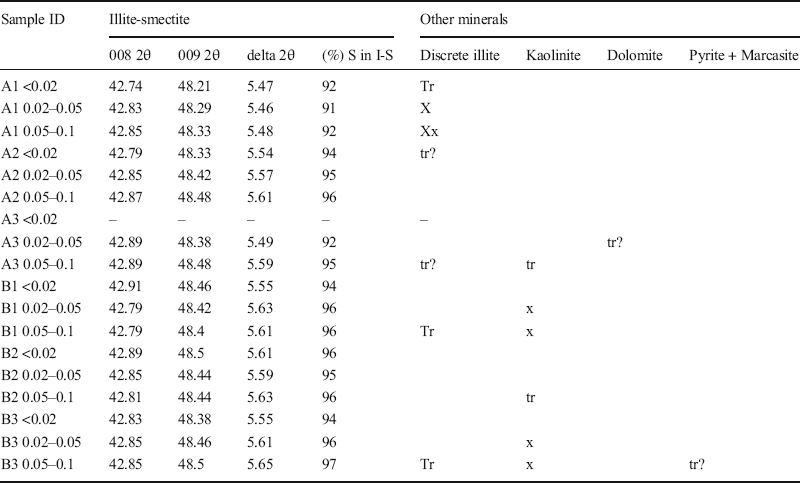
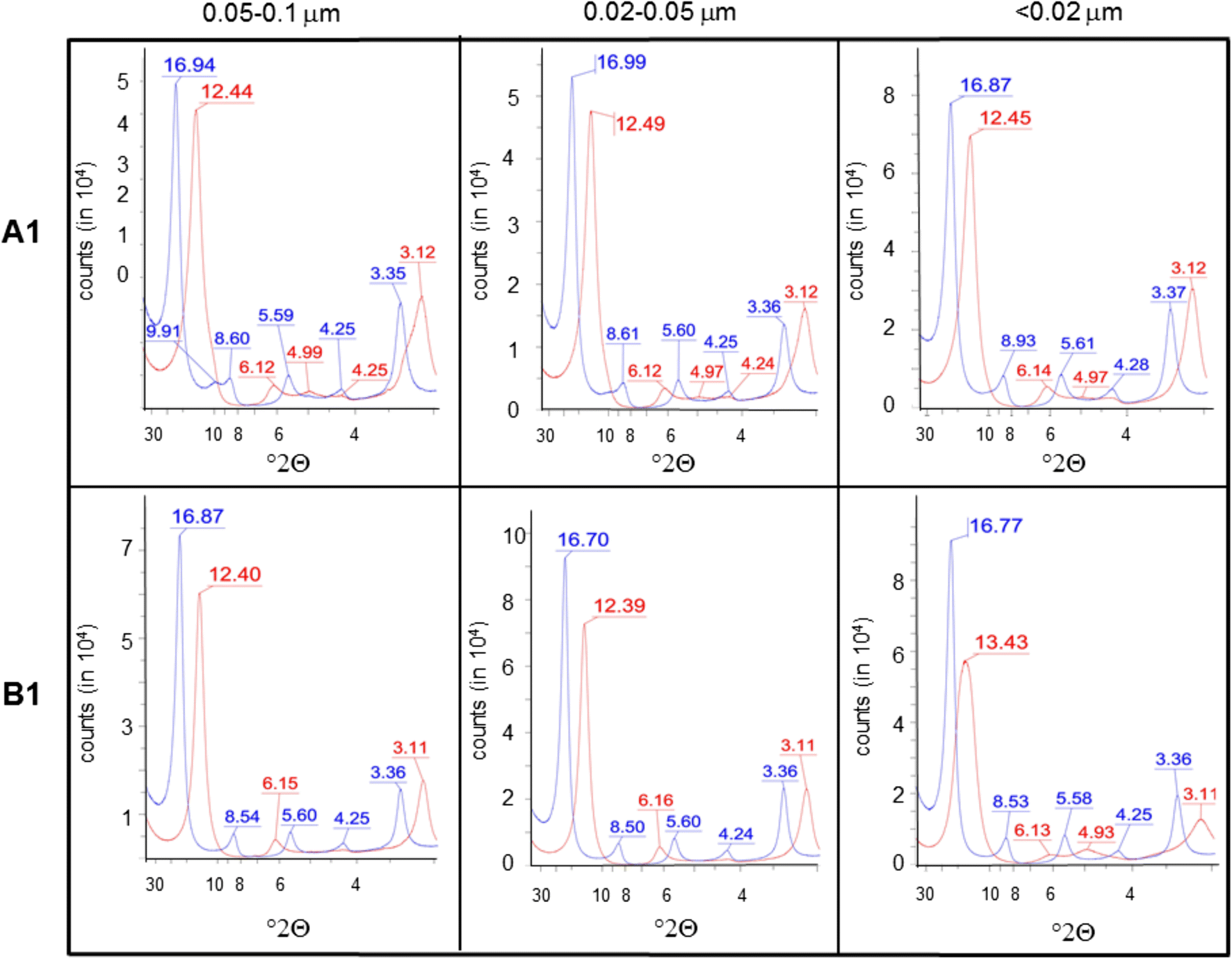
Then, the nm-sized fractions were X-rayed to determine the mineral compositions and possibly to quantify the identified components. Each fraction was scanned twice: air-dried (AD) and after ethylene-glycol solvation overnight at 60°C (EG) (Table 1; Fig. 2). Small rock chips and crystal powders were coated with gold or carbon for scanning electron microscopic (SEM) and transmission electron microscopic (TEM) observations, respectively. The Ar extractions were completed in a glass line, following the method of Bonhomme et al. (Reference Bonhomme, Thuizat, Pinault, Clauer, Wendling and Winkler1975) with a preheating step under vacuum in the extraction line at 80°C over a period of at least 24 h to remove as much as possible the atmospheric Ar adsorbed on the particles during preparation, separation, and handling. The K contents were measured by flame spectrometry with a routine precision better than 1.5 wt.% for amounts of K > 0.5 wt.%. To constrain as well as possible the K contents to this <0.5% limit, the aliquots were first screened for an approximate determination of their K contents, and then each was framed by internal standards set below and above the initially screened contents, the final contents being determined by interpolation between the three values at an estimated precision of 5 wt.%. The accuracy of the Ar extraction was checked weekly by measuring the international glauconite standard GL-O that averaged 24.59 ± 0.17 (2σ)×10–6 cm3/g (STP) radiogenic 40Ar for five independent measurements during the course of the study, which is within the recommended standard value of 24.85 ± 0.48 (2σ)×10–6 cm3/g (Odin et al. 1982). The survey of the procedure also included periodic determinations of atmospheric 40Ar/36Ar loads that averaged 298.7 ± 1.2 (2σ), to be compared to the recommended value of 298.6 ± 0.4 (2σ; Lee et al. Reference Lee, Marti, Severinghaus, Kawamura, Yoo, Lee and Kim2006). Because of the expected small amounts of radiogenic 40Ar due to small K2O contents and potential young ages of the separates, the blanks of the coupled extraction line and mass spectrometer were also controlled before each Ar extraction. Their contents never exceeded 1×10⁻⁸ radiogenic 40Ar, often being <1×10⁻⁹, which means that the equipment did not add measurable residual 40Ar to that of the samples. Some of the 40Ar analyses were also duplicated for further control of the equipment. The K-Ar ages were calculated using the recommended decay constants (Steiger and Jäger Reference Steiger and Jäger1977) with their usual analytical uncertainties (Table 2). The isochron calculations were not given systematically with their corresponding 2σ errors because the individual uncertainties of some analyses were such that this precision was not always of real use.
XRD data of the <0.02, 0.02–0.05, and 0.05–0.1 μm size fractions of the six selected bentonite samples

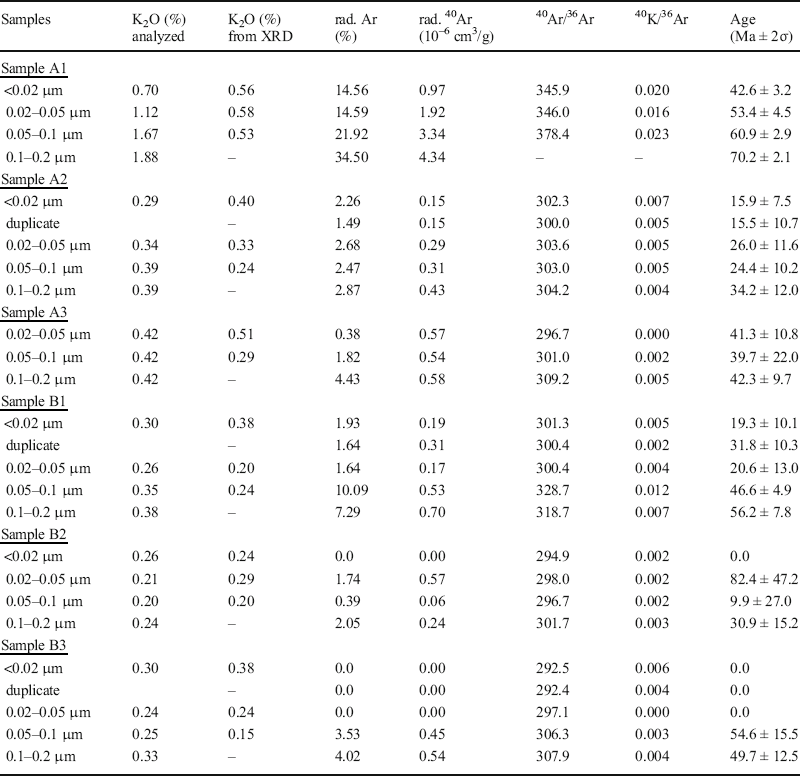
K-Ar data of the <0.02, 0.02–0.05, 0.05–0.1, and 0.1–0.2 μm size fractions of the six bentonite samples

The nm-sized sub-fractions of the A1 and B1 samples were also analyzed for their Rb-Sr isotopic systematics after supplementary, gentle acidic leaching. This leaching was maintained despite the initial removal of the exchangeable elements hosted by the smectite structure and adsorbed on the mineral surfaces at a coarser grain size, and of the elements released by the associated soluble minerals (Jackson Reference Jackson1975). None of the reactive chemical products used added any of the measured elements as they were selected for their ultra-pure quality. In fact, this supplementary acidic leaching allows independent determinations of the Sr contents and 87Sr/86Sr ratios of the solid I-S particles and of the mobile counterparts around and within the I-S crystal agglomerates. These elements were recovered by gentle leaching of the sized fractions with ultra-pure dilute HCl (1 M) over a period of 15 min at room temperature followed by centrifugation (Clauer Reference Clauer1982). This gentle acid leaching does not alter the Rb-Sr or the K-Ar system of the clay materials regardless of type, size, or degree of crystallization (Clauer et al. Reference Clauer, Chaudhuri, Kralik and Bonnot-Courtois1993). The data points of the leachates (labeled L) also need to be aligned with those of the untreated (labeled U) and residual (labeled R) separates in an 87Sr/86Sr vs. 1/Sr diagram and occasionally in an 87Sr/86Sr vs. 87Rb/86Sr diagram, to substantiate a somehow delicate separation and an appropriate analysis. The significance of the arrays obtained depends strictly on the material studied; geologically meaningful ‘isochrons,’ for instance, can be claimed only if all of the material analyzed, liquid and solid, was demonstrated independently to be homogeneously authigenic. If this requirement is not fulfilled, the arrays or the scattered data represent mixtures of solids and solubles of different origins. After tri-acid digestion of the residues and evaporation of the leachates, the Rb and Sr elements were separated by resin chromatography and analyzed by mass spectrometry for their Sr contents and isotopic compositions. These data were obtained on a thermo-ionization mass spectrometer with a multi-collector of five mobile collectors, whereas the Rb elemental amounts were determined on a second mass spectrometer with a single collector, both following a procedure described by Schaltegger et al. (Reference Schaltegger, Stille, Rais, Piqué and Clauer1994). The reproducibility and precision of the analytical cycle were controlled periodically with the 87Sr/86Sr ratio of the NBS987 standard. Its ratio averaged 0.710257 ± 0.000015 (2σ mean) for four independent determinations during the course of the study, the internal uncertainty of each analysis being given at the 2σ level (Table 3). The 87Rb/86Sr ratio had a ±1% (2σ) internal analytical uncertainty and the Rb-Sr data were calculated with the usual decay and fractionation constants (Steiger and Jäger Reference Steiger and Jäger1977). When realistic, the calculated analytical uncertainties of the alignments obtained were based on Ludwig’s (Reference Ludwig2003) Isoplot program.
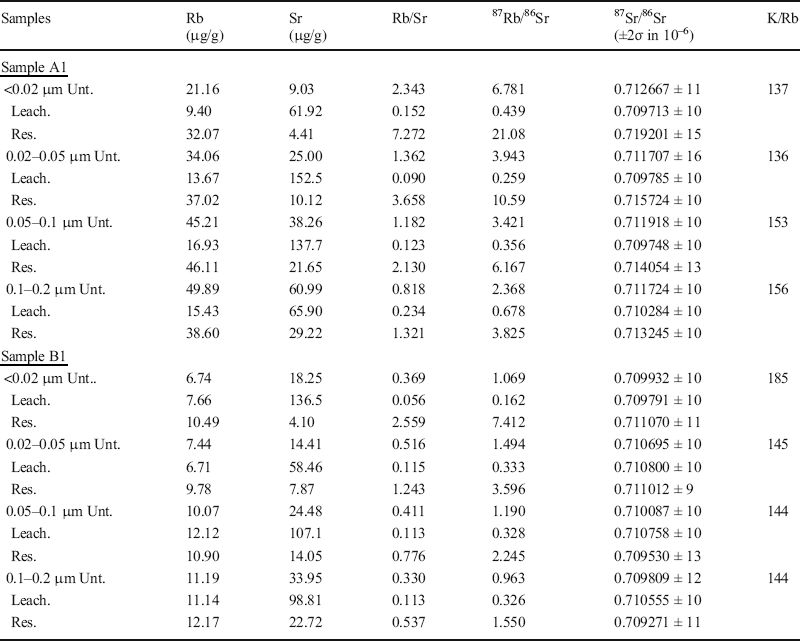
Rb-Sr data of the untreated (Unt.), leachate (Leach.), and residue (Res.) separates from <0.02, 0.02–0.05, 0.05–0.1, and 0.1–0.2 μm size fractions of the samples A1 and B1

The uncertainty of the 87Sr/86Sr ratio is given in 10–6 at the 2σ/mean level.
GEOLOGICAL SETTING
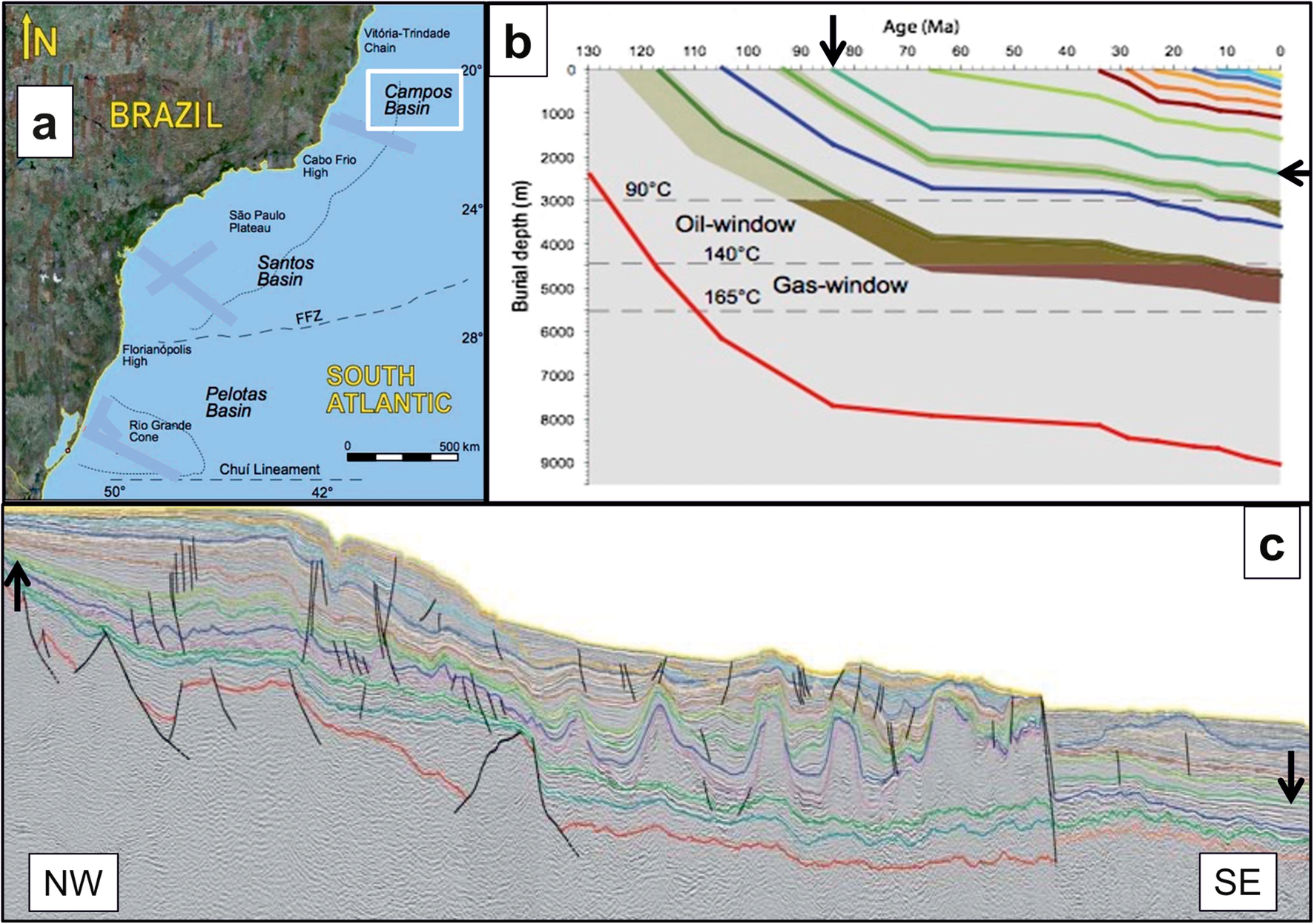
The Campos Basin represents, with the nearby Santos and Pelotas Basins, the rift-basin system of the southern Brazilian continental margin between 20°S and 24°S. This deposition center accumulated a stratigraphic succession up to 9 km thick comprising continental to deep-marine sediments intercalated with basaltic flows and ash levels. Limited to the north by the Vitória-Trindade Chain and to the south by the Cabo Frio High, the Campos Basin covers an area of 115,000 km2 (Fig. 1a; Mohriak et al. Reference Mohriak, Mello, Karner, Dewey and Maxwell1990). Accounting for ~85% of the total hydrocarbon production of the whole area, it is a prolific hydrocarbon producer with oil hosted mainly by sandy turbidites. The structural and volcanic processes that contributed to the continental break-up and the tectonic-stratigraphic evolution of this complex sedimentary basin have been studied extensively (e.g. Kumar et al. Reference Kumar, Gamboa, Schreiber and Macle1977; Ojeda Reference Ojeda1982; Chang et al. Reference Chang, Kowsmann, Figueiredo and Bender1992; Cainelli and Mohriak Reference Cainelli and Mohriak1999; Mohriak et al. Reference Mohriak, Rosendahl, Turner and Valente2002). The whole margin shows permanent changes in subsidence and in the sediment supply, both subordinated to the eustatic sea-level changes in a system controlled mostly by interconnected tectonic actions and sedimentary parameters. Of use for the present study is the burial-depth history of the Barremian to Holocene stratigraphic succession (Contreras Reference Contreras2011) that provides a temperature trend based on data collected at two locations in the basin (Fig. 1b). Also, seismic-stratigraphic data along horizontal seismic lines and in vertical drillings testify to the complexity of the sedimentary sequence (Fig. 1c).
a Map of the offshore southwestern margin of the South Atlantic Ocean on the Brazilian continental margin with the location of the Campos Basin; b sketch of the burial-depth curve of the volcano-sedimentary sequence. The layers of the studied bentonites are indicated by the arrows; and c a profile of the turbidite system along the offshore, again with the arrows marking the bentonite layers (the three sketches are reproduced, with the permission of the author, from Contreras Reference Contreras2011)

Altered volcanic beds were described as interlaying the Upper-Cretaceous turbidites in the central Campos Basin (Alves et al. Reference Alves, Mizusaki and Caddah1993; Viana et al. Reference Viana, Faugères, Kowsmann, Lima, Caddah and Rizzo1998) within shales and siltstones of the Ubatuba Formation and in sandstone reservoirs of the Carapebus Formation. Varying from 5 cm to 1 m in thickness, these bentonite beds occur mostly near the top of sandstone lobes (Caddah et al. Reference Caddah, Alves and Mizusaki1998) with the thinnest layers, often bioturbated and mixed with the host shales. The tectonic activity associated with the volcanic episodes probably played a determining action by initiating the siliciclastic turbidite flows during the Santonian/Campanian epochs (Caddah et al. Reference Caddah, Alves and Mizusaki1998). Six Santonian (85.8–83.5 Ma) bentonite samples buried to ~2800 m were collected from drill-cores for this study. The precise geographic location of the drillings and the detailed stratigraphic ages of the samples in the drill-hole(s) were not provided. The A1 sample was selected deliberately because of a visible contamination by the hosting turbidite for comparison of its mineralogical and isotopic data with those of the five other bentonite samples which were apparently not contaminated.
Results
The Clay Mineralogy and Morphology
The mineral composition of all size fractions of <0.2 μm is dominated by a smectite-type mineral, as all air-dried patterns outline a strong XRD 001 reflection at ~12 Å (for one water layer) and its higher orders, whereas the ethylene-glycolated specimens show ~17 Å 001 reflection (for two glycol layers), again with its higher orders (Fig. 2). The amount of smectite layers in the I-S was evaluated by the most precise method available based on the angular distance between the 008 and 009 reflections of smectite (Table 1; Środoń Reference Środoń1980). The precision of this measurement depends on the registration quality of the XRD patterns and has been estimated here as better than 2% of smectite layers. Traces of kaolinite were also detected in four samples, as well as traces of dolomite in one sample and of pyrite and marcasite in another sample (Table 1)
XRD diagrams of the nm-sized <0.02, 0.02–0.05, and 0.1–0.2 μm size fractions of the A1 and B1 samples. The untreated air-dried separates are in red and the ethylene-glycolated separates are in blue

Identification of the smectite mineral in the <0.2 μm fractions of the six bentonites was based on the ∆2 peak position method of Środoń (Reference Środoń1980) using the following experimental regression based on the data of Środoń et al.(Reference Środoń, Zeelmaekers and Derkowski2009a):

where ∆2 is the angular distance (°2θ CuKα) between the 008 and 009 illite-smectite reflections in the 42.5 – 48.5°2θ range (Table 1). All mineral fractions consisted of smectite-rich I-S containing from ~3% illite layers in a size fraction of sample B3 to 9% in a fraction of sample A1. The percentage of smectite layers (%S in Table 1) in the I-S was also used to estimate the corresponding expected K2O content of the size fractions, assuming that all positions of fixed cations in the illite structure were filled with K (Środoń et al. Reference Środoń, Clauer, Huff, Dudek and Banas2009b). The following regression based on the experimental data of Środoń et al. (Reference Środoń, Kuzmenkova, Stanek, Petit, Beaufort, Gilg, Liivamägi, Goryl, Marynowski and Szczerba2019) for highly smectitic clays (>60 %S) was used:

The calculated K2O contents corresponded well to the measured values (Table 2), while being less than those of the contaminated sample A1. The difference between the measured and the calculated K content in the A1 sample relates to the illite admixture shown by two independent ways. This result indicates that all analyzed K in the I-S is fixed, and that the contribution of ammonium is insignificant (e.g. Środoń et al. Reference Środoń, Zeelmaekers and Derkowski2009a, Reference Środoń, Clauer, Huff, Dudek and Banasb).
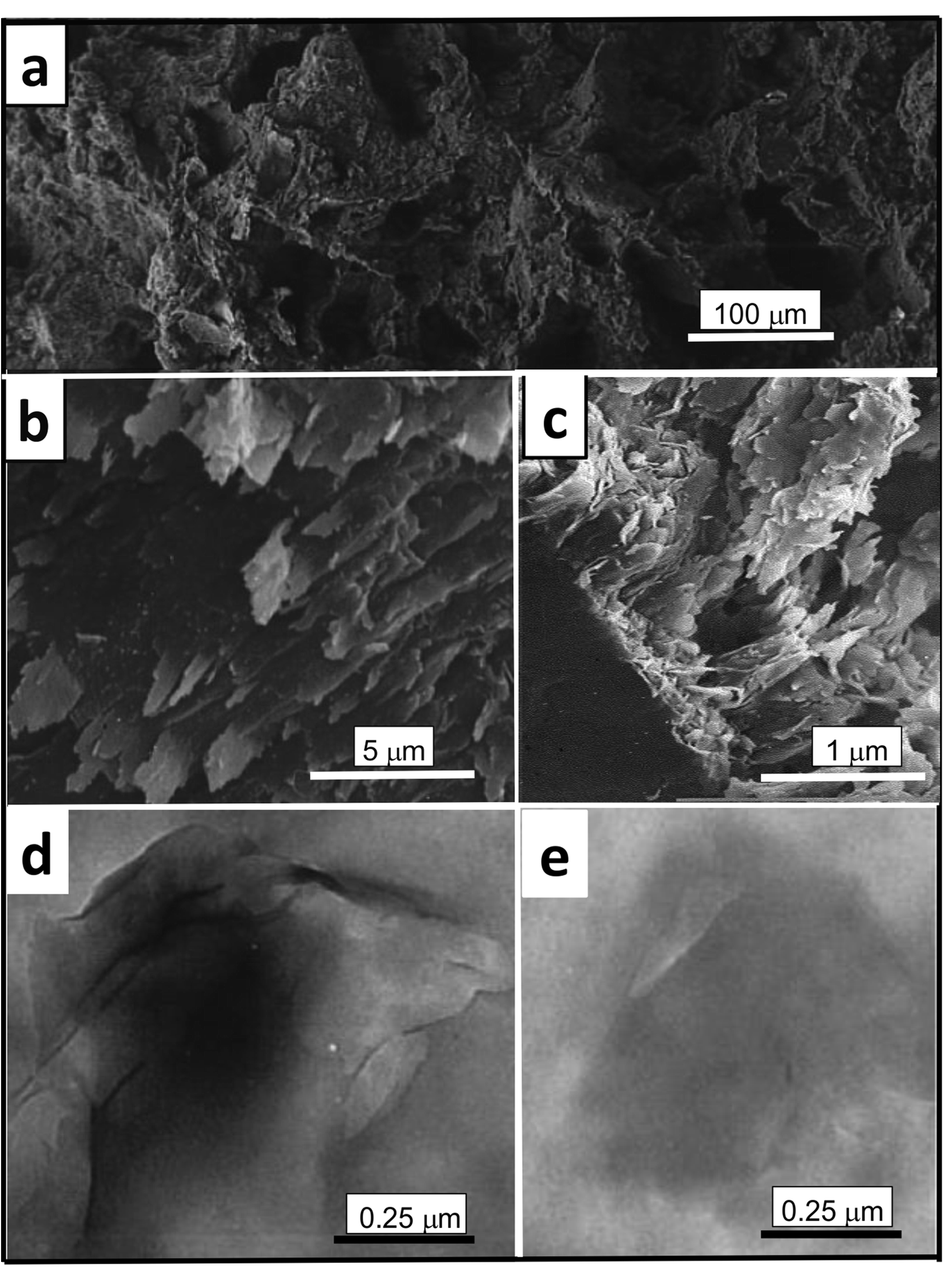
Observations by SEM at low magnification show irregular surfaces which appear to mimic the initial volcanic ash with large imprints of coarse original crystals in the 0.1 mm range (Fig. 3a). In detail, these rough surfaces consist of laminar crystal sheets at the edges of the ash particles (Fig. 3b). Perpendicularly, the sheets are organized into micrometer-sized lamellar “booklets” (Fig. 3c). At higher magnification, the 1-μm platy particles appear oriented, which suggests the action of a pore-fluid flow during crystallization of the particles (Fig. 3b). The TEM observations showed very thin, almost transparent particles with surfaces of about 1-μm2 (Fig. 3d,e).
SEM images of: a the bentonite sample A1 with some impacts of initial volcanic minerals; b sample A2 with authigenic illite-smectite crystals; c a closer look at a layer with very thin, irregular crystals relative to their surface; (d, e) TEM images showing very thin smectite crystals (apparently rolled in d)

The K-Ar Data
The XRD data, together with the geochemical simulations of the K2O contents in sample A1, confirmed the presence of independent illite crystals possibly occurring also in some of the A2, A3, B1, and B3 separates (Table 1). The calculations of the K2O contents showed a reasonably consistent correlation with the measured K2O contents (Table 2). Only those of sample A1 showed differences between the analyzed and computed K2O contents due to the detrital illite, which implies that the K of the I-S is held strongly enough by the so-called fundamental particles to be dated by the K-Ar method. The Rb-Sr method based on the disintegration of Rb, the ‘sister’ element of K, is theoretically also applicable because Rb yields similar characteristics to K but at much smaller amounts. The K2O contents of samples A1 and A2 increased with particle size, while remaining stable in the A3 and B2 samples. The few duplicated analyses showed either identical data in the case of the <0.02 μm fractions of samples A2 and B3, or values within analytical uncertainty in the case of the <0.02 μm fraction of sample B1.
The individual K-Ar results were divided into four groups, not taking into account the data of the 0.05–0.1 μm size fractions of the A3 and B2 samples and that of the 0.02–0.05 μm fraction because of their excessive analytical uncertainties. Three fractions of sample A1 yield K-Ar data beyond 53 Ma, together with one fraction of sample B1 and two fractions of sample B3. As the XRD diagrams of the coarse size fractions confirmed the occurrence of detrital illite, these higher isotopic data have no geological meaning. The smallest separate of samples A1, all those of the samples A2 and A3, and the two smallest of sample B3 yielded data between 47 and 16 Ma, comprising a group of values within analytical uncertainty for all the fractions of sample A2, while those of sample B3 increased slightly with grain size, which could also relate to some contamination by detrital illite. The third group included intermediate fractions of samples A2, B1, and B2 with data between ~10 and 26 Ma, comprising also the smallest fractions of samples B2 and B3 that are characterized by very small amounts of K2O and even by the lack of radiogenic 40Ar. By considering again the large analytical uncertainty, the samples of this third group yielded K-Ar data ranging from 0 to ~26 Ma. No contaminant minerals other than apatite and dolomite that theoretically do not affect the K-Ar values could be detected in the separates. Note also that all K-Ar data obtained were systematically below the stratigraphic age of the bentonite beds, even those of sample A1 with the detrital illite.
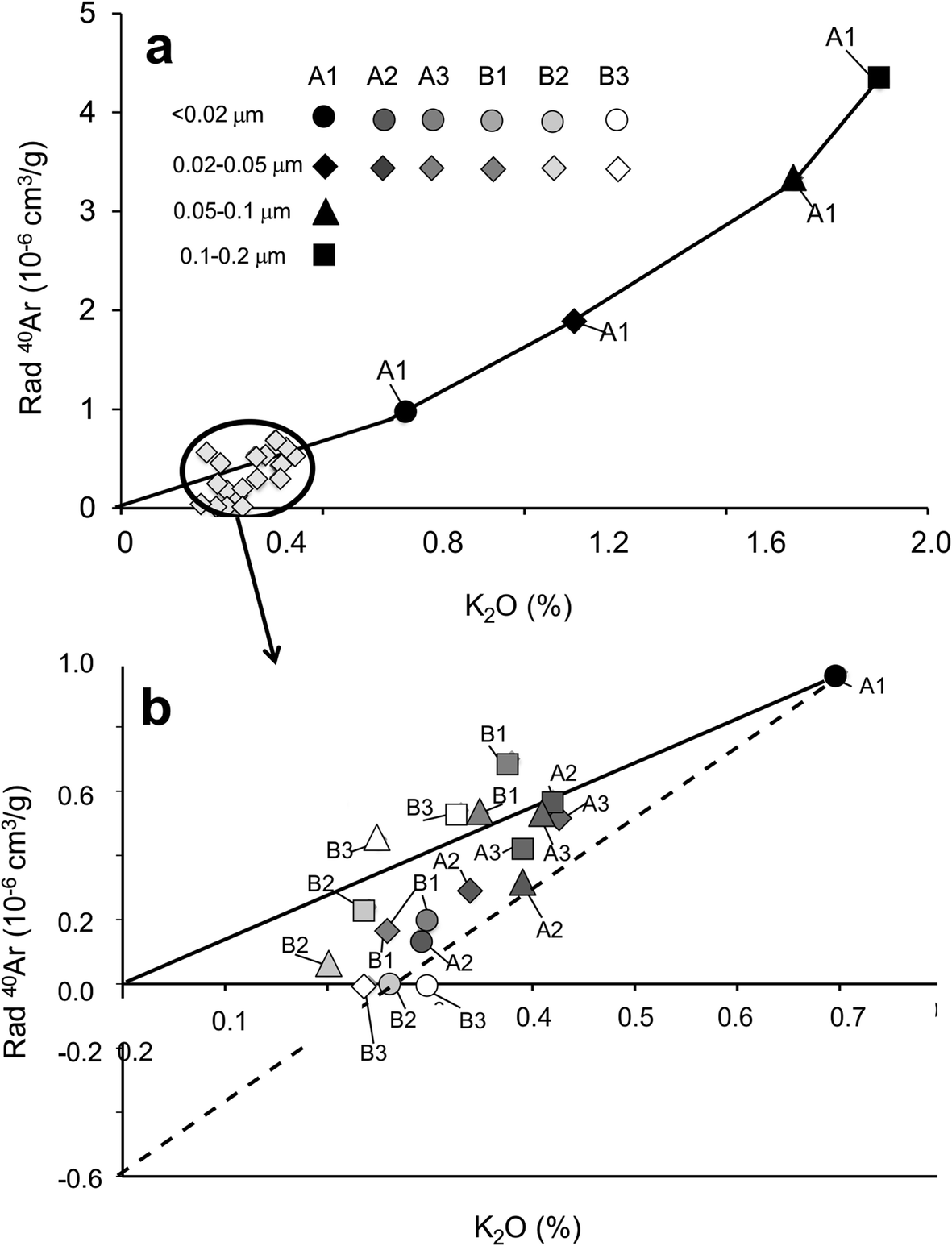
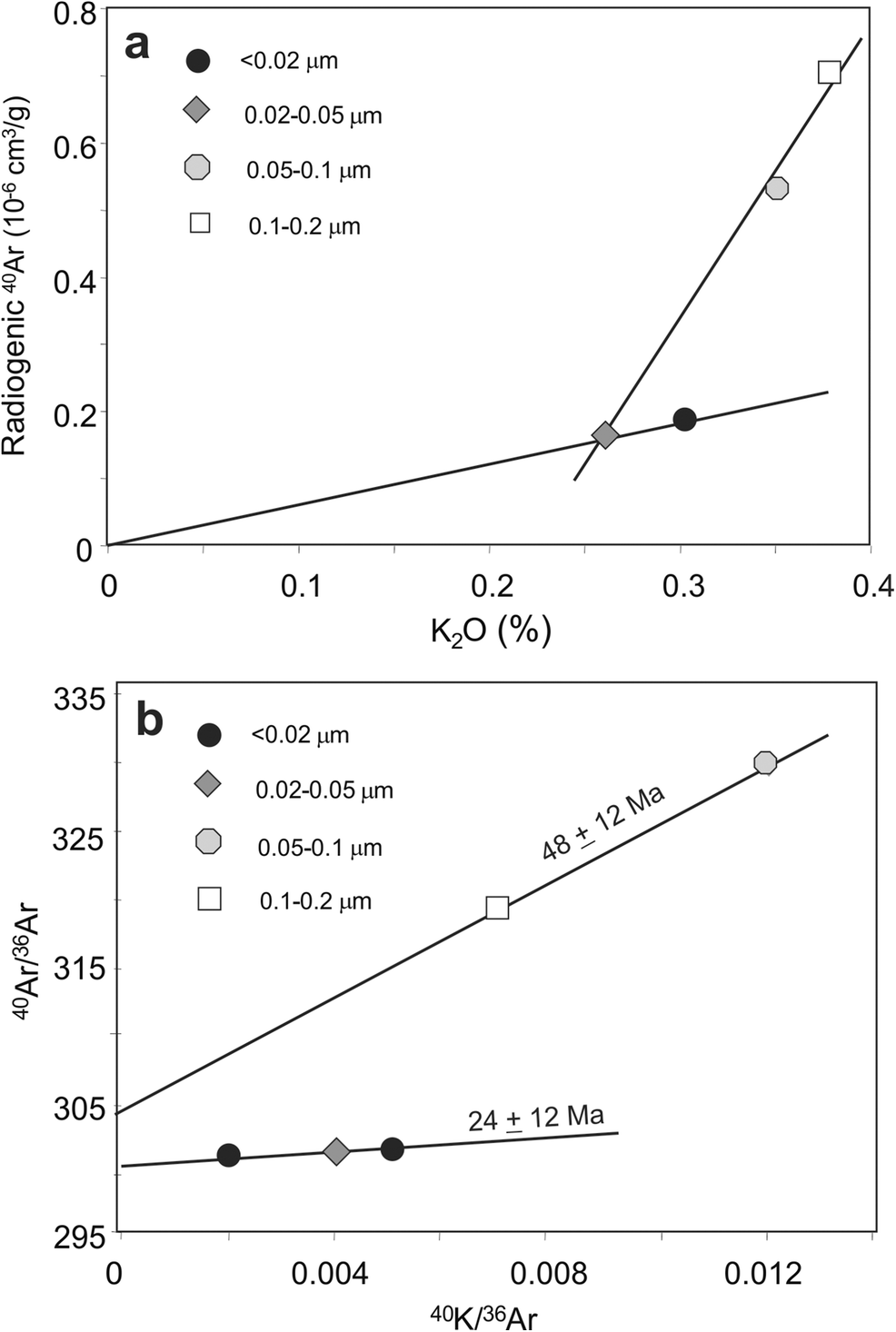
Often used in K-Ar dating of clay minerals, Harper’s (Reference Harper1970) diagram visualizes well the relationship between the K2O and radiogenic 40Ar contents of the analyzed materials. Except for the data points of the four size fractions of sample A1, all others scattered narrowly between 0.2 and 0.4% K2O and between 0.0 and 0.6×10⁻⁶ cm3/g of radiogenic 40Ar (Table 2; Fig. 4a, Fig. 4b). In the alternative isochron diagram, most available data points were clustered at the lower, left part of the diagram (Fig. 6a). Five of these size fractions plotted above the line joining the origin of the coordinates and the data point of the <0.02 μm fraction of sample A1 without detrital illite (Fig. 4b), while 13 more data points plotted below that line and one on it. Interestingly, the size fractions with the smallest radiogenic 40Ar did not plot near the intersection of the two coordinates, as they should have, but instead near the 0.2% K2O content for 0% radiogenic 40Ar. Relative to this display, the data of the A2 and B1 samples also trended more toward larger K2O contents than expected relative to their radiogenic 40Ar contents. Both correlations suggested that the smallest nano-sized illite crystals yield a depleted radiogenic 40Ar content relative to the K2O content, unless they contain an abnormally large K2O content for no radiogenic 40Ar. Independently, the data for the <0.02 and 0.02–0.05 μm fractions of sample B1 ranged from 19 to 31 Ma with large analytical uncertainties of 10 to 13 Ma, while those of the coarser 0.05–0.1 and 0.1–0.2 μm fractions scattered from 47 to 56 Ma, but with lower analytical uncertainties of 5 to 8 Ma, respectively. The data points for the two finest fractions fit a line intersecting the coordinates at their origin in a Harper diagram (Fig. 5a). This repartition favors a geological meaning of the K-Ar data, whereas the two coarser fractions fit a second line intersecting the ordinate at a negative value, which clearly does not support a meaningful age (Fig. 5b).
a A Harper (Reference Harper1970) diagram with the plots of the size fractions from A1, A2, A3, B1, B2, and B3 samples and b enlargement of the data from A2, A3, B1, B2, and B3 samples (those of sample A1 were not redrafted here)

a A Harper (Reference Harper1970) diagram and b a more detailed plot of the same pattern with all analyzed size fractions of sample B1

Among the eight other data points clustering in the Harper (Reference Harper1970) diagram, those above the horizontal segment through the origin can be considered as containing radiogenic 40Ar in excess by 0.4×10⁻⁶ cm3/g relative to 0% K2O, whereas those below yield an apparently average deficit of 0.5×10⁻⁶ cm3/g of radiogenic 40Ar relative to 0% K2O, unless it is an excess of K2O relative to 0×10–6 cm3/g 40Ar (Fig. 4b). A straight interpretation for this alternative possibility could, of course, be the loss of radiogenic 40Ar due to grain-size decrease which has not been demonstrated. If this is the case, however, it cannot be due to a decrease in the size of the nano-sized crystals as the 0.1–0.2 μm size fractions of the B1 and B2 samples are among these separates. Those on the horizontal coordinate correspond to 0×10–6 cm3/g 40Ar and a narrow 0.24 to 0.30% K2O.
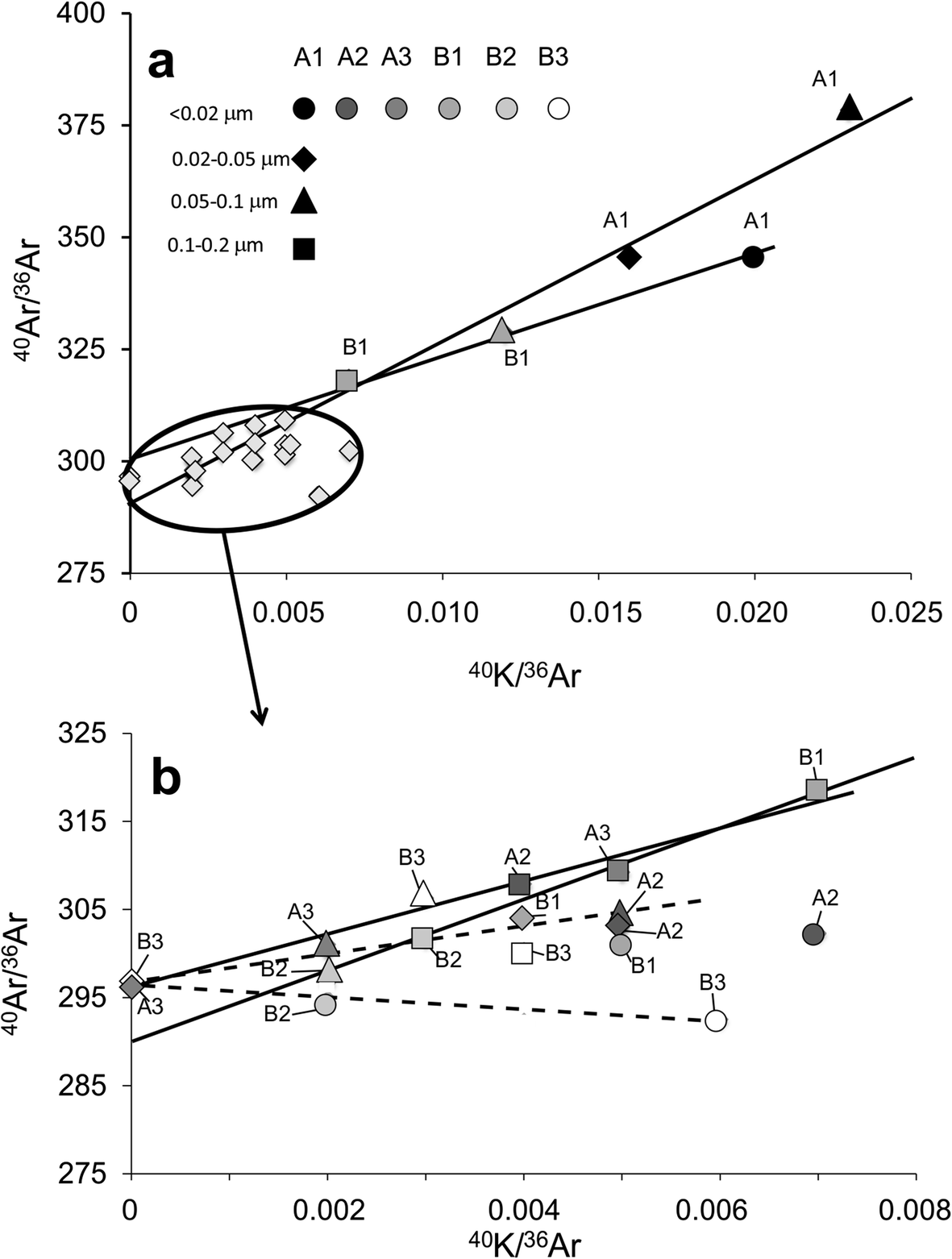
The display of the individual data in an isochron diagram represents another solid validation test for the K-Ar dating method. However, its use implies restrictions that limit a straight application to clay minerals, as it requires a fair knowledge of the amount of atmospheric 36Ar carried by any analyzed material to consolidate best the evaluation of the radiogenic 40Ar. Because the amount of atmospheric Ar increases quite easily in clay samples by adsorption during sample handling and preparation, the 40Ar/36Ar ratio stored in the samples can be more or less biased with its impact on the final age. This adsorption aspect is well known: atmospheric Ar is removed routinely from clay minerals by pre-heating under vacuum, as was done in the present study. The radiogenic 40Ar detected in the total contents of 40Ar represents from 0.0 to 34.5% of the total measured 40Ar in the size fractions analyzed (Table 2), which is what was expected for young materials with small K contents but which is too small for a straight application of the isochron technique. As this amount of atmospheric 40Ar could not be reduced in the I-S due to small K2O contents and young ages, its 40Ar/36Ar ratio was checked carefully as it may bias the K-Ar data with a value which is somewhat distant from the atmospheric 40Ar/36Ar ratio. The check was obtained by means of the data for the fractions without detectable radiogenic 40Ar and by the controls of the purified atmosphere splits. The four separates without radiogenic 40Ar yielded an average 40Ar/36Ar ratio of 294.2 ± 2.9 (2σ), while the 40Ar/36Ar ratio of the atmospheric Ar measured during the course of the study was 298.7 ± 1.2 (2σ), both to be compared to the reference at 298.6 ± 0.4 (2σ; Lee et al., Reference Lee, Marti, Severinghaus, Kawamura, Yoo, Lee and Kim2006). The analytical coherence among the three results is such that a cautious use of the isochron method can be adopted except for the data with very large uncertainties.
The data points scattered along four lines in the isochron pattern (Fig. 6a). That with the steepest slope integrated the two intermediate size fractions of sample A1 and four data points from the cluster in the lower left corner of the diagram (Fig. 6b). This steepest line intersected the ordinate below the atmospheric 40Ar/36Ar value at ~288.8 ± 3.9. Most of these data points belonged to the coarsest fractions with two data points of sample B2 and two of sample A1 characterized by some detrital illite also visualized in the Harper (Reference Harper1970) diagram (Fig. 5a). Together with the initial value of the line clearly below the atmospheric 40Ar/36Ar, this display suggests a mixing line with no geological meaning. The second line with two data points outside the cluster and four to five data points from the cluster yielded an average age of 45.9 ± 11.0 Ma and an intercept at 296.9 ± 0.2 within the analytical range of the atmospheric 40Ar/36Ar value. Due to the large individual uncertainties for most K-Ar data of these size fractions, a more precise error calculation was considered inaccurate. Despite these individual uncertainties, the line satisfies the prerequisites of an isochron with an age that might be a milestone in the evolution of the smectite-rich I-S. Some discrete detrital illite cannot be excluded formally in some of the size fractions concerned, however, on the basis of the XRD information. Of the remaining data points, five fit a third alignment with an even less steep positive slope and with the same initial 40Ar/36Ar ratio than the previous one. The characteristics of the line were, as for the previous one, calculated routinely with an age value at 10.9 ± 5.5 Ma based on the same initial 40Ar/36Ar ratio of 296.9 ± 0.2. This analytical choice was justified by the large individual uncertainties and by the presence of two samples at the origin that could not be related with certainty to any of the two groups of data.
An isochron 40Ar/36Ar vs. 40K/36Ar plot of the different size fractions of the samples A1 and B1. Part b is an enlargement of part a

The data in the two smallest size fractions of the B2 and B3 samples plotted along a supplementary line with an initial 40Ar/36Ar value equal to that of the atmosphere and a slightly negative slope (Fig. 6b). This scatter with values below the analytical uncertainty of the atmospheric 40Ar/36Ar was probably due, at least partly, to the analytical performance of the mass spectrometer that might be at its limits. In fact, the atmospheric 40Ar/36Ar ratio was never below the theoretical value published, e.g. by Lee et al. (Reference Lee, Marti, Severinghaus, Kawamura, Yoo, Lee and Kim2006). Analysis of unspiked samples (e.g. Gillot and Cornette Reference Gillot and Cornette1986) could have been a plausible complementary or alternative test of the analytical aspect, but whether that would have been the case is doubtful, as the 40Ar/36Ar atmospheric ratio obtained provided an acceptable resolution. It would probably not have helped to evaluate directly the relative contents of the radiogenic and the atmospheric 40Ar in the size fractions.
In summary, K-Ar ages were obtained at 45.9 ± 11.0 and 10.9 + 5.5 Ma, with a large analytical uncertainty for the older age. The K-Ar data also highlight the occurrence of nm-sized illite layers lacking radiogenic 40Ar. Some of the size fractions yielded 40Ar/36Ar ratios slightly below the atmospheric value. The lack of radiogenic 40Ar could not be shown to have resulted from its loss from the nm-sized I-S, or from a very recent supply of K that had not yet decayed to radiogenic Ar, which would explain the 0 Ma age.
The Rb-Sr Data
The Rb contents of the untreated (labeled U) size fractions increased in sample A1 from 21 to 50 μg/g when the particle size increased, and significantly less, from 6.7 to 11.2 μg/g, in sample B1 (Table 3). The Sr contents increased also with increasing particle size for both the A1 and B1 samples from 9.0 to 61.0 μg/g and from 18.3 to 34.0 μg/g, respectively. The Rb/Sr ratio increased from 0.82 to 2.34 in sample A1 when grain size increased, remaining almost constant in sample B1 from 0.33 to 0.37. The 87Sr/86Sr ratio decreased slightly from 0.7127 to 0.7117 in the untreated separates when grain size increased in the fractions of sample A1, while remaining constant at 0.70100–0.70107 in those of sample B1.
The Rb contents of the leachates (labeled L) increased irregularly with grain size from 9.4 to 15.4 μg/g in sample A1 and from 7.7 to 11.4 μg/g in sample B1. The Sr contents were also variable with the greatest values in the intermediate size fractions of sample A1 and in the coarser fractions of sample B1. Consequently, the Rb/Sr ratio remained small from 0.06 to 0.12. The 87Sr/86Sr ratios, still of the leachates, were fairly constant in the fractions of sample A1 at ~0.7097–0.7103, whereas they were slightly higher at 0.7106–0.7108 in those of sample B1. The lower values were slightly above the average value of modern seawater that is set at 0.70919 ± 0.00001 (Hodell et al. Reference Hodell, Mead and Mueller1990).
The Rb contents of the residues (labeled R) were fairly constant for the sub-fractions of both samples from 32.1 to 46.1 and from 9.8 to 12.2 μg/g, respectively. The Sr contents increased from 4.4 to 29.2 μg/g in the leachates of sample A1, and from 4.1 to 22.7 μg/g in those of sample B1 when grain size increases.
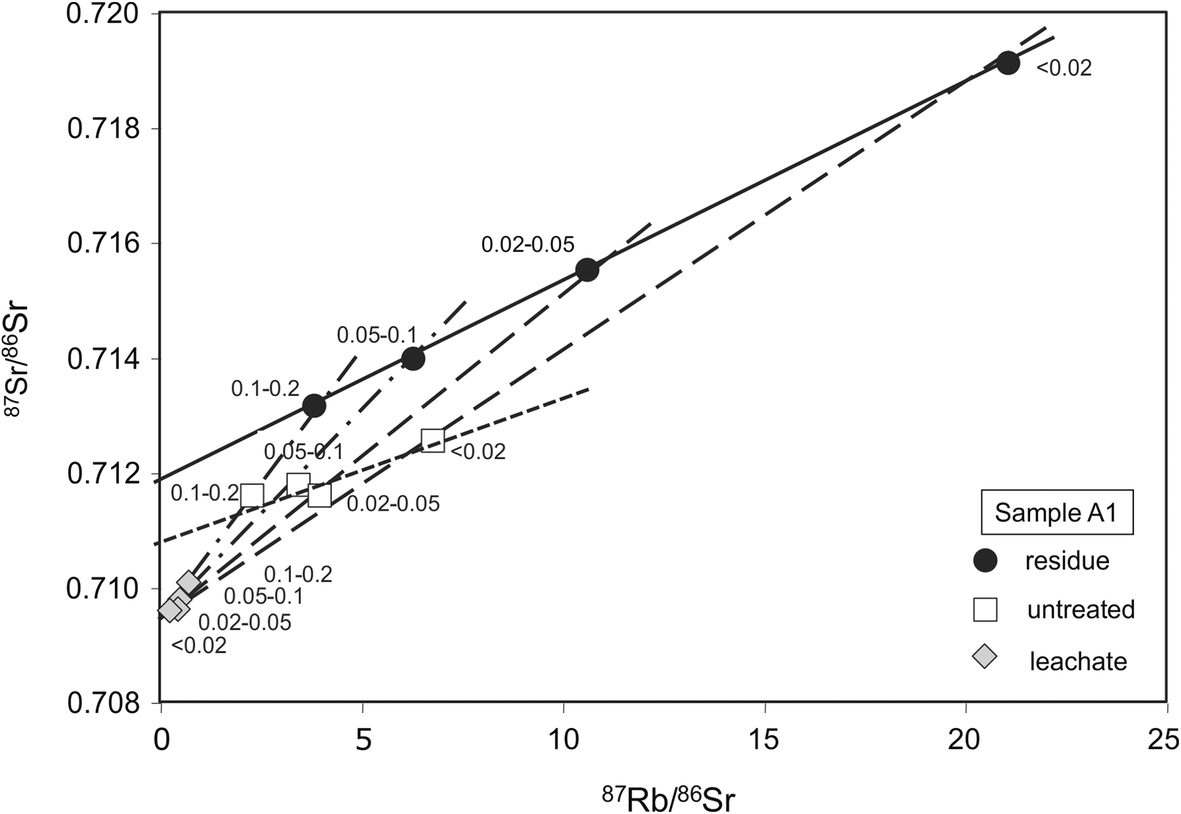
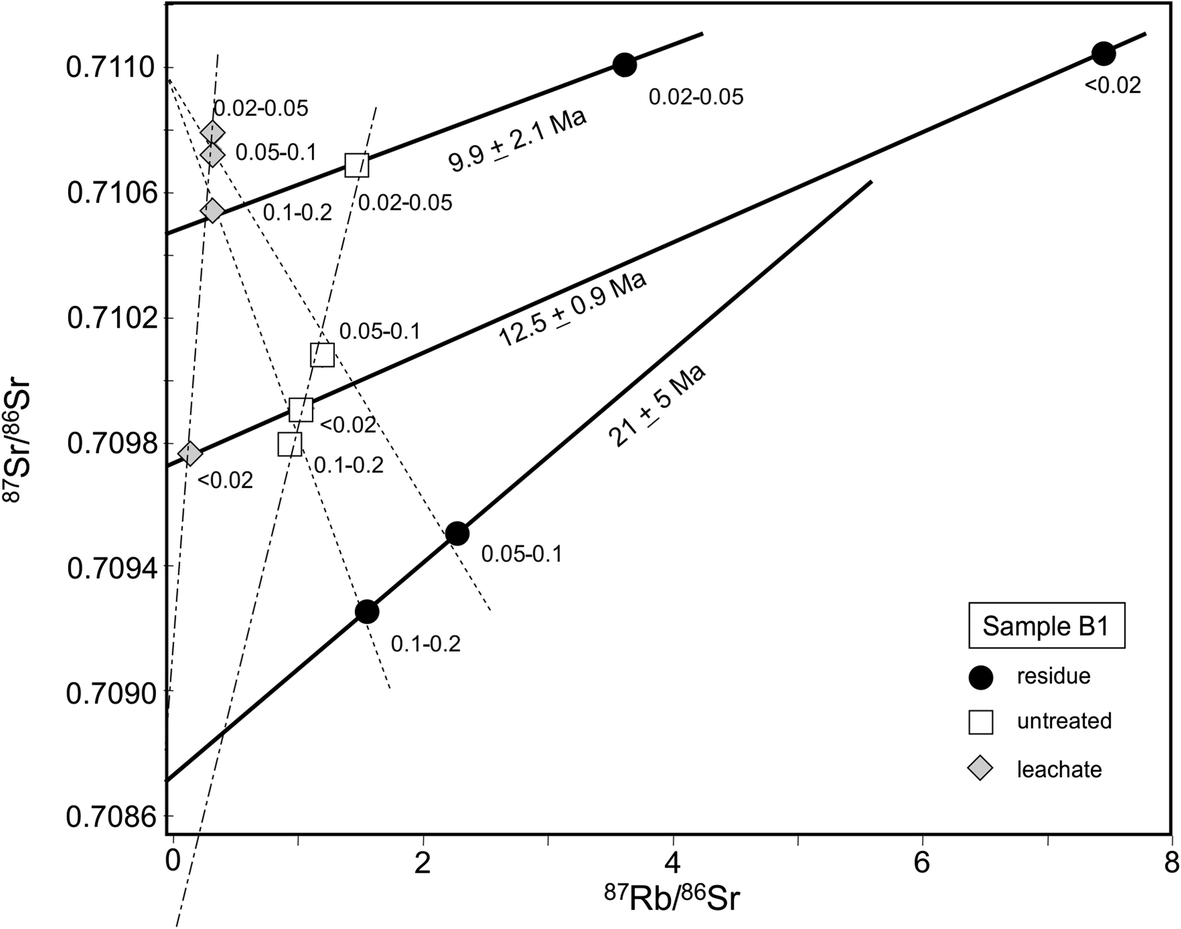
As a preliminary result, all L-U-R data points of each size fraction plotted straight on their respective arrays, as expected in the case of a mastered separation (Clauer Reference Clauer1982; Clauer et al. Reference Clauer, O'Neil, Honnorez and Buatier2011) with initial values close to the 87Sr/86Sr ratios of the leachates. These initial 87Sr/86Sr ratios ranged from 0.70951 ± 0.00015 (2σ) for the array of the <0.02 μm fraction to 0.70955 ± 0.00013 for that of the 0.02–0.05 μm fraction, to 0.70937 ± 0.00015 for that of the 0.05–0.1 μm fraction, and to 0.70985 ± 0.00017 for that of the 0.1–0.2 μm fraction, which together were within analytical uncertainty at 0.70957 ± 0.00024 (2σ). The L-U-R data points of the four A1 size fractions plotted along four individual arrays in an 87Rb/86Sr vs. 87Sr/86Sr isochron pattern with slopes decreasing with the size of the fractions (Fig. 7). Those of the four B1 size fractions outlined a more complex pattern: the data points of the finer <0.02 and 0.02–0.05 μm fractions fit along two lines with positive slopes, whereas the coarser 0.05–0.1 and 0.1–0.2 μm triplets fit two lines with negative slopes (Fig. 8). In the latter case, the 87Sr/86Sr ratios of the leachates were greater than those of the corresponding residues, which is a seldom-seen spread of strictly sedimentary environments, but which has been reported in oceanic volcano-sediments (Clauer et al. Reference Clauer, O'Neil, Honnorez and Buatier2011). The two L-U-R lines with the positive slopes yielded characteristics of isochrons giving close age values at 9.9 ± 4.2 and 12.5 ± 1.8 Ma with initial 87Sr/86Sr ratios of 0.71050 ± 0.00026 for the lower isochron and 0.70975 ± 0.00011 for the upper one. The lines through the U and the L data points characterize heterogeneous components and are, therefore, mixing lines. Also, the data points of the two coarser residues fit a further line giving an age of ~26 Ma with an initial 87Sr/86Sr ratio of ~0.7087, both with large analytical uncertainties. In summary, the data points of the two finest residues of sample B1 plotted on two sub-parallel isochron lines giving an age of 10–12 Ma. Those of the two coarser residues plotted on a separate isochron line; only through two data points, however, with an age of ~26 Ma.
A Rb-Sr data plot of the untreated, leachate, and residue separates of each size fraction of sample A1

A Rb-Sr data plot of the untreated, leachate, and residue separates of each size fraction of sample B1

Discussion
The Thermal Evolution and some Chemical Characteristics of the Bentonites
The nano-sized fractions of the selected bentonite samples consist overwhelmingly of a smectite type with a few illite layers, together with traces of detrital illite in sample A1, and kaolinite plus pyrite/marcasite in some of the other size separates. The small amount of authigenic illite suggests an overall small temperature increase during the thermal evolution of the ash layers, together with a very limited supply of K. The available depth/temperature modeling of these Campos bentonites consists of three successive, quite linear trends from a theoretical 0°C at the time of deposition at ~85 Ma, to 40°C about 20 Ma later, then to 50°C another 15 Ma later, and finally to 80°C now at a depth of 2300 m, the atmospheric temperature having not been taken into account (Fig. 1b; Contreras Reference Contreras2011). The bentonite samples studied were recovered at a present-day depth of ~2800 m, their location being apparently outside the available seismologic section. By correcting the temperature increase relative to the deeper sample location and by allowing 15°C for the atmospheric contribution, the bentonites studied were probably subjected to a final, present-day temperature of ~85°C. This value assumes a theoretical geothermal gradient close to 37°C/km, which is within the 24 to 41°C range of Cardoso and Hamza (Reference Cardoso and Hamza2014) in the same area. It can, therefore, be agreed that the samples were subjected to a moderate diagenetic process.
Combining the K and Rb contents of the smectite-rich fractions may provide information about the type(s) of fluids involved in the smectite (and I-S) authigenesis, as used first by Turekian and Wedepohl (Reference Turekian and Wedepohl1961). The K/Rb ratio varied here between 136 and 185 for the untreated separates of the A1 and B1 samples. Relative to a value of 325 attributed by Elliott and Haynes (Reference Elliott and Haynes2002) to bentonite clays for diagenetic interactions of illite-rich I-S from the Appalachian bentonites with saline fluids, the low values obtained here discard an interaction with such saline fluids and agree with the overall limited degree of illitization.
The Rb-Sr System of the Smectite-rich I-S
Before discussing the behavior of the Rb-Sr isotopic system of the I-S materials, recalling that some of the interpretations may remain somewhat hypothetical would be appropriate. This statement is due to the limited number of samples and also to the limited amount of geographic and recovery information of the sampling, while the data confirm the mixing of authigenic and detrital illite in, at least, the two coarser size fractions of sample A1. Remember also that increasing array slopes through the data points of several size fractions in an isochron diagram means generally, when the grain size increases, that at least some of the size fractions are isotopically heterogeneous, and that the coarser size fractions contain more radiogenic 87Sr and, therefore, ‘older’ crystals of detrital or depositional origin, as is the case here for the bioturbated sample A1. On the other hand, the narrow scatter of the initial 87Sr/86Sr ratios of the U-R-L triplets at 0.70957 ± 0.00024 (2σ), as is also the case here, suggests often that the mineral crystals of different size separates were in contact with pore fluids having similar to identical 87Sr/86Sr ratios. This value raises a problem about the true origin of the elements recovered here in the leachates by gentle dilute acid. The gentle acid leaching was completed after Jackson’s (Reference Jackson1975) treatment that can be considered to be rough enough to remove all elements adsorbed at the surface of the crystals, together with the dissolution of any soluble mineral. The elements concentrated in the leachates could, then, probably result from a discrete disaggregation of crystal edges in contact with the gentle acid because of being less strongly bound than inside the crystals. Suggested by Thompson and Hower (Reference Thompson and Hower1973) and Aronson and Douthitt (Reference Aronson and Douthitt1986), this interpretation is based on experiments that were designed to study the behavior of K and Rb and of their daughter Ar and Sr isotopes of clay materials. In this case, the 87Sr/86Sr ratios of the leachates do not identify seawater or pore fluids.
The data points of the four residues (R) of sample A1 also plotted along an upper array that yielded an age of 24.3 ± 1.9 Ma (2σ) for an initial 87Sr/86Sr ratio of 0.71196 ± 0.00033 (2σ). In fact, this display does not suggest a decreasing occurrence of older minerals when grain size decreases, as the individual isotope data would rather plot along a hyperbolic trend as for the K-Ar system (Fig. 5a). Therefore, this 24-Ma value could result from aggregation of heterogeneous residues and would, then, not represent a reliable age step of the few authigenic illite layers from bentonites. However, it was also obtained independently by the K-Ar method on the two finer fractions of the same sample A1, of another fine fraction, and of a duplicate. The ambiguity of the K-Ar data is the location of the 0.02–0.05 μm data point on the two arrays. No clear interpretation can be provided for this 24-Ma record because of this ambivalence.
In this context, the negative slopes of the arrays by the two coarser 0.05–0.1 and 0.1–0.2 μm triplets of sample B1 (Fig. 8) raise concerns about the identity and the origin of the solid materials and about their interaction with pore fluids. Of sedimentary origin, the environmental fluids that may have interacted with the smectite crystals derived from volcanic ash and/or directly from hosting turbidites. Besides the hypothetical origin of the interacting fluids and the significance of the two slopes, it can be agreed that the analytical conditions were appropriate as the data points of the four L-U-R triplets all fit along straight lines.
In summary, illitization occurred after smectitization, apparently long after ash deposition (at ~85 Ma), unless the limited illitization was a ‘side effect’ of the overwhelming smectitization due to a very limited occurrence of K and Rb in the sedimentary pore fluids. In both cases, illitization was extremely limited with almost no Rb (or K) fixed in illite-type interlayer sites, a consequence being also that almost no radiogenic 87Sr accumulated. The 87Sr/86Sr ratios of the leachates probably correspond to Sr somehow removed from crystal edges with values between 0.7106 and 0.7108, which is greater than those in the marine environment (Jones and Jenkyns Reference Jones and Jenkyns2001), either during ash deposition or later during illitization. Smectitization seems to have been fed, probably, by an aqueous environment that hosted Sr and moved through the pore system of the turbidites.
The K-Ar System of the Illite Layers in the Smectite Particles
Illitization has often been considered as a continuous process lasting, in progressively buried sediments and associated bentonite units, as long as temperature is increasing as shown, e.g. in the East Slovak Basin (e.g. Šucha et al. Reference Šucha, Kraus, Gerthofferová, Peteš and Sereková1993; Clauer et al. Reference Clauer, Środoń, Francù and Šucha1997). Such continuity depends on the local conditions in any sedimentary basin and on the supply of K by the pore fluids and can, therefore, be interrupted or even stopped. The burial/depth sketch used here has shown that the environmental temperature was lowest at the deposition of the ash layers and that it increased continuously until very recently. This evolution suggests, therefore, that illitization followed smectitization when the ambient temperature reached the appropriate level and that it might have continued since. In fact, no determining argument has been presented to favor either: (1) ‘true’ isotopic ages for the different size fractions of a sample when the process stopped definitively; or (2) successive steps of an ongoing process that corresponds to relative amounts of initial and final authigenic materials during a continuous crystallization, especially if its intensity increased with the temperature.
Knowledge of the regional evolution of the Campos Basin is not precise enough here to consolidate the isotopic data into geologically meaningful ages because of the unknown location of the samples and the quite linear increase in the temperature that sets at ~40 Ma the timing for its crossing of the 60°C level at which illitization starts. Also, if the process had stopped in any of the samples, the data of the smaller nano-sized fractions should be similar, indicating in turn the end of the process. Alternatively, the process seems to have been active up to now, with the isotopic data of some of the smallest fractions trending toward 0 Ma. By combining these constraints, the meaningful ages concentrate at ~45 and 0 Ma and, consequently, the coarsest size fractions of the B1 and B3 samples, together with the coarser A1 fractions yield meaningless data. From data of the smallest nano-sized fractions, the age span from 24 to 12 Ma could also yield a true age range for the A2 and B1 samples. If illitization is considered to be a continuous process powered by increasing temperature with possible stops depending on temperature variations and possibly K supply, it is very plausible that the data obtained either by groupings of individual data or alignments could report on content averages of ‘older’ relative to ‘younger’ particles and not on ‘strict’ ages. In turn, the values between the older 45 Ma and the younger 0 Ma would then depend on the specific mixing of the two generations and could, then, outline instead time intervals of illitization rather than age steps.
How did Smectitization and Illitization Proceed?
An overwhelming smectitization of volcanic glass occurred in the bentonite levels, but whether the K supply to the illite layers was supplied contemporaneously or later, when temperature was adequate and K available, is unclear. Indeed, it cannot be argued that the very small amounts of K in the I-S particles resulted from a limited supply by interacting K-poor pore fluids during the initial smectitization or from a later limited supply during an independent illitization. No indisputable evidence was found for contemporaneous or successive episodes from either of the isotopic dating methods as they apply solely to crystal interlayers with fixed K and its sister element Rb. The only age references are, therefore, from illite layers even if they represent <10% of the overall smectite-rich particles. Moreover, the very limited occurrence of alkalis in the smallest nano-sized I-S separates and the small amount of radiogenic 40Ar suggest that discrete illitization has probably occurred up to the present day.
The Smectite-to-illite Genetic Trend during the Evolution of the Campos Basin
Ash layers were deposited during Santonian time, between 85.8 and 83.5 Ma. They appear to have undergone a diagenetic episode that allowed dissolution of the volcanic glass and precipitation of authigenic smectite. During progressive burial, illite layers began to form by locking K and Rb into the crystalline structure. The combined K-Ar and Rb-Sr methods provide age milestones at 44 ± 4 Ma, 25–30 Ma, 12 ± 2 Ma, and probably between 2 and 0 Ma as potential steps in the illitization process. At this point, these isotopic ages validate the evolution of either a lasting but changing diagenetic event, or successive episodes that may have stopped somehow.
Smectitization of the ash deposits probably started when the environmental conditions favored an alteration (dissolution) of the ash particles, sketched at least by the different amounts of the two smaller and the two coarser nano-sized fractions of sample B1. All data points of their residues fit an isochron line with an initial 87Sr/86Sr ratio of 0.7120 ± 0.0003 (2σ; Fig. 7). These smectite-rich size fractions are not in isotopic equilibrium with the 87Sr/86Sr ratio of the leachates at 0.7096 ± 0.0002 (2σ). The scenario is different in the case of the B1 sample for which the two smallest and the two coarsest nano-sized fractions yielded different results, unless they represent different steps of a common evolution. The two smallest fractions gave similar ages for their L-U-R assemblages at ~12 Ma, but with significantly different initial 87Sr/86Sr ratios of 0.7097 and 0.7105. The components of the two coarser nano-sized fractions had obviously less interaction with pore fluids, as the residues still yielded a volcanic Sr isotopic signature. The leachates again yielded 87Sr/86Sr ratios at 0.7108 and 0.7105, close to those of the leachates removed from smaller size fractions. As no change in the sedimentation conditions can be suspected because of the lack of information, an alternative interpretation is needed to explain the differences among the solid separates of the same B1 sample. At this point, the coarser size fractions consist either of pure smectite crystals that crystallized from shards of the ash levels or of altered volcanic remnants mixed with authigenic smectite crystals, including the illite layers. None of the results available favors either of these hypotheses yet. With respect to the timing of the process(es), changes such as crystallization of smectite on volcanic ash could have started at ~45 Ma, and could have lasted for 20 Ma. Interestingly, the Rb/Sr ratios of the nano-sized smectite are systematically highest when grain size decreases (Table 3), which could mean that the alkali supply into the smectite started with the crystallization of the smallest nano-sized particles and could have lasted until very recently. Such a continuous process would explain the lack of radiogenic 40Ar in some of the smallest nano-sized particles. In summary, partial illitization of the smectite appeared to start at ~45 Ma, during progressive burial of the host sediments when the ambient temperature was beyond 60°C. The supply of K and Rb remained limited, even if it lasted for ~12 Ma at least or even until the present time.
On the basis of the results above, alteration of the Campos bentonites involved a two-type process (smectitization followed by illitization), combined or not. Initially, pure smectite crystallized when the glass shards were altered in contact with pore fluids probably expelled from surrounding turbidites. Potassium (and Rb) supply initiated nucleation of illite layers, especially those present now in the finer <0.02 and 0.02–0.05 μm fractions, highlighted by the array joining the two finer residues of sample B1. Since deposition of the volcanic ash at 86–84 Ma, illite crystallization could have started ~40 Ma later, and ending after ~25 Ma. For some illite layers, the process could even have lasted until very recently. This crystallization with some K supply may have been induced by a changing composition of the interstitial fluids or by a changing temperature that could have been at ~25 Ma.
In summary, Rb-Sr and K-Ar isotopic results of Santonian bentonites support following evolutionary steps in the Campos Basin: a burial-induced smectitization starting in the ash beds when the volcano sediments reached a temperature of ~50–55°C probably ~44 ± 4 Ma ago, followed by a very limited illitization until 30–24 Ma, while the temperature continued to increase slightly. Illitization could have lasted longer, until 12 ± 2 Ma, fueled by a low sedimentation rate and a low geothermal gradient, and even until very recently at 0 Ma, both ages depending on the type of host bentonites. The overall occurrence of smectite confirms that burial temperature was at the lower limit of the ‘illitization window,’ at least in the bentonite beds, and that no significant K supply could be detected at the beginning of the alteration process. The Sr isotopic composition of the leachates is systematically above the Sr isotopic value of the seawater, during the ash deposition but also during the diagenetic episode, which suggests a ‘cleaning’ of layer edges from illite-smectite crystals during gentle acid leaching.
Conclusions
In the present study, X-ray determinations were combined with K-Ar and Rb-Sr analyses and electron-microscope observations of Santonian (85.8–83.5 Ma) nm-sized bentonite fractions (<0.02, 0.02–0.05 and 0.05–0.1 μm) buried to ~2800 m in the Campos Basin, offshore Rio de Janeiro State (Brazil). Unlike previous, similar mineralogical, chemical, and isotopic studies of nm-sized illite-rich mixed layers or pure illite crystals of bentonite units, the aim here was to decrypt the initial illitization stage including a limited K fixation after or during alteration of the volcanic ash into smectite, at a burial temperature always <85°C and limited interactions with pore fluids that originated in the hosting turbidites.
Based on the XRD data, the smectite crystals contain <7% illite layers. Their K-Ar data organize into three groups. One with values from 42.6 ± 3.2 to 70.2 ± 2.1 Ma includes the size fractions with detrital illite, thus at least the K-Ar data beyond 43 Ma have no geological meaning. The second group of samples yielded younger K-Ar ages from 15.5 ± 10.7 to 46.6 ± 4.9 Ma for which the data could have some geological meaning. The last group consists of samples with varied age patterns, the smallest nano-sized fractions containing very small amounts of K and no radiogenic 40Ar with analytically 0 Ma ages. The nm-sized fractions of two samples were also leached with dilute acid for Rb-Sr study with individual analyses of the untreated, leachate, and residue size fractions. The complete K-Ar and Rb-Sr database suggests that illitization probably started at 44 ± 4 Ma, smectitization being either earlier or contemporaneous.
The Rb-Sr and K-Ar isotopic data combined with the mineralogical results also provide some information about the evolution of the bentonite beds from the Campos Basin. Indeed, the smectite-rich mixed layers of sample B1 appear polluted by remnants of the volcanic ash. Local conditions in the basin could not be checked but were probably variable due to deposition of turbidites; illitization remained limited due to the slow temperature increase and probably a limited supply of alkalis. A further change occurred at an uncertain time between 24 and 30 Ma, with a likely slowing of illitization. These conditions probably changed because the fluid supply became somewhat restricted, or the fluid chemistry changed around the bentonites collected. Illite layers continued to crystallize and grow afterward, however, until the final 0 Ma age which may represent a very recent supply of K for which radioactive 40K could not decay enough to be detected analytically.
ACKNOWLEDGMENTS
The authors thank Drs D.B. Alves and F. Pellon de Miranda of the Brazilian Research Development Center (CENPES) for sample supply, geographic and stratigraphic information, as well as constructive discussions, and the Petroleo Brasileiro organization for financial support. Sincere thanks are also due to Mrs M. Zielińska (PAN Krakow, Poland) for her determining contribution in completing the nm-size fractionation of the samples. The authors are also grateful to an anonymous reviewer who raised a number of questions and provided many suggestions that helped to improve and clarify the draft manuscript. Finally, sincere thanks also to J. Stucki, K. Murphy, and R. Preston who also reviewed the manuscript, providing further improvements, especially in the use of the English language.
Compliance with Ethical Standards
Conflict of Interest
On behalf of all authors, the corresponding author states that there is no conflict of interest.