Introduction
Indigenous ageing has been widely studied in countries in the Global North, with research in the United States with Alaska Natives, American Indian and Native Hawaiian peoples; in Canada with Métis, Inuit and First Nations peoples; in New Zealand with Mâori peoples; and in Australia with Aboriginal and Torres Strait and Islander peoples, among others (Hillier and Al-Shammaa Reference Hillier and Al-Shammaa2020; Pace and Grenier Reference Pace and Grenier2017; Quigley et al. Reference Quigley, Russell, Larkins, Taylor, Sagigi, Strivens and Redman-MacLaren2022; Viscogliosi et al. Reference Viscogliosi, Asselin, Basile, Borwick, Couturier, Drolet, Gagnon, Obradovic, Torrie, Zhou and Levasseur2020; Yashadhana et al. Reference Yashadhana, Howie, Veber, Cullen, Withall, Lewis, McCausland, Macniven and Andersen2022). These countries have witnessed fruitful and diverse scientific debate regarding the characteristics of these peoples, which has even translated into specific policies, programmes and interventions to promote wellbeing in old age (for example, the Canadian Centre for Elder Law). Meanwhile, in Latin America and the Caribbean (LAC), studies investigating the ageing process in indigenous or ethnic minority communities are still at an early stage (Gallardo-Peralta, Rodríguez-Rodríguez et al. Reference Gallardo-Peralta, Rodríguez-Rodríguez, Valencia Galvez, Tereucán Angulo, Soto Higuera and Sánchez-Moreno2023; García et al. Reference García, García and Curcio2024; Paredes-Arturo et al. Reference Paredes-Arturo, Flórez-Madroñero, Diaz-Velásquez, Yarce-Pinzon and Aguirre-Acevedo2023; Pelcastre-Villafuerte et al. Reference Pelcastre-Villafuerte, Meneses-Navarro, Ruelas-González, Reyes-Morales, Amaya-Castellanos and Taboada2017, Reference Pelcastre-Villafuerte, Cuecuecha Rugerio, Treviño Siller, Rueda Neria and Ruelas-González2020; Raymond et al. Reference Raymond, Carrasco Pavez, Rodríguez Gutierrez, Gallardo Peralta, Gonzálvez Torralbo, Osorio-Parraguez and Caro Puga2023; Vázquez Flores et al. Reference Vázquez Flores, Cantero Flores and Díaz Molina2020; Waters and Gallegos Reference Waters and Gallegos2014).
In recent decades, governments and international bodies have made a combined effort to reduce the levels of social, economic and cultural inequality that affect indigenous and tribal peoples in LAC (Economic Commission for Latin America and the Caribbean (ECLAC) 2020; Pan American Health Organization (PAHO) 2023). Nonetheless, the outlook remains challenging, taking into account the notorious invisibility of the voices of indigenous and Afro-descendant older adults in the scientific debate (García et al. Reference García, García and Curcio2024; Raymond et al. Reference Raymond, Carrasco Pavez, Rodríguez Gutierrez, Gallardo Peralta, Gonzálvez Torralbo, Osorio-Parraguez and Caro Puga2023; Valencia-Gálvez et al. Reference Valencia-Gálvez, Gallardo-Peralta, Andrade-Guzmán, Rain-Rain and Rodriguez-Venegas2025) in addition to insufficient examination of the specific features of ageing among women belonging to these ethnic groups in LAC (Gallardo-Peralta, Fernández-Dávila Jara et al. Reference Gallardo-Peralta, Fernández-Dávila Jara, Tereucán Angulo and Martínv2023).
The regulatory framework of a homogeneous old age remains a key hurdle, and one that is subject to debate at international level (Pace and Grenier Reference Pace and Grenier2017; Westwood Reference Westwood2019) and regionally (Oddone Reference Oddone2014; Ramírez-García et al. Reference Ramírez-García, Montes de Oca and Mendoza-Pérez2022). As such, LAC faces the ongoing challenge of attempting to progress towards a heterogeneous, diverse, inclusive and equitable vision of older adults (Fernández-Silva and Mancilla-Mancilla Reference Fernández-Silva and Mancilla-Mancilla2024; Oddone Reference Oddone2014). The true issue with failing to recognize diversity lies in the increased oppression of certain subgroups that are already marginalized (Raymond et al. Reference Raymond, Carrasco Pavez, Rodríguez Gutierrez, Gallardo Peralta, Gonzálvez Torralbo, Osorio-Parraguez and Caro Puga2023). There is hence a need to develop studies that show the particular features of old age at the intersection of gender, ethnicity and rurality in LAC. In this regard, this study will adopt a broad, holistic perspective that is focused on Living Well (Buen Vivir) to advance the understanding of mental health in old age among Andean and other indigenous and Afro-descendant Chilean women.
Indigenous ageing and gender: the risk of ageing as a woman
There is extensive recognition of the framework of historical oppression that indigenous people have experienced, mainly due to processes of colonization, racism, discrimination and structural inequalities (poverty) (Calma et al. Reference Calma, Dudgeon and Bray2017; Gee et al. Reference Gee, Dudgeon, Schultz, Hart and Kelly2014; Hillier and Al-Shammaa Reference Hillier and Al-Shammaa2020; Marques et al. Reference Marques, Freeman, Carter and Pedersen Zari2021; Roh et al. Reference Roh, Burnette, Lee, Lee and Easton2016; Yashadhana et al. Reference Yashadhana, Howie, Veber, Cullen, Withall, Lewis, McCausland, Macniven and Andersen2022), which have affected older adults during their lifecourse, triggering risk factors in old age (Henson et al. Reference Henson, Chapman, Shepherd, Carlson, Rambaldini and Gwynne2023; Hunter Reference Hunter2009; McCausland et al. Reference McCausland, Jamieson, Robinson, Spencer, MacGillivray and Andersen2025; Warburton and Chambers Reference Warburton and Chambers2007). This tends to affect indigenous women to a greater extent (Neufeld and Richmond Reference Neufeld and Richmond2020; Vázquez Flores et al. Reference Vázquez Flores, Cantero Flores and Díaz Molina2020). Along these lines, a report on the Older Women’s Dialogue Project (OWDP), developed in Canada, states that indigenous older women have experienced a lifecourse involving racist experiences both in institutional terms and in social settings: cultural racism has accompanied them throughout their lives (Canadian Centre for Elder Law 2017). In the case of LAC, the structural inequalities affecting indigenous women have an impact in various areas: (i) poverty, with gender and ethnic gaps in their participation in the labour market, income levels, retirement age, access to pensions and pension amounts; (ii) education, with barriers to accessing education and shortfalls in educational coverage and quality of education; (iii) health care, due to the difficulty of accessing it and the lack of culturally appropriate services in indigenous territories; (iv) the exercise of power and decision-making, since indigenous women have historically been relegated to the domestic sphere; and (v) the different forms of violence these women experience, perpetrated by both indigenous and non-indigenous people (Pan American Health Organization (PAHO) 2023: 4–5).
Based on this line of argument, it can be affirmed that the lifecourse of indigenous women is largely defined by risk factors and disadvantages (Mckinley et al. Reference McKinley, Liddell and Lilly2021; Neufeld and Richmond Reference Neufeld and Richmond2020; Tusasiirwe Reference Tusasiirwe, In Twikirize and Spitzer2019), and particularly by experiences of discrimination and violence (Sasseville et al. Reference Sasseville, Maurice, Montminy, Hassan and St-Pierre2022; Varcoe et al. Reference Varcoe, Ford-Gilboe, Browne, Perrin, Bungay, McKenzie, Smye, Price (Elder), Inyallie, Khan and Dion Stout2021; Vázquez Flores et al. Reference Vázquez Flores, Cantero Flores and Díaz Molina2020) that trigger an old age with greater deterioration in physical and mental health, taking into account that these social and cultural determinants are simultaneous and cumulative (Gee et al. Reference Gee, Dudgeon, Schultz, Hart and Kelly2014). Research has therefore tended to focus on disparities in health among the indigenous population (Anderson et al. Reference Anderson, Robson, Connolly, Al-Yaman, Bjertness, King, Tynan, Madden, Bang, Coimbra, Pesantes, Amigo, Andronov, Armien, Obando, Axelsson, Bhatti, Bhutta, Bjerregaard, Bjertness and Yap2016) and on showing that women face greater disadvantages (Hu and Hajizadeh Reference Hu and Hajizadeh2023). In this respect, studies have noted an increased risk of falls (Chen et al. Reference Chen, Liang and Chang2018; Lee et al. Reference Lee, Lin and Philp2015), higher prevalence of chronic kidney disease (Gomes et al. Reference Gomes, de Souza, Nicacio, Do Carmo, Pereira, Barral-Netto and da Costa Armstrong2023) and greater risk of experiencing loneliness (Gallardo-Peralta, Fernández-Dávila Jara et al. Reference Gallardo-Peralta, Fernández-Dávila Jara, Tereucán Angulo and Martínv2023).
There has also been analysis of depressive symptoms among the older indigenous population, and the data show significant differences with respect to incidence broken down by gender, age and ethnic group. In this respect, a study with indigenous Australians, which included adults aged 45 years and over, reported the point-prevalence of a depressive disorder in this population as 7.7 per cent, with rates of 4.0 per cent for men and 10.4 per cent for women (Almeida et al. Reference Almeida, Flicker, Fenner, Smith, Hyde, Atkinson, Skeaf, Malay and LoGiudice2014). Later, a study by Shen et al. (Reference Shen, Radford, Daylight, Cumming, Broe and Draper2018) with Aboriginal Australian participants aged over 60 years found high rates of lifetime depression (33.3%) and current late-life depression (18.1%). In LAC, a study involving older Chilean adults reported a high prevalence of depressive symptoms among the Aymara people (40.1% as opposed to 34.1% among non-indigenous participants) and a significant difference by gender (47.8% women as opposed to 32.6% men) (Gallardo-Peralta et al. Reference Gallardo-Peralta, Sánchez-Moreno, Barrón López de Roda and Arias Astray2015). In addition, research in Panama by Walker et al. (Reference Walker, Campbell, Dawson and Egede2019) showed more depressive symptoms among older adults aged between 60 and 90 years (37.5%) belonging to the Kuna people than among younger adult populations (31.7% among those aged between 18 and 39 years and 28.1% among those aged from 40 to 59). In contrast, a study by Rashmi et al. (Reference Rashmi, Srivastava, Muhammad, Kumar and Paul2022) in India showed a lower prevalence of depressive symptoms among the older indigenous population (4.8% among indigenous participants as against 8.9% among the non-indigenous sample) and gender-based differences within the indigenous group (5.5% women as opposed to 4.0% men).
Living well and wellbeing among indigenous older adults: a comprehensive approach
The understanding of wellbeing among indigenous peoples in LAC is strongly driven by the concept of Living Well (Buen Vivir), for which several origins have been proposed: sumak kawsay (Quechua people), suma qamaña (Aymara people), küme mogen (Mapuche people), utz k’aslemal (Maya people), ñande reko (Guaraní people), lekil kuxlejal (Tzeltal people), shiir waras (Achuar people), among many others (Economic Commission for Latin America and the Caribbean (ECLAC) 2020). The roots of Living Well are ancestral traditions and ways of understanding the world among the different indigenous peoples of LAC. These roots allude to a broad perspective of what a ‘full life’ or ‘life in fullness’ represents, from a starting point of harmonious and balanced relationships between humans and nature (Vásquez Bustamante et al. Reference Vásquez Bustamante, Orellana Yáñez and Rodrigues Teixeira2021). In this respect, küme mogen means that the ‘respect, love, care, empathy and reciprocity of the Mapuche people concerning nature, themselves and other people enables them to live in harmony and balance from a physical and spiritual standpoint’ (Beltrán-Véliz et al. Reference Beltrán-Véliz, Tereucán Angulo, Alarcón, Gálvez-Nieto and Klenner Loebel2022: 19). This is hence a holistic concept of wellbeing, which is founded on a balance of body, soul and mind, together with harmony in terms of relationships with community and nature that are based on horizontal respect, interdependence and balance (Beltrán-Véliz et al. Reference Beltrán-Véliz, Tereucán Angulo, Alarcón, Gálvez-Nieto and Klenner Loebel2022; Gerlach Reference Gerlach2019; Godden Reference Godden2021).
When the concept of Living Well is applied to old age in indigenous communities, specifically in Chile, several interconnected elements that have been part of international studies on ageing and wellbeing in indigenous communities are significant (Asquith-Heinz et al. Reference Asquith-Heinz, Kim and Lewis2022; Hillier and Al-Shammaa Reference Hillier and Al-Shammaa2020; Lewis Reference Lewis2011; McCausland et al. Reference McCausland, Jamieson, Robinson, Spencer, MacGillivray and Andersen2025; Pace and Grenier Reference Pace and Grenier2017; Quigley et al. Reference Quigley, Russell, Larkins, Taylor, Sagigi, Strivens and Redman-MacLaren2022; Wortman and Lewis Reference Wortman and Lewis2021). Promoting wellbeing in the indigenous ageing process entails a balanced combination of the physical, spiritual, mental and emotional factors (Baron et al. Reference Baron, Fletcher and Riva2020; Lewis Reference Lewis2011) that can challenge indigenous older adults to remain active/busy, continue to engage in productive work, maintain a healthy lifestyle and take part in meaningful cultural and spiritual activities (Quigley et al. Reference Quigley, Russell, Larkins, Taylor, Sagigi, Strivens and Redman-MacLaren2022).
Indigenous older adults want to stay connected to the community, and they are key agents in upholding indigenous identity in this space for social integration (Gallardo-Peralta et al. Reference Gallardo-Peralta, Gálvez-Nieto, Veloso-Besio and Munuera-Gómez2024; Quigley et al. Reference Quigley, Russell, Larkins, Taylor, Sagigi, Strivens and Redman-MacLaren2022). They tend to be responsible for reproduction of language and religious and cultural practices, as well as for transmitting intergenerational knowledge (Abonyi et al. Reference Abonyi, Oosman, Durocher and Roy2016; Viscogliosi et al. Reference Viscogliosi, Asselin, Basile, Borwick, Couturier, Drolet, Gagnon, Obradovic, Torrie, Zhou and Levasseur2020; Warburton and Chambers Reference Warburton and Chambers2007). In fact, they are part of a circuit of reciprocity and circularity in terms of relationships within their families and communities, facilitating each people’s social and cultural reproduction (Asquith-Heinz et al. Reference Asquith-Heinz, Kim and Lewis2022; Valencia-Gálvez et al. Reference Valencia-Gálvez, Gallardo-Peralta, Andrade-Guzmán, Rain-Rain and Rodriguez-Venegas2025). Older adults secure holistic, collective and cyclical wellbeing through these interconnections with community, family and nature (Hillier and Al-Shammaa Reference Hillier and Al-Shammaa2020; McCausland et al. Reference McCausland, Jamieson, Robinson, Spencer, MacGillivray and Andersen2025). A physical, psychological and spiritual understanding of wellbeing therefore juxtaposes various dimensions, including feelings, attachment, happiness, relationships and spirituality (Gee et al. Reference Gee, Dudgeon, Schultz, Hart and Kelly2014; Gudynas and Acosta Reference Gudynas and Acosta2011).
This study
Ten indigenous peoples were officially recognized in Chile via Law 19,253, and an estimated 10.6 per cent of the population identifies as indigenous (Chilean Ministry for Social Development and Family 2020). However, there are no official data available for the Afro-descendant population, despite their recognition through Law 21,151.
Indigenous peoples in Chile can be grouped into Andean and other peoples (Mapuche, Rapa Nui, Kawésqar and Yamán). Within the Andean peoples are the Aymara, Quechua, Atacameño, Colla, Chango and Diaguita (Gundermann Reference Gundermann2018), who represent a combined 14.7 per cent of the Chilean indigenous population. Although these are heterogeneous communities, they share the territory located in the extreme north of Chile and mainly the Atacama Desert. In this sense, they share a territory with similar geographical characteristics in Chile (including desert, coastal areas and the altiplano) and maintain inter-ethnic relations with countries such as Peru, Bolivia and Argentina (Gallardo-Peralta et al. Reference Gallardo-Peralta, Gálvez-Nieto, Veloso-Besio and Munuera-Gómez2024). This shared cultural matrix has its genesis in the Inca Empire. However, following the process of Spanish colonization, Catholic religiosity achieved a cultural syncretism with the pre-Hispanic matrix in various religious, social and cultural aspects of these communities (Santos Reference Santos2009).
The other peoples, including the Mapuche/Huilliche, Rapa Nui and Kawésqar, live in very different environments and have dissimilar forms of socio-cultural organization. The Mapuche (meaning ‘people of the earth’), who represent 84.8 per cent of the Chilean indigenous population, were originally a hunter-gatherer people. Their territorial identity is differentiated by the environment in which they live: Nagche are the northern people, Wenteche are the people of the central valleys, Lafkenche are the coastal people, Pewenche are the people from the foothills and Huilliche are the southern people, including the urban Mapuche identity (Valencia-Gálvez et al. Reference Valencia-Gálvez, Gallardo-Peralta, Andrade-Guzmán, Rain-Rain and Rodriguez-Venegas2025). Meanwhile, the Rapa Nui people, who represent 0.1 per cent of Chile’s indigenous population and originally lived on Easter Island, have a high level of inter-ethnic interaction with other Polynesian communities and a strong ethno-cultural differentiation with non-island peoples. They are currently facing a migration crisis for educational and economic reasons (Muñoz Azócar Reference Muñoz Azócar2014). Finally, the Kawésqar, along with the Yamán, represent 0.4 per cent of Chile’s indigenous peoples. They inhabit the fjords and southern channels of Patagonia and are strongly rooted in their maritime activities (Maldonado and Pérez Reference Maldonado and Pérez2019).
Afro-descendant tribal peoples have fought a long battle for recognition in Chile, which only succeeded in 2019. They originally settled in the extreme north of Chile during Spanish colonial rule, which involved the African slave trade in the Viceroyalty of Peru. Of all the ethnic minorities in Chile, Afro-descendant people have experienced the most racism, exclusion (even exile), rejection and invisibility (Campos Reference Campos2017).
Although Chile is a multicultural country, limited progress has been made to date in terms of social policies on ageing and interculturality, which are only found in the health-care area (Gavilán et al. Reference Gavilán, Vigueras, Madariaga and Parra2018), and these are hence social groups with risk and social exclusion indicators (Chilean Ministry for Social Development and Family 2020; Sandoval et al. Reference Sandoval, Portaccio and Albala2024). General data on the indigenous population are available at national level, but there is no specific information on ageing among ethnic minorities. This makes this article one of the first national-level examinations of quantitative data on wellbeing among the Andean and other indigenous and Afro-descendant tribal peoples in their native settings.
The understanding of health and social indicators in indigenous and ethnic minority communities is still a central focus of the international and local policy agenda (Anderson et al. Reference Anderson, Robson, Connolly, Al-Yaman, Bjertness, King, Tynan, Madden, Bang, Coimbra, Pesantes, Amigo, Andronov, Armien, Obando, Axelsson, Bhatti, Bhutta, Bjerregaard, Bjertness and Yap2016). Specifically, ethnic groups are a key social determinant in the analysis of wellbeing and mental health (Almeida et al. Reference Almeida, Flicker, Fenner, Smith, Hyde, Atkinson, Skeaf, Malay and LoGiudice2014; Shen et al. Reference Shen, Radford, Daylight, Cumming, Broe and Draper2018; Walker et al. Reference Walker, Campbell, Dawson and Egede2019). This provides the rationale for an integrative analysis of mental health through depressive symptomatology in older women. From a comprehensive wellbeing perspective focused on Living Well (Beltrán-Véliz et al. Reference Beltrán-Véliz, Tereucán Angulo, Alarcón, Gálvez-Nieto and Klenner Loebel2022; Gerlach Reference Gerlach2019; Godden Reference Godden2021), this article contains an analysis of depressive symptoms among indigenous and Afro-descendant Chilean women aged over 60 years, covering individual dimensions (age, marital status, living arrangement and ethnic group), physical dimensions (health problems and independence in activities of daily living [ADL]) and social/cultural dimensions (social support, loneliness and resilience). As stated, this is one of the first studies in LAC to focus on analysing mental health among older women belonging to ethnic minorities. There is a regional need for transcultural analysis examining the dimensions that can facilitate an understanding of depression among indigenous ethnic minorities (Yusim et al. Reference Yusim, Anbarasan, Hall, Goetz, Neugebauer, Stewart, Abou, Castaneda and Ruiz2010). As part of this analysis, mental health should be addressed from a broad perspective that takes into account the connections of older adults with their personal, family and community domains (Gee et al. Reference Gee, Dudgeon, Schultz, Hart and Kelly2014).
The older women in the study were grouped into three categories: Andean indigenous (Quechua, Atacameño, Colla, Chango and Diaguita), other indigenous (Rapa Nui, Huilliche/Mapuche and Kawésqar) and Afro-descendant. This study therefore had the following aims: (i) to determine the prevalence of depressive symptoms among older women from ethnic minorities living in rural settings in Chile; and (ii) to analyse the individual, physical and social/cultural dimensions that are associated with depression.
Methods
Participants
The study was based on a national and cross-sectional study entitled ‘Ethnic diversity and ageing: producing a multicultural map of successful ageing in Chile’. The sample consisted of 1,692 older people living in nine regions of Chile, ranging from the north to the south of the country: Arica and Parinacota, Tarapacá, Antofagasta, Atacama, Coquimbo, Valparaíso, Los Lagos, Aisén and Magallanes. The inclusion criteria were age (60 years or older), place of residence (rural setting), health status (no severe cognitive impairment) and voluntary participation in the study. A sample stratified by sex, ethnicity and place of residence (municipal or rural) was used to ensure representativeness in each of the aforementioned regions, and an ethnic quota was established for each study region (calculated using 2017 Census data). Specifically, interviews were conducted with 774 women over 60 years of age, who belonged to the Afro-descendant group (59 participants) and the following indigenous peoples: Quechua (123), Atacameño (152), Colla (96), Chango (53), Diaguita (145), Rapa Nui (71), Huilliche/Mapuche (67) and Kawésqar (8).
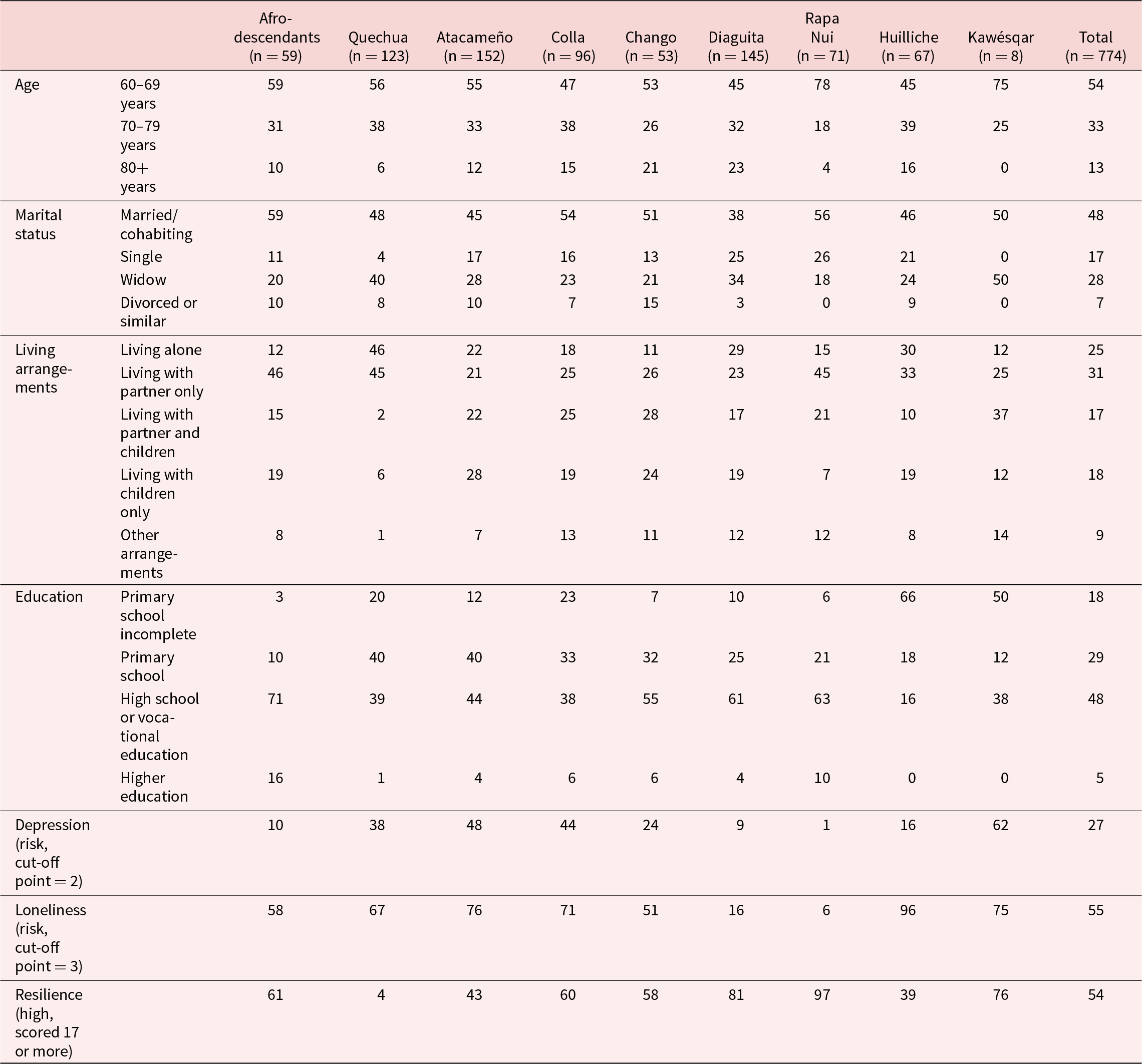
The sample characteristics are presented in Table 1. Notably, 54 per cent of participants were aged between 60 and 69 years (70.10 ± 7.49), 48 per cent were married or with a (cohabiting) partner, 31 per cent were living with a partner only, and 48 per cent had completed high school and/or vocational education. Regarding the central variables of the study: 27 per cent of the sample reported having depressive feelings, with the highest prevalences among the Kawésqar, Atacameño, Colla and Quechua peoples. In terms of loneliness, 55 per cent of the sample reported being affected, with most ethnic groups reporting a high prevalence except for the Diaguita and Rapa Nui peoples. Finally, 54 per cent of the sample had high scores for resilience, with only the Quechua people having low values for this measure.
Participants’ demographic, depression and social characteristics (values are presented as %)

Procedure
A pilot study was applied with 45 individuals, made up of five from each of the aforementioned peoples. The questionnaire was administered in Spanish and some terms were stated in indigenous languages. The pilot study was used to make improvements to the wording of some questions and simplify others. A training workshop was held so that the interviewers (professionals from the social sciences including social workers, psychologists and anthropologists) could familiarize themselves with the specific questionnaire. The study was applied from December 2021 to June 2022; the questionnaire was applied through a personal interview (face-to-face) in a space set up to conduct the interview, preferably the participant’s home or a location provided by the corresponding municipality.
Of the indigenous peoples who participated in the study, it is worth mentioning the particular circumstances of the Kawésqar people who live in the extreme south of Chile, specifically in the archipelago of Patagonia. This is a people at risk of extinction (Acuña Reference Acuña2013; Pulgar Reference Pulgar2007). Although their data do not contribute to the statistical analysis, they will be included to avoid contributing to the systematic invisibilization that they are suffering.
Ethical issues
The Ethics Committee of Tarapacá University supervised and approved the ethical aspects of both studies (monitoring reports nos. 21/2021 and 01/2022). All procedures in studies involving human participants were conducted in accordance with the Declaration of Helsinki 1964 and the regulations established in the Indigenous and Tribal Peoples Convention of the International Labour Organization (Convention 169). Ethical procedures with communities in Chile are not yet moving towards co-participatory research. We tried to contact the older people in the various communities forming part of this study to involve them in the design of the methodology (section on practices and ethnic identity), but this only proved possible in the Afro-descendant, Colla and Chango communities.
Measures
Sociodemographic variables. The sociodemographic variables were age, marital status (1 = partner), household structure (1 = living with someone else) and ethnic group (Andean indigenous, other indigenous and Afrodescendant).
Depressive symptoms. Depressive symptoms were evaluated using the abbreviated (five-item) version of the Geriatric Depression Scale (GDS-5; Brink et al. Reference Brink, Yesavage, Lum, Heersema, Adey and Rose1982). This instrument is used to record the presence of five depressive symptoms, producing a score ranging from 0 to 5. A validation of the five-item version in Chile (Hoyl et al. Reference Hoyl, Valenzuela and Marín2000) showed adequate sensitivity levels, comparable to those of the two longer versions. The internal consistency index (Cronbach’s alpha) for the questionnaire was 0.83.
Main health problems. These were assessed using the Health Problems Questionnaire produced by Herrera et al. (Reference Herrera, Barros and Fernández2007). This instrument was specifically developed to measure the most frequently occurring illnesses among older adults in Chile, within the framework of the Chilean National Survey of Quality of Life in Old Age. It is an inventory/checklist made up of 14 pathologies: tension or hypertension; arthritis; high cholesterol; diabetes or elevated blood sugar levels; cataracts; osteoporosis; heart problems; chronic lung disorders; stomach ulcers; asthma; fractured hip or femur; cancer; stroke or vascular disorders; and Parkinson’s disease.
Dependency. The Barthel ADL Index developed by Mahoney and Barthel (Reference Mahoney and Barthel1965) was applied to measure dependency. This is a scale assessing the capacity of a person to carry out ten basic daily activities, covering feeding, bathing, dressing, grooming, bowels, bladder, toilet use, transfer, mobility and use of stairs. Each activity is assigned a score (5, 10, 15) based on the time spent carrying it out and the need for assistance, resulting in a final score ranging from 0 to 100. This geriatric index is currently applied in Family Health Centres in Chile. The internal consistency index (Cronbach’s alpha) for the general questionnaire was 0.79.
Loneliness. The abbreviated six-item version of the De Jong-Gierveld Loneliness Scale (DJGLS-6; de Jong Gierveld and Van Tilburg Reference de Jong Gierveld and Van Tilburg2006) was used. This scale has been validated for the Chilean population (Rodríguez-Blázquez et al. Reference Rodríguez-Blázquez, Ayala-García, Forjaz and Gallardo-Peralta2021). The internal consistency index (Cronbach’s alpha) for the general scale was 0.72.
Social support. The Perceived Social Support Questionnaire (PSSQ) produced by Gracia et al. (Reference Gracia, Herrero and Musitu2002) was used in this study, specifically focusing on reciprocity and social support. This nine-item scale evaluates functional dimensions, and specifically emotional support, advice and assistance. The PSSQ measures reciprocity of support with respect to each source, whether emotional support, advice or assistance, in addition to offering a total score for elements including functional support and reciprocity of support. The questionnaire included a pre-filter question for each source of support (for example: Do you have a partner? Do you have children?). This meant that participants who did not have the relevant network were included as part of the response category ‘does not apply because you do not have the network’ (category = 0). Those who did have the relevant support network were able to choose from the following responses: 1 = never, 2 = rarely, 3 = sometimes, 4 = quite often and 5 = almost always. The PSSQ has been validated for Chilean older adults (Gallardo-Peralta et al. Reference Gallardo-Peralta, Sánchez Iglesias, Saiz Galdós, Barrón López de Roda and Sánchez Moreno2021). The general internal consistency index (Cronbach’s alpha) was 0.94.
Resilience. The Brief Resilient Coping Scale (BRCS) developed by Sinclair and Wallston (Reference Sinclair and Wallston2004) was used to measure resilience. The BRCS is composed of four items with five Likert-type-scale response categories. The questions were phrased as statements such as ‘I believe that I can grow in positive ways by dealing with difficult situations’. Total scores for the BRCS range between 4 and 20. A total score equal to or lower than 13 indicates low resilience, while scores equal to or higher than 17 result in a classification of high resilience. The BRCS has been validated for Chilean older adults (Gallardo-Peralta et al. Reference Gallardo-Peralta, Rodríguez Blázquez, Ayala García and Forjaz2020). The internal consistency index (Cronbach’s alpha) for the general scale was 0.92.
Analysis plan
The first phase involved descriptive analyses of the study variables, together with the bivariate correlations among the main study variables. Second, a five-step hierarchical regression model was tested to analyse the variables associated with depression: Model 1 (control variables), which incorporated the variables of age, marital status, living arrangement and ethnic groups, with the reference variable being other indigenous peoples (including Rapa Nui, Huilliche/Mapuche and Kawésqar); Model 2 (health), incorporating health problems and independence in ADL; Model 3 (social support), which added social support from partner, children, grandchildren, sibling, relatives and friends; Model 4 (loneliness), adding loneliness; and Model 5 (resilience), which included resilience. The SPSS 29 was used to assist with the analyses.
Results
Table 2 shows the Pearson’s correlation between the main study variables. The depression variable had a significant negative association with social support from relatives and resilience. Meanwhile, depression had a significant positive association with health problems, dependence in ADL and loneliness.
Mean (standard deviation) and Pearson’s correlation coefficients for key study variables

* Notes: p < 0.05, **p < 0.01.
Table 3 presents the results of the stepwise linear regression models to analyse the variables related to depression. In Model 2 (health), depression was negatively associated with age (β = −0.020; p < 0.05) and independence in ADL (β = −0.054; p < 0.001), while there was a positive association with being Andean (β = 0.675; p < 0.001), being Afro-descendant (β = 0.831; p < 0.001) and health problems (β = 0.422; p < 0.001). Model 3 (social support) shows a positive association with depression for being Andean (β = 0.693; p < 0.001), being Afro-descendant (β = 0.759; p < 0.01), health problems (β = 0.402; p < 0.001) and social support from grandchildren (β = 0.053; p < 0.05), with a negative association for age (β = −0.023; p < 0.01), marital status (β = −1.371; p < 0.01), independence in ADL (β = −0.057; p < 0.001) and social support from partner (β = −0.182; p < 0.01). Model 4 (loneliness) reflected a negative association with depression for age (β = −0.025; p < 0.001) and independence in ADL (β = −0.056; p < 0.001). On the contrary, being Andean (β = 0.756; p < 0.001), being Afro-descendant (β = 1.040; p < 0.01), health problems (β = 0.331; p < 0.001) and loneliness (β = 0.390; p < 0.001) were positively associated with depression. Finally, the following variables were negatively associated with depression in Model 5 (resilience): age (β = −0.029; p < 0.001), independence in ADL (β = −0.050; p < 0.001) and resilience (β = −0.124; p < 0.001). In contrast, the following variables were positively associated with depression in the same model: being Andean (β = 0.541; p < 0.001), being Afro-descendant (β = 0.954; p < 0.01), health problems (β = 0.306; p < 0.001) and loneliness (β = 0.302; p < 0.001). The inclusion of loneliness led to a substantial increase in explanatory power in Model 4 (R2 = 0.33), as did the incorporation of resilience in Model 5 (R2 = 0.38).
Summary of logistic regression analyses to predict depression among Afro-descendat and indigenous older women

* Notes:p < 0.05, **p < 0.01, ***p < 0.001.
Discussion
This study examined mental health among 774 Chilean women belonging to ethnic minorities, with a high prevalence of depressive symptoms reported and an increased risk of depressive symptomatology among Andean indigenous and Afro-descendant women, in addition to an association between depression and various individual, physical and social/cultural dimensions. Under the umbrella of the concept of Living Well (Buen Vivir), a combination of these dimensions can strengthen harmony during the ageing process and thereby avoid feelings of ‘nerves’ and excessive worry (Quigley et al. Reference Quigley, Russell, Larkins, Taylor, Sagigi, Strivens and Redman-MacLaren2022; Yusim et al. Reference Yusim, Anbarasan, Hall, Goetz, Neugebauer, Stewart, Abou, Castaneda and Ruiz2010). From the perspective of the indigenous cosmovision in LAC, ‘nerves’ express a form of agitation with impacts in terms of physical suffering, emotional states and life changes, arising as a natural consequence of the human condition (Yusim et al. Reference Yusim, Anbarasan, Hall, Goetz, Neugebauer, Stewart, Abou, Castaneda and Ruiz2010).
In this regard, the prevalence of depressive symptoms among the total sample of older women was 27 per cent, with higher rates among the Quechua, Colla, Atacameño and Kawésqar peoples (between 38% and 62%). When comparing these data with those reported by Moreno et al. (Reference Moreno, Gajardo and Monsalves2022) with non-indigenous older Chilean women (36.38 per cent), a negative gradient in mental health can be observed for indigenous women. This disadvantaged position among the older indigenous population has been analysed with the Kuna people in Panama, with a prevalence of 37.5 per cent (Walker et al. Reference Walker, Campbell, Dawson and Egede2019), and specifically with Aymara women in Chile, with a prevalence of 47.8 per cent (Gallardo-Peralta et al. Reference Gallardo-Peralta, Sánchez-Moreno, Barrón López de Roda and Arias Astray2015).
The poor mental health affecting the majority of indigenous peoples in the Global North (Brown et al. Reference Brown, Mentha, Rowley, Skinner, Davy and O’Dea2013; Calma et al. Reference Calma, Dudgeon and Bray2017; McIntyre et al. Reference McIntyre, Harris, Baxter, Leske, Diminic, Gone, Hunter and Whiteford2017) as well as in LAC (Gallardo-Peralta et al. Reference Gallardo-Peralta, Gálvez-Nieto, Veloso-Besio and Munuera-Gómez2024; Walker et al. Reference Walker, Campbell, Dawson and Egede2019; Yusim et al. Reference Yusim, Anbarasan, Hall, Goetz, Neugebauer, Stewart, Abou, Castaneda and Ruiz2010) is linked to systematic processes of oppression, violence and discrimination (Calma et al. Reference Calma, Dudgeon and Bray2017; Gee et al. Reference Gee, Dudgeon, Schultz, Hart and Kelly2014). It is also related to traumatic experiences and loss of identity, including displacement from ancestral lands (Marques et al. Reference Marques, Freeman, Carter and Pedersen Zari2021; Walker et al. Reference Walker, Campbell, Dawson and Egede2019). Added to this are shortfalls in terms of access to the health-care system (Hunter Reference Hunter2014; McIntyre et al. Reference McIntyre, Harris, Baxter, Leske, Diminic, Gone, Hunter and Whiteford2017; Yashadhana et al. Reference Yashadhana, Howie, Veber, Cullen, Withall, Lewis, McCausland, Macniven and Andersen2022) and even socio-health-care systems that show little respect for these peoples’ wellbeing and health cosmovision (Calma et al. Reference Calma, Dudgeon and Bray2017; Gavilán et al. Reference Gavilán, Vigueras, Madariaga and Parra2018; McCausland et al. Reference McCausland, Jamieson, Robinson, Spencer, MacGillivray and Andersen2025) and offer inadequate treatment, increasing failures to meet needs and barriers to appropriate and effective mental health care (McIntyre et al. Reference McIntyre, Harris, Baxter, Leske, Diminic, Gone, Hunter and Whiteford2017).
In addition to this structural framework of inequalities, mental wellbeing in indigenous communities cannot be separated from interconnected harmony with other dimensions of the human experience (Asquith-Heinz et al. Reference Asquith-Heinz, Kim and Lewis2022; Hillier and Al-Shammaa Reference Hillier and Al-Shammaa2020; McCausland et al. Reference McCausland, Jamieson, Robinson, Spencer, MacGillivray and Andersen2025; Viscogliosi et al. Reference Viscogliosi, Asselin, Basile, Borwick, Couturier, Drolet, Gagnon, Obradovic, Torrie, Zhou and Levasseur2020; Yashadhana et al. Reference Yashadhana, Howie, Veber, Cullen, Withall, Lewis, McCausland, Macniven and Andersen2022). The understanding of health in the context of indigenous ageing differs from the Western vision in that it incorporates a holistic view that is underpinned by a connection with the earth and spiritual, environmental, ideological, political, social, economic, mental and physical factors. Changes to any of these factors trigger health problems (Quigley et al. Reference Quigley, Russell, Larkins, Taylor, Sagigi, Strivens and Redman-MacLaren2022).
From this comprehensive perspective, the specific interweaving of individual, physical and social/community dimensions must be established to understand the factors associated with depressive symptoms among Chilean women who belong to ethnic minorities. The dimensions that are negatively associated with depression are age, marital status (having a partner), independence in ADL, social support from partner and resilience. In contrast, the dimensions that are positively associated with depression are ethnic group (Andean indigenous and Afro-descendant), health problems, relationship quality with grandchildren and loneliness.
When analysing individual dimensions, the negative association between depression and age is potentially explained by the development of gerotranscendence (Sánchez-Moreno et al. Reference Sánchez-Moreno, Gallardo-Peralta, Rodríguez-Rodríguez and Soto Higuera2021). This process has been examined among Alaska Native Elders as a key element in the process of successful ageing in communities, which involves a mature and satisfactory reflection on how to understand one’s surroundings, life and death as one ages (Wortman and Lewis Reference Wortman and Lewis2021). Indigenous and Afro-descendant women might therefore wish to leave a legacy in their community as they age, positively affecting their wellbeing (Gallardo-Peralta, Fernández-Dávila Jara et al. Reference Gallardo-Peralta, Fernández-Dávila Jara, Tereucán Angulo and Martínv2023; Warburton and Chambers Reference Warburton and Chambers2007). Along the same lines, for indigenous communities old age is not a question of age in years; rather, it is associated with wisdom (García et al. Reference García, García and Curcio2024). Meanwhile, the negative association with marital status (that is, having a partner acting as a protective factor against depressive symptoms) can be explained by the importance of the matrimonial structure for indigenous communities in Chile (Larach Herrera Reference Larach Herrera2023; Mamani Reference Mamani1999). This is the case taking into account that the organization of the indigenous community is founded on marriage (Chacha-warmi/Aymara; Mafutün/Mapuche), and hence on an alliance between indigenous families to perpetuate the social, reproductive, productive and cultural organization of communities and, moreover, to ensure community balance through the couple (Mamani Reference Mamani1999). This cohabitation in partnerships is hence expected to be lifelong, with the formation of an extended family that can guarantee social and economic benefits. The union of families (both the woman’s and the man’s) is a community alliance based on reciprocal support and solidarity (Larach Herrera Reference Larach Herrera2023). With regard to ethnicity, this study shows that Andean indigenous and Afro-descendant women suffer greater deterioration in their mental health. These findings show the need for a more specific analysis of minority ethnic groups in Chile, whose geographical characteristics (such as living in the Atacama Desert or the Altiplano) and therefore access to specialist mental health services require a more detailed treatment of their particularities (Gallardo-Peralta et al. Reference Gallardo-Peralta, Gálvez-Nieto, Veloso-Besio and Munuera-Gómez2024; Gavilán et al. Reference Gavilán, Vigueras, Madariaga and Parra2018).
In terms of physical dimensions, depression is negatively associated with independence in ADL and positively associated with health problems (diagnosed illnesses). This means that suffering from medical issues implies a negative impact on wellbeing (Quigley et al. Reference Quigley, Russell, Larkins, Taylor, Sagigi, Strivens and Redman-MacLaren2022). For indigenous communities, illness represents an imbalance between mind, body, spirit and emotions (Hillier and Al-Shammaa Reference Hillier and Al-Shammaa2020; Pace and Grenier Reference Pace and Grenier2017), implying that physical and mental health are interconnected dimensions. This is also reflected in Chilean indigenous communities. For the Aymara people, good health (thani) is a state of wellbeing, moral tranquility and physical integrity (Flores-Guerrero Reference Flores-Guerrero2004). Similarly, the Mapuche people give the label ‘az mapu’ to a code of ethics and conduct for being Mapuche that enables those following it to behave in a way that is harmonious and in balance with their setting, nature and the environment (Beltrán-Véliz et al. Reference Beltrán-Véliz, Tereucán Angulo, Alarcón, Gálvez-Nieto and Klenner Loebel2022).
Social and cultural dimensions are worthy of particular examination. Connections with partner through social support are associated with lower levels of depressive symptoms. In contrast, connections with grandchildren are linked to increased depression. In other words, relationship quality with grandchildren is associated with poorer mental health. Indigenous communities in Chile no longer tend to co-reside in intergenerational family structures (Valencia-Gálvez et al. Reference Valencia-Gálvez, Gallardo-Peralta, Andrade-Guzmán, Rain-Rain and Rodriguez-Venegas2025) and in this study only 9 per cent of the sample lived within broad family structures (within which there were hardly any children or young people). Older women are less likely to teach and transmit their knowledge to the younger generations. This loss of physical proximity between grandmothers and grandchildren places mental health at risk, since it breaks the intergenerational solidarity that is based on the transmission of knowledge, values and culture (Hillier and Al-Shammaa Reference Hillier and Al-Shammaa2020; McCausland et al. Reference McCausland, Jamieson, Robinson, Spencer, MacGillivray and Andersen2025; Viscogliosi et al. Reference Viscogliosi, Asselin, Basile, Borwick, Couturier, Drolet, Gagnon, Obradovic, Torrie, Zhou and Levasseur2020; Warburton and Chambers Reference Warburton and Chambers2007). Previous research has confirmed that separation from family, friends and community has a negative impact on mental health among indigenous older adults (Quigley et al. Reference Quigley, Russell, Larkins, Taylor, Sagigi, Strivens and Redman-MacLaren2022). There is also a line of research examining the interruption of family care-giving and its replacement with care services for older adults, owing to the lack of a family system to perform this traditional role (McCausland et al. Reference McCausland, Jamieson, Robinson, Spencer, MacGillivray and Andersen2025).
Closely linked to this are difficulties in terms of access to intergenerational social links and hence emotionally intimate social relationships. This can give rise to feelings of loneliness, which were in fact very common among the sample of older women (55% of the total sample). In this study, loneliness is associated with increased levels of depressive symptoms. As has been proposed, social connections with family and community provide the basis for successful ageing among indigenous people (Pace and Grenier Reference Pace and Grenier2017; Warburton and Chambers Reference Warburton and Chambers2007) and changing family structures in these communities are causing an increase in loneliness and social isolation among older adults (Gallardo-Peralta, Fernández-Dávila Jara et al. Reference Gallardo-Peralta, Fernández-Dávila Jara, Tereucán Angulo and Martínv2023; Quigley et al. Reference Quigley, Russell, Larkins, Taylor, Sagigi, Strivens and Redman-MacLaren2022).
Finally, resilience is a protective factor against depression. Among indigenous people, resilience is a collective process of healing from the various traumas and negative experiences they have experienced. Based on this community empowerment, it is possible to cope with life, collectively adjusting to and overcoming problems (Pace and Grenier Reference Pace and Grenier2017; Yashadhana et al. Reference Yashadhana, Howie, Veber, Cullen, Withall, Lewis, McCausland, Macniven and Andersen2022). Indigenous older adults have been documented as leading the fight to claim their rights. It has even been claimed that communities exist due to the efforts and determination of the older people of the past (Warburton and Chambers Reference Warburton and Chambers2007). This capacity to resist and overcome has been studied among Alaska Native older adults, their search for positive emotions linked to optimism, happiness, acceptance, enjoyment, feeling good or gratitude (Asquith-Heinz et al. Reference Asquith-Heinz, Kim and Lewis2022) being linked to pushing the community towards a collective healing of wounds. In this regard, older adults have a fundamental role in promoting cohesion, resilience, the capacity to cope, controlling anger, hope, perseverance, dignity, motivation, strength, sense of belonging, tolerance, empathy, respect and pride within their communities (Viscogliosi et al. Reference Viscogliosi, Asselin, Basile, Borwick, Couturier, Drolet, Gagnon, Obradovic, Torrie, Zhou and Levasseur2020). In the Chilean case, indigenous women have historically fought for collective rights, whether concerning the earth, agroecology, political participation or the revitalization of language, despite facing systematic discrimination for being female and indigenous (García Mingo Reference García Mingo2017).
This article highlights resilience among the dimensions analysed, as it significantly increases the explained variance of the depression model (38%), therefore comprising a central dimension in understanding mental health. The analysis of resilience among Chilean ethnic minorities deserves greater depth in future studies, and such research should even be situated within LAC’s own decolonial feminist approaches (Espinoza Reference Espinoza2023; Masson and Castro Reference Masson and Castro2011). Racialized women in Chile have to fight racism and machismo (García Mingo Reference García Mingo2017), added to ageism (Pavez Lizarraga et al. Reference Pavez Lizarraga, Baeza Correa, Faure Bascur and Pallavicini Magnere2023). This article aims to contribute to a collective, circular notion of wellbeing (McCausland et al. Reference McCausland, Jamieson, Robinson, Spencer, MacGillivray and Andersen2025; Warburton and Chambers Reference Warburton and Chambers2007) and also to show that depressive symptoms among older ethnic minorities are the result of cumulative disadvantages over the lifecourse (Pan American Health Organization (PAHO) 2023), creating a need to design policies that restore social justice and close the mental health gap (Calma et al. Reference Calma, Dudgeon and Bray2017)
Limitations of the study
This study is subject to limitations in terms of design and scope. This is one of the first studies of indigenous and Afro-descendant ageing in Chile. Although the research focused on using quantitative data to increase the visibility of the reality faced by a majority of legally recognized peoples, it remains necessary to supplement this type of study with others that are based on the life stories of indigenous women. Although the sample was representative in rural areas, probabilistic sampling that would permit the generalization of the data was not applied. A further limitation concerned the complexity of evaluating depression among indigenous peoples (Brown et al. Reference Brown, Mentha, Rowley, Skinner, Davy and O’Dea2013; Yusim et al. Reference Yusim, Anbarasan, Hall, Goetz, Neugebauer, Stewart, Abou, Castaneda and Ruiz2010), since there is no consensus within these peoples as to how mental health can be defined (Gee et al. Reference Gee, Dudgeon, Schultz, Hart and Kelly2014), and there are even diverse linguistic expressions in each culture (Brown et al. Reference Brown, Mentha, Rowley, Skinner, Davy and O’Dea2013). Although the scale for assessing depression has been validated among indigenous older adults (Rodríguez-Blázquez et al. Reference Rodríguez-Blázquez, Ayala-García, Forjaz and Gallardo-Peralta2021), it remains difficult to use Western psychiatric classification systems such as GDS-5 (Gee et al. Reference Gee, Dudgeon, Schultz, Hart and Kelly2014), with a risk of tending to pathologize indigenous communities (McIntyre et al. Reference McIntyre, Harris, Baxter, Leske, Diminic, Gone, Hunter and Whiteford2017). The advisable response to this in LAC would be to develop studies that incorporate cultural sensitivity in aspects related to mental health (Hunter Reference Hunter2014; Yusim et al. Reference Yusim, Anbarasan, Hall, Goetz, Neugebauer, Stewart, Abou, Castaneda and Ruiz2010), and for these approaches to take into account the social, moral and cultural context (Brown et al. Reference Brown, Mentha, Rowley, Skinner, Davy and O’Dea2013). The challenge for future studies with ethnic minority communities is to move towards decolonial theoretical models (Masson and Castro Reference Masson and Castro2011) and to promote a more active role for the communities themselves, given that all protocols, values and behaviours from indigenous methodologies should be valued as part of the methodological processes of the research (Tuhiwai Smith Reference Tuhiwai Smith1999).
In conclusion, this study seeks to contribute to the understanding of mental health among indigenous and Afro-descendant Chilean women based on analytical frameworks that are inherent to LAC, such as Living Well (Buen Vivir). In general terms, the study of depressive symptoms among ethnic minorities requires a broad approach that does not focus exclusively on medical issues and involves culturally sensitive dimensions.
Financial support
This present piece of research obtained financial support from the Government of Chile, FONDECYT 1210021.
Competing Interests
The authors declare no competing interests.