Recent theories of the development of antisocial behavior emphasize the importance of the age of onset of antisocial behavior (ASB; Loeber & Stouthamer Loeber, 1998; Moffitt, 1993; Patterson, DeBaryshe, & Ramsey, 1989; Patterson & Yoerger, 1993, 1997). According to these theories, some children will exhibit ASB early in life and, subsequently, are very likely to follow a life course-persistent pathway of ASB. Other children will first exhibit ASB at a later age (i.e., during adolescence). The pathway of antisocial behavior among the adolescent-onset youth is thought to be transient. Their levels of ASB diminish by early adulthood. Childhood onset of antisocial behavior is relatively rare and persistent, and is considered pathological. In contrast, adolescent onset is believed to be common and even normative, especially among males (Moffitt, 1993). Risk factors for childhood-onset ASB include early neuropsychological problems, such as verbal IQ, and a difficult temperament that is often reflected in early behavior problems. These behavior problems may be further exacerbated by a high-risk social environment. On the other hand, social and environmental factors have been hypothesized to primarily promote the adolescent-onset path of ASB development (Loeber & Stouthamer Loeber, 1998; Moffitt, 1993; Patterson & Yoerger, 1997). Children exhibiting adolescent-onset ASB are believed to be motivated to engage in ASB as a form of rebellion against adults or through their association with deviant peers. The purpose of this study is to test the importance of distinguishing among youth with early and late onset of ASB by (a) empirically identifying trajectories of ASB, and (b) studying whether the identified developmental trajectories are associated with indices of both neuropsychological and social environmental factors in expected ways.
Over the past decade, Moffitt and colleagues (Moffitt & Caspi, 2001; Moffitt, Caspi, Dickson, Silva, & Stanton, 1996; Moffitt, Caspi, Harrington, & Milne, 2002) have used a general measure of antisocial behavior, which includes physical aggression, vandalism, theft, and drug use, to identify individuals with childhood and adolescent-onset forms of ASB. Childhood-onset ASB has been associated with life course-persistent antisocial behavior and other negative outcomes (Moffitt et al., 1996, 2002). The identification of these two paths of ASB onset were, however, based on predetermined cutoff values and guided by the theoretical work in this area. Newly available methods allow researchers to distinguish among groups of individuals on different developmental pathways through the empirical identification of developmental trajectories (e.g., Muthén & Shedden, 1999; Nagin, 1999). Studies that have employed these newer methods using measures of generalized aggression similar to those employed by Moffitt and colleagues, and have found some support for the distinction between childhood and adolescent onset of ASB. For example, Fergusson, Horwood, and Nagin (2000) used mixture modeling to identify a “chronic offenders” and an “adolescent-onset offenders” group in addition to a “nonoffenders” and a “moderate offenders” group of youth. In accordance with the theory, the chronic offenders group comprised only 6% of the total sample. Fergusson et al. (2000) also determined, however, that the adolescent-onset group comprised only 8% of the sample, a finding that conflicts with the theoretical contention that this path is normative in boys (Moffitt, 1993). In a later study, Fergusson and Horwood (2002) included information from childhood, and again identified a chronic path in addition to multiple adolescent-onset paths. Likewise, Schaeffer, Petras, Ialongo, Poduska, and Kellam (2003) identified a group of boys with aggressive/disruptive behavior that increased with age (from 6 to 13 years), in addition to the chronically high group. However, the “increasers” group again comprised only 7% of the total sample. In an attempt to expand the theory into adulthood, White, Bates, and Buyske (2001) identified trajectories of delinquent behavior from age 12 to 31 years and identified a persistent delinquency group (7%) and an adolescent limited group (33%). In contrast, Chung, Hill, Hawkins, Gilchrist, and Nagin (2002) found no evidence for an adolescent-onset path, although this study started at the relatively late age of 13 years. In addition, it is important to note that studies that focused on more specific forms of antisocial behavior (i.e., physical aggression, oppositional behavior, property violations) generally did not find both childhood- and adolescent-onset paths (e.g., Bongers, Koot, Van der Ende, & Verhulst, 2004; Brame, Nagin, & Tremblay, 2001; Broidy et al., 2003; Nagin & Tremblay, 1999, 2001).
Theories that stress the risk of childhood onset of ASB versus adolescent onset suggest that these trajectories of ASB development are associated with individual-level characteristics and social environmental factors. As described above, the childhood-onset path is thought to emerge from neuropsychological deficits manifested as subtle cognitive deficits, such as difficult temperament and/or hyperactivity (Moffitt, 1993). Loeber and Stouthamer Loeber (1998) argue that the presence or absence of comorbid attention-deficit/hyperactivity disorder (ADHD) distinguishes the early-onset from late-onset children. ADHD is believed to be prospectively linked to childhood onset through three processes, including poor cognitive and academic capabilities, oppositional behavior, and early and accelerated development of aggressive behaviors and conduct problems. It should be noted though that some recent studies have demonstrated that the trajectories of antisocial behavior are also predicted by early childhood physical aggression (NICHD Early Child Care Research Network, 2004; Tremblay et al., 2004). The risky child characteristics are thought to be maintained and exacerbated by social environmental factors, such as poor parenting styles, poverty, poor relations with peers, and the affiliation with and learning from other deviant peers (Dishion, Patterson, & Griesler, 1994; Elliott, Huizinga, & Ageton, 1985; Moffitt, 1993; Patterson, Dishion, & Yoerger, 2000; Snyder, Prichard, Schrepferman, Patrick, & Stoolmiller, 2004; van Lier, Vitaro, Wanner, Vuijk, & Crijnen, 2005). Support for this assertion has been identified in the empirical literature. The “life-course persisters” identified by Moffitt and Caspi (2001) were characterized not only by persistently high levels of aggressive behavior, but also by early neurocognitive and behavior problems, especially hyperactivity and fighting, and by exposure to inadequate parenting.
Adolescent-onset ASB, in contrast to child-onset ASB, is hypothesized to stem from environmental, rather than organic, factors (Moffitt, 1993; Patterson & Yoerger, 1997). Specifically, affiliation with deviant peers during adolescence is thought to contribute to adolescent ASB. It has been shown that young children will not affiliate with early-onset antisocial children and, instead, ignore and reject them (Coie, Dodge, & Kupersmidt, 1990). During adolescence, however, as antisocial behavior becomes more normative, more adolescents model the behavior of their antisocial peers, resulting in an increase in ASB among youth in this age group. Support for the distinction between predictors of the childhood and adolescent-onset paths was reported by Moffitt and Caspi (2001). They found that the “adolescent limited” youth tended to affiliate with antisocial peers. Recently, Vitaro, Brendgen, and Wanner (2005) studied patterns of affiliation with deviant friends in late childhood and early adolescence. Early and late affiliation trajectories were identified. In addition, most children were found to parallel the level of deviancy among the peers with whom they affiliated. This latter finding suggests that both the childhood and adolescent onset of antisocial behavior are linked to affiliation with deviant peers. No indices of early behavioral problems were incorporated in this study.
It is unclear to what extent the distinctions among the types of ASB trajectories and among the predictors of childhood and adolescent-onset antisocial behavior trajectories hold for girls. Most of the research and theories cited above were validated with samples of boys only. Silverthorn and Frick (1999) suggested that only one type of onset accurately described the development of antisocial behavior in girls. Girls were described as exclusively following a delayed-onset trajectory in which the development of antisocial behavior appears in adolescence. Partial support for this was found by Moffitt and Caspi (2001) who reported a 10:1 (boys to girls) ratio in childhood-onset path versus a 1.5:1 (boys to girls) ratio for the late-onset, adolescent-limited path. Similar findings were reported by Fergusson and Horwood (2002), who demonstrated that when females exhibit antisocial behavior, they are much more likely than males to follow an adolescent-onset path. However, a small number of females (2%) did follow the childhood-onset path.
Although the studies described above have provided a solid foundation for work in this area, the extent to which the age of onset of antisocial behavior reflects an important dimension on which trajectories of ASB can be distinguished has not been directly tested by a model that incorporates all the critical elements of the developmental taxonomy. To directly test the two types of onset patterns, three different indices are needed. First, repeated assessment of antisocial behavior from childhood into adolescence is required for the empirical identification of the developmental trajectories. According to DSM-IV (American Psychiatric Association, 1994) one characteristic of the early-onset type of conduct disorder is antisocial behavior beginning prior to or at the age of 10. Ratings of antisocial behavior starting at around this age would therefore be required. Second, indices of learned behavioral or personal dispositions during childhood are needed to test whether they discriminate between childhood-onset and adolescent-onset cases. Given the hypothesized influence of attention-deficit/hyperactivity (ADH) problems on a childhood-onset trajectory, information on the developmental course of such problems in childhood would be needed. Third, information on the concomitant process of friends' antisocial behavior would be necessary to test whether the course of antisocial behavior among adolescent-onset children is directly associated with affiliation with deviant friends. Although deviant peers may exacerbate the deviant behavior of childhood-onset children, the high level of antisocial behavior among childhood-onset children should not be explained solely by deviant friends' influences.
This study attempts to resolve the contradictory findings in past research by attempting to establish the existence of childhood and adolescent-onset trajectories of ASB and establishing differential associations of these trajectories with early ADH problems and friends' deviancy. Specifically, we address the following questions: how many developmental trajectories of self-reported antisocial behavior can be identified in a sample of French-Canadian youths surveyed across middle childhood and adolescence? How many developmental trajectories of ADH behavior are evident in the same sample surveyed from kindergarten to middle childhood? What is the developmental course of friends' antisocial behavior of the children in each of the developmental trajectories of antisocial behavior? Are the developmental trajectories of antisocial behavior associated with the preceding developmental trajectories of ADH problems and with the simultaneous development of friends' antisocial behavior? We expected to identify three trajectories of ASB, including a childhood-onset, an adolescent-onset, and a low antisocial behavior trajectory. We also hypothesized that participation in the childhood-onset trajectory would be limited to a small number of subjects and would be particularly rare among females. In contrast, an adolescent-onset path was expected to characterize the ASB development of a substantial proportion of males. We further hypothesized that the level of antisocial behavior of children on the adolescent-onset path mirrors that of friends' antisocial behavior. Although childhood-onset children are likely to affiliate with friends who are high on antisocial behavior, we expected that these children already exhibit elevated levels of antisocial behavior prior to their affiliation with deviant friends. We also hypothesized that the childhood-onset path would be predicted by high levels of ADH problems in childhood, whereas the adolescent-onset path would not be predicted by childhood ADH problems.
Method
Participants
Participants in the present study were 316 Caucasian children surveyed yearly from age 6 to age 15 (52% boys). All children lived in a small city in northwestern Quebec, Canada. They attended five elementary schools up to age 12, after which they transferred to one large high school (except for those who were retained). The schools were relatively homogeneous in size, number of classes, characteristics of the children in the classes, and characteristics of the neighborhood. In addition, all children attended regular classrooms, although 12% of the sample was in classrooms with younger classmates because of grade retention. In each year of data collection, at least 90% of children in the targeted classrooms participated in the study. Those who did not participate did not receive parental permission or were absent from school on the day of data collection.
Data used in this study comes from a larger study of 445 children. Two criteria were used for inclusion in the present study. First, antisocial behavior scores in childhood had to be present to ensure that the early-onset trajectory could be disentangled from an adolescent-onset trajectory. Second, teacher-rated ADH problem scores from kindergarten to age 10 had to be available. In total, 129 participants were excluded by virtue of these two criteria, leading to the final sample of 316 participants (165 boys, 151 girls). No differences were present in gender distribution, grade retention, or antisocial behavior scores between included and excluded children. Participants' socioeconomic status was lower compared to participants of a representative sample of same-age Quebec children according to the Blishen, Carroll, and Moore (1987) occupational prestige scale (means for the years they participated in the studies: M = 41.92, SD = 12.77 vs. M = 46.02, SD = 13.18). Seventeen percent of the parents completed high school, 43% had posthigh school education, and 40% had less than high school education, and 75% if the participant's families were intact at the start of the study, when children were 6 years old. Parental permission was obtained each year for all participants.
Procedure
Each spring, participants spent 2 hr of classroom time, divided by a 20-min break, answering questionnaires. After the children were informed about the purpose of the study, they were told that all of their answers would be confidential and that they did not have to answer any of the questions if they did not want to. The children were encouraged to keep their answers confidential and not to talk with classmates about their answers. Trained research assistants administered and collected the questionnaires. Teachers were asked to leave the classroom during the assessment time to emphasize that participants' answers would not be revealed to their teachers. Teachers also completed questionnaires during this period.
Measures
Participants' antisocial behaviors were assessed by means of the Self-Reported Delinquency Questionnaire (SRDQ; LeBlanc & Fréchette, 1989). At each time of assessment from age 10 through age 15 (i.e., six times), the participants reported how frequently (0 = never, 1 = rarely, 2 = sometimes, or 3 = often) they had been involved over the past 12 months in physical violence (6 items, e.g., threaten to beat someone, used a weapon, beat someone without a reason, engaged in a fistfight, threw rocks or other objects at someone), vandalism (6 items, e.g., broken or destroyed something that did not belong to you, demolishing school equipment, having broken down parts of a car deliberately, setting fire), theft (10 items, e.g., taken and kept something in a store without paying, steals something from parents, steals an amount of CAD 10 or more from school, buying, using or selling something that has been stolen, stealing by breaking and entering), or alcohol–drug use (3 items: used marijuana, binge drinking, drinks alcohol). The 25 items of the SRDQ were embedded in various other items pertaining to school, hobbies, social relationships, and parent relationships. LeBlanc and McDuff (1991) reported satisfactory internal consistency, test–retest reliability, and convergent, discriminant, and predictive validity for early adolescents of both genders. With respect to convergent validity, these authors found higher correlations among the subscales of the SRDQ (i.e., violence, vandalism, theft, substance use; r ∼ .35) than with other scales tapping into family relationships and school (r ∼ .20). As for discriminant and predictive validity, the SRDQ scales significantly distinguished groups of adjudicated and nonadjudicated juveniles. It also significantly discriminated adolescents who subsequently received a criminal record by age 30 years from those who remained without a crime record (see also Loeber & LeBlanc, 1990). Other researchers have also documented the validity of self-reported measures of delinquency (Hindelang, Hirschi, & Weiss, 1981; Klein, 1989). For the total antisocial behavior scale, which was created by summing the individual item scores, Cronbach α values varied from .83 to .92 from age 10 through age 15 years. Fifty-seven percent were missing one or more assessments.
Reciprocal friends' antisocial behavior was assessed from age 10 through age 13 years. Participants were asked to nominate up to four best friends in the classroom. Classroom size varied from 20 to 27 participants, with an average of 24.5 participants. Friendship nomination was restricted to the classroom at all assessment times because classroom composition remained stable throughout the year and participants spent all of their time within the same classroom. A friendship was considered reciprocal only when the nominated friend, in turn, also nominated the participant as one of his or her four best friends (Bukowski & Hoza, 1989). Because the friends also filled out all questionnaires, including the Self-Reported Delinquency Questionnaire, it was possible to assess the reciprocal friends' engagement in antisocial behavior. The use of friends' own reports of their antisocial behaviors avoids the problem of shared source variance with respect to the participant's own antisocial behavior, which is self-reported (Thornberry & Krohn, 1997). When a participant had more than one mutual friend in a given year, the friends' total antisocial behavior scores were averaged to gain a more complete picture of the characteristics of a participant's selected friendship network. To study whether this procedure impacted the friends' antisocial behavior scores, the averaged scores were compared to the first reciprocal best friend's scores. No differences in mean antisocial behavior scores were found. Eighteen children (6%) did not have a mutual friend on any of the four assessments. Boys had, on average, between 1.22 (SD = 1.10) and 1.61 (SD = 1.19) reciprocated friendships and girls had 1.27 (SD = 1.20) to 1.77 (SD = 1.30) reciprocated friendships across assessments. Of those friendships, only 3.03–6.67% for the boys and 3.31–7.95% for the girls were with a child of the other gender. Only one boy and one girl had two friends of the opposite gender at one time of measurement.
ADH problems from age 6 to age 10 were rated by the teachers using the Social Behavior Questionnaire (SBQ; Loeber, Tremblay, Gagnon, & Charlebois, 1989). The SBQ is a 32-item behavior-rating questionnaire in which teachers indicated whether items did not apply (0), applied sometimes (1), or applied often (2) to a target child. The inattention scale comprised two items. The hyperactivity problems scale was comprised of four items. The two scales were summed to create an ADH problems scale (ADH problems). Of the 316 children, 30% were missing one or more assessments. Cronbach's α values ranged from .81 to .89 from age 6 through age 10 years.
Statistical approach
The analyses were performed in three stages. First, the developmental trajectories of self-reported antisocial behavior and the developmental trajectories of ADH problems were analyzed using trajectory analyses in a general mixture model (GMM; Muthén & Shedden, 1999; Nagin, 1999). The objective of GMM is to find the smallest number of classes of individuals with similar developmental trajectories of antisocial behavior. GMM estimates mean growth curves, that is, initial status (intercept) and change (slopes), for each class and captures individual variation around these growth curves by the estimation of factor variances for each class. Several indications may be used in deciding on the optimal number of classes (Muthén & Muthén, 2000). The first is the Baysian information criterion (BIC; Kass & Raftery, 1993; Schwartz, 1978). Lower BIC values indicate improvement of the model when compared to the model with one fewer class. The second is the usefulness of the classes, which can be determined by comparing the developmental trajectories, the number of children in each class, and the associations among the classes and the predictor variables. The third is the stability of the solutions. To test this, models were repeatedly estimated with random perturbations of starting values, generated by the program. Stable models achieve similar solutions despite different starting values.
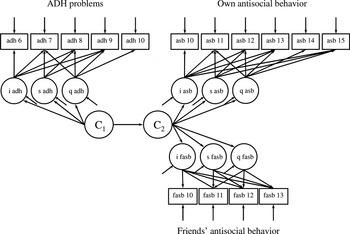
In the second stage of the analyses, the developmental trajectories of ADH problems were included in the model. The trajectory classes of ADH problems were regressed on the trajectory classes of antisocial behavior to test whether ADH problem trajectories were predictive of later developmental trajectories of antisocial behavior. In the third stage of the analyses, the developmental course of reciprocal friends' antisocial behavior was added to the model. The development of friends' antisocial behavior was estimated using the average scores of the reciprocal friends of the children in each of the antisocial behavior developmental trajectories identified in the first stage of the analyses. Figure 1 gives an overview of the observed and latent variables of this third and final model. The estimated parameters of this model are (a) latent class membership probabilities (i.e., the probability that each individual belongs to each of the antisocial behavior and ADH problems trajectory classes); (b) the means and variances of the growth factors (intercept and slopes) of the antisocial behavior trajectories, the means and variances of the growth factors of their reciprocal friends' antisocial behavior, and the means and variances of the growth factors of the ADH problems trajectories; and (c) the multinomial regression coefficient (i.e., the odds ratio), which tested whether the antisocial behavior trajectories were predicted by the ADH problems trajectories. Males and females were not analyzed separately, because of the sample size, but the parameter estimates were adjusted for (male) gender in those trajectories that contained a sufficient number of males and females. All analyses were performed with Mplus 3.0 (Muthén & Muthén, 1998–2004). All presented results are based on the final model.

Observed and latent variables to test the theories childhood versus adolescent onset of antisocial behavior.
Results
Descriptive data
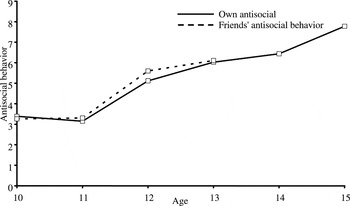
Figure 2 illustrates the development of self-reported ASB from age 10 to age 15 and friends' ASB from age 10 to age 13. In line with the expected age-crime curve, ASB increased with age for both own and friends' ASB.

Mean levels of self-reported antisocial behavior and friends' self-reported antisocial behavior from childhood into adolescence.
Determining trajectories of antisocial behavior and ADH problems
To find the optimal number of trajectory classes, the variances and covariances of the continuous latent variables and the variance of the indicators were set to zero (Muthén & Muthén, 2000). The BIC indicated that up to four developmental trajectories of self-reported ASB could be fitted (BIC three classes = 8863, four classes = 8788). Moving to five (BIC = 8721) trajectory classes or more resulted in trajectory classes comprising very few subjects (<3% of the sample), and to unstable or to nonconverging solutions due to empty trajectory classes. To study whether the three and four class solution could be improved the indicator variances were freed for the overall model (three class BIC = 8791, four class BIC = 8685). Then, the variances of the continuous latent variables were freed (three class BIC = 8647, four class BIC = 8600). However, this four class solution had one class comprising less than 3%, and a second comprising less than 5% of the sample. When allowing for class-specific indicator variances, model fit further improved in the three class solution (BIC = 7922), but resulted in unstable solutions for the four class model. The development of self-reported antisocial behavior was therefore best described by three developmental trajectories. To test whether missing assessments values impacted the estimation of the ASB trajectories, the model was run again for children with complete data only. The parameter estimates were similar to the model that used all available data.
The same approach was used for ADH problems. Up to five trajectory classes were fitted. The two class (BIC = 5344) and three class (BIC = 5296) solution were stable and had meaningful trajectory classes. The four and five class solutions had improved BIC values (four class BIC = 5258, five class BIC = 5225) compared to the three class solution. However, the extra classes were always subpopulations comprised of children with low ADH problems (i.e., no additional meaningful deviant trajectories were identified). We therefore chose the three class solution as the optimal model.
In the final model, the three developmental trajectories of ADH problems and the three developmental trajectories of ASB and friends' ASB were estimated simultaneously. To test whether missing assessments impacted the model of ADH problems, the model was run again for children with complete data only. Parameter estimates were similar to those identified by the model that included all available data. The model including all available data was therefore used for the presentation of the results.
Developmental trajectories of antisocial behavior: Shape, prevalence, and gender
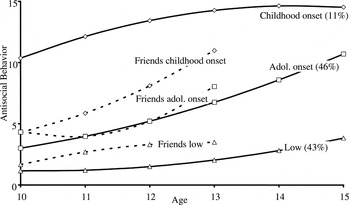
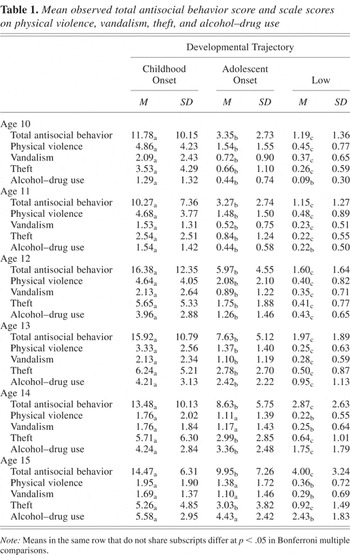
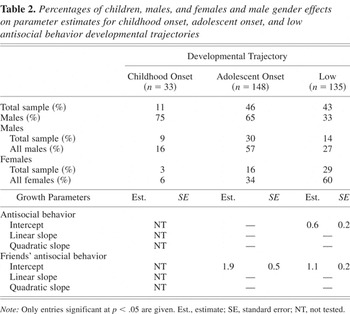
Figure 3 presents the developmental trajectories of self-reported antisocial behavior from age 10 to age 15. Eleven percent of all participants followed a chronically high trajectory that was significantly higher than the remaining trajectories from childhood into adolescence. This trajectory is best described as childhood onset of ASB. The average scores on total ASB and on the four scales (physical violence, vandalism, theft, and alcohol–drug use) that comprise the total scale are given in Table 1. The table shows that the childhood-onset group had consistently high values of each type of ASB. The gender distribution of the developmental trajectories is presented in Table 2. Although 75% of the children on the childhood-onset trajectory were male, 6% of all females were members of this trajectory group.

Developmental trajectories of (—) self-reported antisocial behavior and (···) friends' self-reported antisocial behavior from childhood into adolescence.
Mean observed total antisocial behavior score and scale scores on physical violence, vandalism, theft, and alcohol–drug use

Percentages of children, males, and females and male gender effects on parameter estimates for childhood onset, adolescent onset, and low antisocial behavior developmental trajectories

To validate the level of deviancy of this childhood-onset trajectory group, the ASB scores at age 13 were compared to the ASB scores of early adolescents from a large representative sample (N = 2000) who had problems with the police and were convicted of illegal acts (N = 185). These data were collected from the representative sample throughout the province of Quebec during the same period that data were collected from the studied sample. A t test showed that the ASB scores of the two groups did not differ significantly (childhood-onset trajectory group, M = 12.5, SD = 10.5; representative sample, M = 10.6, SD = 7.2; only boys were compared because of the small number of girls in the childhood-onset trajectory group).
Nearly half (46%) of the participants (65% males) followed a trajectory characterized by low initial levels of ASB in childhood that increased throughout adolescence. This trajectory is best described as an adolescent onset of antisocial behavior class. For this class, the increase in antisocial behavior is mainly due to increases in theft and alcohol–drug use (see Table 1). Fifty-seven percent of all males in the sample followed this developmental trajectory. Thirty-four percent of the females were in this trajectory class (see Table 2). The parameter estimates were adjusted for gender, and the shape of the adolescent-onset trajectory was found to be similar for boys and girls (see Table 2). Again, the ASB scores of these children were compared with the ASB scores of boys who had been arrested. A t test showed that the adolescent-onset youths had lower ASB scores at age 13 than boys who had been arrested.
The remaining 43% of the sample, of whom 67% were females, followed a trajectory of low ASB in childhood that slightly increased through adolescence. Overall, the level of antisocial behavior in this trajectory class was lower than the level in the other two trajectory classes. Thus, this class is referred to as a low antisocial behavior trajectory class. Sixty percent of all females in the sample followed this trajectory. A significant relation between gender and the intercept of this trajectory indicated that males who traveled along this trajectory had higher levels of antisocial behavior than females (see Table 2).
The male–female ratio differed among the three trajectory classes, χ2 (2, N = 316) = 37.5, p < .01. However, the male–female ratio of the childhood-onset trajectory class was not statistically different from the male–female ratio of the adolescent-onset trajectory, χ2 (1, N = 316) = 1.3, p > .05, indicating that the overall in male to female ratio difference was due to the fact that females were more likely than males to follow the low ASB trajectory.
Developmental trajectories of ADH problems
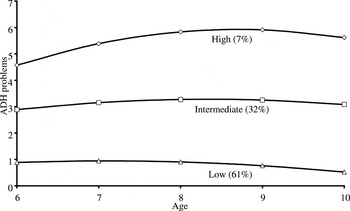
Figure 4 shows the developmental trajectories of ADH problems from age 6 to age 10. Seven percent of all children, of whom 91% were boys, followed a trajectory of high ADH problems from kindergarten to middle childhood. A third (31%) of the participants in this study, of whom two thirds were boys, followed an intermediate developmental trajectory from kindergarten to middle childhood. The remaining 62% of the participants, of whom 59% were girls, had stable low levels of ADH problems. Boys in this low ADH problems class had stable but slightly higher levels of ADH problems than girls (estimate = 0.24, SE = 0.09, p < .05).

Developmental trajectories of AHD problems from age 6 to age 10 years.
Childhood-onset, adolescent-onset, and trajectories of ADH problems
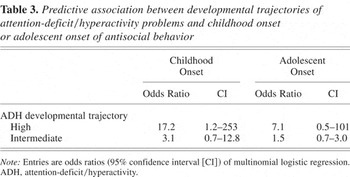
To examine whether the childhood and adolescent-onset trajectories of ASB were predicted by the high developmental trajectory of ADH problems, membership in each of the antisocial developmental trajectories was regressed on membership in the ADH problems trajectories. Results of these analyses are reported in Table 3. Membership in the high developmental trajectory of ADH problems predicted membership in the childhood-onset trajectory of ASB. In contrast, membership in the high developmental trajectory of ADH problems was not significantly associated with the adolescent-onset trajectory of antisocial behavior. Membership in the intermediate trajectory of ADH problems predicted neither the childhood- nor adolescent-onset trajectory of antisocial behavior.
Predictive association between developmental trajectories of attention-deficit/hyperactivity problems and childhood onset or adolescent onset of antisocial behavior

Childhood-onset, adolescent-onset, and friends' antisocial behavior
Children who were without a mutual friend at each assessment were equally distributed over the three antisocial behavior trajectories, χ2 (2, N = 316) = 4.3, p > .05. Children in each of the trajectories did not differ in the number of mutual friends. The development of antisocial behavior and the development of friends' antisocial behavior from age 10 to 13 are depicted in Figure 3. From this figure, it is apparent that in childhood, the levels of ASB exhibited by childhood-onset children are much higher than the levels of antisocial behavior exhibited by their friends. To test whether the shape of friends' ASB was different from the shape of children's own antisocial behavior, the parameters of the continuous latent variables (intercept, slope, quadratic slope) between own and friends' ASB were constrained to be equal. For the childhood-onset class, the developmental shape of friends' antisocial behavior was different from the developmental shape of own antisocial behavior, χ2 (3, N = 316) = 19.1, p < .01. To study whether this difference in development was due to the difference in ASB at age 10, the intercepts of antisocial behavior and friends' antisocial behavior were freed. It showed that childhood-onset children had higher levels of ASB at age 10 than their friends, χ2 (1, N = 316) = 16.2, p < .01.
The adolescent-onset children followed an antisocial pathway that seemed to parallel the development of their friends' ASB more closely than childhood-onset children. To test this similarity of pathways in the adolescent-onset class, parameter estimates for own and friends' antisocial behavior were constrained to be equal. A chi-square difference test indicated that the development of friends' antisocial behavior was similar to the development of own antisocial behavior in the adolescent-onset class, χ2 (3, N = 316) = 6.2, p > .05. Boys in the adolescent-onset class affiliated with more antisocial friends than girls in this class (see Table 2).
Discussion
The goals of this study were to test for the existence of childhood and adolescent-onset trajectories of antisocial behavior and to identify predictors of each trajectory. To our knowledge, this is the first study that has done so by integrating a number of the critical components of the theories on the age of onset of antisocial behavior into one model. The developmental trajectories of antisocial behavior were identified empirically, not based on predetermined cutoff values. Two processes that should differentially predict the timing of ASB onset were included in the estimation of the trajectories of this behavior. First, the development of ADH problems in childhood was believed to predict only childhood onset of ASB. Second, the parallel development of friends' antisocial behavior was posited to predict adolescent-onset ASB but not childhood-onset ASB.
Childhood and adolescent onset of antisocial behavior: Prevalence and gender
Three developmental trajectories of self-reported antisocial behavior were identified. Eleven percent of the children followed a childhood-onset path characterized by high levels of antisocial behavior in childhood and the highest levels of antisocial behavior throughout the study period. The level of ASB of these children resembled the level of ASB of youth who were in contact with police or justice, which confirmed the severity of the behavioral problems of this childhood-onset group. The finding that approximately one tenth of all participants followed the childhood-onset trajectory is largely in accordance with previous findings (e.g., Fergusson et al., 2000; Fergusson & Horwood, 2002; Moffitt & Caspi, 2001; Moffitt et al., 2002). Forty-six percent of the sample followed an adolescent-onset trajectory, which is in line with the hypothesis that such a trajectory is common or near normative (Moffitt, 1993). This percentage is, however, higher than has been found in previous studies (e.g., Moffitt & Caspi, 2001; Moffitt et al., 2002; White et al., 2001). The remaining participants had low levels of antisocial behavior throughout the study period. Both the shape and percentage of participants in each trajectory tended to be consistent with Moffitt's (1993) theory regarding the variation in and initiation of ASB across childhood and adolescence.
More than half of all males in the sample followed the adolescent-onset developmental trajectory. This indicates that adolescent onset of ASB may be considered normative for males, which is, again, in accordance with Moffitt's theory (1993). The male–female ratio in the adolescent-onset class of 1.8:1 was similar to the ratio identified by Moffitt and Caspi (2001). Seventy-five percent of the participants in the childhood-onset class were male. This 3:1 male–female ratio is much lower than has been found in other studies (Fergusson & Horwood, 2002; Moffitt & Caspi, 2001). On the other hand, 60% of all females in the sample followed the consistently low trajectory, which is in accordance with previous studies.
Of particular interest is that although few females traveled along the childhood-onset trajectory, the male–female ratio of the childhood-onset trajectory was not significantly different from the male–female ratio of the adolescent-onset trajectory. A problem with comparing this finding with previous studies is that most studies either excluded females (e.g., Nagin & Tremblay, 1999; Schaeffer et al., 2003) or analyzed males and females separately (e.g., Broidy et al., 2003). Moreover, the methods used in this study to identify the developmental trajectories differed from the methods employed by previous studies (Moffitt & Caspi, 2001; Fergusson and Horwood, 2002). Differences in the samples, measures, and local norms for female behavior between the current study and previous studies used females participants may also explain differences in the findings. Thus, our ability to compare the current study's findings to those of other studies is limited with regard to gender differences. In the present study, females were more inclined than males to follow a consistently low ASB trajectory. Those females who did not follow the low trajectory of antisocial behavior, however, were as likely as males to follow either the childhood or the adolescent-onset trajectory. This finding contradicts the theory of a delayed-onset pathway for girls proposed Silverthorn and Frick (1999).
Childhood and adolescent onset of antisocial behavior: ADH problems and friends' antisocial behavior
The childhood-onset path of ASB development is believed to be caused by neuropsychological variation in childhood, especially expressed as ADH problems. In contrast, the adolescent-onset path is hypothesized to stem solely from social–environmental influences. To test the validity of these predictions, trajectory group membership of ADH problems in childhood and the concomitant development of friends' antisocial behavior were included in the trajectory model.
Seven percent of the sample followed a high ADH problems trajectory from kindergarten to age 10. An additional 31% of children followed an intermediate trajectory of ADH problems. Following the high ADH problems trajectory predicted membership in the childhood-onset trajectory of antisocial behavior. In contrast, membership in the high ADH problem trajectory did not significantly predict membership in the adolescent-onset trajectory. This finding is consistent with the theories of Moffitt (1993) and Loeber and Stouthamer Loeber (1998). It should be noted, however, that no clinical diagnosis of ADHD was included in this study, only indicators of ADH problems. In addition, the potential contribution of high levels of ADH problems to the development of adolescent-onset ASB still should not be ruled out completely. The odds ratio (OR) for this association was considerably high (OR = 7.1) and was not statistically significant because of the large amount of variation reflected in a wide confidence interval.
To study the possible contribution of involvement with antisocial friends to the trajectories, the development of friends' antisocial behavior was included as a predictor of trajectory class membership. The results showed that the increase in antisocial behavior of youths on the adolescent-onset trajectory paralleled the increase in antisocial behavior of their friends. Previous findings showed that preadolescents who are initially moderately antisocial are particularly vulnerable to negative peer influences (Vitaro, Tremblay, Kerr, Pagani, & Bukowski, 1997). It has been also shown that affiliation with consistently deviant or increasingly deviant peers is associated with increases in children's own antisocial behavior (Lacourse, Nagin, Tremblay, Vitaro, & Claes, 2003; Patterson et al., 2000; Vitaro et al., 2005). This study found that the level of antisocial behavior of the children in the childhood-onset trajectory was already higher than their friends' antisocial behavior at age 10, which suggests that for these children the development of antisocial behavior was not preceded by affiliation with deviant friends. However, childhood-onset children did affiliate with friends who were highly and increasingly deviant. It therefore suggests that the longitudinal antisocial behavior patterns of childhood-onset trajectory children and their friends are interrelated. More specifically, because childhood-onset children had higher levels of antisocial behavior than their friends at age 10, it suggests that childhood-onset children are the lead amplifiers in their increasing antisocial behavior, through their selection of increasingly deviant friends.
The adolescent-onset path, in contrast, paralleled the affiliation with increasingly deviant friends. Friends' deviancy was therefore linked more closely to the antisocial developmental path of adolescent-onset children than of childhood-onset children. In accordance with suggestions from several theorists, the present findings suggest that friends can play different roles in the development of ASB, for example, as facilitators of those predisposed to become involved in ASB or as instigators of ASB among those not predisposed to such behavior, depending on children's personal dispositions (Moffitt, 1993; Patterson & Yoerger, 1997).
Three theoretical models account for the role of individual and social environmental factors in the development of antisocial behavior. The selection or individual characteristics model states that antisocial individuals will choose or self-select themselves into deviant groups. This theory proclaims that individual characteristics cause these children to affiliate with similarly deviant children. In this theory, the exposure to these deviant peers plays no contributory role in the development of their antisocial behavior (e.g., Gottfredson & Hirschi, 1990). The Enhancement model proclaims that deviant friends can strengthen the link between the personal risk variables and the development of antisocial behavior (e.g., Patterson et al., 1989; Thornberry, 1987). The Socialization or Peer Influence model, finally, proclaims that affiliation with antisocial friends causes youths to manifest more antisocial behaviors (Elliott et al., 1985).
The findings of the present study suggest that the development of childhood-onset antisocial behavior is mostly in accordance with the selection or the enhancement model, but not with the socialization model. They show that in accordance with the selection model, the childhood-onset path is preceded by child behavioral factors that originate in childhood. In accordance with the enhancement model, however, the preexisting deviant levels of antisocial behavior appeared to be exacerbated by affiliation with increasingly deviant friends. In contrast, the development of the adolescent-onset path is mostly in accordance with the socialization perspective. Hence, the models that try to account for the role of deviant peers and their underlying processes (i.e., the selection vs. influence) can be both true, but not with the same group of individuals.
As described, the total antisocial behavior score that was used to analyze the developmental trajectories comprised various types of behavior, including physical violence, vandalism, theft, and alcohol and drug use. Studies examining more specific forms of antisocial and delinquent behavior have identified developmental trajectories different from the childhood and adolescent-onset trajectories identified in this study (see, e.g., Bongers et al., 2004; Broidy et al., 2003; Nagin & Tremblay, 1999). This discrepancy may suggest that the distinction between childhood and adolescent-onset trajectories of antisocial behavior development is not valid once different forms of antisocial behavior are taken into account. Our data do not support this line of thinking. As shown in this study, early-onset children always exhibited among the highest levels of each form of antisocial behavior. Thus, the various types of antisocial behavior co-occur in these children. This finding also supports the utility of a generalized antisocial behavior score.
It should be noted that adolescent-onset children were much less likely than childhood-onset children to exhibit high levels of physical violence. This suggests that the antisocial behavior of adolescent-onset children is less severe than that of childhood-onset children. Moffitt (1993) argued that the behaviors of adolescent-limited antisocial children should be considered near normative among males, and showed that youth in the adolescent-limited path were better adjusted in adulthood than those who followed the childhood-onset path (Moffitt et al., 2002). This suggests that the adolescent-onset children from this study should not be considered “antisocial” (i.e., not pathological), but rather as youths who engage in some forms of antisocial behavior that are normative among males. Alternatively, the finding that these children were not physically violent may be explained by the age at which these children started their antisocial acts. Childhood-onset children had diminishing levels of physical violence with age, which supports previous research (Broidy et al., 2003; Nagin & Tremblay, 1999). Given that physical violence seems to diminish in adolescence, adolescent-onset children are less likely to engage in this type of antisocial behavior.
There are limitations to this study. The first is the sample size. With a total sample of 316 children, the childhood-onset group and the high ADH problems group were relatively small. Consequently, the finding that females were as likely as males to follow a childhood- or adolescent-onset trajectory may be due to the small sample size. Our analysis may have lacked the statistical power necessary to detect any difference in the distribution of boys and girls among the trajectories because the number of girls (particularly in the childhood-onset trajectory) was small. The small sample size may have also caused the large confidence intervals around the associations between the ASB trajectory classes and the childhood ADH problems, although the associations conformed to our expectations. The simultaneous estimation of the ADH problems and ASB trajectories may additionally have contributed to these large error estimates. This model accounted for the uncertainty in classification of children to the developmental trajectories and the resulting uncertainty in the association between the trajectories. The confidence intervals therefore reflected the unbiased estimate of this error. The tradeoff, however, was the estimation of large confidence intervals around the odds ratios. Moreover, it was impossible to test whether the association between the developmental trajectories of antisocial behavior with ADH problems and friends' antisocial behavior depended on the gender of the children. Males, however, were overrepresented in both the high ADH problems and the childhood-onset trajectory. In addition, males and females tended to chose same-gender children as their friends. Taken together, these two pieces of information may indicate that the associations that we identified between ASB trajectory membership and ADH trajectory membership did not depend on the gender of the children. Still, these issues should be investigated further in larger samples of children.
The second limitation reflects the measure of ADH problems. No clinical diagnosis of ADHD was made on the basis of our assessment (i.e., a teacher-rated survey of child behaviors). The ADH problems scale was comprised of only six items. These items primarily assessed the child's level of activity. Moreover, because the six items were nested in a larger questionnaire, teachers may have overrated generally disruptive children.
Related to the use of ADH problems, two recent studies addressed the development of childhood physical aggression, starting at or before age 2 years (NICHD Early Child Care Research Network, 2004; Tremblay et al., 2004). Both studies identified a high aggression trajectory. Children who followed these high aggression trajectories lived in socioeconomically deprived families and had mothers with low levels of education, who employed ineffective parenting styles (NICHD Early Child Care Research Network, 2004; Tremblay et al., 2004), and who smoked during pregnancy (Tremblay et al., 2004). This suggests that physical aggression in childhood, similar to ADH problems, is indicative of early-onset problem behaviors. Further, in line with the hypothesized physical aggressive trajectories by Tremblay (2003), the study by the NICHD Early Child Care Research Network (2004) identified a group of 13% of the children with moderate levels of physical aggression at age 2 that rapidly declined with age. Therefore, to fully understand the developmental courses of problem behavior from early childhood into adolescence, and to disentangle potential contributions of child characteristics including both ADH problems and early physical aggression, researchers should target very young children and study multiple forms of problem behaviors.
A third limitation concerns the friends' antisocial behavior scores. These data were only available from age 10 to 13 years. Therefore, the association between friends' and own antisocial behavior could not be assessed across the entire study period. Our results suggested that the onset of childhood ASB was less strongly associated with friends' behaviors than the onset of adolescent-onset ASB. Extending the friends' antisocial behavior scores to age 15 years may therefore have provided more insight on how deviant friends influence the further course of ASB among youth on the childhood and adolescent-onset trajectories after their ASB had already started. Our results also suggested that childhood-onset children are the lead amplifiers in their increasing antisocial behavior through their selection of increasingly deviant friends. However, without information on friends' antisocial behavior prior to age 10, this remains speculative. Friends may already have played a role in ASB development before this age (Boivin, Vitaro, & Poulin, 2005). In addition, children's choice of friends was limited to within-classroom peers, which may have restricted some children's selection of friends. We do not, however, believe that limiting friendship nominations to the classroom overly restricted such friend selection. A vast majority of elementary school children choose classmates as their best friend, even when allowing nominating friends from outside the classroom (Kupersmidt, Burchinal, & Patterson, 1995; Parker & Asher, 1993).
The final limitation concerns the surveyed age period. The theories around the age of onset of antisocial behavior suggest that youths on the adolescent-onset path grow out of their antisocial behavior in young adulthood. Identifying this expected decline in ASB would have further validated the distinction between the childhood and adolescent-onset ASB trajectories. Similarly, the childhood-onset trajectory is hypothesized to start prior to age 10 according to DSM-IV (American Psychiatric Association, 1994). However, no information on ASB prior to age 10 was available. The expected association with ADH problems during childhood and the high levels of antisocial behavior at age 10 suggested that the antisocial behavior of the childhood-onset children was already present prior to this age.
Conclusion
In sum, the goal of this study was to directly test the existing theories around the age of onset of antisocial behavior. An integrated model was used in which both the developmental trajectories and the association with preexisting and concurrent processes were estimated simultaneously. The following are the main conclusions that we draw from our results:
- Using self-reports of antisocial behavior, the findings support our hypotheses concerning the most typical trajectories of ASB among children: childhood-onset, adolescent-onset, and consistently low antisocial behavior. In fact, no other trajectories were identified.
- The percentages of the total sample in each of the antisocial behavior trajectories also tended to support our hypotheses, and were in line with prior research. Following a childhood-onset trajectory was rare. In contrast, the adolescent-onset trajectory was fairly common and near normative for boys.
- The differential associations between the ASB trajectories with preexisting and concurrent risk factors (i.e., ADH problems and friends' deviancy) were consistent with our hypotheses and prior research. As expected, the childhood-onset trajectory was predicted by high levels of ADH problems earlier in childhood and maintained by association with increasingly deviant friends. In contrast, the increase in ASB of youths on the adolescent-onset path paralleled their friends' ASB development.
- As expected, females were much more likely than males to follow a path of consistently low antisocial behavior. However, when girls are involved in ASB, they are as likely as males to follow the childhood-onset and adolescent-onset paths. In other words, in contrast to the theory by Silverthorn and Frick (1999), the age of onset of antisocial behavior is important for the development of girls as well as boys.