Introduction
Globally, around 4 million infants die every year within the first 28 days of life. Three-quarters of these deaths occur in the first week of life, with more than a quarter occurring in the first 24 hours of life. Although there has been a considerable decline in infant mortality rates throughout the world in the past two decades, they have remained largely unchanged in developing countries (UNICEF, 2009).
Child mortality is largely concentrated in the first year of life, and mortality in this period is known as ‘infant death’. Worldwide, 4 million infants die each year in the first 28 days of life (the neonatal period). The child survival Millennium Development Goal cannot be met without a substantial reduction in infant mortality (UNICEF, 2009). Infant and child mortality rates are important indicators of the health status of a nation, and the infant mortality rate is a widely accepted index of socioeconomic development reflecting a country’s health care system and quality of life.
The decline in the infant mortality rate in Nigeria over the past few years has been inadequate (Aigbe & Zannu, Reference Aigbe and Zannu2012). More specifically, the decrease in infant mortality has been accompanied by an increased concentration of deaths in the first week of life. It is generally argued that two-thirds of all deaths in the first 5 years of life in developing countries are infant deaths, with two-thirds of these deaths being confined to the neonatal period (Whitworth & Stephenson, Reference Whitworth and Stephenson2002; DaVanzo et al., Reference DaVanzo, Razzaque, Rahman, Hale, Ahmed and Khan2004). In Nigeria, the newborn death rate, especially in the neonatal mortality period, is almost 528 per day. This neonatal mortality is one of the highest in the world. More than a quarter of a million children die under the age of 5 years annually in Nigeria. These deaths occur during the first 28 days of life, especially in the neonatal period. One important thing about this mortality is that about nine out of ten newborn deaths are preventable. In Nigeria, about 5.3 million children are born yearly, which is about 11,000 every day; 1 million of these children die before the age of 5 years (UNICEF, 2019).
An important determinant of the risk of death in the first 5 years of life repeatedly highlighted in previous studies is the birth interval (Winikoff, Reference Winikoff1983; Biradar et al., Reference Biradar, Patel and Prasad2019). It has been conclusively argued that newborns with a short birth interval (less than 2 years) have a higher probability of dying in the first 5 years of life than those with a birth interval of 3 years or more (Gubhaju, Reference Gubhaju1986). The published literature shows that there is high mortality rate in the first years of life in Nigeria, but little is known about how this has changed over time, or its determining factors. The aim of this study was to attempt to understand the effects of policy over recent decades on neonatal and infant mortality, as implemented by governmental and non-governmental organizations in Nigeria.
Methods
Data
Data were taken from the ‘child’ file of the fifth round (2018) of the Nigerian Demographic and Health Survey (NDHS-2018) implemented by the National Population Commission (NPC, 2019). This collected information on 27,465 infants under the age of 1 year, all of which were analysed in the study. The survey provides information about important aspects of neonatal and post-neonatal care, infant deaths, birth spacing, family planning, child feeding practices, women and child nutritional status and knowledge and attitudes regarding HIV/AIDS.
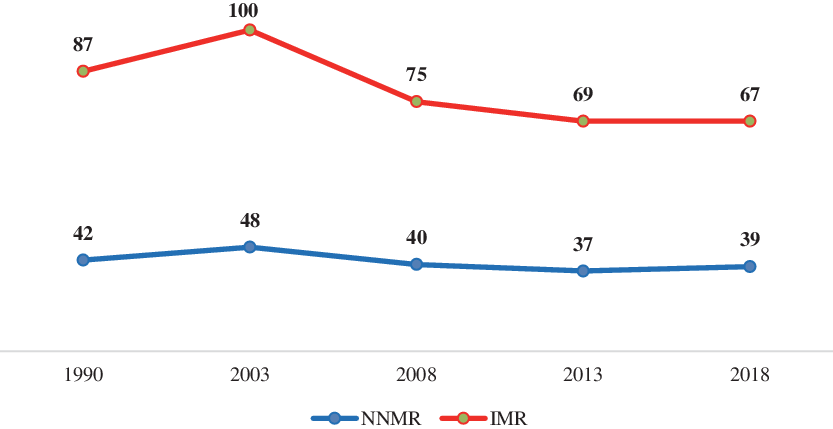
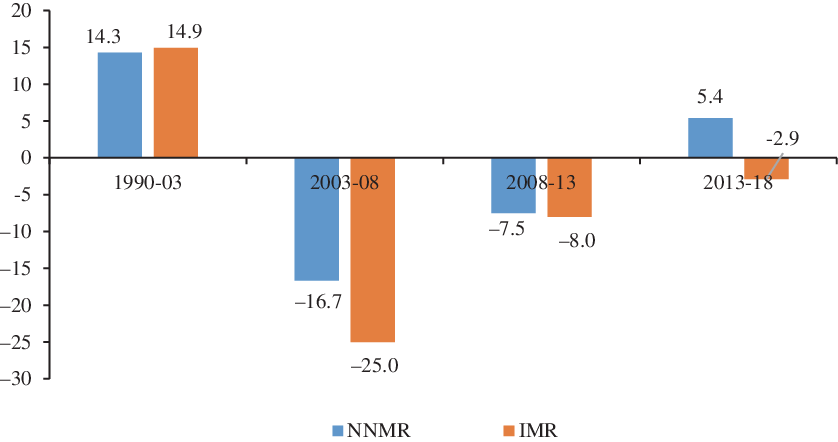
To examine the changes in neonatal and infant mortality rates over time, information at 1990, 2003, 2008, 2013 and 2018 were extracted from NDHS-2018 report, and this is shown in Figure 1. From this the changes in neonatal and infant mortality rates were estimated (see Figure 2). Neonatal and infant mortality rates can also be estimated from the ‘child’ file of the five rounds of Nigeria Demographic and Health Survey (NDHS).
Infant mortality rate (IMR) and neonatal mortality rate (NNMR) trends in Nigeria, 1990–2018. Data source: Nigeria Demographic and Health Survey Report 2018 (NPC, 2019).

Percentage changes in Infant mortality rate (IMR) and neonatal mortality rate NNMR, 1990-2018. Data source: Nigeria Demographic and Health Survey Report 2018 (NPC, 2019).

Study variables
The response variables were neonatal mortality and infant mortality, estimated as percentages of live births. The associations of these with various socioeconomic and demographic predictors were analysed. A wealth index was constructed using information about household assets and amenities collected during the NDHS-2018. Other predictor variables were mother’s education (not educated, educated), mother’s occupation (not working, working), mother’s age at first birth (<20 years, ≥20 years), type of delivery (non-institutional delivery, institutional delivery), antenatal care (no ANC visits, at least one ANC visit), birth size (very small, smaller than average, average, larger than average), religion (Islam, Other), place of residence (urban, rural), number of children in household (1–2, 3–4, ≥5) and child’s sex (male, female).
Analysis
Bivariate and multivariate analyses were done using SPSS Version 22 software. Bivariate analysis was employed to estimate the distribution of neonatal and infant mortality by background variables. For multivariate analysis, the Cox regression model was used as this deals with censored observations, and, moreover, the outcome variable was time dependent. So, this model was appropriate to assess the effects of socioeconomic and demographic factors on neonatal and infant mortality.
Cox regression is a method of studying the effect of variables on the time an itemized event takes to occur. For an outcome such as death, this is known as Cox regression for survival analysis. Cox regression was used to examine the effect of socioeconomic and demographic variables on neonatal and infant mortality. This model was employed primarily for two reasons: 1) it is appropriate while analysing survival data and handling censored observations, and 2) it accounts for the hierarchical structure of data (Adedini et al., Reference Adedini, Odimegwu, Imasiku, Ononokpono and Ibisomi2015). Using the Cox proportional hazard model, the probability of death was regarded as the hazard (Rabe-Hesketh et al., Reference Rabe-Hesketh, Skrondal and Pickles2004). The hazard was determined using the following equation:
 $$ln\left( {{{P\left( t \right)} \over {{P_0}\left( t \right)}}} \right) = {a_1}{X_1} + {a_2}{X_2} + {a_3}{X_3} + \cdots \ldots \ldots \ldots . + {a_n}{X_n}$$
where X 1, X 2, X 3………X n are the sets of independent variables, a 1, a 2, a 3, ….a n are the coefficients in Cox regression, P 0(t) is the baseline hazard at time t, P(t) is the hazard function at time t and P(t)/P 0(t) is defined as the hazard ratio (HR).
Results
Trends in neonatal and infant mortality rates over time
The infant mortality rate in Nigeria was 87 per 1000 live births in 1990 and this increased to 100 per 1000 live births in the year 2003 – an increase of around 15% over 13 years. The corresponding estimates for the neonatal mortality rate were 42 per 1000 live births in 1990 and 48 per 1000 live births in 2003 – an increase of nearly 14% over the same 13-year period. Neonatal as well as infant mortality rates started to decline thereafter and continued to do so until 2013 (Fig. 1). Infant deaths decreased by almost 25%, 8% and 2.9% over the 5-year periods 2003–2008, 2008–2013 and 2013–2018, respectively. Neonatal mortality decreased by around 17% and 7.5% over the 5-year periods 2003–2008 and 2008–2013, respectively, and increased by 5.4% over the period 2013–2018 (Fig. 2).
Neonatal and infant mortality in 2018 by socio-demographic characteristics
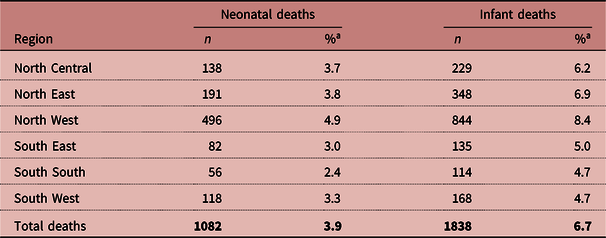
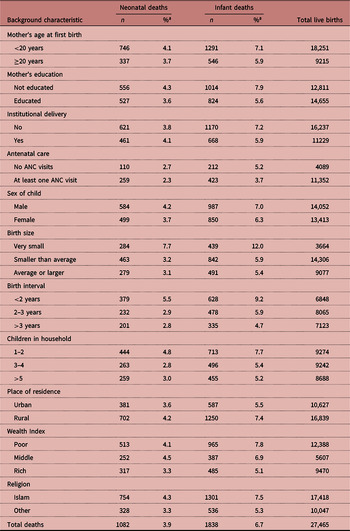
Tables 1 and 2 show the percentage distribution of neonatal and infant deaths in 2018 by region and socio-demographic characteristics, respectively. Neonatal and infant deaths were highest in the North West region at 8.4% and 4.9% of total deaths respectively, and lowest in the South region of the country (Table 1). Neonatal and infant deaths were higher among mothers who had their first birth at less than 20 years of age compared with those who did so at age 20 years or over (Table 2). Neonatal and infant deaths were higher among illiterate mothers, among who had a non-institutional delivery and those who did not receive any antenatal care (ANC). More male babies died before their first birthday than did female babies. Infant deaths decreased as wealth index increased, with more deaths occurring in the poor economic class, followed by the middle class. Deaths were more common in infants who had a small birth size than among those who had an average or larger than average size at birth. The death rates of infants and neonates with small birth size were around 12% and 8%, respectively. The death rates were highest among women with a birth interval of less than 2 years, followed by those with an interval of 2–3 years. Infant and neonatal death rates were higher among practitioners of Islam than those of other religions, and higher among those residing in rural settings than those residing in urban areas.
Neonatal and infant deaths (n, %) by region, Nigeria, NDHS-2018, N = 27,465

a Percentage of total births.
Neonatal and infant deaths rates by selected background characteristics of mothers, NDHS-2018

a Percentage of total births.
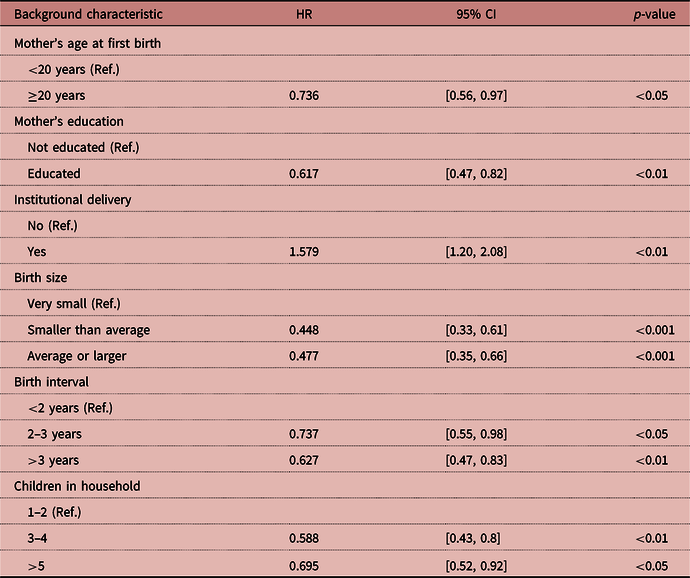
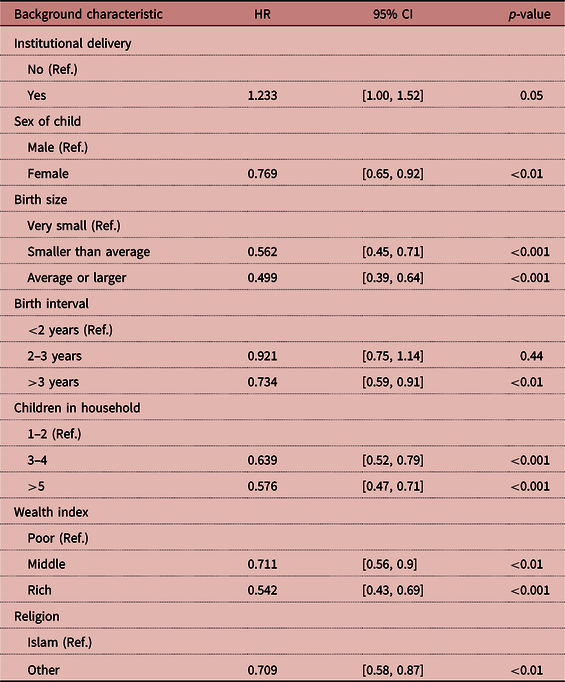
Tables 3 and 4 show the results of the Cox regression analysis for the effects of socio-demographic characteristics on neonatal and infant deaths in Nigeria in 2018. Women who had more than 3 years birth interval had significantly fewer neonatal and infant deaths. Deaths of infants were significantly fewer in the rich (around 45%) and middle economic classes (nearly 29%) than in the poor class. The Islamic community had a significantly higher infant death rate than other communities. Mortalities were significantly higher in male than female children. Neonatal deaths were found to be 25% fewer in mothers who had their first child at age 20 or over compared with those who had the first child under the age of 20. Institutional delivery was associated with decreased neonatal and infant mortality.
Results of Cox regression analysis of the association between neonatal mortality and socio-demographic factors, NDHS-2018

All factors (mother’s age at first birth, mother’s education, antenatal care, birth interval, sex of child, children in the household, place of residence, wealth index, religion, institutional delivery and birth size) were included in the Cox Forward LR model but only significant factors are presented in the model.
Ref.: Reference Category; HR: Hazard Ratio.
Result of Cox regression analysis of the association between infant mortality and socio-demographic factors, NDHS-2018

See footnote to Table 3.
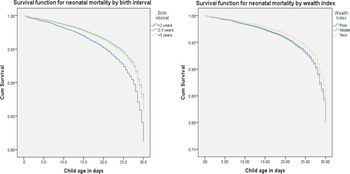
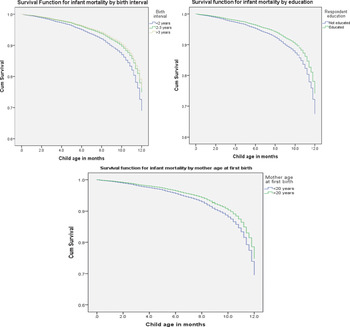
The survival functions for neonatal and infant mortality by selected significant socio-demographic variables are shown in Figures 3 and 4, respectively. Figure 3 shows a higher infant mortality rate in mothers who had their first child before 20 years of age. Also, mortality was higher in illiterate women and women with birth intervals of under 2 years. In other words, the children of women who gave birth with an interval of 2 years or more had a better chance of survival than those who gave birth with an interval of under 2 years. Additionally, neonatal and infant mortality rates were lower in mothers from rich families compared with mothers in other economic groups.
Survival function for neonatal mortality, Nigeria.

Survival function for infant mortality, Nigeria.

Discussion
Birth interval is a significant risk factor for death in the first 5 years of life (Winikoff, Reference Winikoff1983; UNICEF, 2009; Biradar et al., Reference Biradar, Patel and Prasad2019). Biradar et al. (Reference Biradar, Patel and Prasad2019) showed the effect of wealth and birth interval on under-5 child mortality in Nigeria. Adedini et al. (Reference Adedini, Odimegwu, Imasiku, Ononokpono and Ibisomi2015) and Slinkard et al. (Reference Slinkard, Pharr, Bruno, Patel, Ogidi, Obiefune and Ezeanolue2018) reported mortality rates and their determinants in Nigeria, but none has assessed its variation and determinants over time. The present study aimed to understand the effect of policy on neonatal and infant mortality in Nigeria, as implemented by the governmental and non-governmental organizations, in an attempt to reduce mortality in accordance with the Millennium Development Goals.
The results indicate that the infant mortality rate increased by around 15% over the 13 years from 1990 to 2003, and that the neonatal mortality rate increased by nearly 14% over the same period, with both rates declining thereafter until 2013. In addition, infant deaths were shown to have decreased by almost 25%, 8% and 2.9% over the 5-year periods 2003–08, 2008–13 and 2013–18, respectively. Neonatal deaths decreased by around 17% and 7.5% over the 5-year periods 2003–08 and 2008–13, respectively, but increased by 5.4% from 2013 to 2018. This may have been due increases in poverty or declines in health care. In 2018, neonatal and infant deaths were highest in the North West region and lowest in the South region of the country. This result may be attributed to spatial inequality in economic and social development between regions (Antai, Reference Antai2011), with regional differences in maternal education and hygiene practices (Ladusingh & Singh, Reference Ladusingh and Singh2006), distribution and use of health facilities (Say & Raine, Reference Say and Raine2007), age at first marriage (Wall, Reference Wall1998) and education and use of preventive health care services (Kravdal, Reference Kravdal2004; Ladusingh & Singh, Reference Ladusingh and Singh2006). Furthermore, a different causal mechanism similar to the regional diversification in immunization protection, might account for the massive disparities in mortality between the south and north of Nigeria.
In 2018, infant and neonatal deaths were lower in mothers who had their first child at older ages, i.e. after the age of 20. This finding is consistent with the results of other studies conducted in Nigeria and other developed countries (Ballot et al., Reference Ballot, Chirwa and Cooper2010; Onwuanaku et al., Reference Onwuanaku, Okolo, Ige, Okpe and Toma2011). Institutional delivery appeared to play a negative role in the country. However, previous studies have suggested that components of social capital are positively associated with better health care services, especially professional delivery care (Story, Reference Story2014; Biradar, Reference Biradar2018). Mothers who had at least one ANC visit had 17% fewer infant deaths than those who had no ANC visits. Death rates were a little higher in rural compared with urban settings. This finding is supported by other study conducted in Nigeria (Adedini et al., Reference Adedini, Odimegwu, Imasiku, Ononokpono and Ibisomi2015).
Women who had a birth interval of more than 3 years had significantly fewer neonatal and infant deaths. Deaths of infants were significantly fewer in the rich (around 35%) and the middle (nearly 21%) economic classes than in the poor class. This finding supported that of Adedini et al. (Reference Adedini, Odimegwu, Imasiku, Ononokpono and Ibisomi2015), who found birth interval and economic class to be important predictors of infant mortality in Nigeria. Furthermore, mortality rates were significantly higher in male than female children. Similar findings have been made in a cross-sectional studies in Indonesia (Titaley et al., Reference Titaley, Dibley, Agho, Roberts and Hall2008) and Bangladesh (Mondal et al., Reference Mondal, Hossain and Ali2009). The higher risk of death among male infants may be due to their greater susceptibility to infectious disease (Alonso et al., Reference Alonso, Fuster and Luna2006). The lower infant death rate among female infants may be due to earlier fetal lung maturity during the first week of life resulting in a lower incidence of respiratory infection. Worldwide, an estimated 23% of newborn deaths can be attributed to respiratory problems (Khoury et al., Reference Khoury, Marks, McCarthy and Zaro1985).
Higher neonatal and infant deaths were observed among mothers who had their first birth at less than 20 years of age compared with those who did so at 20 or over. The multivariate analysis also indicated that mother’s age at first birth had a significant effect on neonatal mortality. In addition, neonatal and infant mortality rates were higher among illiterate mothers, those who had a non-institutional delivery and those who did not receive antenatal care. Other studies have also supported and demonstrated that education plays a significant role in infant mortality (Adedini et al., Reference Adedini, Odimegwu, Imasiku, Ononokpono and Ibisomi2015; Biradar et al., Reference Biradar, Patel and Prasad2019). Slinkard et al. (Reference Slinkard, Pharr, Bruno, Patel, Ogidi, Obiefune and Ezeanolue2018), in their study on infant mortality in Nigeria, found a high mortality rate due to a lack of initial ANC visits. The 2018 NDHS reported that 34% of women did not receive any ANC visits, and only 18% received ANC during the first trimester of pregnancy (NPC, 2019).
More male than female babies died before their first birthday. Deaths were also more common in infants of small birth size than among those of an average or larger size. Deaths were more common in the poor economic class, followed by the middle class. Infant deaths decreased as wealth index increased. Similar findings have been made in Kenya, where infant deaths are lower among those from wealthier households (Mutunga, Reference Mutunga2011). Infant mortality was also higher among women with birth intervals of less than 2 years, than those with birth intervals of 2–3 years.
In conclusion, this study found that neonatal mortality in Nigeria increased by around 5.4% over the 5-year period 2013 to 2018. Analysis of the most recent NDHS data indicated that in 2018 infant deaths decreased as wealth increased in 2018, the incidence of infant deaths was greater in the Islamic community and there was a negative association between the size of a child at birth and chance of infant death. Also, infant mortality was higher in rural than urban areas. It was also higher among male children compared with female children. Overall, neonatal infant and mortality was found to vary by region and other socio-demographic characteristics in the country. These findings should be taken into account in policy interventions in Nigeria, and periodic evaluations of the interventions should be made. Particular focus should be given to the poorer classes, women with birth intervals of less than 2 year and those living in the North West region of the country.
Conflicts of Interest
The authors have no conflicts of interest to declare.
Ethical Approval
The authors assert that all procedures contributing to this work comply with the ethical standards of the relevant national and institutional committees on human experimentation and with the Helsinki Declaration of 1975, as revised in 2008.
Funding
This research received no specific grant from any funding agency, commercial entity, or not-for-profit organization.