


Introduction
Staff attitudes can be influenced by a number of factors and affect how staff relate towards patients and clients. This study focuses on staff attitudes towards deliberate self-harm (DSH) in a mental health inpatient setting for nursing staff working in inpatient units within an independent healthcare organization. For the purposes of this study, DSH is defined as “self-poisoning or injury, irrespective of the apparent purpose of the act”, in accordance with the definition provided by the National Institute for Health and Clinical Excellence (NICE, 2004, p. 7). It has been reported that the UK has one of the highest rates of self-harm in Europe, at 400 per 100,000 people (Horrocks and House, Reference Horrocks and House2002), and DSH has been quoted as one of the top five causes of acute medical admissions (Hawton and Fagg, Reference Hawton and Fagg1992). Sansone, Songer and Miller (Reference Sansone, Songer and Miller2005) discussed higher prevalence rates for DSH in people diagnosed with Borderline Personality Disorder (BPD) and women treated for alcohol and substance abuse, and higher comorbidity rates for depression and eating disorders in those who self-harm.
Deliberate self-harm in mental health inpatient settings
DSH is a common phenomenon within mental health inpatient units and secure facilities, predominantly in female inpatients (for example, James and Warner, Reference James and Warner2005; Thomson, Bogue, Humphreys and Johnstone, Reference Thomson, Bogue, Humphreys and Johnstone2001), although it can be as common in male inpatients. For example, White, Leggett and Beech (Reference White, Leggett and Beech1999) found a 45.5% prevalence of self-harm in male patients in one secure unit. DiClemente, Ponton and Hartley (Reference DiClemente, Ponton and Hartley1991) reported a 61% prevalence rate for institutionalized young people. Penn, Esposito, Schaeffer, Fritz and Spirito (Reference Penn, Esposito, Schaeffer, Fritz and Spirito2003) found 30% of a sample of 78 clinically referred juveniles to have engaged in DSH while incarcerated. Compared to findings in the general population, Sansone, Songer and Miller (Reference Sansone, Songer and Miller2007) did not find DSH to relate to particular psychiatric diagnoses amongst a sample of psychiatric inpatients.
Staff attitudes towards DSH
It has been found that patients who present with DSH are often regarded as more challenging than other patients (for example, Huband and Tantam, Reference Huband and Tantam2000). White et al. (Reference White, Leggett and Beech1999) posited that, because of this, it is important for staff to receive adequate training and support to help them intervene and relate to these patients positively.
The majority of research literature looking at staff attitudes towards DSH has taken place in medical settings such as Accident and Emergency (A&E) departments of general hospitals. Ghodse (Reference Ghodse1978) and Ghodse et al. (Reference Ghodse, Ghaffari, Vaman Bhat, Galea and Qureshi1986) found that patients who had taken accidental overdoses were regarded more favourably than those who had taken deliberate overdoses, who in turn were viewed more positively than overdoses occurring through drug addiction. McAllister, Creedy, Moyle and Farrugia (Reference McAllister, Creedy, Moyle and Farrugia2002) reported a generally negative attitude from emergency department staff towards clients who self-harmed, and a correlation was found between years of experience and an empathic approach towards clients. Sidley and Renton (Reference Sidley and Renton1996) reported 55% of a sample of nursing staff disliked working with patients who self-harm. McCann, Clark, McConnachie and Harvey (Reference McCann, Clark, McConnachie and Harvey2006) found the majority of a sample of A&E staff to report a lack of educational preparation for caring for patients who self-harm. Older and more experienced nurses were more supportive in their attitude than younger and less experienced staff. Nurses who attended in-house DSH education were also more positive. Overall, these authors concluded that attitudes appeared to be improving. Friedman et al. (Reference Friedman, Newton, Coggan, Hooley, Patel, Pickard and Mitchell2006) reported evidence that contradicted previous research findings cited above, as unhelpful attitudes towards A&E self-laceration cases were particularly displayed by more senior staff without DSH training. There was also a correlation between declining positive attitudes and longer A&E work experience.
Some studies have used Weiner's attributional model of helping behaviour (Weiner, Reference Weiner1980, Reference Weiner1986) as a basis for attitude research. The first central component of Weiner's theory is that people are more likely to withhold helping behaviour from someone if the cause of their need is believed to be controllable by that individual, and if the cause originates from factors internal to them. The second component of the theory is that the relationship between one's perception of the controllability and internality factors and helping behaviour are not direct, but mediated through emotions. Therefore, if the need for help is attributed to uncontrollable factors, the potential helper feels sympathy and pity, which should lead to an offer of help. If the need for help is attributed to controllable and internal factors, then emotions such as anger result, which would lead to the denial of help. Weiner's updated theory (Weiner, Reference Weiner1986) placed an emphasis on the influence of the attributional stability of the problematic behaviour, positing that higher perceived stability means a lower propensity to help because there are low expectations for the help to result in a successful outcome.
Dagnan, Trower and Smith (Reference Dagnan, Trower and Smith1998) found support for Weiner's theory (Weiner, Reference Weiner1980, Reference Weiner1986) in relation to care staff working with people with learning disabilities and challenging behaviour. They reported that optimism, negative emotions (anger, disgust, anxiety and depression), and controllability were factors that predicted helping behaviour. However, Sharrock, Day, Qazi and Brewin (Reference Sharrock, Day, Qazi and Brewin1990) found optimism, not mediated by emotional reactions, was linked to helping behaviour. Mackay and Barrowclough (Reference Mackay and Barrowclough2005) tested Weiner's attributional model to try and identify influential factors in A&E staff's judgements of patients who self-harmed, and findings were consistent with Weiner's theory. The more controllable staff viewed a hypothetical patient's DSH, the greater the negative affect towards the patient, and propensity to help was lower. The more likely that DSH was considered to be a stable and repeated behaviour, the less optimism staff reported for a successful outcome as a result of their help. Also, a correlation was found between higher irritation ratings in staff who perceived higher controllability of DSH in hypothetical patients, and lower propensity for helping behaviour.
To date, the majority of studies have focused on attitudes towards DSH in adults. However, Crawford, Geraghty, Street and Siminoff (Reference Crawford, Geraghty, Street and Simonoff2003) developed questionnaires to assess staff attitudes and knowledge related to DSH in adolescents. Staff who reported feeling more effective in their work felt less negative towards patients who display DSH. Gaps in staff knowledge commonly found were in relation to unawareness that homosexual young men and those who had experienced sexual abuse were at greater risk of DSH, and that those who self-harm are at increased risk of suicide. Of their participant group, 42% perceived a need for further training about DSH, and the authors suggested that training should address the misconceptions they identified.
Staff attitudes in mental health inpatient settings
Comparatively little research has been conducted on staff attitudes towards DSH in mental health inpatient or forensic settings. It is possible that the attitudes of staff working in secure settings, where patients may be residents on units for months to years, may differ from the attitudes of staff working in acute admission settings, where patients' stays are much shorter. Gough and Hawkins (Reference Gough and Hawkins2000) conducted a survey of staff working in a forensic psychiatric service. They found a number of staff with negative or punitive attitudes towards DSH and its management. However, they also found that the more experience staff had of working with people who self-harm and the more training they received, the greater the perceived understanding of DSH.
The current study
The aim of the current study was to add to the evidence base regarding staff attitudes towards patients who self-harm in mental health inpatient settings. The attributional questionnaire using a hypothetical case vignette developed by Mackay and Barrowclough (Reference Mackay and Barrowclough2005) was adapted and used to ascertain whether Weiner's attributional model of helping would be supported by inpatient staff responses. The knowledge and attitudes questionnaires devised by Crawford et al. (Reference Crawford, Geraghty, Street and Simonoff2003) were used, and adapted for use with staff working with adult inpatients. The aim of using the knowledge questionnaire was to ascertain whether there were particular gaps in inpatient nursing staff's knowledge about DSH. The attitudes questionnaire was used to ascertain if there were any significant relationships between inpatient nursing staff's reported effectiveness, negativity and worry.
As discussed previously, many studies have found negative attitudes from staff towards adults who have displayed DSH (for example, Ghodse Reference Ghodse1978; McAllister et al., Reference McAllister, Creedy, Moyle and Farrugia2002; Sidley and Renton, Reference Sidley and Renton1996), although it is argued that attitudes may be improving (McCann et al., Reference McCann, Clark, McConnachie and Harvey2006). Conversely, Crawford et al. (Reference Crawford, Geraghty, Street and Simonoff2003) found that staff from casualty departments, inpatient units, and a Child and Adolescent Mental Health Service, displayed particularly positive attitudes towards young people who display DSH. Following these apparently disparate views depending on the age group of those self-harming, the current study aimed to discover if there were significant differences between the attitudes of nursing staff working with adults who self-harm and nursing staff working with young people who self-harm. Previous research has not looked at such direct comparisons.
Mackay and Barrowclough (Reference Mackay and Barrowclough2005) found some differences in staff attitudes depending on gender as male staff reported more negative attitudes, in terms of lower personal optimism and higher irritation, than female staff. Any possible attitude differences depending on gender were therefore investigated in the current study. Previous studies have found relationships between length of experience in current area of work and seniority and attitudes towards DSH (for example, McAllister et al., Reference McAllister, Creedy, Moyle and Farrugia2002; McCann et al., Reference McCann, Clark, McConnachie and Harvey2006; Friedman et al., Reference Friedman, Newton, Coggan, Hooley, Patel, Pickard and Mitchell2006), and therefore level of nursing qualification and length of experience were investigated to establish whether either of these factors are associated with attitudes towards DSH. Friedman et al. (Reference Friedman, Newton, Coggan, Hooley, Patel, Pickard and Mitchell2006) assessed levels of training regarding DSH and Crawford et al. (Reference Crawford, Geraghty, Street and Simonoff2003) assessed perceived training needs of staff regarding DSH. The current study also aimed to collect some information regarding nursing staff's views about how much training they received for working with patients who self-harm, and suggested additional training needs.
Method
Participants
All nursing staff working in the adolescent services and the men's and women's adult services at St Andrew's Healthcare, Northampton were potential participants. There was 647 nursing staff identified as working in these areas, of whom 293 were working in the adolescent units and 354 in the adult units. Of these staff, 271 were qualified nursing staff, 122 in adolescent services, 149 in adult services, and 376 were unqualified Healthcare Assistants, Senior Healthcare Assistants, and Nursing Assistants, 171 in the adolescent services and 205 in the adult services. It was not possible to ascertain the number of male and female staff in total as it was not possible to identify gender on the basis of names in all cases.
Measures
Three questionnaires were contained in the pack sent to all potential participants. A demographics sheet asked participants to identify their gender, profession, Healthcare Assistant or qualified Nurse, and length of experience. It was considered that asking for the age of participants, along with other demographic information, may make staff identifiable, so this was excluded. It was estimated that the questionnaire pack would take approximately 30 minutes to complete.
Vignette questionnaire
The first questionnaire comprised one case vignette and corresponding measures, adapting methodology used by Mackay and Barrowclough (Reference Mackay and Barrowclough2005). Age, gender, ethnicity, and the type of DSH displayed were consistent across all vignettes presented. Self-harm has been reported to be most common in females aged between 15 and 19 years (for example, Hawton, Reference Hawton and Paykel1992), and therefore the case vignette depicted a 17-year-old female, as this was the median age for this group. Overdose has been cited as the most common method of DSH in the general population (for example, Hawton et al., Reference Hawton, Townsend, Deeks, Appleby, Gunnell, Bennewith and Cooper2001), although no clear data on the most typical form of DSH displayed in inpatients were found. Therefore, the hypothetical patient was described as having taken an overdose of tablets. No clear evidence as to the ethnicity of people who most commonly display DSH in the general population or in inpatient populations in the UK could be found. The patient in the vignette is described as being White, as it was considered that this was the most common ethnic background for a young female inpatient in this setting. The stability of self-harm was manipulated by changing the reported number of times the patient had previously displayed DSH, and the incident described was either the first time or the sixth time that the patient had displayed DSH. Controllability of the precipitant to self-harm was manipulated by adding a piece of information, either that the patient's mother had recently died, or that she had accumulated huge financial debt for her family. Each participant received one of the stability statements and one of the controllability statements in their case vignette, and therefore four versions of the vignette were used. Participants were randomly assigned one version.
Questions 1–5 on the Vignette Questionnaire were an adaptation of the Attributional Style Questionnaire (ASQ) following Peterson et al. (Reference Peterson, Semmel, von Baeyer, Abramson, Metalsky and Seligman1982) and Mackay and Barrowclough (Reference Mackay and Barrowclough2005). Nursing staff participants were asked to generate their own cause of self-harm in a hypothetical patient and to rate the cause on a scale corresponding to the dimensions of controllability, stability of cause, stability of outcome, and internality.
Questions 6–9 related to the Emotional Response Rating Scale, devised following Mackay and Barrowclough (Reference Mackay and Barrowclough2005), who used emotional responses identified by Weiner (Reference Weiner1980) as impacting on helping behaviours. The Optimism/Pessimism Scale followed Mackay and Barrowclough, who devised questions following Moores and Grant (Reference Moores and Grant1976), comprised of questions 10 and 11 on the Vignette Questionnaire. The Helping Behaviour Scale following Mackay and Barrowclough was used, asking questions regarding staff's willingness to prioritize the person described in the vignette, to offer extra time and support, and the likelihood of initiating contact with another appropriate professional.
Questions 12–14 related to this scale. Mackay and Barrowclough (Reference Mackay and Barrowclough2005) discussed how staff feeling that they do not have the appropriate skills to deal with acts of DSH may be an additional factor motivating staff's helping behaviour. Therefore, a question addressing this was included as Question 15.
Knowledge and attitudes questionnaires
Modified versions of the knowledge and attitudes questionnaires developed by Crawford et al. (Reference Crawford, Geraghty, Street and Simonoff2003) were used, and the wording altered to be applicable to adult service staff. Searches on the Internet and of research papers were carried out to verify that the knowledge questionnaire answers were still valid when applied to the adult population. Nursing staff working within adult services received the adult version of the knowledge and attitudes questionnaires, and staff working within adolescent services received the adolescent version of the questionnaires.
Design
Between-groups and within-groups differences were analysed using quantitative methods. Case vignettes of a hypothetical patient displaying DSH were used to see whether manipulating the controllability of the precipitant for self-harm and the stability of its occurrence affected staff's attributions regarding the patient described. The Attitudes Questionnaire was administered with the aim of drawing some conclusions about relationships between staff's self-reported effectiveness, worry and negativity in relation to working with patients who self-harm. It was also possible to look at possible relationships between gender, occupational experience, and knowledge about DSH, and any of the above variables outlined. Using a quantitative approach allowed for information to be gathered regarding many variables in the most time effective manner, from a large participant group.
All data were collected through returned questionnaire packs. Ratings on Likert scales were gathered from the Vignette Questionnaire and the Attitudes Questionnaire. True/false responses were obtained for the Knowledge Questionnaire items, and numbers of correct responses calculated. The SPSS (2006) software package was used to analyse the quantitative data. G*POWER 3 (Faul, Erdfelder, Lang and Buchner, Reference Faul, Erdfelder, Lang and Buchner2007) was used to calculate effect sizes and observed power.
Procedure
All nursing staff identified as working on adolescent and adult units within St Andrew's Healthcare were sent a pack with a covering letter, the Participant Information Sheet, Informed Consent Sheet, and questionnaire pack. All responses were anonymized.
Results
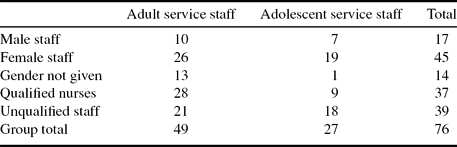
Seventy-six staff completed and returned questionnaires, which constituted a 12% response rate. Table 1 displays participant details in terms of service, gender, and qualification level. One participant completed the Vignette Questionnaire but not the subsequent measures, and therefore there were 75 sets of responses to the Knowledge and Attitudes Questionnaires. The mean length of experience for all participants in their current area of work was 6.4 years (SD = 4.75 years).
Participant information

Investigating the attributional model of helping behaviour (Vignette Questionnaire)
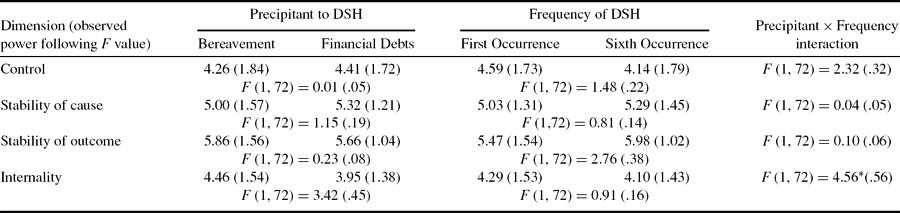
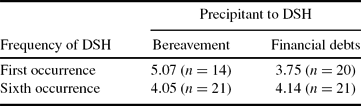
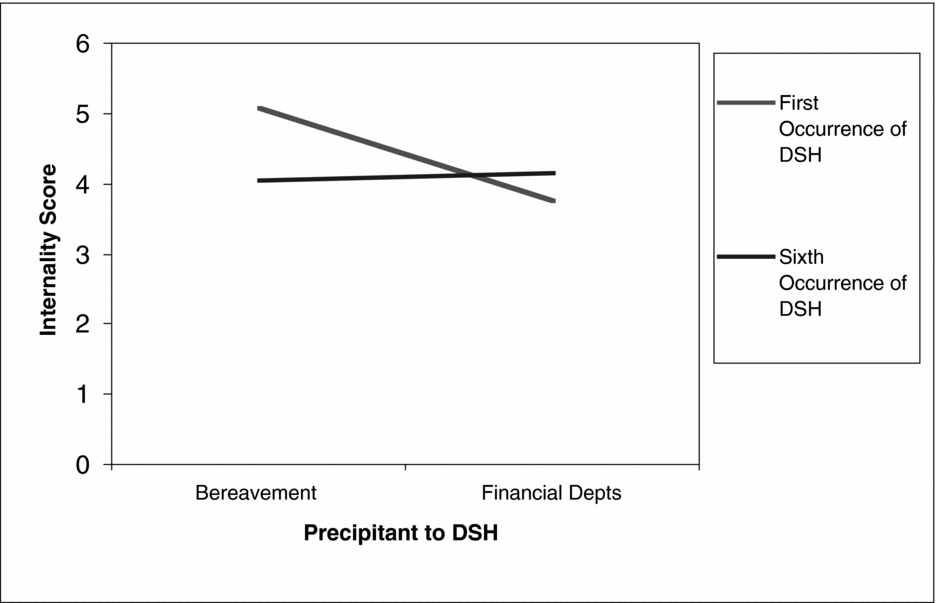
The attributional model of helping behaviour was firstly investigated by looking at the precipitant to and frequency of self-harm. The impact of precipitant and frequency of DSH presented in the case vignettes on the control, stability of cause, stability of outcome, and internality ratings (responses to questions 2–5 on the Vignette Questionnaire) was initially screened by conducting independent-samples t-tests on the mean scores on these dimensions for adult and adolescent unit staff. No significant differences between these mean scores were found, and therefore the data for the two groups were collapsed for further analysis. The data were subjected to 2 (Precipitant) × 2 (Frequency) factorial analyses of variance (ANOVAs). The results of these ANOVAs are presented in Table 2. It should be noted that higher mean scores on the internality dimension indicated lower internality. The only statistically significant result was the interaction effect between precipitant to DSH and frequency of DSH on the internality dimension, F(1,72) = 4.56, MSE = 2.03, p < .05. Therefore, internality ratings were influenced by a combined effect of the precipitant and frequency information given. Table 3 and Figure 1 display further details of the interaction. The mean scores indicated that the DSH was viewed as more due to external factors when it was the first occurrence and the precipitant given was bereavement. Conversely, it was viewed as more due to internal factors when it was the first occurrence of DSH, and the precipitant was financial debt. However, planned post-hoc comparisons showed a non-significant effect for precipitant on internality scores, F(1,74) = 2.28, MSE = 2.12, p = .14, in addition to a non-significant effect for frequency of DSH on internality scores, F (1, 74) = 0.34, MSE = 2.17, p = .56
Means, standard deviations, and interactions for effects of precipitant and frequency of DSH on attributional style ratings

*p < .05, partial eta squared = .06 (other results p ≥ .05; n = 76; all effect sizes ≤ partial eta squared .06).
Group means to display precipitant × frequency interaction for internality ratings

Precipitant X frequency interaction for internality ratings

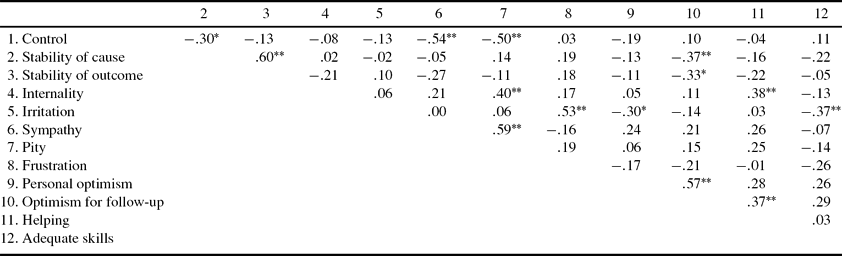
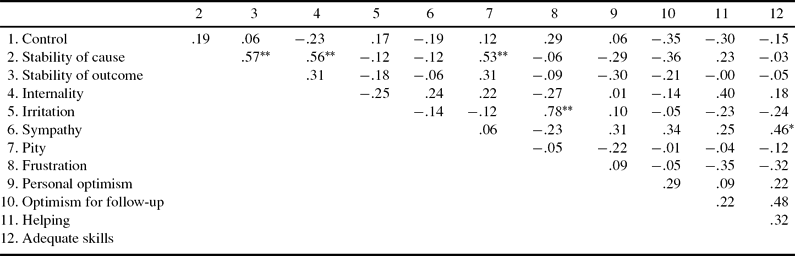
Data from the vignette questionnaires were analysed using a series of Pearson's product moment correlations to examine the associations between the attributional variables and emotional responses for the adult and adolescent unit staff respectively. The results are displayed in Tables 4 and 5. These analyses indicated that there were significant associations between control and sympathy (r = −.54, p < .01), and between control and pity (r = −.50, p < .01) for adult unit staff, with lower ratings of control over DSH being associated with greater sympathy and greater pity. There were significant positive correlations between internality and pity (r = .40, p < .01), and internality and helping (r = .38, p < .01) for adult unit staff, with scores indicating that DSH was perceived as more due to external factors in association with higher pity and helping scores. There was a significant negative correlation between irritation and adequate skills for adult unit staff (r = −.37, p < .01), with lower irritation being associated with higher perceived adequate skills to deal with the DSH act described in the vignette. There were significant positive associations between sympathy and pity for adult unit staff (r = .59, p < .01), and between sympathy and adequate skills for adolescent unit staff (r = .46, p < .05).
Correlations between vignette questionnaire variables for adult unit staff

*p <.05; **p < .01.
Correlations between vignette questionnaire variables for adolescent unit staff

*p < .05; **p < .01.
Further correlational analyses examined the relationship between stability of cause of DSH and the likelihood of repetition and staff optimism. There was a significant negative correlation between stability of cause and optimism for follow-up for adult unit staff (r = −.37, p < .01), with lower ratings for the likelihood of the cause of DSH persisting, being associated with higher optimism for follow-up. There was also a significant correlation between stability of outcome and optimism for follow-up for this staff group (r = −.33, p < .05), indicating that lower ratings of the likelihood that DSH was a stable, repeated behaviour in the patient were associated with higher optimism for subsequent treatment to be helpful. In addition, there was a significant positive correlation between optimism for follow-up and helping behaviour for adult unit staff (r = .37, p < .01), with higher perceived optimism for follow-up associated with higher helping behaviour scores. No significant correlations between these variables were found for adolescent unit staff.
Investigating the relationships between effectiveness, negativity and worry
Descriptive data and between-group comparisons for the Attitudes Questionnaire are presented in Table 6. Participants reported feeling reasonably effective in managing DSH, as all group mean effectiveness scores were between 11 and 12 out of 15. Negativity scores were low, between 3 and 6 out of 15 on average. Worry scores were also low, with mean scores of between 2 and 4 out of 9. Linear regression was carried out to determine the predictability of one variable from another from the knowledge, effectiveness, negativity, and worry variables. There was no predictive value of the three attitude dimensions on knowledge scores. The relationship between effectiveness and negativity was not significant, but did approach significance, (B = −.22, F(1,73) = 3.71, p = .06, observed power = .43), in the direction of higher reported effectiveness being associated with lower reported negativity. Similarly, the relationship between effectiveness and worry approached significance, (B = −.22, F(1,73) = 3.71, p = .06, observed power = .43), in the direction of higher reported effectiveness being associated with lower reported worry. There was a perfect positive correlation between negativity and worry, indicating that higher negativity was associated with higher worry (B = 1.00, F(1,73) = 1.70, p < .01). This relationship was found for all subgroup comparisons.
Mean scores and standard deviations of attitudes

Comparisons between adult and adolescent unit staff
One-way between-groups multivariate analysis of variance (MANOVA) was performed to evaluate differences in scores on questions 6–15 of the Vignette Questionnaire. No statistically significant differences were found between scores on any of the dependent variables between adult and adolescent unit staff.
Adult unit staff reported a similar level of effectiveness in managing DSH to adolescent unit staff (11.54 compared to 11.63), but adolescent unit staff reported slightly higher negativity and worry than adult unit staff (4.59 and 3.44 compared to 3.92 and 2.94 respectively). Independent samples t-tests were conducted to compare the mean scores between adult and adolescent unit staff. No significant differences were found.
Independent samples t-tests were also conducted to compare knowledge questionnaire scores between staff unit groups. No significant differences were found in this analysis.
Comparisons between gender and level of qualification
One-way between-groups multivariate analysis of variance (MANOVA) was performed to investigate differences in scores on questions 6–15 of the Vignette Questionnaire, on the basis of staff gender and qualification level, qualified or unqualified nursing staff. No statistically significant differences were found between scores on any of the dependent variables.
Female staff reported slightly lower effectiveness, negativity and worry than male staff. Qualified staff reported higher effectiveness, lower negativity and lower worry than unqualified staff. Independent samples t-tests were conducted to compare mean scores between gender and qualification level. There were no significant differences between attitudes scores for male and female staff, but a significant difference in negativity scores between qualified staff (M = 3.40, SD = 1.72) and unqualified staff (M = 5.08, SD = 2.21); t (73) = − 3.66, p < .01 (two-tailed), d = .86, was evident. Further, there was a significant difference in worry scores between qualified staff (M = 2.55, SD = 1.29) and unqualified staff (M = 3.81, SD = 1.65); t (73) = − 3.69, p < .01 (two-tailed), d = .86. There were no significant differences between qualified and unqualified staff on effectiveness scores.
Independent samples t-tests were conducted to compare the Knowledge Questionnaire scores between male and female staff, and qualified and unqualified staff. No significant differences were found when comparing between male staff (M = 6.94, SD = 1.43) and female staff (M = 7.20, SD = 1.50); t (60) = −.61, p = .54 (two-tailed), observed power = .86. Similarly, there were no significant differences between qualified staff (M = 7.49, SD = 1.37) and unqualified staff (M = 6.95, SD = 1.62); t (74) = 1.56, p = .12 (two-tailed), observed power = .85.
Investigating length of work experience
The relationship between length of work experience and all of the Vignette Questionnaire response dimensions was investigated using Pearson product-moment correlation coefficients. No significant correlations were found.
The relationships between length of work experience and effectiveness, negativity, and worry scores were investigated using Pearson product-moment correlation coefficients. No significant correlations were found.
The relationship between length of work experience and knowledge scores was analysed using Pearson product-moment correlation. A significant correlation was not found between the two variables, r = .12, n = 76, p = .30, observed power = .70.
Gaps in staff knowledge
The average number of correct responses on the Knowledge Questionnaire was 7 out of 11 (64%) for all participants, with scores ranging between 4 and 10 out of 11. The same three questions received the lowest number of correct responses in participants from both adult and adolescent units: Question 3 - Adults/children and adolescents who have been sexually abused are no more likely to self-harm than the general population (false); Question 7 - Self-harm is more likely to occur among adults/young people who are socio-economically deprived (true); and Question 8 - Gay men/gay young men are no more likely to self-harm than the general population (false).
Discussion
In summary, further support was found for attributional theories suggesting views on DSH are linked to individuals' propensity to help, and for a mediating role of emotions in this association. The results of the current study established that these theories are applicable to staff working with patients in a mental health inpatient setting. Staff who reported feeling more negative about patients who self-harm reported more worry about working with this patient group. There were nonsignificant trends suggesting that staff who reported feeling more effective in their work with patients who self-harm reported less negativity and worry about working with the patient group, although this was not necessarily the case for female staff. Unqualified nursing staff reported more negativity and worry in working with patients who display DSH than qualified staff. Particular gaps in knowledge found were in relation to subgroups of the population who are at higher risk of self-harming. It is also important to acknowledge that the current study did not replicate previous research findings that have suggested that there are more positive attitudes towards adolescents and more negative attitudes towards adults who self-harm, higher negativity from male staff, and significant differences in attitudes dependent on length of work experience, establishing that these findings have not been found with nursing staff across a large inpatient organization.
The results from the Attitudes Questionnaire suggested that training and support to help unqualified staff feel less negative and concerned about working with patients who self-harm may be particularly important. Results from the Knowledge Questionnaire suggested that information about individuals at increased risk of self-harming may also be an important inclusion in training.
Training and support should be targeted for delivery to new staff at the earliest opportunity. Induction of new staff should seek to teach comprehensive knowledge regarding prevalence, incidence across specific populations, and perhaps most importantly, the underlying causes, reasons and functions of DSH. This will allow staff, particularly those with limited training and experience, to start to grasp the complexity of this behavioural phenomenon and to ameliorate the anxiety and worry associated with working with these problems. However, initial training and support is unlikely to be adequate in itself. Ongoing staff development in the form of regular clinical supervision and support groups will allow the staff to further explore any difficulties in working with DSH in order to reduce worry and promote effective helping behaviour.
Conclusion
The findings of this study serve to reiterate the importance of considering the potential impact that staff's views about patients who self-harm, their views about their work with such patients, and their knowledge about people who self-harm, could have upon their work and the care they provide individuals who present with DSH. Untrained nursing staff are utilized widely in these settings and yet clearly experience difficulties in feeling positive about their work with this client group. Appropriate ongoing training and support for staff who work with cases of DSH should help to increase positive views and knowledge, which could ultimately serve to improve staff retention and morale, and is likely to increase the effectiveness of inpatient intervention programmes.




Comments
No Comments have been published for this article.