In general terms, mimicry occurs when a species evolves to closely resemble another and, by doing so, gains some selective advantage (Wickler, Reference Wickler1965). This phenomenon is relatively widespread among reef fish with approximately 60 cases distributed within 16 families (Moland et al., Reference Moland, Eagle and Jones2005). Four basic types of mimicry have already been proposed for reef fish: Batesian, Müllerian, aggressive and social. However, most cases are anecdotal accounts with only a few studies providing ecological evidence to the existence of mimicry (e.g. Caley & Schluter, Reference Caley and Schluter2003; Munday et al., Reference Munday, Eyre and Jones2003; Côté & Cheney, Reference Côté and Cheney2004; Eagle & Jones, Reference Eagle and Jones2004; Moland & Jones, Reference Moland and Jones2004).
Some confusion still exists regarding the precise classification of different types of mimicry for many reef fish examples (Randall, Reference Randall2005) due to their complexities and the presence of more than one selective mechanism involved in most of the cases (Smith-Vaniz et al., Reference Smith-Vaniz, Satapoomin and Allen2001; Rainey, Reference Rainey2010). Moreover, since the perception of mimicry has been based only on the human eye perception of colour, and as most fish possess a greater visual acuity than ours (Cheney & Marshall, Reference Cheney and Marshall2009), recognizing the colours that are transmitted as well as what can be seen by mimics and models may bring essential information on mimicry prevalence among coral reef fish. Thus the number of recognized mimics among reef fish can be overlooked and new mimic–model systems are yet to be described not only in tropical reefs, but also in subtropical waters. Here, we describe a new possible case of mimicry involving the barber goby Elacatinus figaro Sazima, Moura & Rosa, Reference Sazima, Moura and Rosa1997 and the juvenile parrotfish Scarus zelindae Moura, Figueiredo & Sazima, Reference Moura, Figueiredo and Sazima2001, two endemic species of the Brazilian province.
The fieldwork was conducted at Arraial do Cabo, south-eastern Brazil, between January and April 2010. The records were made basically at two different sites: Forno (between 22°57′59″S and 42°00′27″W) and Maramutá (22°59′30″S and 41°59′50″W). Observations on both species were performed with SCUBA divers during different periods within daylight hours. During the observations, the behaviour of both species was recorded using ad libitum sampling (Altmann, Reference Altmann1974) and photographs were taken.
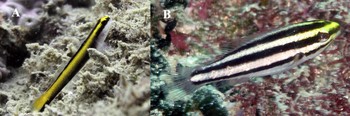
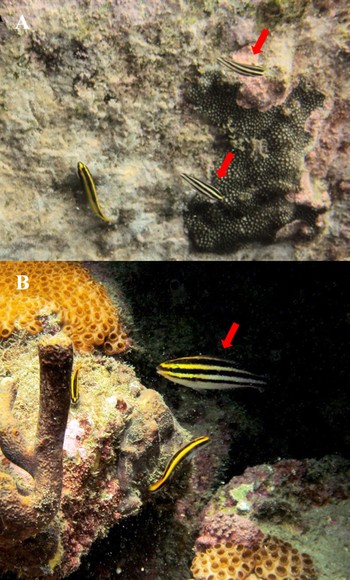
The barber goby Elacatinus figaro reaches ~4 cm total length (TL) and presents a dark body with a pale belly and a bright yellow stripe that runs from head to tail (Figure 1A). Similarly, juvenile S. zelindae individuals have dark stripes over a yellowish to whitish body (Figure 1B). During the January observations, 3–5 cm (TL) juveniles of S. zelindae were continually recorded within the cleaning station of E. figaro, usually in pairs (Figure 2A). The same pattern was observed until April, when some juvenile S. zelindae had already overgrown E. figaro but were still found associating with them (Figure 2B).
(A) The barber goby Elacatinus figaro; (B) coloration of juvenile individuals of Scarus zelindae.

Different-sized individuals of juvenile Scarus zelindae (marked with red arrows) close to the model Elacatinus figaro. (A) Two small juvenile individuals of S. zelindae and one E. figaro; (B) one S. zelindae juvenile that overgrew the models but still remained close to two individuals of E. figaro.

Colour or morphological resemblance alone do not guarantee the existence of mimicry (Snyder, Reference Snyder1999). In many cases, the mimic adopts an unusual behaviour to enhance the deception. For example, during its juvenile mimic stage, and in the presence of its model Centropyge vroliki, the surgeonfish Acanthurus pyroferus adopts a swimming mode typical of the Pomacanthidae (Eagle & Jones, Reference Eagle and Jones2004). Similarly, juvenile S. zelindae change their swimming pattern when in danger. When approached by divers, juvenile S. zelindae, which usually maintain a constant swimming close to the bottom, remained stationary on the bottom presenting the same site-attached mode of E. figaro.
Another feature that would help deceive predators is the transparent caudal fin of juvenile S. zelindae (Figure 1B). This feature makes the mimic look smaller than its actual size and increases the time it could use mimetic coloration (Moland & Jones, Reference Moland and Jones2004).
The mimic–model relationship between E. figaro and S. zelindae can be tentatively explained on the basis of Batesian mimicry. According to Bates (Reference Bates1862), in this type of mimicry a harmless and palatable species closely resemble unpalatable or venomous species usually avoided by predators. Although E. figaro does not seem to be unpalatable or venomous, it is largely avoided by predators due to its important role in reef systems as a cleaning species (Grutter, Reference Grutter1999; Côté, Reference Côté2000; Francini-Filho et al., Reference Francini-Filho, Moura and Sazima2000).
Rates of predation on cleaner fish are extremely low (Côté, Reference Côté2000). Thus, by mimicking a cleaner model, a mimic may face a lower predation rate during its juvenile stage, which is when reef fish are more susceptible to be preyed upon (Jones & McCormick, Reference Jones, McCormick and Sale2002). Cleaning stations can be considered ‘safe havens’, where predators' aggression towards potential prey is decreased (Cheney et al., Reference Cheney, Bshary and Grutter2008). Nevertheless, this does not seem to be the case in this study since there was a great number of other juvenile fish (like the closely-related Sparisoma spp.) that could be using E. figaro cleaning stations as a refuge, but the only species observed finding refuge within the cleaning station was the similar-coloured juvenile S. zelindae.
Mimicry involving cleaning fish has already been described for other species. Examples are the relationships involving the cleaning wrasse Labroides dimidiatus and the blennies Aspidontus taeniatus and Plagiotremus rhinorhynchos (Moland et al., Reference Moland, Eagle and Jones2005). However, in both cases the mimicry is explained on the basis of aggressive mimicry, in which the mimic gains advantage by deceiving the cleaner's clients in order to feed upon their scales and tissues (Moland & Jones, Reference Moland and Jones2004). Thus this is the first time that a mimic–model relationship involving a cleaner fish is tentatively explained on the basis of Batesian mimicry. This is also the first time that a mimic–model system is proposed between a species of goby as the model and a parrotfish as the mimic (Moland et al., Reference Moland, Eagle and Jones2005).
The relationship between E. figaro and juveniles of S. zelindae seems to fulfil all the defining ecological characteristics that should apply in mimic–model systems. However, to establish the real existence of this mimicry, additional field observations and manipulative experiments must be performed to define the relationships of abundance between both species, their distributions along the rocky reefs, and the ecological advantages of the mimic S. zelindae.
ACKNOWLEDGEMENTS
We thank Diving Arraial for logistic support and Marcelo and Zé from the boat ‘Iceberg’. Financial support was provided by FAPERJ and CNPq with grants to C.E.L.F.